Learning a complex topic can sometimes feel like trying to solve a huge puzzle without knowing where the pieces belong. You may read the same paragraph several times, watch multiple videos, take detailed notes, and still feel that you do not truly understand the subject.
The problem is often not a lack of intelligence or ability. Complex topics require a structured learning process. When information is presented as one large block, the brain can struggle to organize it. However, when the same subject is divided into smaller concepts and learned in a logical sequence, understanding becomes much easier.
Whether you are a student preparing for an examination, a professional learning a new skill, or simply someone who enjoys acquiring knowledge, knowing how to learn complex topics step by step can make your learning process more effective.
You do not need to understand everything at once.
You need to understand one important idea at a time, connect it with what you already know, practice using it, and gradually build toward the bigger picture.
We have some amazing books at our Shop page you may want to buy.
This article explains a practical step-by-step approach to learning difficult and complicated subjects. It also covers reading strategies, active learning, note-making, revision, self-testing, common mistakes, and ways to improve long-term retention.
Table of Contents
How to Learn Complex Topics Step by Step: A Practical Guide to Understanding Difficult Subjects
Why Complex Topics Feel Difficult
Before learning how to study a difficult subject, it is useful to understand why some topics feel complicated.
A complex topic usually contains several smaller concepts that depend on one another. If you do not understand an earlier concept, the next concept can become difficult.
For example, someone learning mathematics may struggle with calculus because the problem is not necessarily calculus itself. The learner may have gaps in algebra, functions, graphs, or basic equations.
Similarly, someone studying economics may find advanced concepts difficult because they have not developed a strong understanding of basic economic principles.
This creates a chain:
Basic knowledge → Intermediate concepts → Advanced concepts → Application
If an earlier link is weak, later learning becomes harder.
Information Overload
One major reason people struggle with difficult topics is information overload.
When you try to learn too many concepts simultaneously, your attention becomes divided. You may remember individual facts but fail to understand how those facts relate to one another.
Instead of asking:
“How can I learn this entire chapter today?”
ask:
“What is the first concept I need to understand?”
This simple change can make learning more manageable.
Lack of Prior Knowledge
New information becomes easier to understand when it connects to something you already know.
For instance, understanding computer networks becomes easier if you already understand basic computers and communication. Learning advanced biology becomes easier when you have a foundation in cells, genetics, and basic biological processes.
This is why building background knowledge is an important part of learning complex subjects.
Passive Reading
Another common problem is passive reading.
You can spend an hour reading a textbook without remembering much afterward.
Reading alone does not guarantee learning.
Effective learning requires you to interact with information by:
- asking questions,
- explaining concepts,
- making connections,
- solving problems,
- recalling information,
- applying ideas,
- and reviewing mistakes.
This is why active learning is so important.
Step 1: Define Exactly What You Want to Learn
The first step in learning a complex topic is to define your learning goal.
A broad goal such as “I want to learn physics” is difficult to act upon because physics contains hundreds of concepts.
Instead, create a specific objective.
For example:
- Understand Newton’s laws of motion.
- Learn how electric circuits work.
- Understand the basics of probability.
- Learn how photosynthesis works.
- Understand database normalization.
- Learn the fundamentals of financial accounting.
A specific goal gives your learning process direction.
Turn a Large Topic Into a Small Question
One of the most effective techniques for learning complex subjects is to turn a large topic into smaller questions.
Suppose you want to learn artificial intelligence.
Instead of trying to understand everything about AI immediately, divide the topic into questions:
- What is artificial intelligence?
- What is machine learning?
- How is machine learning different from traditional programming?
- What is a dataset?
- What is a model?
- What is training?
- What is testing?
- What are neural networks?
- What is deep learning?
- How are AI systems evaluated?
Now the huge subject has become a collection of manageable learning goals.
Use the “What, Why, How” Framework
For almost any difficult subject, begin with three questions:
What is it?
Understand the basic definition.
Why does it matter?
Understand its purpose, importance, or real-world use.
How does it work?
Understand the process, mechanism, or method.
For example, while learning inflation:
- What: Inflation is a sustained increase in the general price level.
- Why: It affects purchasing power, savings, wages, and economic decisions.
- How: It can result from factors such as demand pressures, supply constraints, and monetary conditions.
This framework creates an initial mental structure.
Step 2: Start With the Big Picture
Before diving into details, spend some time understanding the overall structure of the subject.
This is sometimes called previewing.
Look at:
- the table of contents,
- chapter headings,
- subheadings,
- diagrams,
- summaries,
- key terms,
- examples,
- and learning objectives.
Do not worry about understanding every detail during the first reading.
Your goal is to answer:
“What is this subject about?”
Build a Mental Map
Imagine that you are visiting a large city for the first time.
You would probably look at a map before exploring every street.
Learning a complex subject works similarly.
First understand the map.
Then explore the streets.
For example, if you are learning human biology, your initial mental map might look like:
Human Biology
→ Cells
→ Tissues
→ Organs
→ Organ Systems
→ Nervous System
→ Circulatory System
→ Respiratory System
→ Digestive System
→ Reproduction
→ Genetics
You do not need to master every item immediately.
You simply need to understand how the pieces fit together.
Why the Big Picture Helps
A big-picture overview gives your brain a framework for organizing new information.
When you later encounter a new concept, you can ask:
“Where does this fit?”
That question helps transform isolated information into connected knowledge.
Step 3: Check Your Prerequisite Knowledge
One of the most overlooked steps in learning complex topics is checking whether you understand the prerequisites.
A difficult topic often depends on simpler concepts.
For example:
Calculus
requires algebra, functions, graphs, and basic geometry.
Advanced programming
requires programming fundamentals, data structures, and logical thinking.
Organic chemistry
requires basic chemistry, atoms, bonding, and chemical reactions.
Econometrics
requires statistics, probability, and mathematics.
If you jump directly into an advanced topic without the necessary foundation, you may feel that the subject is impossibly difficult.
The actual problem may simply be a knowledge gap.
Find Your Knowledge Gaps
Before starting, ask yourself:
- What do I already know?
- What do I partially understand?
- What concepts are completely unfamiliar?
- What basic terms appear repeatedly?
- What do I need to learn first?
Make three simple lists:
I Know
Concepts you already understand.
I Need to Review
Concepts you learned before but no longer remember clearly.
I Need to Learn
Concepts that are completely new.
This classification prevents you from wasting time studying information you already know while also identifying areas that require additional attention.
Step 4: Break the Topic Into Smaller Concepts
This is one of the most important principles for learning difficult subjects.
Do not study the entire complex topic as one unit.
Break it into smaller learning blocks.
For example, consider the topic Photosynthesis.
Instead of studying it as one large concept, divide it into:
- Definition of photosynthesis
- Why photosynthesis is important
- Chloroplasts
- Chlorophyll
- Light-dependent reactions
- ATP and NADPH
- Calvin cycle
- Carbon dioxide fixation
- Glucose formation
- Factors affecting photosynthesis
Now you have a learning sequence.
Each concept becomes a smaller target.
Learn From Simple to Complex
A useful progression is:
Definition → Basic idea → Components → Process → Examples → Application → Advanced details
This progression reduces cognitive overload.
For example, when learning how a car engine works, you might begin with:
- What is an engine?
- What is its purpose?
- What are the major components?
- How does fuel enter?
- How does combustion occur?
- How does combustion create movement?
- How is movement transferred to the wheels?
- What factors affect engine performance?
Trying to memorize every engine component before understanding the basic process would make learning unnecessarily difficult.
Step 5: Learn One Concept at a Time
Once you have divided the subject into smaller sections, begin with the first concept.
Give yourself permission not to understand the entire topic immediately.
Focus on one question.
For example:
What is a neural network?
Read about it.
Watch a simple explanation if necessary.
Write the definition in your own words.
Then ask yourself:
Can I explain this without looking at my notes?
If yes, move forward.
If no, spend more time on the concept.
This approach creates a solid foundation.
Avoid the “I Read It, So I Know It” Trap
Recognition is not the same as understanding.
When you read an explanation, it may seem familiar.
But if you close the book and try to explain the concept, you may discover that you cannot.
This is normal.
It simply means you need to practice retrieval and explanation.
Step 6: Explain Difficult Ideas in Simple Language
One of the strongest methods for understanding a complex subject is to explain it in simple language.
After studying a concept, pretend that you are teaching it to someone who knows nothing about the topic.
Ask:
“How would I explain this without using complicated terminology?”
For example, instead of memorizing a technical definition, try to explain the concept using ordinary language.
This method reveals gaps in understanding.
If you cannot explain something simply, you may need to study it again.
The Teach-Back Method
Use this four-step process:
1. Study
Read or learn the concept.
2. Close the Material
Put your book or notes aside.
3. Explain
Describe the concept from memory.
4. Identify Gaps
Notice where your explanation becomes unclear.
Then return to the material and study only those weak areas.
This is more efficient than repeatedly rereading the entire chapter.
Step 7: Connect New Knowledge With What You Already Know
Learning becomes easier when new information has a connection to existing knowledge.
Think of knowledge as a network rather than a collection of isolated facts.
For example, if you already understand that plants need sunlight, water, and carbon dioxide, you can connect these ideas to the process of photosynthesis.
Similarly, if you understand basic computer storage, you can more easily understand databases and file systems.
Ask Connection Questions
Whenever you learn something new, ask:
- What does this remind me of?
- How is this related to something I already know?
- Is this similar to another concept?
- How is it different?
- What causes it?
- What does it cause?
- Where is it used?
- What problem does it solve?
These questions turn learning into an active process.
Step 8: Use Analogies Carefully
Analogies can make complicated ideas easier to understand.
For example, you can think of a computer’s RAM as a temporary workspace where information currently being used is kept readily available.
You can think of a database index as something similar to an index in a book: instead of scanning every page, you can use the index to locate information faster.
Analogies provide a bridge between familiar and unfamiliar concepts.
However, remember that an analogy is not the concept itself.
Once you understand the basic idea, return to the technical explanation.
Use analogies to build intuition, not to replace accurate knowledge.
How to Learn Complex Topics Step by Step: A Practical Guide to Understanding Difficult Subjects
Reading, Note-Making, Active Learning and Practice
Step 9: Read Difficult Material in Layers
When a topic is complicated, reading it from beginning to end repeatedly is usually not the most effective strategy.
Instead, use layered reading.
Layered reading means approaching the same material at different levels of depth.
First Reading: Get the Overview
During your first reading, focus on understanding the general idea.
Look for:
- Main concepts
- Important terms
- Headings and subheadings
- Major processes
- Important examples
- Relationships between ideas
Do not stop at every unfamiliar word.
Your goal is to understand the overall structure.
For example, if you are reading a chapter about the human nervous system, you might first identify:
Nervous System → Brain → Spinal Cord → Peripheral Nerves → Sensory and Motor Functions
You do not need to memorize every technical detail during this stage.
Second Reading: Understand the Details
Now read more carefully.
Ask:
- What does each term mean?
- Why is this process important?
- How do the components interact?
- What causes the process?
- What happens next?
- What examples are provided?
At this stage, you can pause and make notes.
Third Reading: Test Your Understanding
After studying the material, close the book and attempt to reconstruct what you learned.
Write down:
- Main ideas
- Important processes
- Definitions
- Examples
- Connections
If you cannot recall something, return to that specific section.
This is much more productive than automatically rereading the entire chapter.
Step 10: Preview Before You Read
Before beginning a chapter, spend a few minutes previewing it.
Check:
- The title
- Headings
- Subheadings
- Images
- Charts
- Tables
- Key terms
- Chapter summary
- Questions at the end
Then predict what you expect to learn.
For example:
“This chapter is about the causes of climate change. I expect to learn about greenhouse gases, human activities, natural factors, environmental effects, and possible solutions.”
Now your brain has questions to answer while reading.
This makes reading more purposeful.
Step 11: Turn Headings Into Questions
A simple but powerful reading technique is to convert headings into questions.
Suppose your textbook contains the heading:
Causes of Inflation
Turn it into:
What causes inflation?
If the heading is:
Functions of the Human Brain
ask:
What are the major functions of the human brain?
If the heading is:
Types of Computer Networks
ask:
What are the different types of computer networks, and how are they different?
Now you are reading to find answers rather than simply moving your eyes across a page.
This method encourages active engagement with the material.
Step 12: Highlight Less and Think More
Highlighting can be useful, but excessive highlighting often creates an illusion of learning.
If almost every sentence is highlighted, nothing is actually being prioritized.
Instead, highlight only:
- Key definitions
- Important principles
- Essential formulas
- Critical examples
- Major relationships
- Important conclusions
After highlighting, ask yourself:
“If I had to explain this section in three sentences, what would I say?”
That question is more valuable than simply adding more color to the page.
Use the Margin for Questions
Instead of highlighting every important-looking sentence, write short questions in the margin.
For example:
- Why does this happen?
- What causes this?
- What is the difference?
- What is the example?
- What happens next?
- Why is this important?
These questions can later become revision material.
Step 13: Make Notes That Help You Think
Good notes should not simply reproduce the textbook.
They should help you understand, recall, and apply the information.
A useful note contains:
Concept → Explanation → Example → Connection
For example:
Supply and Demand
Concept: Demand
Explanation: The quantity of a product consumers are willing and able to purchase at different prices.
Example: If the price of a product falls, more consumers may be willing to buy it.
Connection: Demand interacts with supply to influence market prices.
This format is much more useful than copying an entire paragraph from a textbook.
Step 14: Use the Question-and-Answer Note Method
For difficult subjects, question-and-answer notes can be extremely effective.
Instead of writing:
Photosynthesis is the process by which green plants use light energy to convert carbon dioxide and water into chemical energy.
Write:
Q: What is photosynthesis?
A: It is the process through which plants use light energy to produce chemical energy from carbon dioxide and water.
Then add:
Q: Why is photosynthesis important?
A: It provides energy-rich organic compounds and plays a major role in the movement of carbon through ecosystems.
This creates ready-made revision questions.
Step 15: Create Concept Maps
A concept map visually represents relationships between ideas.
For example:
Photosynthesis
→ Requires sunlight
→ Occurs mainly in chloroplasts
→ Uses carbon dioxide
→ Uses water
→ Produces glucose
→ Releases oxygen
You can then expand each branch.
Concept maps are particularly useful for subjects involving:
- Processes
- Systems
- Classifications
- Causes and effects
- Relationships
- Hierarchies
They help you see the structure of knowledge rather than just individual facts.
Step 16: Use Diagrams for Processes
Some subjects become much easier when information is converted into a sequence.
For example:
Input → Process → Output
This structure can be applied to many topics.
Example: A Simple Learning Process
Information
↓
Understanding
↓
Practice
↓
Feedback
↓
Revision
↓
Application
↓
Long-Term Knowledge
Whenever you study a process, try to represent it visually.
Ask:
- What starts the process?
- What happens first?
- What happens next?
- What changes?
- What is produced?
- What happens at the end?
This approach is especially useful for science, mathematics, economics, computer science, geography, and technical subjects.
Step 17: Compare Similar Concepts
Complex subjects often contain concepts that look similar but have important differences.
For example:
Speed vs Velocity
Mass vs Weight
RAM vs Storage
Revenue vs Profit
Weather vs Climate
Hypothesis vs Theory
Creating a comparison table can make these distinctions easier to remember.
| Concept A | Concept B | Main Difference |
| Speed | Velocity | Speed describes rate of motion; velocity includes direction |
| Mass | Weight | Mass measures amount of matter; weight is related to gravitational force |
| Revenue | Profit | Revenue is income from sales; profit remains after expenses |
Comparison is particularly valuable when preparing for examinations because questions often test differences between related concepts.
Step 18: Learn Through Examples
Definitions provide a foundation, but examples make abstract concepts easier to understand.
Suppose you are learning opportunity cost.
A definition might say:
Opportunity cost is the value of the next-best alternative given up when a choice is made.
That is useful, but an example makes the idea clearer.
Imagine you have two hours available. You can either study for an examination or watch a movie.
If you choose to study, the movie is the opportunity you gave up.
The example creates a concrete mental picture.
Use Multiple Examples
For difficult topics, study several examples.
Try to find:
- A simple example
- A real-world example
- An unusual example
- A problem-solving example
Different examples help you understand the underlying principle rather than memorizing one situation.
Step 19: Practice Before You Feel Ready
A common mistake is waiting until you “fully understand” a topic before attempting questions.
In reality, practice helps create understanding.
For subjects involving problem-solving, begin practicing early.
This applies to:
- Mathematics
- Physics
- Chemistry
- Programming
- Accounting
- Statistics
- Reasoning
- Grammar
- Data analysis
After learning a basic concept, attempt a simple problem.
Then gradually increase difficulty.
The Difficulty Ladder
Use this progression:
Easy → Moderate → Challenging → Mixed Problems → Real-World Application
This gives you an opportunity to develop confidence before tackling difficult questions.
Step 20: Solve Problems Without Looking at the Answer
When practicing, avoid looking at the solution too quickly.
First attempt the problem independently.
Even if your answer is wrong, the attempt itself provides valuable information.
Ask:
- What did I understand?
- Where did I get confused?
- Which step caused the problem?
- Did I use the wrong formula?
- Did I misunderstand the question?
- Did I make a calculation error?
The purpose of practice is not merely to get answers correct.
It is to discover how you think.
Step 21: Maintain an Error Log
An error log is one of the most useful tools for mastering difficult subjects.
Whenever you make a mistake, record it.
A simple format is:
| Question | Mistake | Why It Happened | Correct Approach |
| Problem 1 | Used wrong formula | Confused two formulas | Review formula conditions |
| Problem 2 | Misread question | Read too quickly | Underline key information |
| Problem 3 | Conceptual error | Weak foundation | Review basic concept |
Review this log regularly.
You will often notice patterns.
Perhaps you repeatedly:
- forget certain formulas,
- confuse similar concepts,
- make calculation errors,
- misunderstand terminology,
- skip important steps,
- or misinterpret questions.
Once you identify the pattern, you can fix the underlying problem.
Step 22: Use Active Recall
Active recall means trying to retrieve information from memory instead of simply looking at it.
For example, after reading about the water cycle, close your book and ask yourself:
What are the major stages of the water cycle?
Try to answer from memory.
Then check your notes.
If you forgot evaporation, condensation, precipitation, or collection, review those concepts.
This process is more demanding than rereading, but that difficulty is useful.
Simple Active Recall Exercises
After every study session, ask:
- What did I learn?
- What are the three most important ideas?
- Can I explain the main concept?
- What examples can I remember?
- What questions remain unanswered?
- How does this topic connect to previous material?
Spend five minutes answering these questions without looking at your notes.
Step 23: Use the Blank Page Method
The blank page method is a simple technique for testing understanding.
Take a blank sheet of paper.
Write the name of the topic at the top.
Then, without looking at your materials, write everything you remember.
For example:
Topic: The Human Digestive System
You might write:
- Mouth
- Esophagus
- Stomach
- Small intestine
- Large intestine
- Liver
- Pancreas
- Digestion
- Absorption
Then compare your page with your textbook or notes.
Circle missing or incorrect information.
Now you know exactly what needs review.
Step 24: Practice Retrieval in Different Ways
Do not always test yourself using the same method.
Try:
Verbal Recall
Explain the concept aloud.
Written Recall
Write everything you remember.
Question Recall
Answer questions without notes.
Diagram Recall
Draw the process from memory.
Problem Recall
Solve a problem using the concept.
Teaching Recall
Teach the topic to another person.
Different forms of retrieval strengthen different aspects of understanding.
Step 25: Ask “Why?” Repeatedly
When learning a complex topic, repeatedly asking why can take you deeper.
For example:
Why do plants need sunlight?
Because light provides energy for photosynthesis.
Why is photosynthesis important?
Because it helps plants produce energy-rich organic compounds and supports food chains.
Why are plants important to food chains?
Because they serve as primary producers in many ecosystems.
Each question creates another connection.
You do not always need to ask “why” five times, but the principle is valuable:
Don’t stop at what happens. Try to understand why it happens.
Step 26: Ask “How?” and “What If?”
“Why?” explains causes.
“How?” explains mechanisms.
“What if?” develops deeper understanding.
For example, while learning about supply and demand, ask:
- What is demand?
- What causes demand to increase?
- How does an increase in demand affect price?
- What happens if supply remains unchanged?
- What if supply increases at the same time?
“What if?” questions encourage you to apply knowledge rather than simply recall definitions.
Step 27: Study From Multiple Sources, But Don’t Overdo It
Different resources can explain the same concept in different ways.
You might use:
- A textbook
- A reference book
- Educational videos
- Articles
- Diagrams
- Practice questions
- Lectures
- Reliable online resources
If one explanation does not make sense, another explanation may provide the missing connection.
However, avoid collecting too many resources.
A common mistake is spending more time searching for learning materials than actually learning.
Choose:
One primary source + one supporting source + practice material
That is often enough.
Step 28: Know When to Move On
Perfectionism can slow learning.
You may spend an entire day trying to understand one small detail while ignoring the rest of the topic.
A better strategy is to distinguish between:
Essential Understanding
You must understand this before continuing.
Useful Detail
It improves your knowledge but is not required immediately.
Advanced Detail
You can study it later.
If a concept is important but difficult, mark it and continue after gaining more context.
Sometimes a concept that seems confusing at the beginning becomes much clearer after you understand the surrounding material.
Step 29: Use Short Focused Study Sessions
Complex topics require concentration.
Long study sessions without breaks can reduce attention and increase mental fatigue.
Instead, divide your learning into focused sessions.
For example:
Session 1: Learn the basic concept
Break
Session 2: Study examples
Break
Session 3: Practice questions
Break
Session 4: Active recall and review
The exact duration can vary from person to person.
The important principle is:
Focused learning is usually more useful than simply sitting with a book for many hours.
Step 30: End Every Study Session With a Summary
Never finish a study session simply because the clock says it is time to stop.
Spend the final few minutes summarizing what you learned.
Write:
Today I learned:
- Concept 1
- Concept 2
- Concept 3
I still need to understand:
- Difficult concept
- Unclear process
- Unanswered question
Next session:
- Review today’s material
- Learn the next concept
- Solve practice problems
This creates continuity between study sessions.
A Simple Daily Method for Learning Complex Topics
You can combine the techniques from Part 1 and Part 2 into a simple routine.
Step 1: Preview
Spend a few minutes looking at the topic structure.
Step 2: Choose One Concept
Do not attempt the entire chapter at once.
Step 3: Read Actively
Turn headings into questions.
Step 4: Make Short Notes
Write ideas in your own words.
Step 5: Find an Example
Connect the concept with a practical situation.
Step 6: Explain It
Teach the concept aloud or write an explanation.
Step 7: Practice
Solve questions or apply the concept.
Step 8: Test Yourself
Close your materials and recall the main ideas.
Step 9: Record Mistakes
Add important errors to your error log.
Step 10: Review
Return to difficult concepts later.
This creates a complete learning cycle:
Read → Understand → Explain → Practice → Recall → Correct → Review
Example: Applying the Method to a Difficult Topic
Suppose a student wants to learn probability.
Instead of immediately opening an advanced textbook, the student can follow this sequence.
Stage 1: Define the Goal
“I want to understand basic probability and solve simple probability problems.”
Stage 2: Check Prerequisites
Review:
- Fractions
- Ratios
- Basic arithmetic
- Sets
- Counting principles
Stage 3: Create a Topic Map
Study:
- Meaning of probability
- Experiments
- Outcomes
- Events
- Sample space
- Basic probability formula
- Complementary events
- Independent events
- Conditional probability
- Applications
Stage 4: Learn the Basic Concept
Understand what probability represents.
Stage 5: Use Examples
Use familiar situations such as coins, dice, cards, or simple real-life events.
Stage 6: Practice
Start with easy questions.
Stage 7: Explain
Explain probability to yourself without using your notes.
Stage 8: Increase Difficulty
Move toward more complicated questions only after the basics become comfortable.
This is what step-by-step learning looks like in practice.
The Most Important Principle
When a subject feels overwhelmingly difficult, do not immediately conclude:
“I am not good at this.”
Instead ask:
“Which part of this topic do I not understand yet?”
That question changes the learning process.
A complex subject is usually not one giant problem.
It is a collection of smaller problems.
Solve them one at a time.
How to Learn Complex Topics Step by Step: A Practical Guide to Understanding Difficult Subjects
Memory, Revision, Spaced Learning and Deep Understanding
Step 31: Understand the Difference Between Memorizing and Understanding
Memorization and understanding are not the same thing.
You can memorize a definition without understanding what it means.
You can also understand an idea without memorizing its exact wording.
For example, a student may memorize:
“Photosynthesis is the process by which green plants convert light energy into chemical energy.”
But if the student cannot explain:
- what plants need for photosynthesis,
- where the process occurs,
- what products are created,
- why sunlight matters,
- and how photosynthesis connects to food chains,
then the learning is incomplete.
Good learning combines understanding and memory.
Memorization Is Useful When:
- You need to remember formulas.
- You need important dates.
- You need vocabulary.
- You need terminology.
- You need rules or definitions.
- You need basic facts for later reasoning.
Understanding Is Essential When:
- You need to solve problems.
- You need to explain a concept.
- You need to compare ideas.
- You need to apply knowledge.
- You need to analyze a situation.
- You need to adapt knowledge to a new problem.
The goal should therefore be:
Understand first, memorize strategically, and practice applying the knowledge.
Step 32: Use Spaced Repetition
One of the most effective ways to retain information is to review it at increasing intervals.
This approach is known as spaced repetition.
Instead of studying a topic once for several hours, study it multiple times over a longer period.
For example:
Day 1: Learn the concept
Day 2: Quick recall
Day 4: Review
Day 7: Practice
Day 14: Recall
Day 30: Final review
The exact schedule does not need to be perfect.
The main principle is to avoid leaving everything until the night before an examination.
Why Spacing Helps
When you try to remember something after some time has passed, recalling it requires more mental effort.
That effort can strengthen your ability to retrieve the information later.
A short review several days after learning can therefore be more useful than simply rereading the same material immediately.
Step 33: Combine Spaced Repetition With Active Recall
Spaced repetition becomes much more powerful when combined with active recall.
Do not simply open your notes every few days and read them again.
Instead, test yourself.
Suppose you learned the major functions of the heart.
On the next day, ask:
What are the four chambers of the heart?
Try to answer without looking.
Then ask:
How does blood move through the heart?
Again, recall it.
Only after attempting the answer should you check your notes.
This turns revision into an active mental exercise.
Step 34: Create a Simple Revision Calendar
A revision calendar can prevent information from disappearing from memory.
For each major concept, record:
| Topic | Learned | Review 1 | Review 2 | Review 3 | Practice |
| Topic A | Day 1 | Day 2 | Day 5 | Day 10 | Day 12 |
| Topic B | Day 2 | Day 3 | Day 6 | Day 12 | Day 14 |
| Topic C | Day 3 | Day 4 | Day 7 | Day 14 | Day 16 |
You do not have to follow these exact intervals.
Adjust the schedule according to:
- difficulty,
- importance,
- examination date,
- previous performance,
- and how easily you remember the material.
Difficult topics should generally receive more frequent attention.
Step 35: Use Retrieval Before Reviewing
A common revision mistake is:
Open notes → Read notes → Feel familiar → Close notes
Instead try:
Close notes → Recall → Check notes → Correct → Recall again
For example, before reviewing a chapter on economics, take a blank sheet and write everything you remember.
Then compare your answer with your notes.
This tells you what your memory can actually retrieve.
The difference between recognizing information and recalling information is important.
When you read something and think, “Yes, I remember this,” you are recognizing it.
But an examination often requires you to produce the information without seeing it first.
Therefore, your study method should regularly simulate that situation.
Step 36: Use the Feynman Technique
The Feynman Technique is a popular approach for identifying gaps in understanding.
The basic idea is simple:
Explain a difficult concept as if you were teaching it to a beginner.
For example, suppose you are studying electricity.
Instead of repeating a technical definition of electric current, try to explain:
“Electric current describes the movement of electric charge through a conductor.”
Then ask:
- What is electric charge?
- What makes it move?
- What is a conductor?
- How is current measured?
- What affects current?
If you become stuck, you have discovered a knowledge gap.
Go back to the material, learn that specific part, and try explaining it again.
Keep Your Explanation Simple
Avoid using complicated words merely to sound knowledgeable.
If you say:
“The phenomenon occurs due to electromagnetic interactions within the conductive medium.”
but cannot explain what that actually means, your understanding may still be incomplete.
Simple language often reveals genuine understanding.
Step 37: Learn the Language of the Subject
Every complex field has its own vocabulary.
A student learning medicine encounters terms such as:
- anatomy,
- metabolism,
- inflammation,
- pathogen,
- immunity.
A student learning economics encounters:
- inflation,
- elasticity,
- fiscal policy,
- monetary policy,
- opportunity cost.
A student learning computer science encounters:
- algorithm,
- variable,
- function,
- recursion,
- database,
- abstraction.
If you do not understand the terminology, the entire subject may seem difficult.
Therefore, create a subject vocabulary list.
For each unfamiliar term, write:
Term → Simple meaning → Example → Related concept
For example:
Algorithm
Simple meaning: A step-by-step method for solving a problem.
Example: A recipe can be viewed as a sequence of instructions.
Related concept: Programming, computation, problem-solving.
This makes technical language less intimidating.
Step 38: Don’t Memorize Every New Word Immediately
When reading difficult material, you may encounter many unfamiliar terms.
Do not interrupt your learning every few seconds to memorize each one.
First determine whether the term is important.
Ask:
Does this term appear repeatedly?
Is it central to the topic?
Do later concepts depend on it?
Is it likely to be tested or used?
If yes, study it carefully.
If not, understand it from context and continue.
This keeps your learning process efficient.
Step 39: Use Technology as a Learning Tool, Not a Distraction
Technology provides access to enormous amounts of educational information.
You can use:
- Digital textbooks
- Educational videos
- Online courses
- Flashcard applications
- Digital note-taking tools
- Practice platforms
- Online dictionaries
- Interactive simulations
- Educational websites
But technology can also create distractions.
One minute you may be watching an educational video; ten minutes later you may be scrolling through unrelated content.
The solution is to use technology with a specific purpose.
Before opening an app or website, ask:
“What exactly am I trying to learn?”
Then search for that information.
Step 40: Use Videos Strategically
Educational videos can be useful when a concept is difficult to visualize.
They can help with:
- scientific processes,
- historical events,
- mathematical demonstrations,
- technical procedures,
- programming concepts,
- mechanical systems,
- geographical processes.
However, watching videos passively can create a false feeling of understanding.
After watching a video, pause and ask:
Can I explain what I just watched without replaying it?
If not, write a short explanation or diagram from memory.
The goal is not to watch more videos.
The goal is to learn more effectively.
Step 41: Avoid the Endless Tutorial Trap
Modern learners can access hundreds of tutorials about almost any topic.
This can become a problem.
You might watch:
- one introductory video,
- another explanation,
- a longer lecture,
- another course,
- another tutorial,
- and several reviews.
Eventually, you have consumed hours of content without practicing.
Remember:
Learning requires participation.
A useful rule is:
Learn → Practice → Evaluate → Learn More
Do not remain permanently in the “watching” stage.
Step 42: Apply What You Learn
Application is one of the strongest tests of understanding.
Suppose you learned a principle in physics.
Can you solve a problem using it?
Suppose you learned a programming concept.
Can you write a small program using it?
Suppose you learned a business concept.
Can you identify an example in the real world?
Suppose you learned a grammar rule.
Can you use it correctly in your own sentences?
Application transforms theoretical knowledge into practical knowledge.
Step 43: Move From Simple Problems to Complex Problems
When learning something difficult, do not start with the hardest possible question.
Build your skill gradually.
Level 1: Recognition
Identify the concept.
Level 2: Basic Application
Use the concept in a straightforward situation.
Level 3: Intermediate Application
Solve a problem requiring several steps.
Level 4: Complex Application
Combine multiple concepts.
Level 5: Novel Application
Use your knowledge in an unfamiliar situation.
This progression helps you develop confidence and competence simultaneously.
Step 44: Mix Different Types of Questions
Once you become comfortable with a topic, stop practicing only one type of problem.
For example, if you are learning mathematics, do not solve twenty nearly identical questions.
Instead mix:
- Basic problems
- Conceptual questions
- Calculation problems
- Application problems
- Comparison questions
- Challenge problems
Mixed practice forces you to decide which method to use.
That is closer to what real problem-solving requires.
Step 45: Learn From Mistakes Instead of Avoiding Them
Mistakes are not evidence that learning has failed.
They are information.
When you make a mistake, investigate it.
Ask:
What did I think?
What actually happened?
Why was my reasoning incorrect?
What rule or concept did I misunderstand?
How can I recognize this type of problem next time?
This process turns an incorrect answer into a learning opportunity.
Step 46: Distinguish Between Conceptual and Careless Errors
Not every mistake requires the same solution.
Conceptual Error
You did not understand the underlying idea.
Solution: Review the concept and find another explanation.
Procedural Error
You understood the idea but used the wrong steps.
Solution: Practice the correct procedure.
Calculation Error
Your method was correct but you made an arithmetic mistake.
Solution: Slow down and verify calculations.
Careless Error
You misunderstood or skipped something because you rushed.
Solution: Improve attention and checking habits.
Understanding the type of error prevents you from studying unnecessarily.
Step 47: Build Connections Between Chapters
Complex subjects often become easier when you stop treating chapters as separate units.
For example, in economics:
Demand and Supply
connect to
Market Equilibrium
which connects to
Price Changes
which connects to
Inflation and Market Behavior
Similarly, in biology:
Cells
connect to
Tissues
which connect to
Organs
which connect to
Organ Systems
Knowledge becomes stronger when these relationships become clear.
At the end of each chapter, ask:
“How does this topic connect to what I learned before?”
Step 48: Use Cause-and-Effect Relationships
Many difficult subjects become easier when you identify causes and effects.
Write:
Cause → Process → Effect
For example:
Increased demand → Greater pressure on available supply → Potential upward pressure on prices
Or:
Lack of sleep → Reduced alertness → Lower concentration
Or:
Rainfall → Increased water flow → River level rises
Cause-and-effect chains help you understand processes rather than memorize disconnected statements.
Step 49: Look for Patterns
Complex information often contains patterns.
Look for:
- Similar structures
- Repeated processes
- Common causes
- Exceptions
- Sequences
- Categories
- Relationships
For example, if several historical events have similar causes, you may be able to understand the underlying pattern rather than memorizing each event independently.
Pattern recognition reduces the amount of information you need to treat as completely new.
Step 50: Use Stories for Information That Is Difficult to Remember
Stories can make information memorable.
Historical subjects are a good example.
Instead of memorizing a list of events:
Event A → Event B → Event C → Event D
try understanding:
Situation → Problem → Response → Consequence → Change
This creates a narrative structure.
Similarly, scientific processes can sometimes be remembered as a sequence of events.
The more meaningful the structure, the easier the information may be to retrieve.
Step 51: Use Mnemonics Selectively
Mnemonics are memory aids that help you remember information.
They can be useful for:
- Lists
- Sequences
- Categories
- Terminology
- Rules
For example, learners sometimes create an acronym from the first letters of several items.
However, mnemonics should not replace understanding.
Use them for information that genuinely needs memorization.
A mnemonic may help you remember a list, but you should still understand what each item means.
Step 52: Study Difficult Topics When Your Mind Is Ready
The best study time varies between individuals.
Some people concentrate better in the morning.
Others prefer afternoon or evening sessions.
Instead of blindly following someone else’s routine, identify when you are most alert.
Use your strongest concentration period for difficult subjects.
Save simpler activities such as:
- organizing notes,
- reviewing flashcards,
- arranging study materials,
- or checking definitions
for lower-energy periods.
The principle is:
Match the difficulty of the task with your available mental energy.
Step 53: Protect Your Attention
Learning complex subjects requires focused attention.
During a serious study session:
- silence unnecessary notifications,
- keep unrelated tabs closed,
- put the phone away if possible,
- use a clean study environment,
- choose one learning objective,
- avoid switching between unrelated tasks.
Multitasking may feel productive, but frequent switching can interrupt your concentration.
A focused session with one clear goal is often more effective.
Step 54: Take Breaks Without Losing Momentum
Breaks are not wasted time.
After sustained concentration, a short break can help you return with greater attention.
During a break, avoid immediately replacing one demanding activity with another demanding digital activity.
Try:
- walking,
- stretching,
- drinking water,
- resting your eyes,
- breathing slowly,
- or simply stepping away from your study material.
Then return to the next learning block.
Step 55: Review the Whole Topic Regularly
After studying individual concepts, periodically zoom out.
Ask:
What is the complete structure of this subject?
Try to recreate the topic map.
For example:
Main Topic
→ Concept A
→ Concept B
→ Concept C
Concept A → Related idea
Concept B → Process
Concept C → Application
This prevents you from becoming good at individual pieces while losing sight of the larger picture.
Step 56: Use the “Explain, Connect, Apply” Test
A powerful final test for any concept is:
Explain
Can I explain it simply?
Connect
Can I relate it to other concepts?
Apply
Can I use it in a problem or real situation?
If you can do all three, you probably have a much stronger understanding than someone who can simply repeat the definition.
Step 57: Know When You Truly Understand a Topic
You do not need to know every tiny detail to say that you understand a subject.
A strong level of understanding usually means you can:
- define the major concepts,
- explain the important processes,
- identify relationships,
- give examples,
- answer questions,
- solve appropriate problems,
- recognize common mistakes,
- and apply the knowledge to new situations.
You should also be able to identify what you do not yet know.
Recognizing your knowledge limits is itself a sign of mature learning.
Step 58: Create a Personal Learning System
The techniques discussed so far become much more useful when combined into a repeatable system.
Your personal learning system might look like this:
1. Define the goal
↓
2. Preview the subject
↓
3. Check prerequisites
↓
4. Break the topic into concepts
↓
5. Learn one concept
↓
6. Explain it simply
↓
7. Make concise notes
↓
8. Find examples
↓
9. Practice
↓
10. Test yourself
↓
11. Record mistakes
↓
12. Review with spaced repetition
↓
13. Connect concepts
↓
14. Apply the knowledge
↓
15. Reassess your understanding
This system can be adapted to almost any academic or professional subject.
A Practical Weekly Learning Example
Suppose you have one difficult subject to learn over a week.
Monday: Build the Foundation
- Preview the topic.
- Identify prerequisites.
- Learn the first two concepts.
- Make short notes.
Tuesday: Expand Understanding
- Review Monday’s concepts from memory.
- Learn two or three additional concepts.
- Use examples.
- Explain the concepts aloud.
Wednesday: Practice
- Recall earlier concepts.
- Solve basic problems.
- Identify mistakes.
- Review weak areas.
Thursday: Connect Ideas
- Create a concept map.
- Compare related concepts.
- Study how the concepts interact.
Friday: Increase Difficulty
- Solve intermediate problems.
- Apply concepts to unfamiliar examples.
- Explain the entire topic without notes.
Saturday: Test Yourself
- Take a practice test.
- Use a blank-page recall exercise.
- Review mistakes.
Sunday: Consolidate
- Review major concepts.
- Rebuild the topic map.
- Identify remaining gaps.
- Plan the next week’s learning.
This approach is far more effective than waiting until the end of the week and attempting to memorize everything in one sitting.
How to Learn Complex Topics Step by Step: A Practical Guide to Understanding Difficult Subjects
Overcoming Difficulties, Building Mastery and a Complete Learning Framework
Step 59: Don’t Panic When You Get Stuck
Every serious learner eventually reaches a point where something simply does not make sense.
You may read an explanation three times and still feel confused.
The wrong response is to immediately conclude:
“I cannot understand this.”
Instead, treat confusion as a signal.
Ask:
What exactly am I confused about?
There is a big difference between saying:
“I don’t understand physics.”
and saying:
“I understand force and mass, but I don’t understand why acceleration changes when force changes.”
The second statement gives you something specific to investigate.
Turn Confusion Into a Question
When you are stuck, write your confusion as a question.
For example:
- What does this term actually mean?
- Why does this process occur?
- What happens before this step?
- Why is this formula used?
- What is the difference between these two concepts?
- Which prerequisite am I missing?
- Can I find a simple example?
Specific questions are easier to solve than vague frustration.
Step 60: Go Back One Level When Necessary
Sometimes an advanced concept is difficult because the previous concept is weak.
Imagine a staircase.
If you cannot stand comfortably on one step, climbing to the next step becomes difficult.
The same applies to knowledge.
For example:
Advanced Statistics
depends on
Probability
which depends on
Basic Mathematics
If probability is unclear, advanced statistics may seem impossible.
Instead of repeatedly attacking the advanced topic, temporarily step backward.
Review the prerequisite.
Then return.
This can save a considerable amount of time.
Step 61: Change the Explanation, Not Just the Amount of Reading
If one explanation does not work, reading the same explanation repeatedly may not solve the problem.
Try changing the format.
For example:
Textbook explanation → Video explanation → Diagram → Simple analogy → Worked example → Practice problem
Different explanations can reveal different aspects of the same idea.
One person may understand a concept through words.
Another may understand it better through diagrams.
Someone else may need an example or practical demonstration.
The goal is not to find the “perfect” resource.
The goal is to find an explanation that helps you build an accurate mental model.
Step 62: Separate Understanding From Memorization
When studying a difficult subject, identify which information requires genuine understanding and which information mainly requires memorization.
For example, in a science subject:
Understanding: How a process works.
Memorization: Names of specific components.
In mathematics:
Understanding: Why a method works.
Memorization: Certain formulas.
In history:
Understanding: Relationships between causes and consequences.
Memorization: Important dates and names.
This distinction helps you choose the right learning method.
Don’t try to memorize something that you should understand.
And don’t waste enormous amounts of time trying to derive information that simply needs to be remembered.
Step 63: Learn in the Right Order
The sequence in which you learn concepts matters.
A useful general sequence is:
1. Foundation
Learn basic terminology and ideas.
2. Structure
Understand the major components.
3. Relationships
Understand how the components interact.
4. Process
Understand what happens and in what order.
5. Application
Use the knowledge to solve problems.
6. Analysis
Compare, evaluate, and interpret information.
7. Mastery
Apply the knowledge to unfamiliar situations.
Trying to jump directly to analysis without understanding the foundation creates unnecessary difficulty.
Step 64: Use Difficulty as Feedback
If you consistently struggle with a particular type of question, do not simply do more questions without investigating the problem.
For example, suppose you solve ten problems and get six wrong.
Instead of immediately solving another twenty, analyze the six mistakes.
Maybe:
- three involve the same concept,
- two involve a formula,
- one resulted from careless calculation.
Now you know what to work on.
This is deliberate practice.
The purpose is not simply to accumulate hours.
The purpose is to improve specific weaknesses.
Step 65: Practice Deliberately
Deliberate practice means focusing on a particular skill or weakness rather than practicing randomly.
Suppose you are learning mathematics and repeatedly struggle with word problems.
Spend a study session specifically on:
Understanding mathematical word problems.
Practice:
- Identifying known information.
- Identifying what is being asked.
- Selecting the relevant concept.
- Translating words into mathematical expressions.
- Solving.
- Checking the result.
Targeted practice is often more useful than completing random exercises without analysis.
Step 66: Use a “Difficulty Ladder”
You can classify concepts according to difficulty.
Level 1 — Familiar
You understand the basic idea.
Level 2 — Developing
You understand it but occasionally make mistakes.
Level 3 — Difficult
You require additional explanation and practice.
Level 4 — Very Difficult
You cannot yet explain or apply the concept independently.
Start your next study session with Level 4 topics.
Once they improve, move them to Level 3.
This creates a simple system for prioritizing your time.
Step 67: Don’t Spend Equal Time on Everything
Not every piece of information deserves equal study time.
Prioritize according to:
- Importance
- Difficulty
- Frequency of use
- Examination relevance
- Connection to other concepts
- Your current level of understanding
A foundational concept that supports five later topics deserves more attention than an isolated minor detail.
Think in terms of learning value, not just chapter length.
Step 68: Use the 80/20 Principle Carefully
The 80/20 principle suggests that a relatively small number of important elements may account for a large portion of results.
In learning, this means identifying the concepts that provide the foundation for many others.
For example, in programming, understanding:
- variables,
- conditions,
- loops,
- functions,
- data structures
can provide a foundation for many advanced concepts.
However, do not use the 80/20 idea as an excuse to skip essential material.
The goal is to identify high-value concepts, not to avoid learning.
Step 69: Teach Someone Else
Teaching is one of the best tests of understanding.
Choose a concept and explain it to:
- a friend,
- a classmate,
- a family member,
- a study partner,
- or even an imaginary beginner.
Avoid simply reading your notes aloud.
Instead, explain:
- What the concept means.
- Why it matters.
- How it works.
- An example.
- A common mistake.
- How it connects to another concept.
If your explanation is clear, your understanding is probably strong.
If you struggle, you have identified an area that needs more work.
Step 70: Study With Other People When It Helps
Independent learning is powerful, but discussion can improve understanding.
A study group can help you:
- hear different explanations,
- discover alternative approaches,
- identify gaps,
- practice teaching,
- solve problems collaboratively,
- discuss difficult questions.
However, group study can also become social time rather than learning time.
Keep sessions structured.
For example:
10 minutes: Review
20 minutes: Discuss difficult concepts
30 minutes: Solve problems
15 minutes: Explain answers
10 minutes: Summarize
The purpose should remain learning.
Step 71: Ask Better Questions
Good questions accelerate learning.
Instead of asking:
“What is this?”
also ask:
- Why does it matter?
- How does it work?
- What causes it?
- What happens if one factor changes?
- What is it similar to?
- What is it different from?
- Where is it used?
- What are its limitations?
- What are common mistakes?
- Can I apply it somewhere else?
These questions encourage deeper thinking.
Step 72: Learn From Different Perspectives
A complex topic can often be understood at several levels.
For example:
Beginner Level
“What is it?”
Intermediate Level
“How does it work?”
Advanced Level
“Why does it work this way?”
Expert Level
“When does it fail, what are its limitations, and how can it be improved?”
You do not need to start at the expert level.
Progress naturally from simple understanding toward deeper analysis.
Step 73: Review Before You Forget Everything
One of the biggest mistakes learners make is reviewing only before an examination.
By that point, much of the earlier learning may already be weak.
Instead, review continuously.
A simple pattern is:
Learn today → Recall tomorrow → Review later → Practice next week → Revisit next month
This makes learning a continuous process rather than an emergency activity.
Step 74: Create a One-Page Summary
After completing a major topic, create a one-page summary.
Include only the most important information:
- Main definitions
- Core concepts
- Major formulas
- Important relationships
- Key examples
- Common mistakes
- Essential diagrams
- Important applications
The one-page summary should not contain everything.
Its purpose is to capture the structure of the subject.
When you can reduce a complicated topic to one meaningful page, you often gain a much clearer view of what matters most.
Step 75: Use Your Own Words
One of the strongest signs of understanding is the ability to explain information without copying the original wording.
After reading something, close the source and ask:
“How would I say this?”
Your explanation does not have to use sophisticated language.
In fact, simple language can be better.
For example:
Instead of memorizing a long technical paragraph, write:
“This process moves information from one stage to another and changes it along the way.”
Then add the technical terminology afterward.
First understand the idea.
Then learn the precise language.
Step 76: Avoid Common Learning Mistakes
Even motivated learners can make inefficient study choices.
Mistake 1: Studying Everything at Once
This creates information overload.
Better: Divide the subject into manageable concepts.
Mistake 2: Rereading Without Testing
Familiarity can feel like mastery.
Better: Use active recall.
Mistake 3: Copying Notes Word for Word
This consumes time without necessarily improving understanding.
Better: Summarize in your own words.
Mistake 4: Avoiding Difficult Questions
Easy questions can create false confidence.
Better: Gradually increase difficulty.
Mistake 5: Ignoring Mistakes
Wrong answers contain useful information.
Better: Maintain an error log.
Mistake 6: Using Too Many Resources
Too many sources can create confusion.
Better: Select a primary resource and a small number of supporting resources.
Mistake 7: Memorizing Without Understanding
This creates fragile knowledge.
Better: Understand the concept before memorizing details.
Mistake 8: Studying Only Before Exams
This encourages cramming.
Better: Use regular spaced review.
Mistake 9: Comparing Your Progress With Others
Everyone starts with different background knowledge.
Better: Compare your current understanding with your previous understanding.
Mistake 10: Giving Up Too Quickly
Some concepts need multiple explanations.
Better: Change the strategy when the current one is not working.
Step 77: Don’t Confuse Difficulty With Failure
A difficult learning experience does not necessarily mean that your method has failed.
Sometimes the difficulty is evidence that you are working at the edge of your current knowledge.
The important question is:
“Am I becoming better over time?”
If you can explain more today than you could last week, progress is happening.
Learning is rarely perfectly linear.
You may experience:
Confusion → Understanding → Confusion → Better Understanding → Application → Mastery
This is normal.
Step 78: Be Patient With Complex Subjects
Some subjects simply require time.
You cannot always compress months of learning into a few days.
Complex knowledge develops through repeated exposure and practice.
Give yourself time to:
- encounter concepts,
- forget some information,
- recall it again,
- make mistakes,
- correct them,
- connect ideas,
- and apply knowledge.
Patience is not passive.
It means continuing the process consistently.
Step 79: Build a Long-Term Learning Habit
If you want to become better at learning complex topics, do not focus only on individual examinations.
Build a general learning habit.
For example:
Daily
- Read something important.
- Review previous learning.
- Practice one skill.
Weekly
- Test yourself.
- Review difficult concepts.
- Update your notes.
Monthly
- Revisit major topics.
- Identify knowledge gaps.
- Review your progress.
Over time, this creates a sustainable learning system.
Step 80: The Complete Step-by-Step Method
We can now combine the entire article into one practical framework.
Phase 1: Prepare
Step 1: Define Your Goal
Decide exactly what you want to learn.
Step 2: Understand the Big Picture
Preview the subject and identify its major parts.
Step 3: Check Prerequisites
Find the knowledge you need before beginning.
Step 4: Identify Knowledge Gaps
Separate what you know from what you need to learn.
Phase 2: Break It Down
Step 5: Divide the Subject
Turn the large topic into smaller concepts.
Step 6: Put Concepts in Order
Start with foundations and progress toward advanced ideas.
Step 7: Create Questions
Turn headings and concepts into questions.
Phase 3: Learn
Step 8: Read Actively
Look for answers rather than simply reading.
Step 9: Use Simple Explanations
Translate complicated information into your own words.
Step 10: Make Concise Notes
Record the important ideas, not entire paragraphs.
Step 11: Use Examples
Connect abstract ideas with practical situations.
Step 12: Create Diagrams
Visualize processes and relationships.
Phase 4: Practice
Step 13: Recall
Close your materials and retrieve the information.
Step 14: Explain
Teach the concept in simple language.
Step 15: Solve Problems
Apply what you learned.
Step 16: Increase Difficulty
Move from easy to challenging questions.
Step 17: Record Mistakes
Maintain an error log.
Phase 5: Strengthen Memory
Step 18: Review With Spacing
Return to the material at increasing intervals.
Step 19: Test Yourself
Use questions, blank-page recall, flashcards, and practice tests.
Step 20: Connect Concepts
Link new information to previous knowledge.
Step 21: Rebuild the Topic Map
Periodically reconstruct the entire subject from memory.
Phase 6: Achieve Mastery
Step 22: Apply Knowledge
Use the concept in real or unfamiliar situations.
Step 23: Analyze
Compare ideas, identify causes, and evaluate relationships.
Step 24: Teach
Explain the subject to someone else.
Step 25: Find Remaining Gaps
Identify what you still cannot explain.
Step 26: Review and Repeat
Continue the cycle until the knowledge becomes reliable.
A Simple Formula for Learning Complex Topics
You can remember the entire approach with this formula:
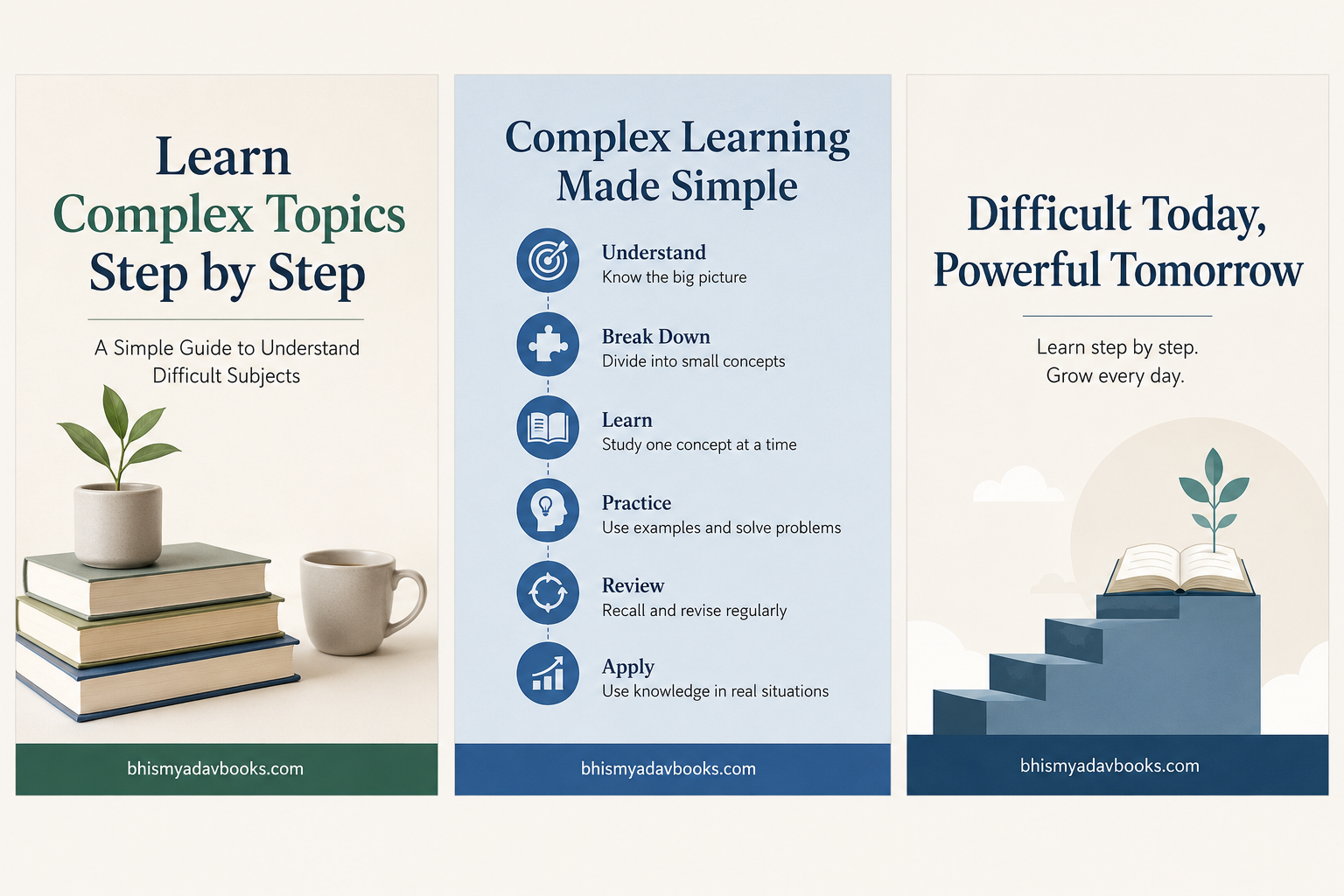
Understand → Break Down → Learn → Explain → Practice → Recall → Review → Apply
Each stage has a purpose.
Understand: Know what you are trying to learn.
Break Down: Make the subject manageable.
Learn: Study one concept at a time.
Explain: Confirm that you understand it.
Practice: Use the knowledge.
Recall: Retrieve it without assistance.
Review: Strengthen memory over time.
Apply: Use it in new situations.
This is the foundation of effective step-by-step learning.
Recommended Books for Job Aspirants
Frequently Asked Questions About Learning Complex Topics
1. What is the best way to learn a difficult subject?
The best approach is to divide the subject into smaller concepts, learn the foundational ideas first, study actively, practice regularly, test yourself, and review the material over time.
There is no single technique that works perfectly for every learner. A combination of structured learning methods is generally more effective.
2. Why can’t I understand complex topics even after reading them several times?
Repeated reading may create familiarity without deep understanding.
You may need to:
- identify missing prerequisites,
- find a simpler explanation,
- use examples,
- draw diagrams,
- explain the concept yourself,
- and practice applying it.
Instead of asking, “How many times should I read this?” ask, “Can I explain and use this without looking at the material?”
3. How can I understand difficult concepts faster?
Start with the basics, break the concept into smaller parts, connect new information to what you already know, use simple examples, and actively recall what you have learned.
Trying to rush through a complex subject can actually slow you down if it creates gaps in understanding.
4. Should I memorize or understand first?
For most complex subjects, understanding should come first.
Once you understand the idea, memorization becomes easier and more meaningful.
However, some information, such as terminology, formulas, dates, and basic facts, still requires deliberate memorization.
5. How long should I study a difficult topic each day?
There is no universal number of hours.
The quality of concentration matters more than simply counting hours.
Use focused sessions, take appropriate breaks, and stop or change activities when your attention becomes significantly weaker.
Consistency is usually more valuable than occasional extremely long study sessions.
6. Are videos better than textbooks for learning complex topics?
Neither is automatically better.
Textbooks may provide detailed explanations and organized reference material, while videos can make visual or procedural concepts easier to understand.
A strong approach is to use a reliable primary resource and supplement it with another format when needed.
7. How can I remember difficult topics for a long time?
Use:
- Active recall
- Spaced repetition
- Practice questions
- Teaching
- Concept maps
- Meaningful examples
- Regular revision
- Real-world application
The key is to retrieve and use information repeatedly rather than simply rereading it.
8. What should I do when I forget something I previously learned?
Do not become discouraged.
Forgetting is a normal part of learning.
Try to recall the information first, check the correct answer, and then review it again later.
Repeated retrieval over time can make future recall easier.
9. Should I study one subject at a time?
It depends on your situation.
When learning a particularly difficult concept, focused study can be useful.
For long-term practice, however, mixing different topics or types of problems can sometimes help you learn when and how to use different methods.
The important thing is to avoid constant switching that destroys concentration.
10. How do I know whether I really understand a complex topic?
Ask yourself:
- Can I explain it simply?
- Can I define the important terms?
- Can I describe how it works?
- Can I give examples?
- Can I answer questions without notes?
- Can I solve relevant problems?
- Can I connect it with other concepts?
- Can I apply it to a new situation?
- Can I identify what I still do not understand?
If you can do these things, you have moved beyond simple memorization toward genuine understanding.
Final Checklist: How to Learn Complex Topics Step by Step
Before considering a complex topic learned, use this checklist:
Preparation
☐ I have defined my learning goal.
☐ I understand the basic structure of the topic.
☐ I know which prerequisites I need.
☐ I have identified my knowledge gaps.
Learning
☐ I divided the topic into smaller concepts.
☐ I learned the concepts in a logical order.
☐ I read actively.
☐ I made concise notes.
☐ I used examples and analogies where useful.
☐ I created diagrams or concept maps when appropriate.
Practice
☐ I explained important concepts in my own words.
☐ I used active recall.
☐ I solved practice problems.
☐ I gradually increased difficulty.
☐ I recorded and analyzed mistakes.
Memory
☐ I reviewed the topic after some time had passed.
☐ I used spaced repetition.
☐ I tested myself without looking at my notes.
☐ I revisited difficult concepts.
Mastery
☐ I can explain the topic simply.
☐ I can connect it with related concepts.
☐ I can apply it to problems.
☐ I can give practical examples.
☐ I can identify common mistakes.
☐ I can use the knowledge in a new situation.
Conclusion: Complex Learning Becomes Easier One Step at a Time
Learning a complex topic does not require you to understand everything in one sitting.
The most effective approach is to build understanding gradually.
Start by defining what you want to learn. Understand the big picture. Check your prerequisites. Break the subject into smaller concepts. Learn those concepts one at a time. Read actively, make useful notes, use examples, and explain ideas in your own words.
Then practice.
Test yourself.
Make mistakes.
Learn from those mistakes.
Return to the material through spaced review.
Connect new knowledge with what you already know.
Finally, apply what you have learned to unfamiliar situations.
The process can be summarized as:
Start small → Build the foundation → Connect ideas → Practice → Recall → Review → Apply.
When a topic feels difficult, do not try to fight the entire subject at once. Find the smallest part you do not understand and work on that part.
A complicated subject is often simply a collection of smaller ideas connected together.
Once you understand those individual ideas and the relationships between them, the complexity begins to disappear.
Most importantly, remember that learning is a process, not a single event.
You may forget. You may become confused. You may make mistakes. You may need another explanation.
None of these things mean that you cannot learn.
They are normal parts of the learning journey.
With a structured approach, consistent practice, active recall, thoughtful reading, and regular revision, even difficult subjects can become understandable.
So the next time you face a complex chapter, unfamiliar skill, difficult examination topic, or challenging subject, don’t ask:
“How can I learn all of this?”
Instead ask:
“What is the first thing I need to understand?”
Learn that.
Then move to the next.
One concept at a time. One connection at a time. One practice session at a time.
That is how complex learning becomes manageable—and eventually becomes knowledge you can confidently understand, remember, and use.