Description
Space missions are among the most technically demanding engineering projects in the world. Designing a mission involves much more than calculating an orbit. Engineers and mission planners must consider mission objectives, spacecraft configuration, launch vehicles, propulsion, orbital transfers, flight dynamics, telemetry, ground stations, simulation, geographic coverage, and many other interconnected factors.
Traditionally, these activities may require multiple specialized tools. Engineers might use one application for orbital calculations, another for spacecraft design, another for geographic analysis, and separate tools for simulation, mission planning, or project management.
EGZI Space Engineering Suite v2.0 is designed around a different approach: bringing a broad collection of space engineering and mission-design capabilities together within an integrated software environment.
The suite combines mission planning, orbital mechanics, spacecraft engineering, propulsion analysis, simulation, telemetry, GIS, constellation design, and engineering data management into one platform.
The result is an environment intended to help students, educators, researchers, aerospace enthusiasts, engineers, and mission designers explore the complete lifecycle of a space mission.
With version 2.0, EGZI introduces several important workflow improvements, including module search, common mission data management, .egzi project files, spacecraft-launch vehicle synchronization, enhanced simulation capabilities, multistage propulsion analysis, and satellite constellation coverage calculations.
What Is EGZI Space Engineering Suite v2.0?
EGZI Space Engineering Suite v2.0 is an integrated space engineering software platform designed for analyzing and planning different aspects of space missions.
Instead of treating orbital mechanics, spacecraft design, propulsion, mission operations, and geographic analysis as completely separate activities, EGZI organizes them into connected modules.
The suite contains 25 major modules:
- Dashboard
- Project Management
- Mission Designer
- Mission Control
- Mission Workflow
- Orbit Designer
- Maneuver Planner
- Hohmann Transfer
- Bi-Elliptic Transfer
- Hyperbolic / Escape
- Sphere of Influence
- Lambert Transfer
- Patched-Conic Transfer
- Launch Vehicle
- Propulsion Analysis
- Flight Dynamics
- Telemetry
- Simulation
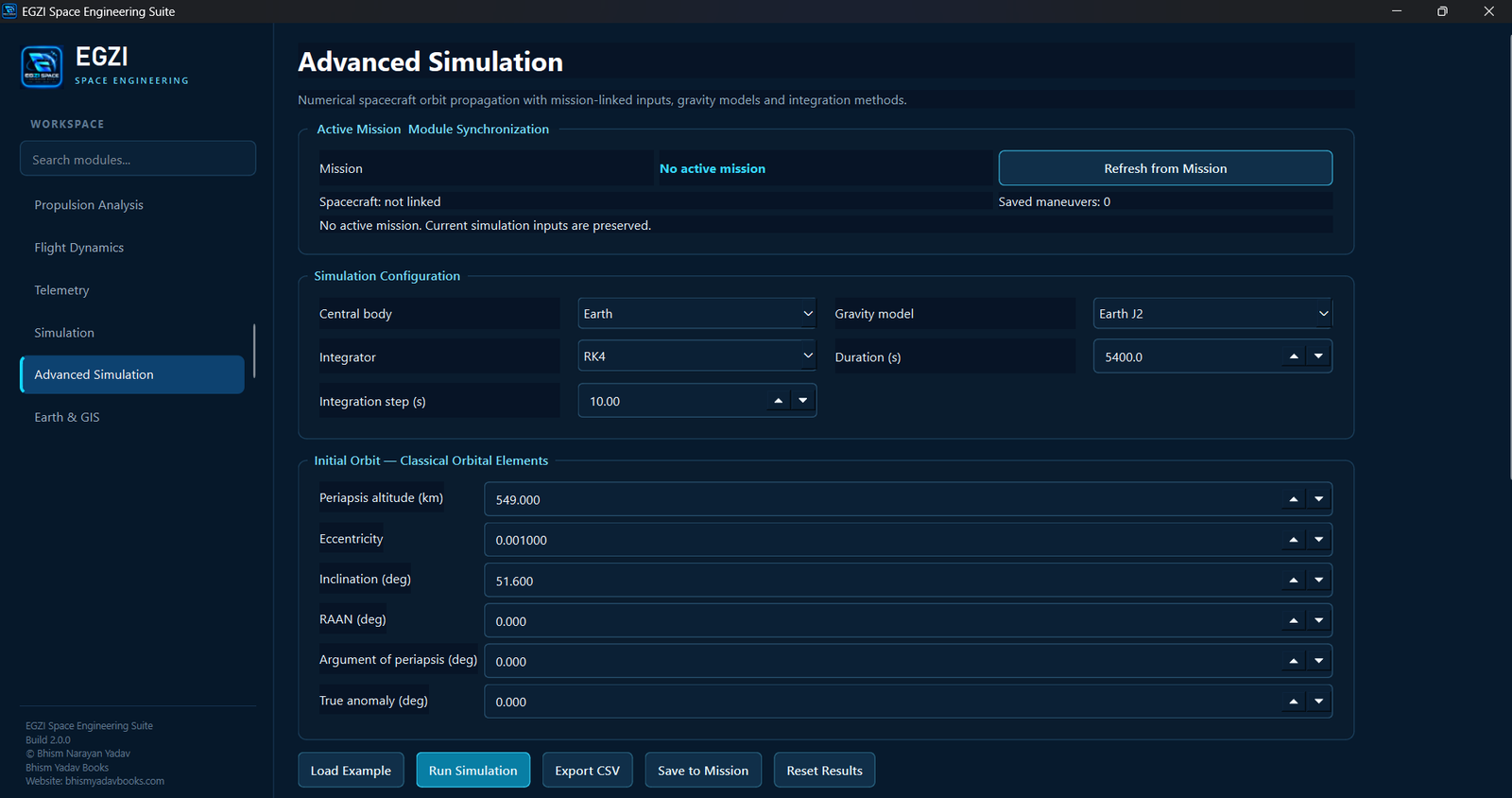
- Advanced Simulation
- Earth & GIS
- Ground Station Planner
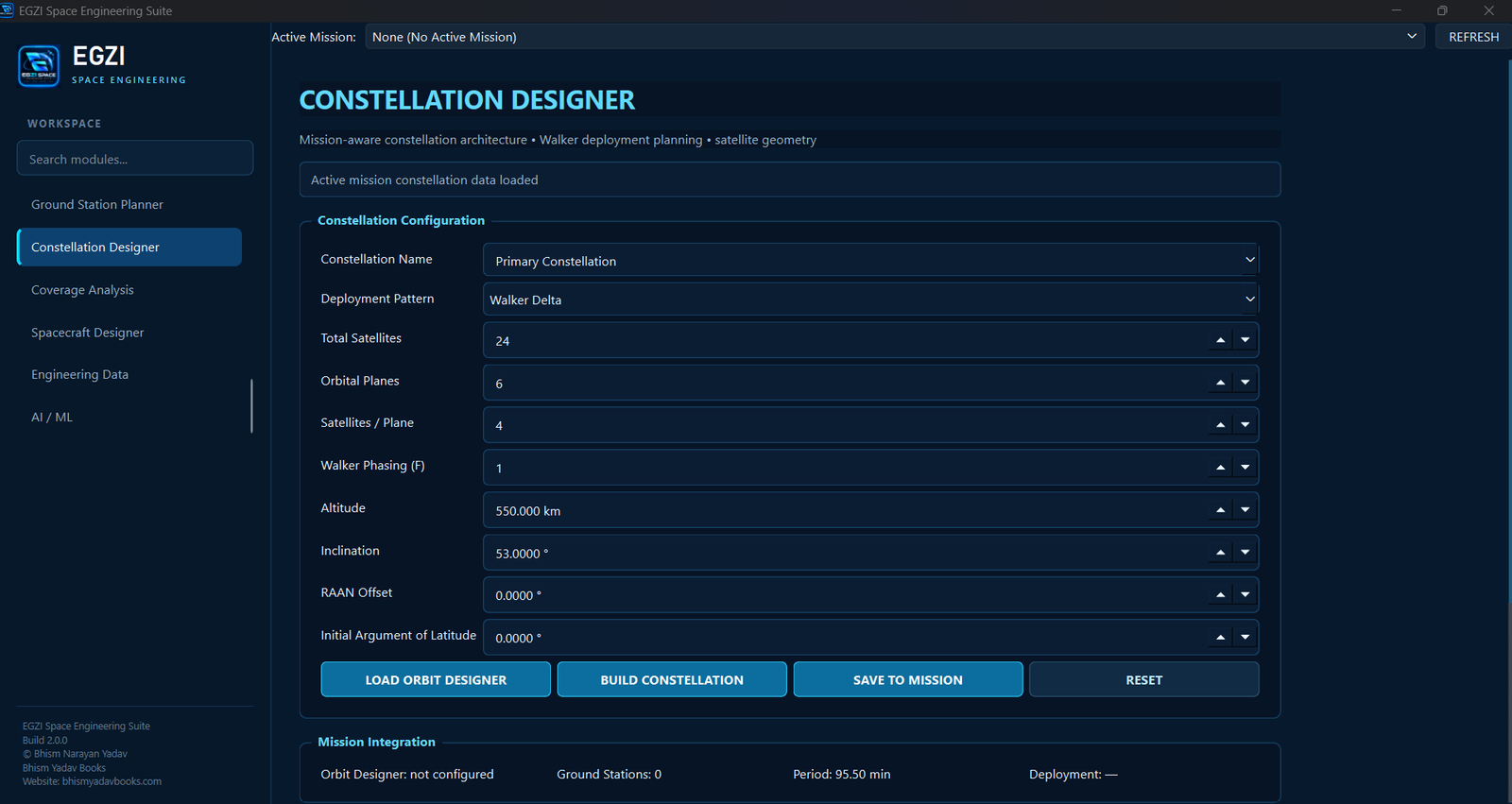
- Constellation Designer
- Coverage Analysis
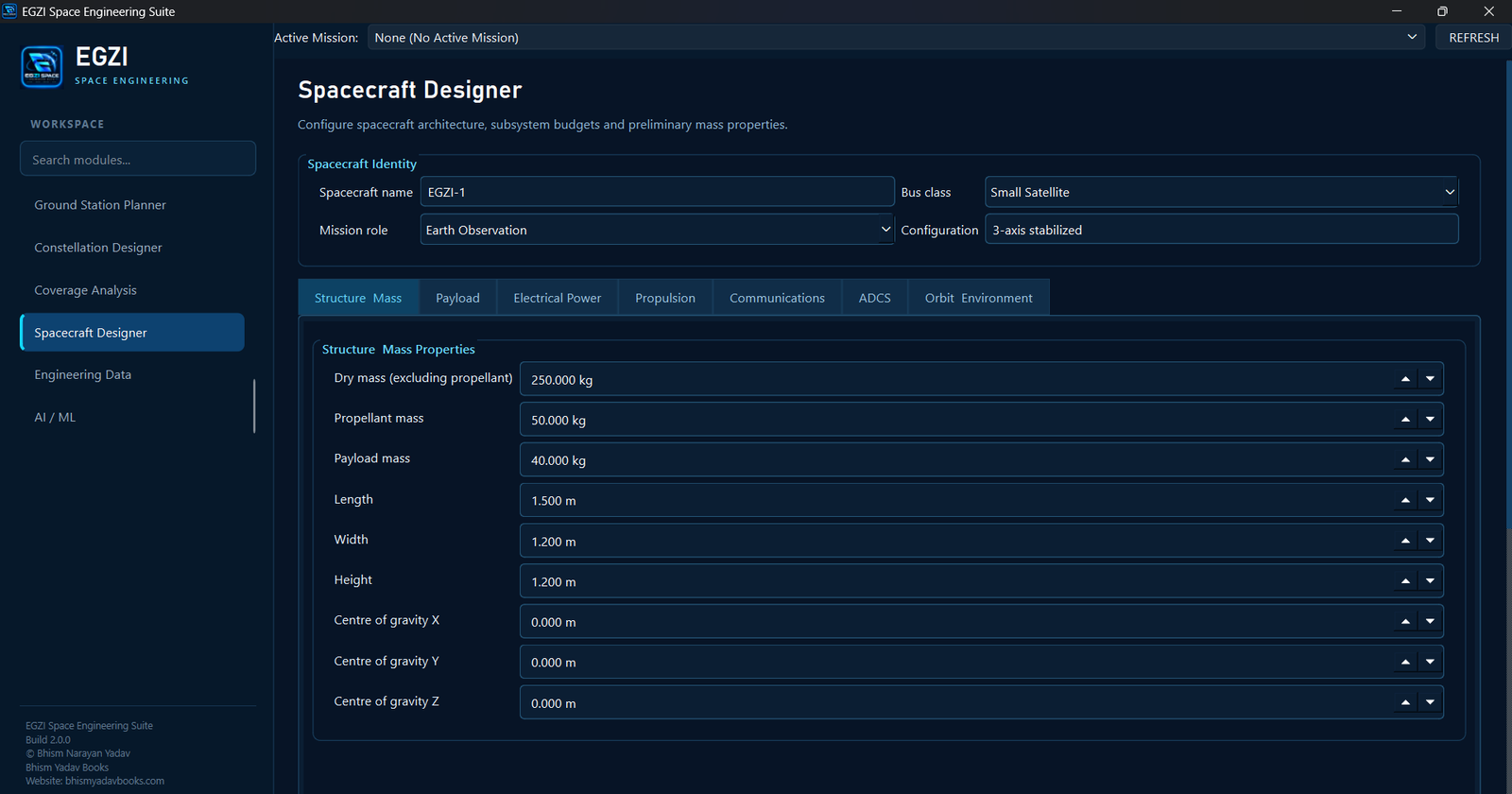
- Spacecraft Designer
- Engineering Data
These modules cover different layers of a mission, from early conceptual planning to orbital analysis, spacecraft engineering, simulation, and ground-segment considerations.
Why an Integrated Space Engineering Platform Matters
A spacecraft does not operate independently from the rest of a mission.
For example, changing the spacecraft mass can affect the launch vehicle requirements. Changing the propulsion system can affect available delta-v. Changing the orbit can affect ground-station visibility and satellite coverage. Changing the constellation configuration can affect geographic coverage and mission performance.
This interconnected nature of space engineering makes integration particularly valuable.
Consider a simple example.
Suppose a mission designer wants to place a spacecraft into a particular orbit.
The process could involve:
- Defining the mission objective
- Selecting the spacecraft
- Estimating spacecraft mass
- Selecting a launch vehicle
- Determining the initial orbit
- Calculating orbital transfers
- Planning maneuvers
- Evaluating propulsion requirements
- Simulating the mission
- Examining ground-station visibility
- Analyzing geographic coverage
- Reviewing engineering data
In a fragmented software workflow, each stage may require moving information between different applications.
An integrated environment can make this process easier to organize.



Reviews
There are no reviews yet.