Introduction
Understanding Self Study and Coaching
Preparing for a competitive examination is a journey that requires discipline, consistency, patience, and the right strategy. Whether you are preparing for UPSC, SSC, banking examinations, railway examinations, teaching exams, state-level government examinations, or another competitive test, one important question often arises:
Should you prepare through self-study or join a coaching institute?
This question has no single answer.
Some students achieve excellent results through completely independent preparation, while others perform better when they have structured classes, teachers, regular tests, and professional guidance. The better option depends on your learning style, financial situation, available time, academic background, target examination, and ability to remain disciplined.
The debate between self-study vs coaching has become even more relevant because students now have access to books, online classes, recorded lectures, mock tests, educational websites, mobile applications, previous-year papers, and digital study materials.
The good news is that you do not necessarily have to choose one method completely.
A student can successfully combine self-study with selective coaching or online guidance. The goal is not to decide which method is universally superior. The goal is to identify the preparation system that helps you understand concepts, practice questions, revise effectively, and perform well in the actual examination.
We have some amazing books at our Shop page you may want to buy.
Table of Contents
In this article, we will compare self-study and coaching in detail, examine their advantages and disadvantages, discuss costs and time management, and explain how you can decide which approach is suitable for your competitive exam preparation.
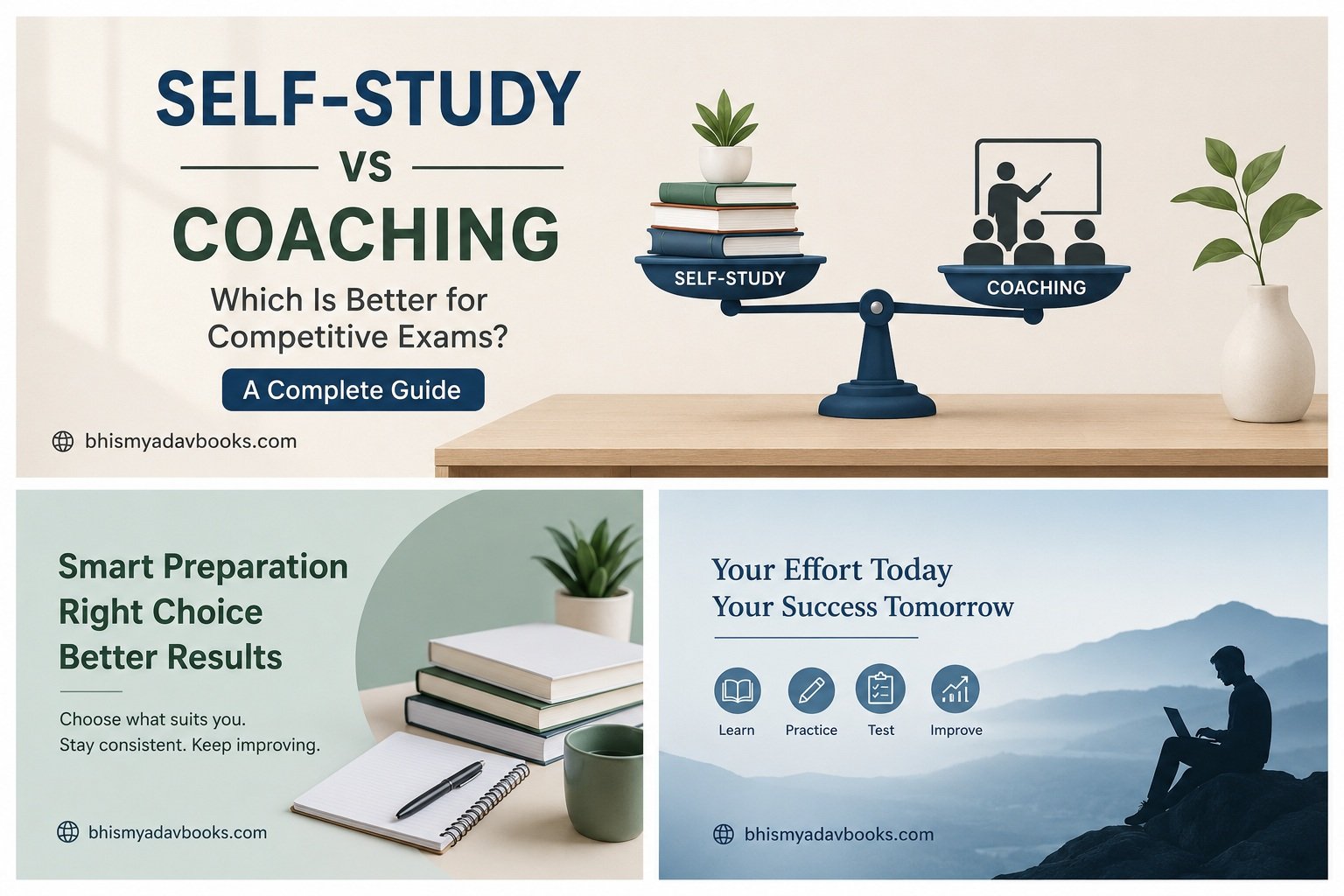
Self Study vs Coaching for Competitive Exams: Which Is Better for Success?
What Is Self-Study?
Self-study means preparing for an examination primarily through your own planning and effort rather than depending on a physical coaching institute.
A self-study student generally decides:
- What subjects to study
- Which books to use
- Which topics to cover first
- How many hours to study
- When to revise
- Which mock tests to attempt
- How to analyze mistakes
- When to change the study strategy
Self-study does not necessarily mean studying completely alone.
You can use textbooks, online lectures, educational websites, video tutorials, test series, digital courses, discussion forums, and other resources while still following a self-directed preparation strategy.
For example, a student preparing for a banking examination may use standard books for quantitative aptitude and reasoning, watch online lectures for difficult concepts, solve previous-year papers, take mock tests, and create a personal revision schedule.
The student is still following self-study because the overall preparation is independently planned and managed.
Why Is Self-Study Popular?
Self-study has become increasingly popular because educational resources are more accessible than ever.
A student can now find:
- Free educational videos
- Online practice questions
- Previous-year question papers
- Digital notes
- E-books
- Mock tests
- Current-affairs resources
- Study planners
- Educational blogs
- Online discussion communities
This accessibility allows students from different backgrounds to build their own preparation systems.
However, access to resources does not automatically guarantee success.
One of the biggest challenges of self-study is resource management. Having hundreds of books, videos, PDFs, and websites can sometimes create confusion instead of improving preparation.
Successful self-study therefore requires the ability to select useful resources and ignore unnecessary ones.
What Is Coaching?
Coaching refers to preparing for an examination under the guidance of teachers, mentors, or a structured coaching institute.
Coaching may be:
- Classroom-based
- Online live classes
- Recorded courses
- Hybrid programs
- Subject-specific coaching
- Test-series-based programs
- Personalized mentoring
A coaching program generally provides a predefined curriculum and study schedule.
Instead of deciding everything independently, students receive guidance regarding:
- Syllabus coverage
- Study material
- Important topics
- Practice questions
- Tests
- Revision
- Examination strategy
For students who struggle to create and follow their own study schedules, coaching can provide useful structure.
However, joining coaching does not eliminate the need for self-study.
In fact, coaching and self-study work best together when the student actively studies outside the classroom.
A teacher can explain a concept, but the student must still revise it.
A coaching institute can provide mock tests, but the student must analyze mistakes.
A teacher can give study material, but the student must practice consistently.
Therefore, coaching should not be considered a replacement for personal effort.
Self-Study vs Coaching: The Basic Difference
The biggest difference between self-study and coaching is who controls the preparation process.
In self-study, the student controls almost everything.
In coaching, the institute or teacher provides much of the structure.
Consider the following comparison:
| Factor | Self-Study | Coaching |
| Study schedule | Self-managed | Usually structured |
| Teacher guidance | Limited or optional | Regular |
| Study material | Selected independently | Usually provided |
| Discipline | Requires strong self-discipline | External structure helps |
| Cost | Usually lower | Usually higher |
| Flexibility | Very high | Comparatively lower |
| Doubt solving | Self-managed/online | Teacher support available |
| Peer competition | Limited | Usually available |
| Personalized pace | Easy to adjust | Depends on institute |
| Revision | Student manages it | May be scheduled |
| Mock tests | Must arrange | Often included |
| Travel | Usually none | Possible for classroom coaching |
Neither method wins in every category.
The right choice depends on your personal circumstances.
Advantages of Self-Study for Competitive Exams
1. Lower Cost
One of the most important advantages of self-study is affordability.
Coaching programs can sometimes require a significant financial investment. Self-study can reduce expenses because students can use affordable books, libraries, free online resources, and reasonably priced test series.
For students with limited financial resources, this can make competitive examination preparation more accessible.
However, low cost should not mean low quality.
A student should still invest in reliable books, good practice material, and quality mock tests where necessary.
2. Complete Flexibility
Self-study gives you control over your timetable.
Suppose you are more productive in the morning. You can schedule difficult subjects during the morning.
If you have college, work, or family responsibilities during the day, you can study at night.
You can also change your schedule when necessary.
This flexibility is particularly useful for students preparing alongside:
- College
- Employment
- Family responsibilities
- Other examinations
- Part-time work
A coaching timetable may not always fit your personal routine.
Self-study allows you to create a schedule based on your actual availability.
3. Study at Your Own Speed
Every student learns differently.
One student may understand percentages after one explanation. Another may need several examples and practice sessions.
With self-study, you can spend more time on difficult topics without worrying about the rest of the class.
You can pause an online lecture, reread a chapter, solve additional questions, or revise a concept multiple times.
Similarly, if you already understand a particular topic, you can move forward instead of spending several hours attending a class on it.
This makes self-study particularly useful for students who have a strong understanding of the examination syllabus.
4. Encourages Independence
Self-study develops an important skill that extends beyond competitive examinations: independent learning.
When you prepare independently, you learn how to:
- Find information
- Evaluate study material
- Identify weaknesses
- Create schedules
- Analyze performance
- Solve problems independently
- Adapt your strategy
These skills can be valuable throughout academic and professional life.
A competitive exam is not only testing knowledge. It also tests how effectively you can use your knowledge under pressure.
Independent preparation can strengthen that ability.
5. Easier Personalization
A coaching institute generally follows a common curriculum for many students.
But your weaknesses may be different from those of other students.
For example, you may be strong in reasoning but weak in mathematics.
Instead of spending equal time on every subject, you can allocate additional study hours to mathematics.
Self-study allows you to create a preparation plan based on your personal performance.
You can divide your time according to:
Strengths + Weaknesses + Exam Weightage + Available Time
This can make preparation more efficient.
Disadvantages of Self-Study
Self-study has many advantages, but it also presents serious challenges.
1. Lack of External Discipline
The greatest challenge is maintaining consistency.
When nobody is checking your attendance or progress, it becomes easy to postpone studying.
You may tell yourself:
“I will study tomorrow.”
One postponed session becomes two.
Two become a week.
Eventually, the preparation schedule falls behind.
This is why self-study requires strong discipline.
A student choosing self-study should create a realistic timetable and treat study sessions as fixed commitments.
2. Difficulty in Choosing Resources
The internet provides an enormous amount of information.
This sounds helpful, but too many resources can create confusion.
You may find:
- Ten teachers explaining the same topic
- Multiple books for one subject
- Hundreds of PDFs
- Different study strategies
- Numerous test series
- Conflicting recommendations
Constantly changing resources wastes time.
A better approach is to select a limited number of reliable resources and use them consistently.
More resources do not necessarily mean better preparation.
3. Doubt Resolution Can Be Difficult
Some concepts are difficult to understand without guidance.
A student may spend several hours trying to understand one problem that a good teacher could explain in a few minutes.
Online explanations can help, but they may not always address your exact doubt.
This is one area where coaching can have a clear advantage.
However, students can reduce this disadvantage by using:
- Online doubt-solving platforms
- Discussion communities
- Subject-specific lectures
- Reference books
- Study partners
- Teacher consultations
4. Limited Competitive Environment
Studying alone can sometimes make it difficult to judge your actual performance.
You may solve questions correctly but still not know whether your speed and accuracy are competitive enough.
Regular mock tests can solve much of this problem.
A good test series allows you to compare your performance with broader benchmarks and identify areas requiring improvement.
Advantages of Coaching for Competitive Exams
1. Structured Study Plan
One of the biggest advantages of coaching is structure.
A good coaching program generally follows a planned sequence.
For example:
Basic Concepts → Advanced Concepts → Practice → Tests → Revision
This can be extremely helpful for beginners who do not know where to start.
Instead of spending days creating a preparation strategy, students can begin studying according to the provided schedule.
2. Teacher Guidance
Experienced teachers can simplify complicated concepts.
A good teacher may explain:
- Which topics are important
- Which topics require more practice
- Common mistakes
- Shortcuts
- Question-solving approaches
- Time-management techniques
- Examination patterns
This guidance can save considerable time.
However, the quality of coaching matters greatly.
Joining an expensive institute does not automatically guarantee good teaching or success.
Students should evaluate the quality of faculty, study material, testing system, student feedback, and overall approach before making a decision.
3. Regular Tests and Practice
Many coaching programs include regular tests.
These tests help students become familiar with:
- Question patterns
- Time limits
- Examination pressure
- Accuracy requirements
- Speed management
Regular testing is essential for competitive examinations because knowing the answer is only part of the challenge.
You must also be able to solve it accurately and quickly.
4. Doubt-Solving Support
A teacher or mentor can provide immediate clarification when students encounter difficult concepts.
This is especially useful for subjects such as:
- Mathematics
- Reasoning
- Science
- Economics
- Accounting
- Grammar
Instead of remaining stuck on one topic, students can ask questions and continue with their preparation.
5. Competitive Environment
Studying alongside other serious candidates can create a competitive atmosphere.
Seeing classmates perform well can encourage students to improve.
It can also help students understand where they stand relative to others.
However, competition should be used constructively.
Constantly comparing yourself with others can create unnecessary stress.
The better comparison is often:
Today’s performance vs your previous performance.
Disadvantages of Coaching
1. Higher Cost
Coaching can be expensive, particularly for long-duration programs.
Additional expenses may include:
- Course fees
- Travel
- Accommodation
- Books
- Test series
- Online subscriptions
- Other study materials
Students should consider the total cost rather than looking only at the advertised course fee.
2. Fixed Schedule
Classroom coaching generally follows a fixed timetable.
If the teacher moves quickly through a topic, you may have difficulty keeping up.
If you already know the topic, you may still have to attend the class.
This can make coaching less efficient for students who prefer personalized learning.
3. Quality Varies
Not every coaching institute provides high-quality education.
Some may have excellent teachers and study materials, while others may rely heavily on marketing.
Before joining a coaching program, investigate:
- Faculty experience
- Course structure
- Test quality
- Study material
- Student feedback
- Doubt-solving system
- Class size
- Past results
Do not select a coaching institute simply because it is popular.
4. Risk of Becoming Dependent
Some students become overly dependent on coaching.
They attend classes regularly but do not study independently.
This creates a serious problem.
Watching someone teach is not the same as learning.
You must revise, practice, solve questions, take tests, and analyze mistakes yourself.
Coaching can provide direction, but personal study determines how much of that direction becomes actual knowledge.
Self-Study vs Coaching for Competitive Exams: Which Is Better for Success?
Detailed Comparison of Self-Study and Coaching
Self-Study vs Coaching: Which One Saves More Money?
Cost is an important consideration for many competitive-exam aspirants.
Self-Study
Self-study is generally less expensive.
A student may need to spend money on:
- Standard textbooks
- Previous-year papers
- Mock-test series
- Current-affairs resources
- Notebooks and stationery
- Selected online courses, if required
Many educational resources are also available free of cost.
However, free resources should be selected carefully. Spending hours searching for free material can sometimes waste more time than purchasing a reliable book or test series.
Coaching
Coaching generally involves higher expenses.
Depending on the examination and institution, students may pay for:
- Classroom classes
- Online courses
- Test series
- Study material
- Personal mentoring
- Doubt-solving programs
For students who need structured guidance, this investment may be worthwhile.
Which Is Better?
If your budget is limited and you are capable of planning your own preparation, self-study can be an excellent option.
If financial resources are available and you need professional guidance and structure, coaching may be useful.
The important thing is to calculate the value you receive, not simply the price you pay.
Flexibility: Self-Study Has a Clear Advantage
Flexibility is one of the strongest benefits of self-study.
Suppose you have four hours available today but only two hours tomorrow. You can adjust your schedule accordingly.
You can also change the order of subjects based on your performance.
For example:
Morning: Mathematics
Afternoon: General Awareness
Evening: Reasoning
Night: Revision
You are free to modify the plan whenever necessary.
Coaching is comparatively less flexible.
A classroom course may have fixed timings. Even online live classes usually follow a predefined schedule.
This can become difficult for students preparing alongside college, employment, or other responsibilities.
Best Choice for Flexible Learners
If you need complete control over your timetable, self-study is usually better.
If you struggle to create and follow a schedule, coaching may provide useful structure.
Discipline: The Hidden Factor in Exam Preparation
Many students believe that having good books or joining a famous coaching institute is enough.
It is not.
Consistency is one of the most important factors in competitive exam preparation.
Self-study requires strong self-discipline.
Nobody may remind you to:
- Wake up on time
- Complete a chapter
- Revise yesterday’s lesson
- Solve practice questions
- Take a mock test
- Analyze your mistakes
You must take responsibility for all of these activities.
Coaching provides external structure.
Classes happen at particular times. Homework may be assigned. Tests may have fixed dates.
This structure can help students who find it difficult to maintain discipline independently.
A Simple Test
Ask yourself:
“If nobody forces me to study, can I consistently follow my study plan for several months?”
If your answer is yes, self-study may work very well.
If your answer is no, coaching or mentoring may provide useful accountability.
Learning Speed: Who Has the Advantage?
Students do not learn at the same speed.
Some understand a concept immediately. Others need repeated explanations and practice.
Self-Study
Self-study allows you to control your learning speed.
You can:
- Pause lectures
- Repeat explanations
- Read chapters again
- Solve additional questions
- Skip familiar material
- Spend extra time on weak topics
This makes self-study highly personalized.
Coaching
In coaching, the teacher generally has to teach an entire group.
The pace is therefore designed for the class as a whole.
A student who learns slowly may need additional study after class.
A student who learns quickly may find some classes repetitive.
Winner?
For personalized learning speed, self-study has an advantage.
However, a good coaching program can still be effective if the student uses independent study to fill learning gaps.
Doubt Solving: Where Coaching Can Help
Doubt solving is one area where coaching can provide significant value.
Imagine that you are studying quantitative aptitude and cannot understand why your answer differs from the solution.
You may spend a long time trying to identify the mistake.
A teacher can sometimes identify the issue within minutes.
This is particularly useful for complicated subjects and advanced concepts.
However, self-study students are not without options.
They can use:
- Online lectures
- Educational websites
- Discussion platforms
- Question-solving communities
- Reference books
- Recorded classes
- Online mentors
The important point is to avoid remaining stuck for too long.
The 20-Minute Rule
If you have tried seriously for around 15–20 minutes but still cannot understand a concept, mark the problem and seek another explanation.
Do not spend an entire study session fighting with one question.
Efficient preparation requires knowing when to persist and when to seek help.
Study Material: Quality Matters More Than Quantity
Both self-study and coaching can provide access to study material.
But students often make the mistake of collecting too much.
A common pattern looks like this:
- Buy one book.
- Find another recommended book.
- Download several PDFs.
- Start watching another teacher.
- Save dozens of videos.
- Never complete the original material.
This creates resource overload.
A better strategy is to create a limited resource list.
For each subject, ideally have:
One primary source + one supplementary source + previous-year questions + mock tests
You do not need ten books for every subject.
Coaching Material
Coaching institutes often provide prepared notes and study material.
This saves time because students do not have to search for everything independently.
However, the quality of these materials varies.
Self-Study Material
Self-study requires more research initially, but you can select resources that suit your learning style.
Best Approach
Regardless of whether you choose coaching or self-study, prioritize:
Reliable → Relevant → Complete → Revisable
A resource is useful only if you actually study and revise it.
Mock Tests: Essential for Both Methods
Mock tests are an essential part of competitive exam preparation.
Whether you study independently or through coaching, you should regularly practice full-length and sectional tests.
Mock tests help you understand:
- Your speed
- Accuracy
- Time management
- Weak subjects
- Repeated mistakes
- Question-selection strategy
- Examination pressure
Simply taking tests is not enough.
You must analyze your tests.
After every mock test, divide mistakes into categories:
1. Conceptual Mistakes
You did not understand the concept.
Solution: Relearn the topic.
2. Calculation Mistakes
You knew the method but made an arithmetic error.
Solution: Practice carefully and improve calculation accuracy.
3. Careless Mistakes
You misunderstood the question or marked the wrong option.
Solution: Slow down slightly and read questions carefully.
4. Time-Management Mistakes
You spent too much time on difficult questions.
Solution: Improve question selection.
5. Guessing Mistakes
You attempted questions without sufficient confidence.
Solution: Understand the examination’s marking system and improve judgment.
This analysis is valuable whether you are a self-study student or a coaching student.
Self-Study vs Coaching for Time Management
Time management has two dimensions:
Managing study time and managing examination time.
Coaching can help with the first by providing a timetable.
Self-study can help develop personal scheduling skills.
For examination time management, both methods can be equally effective if the student regularly practices timed tests.
A useful daily structure might look like:
Study Block 1: Concept Building
Learn a new topic.
Study Block 2: Practice
Solve questions based on the topic.
Study Block 3: Revision
Review previously studied material.
Study Block 4: Testing
Take a short timed test.
This creates a balanced cycle:
Learn → Practice → Revise → Test → Analyze → Improve
Which Is Better for Working Students?
Working professionals often face a different challenge.
They may have only two to four hours available each day.
For such students, traditional full-time classroom coaching may be difficult.
Self-study can provide greater flexibility.
For example:
Morning: 60 minutes
Lunch break: 30 minutes
Evening: 90 minutes
Weekend: 4–6 hours
Online recorded coaching can also be useful because lessons can be watched according to the student’s schedule.
Recommended Approach
Working candidates may benefit from a self-study + selective online guidance model.
Instead of enrolling in a complete coaching program, they can purchase:
- A focused course for difficult subjects
- A quality test series
- Current-affairs resources
- Occasional mentorship
This can reduce both cost and time pressure.
Which Is Better for College Students?
College students often have changing schedules because of:
- Lectures
- Assignments
- Practical classes
- Examinations
- Projects
- Vacations
Self-study provides flexibility.
However, students who lack preparation experience may benefit from some external guidance.
A hybrid strategy can work well:
Self-study for regular preparation + online classes for difficult topics + test series for performance evaluation
This gives students flexibility without completely eliminating professional guidance.
Self-Study vs Coaching for Beginners
Beginners often face three major problems:
- They do not understand the syllabus.
- They do not know which resources to choose.
- They do not know how to create a realistic study plan.
For such students, coaching can reduce the initial confusion.
However, joining coaching is not mandatory.
A beginner can also start with:
- Official examination syllabus
- Previous-year papers
- One reliable book per subject
- A basic study schedule
- Quality online lectures
- A beginner-level test series
After two or three weeks of preparation, the student can evaluate whether additional guidance is required.
Self-Study vs Coaching for Advanced Students
Students who have already attempted the examination or have a strong academic foundation may not need complete coaching.
They may already understand:
- The syllabus
- Question patterns
- Their strengths
- Their weaknesses
- Required preparation level
Such students may benefit more from targeted preparation.
For example:
Self-study + advanced test series + specialized classes for weak areas
This approach can be more efficient than repeating an entire coaching course.
The Role of Previous-Year Question Papers
Previous-year papers are among the most valuable resources for competitive examinations.
They help you understand what the examination actually asks.
Use them to identify:
- Frequently tested topics
- Question difficulty
- Repeated concepts
- Question patterns
- Time requirements
- Important chapters
Both self-study and coaching students should solve previous-year papers.
Do not wait until the final month.
Start analyzing them early.
A simple method is:
Step 1
Take one previous-year paper.
Step 2
Attempt it without looking at solutions.
Step 3
Check your answers.
Step 4
Identify weak areas.
Step 5
Add those topics to your study plan.
This makes preparation more examination-oriented.
The Importance of Revision
One major difference between successful and unsuccessful preparation is often not the number of hours studied but how much information is retained.
Students frequently spend weeks learning new topics but very little time revising old ones.
This creates a dangerous cycle:
Study → Forget → Study Again → Forget Again
Instead, use spaced revision.
For example:
First revision: Within 24 hours
Second revision: After several days
Third revision: After a few weeks
Final revision: Before the examination
The exact intervals can vary, but the principle is simple:
Do not study something once and assume you will remember it.
Can Coaching Replace Self-Study?
No.
This is one of the most important points in the entire discussion.
Even the best teacher cannot study on your behalf.
Coaching may provide:
- Explanation
- Direction
- Material
- Tests
- Mentoring
But you still have to:
- Attend or watch classes
- Revise
- Practice
- Solve previous-year questions
- Take tests
- Analyze mistakes
- Improve weaknesses
Therefore:
Coaching can guide preparation, but self-study converts guidance into performance.
This is why students who join coaching still need a strong personal study routine.
Can Self-Study Replace Coaching?
In many cases, yes.
A disciplined student with good resources, a clear strategy, and access to quality tests can prepare successfully without traditional coaching.
However, this does not mean every student should avoid coaching.
If you repeatedly struggle with:
- Understanding concepts
- Creating a timetable
- Maintaining consistency
- Identifying important topics
- Solving advanced questions
- Evaluating your performance
then external guidance may save time and prevent repeated mistakes.
The decision should be based on your actual needs rather than general opinions.
A Practical Decision-Making Framework
Before choosing between self-study and coaching, answer these ten questions honestly:
Question 1: Do I understand the examination syllabus?
If yes, self-study may be easier.
If no, some guidance may help.
Question 2: Can I create a realistic timetable?
If yes, self-study has an advantage.
If no, structured coaching may help.
Question 3: Can I follow my timetable consistently?
If yes, self-study can work.
If no, external accountability may be valuable.
Question 4: Do I have a strong academic foundation?
If yes, self-study may be sufficient for many subjects.
If no, consider targeted guidance.
Question 5: Can I solve difficult questions independently?
If yes, you may need less coaching.
If no, subject-specific guidance could be useful.
Question 6: Can I afford coaching comfortably?
If yes, consider whether it provides genuine value.
If no, build a strong self-study system.
Question 7: Do I have enough time?
If your schedule is unpredictable, flexible self-study may be better.
Question 8: Can I evaluate my mistakes?
If yes, self-study becomes easier.
If no, mentoring or coaching may help.
Question 9: Am I easily distracted?
If yes, structured classes and accountability may improve consistency.
Question 10: What does my mock-test performance show?
This is perhaps the most important question.
Your test performance provides evidence rather than assumptions.
A Simple Scoring Method
You can create your own decision score.
Give yourself:
- 2 points for strong ability
- 1 point for moderate ability
- 0 points for significant difficulty
Evaluate yourself on:
- Self-discipline
- Time management
- Subject knowledge
- Resource selection
- Doubt solving
- Test analysis
- Consistency
- Study planning
- Independent learning
- Financial flexibility
If your score is high, you may be well suited to self-study.
If your score is low in several areas, coaching or mentoring may provide additional support.
If your score is mixed, a hybrid approach may be the best solution.
Self-Study vs Coaching for Competitive Exams: Which Is Better for Success?
The Hybrid Approach and Subject-Wise Preparation Strategy
What Is the Hybrid Approach?
The hybrid approach means combining:
Self-study + Coaching/Online Guidance + Practice + Mock Tests
For example, a student may attend coaching for mathematics and reasoning but prepare general awareness independently.
Another student may study the entire syllabus independently but purchase a test series and occasional mentorship.
Someone else may use recorded online lectures for difficult topics while using textbooks and previous-year papers for the rest of the preparation.
There is no single formula.
The purpose of the hybrid approach is to use external help selectively instead of depending on it completely.
Why the Hybrid Approach Can Be Effective
Consider two extreme situations.
Situation 1: Complete Dependence on Coaching
A student attends every class but does not revise independently.
The teacher explains the topic.
The student understands it temporarily.
A few weeks later, the student forgets much of it.
The problem is not the coaching.
The problem is the absence of independent practice and revision.
Situation 2: Complete Isolation
Another student attempts everything alone.
They spend several days trying to understand one difficult concept.
They repeatedly use unsuitable study material.
They do not know why their mock-test scores are not improving.
Here, some professional guidance could save time.
The hybrid model attempts to avoid both situations.
It follows a simple principle:
Use coaching for direction and difficult concepts; use self-study for mastery.
How to Build an Effective Hybrid Preparation Strategy
A hybrid strategy should not mean collecting every available resource.
Instead, divide your preparation into different components.
Component 1: Concept Learning
Use textbooks, coaching classes, or online lectures to understand concepts.
Component 2: Independent Practice
Solve questions without depending on the teacher.
Component 3: Revision
Review concepts and notes regularly.
Component 4: Testing
Take sectional and full-length mock tests.
Component 5: Analysis
Identify why you made mistakes.
Component 6: Improvement
Modify your preparation according to test results.
This creates a continuous improvement cycle:
Learn → Practice → Revise → Test → Analyze → Improve
Repeat this cycle throughout your preparation.
When Should You Choose Coaching?
Coaching can be particularly useful when you face one or more of the following situations.
You Are Starting From Zero
If you have never prepared for a competitive examination before, you may not know:
- How to read the syllabus
- Which topics are important
- How questions are asked
- Which books to select
- How to plan revision
- How to approach mock tests
A good coaching program can provide an initial roadmap.
However, you should still develop your own understanding of the examination rather than blindly following every instruction.
You Have Weak Fundamentals
Suppose your mathematics fundamentals are weak.
You may understand basic arithmetic but struggle with:
- Percentages
- Ratio and proportion
- Algebra
- Geometry
- Data interpretation
- Probability
A structured teacher-led course can help rebuild your foundation.
Once your fundamentals improve, you can gradually shift toward independent practice.
You Keep Changing Your Strategy
Some students change their preparation method every few weeks.
One week they follow one teacher.
The next week they discover another strategy.
Then they buy a new book.
After that, they download another PDF.
This constant switching creates fragmented preparation.
A mentor or structured coaching program can help establish a stable direction.
When Should You Prefer Self-Study?
Self-study may be more suitable when you:
- Understand the syllabus
- Have a strong academic foundation
- Can follow a timetable
- Learn effectively independently
- Can identify your weaknesses
- Have access to reliable resources
- Can analyze mock tests
- Are comfortable solving difficult problems independently
Experienced candidates often benefit greatly from self-directed preparation because they already understand their individual requirements.
Use Coaching Selectively
One of the smartest ways to use coaching is to avoid paying for help you do not need.
Suppose you are excellent at reasoning but weak in mathematics.
Instead of joining a complete program, you may consider:
Self-study for reasoning + targeted mathematics course + complete mock-test series
Similarly, if your concepts are strong but your examination performance is poor, you may need:
Self-study + intensive test practice + performance analysis
This is often more efficient than restarting the entire syllabus.
Subject-Wise Self-Study vs Coaching Strategy
Different subjects require different learning approaches.
A student should not necessarily use the same method for every subject.
Let’s examine a few common competitive examination subjects.
1. Quantitative Aptitude
Quantitative aptitude is a subject where conceptual clarity and repeated practice are extremely important.
Important areas may include:
- Number systems
- Percentages
- Profit and loss
- Ratio and proportion
- Average
- Time and work
- Time, speed and distance
- Simple and compound interest
- Algebra
- Geometry
- Data interpretation
Self-Study Strategy
Start with fundamentals.
For each topic:
- Understand the concept.
- Study solved examples.
- Solve basic questions.
- Move to moderate questions.
- Attempt previous-year questions.
- Practice timed sets.
- Record common mistakes.
When Coaching Helps
Coaching can be useful if you:
- Have weak mathematical fundamentals
- Cannot understand certain concepts
- Need shortcut techniques
- Struggle with advanced questions
- Have difficulty managing time
However, shortcuts should never replace conceptual understanding.
A shortcut is useful only when you know why it works and when to use it.
2. Reasoning Ability
Reasoning often improves significantly through practice.
Common areas include:
- Analogy
- Classification
- Series
- Coding-decoding
- Blood relations
- Direction sense
- Syllogism
- Seating arrangement
- Puzzles
- Logical reasoning
Self-study can work extremely well for reasoning because students can learn a concept and immediately practice dozens of questions.
Recommended Method
Concept → Example → Practice → Timed Set → Previous-Year Questions
If you repeatedly struggle with complex puzzles or arrangements, targeted coaching may be useful.
The key is to identify whether the problem is lack of understanding or lack of practice.
If you understand the method but cannot solve questions quickly, more practice may be more valuable than another lecture.
3. English Language
English preparation can often be handled effectively through self-study.
Important areas may include:
- Grammar
- Vocabulary
- Reading comprehension
- Sentence correction
- Fill-in-the-blanks
- Synonyms and antonyms
- Para jumbles
- Error detection
A self-study student can develop English through daily reading and regular practice.
A useful routine could include:
20 minutes reading + 20 minutes vocabulary + 30 minutes grammar/practice
Students who struggle with grammar fundamentals may benefit from structured instruction.
But vocabulary requires long-term personal effort.
No teacher can memorize words for you.
4. General Awareness
General awareness is particularly suitable for self-study.
Students can use:
- Standard books
- Current-affairs resources
- Newspapers
- Monthly compilations
- Previous-year questions
- Revision notes
The major challenge is not collecting information.
It is remembering and revising information.
Avoid continuously consuming new current-affairs content without revising previous material.
A simple approach is:
Learn → Make short notes → Revise → Practice questions
5. General Science
Science preparation depends heavily on the examination level.
For basic competitive examinations, self-study from standard textbooks and reliable notes may be sufficient.
For more advanced examinations, professional guidance can sometimes help with complicated concepts.
Focus on:
- Basic concepts
- Important facts
- Applications
- Diagrams where relevant
- Previous-year questions
- Regular revision
Do not spend excessive time memorizing information without understanding basic concepts.
6. Current Affairs
Current affairs preparation requires consistency more than occasional intensive study.
A student who studies current affairs for several hours once a month may not retain information effectively.
Instead, use a daily or weekly routine.
For example:
Daily: Read important news and make brief notes.
Weekly: Revise major events.
Monthly: Complete a monthly revision.
Before examination: Revise important facts and previous questions.
Self-study works well here because you can customize your current-affairs preparation according to the examination.
Build Your Own Study Dashboard
Whether you use coaching or self-study, maintain a simple record of your preparation.
You can track:
| Subject | Topics Completed | Accuracy | Revision | Weak Areas |
| Quantitative Aptitude | 70% | 72% | 2 times | Algebra |
| Reasoning | 85% | 82% | 3 times | Puzzles |
| English | 75% | 78% | 2 times | Vocabulary |
| General Awareness | 65% | 68% | 1 time | History |
This gives you a more realistic picture of your preparation.
Do not measure progress only by the number of hours studied.
Measure:
Topics completed + Accuracy + Retention + Test performance
How to Know Whether Coaching Is Actually Helping
Joining coaching does not automatically mean your preparation is improving.
Evaluate your performance after several weeks.
Ask:
Am I understanding concepts better?
If yes, coaching is adding value.
Are my mock-test scores improving?
If yes, the preparation system may be working.
Am I making fewer repeated mistakes?
If yes, your learning is becoming more effective.
Am I becoming more independent?
This is important.
Good coaching should gradually make you more capable, not more dependent.
If you attend classes regularly but your performance remains unchanged, investigate the reason.
Perhaps you need:
- More practice
- Better revision
- Different study material
- More mock tests
- Better time management
- Individual guidance
Do not assume that simply attending more classes will solve the problem.
How to Know Whether Self-Study Is Working
Self-study should also be evaluated objectively.
Do not continue self-study simply because it is inexpensive.
Check your results.
Ask:
- Are my concepts improving?
- Are my mock scores increasing?
- Is my accuracy improving?
- Am I completing the syllabus?
- Am I revising regularly?
- Can I solve previous-year questions?
- Am I maintaining my timetable?
- Am I able to identify my weaknesses?
If the answers are mostly yes, continue.
If the answers are mostly no, change something.
The solution may not necessarily be coaching.
You might simply need a better study strategy.
The 70–20–10 Preparation Model
A useful framework for many students is:
70% — Self-Study and Practice
Spend most of your preparation time studying independently, solving questions, revising, and analyzing mistakes.
20% — Guided Learning
Use teachers, coaching, online lectures, or mentors for difficult concepts and strategic guidance.
10% — Evaluation
Use mock tests, previous-year papers, and performance analysis to measure progress.
The exact percentages do not need to be followed strictly.
The principle is more important:
Most of your progress should come from active learning and practice.
Avoid the “Lecture Trap”
One of the biggest problems with modern online preparation is excessive lecture consumption.
Students may watch:
- Five hours of lectures
- Several strategy videos
- Multiple motivational videos
- Numerous “how to prepare” videos
At the end of the day, they feel productive.
But how many questions did they solve?
How much did they revise?
How many mistakes did they analyze?
Competitive exams require active preparation, not just passive consumption.
A useful rule is:
For every learning session, include a practice session.
If you study a mathematics topic for one hour, spend additional time solving questions.
If you watch an English grammar lecture, immediately practice grammar questions.
If you learn reasoning concepts, solve problems without looking at the solution.
Coaching Should Reduce Confusion, Not Increase It
A good coaching program should make preparation simpler.
If after joining coaching you have:
- Too many books
- Too many notes
- Too many assignments
- Too many teachers
- Too many tests
- Too many strategies
then you may need to simplify your system.
The objective is not to complete every resource.
The objective is to master the examination requirements.
Create a hierarchy:
Essential
Must be completed.
Useful
Complete if time permits.
Optional
Use only when necessary.
This simple classification can prevent resource overload.
Create a Personalized Study Schedule
A good study timetable should be realistic.
Suppose you have six hours available.
You might divide them like this:
2 hours: Quantitative Aptitude
1.5 hours: Reasoning
1 hour: English
1 hour: General Awareness
30 minutes: Revision
Another student may require a completely different schedule.
Do not copy someone else’s timetable blindly.
A study plan should consider:
- Your strengths
- Your weaknesses
- Available time
- Examination date
- Subject weightage
- Daily responsibilities
- Learning speed
Weekly Self-Evaluation
Every week, spend 30–60 minutes reviewing your preparation.
Ask:
What did I complete?
List the topics.
What did I fail to complete?
Identify the reason.
What mistakes did I make?
Look at your practice and mock tests.
What improved?
Recognize measurable progress.
What should change next week?
Modify your timetable.
This turns preparation into a continuous improvement process.
Do Not Compare Your Journey With Other Students
Competitive examination preparation can become stressful when students constantly compare themselves with others.
You may see someone claiming:
“I study 12 hours every day.”
Another person may say:
“I completed the syllabus in two months.”
Someone else may claim:
“I solved 500 questions today.”
Such statements do not tell you the quality of their preparation.
Instead of asking:
“How many hours is that student studying?”
ask:
“Is my performance improving?”
Your own mock-test scores, accuracy, completion rate, and revision quality are better indicators.
The Importance of Active Recall
One powerful self-study technique is active recall.
Instead of repeatedly reading notes, close the book and ask yourself questions.
For example:
Instead of reading a definition five times, close the book and explain the definition from memory.
Instead of rereading formulas, write down the formulas you remember.
Instead of simply reading history notes, try to recall important events without looking at the page.
Active recall forces the brain to retrieve information.
This can make revision more meaningful than passive rereading.
Use Spaced Revision
Another effective strategy is spaced revision.
Instead of studying a topic once and forgetting it, revisit it periodically.
For example:
Day 1: Learn
Day 2: Quick revision
Day 7: Practice
Day 15: Revision
Day 30: Test
You can adjust the schedule according to the subject and your retention.
The important principle is to revisit information before it disappears from memory.
Combine Previous-Year Questions With Coaching
If you are enrolled in coaching, do not depend exclusively on the institute’s assignments.
Solve actual previous-year questions.
This allows you to determine whether your classroom learning translates into examination performance.
Suppose your coaching teacher says a particular topic is important.
Check previous-year questions.
If questions from that topic frequently appear, prioritize it.
This creates an evidence-based preparation strategy.
When to Switch From Coaching to Self-Study
You do not necessarily need coaching throughout your entire preparation journey.
You may initially require structured teaching.
Once the concepts become clear, you can transition toward:
Self-study + Mock Tests + Revision
For example:
Phase 1: Foundation
60% guided learning
40% self-study
Phase 2: Development
40% guided learning
60% self-study
Phase 3: Intensive Practice
20% guided learning
80% self-study and testing
Phase 4: Final Revision
Mostly self-study, mock tests, and revision.
The percentages are only examples.
The larger principle is that your preparation should gradually become more independent.
A Four-Phase Competitive Exam Preparation Model
A practical preparation journey can be divided into four stages.
Phase 1: Understand
Learn the syllabus, examination pattern, and basic concepts.
Phase 2: Build
Complete major topics and develop foundational knowledge.
Phase 3: Practice
Solve large numbers of questions and previous-year papers.
Phase 4: Perform
Take full-length tests, improve speed and accuracy, and revise repeatedly.
Coaching can be particularly valuable during the Understand and Build phases.
Self-study becomes increasingly important during the Practice and Perform phases.
Self-Study vs Coaching for Competitive Exams: Which Is Better for Success?
Practical Decision Guide, Common Mistakes, FAQs and Final Verdict
How to Decide Between Self-Study and Coaching
Before spending money on a coaching program or committing yourself entirely to self-study, evaluate your situation honestly.
Consider the following factors.
1. Your Current Level
If you are a complete beginner, you may need more guidance during the initial stage.
If you have already prepared for the examination before, you may understand the syllabus and examination pattern well enough to study independently.
Ask yourself:
Do I need someone to teach me what to study, or do I already know what I need to improve?
If you know your weaknesses clearly, self-study may be sufficient.
2. Your Discipline Level
This is one of the most important considerations.
Imagine that you have created a six-hour study timetable.
Can you follow it even when nobody is monitoring you?
If yes, self-study can work extremely well.
If you repeatedly postpone your study sessions, coaching or mentoring may provide the external structure you need.
Remember:
A perfect timetable that you never follow is worse than a simple timetable that you follow every day.
3. Your Financial Situation
Never join coaching simply because other students are doing it.
Consider:
- Course fees
- Travel expenses
- Accommodation
- Books
- Test series
- Online subscriptions
- Other preparation costs
If coaching creates financial pressure, a well-designed self-study system may be a better choice.
There is no shame in preparing independently.
Thousands of students use affordable resources and build successful preparation strategies through self-study.
4. Your Available Time
Your daily schedule matters.
A student preparing full-time has different requirements from someone preparing alongside a job.
Full-Time Student
You may be able to attend regular classes and devote several hours to independent study.
Working Student
You may require recorded lectures, weekend classes, or self-study.
College Student
You may need a flexible schedule around academic commitments.
The best preparation method should fit your real life.
Do not design a timetable based on an imaginary day in which you have unlimited time.
5. Your Subject Strengths
You may not need the same amount of guidance in every subject.
For example:
Strong in English → Self-study
Strong in Reasoning → Self-study
Weak in Mathematics → Targeted coaching
Weak in General Awareness → Structured resources and revision
This is much more efficient than automatically choosing full coaching.
6. Your Mock-Test Performance
Your mock-test performance is one of the most reliable indicators of whether your preparation method is working.
Suppose you have been studying independently for three months.
Your mock-test scores are:
Week 1: 48%
Week 4: 56%
Week 8: 64%
Week 12: 72%
This shows measurable progress.
You may not need to change your preparation system.
But if your scores remain almost unchanged for several months despite consistent effort, something needs to change.
Possible solutions include:
- Better study material
- More practice
- Improved revision
- Subject-specific coaching
- Mentoring
- Better mock-test analysis
Do not change everything at once.
Identify the actual problem first.
A Practical Decision Chart
You can use this simple guide.
Choose Mostly Self-Study If:
- You are disciplined.
- You can follow a timetable.
- You understand the syllabus.
- You have a reasonable academic foundation.
- You can select reliable resources.
- You can solve questions independently.
- You can analyze mock tests.
- Your performance is improving.
Choose Coaching If:
- You need structured guidance.
- You struggle with fundamentals.
- You have difficulty planning your preparation.
- You need regular accountability.
- You repeatedly struggle with difficult topics.
- You need frequent doubt solving.
- You find independent preparation difficult.
Choose Hybrid Preparation If:
- You are strong in some subjects but weak in others.
- You need occasional guidance.
- You want flexibility.
- You want to reduce coaching expenses.
- You need a test series and targeted classes.
- You can handle most of the preparation independently.
For many students, the hybrid approach is a practical middle path.
Common Mistakes Students Make With Self-Study
Self-study can be highly effective, but only when it is organized.
Here are some common mistakes to avoid.
Mistake 1: Collecting Too Many Books
More books do not automatically mean more knowledge.
If one reliable book covers the required syllabus, complete it thoroughly before adding another.
Quality of study matters more than quantity of resources.
Mistake 2: Watching Too Many Strategy Videos
Students sometimes spend hours watching videos about:
- How to study
- Which books to use
- How toppers prepare
- Which timetable is best
- How many hours to study
Learning about preparation is not the same as preparing.
After understanding the basic strategy, start studying.
Action is more valuable than endless planning.
Mistake 3: Changing Teachers Frequently
Suppose you watch three different teachers explain the same mathematics chapter.
You may learn three different methods and become confused.
Select a reliable teacher and give yourself enough time to understand the teaching approach.
Change only when there is a genuine problem.
Mistake 4: Ignoring Previous-Year Questions
Some students study the entire syllabus without examining actual examination questions.
This is a mistake.
Previous-year papers help you understand what the examination really demands.
Use them throughout preparation.
Mistake 5: Not Taking Mock Tests
You may understand every chapter and still perform poorly under time pressure.
Mock tests expose problems that ordinary practice may not reveal.
Start with sectional tests and gradually move toward full-length tests.
Mistake 6: Not Analyzing Mistakes
Taking a mock test without analyzing it is incomplete preparation.
After every test, ask:
Why did I get this question wrong?
Was it:
- Lack of knowledge?
- Wrong method?
- Calculation error?
- Carelessness?
- Poor question selection?
- Time pressure?
Record recurring mistakes and work specifically on them.
Common Mistakes Students Make With Coaching
Coaching also has its own risks.
Mistake 1: Assuming Coaching Guarantees Success
No coaching institute can replace personal effort.
Joining classes is only the beginning.
You still need independent study.
Mistake 2: Attending Classes Without Revising
A concept can feel easy when the teacher explains it.
But understanding during class does not guarantee long-term retention.
Revise the material soon after learning it.
Mistake 3: Completing Every Assignment Without Prioritization
Some assignments may be useful.
Others may be less relevant to your current weaknesses.
Learn to prioritize according to the examination syllabus and your performance.
Mistake 4: Blindly Following Toppers’ Strategies
A successful candidate’s timetable may not suit you.
Someone may study eight hours daily.
Another person may achieve better results with five highly focused hours.
Someone may prefer morning study.
Another may perform better at night.
Use successful candidates’ experiences for ideas, not as strict instructions.
How to Make Self-Study More Effective
If you choose self-study, follow these principles.
Create a Limited Resource List
For each subject, identify:
Primary book/resource
Supplementary resource
Previous-year papers
Mock-test source
That’s enough for most situations.
Set Weekly Targets
Instead of saying:
“I will study mathematics.”
Set a measurable target:
“I will complete percentages, profit and loss, and averages and solve 150 practice questions this week.”
Specific targets are easier to evaluate.
Keep a Mistake Notebook
Whenever you make an important mistake, record:
- Question type
- Your mistake
- Correct method
- Reason for error
- Lesson learned
Review this notebook regularly.
It can become one of your most valuable revision resources.
Use Timed Practice
Competitive examinations are time-bound.
Therefore, practice should sometimes be time-bound as well.
Instead of simply solving 20 questions, try:
20 questions in 15 minutes
Then gradually improve your speed without sacrificing accuracy.
How to Make Coaching More Effective
If you choose coaching, make sure you use it properly.
Before Class
Spend a few minutes looking at the topic.
This gives you basic familiarity.
During Class
Focus on understanding rather than copying every word.
Write short, useful notes.
After Class
Revise the concept.
Then solve related questions independently.
Before the Next Class
Review your previous material.
This creates continuity.
A Sample Daily Routine for Competitive Exam Preparation
There is no universal timetable, but the following structure can provide a useful starting point.
Morning Session
6:30–8:30 AM: Difficult subject or concept learning
Morning can be used for demanding topics if you are mentally fresh.
Midday Session
11:00 AM–12:30 PM: Practice questions
Focus on applying what you learned.
Afternoon Session
3:00–4:00 PM: General awareness/current affairs
Read, make short notes, and revise.
Evening Session
6:00–8:00 PM: Second major subject
Focus on another core area.
Night Session
9:00–9:45 PM: Revision
Review important concepts and mistakes from the day.
The exact timings can be changed according to your lifestyle.
The important thing is to maintain a consistent structure.
A Sample Weekly Study Plan
A weekly plan can look like this:
| Day | Main Focus | Additional Work |
| Monday | Quantitative Aptitude | English + Revision |
| Tuesday | Reasoning | General Awareness |
| Wednesday | English | Mathematics Practice |
| Thursday | Quantitative Aptitude | Current Affairs |
| Friday | Reasoning | English Practice |
| Saturday | Mixed Practice | Previous-Year Questions |
| Sunday | Full Mock Test | Test Analysis + Revision |
Sunday should not necessarily become a completely free day.
A weekly mock test and analysis session can provide valuable feedback.
How Many Hours Should You Study?
There is no magic number.
Some students ask:
“Is 8 hours enough?”
Another asks:
“Do I need 12 hours?”
The better question is:
“How much focused study can I consistently maintain while achieving measurable progress?”
Four highly focused hours can be more productive than ten distracted hours.
Instead of obsessing over the number of hours, focus on:
- Concentration
- Completion
- Retention
- Practice
- Accuracy
- Revision
- Test performance
Your preparation should be sustainable.
Quality Study vs Long Study Hours
Consider two students.
Student A
Studies 10 hours but:
- Frequently checks the phone
- Changes resources
- Takes long breaks
- Rarely revises
- Avoids mock tests
Student B
Studies 6 hours but:
- Follows a clear plan
- Solves questions
- Revises regularly
- Takes mock tests
- Analyzes mistakes
- Improves weak areas
Student B may achieve better results.
Therefore:
Study duration matters, but study quality matters more.
The 5-Step Daily Improvement System
A simple system can make preparation more effective.
Step 1: Learn
Understand a new concept.
Step 2: Practice
Solve questions based on that concept.
Step 3: Recall
Close the book and explain what you learned.
Step 4: Test
Attempt timed questions.
Step 5: Review
Identify mistakes and revise.
This system works regardless of whether you use coaching or self-study.
What Successful Preparation Really Requires
Regardless of your chosen method, successful competitive exam preparation generally requires five essential elements.
1. Clear Goal
Know which examination you are preparing for.
Do not prepare vaguely for “government exams.”
Understand the exact:
- Syllabus
- Pattern
- Eligibility
- Subjects
- Marking system
- Time limit
2. Reliable Resources
Select resources based on relevance and quality.
Avoid constantly changing books and teachers.
3. Consistent Practice
Knowledge becomes useful through application.
Solve questions regularly.
4. Repeated Revision
You cannot expect to remember everything after one reading.
Schedule multiple revisions.
5. Performance Analysis
Tests should tell you what to improve.
Do not become emotionally attached to your mock-test score.
A low score is not necessarily a failure.
It can be useful feedback.
Self-Study vs Coaching: The Final Comparison
Let’s summarize the entire discussion.
| Factor | Self-Study | Coaching |
| Cost | Lower | Higher |
| Flexibility | Excellent | Moderate |
| Structure | Self-created | Provided |
| Personalization | Excellent | Moderate |
| Teacher guidance | Limited/optional | Stronger |
| Discipline requirement | High | Moderate |
| Doubt solving | Self-managed | Usually easier |
| Learning speed | Self-controlled | Class-controlled |
| Test environment | Must arrange | Often provided |
| Resource selection | Student’s responsibility | Usually provided |
| Independence | High | Moderate |
| Best for | Disciplined learners | Students needing structure |
Neither column represents guaranteed success.
The deciding factor is how effectively you use the method.
Recommended books for Job Aspirants
Frequently Asked Questions About Self-Study vs Coaching
Is self-study better than coaching for competitive exams?
Self-study can be better for disciplined students who understand the syllabus and can manage their preparation independently. Coaching can be better for students who need structured guidance and regular support.
There is no universally superior method.
Can I crack a competitive exam without coaching?
Yes. Many students prepare independently using books, previous-year papers, online educational resources, mock tests, and self-created study plans.
However, success depends on the quality and consistency of preparation rather than whether coaching was used.
Is coaching necessary for beginners?
Not necessarily.
Beginners can start with the official syllabus, previous-year papers, reliable books, and quality online resources.
However, if you struggle to understand the syllabus or build a study plan, coaching can provide useful guidance.
Is online coaching better than offline coaching?
Neither is automatically better.
Online coaching provides:
- Flexibility
- Recorded lessons
- No commuting
- Easy revision
Offline coaching may provide:
- Face-to-face interaction
- Classroom discipline
- Immediate teacher interaction
- Peer environment
Your learning style should determine the choice.
Can I prepare with self-study while working?
Yes.
Many working candidates use flexible schedules, recorded courses, weekends, and targeted self-study.
The key is to create a realistic timetable rather than attempting to copy a full-time student’s schedule.
How much self-study is required after coaching?
There is no universal number of hours.
The required amount depends on the examination, your current level, and your progress.
As a general principle, coaching should be followed by independent revision and practice.
Should I join coaching if my mock-test scores are low?
Not automatically.
First determine why your scores are low.
If the problem is conceptual understanding, coaching may help.
If the problem is insufficient practice, more practice may be the solution.
If the problem is time management, timed tests may be more useful.
Always diagnose the problem before choosing the solution.
Should I use multiple teachers?
Usually, avoid unnecessary duplication.
Choose one primary teacher or resource for a subject and use another source only when you need clarification or a different explanation.
Too many resources can create confusion.
Is expensive coaching worth it?
It can be worth it if the coaching provides genuine value and addresses your specific needs.
But expensive coaching does not guarantee success.
Evaluate the teaching quality, structure, testing system, mentorship, and your own ability to use the resources.
The Most Effective Strategy for Most Students
If you are uncertain about what to choose, consider starting with a hybrid model.
A practical approach could be:
Step 1: Start With Self-Study
Read the syllabus and previous-year papers.
Try studying independently for two to four weeks.
Step 2: Identify Your Weaknesses
Take diagnostic tests.
Find the subjects and topics causing difficulty.
Step 3: Add Targeted Guidance
Use coaching or online courses only for areas where you genuinely need help.
Step 4: Return to Independent Practice
After learning the difficult concepts, practice independently.
Step 5: Test Regularly
Take sectional and full-length mock tests.
Step 6: Analyze and Adjust
Use your performance to decide what needs additional attention.
This strategy prevents you from making a major investment before understanding your actual needs.
Final Verdict: Self-Study or Coaching?
So, self-study vs coaching—which is better?
The honest answer is:
Neither is universally better.
Self-study is an excellent choice for students who are disciplined, independent, financially conscious, and capable of planning their own preparation.
Coaching is valuable for students who need structured learning, teacher guidance, accountability, and assistance with difficult concepts.
For many aspirants, the hybrid approach offers the best balance.
Use coaching where it adds value.
Use self-study for mastery.
Use mock tests to measure progress.
Use previous-year papers to understand the examination.
Use revision to improve retention.
Use mistake analysis to correct weaknesses.
Most importantly, remain consistent.
The competitive examination journey is not won by studying one extraordinary day. It is built through hundreds of ordinary days in which you continue studying despite distractions, setbacks, difficult topics, and disappointing test scores.
Your preparation method matters, but your execution matters more.
A student with ordinary resources and excellent consistency can outperform a student with expensive resources and poor discipline.
Therefore, instead of asking:
“Should I join coaching?”
ask:
“What exactly is preventing my preparation from improving?”
If you can solve that problem through self-study, continue independently.
If you need guidance, get guidance.
If you need both, combine them.
The ultimate objective is simple:
Learn the concepts, practice consistently, revise repeatedly, test yourself honestly, analyze your mistakes, and keep improving.
That is the foundation of effective competitive exam preparation.
Conclusion
The choice between self-study and coaching for competitive exams is a personal decision.
Self-study offers freedom and flexibility. Coaching offers structure and guidance. A hybrid approach combines the strengths of both.
There is no shortcut that can replace consistent preparation.
Whether you study in a classroom, through online classes, with books, or completely independently, success ultimately depends on what you do with the time and resources available to you.
Build a realistic plan.
Choose reliable resources.
Avoid unnecessary distractions.
Practice every day.
Revise what you learn.
Take mock tests.
Analyze your mistakes.
Improve one weakness at a time.
And most importantly, trust the process while remaining honest about your performance.
Competitive examinations test not only knowledge but also patience, discipline, adaptability, and the ability to continue working toward a goal.
Choose the preparation method that helps you develop these qualities.
Self-study can work. Coaching can work. The right combination can work even better. What matters most is consistent, focused, and intelligent preparation.