Introduction
Memory plays a central role in almost everything we do. We use memory when learning a new subject, preparing for an examination, remembering someone’s name, following instructions, solving problems, speaking a language, or recalling information from a book we read several months ago.
For students and lifelong learners, memory is especially important. You may spend hours reading textbooks, watching lectures, making notes, and solving questions, but if you cannot retrieve the information when you need it, much of that effort may not produce the desired results.
The good news is that memory is not simply a fixed ability that you are born with. The way you learn, practice, review, sleep, exercise, and manage attention can influence how effectively information is remembered.
Modern research in cognitive psychology and learning science has identified several strategies that can make learning more effective. Some of these techniques are remarkably simple. However, they work differently from the common approach of repeatedly reading the same chapter.
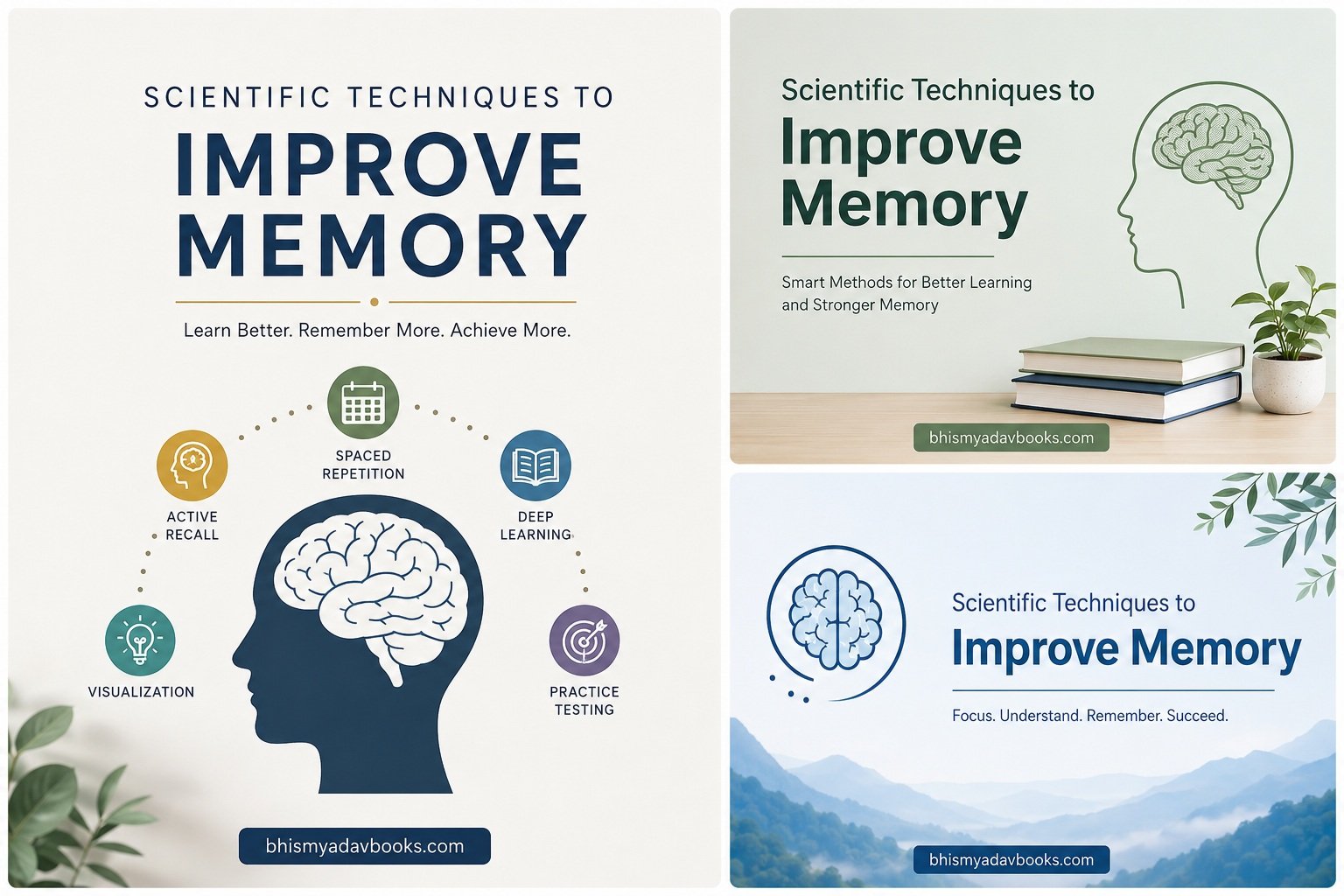
Among the most useful approaches are active recall, spaced repetition, elaboration, chunking, dual coding, mnemonic techniques, interleaving, deliberate practice, and effective sleep and exercise habits.
We have some amazing books at our Shop page you may want to buy.
This article explains these techniques in a practical way so that students, competitive-exam aspirants, teachers, professionals, and general readers can apply them in everyday learning.
Table of Contents
Scientific Techniques to Improve Memory: Evidence-Based Ways to Learn Faster and Remember More
Why Is Memory Important for Learning?
Before discussing memory improvement techniques, it is useful to understand why memory matters so much.
Learning is not merely the process of putting information into the brain. Effective learning involves several stages:
- Attention
- Encoding
- Storage
- Retrieval
- Application
If attention is poor, information may not be encoded effectively. If the information is not connected to existing knowledge, it may be difficult to understand. If it is not reviewed appropriately, it may gradually become harder to retrieve.
This is why simply studying for many hours does not necessarily produce better memory.
Imagine a student reads a chapter about the Indian Constitution three times. The chapter may feel familiar after repeated reading. However, when the student closes the book and attempts to answer questions, they may discover that they cannot recall important details.
Another student reads the chapter once carefully and then closes the book. They try to explain the fundamental rights from memory, answer questions without looking at the textbook, and review the difficult information several days later.
The second approach can create stronger retrieval practice.
The important lesson is:
Good memory is not only about how much information you expose yourself to; it is also about how effectively you retrieve and use that information.
1. Understand How Memory Works
Memory is a complex cognitive process rather than a single mental ability.
A simplified model of learning involves three important processes:
Encoding
Encoding is the process through which information is initially processed and represented in memory.
For example, when you read the definition of photosynthesis and understand what it means, you are encoding that information.
Storage
Storage refers to maintaining information over time.
Some information may remain available for a few seconds, while other information can remain accessible for years.
Retrieval
Retrieval is the process of bringing stored information back into conscious awareness.
For example, answering a question in an examination requires retrieval.
These three processes are closely connected.
If you are distracted while studying, encoding may be weak. If you do not revisit important information, long-term retention may decline. If you never practice retrieving the information, recalling it under pressure may become more difficult.
Therefore, an effective memory strategy should not focus only on reading.
It should improve attention, understanding, encoding, retention, and retrieval.
2. Active Recall: One of the Most Powerful Study Techniques
One of the most useful scientific techniques to improve memory is active recall.
Active recall means deliberately trying to retrieve information from memory instead of simply looking at the answer again.
This distinction is extremely important.
Passive Study
You read:
The capital of Australia is Canberra.
Then you read the sentence again.
Active Recall
You close the book and ask:
What is the capital of Australia?
You try to produce the answer yourself.
That effort to retrieve information is active recall.
Why Active Recall Works
When you attempt to retrieve information, your brain has to search for the relevant knowledge.
This makes learning more effortful than simply rereading.
That effort can be beneficial because you are practicing the exact skill required later—retrieving information when the answer is not immediately visible.
Active recall can be incorporated into almost any subject.
For example, after studying a biology chapter, close your textbook and ask:
- What is the function of mitochondria?
- What is cellular respiration?
- What are the major stages?
- How are aerobic and anaerobic respiration different?
- Can I explain the process without looking at my notes?
Try answering each question before checking your textbook.
How Students Can Use Active Recall
A simple active-recall routine is:
Step 1: Study a small section
Do not immediately attempt to memorize an entire textbook chapter.
Study a manageable section and make sure you understand it.
Step 2: Close your material
Put away your textbook, notes, or lecture.
Step 3: Ask yourself questions
Try to reproduce the important information.
Step 4: Check your answer
Compare your response with the original material.
Step 5: Correct mistakes
Pay particular attention to information you could not remember.
This creates a continuous learning loop:
Study → Recall → Check → Correct → Recall Again
3. Spaced Repetition: Review Information at the Right Time
Another powerful scientific technique for memory improvement is spaced repetition.
Spaced repetition means reviewing information at increasing intervals rather than trying to learn everything during one long study session.
For example, instead of reviewing a topic ten times in one day, you might review it:
- Later the same day
- The next day
- Several days later
- A week later
- A few weeks later
- Again after a longer interval
The exact schedule can vary depending on the learner and material.
The basic idea is to spread learning over time.
Why Spaced Repetition Is Better Than Cramming
Cramming can sometimes help you remember information temporarily, particularly when an examination is very close.
However, information learned through intensive short-term study can become difficult to recall later.
Spaced learning gives your brain multiple opportunities to retrieve information after some time has passed.
This is particularly useful for subjects that require memorization, such as:
- Vocabulary
- Historical dates
- Scientific terms
- Formulas
- Definitions
- Geography
- Current affairs
- Important facts
- Medical terminology
- Legal concepts
- Competitive-exam material
A Simple Spaced-Repetition Schedule
You do not need complicated software to start.
For example, suppose you learn a new topic on Monday.
You could create a review plan like:
Monday: Learn the topic
Tuesday: First review
Friday: Second review
Next Wednesday: Third review
Two weeks later: Fourth review
One month later: Final review
The schedule can be adjusted according to your performance.
If you forget something, review it sooner.
If you remember it easily, the interval can gradually become longer.
4. Combine Spaced Repetition With Active Recall
Active recall and spaced repetition become particularly useful when combined.
Consider learning ten new vocabulary words.
Instead of reading the words repeatedly, create questions.
For example:
Question: What does “abundant” mean?
Try to answer without looking.
Then review the question again later.
Your learning process becomes:
Learn → Recall → Wait → Recall → Wait → Recall
This is more effective than repeatedly looking at the word and definition together.
A useful rule is:
Do not make reviewing an exercise in recognition only. Make it an exercise in retrieval.
5. Use the Testing Effect
The testing effect refers to the learning benefit that can result from practicing retrieval through tests or quizzes.
Many students think of tests only as evaluation tools.
But tests can also function as learning tools.
Suppose you have studied a chapter containing 50 important facts.
You could reread those facts several times.
Alternatively, you could test yourself with questions.
The second method gives you opportunities to retrieve information and identify gaps in your knowledge.
Practice Questions Are Memory Training
For competitive-exam preparation, practice questions can be especially valuable.
After studying a topic, solve questions without looking at your notes.
For example:
Topic: Indian Geography
Ask yourself:
- Which rivers flow through particular regions?
- What are the major types of soil?
- Which states have specific geographical features?
- What are the important mountain ranges?
- Can I identify the correct answer without seeing the options?
After answering, check your mistakes.
Do not become discouraged by incorrect answers.
Mistakes reveal what needs more attention.
6. Make Questions From Your Notes
Your notes can become a powerful memory tool if you transform them into questions.
Suppose your note says:
The human heart has four chambers: two atria and two ventricles.
Instead of simply rereading this statement, convert it into:
Question: How many chambers does the human heart have, and what are they called?
Now your notes can be used for active recall.
You can do the same with almost every subject.
History
Instead of:
The Revolt of 1857 began at Meerut.
Create:
Where did the Revolt of 1857 begin?
Science
Instead of:
Water boils at 100°C at standard atmospheric pressure.
Create:
At what temperature does water boil under standard atmospheric pressure?
Mathematics
Instead of memorizing a formula passively:
What is the formula for the area of a circle?
Try writing it from memory.
English
Instead of reading vocabulary lists:
What is the meaning of “meticulous”?
This turns ordinary study material into a retrieval system.
7. The Feynman Technique: Explain What You Learn
Another useful learning strategy is commonly associated with physicist Richard Feynman and is often called the Feynman Technique.
The basic idea is simple:
If you cannot explain something clearly, your understanding may not yet be strong enough.
After studying a concept, try explaining it using simple language.
Imagine that you have to teach the topic to a student who has never encountered it before.
Avoid unnecessary technical vocabulary.
Ask:
- What does this concept mean?
- Why does it happen?
- How does it work?
- What is an example?
- How is it different from related concepts?
- Where can it be applied?
Example of the Feynman Technique
Suppose you are studying inflation in economics.
A textbook definition might be difficult to remember word-for-word.
Instead, explain it in simple language:
Inflation means a sustained increase in the general price level of goods and services, which reduces the purchasing power of money.
Then ask yourself:
Why does inflation matter?
You might explain:
If prices rise while income does not rise at the same rate, people can buy fewer goods and services with the same amount of money.
Now the concept is connected to meaning rather than being treated as a sentence to memorize.
8. Elaboration: Connect New Information With What You Already Know
Memory becomes easier when new information is connected to existing knowledge.
This technique is known as elaborative learning or elaboration.
Instead of asking only:
What is this?
Ask:
- Why is this true?
- How does it work?
- What causes it?
- What is an example?
- What does it remind me of?
- How is it connected to something I already know?
- What would happen if the situation changed?
These questions create additional mental connections.
Example
Suppose you learn that plants require sunlight for photosynthesis.
Instead of memorizing this as an isolated fact, connect it with:
- Chlorophyll
- Carbon dioxide
- Water
- Glucose
- Oxygen
- Energy from sunlight
Now the concept becomes part of a larger network of information.
The more meaningful connections you create, the easier it can become to understand and retrieve the information.
9. Use the Chunking Technique
Chunking means grouping smaller pieces of information into meaningful units.
Our working memory has limited capacity. Trying to process many unrelated pieces of information simultaneously can become difficult.
Chunking reduces this burden by organizing information into meaningful groups.
Example of Chunking
Consider the number:
194719521999
It is difficult to process as one long sequence.
You could organize it into:
1947 – 1952 – 1999
Now it becomes three meaningful chunks.
The same principle can be used when studying.
Instead of memorizing 20 unrelated facts, organize them into categories.
For example, while studying a history chapter, create groups such as:
Causes
- Political causes
- Economic causes
- Social causes
Events
- Event A
- Event B
- Event C
Consequences
- Political effects
- Economic effects
- Social effects
The information becomes easier to navigate mentally.
10. Organize Information Before Memorizing It
One common mistake is trying to memorize information before understanding its structure.
Organization can make learning considerably easier.
Suppose you have to study a large chapter.
Start by identifying:
Main topic → Subtopics → Key concepts → Examples → Facts → Questions
For example:
Indian Polity
→ Constitution
→ Fundamental Rights
→ Directive Principles
→ Fundamental Duties
→ Parliament
→ Judiciary
→ Executive
Instead of viewing the material as thousands of separate facts, you now have a conceptual structure.
This structure acts like a mental map.
11. Visualization and Mental Imagery
Visualization is another technique that can help make information more memorable.
When appropriate, convert abstract information into mental images.
For example, if you need to remember a sequence of objects, imagine them interacting in an unusual scene.
Unusual, exaggerated, humorous, or emotionally engaging images may be easier to remember than completely ordinary ones.
Example
Suppose you need to remember:
Book → Clock → Tree → Bicycle
Instead of repeating the four words, imagine:
A giant book opens and a clock jumps out. The clock is hanging from a tree while a bicycle is riding around the tree.
You have transformed four separate items into a connected visual story.
This can provide additional cues for retrieval.
12. Dual Coding: Combine Words and Visuals
Dual coding involves representing information using both verbal and visual forms when appropriate.
For example, while studying the human digestive system, you might use:
- Written explanations
- A labeled diagram
For geography:
- Text
- Maps
For mathematics:
- Written steps
- Graphs or diagrams
For processes:
- Descriptions
- Flowcharts
The goal is not to decorate your notes with unnecessary images.
The visual representation should actually help you understand or organize the information.
Avoid Decorative Note-Making
A common study mistake is spending too much time making beautiful notes without improving understanding.
Using ten different colors, elaborate borders, stickers, and decorations does not automatically improve memory.
A better approach is to use visuals strategically.
For example:
Cause → Process → Result
can be represented as a simple flowchart.
The visual structure can make relationships easier to understand.
13. Mnemonics: Create Memory Aids
Mnemonics are techniques that help people remember information by associating it with easier-to-recall cues.
Common mnemonic methods include:
- Acronyms
- Acrostics
- Rhymes
- Stories
- Associations
- Visual imagery
- Memory palaces
For example, students sometimes create memorable phrases to remember a sequence or list.
The key principle is that the mnemonic should be meaningful and easy for you to retrieve.
A complicated mnemonic that takes longer to remember than the original information is not particularly useful.
14. Make Information Meaningful
Meaning is one of the most important ingredients in effective learning.
Compare these two approaches.
Approach A
Memorize:
Photosynthesis is the process by which…
Approach B
Understand:
Plants use light energy to help convert water and carbon dioxide into chemical energy stored in glucose, releasing oxygen as a by-product.
The second approach gives you a conceptual framework.
When you understand how parts of a concept relate to one another, you have more retrieval cues available.
This is why understanding should generally come before memorization.
15. Pay Attention Before Trying to Improve Memory
Sometimes the real problem is not memory.
It is attention.
If you are scrolling through social media while studying, checking messages every few minutes, watching videos in the background, or repeatedly switching between tasks, the information may never be encoded effectively.
You cannot reliably remember information that you did not properly attend to in the first place.
Therefore:
Better attention → Better encoding → Better memory
Before searching for complicated memory hacks, improve your study environment.
Put your phone away.
Close unnecessary browser tabs.
Choose a specific study objective.
Study one task at a time.
Take short breaks when needed.
16. Study in Focused Sessions
Instead of studying continuously for several hours while your attention gradually declines, divide your work into focused sessions.
For example:
45 minutes study → 10 minutes break
or
25 minutes study → 5 minutes break
The exact duration does not have to be identical for everyone.
The important principle is to create periods of deliberate, distraction-reduced attention.
During the study period:
- Keep your phone away.
- Work on one subject.
- Set a clear objective.
- Avoid unnecessary multitasking.
- Use active recall.
- Take brief breaks before returning to study.
17. Do Not Confuse Familiarity With Memory
One of the biggest problems in studying is the illusion of familiarity.
When you read the same page repeatedly, the words may start to feel familiar.
You may think:
“I know this.”
But familiarity is not necessarily the same as the ability to retrieve the information independently.
A simple test can reveal the difference.
Close the book.
Take a blank sheet of paper.
Write everything you remember about the topic.
Then compare your answer with the textbook.
You may discover that you remembered less than you expected.
This is precisely why active recall is so valuable.
18. The Blank-Page Method
The blank-page method is a simple way to combine active recall, organization, and self-testing.
After studying a topic:
- Close your book.
- Take a blank sheet.
- Write the topic at the top.
- Write everything you can remember.
- Create diagrams if appropriate.
- Reconstruct important formulas or facts.
- Compare your answer with your notes.
- Identify missing information.
- Review only the weak areas.
- Repeat later.
This method is particularly useful for examination preparation.
It forces your brain to produce information rather than merely recognize it.
Scientific Techniques to Improve Memory
Advanced Memory Strategies for Stronger Recall and Long-Term Learning
19. Use the Memory Palace Technique
The memory palace technique, also called the method of loci, is one of the most famous mnemonic strategies.
The basic idea is to associate information with familiar locations.
Instead of trying to remember a list as unrelated information, you mentally place each item at a particular location in a familiar environment.
Your environment might be:
- Your home
- Your classroom
- Your office
- A familiar street
- Your route to school or work
- A building you know well
How the Memory Palace Works
Imagine that you want to remember five concepts.
You mentally walk through your house.
For example:
- Put the first concept at the front door.
- Put the second concept near the sofa.
- Put the third concept on the dining table.
- Put the fourth concept in the kitchen.
- Put the fifth concept in your bedroom.
When you later need to remember the information, mentally walk through the same locations.
Each location becomes a retrieval cue.
Make the Mental Images Unusual
The images should not necessarily be ordinary.
Suppose you want to remember the word “gravity.”
Imagine a giant apple floating above your front door and suddenly falling onto the floor.
For another concept, create another distinctive image in another location.
The more distinctive the image, the easier it may be to use as a cue.
Memory Palace for Exam Preparation
Memory palaces can be useful when remembering ordered information.
For example, if you need to remember stages in a process, categories, lists, or sequences, assign each item to a location.
However, a memory palace should not replace understanding.
For complex subjects, first understand the concept.
Then use mnemonic methods for details that are difficult to retain.
20. Use Association to Strengthen Memory
Association means connecting new information to something you already know.
Suppose you meet someone named Ravi.
Instead of simply repeating the name, you could connect it with another Ravi you already know, a familiar person, a place, or a memorable image.
The new information now has an additional mental connection.
Association in Academic Learning
Suppose you are learning a historical event.
Instead of memorizing:
Event → Date
create a network:
Event → Cause → Important person → Location → Date → Consequence
Each connection can provide another retrieval pathway.
This is especially useful for subjects such as:
- History
- Geography
- Biology
- Economics
- Political science
- General knowledge
21. Turn Facts Into Stories
The human mind often finds connected information easier to remember than completely unrelated pieces of information.
A story creates relationships between events.
Suppose you have to remember:
A → B → C → D
Rather than repeating the four items, create a short story connecting them.
For example:
A student opens a book, finds a map, follows the map to a laboratory, and discovers a historical document.
Now the sequence has a narrative structure.
Storytelling for Difficult Lists
Imagine you have ten unrelated vocabulary words.
Instead of memorizing them independently, create a strange story that contains all ten words.
The story does not need to be realistic.
In fact, an unusual story can be more memorable.
The goal is to transform disconnected information into a connected sequence.
22. Use the First-Letter Technique
Acronyms can simplify lists.
Suppose you need to remember a list of concepts beginning with:
C, A, R, E
You could create a memorable phrase using those letters.
However, acronyms work best when:
- The number of items is manageable.
- The order matters.
- The acronym itself is easy to remember.
Do not force an acronym onto information that is better understood conceptually.
23. Use Retrieval Cues
A retrieval cue is something that helps trigger access to stored information.
Examples include:
- A keyword
- A location
- An image
- A question
- A sound
- A related concept
- A personal association
- A diagram
Good study materials can therefore be designed to contain useful retrieval cues.
Example
Suppose you study the concept of opportunity cost.
Instead of writing only:
Opportunity cost is the value of the next best alternative forgone.
You could add:
Cue: “What do I give up when I choose something?”
Now, when you see the cue, it can help activate the concept.
24. Ask “Why?” and “How?”
One of the simplest ways to deepen memory is to ask questions.
Instead of:
What is this?
also ask:
Why is this true?
and:
How does it work?
These questions encourage deeper processing.
For example:
Question
Why does regular exercise matter for learning?
Follow-up
How might physical activity influence cognitive performance?
The goal is to transform learning from passive information consumption into active thinking.
25. Use the “Explain It Without Looking” Rule
After studying a concept, close your notes and explain it aloud.
Imagine you are teaching it to someone else.
You should be able to answer:
- What is it?
- Why is it important?
- How does it work?
- What is an example?
- What are its limitations?
- How is it different from similar concepts?
If you get stuck, open your notes, review the missing part, close them again, and explain it once more.
This creates a powerful cycle:
Learn → Explain → Identify gaps → Review → Explain again
26. Practice Interleaving
Another useful learning strategy is interleaving.
Interleaving means mixing related topics or problem types instead of practicing one type continuously for a very long period.
For example, instead of solving:
20 percentage problems → 20 ratio problems → 20 profit-and-loss problems
you could practice:
Percentage → Ratio → Profit & Loss → Percentage → Ratio → Profit & Loss
This forces you to identify which method is appropriate for each problem.
Interleaving for Competitive Exams
Competitive examinations often require you to identify the correct approach quickly.
Questions do not always tell you:
“Use this particular formula.”
You must determine what kind of problem you are facing.
Interleaving can therefore help develop discrimination between problem types.
For example, a mathematics practice session might include:
- Percentages
- Ratios
- Averages
- Simple interest
- Time and work
- Profit and loss
Instead of solving all questions from one chapter consecutively, mix them after you have learned the basic methods.
27. Understand the Difference Between Blocked Practice and Interleaved Practice
Blocked Practice
You practice the same skill repeatedly.
Example:
Addition → Addition → Addition → Addition
This can make you feel comfortable quickly.
Interleaved Practice
You switch between related skills.
Example:
Addition → Multiplication → Division → Addition → Subtraction
Interleaving can feel harder.
But difficulty during practice does not necessarily mean that learning is poor.
Sometimes desirable difficulty can encourage more active thinking and retrieval.
28. Use Deliberate Practice
Deliberate practice means practicing with a specific objective rather than simply spending time on an activity.
Suppose a student says:
“I studied mathematics for three hours.”
That does not tell us much about what was actually practiced.
A more useful description would be:
“I practiced identifying which arithmetic method to use in 30 mixed questions and analyzed every mistake.”
The second approach has a clear objective.
A Deliberate-Practice Cycle
Use this sequence:
Identify weakness → Practice specifically → Get feedback → Correct mistakes → Repeat
For example:
If you repeatedly forget formulas, do not simply reread the formula sheet.
Instead:
- Cover the formulas.
- Try writing them from memory.
- Solve problems using them.
- Check your answers.
- Identify formulas you forgot.
- Practice those formulas again later.
29. Learn From Mistakes
Mistakes are valuable information.
When you get a question wrong, do not immediately move to the next question.
Ask:
What happened?
Did you:
- Forget the fact?
- Misunderstand the concept?
- Misread the question?
- Use the wrong formula?
- Make a calculation error?
- Fail to retrieve information under pressure?
Different problems require different solutions.
Create a Mistake Log
A simple mistake log can contain:
| Question | Mistake | Correct Idea | Reason |
| Q1 | Wrong formula | Correct formula | Formula confusion |
| Q2 | Incorrect fact | Correct fact | Weak recall |
| Q3 | Misread question | Key word identified | Attention problem |
Review your mistake log periodically.
This turns errors into learning opportunities.
30. Sleep and Memory Consolidation
Memory improvement is not only about what happens while you are studying.
Sleep also plays an important role in learning and memory.
During sleep, the brain continues processing information acquired during waking hours. Sleep is associated with processes involved in memory consolidation.
This is one reason why staying awake all night before an examination is generally a poor long-term learning strategy.
A student might think:
“If I study for five additional hours instead of sleeping, I will remember more.”
But if exhaustion reduces attention and cognitive performance the next day, the extra study time may not provide the expected benefit.
Avoid Regular All-Nighters
If you have an examination approaching, try to plan your revision early enough that you do not need to sacrifice sleep repeatedly.
A better strategy is:
Study → Review → Sleep → Retrieve later
rather than:
Study all night → sleep very little → hope to remember everything
31. Build a Consistent Sleep Routine
Good sleep habits can support learning.
Try to:
- Maintain a relatively consistent sleep schedule.
- Give yourself enough time for sleep.
- Reduce unnecessary late-night screen use.
- Avoid relying on repeated all-nighters.
- Create a comfortable sleeping environment.
- Plan difficult study sessions when you are mentally alert.
The exact sleep requirement varies with age and individual circumstances, but regularly getting adequate sleep is an important part of an effective learning routine.
32. Exercise and Brain Health
Physical activity is another important part of a healthy learning lifestyle.
Regular exercise benefits overall physical health and is also associated with cognitive and mental well-being.
You do not necessarily need an elaborate fitness program.
Activities such as:
- Walking
- Cycling
- Jogging
- Swimming
- Sports
- Strength training
- Yoga or mobility exercises
can be incorporated into a balanced routine.
Use Movement During Study Breaks
If you have been sitting for a long time, a short movement break can help you reset.
For example:
50 minutes study → 5–10 minutes movement
During the break you might:
- Walk around
- Stretch
- Get some water
- Step outside
- Perform light movement
Then return to your study session.
The purpose is not to turn every study break into a workout.
It is simply to avoid remaining mentally and physically inactive for excessively long periods.
33. Manage Stress During Learning
Stress can affect attention, concentration, and the ability to retrieve information effectively.
Students preparing for competitive examinations may experience pressure because of:
- Large syllabi
- Competition
- Time limitations
- Fear of failure
- High expectations
- Previous poor performance
Instead of allowing these concerns to dominate your study session, focus on controllable actions.
For example:
Today I will revise two topics.
Today I will complete 50 practice questions.
Today I will review yesterday’s mistakes.
Breaking a large goal into smaller tasks can make it easier to start.
34. Use Deep Breathing Before a Difficult Study Session
A brief period of slow, comfortable breathing can be used as a simple transition into focused study.
For example:
- Sit comfortably.
- Relax your shoulders.
- Breathe slowly.
- Pay attention to the breath.
- Allow distracting thoughts to pass.
- Begin your study task.
This is not a magical memory technique.
Its practical value is that it can help create a deliberate transition from distraction to focused work.
35. Avoid Multitasking While Studying
Many learners believe they can study effectively while simultaneously:
- Watching television
- Checking social media
- Responding to messages
- Listening to unrelated videos
- Browsing websites
- Switching between several subjects
Frequent task switching can interfere with sustained attention.
Instead, establish a clear study period.
For example:
7:00–7:45 PM: Biology — Cell Structure
During those 45 minutes, focus primarily on that task.
Then take a short break before switching activities.
36. Use Your Phone Strategically
A smartphone can either support or interfere with memory.
It can provide:
- Flashcards
- Educational videos
- Practice tests
- Dictionaries
- Study timers
- Digital notes
But it can also provide endless distractions.
Therefore, use technology intentionally.
During focused study:
- Enable Do Not Disturb.
- Turn off unnecessary notifications.
- Keep distracting apps closed.
- Use only the applications required for study.
- Consider keeping the phone physically away from your desk.
The objective is not to eliminate technology.
It is to prevent technology from controlling your attention.
37. Use Flashcards Properly
Flashcards can be extremely useful when designed around active recall.
Weak Flashcard
Front: Photosynthesis
Back: A long paragraph copied from a textbook.
This encourages passive reading.
Better Flashcard
Front: What is photosynthesis?
Back: The process by which green plants use light energy to produce chemical energy from carbon dioxide and water, releasing oxygen.
An even better approach may be to create several focused cards:
- What is photosynthesis?
- Where does photosynthesis occur?
- What raw materials are required?
- What is the role of chlorophyll?
- What products are formed?
Small, focused questions are often easier to review effectively.
38. Do Not Put Too Much Information on One Flashcard
A flashcard should ideally test a specific piece of knowledge or relationship.
If the card contains half a textbook chapter, retrieval becomes unclear.
Instead of:
“Explain everything about the Indian Parliament.”
create focused questions such as:
- What are the two houses of Parliament?
- What is the normal term of the Lok Sabha?
- What is the role of the Speaker?
- How does a bill become law?
This creates a more manageable retrieval practice system.
39. Use Spaced Flashcard Reviews
Once you create useful flashcards, review them over multiple sessions.
Cards you find difficult can be reviewed more frequently.
Cards you consistently remember can appear less frequently.
The important principle is:
Review before information becomes completely inaccessible, and keep retrieving it over increasing intervals.
This is more useful than reviewing every card equally often forever.
40. Practice Retrieval in Different Environments
Memory can become more flexible when you practice retrieving information under different conditions.
For example:
- At your study desk
- In the library
- During a practice test
- While walking
- By writing
- By explaining aloud
However, do not deliberately create stressful or distracting environments just to make studying harder.
The goal is to become capable of retrieving knowledge in realistic situations.
For examination preparation, timed mock tests are especially valuable because they approximate the retrieval conditions of the real examination.
41. Use Different Retrieval Formats
Do not always retrieve information in the same way.
You can:
Speak
Explain the concept aloud.
Write
Write everything you remember.
Draw
Create a diagram from memory.
Answer Questions
Solve practice questions.
Teach
Explain the topic to another person.
Summarize
Write a short summary without looking at your notes.
Using different formats can reveal different weaknesses.
For example, you might be able to recognize the correct answer in multiple-choice questions but struggle to explain the concept independently.
That difference is useful information.
42. Use the “Blurting” Technique
The blurting method is a simple variation of active recall.
The process is:
- Study a topic.
- Close your textbook.
- Take a blank sheet.
- Write everything you remember.
- Compare it with your notes.
- Highlight missing or incorrect information.
- Review those areas.
- Repeat the exercise later.
This technique is particularly useful for:
- Theory subjects
- History
- Geography
- Biology
- General knowledge
- Definitions
- Long-form concepts
It quickly shows what you actually know.
43. Review Mistakes Instead of Only Reviewing Correct Answers
Suppose you take a 50-question practice test and score 40/50.
Many students simply look at their score and move on.
A better strategy is to analyze the ten incorrect answers.
For each mistake, ask:
Did I know the information but make an error?
Did I misunderstand the concept?
Did I forget it?
Did I guess?
Did I misread the question?
Your score tells you what happened.
Your mistake analysis tells you why it happened.
That information is much more useful for improving future performance.
44. Use Difficulty as Feedback
If a topic feels difficult, do not automatically assume that you are bad at it.
Difficulty can indicate:
- Weak prior knowledge
- Poor organization
- Insufficient retrieval practice
- Confusing terminology
- Lack of examples
- Inadequate review
Instead of saying:
“I cannot remember this.”
ask:
“What part of this information is causing the problem?”
Then modify your learning method.
Maybe you need:
- A diagram
- A simpler explanation
- More examples
- More retrieval questions
- A mnemonic
- Additional spaced reviews
45. Combine Multiple Techniques
The strongest learning system usually does not depend on a single technique.
For example, suppose you are preparing a chapter for an examination.
You could use:
Step 1 — Understand
Read the topic carefully.
Step 2 — Organize
Create a simple concept map.
Step 3 — Elaborate
Ask why and how.
Step 4 — Recall
Close the book and explain it.
Step 5 — Test
Answer practice questions.
Step 6 — Review
Use spaced repetition.
Step 7 — Correct
Study your mistakes.
Step 8 — Retrieve Again
Return to the topic after several days.
This creates a complete learning cycle.
46. A Practical Memory Improvement Session
Here is an example of how you could structure a one-hour study session.
First 5 minutes: Preview
Look at the topic and identify the main concepts.
Next 20 minutes: Learn
Study carefully and focus on understanding.
Next 10 minutes: Active Recall
Close your book and write what you remember.
Next 10 minutes: Practice Questions
Answer questions without looking at the solutions.
Next 5 minutes: Analyze Mistakes
Identify weak areas.
Final 10 minutes: Review
Correct gaps and create questions for later spaced repetition.
This is much more active than spending the entire hour rereading the same material.
47. Build a Personal Memory System
Different people remember information in different ways.
Therefore, you should experiment with techniques and observe what works best for you.
For example, you may discover:
History: Stories + timelines
Geography: Maps + retrieval questions
Science: Diagrams + explanation
Vocabulary: Flashcards + spaced repetition
Mathematics: Practice problems + error analysis
Current affairs: Questions + periodic revision
There is no requirement to use the exact same technique for every subject.
48. Don’t Try to Memorize Everything
One of the biggest mistakes students make is attempting to memorize every sentence.
Effective learning involves deciding what deserves detailed memorization.
Prioritize:
- Core concepts
- Important definitions
- Formulas
- Key facts
- Frequently tested information
- Relationships between concepts
- Difficult-to-recall details
Some information only needs to be understood.
Other information must be memorized.
Knowing the difference saves time.
49. Understanding vs. Memorization
Consider a mathematics formula.
You should ideally understand:
- What the formula represents
- Why it works
- When to use it
- What each variable means
Then memorize the formula if necessary.
Similarly, in science, understand the mechanism before attempting to memorize terminology.
A useful learning sequence is:
Understand → Organize → Connect → Retrieve → Practice → Review
50. The Most Important Principle: Retrieval Beats Rereading
If you remember only one idea from this article, remember this:
Do not spend all your study time looking at information. Spend part of your study time trying to produce it from memory.
Reading is necessary.
But after reading, close the material.
Ask yourself questions.
Explain the concept.
Write what you remember.
Solve problems.
Take practice tests.
Then check your performance.
That is where much of the real learning work happens.
Scientific Techniques to Improve Memory
Practical Daily Memory Improvement System for Students and Lifelong Learners
51. Start With a Clear Learning Objective
Before beginning a study session, define exactly what you want to accomplish.
Avoid vague goals such as:
“I will study history today.”
Instead, create a specific objective:
“I will understand the causes of the Revolt of 1857, create ten recall questions, and complete 20 practice questions.”
A clear objective gives your brain a specific target.
Examples of Better Study Goals
Instead of:
Study Biology
Try:
Learn the functions of the major cell organelles and recall them without looking.
Instead of:
Study English
Try:
Learn 20 new vocabulary words and recall their meanings tomorrow.
Instead of:
Study Mathematics
Try:
Understand the percentage formula and solve 25 mixed questions.
Specific goals make it easier to measure progress.
52. Use the Learn–Recall–Review Cycle
A simple memory system can be built around three stages:
1. Learn
Understand the new information.
2. Recall
Close your study material and reproduce the information.
3. Review
Return to the material later using spaced repetition.
This creates a continuous cycle:
Learn → Recall → Correct → Review → Recall Again
This cycle should become the foundation of your study routine.
53. Create a Daily Memory Routine
A practical daily routine does not need to be complicated.
For example:
Morning
Spend 15–20 minutes reviewing older material using active recall.
Main Study Session
Learn a new topic for 30–60 minutes.
Immediate Recall
Close your book and write or explain what you remember.
Afternoon or Evening
Solve practice questions.
Night
Spend a few minutes reviewing difficult points.
This creates multiple retrieval opportunities throughout the day.
54. The 10-Minute Memory Review
Even when you are busy, a short review can be useful.
Take approximately ten minutes and ask:
- What did I learn yesterday?
- What are the five most important points?
- Which facts did I forget?
- Which concepts remain confusing?
- Can I explain the topic without looking?
You don’t need to reread the entire chapter.
Focus on retrieval.
55. Use the 24-Hour Review Principle
After learning something new, review it relatively soon rather than waiting until the information has become completely unfamiliar.
For example:
Day 1: Learn
Day 2: Recall
Day 4: Recall
Day 7: Recall
Day 14: Recall
Day 30: Recall
This is only an example schedule.
The exact intervals can be adjusted according to difficulty and performance.
If you consistently forget a topic, shorten the interval.
If you consistently remember it, gradually increase the interval.
56. Create a Weekly Memory Review
Daily study is important, but weekly review provides another opportunity to strengthen long-term retention.
At the end of each week, review:
Topics learned
What new material did you study?
Retrieval performance
What could you remember without looking?
Mistakes
Which questions did you get wrong?
Weak areas
Which concepts still require additional practice?
Upcoming topics
What should you study next?
This transforms revision from random rereading into a planned process.
57. Use a Memory Dashboard
You can maintain a simple table to monitor your learning.
| Topic | Learned | First Recall | Second Recall | Confidence | Needs Review |
| Biology | ✓ | ✓ | ✓ | High | No |
| History | ✓ | ✓ | ✗ | Medium | Yes |
| Geography | ✓ | ✗ | — | Low | Yes |
| Economics | ✓ | ✓ | ✓ | High | No |
The purpose is not to create complicated paperwork.
It is simply to identify what deserves your attention.
58. Use Confidence Ratings Carefully
After attempting to recall information, rate your confidence.
For example:
5 — I can explain it completely.
4 — I remember most of it.
3 — I remember the basic idea.
2 — I remember very little.
1 — I cannot recall it.
Then compare your confidence with your actual performance.
This can help you discover whether you tend to overestimate your knowledge.
59. Practice Retrieval Before Looking at the Answer
When using flashcards or practice questions, resist the temptation to reveal the answer immediately.
Give yourself time to think.
Ask:
“What is the answer?”
Try to retrieve it.
Only then check the solution.
This small change can make your review more active.
60. Use “Free Recall” for Large Topics
Free recall means attempting to reproduce everything you can remember about a topic without being given specific questions.
For example:
Write:
The Indian Constitution
Then, without opening your notes, write everything you remember.
You might recall:
- Fundamental Rights
- Directive Principles
- Fundamental Duties
- Parliament
- Judiciary
- President
- Prime Minister
- Constitutional amendments
Afterward, compare your response with your study material.
This reveals the structure of your memory.
61. Use Cued Recall for Specific Details
Cued recall provides a small hint.
For example:
Question: What are the three branches of government?
The cue “three branches” helps trigger retrieval.
Cued recall is useful for:
- Vocabulary
- Definitions
- Dates
- Names
- Formulas
- Classifications
- Lists
A good study system can use both free recall and cued recall.
62. Use Recognition Tests Carefully
Multiple-choice questions primarily involve recognition.
Recognition is useful, but it can sometimes feel easier than actual recall because possible answers are visible.
Therefore, don’t rely exclusively on multiple-choice practice.
Combine:
Free recall + short-answer questions + multiple-choice questions
For example:
Level 1
“What are the major causes of inflation?”
Level 2
“Explain demand-pull inflation.”
Level 3
“Which of the following is an example of demand-pull inflation?”
Different question types test different aspects of knowledge.
63. Build a Question Bank
Instead of simply storing notes, build a personal question bank.
For each chapter, create questions under categories such as:
Basic Knowledge
What is…?
Explanation
Why does…?
Comparison
How is A different from B?
Application
What would happen if…?
Analysis
Why is this important?
Recall
List the major points.
This transforms your notes into a retrieval system.
64. Use the Question-First Approach
You do not always need to begin by reading the entire chapter.
First look at:
- Learning objectives
- Chapter headings
- Important questions
- Practice questions
- Previous examination questions
Then study the chapter with those questions in mind.
This can give your attention a specific purpose.
65. Connect Study Material to Real-Life Examples
Real-world examples can provide meaningful retrieval cues.
Suppose you are studying economics.
Instead of learning inflation as an abstract definition, think about how rising prices affect:
- Food
- Transportation
- Housing
- Education
- Household budgets
Similarly, when studying physics, connect concepts with familiar situations.
When studying biology, connect processes with everyday observations where appropriate.
Meaningful connections can make information easier to understand and remember.
66. Use Comparison to Strengthen Understanding
Comparing similar concepts can clarify differences.
For example:
| Concept | Key Feature |
| Mitosis | Produces genetically similar cells |
| Meiosis | Produces cells with reduced chromosome number |
Or:
| Term | Meaning |
| Speed | Distance covered per unit time |
| Velocity | Displacement per unit time with direction |
When two concepts are easily confused, comparison can create stronger distinctions.
67. Create “Contrast Cards”
For confusing concepts, make cards that specifically ask about differences.
For example:
Question: What is the difference between weather and climate?
Then provide a concise answer.
Other examples:
- Mass vs. weight
- GDP vs. GNP
- Mitosis vs. meiosis
- Speed vs. velocity
- Debit vs. credit
- Hardware vs. software
- Primary vs. secondary data
Contrast questions can be especially useful for examination preparation.
68. Use Timelines for Chronological Information
Timelines are excellent for information that depends on sequence.
History students can organize:
Event A → Event B → Event C → Event D
Instead of memorizing isolated dates, connect each date to an event and its surrounding context.
For example:
Year → Event → Person → Cause → Consequence
This creates a richer memory structure.
69. Use Maps for Geographic Information
Geographical information can often be easier to understand when represented spatially.
Instead of memorizing a long list of places, use:
- Maps
- Regions
- Boundaries
- Rivers
- Mountains
- Cities
- Climate zones
Then practice recalling the information without looking at the map.
Try drawing a simplified map from memory.
It does not need to be artistically perfect.
The purpose is retrieval and spatial organization.
70. Draw Diagrams From Memory
Diagrams can be especially useful for scientific processes.
For example, after studying the human heart, close your book and draw:
- Chambers
- Major blood vessels
- Direction of blood flow
Then compare your drawing with the original.
The missing parts reveal what needs additional review.
This is an excellent example of active recall.
71. Reconstruct Processes Step by Step
For processes, try recalling the sequence.
For example:
Input → Stage 1 → Stage 2 → Stage 3 → Output
Ask yourself:
- What happens first?
- What happens next?
- Why does the next stage occur?
- What is the final result?
This approach can be applied to:
- Scientific processes
- Mathematical procedures
- Historical events
- Business processes
- Computer algorithms
- Grammar rules
72. Memorize Formulas Through Application
Simply staring at formulas is usually not the best way to learn them.
Instead:
- Understand the formula.
- Write it from memory.
- Explain what each symbol represents.
- Solve a simple problem.
- Solve a more difficult problem.
- Recall the formula later without looking.
For example, after learning the area of a circle:
A = πr²
ask:
- What does A represent?
- What does r represent?
- Why is the radius squared?
- Can I write the formula without looking?
- Can I use it in a problem?
This creates multiple retrieval pathways.
73. Practice Vocabulary in Context
Learning vocabulary through isolated lists can be useful, but context can make words more meaningful.
Instead of only memorizing:
“Reluctant = unwilling or hesitant”
also create a sentence:
“He was reluctant to speak in front of the audience.”
Then retrieve:
- Meaning
- Example
- Synonym
- Antonym
This gives the word several associations.
74. Use the “Three Contexts” Method
For difficult information, try encountering it in three different contexts.
For example, a new word might be:
- Read in a textbook.
- Used in your own sentence.
- Recalled during a flashcard session.
For a scientific concept:
- Read the explanation.
- See a diagram.
- Solve a related problem.
Different contexts can provide additional retrieval cues.
75. Teach Someone Else
Teaching is one of the most practical ways to discover whether you understand something.
You can teach:
- A friend
- A classmate
- A family member
- A study partner
Or simply pretend that you are teaching a class.
Explain the topic without looking at your notes.
When you become unable to explain something, you have identified a knowledge gap.
Return to that section and study it again.
76. Record Yourself Explaining Difficult Topics
If you prefer learning through audio, record a short explanation of a difficult concept in your own words.
Later, you can listen to it and attempt to reconstruct the information.
However, do not turn this into passive listening only.
After listening, pause and ask:
“What can I remember?”
Then explain it without the recording.
77. Use Handwriting Strategically
Writing can be useful when it requires active thinking.
For example:
- Writing a summary from memory
- Reconstructing a diagram
- Solving problems
- Writing formulas
- Creating questions
- Making a mistake log
The important factor is not simply handwriting versus typing.
The more important question is:
Am I actively processing and retrieving the information?
78. Don’t Rewrite the Textbook
Some students spend hours copying textbook material into notebooks.
This may create extensive notes without necessarily creating strong memory.
Instead of copying:
Write questions, summaries, diagrams, relationships, examples, and difficult points.
Your notes should help you think and retrieve, not merely reproduce the textbook.
79. Keep Notes Short Enough to Review
If your notes are enormous, you may avoid reviewing them.
A useful note-making strategy is:
Detailed textbook → condensed notes → questions → flashcards
This gradually converts a large amount of information into a manageable revision system.
80. Use the 80/20 Idea Carefully
You may have heard the phrase:
“Learn 20% of the material that gives 80% of the results.”
The exact ratio should not be treated as a scientific law for every examination or subject.
However, the underlying principle is useful:
Prioritize high-value information.
Identify:
- Frequently tested topics
- Core concepts
- Foundational principles
- Important formulas
- Common question patterns
- Your personal weak areas
Then allocate your study time intelligently.
81. Avoid the “More Hours = More Learning” Trap
Studying for ten hours does not automatically mean learning twice as much as studying for five hours.
Quality matters.
A focused two-hour session involving:
- Understanding
- Active recall
- Practice
- Feedback
- Spaced review
may be more productive than several hours of distracted rereading.
Instead of asking:
“How many hours did I study?”
also ask:
“What can I retrieve now that I couldn’t retrieve before?”
That is a much better measure of learning progress.
82. Use Practice Tests as Learning Tools
Practice tests should not be reserved for the final stage of preparation.
Use them throughout your study process.
A practice test can show:
- What you know
- What you forgot
- What you misunderstood
- Which topics require more work
- How accurately you retrieve information under pressure
After the test, spend time analyzing mistakes.
The analysis is often more valuable than simply seeing the score.
83. Simulate Examination Conditions
As an examination approaches, practice retrieving information under realistic conditions.
For example:
- Set a timer.
- Keep your phone away.
- Use the appropriate question format.
- Avoid looking at notes.
- Complete the test continuously where practical.
- Check answers afterward.
This helps you identify whether your knowledge can actually be accessed when you need it.
84. Create an Exam-Week Memory Strategy
During the final week before an examination, avoid trying to relearn everything from scratch.
Instead, prioritize:
High-value topics
Frequently tested and important concepts.
Weak topics
Information you repeatedly forget.
Mistake logs
Questions you previously answered incorrectly.
Practice tests
To test retrieval.
Spaced reviews
To maintain previously learned information.
Avoid spending most of the final week passively rereading familiar chapters.
85. The Day Before an Examination
The day before an examination should generally be focused on consolidation rather than panic.
Useful activities may include:
- Reviewing key concepts
- Testing important formulas
- Looking through your mistake log
- Doing a limited amount of practice
- Preparing examination materials
- Getting adequate sleep
Avoid attempting to memorize huge amounts of new material at the last minute whenever possible.
86. What to Do When You Forget Something
Forgetting is a normal part of learning.
If you cannot remember something, do not immediately conclude:
“My memory is weak.”
Instead ask:
Was the information understood?
Was it retrieved previously?
Was it reviewed after learning?
Was it connected to anything else?
Was I distracted when learning it?
Then use the appropriate solution.
Poor understanding
Study the concept again.
Weak retrieval
Use active recall.
Rapid forgetting
Use spaced repetition.
Confusion
Use comparison.
Difficult list
Use chunking or mnemonics.
Abstract concept
Use visualization or examples.
87. The Forgetting Curve and Why Review Matters
Information tends to become harder to retrieve when it is not revisited.
The exact rate of forgetting varies by person, material, prior knowledge, and learning conditions.
The practical lesson is simple:
Do not wait until you have completely forgotten something before reviewing it.
Repeated retrieval over time can help maintain accessibility.
This is why a planned revision system is superior to relying on memory alone to decide what to review.
88. Use Weakness-Based Revision
Not every topic deserves equal revision time.
Suppose you have five topics:
| Topic | Recall Performance |
| Topic A | 90% |
| Topic B | 85% |
| Topic C | 60% |
| Topic D | 95% |
| Topic E | 50% |
If your time is limited, Topics E and C probably deserve more attention than Topic D.
This is more efficient than reviewing everything equally.
89. Build a “Memory Priority List”
Divide information into three groups.
Priority 1 — Weak
You frequently forget it.
Priority 2 — Medium
You remember the basic idea but make occasional mistakes.
Priority 3 — Strong
You can retrieve and apply it reliably.
Spend the most time on Priority 1.
Continue periodic reviews of Priority 2.
Use longer intervals for Priority 3.
90. Create a Complete Weekly Learning System
Here is a practical example.
Monday
Learn new Topic A.
Use:
Understanding + elaboration + active recall
Tuesday
Review Topic A.
Learn Topic B.
Use:
Spaced repetition + active recall
Wednesday
Review Topics A and B.
Solve practice questions.
Thursday
Learn Topic C.
Create questions.
Friday
Review A, B, and C.
Focus on weak areas.
Saturday
Take a mixed practice test.
Analyze mistakes.
Sunday
Conduct a weekly review.
Organize next week’s study plan.
This creates continuous retrieval instead of last-minute revision.
91. A 30-Day Memory Improvement Challenge
If you want to improve your learning habits, try a simple 30-day challenge.
Week 1: Attention
Focus on:
- Reducing distractions
- Studying in focused sessions
- Setting clear goals
- Improving your study environment
Week 2: Retrieval
Practice:
- Active recall
- Blank-page recall
- Practice questions
- Teaching concepts aloud
Week 3: Spacing
Create:
- Review intervals
- Flashcards
- Weekly revision
- Mistake tracking
Week 4: Integration
Combine:
- Active recall
- Spaced repetition
- Interleaving
- Visualization
- Practice tests
- Error analysis
The objective is not perfection.
It is consistency.
92. A Simple Daily Memory Workout
You can dedicate a short period each day to deliberate memory practice.
Exercise 1 — Recall
Write five things you learned yesterday.
Exercise 2 — Explain
Explain one difficult concept in simple language.
Exercise 3 — Visualization
Create a mental image for one difficult fact.
Exercise 4 — Retrieval
Answer five questions without looking at the answers.
Exercise 5 — Review
Revisit one older topic.
This can be completed relatively quickly and integrated into a normal study routine.
93. Memory Training Should Be Relevant
There are many activities marketed as “brain training.”
Some may be entertaining, but becoming excellent at a particular memory game does not automatically mean you will remember textbooks, names, formulas, or historical facts better.
For students, the most useful memory training is often directly related to the information they actually need to learn.
Therefore:
Instead of spending all your time memorizing random sequences, practice recalling:
- Your actual syllabus
- Your vocabulary
- Your formulas
- Your concepts
- Your practice questions
- Your examination material
Train the skill you actually need.
94. Make Memory Improvement a Lifestyle, Not a Shortcut
There is no single trick that transforms memory overnight.
Long-term improvement comes from several factors working together:
Attention
Understanding
Active Recall
Spaced Repetition
Practice
Sleep
Physical Activity
Consistent Habits
This combination is much more realistic than relying on a single “memory booster.”
95. A Complete Study Formula for Better Memory
You can summarize the entire system using this framework:
Step 1: Focus
Remove distractions.
Step 2: Understand
Learn the meaning.
Step 3: Organize
Group related information.
Step 4: Connect
Link new knowledge with existing knowledge.
Step 5: Retrieve
Close your notes and recall.
Step 6: Test
Use questions and practice problems.
Step 7: Correct
Analyze mistakes.
Step 8: Space
Review over increasing intervals.
Step 9: Apply
Use the knowledge in different situations.
Step 10: Sleep
Give your brain adequate opportunity for recovery and memory consolidation.
This is a practical framework for building stronger long-term learning habits.
96. Common Memory Mistakes Students Should Avoid
Even when students know effective techniques, certain habits can undermine their efforts.
Mistake 1: Rereading Everything
Repeated reading can create familiarity without sufficient retrieval.
Mistake 2: Highlighting Too Much
If almost every sentence is highlighted, nothing is prioritized.
Mistake 3: Studying Without Testing
You may not discover what you actually remember.
Mistake 4: Cramming
Large amounts of information are learned immediately before an examination and then forgotten.
Mistake 5: Ignoring Mistakes
Wrong answers are treated as failures rather than feedback.
Mistake 6: Studying While Distracted
Attention is repeatedly interrupted.
Mistake 7: Sacrificing Sleep
Excessive late-night study can undermine alertness and learning.
Mistake 8: Using Too Many Techniques
Constantly changing methods prevents the development of a consistent system.
Choose a few effective strategies and use them regularly.
97. Your Memory System Should Be Simple Enough to Maintain
A complicated study system may look impressive but become difficult to maintain.
You do not need:
- Ten notebooks
- Dozens of apps
- Hundreds of complicated rules
- Elaborate note templates
A simple system can be enough:
One notebook + questions + active recall + spaced review + practice tests
The best memory system is one you can consistently use.
98. The Role of Consistency
Memory improvement is similar to physical fitness in one important respect: regular practice generally matters more than occasional extreme effort.
Studying intensely for one day and doing nothing for six days is not an ideal learning pattern.
A better approach is:
30–60 minutes of focused, active practice regularly
rather than depending entirely on occasional marathon study sessions.
Consistency gives you repeated opportunities to encode, retrieve, correct, and strengthen information.
99. Track Progress by Retrieval, Not Reading Time
A useful learning journal might record:
Topic: Indian Polity
Questions attempted: 30
Correct: 24
Weak areas: Parliament, Constitutional Amendments
Next review: Friday
This tells you much more than:
“Studied for 2 hours.”
Time is an input.
Retrieval performance is evidence of learning.
100. The Ultimate Memory Improvement Routine
If you want a simple routine to begin immediately, use this:
Before studying
Set one clear objective.
During studying
Understand the concept and connect it with existing knowledge.
After studying
Close the material and recall what you learned.
Later
Answer practice questions.
The next day
Retrieve the information again.
Several days later
Review it again.
Each week
Test yourself on older material.
Each month
Revisit important topics.
Every day
Protect your attention, sleep adequately, and maintain healthy physical activity.
This routine is simple, but it incorporates many of the most important principles discussed throughout this article.
Scientific Techniques to Improve Memory
Complete Memory Improvement Guide, Practical Timetable, Myths, FAQs and Action Plan
101. The Most Effective Scientific Techniques to Improve Memory
If you want to simplify everything discussed in this article, start with these core techniques.
1. Active Recall
Close your book and retrieve information from memory.
2. Spaced Repetition
Review information across increasing intervals.
3. Practice Testing
Use questions and tests as learning tools.
4. Elaboration
Ask why, how, and how the information connects to what you already know.
5. Chunking
Organize large amounts of information into meaningful groups.
6. Mnemonics
Use associations, acronyms, stories, and imagery when appropriate.
7. Visualization
Convert suitable information into mental images or diagrams.
8. Interleaving
Mix related topics and problem types during practice.
9. Deliberate Practice
Focus specifically on weaknesses and correct mistakes.
10. Healthy Learning Habits
Protect attention, get adequate sleep, remain physically active, and manage unnecessary stress.
These techniques work best as a system, not as isolated tricks.
102. The 5-Step Memory Formula
For learners who want an extremely simple framework, use this five-step formula:
Step 1: Understand
Do not immediately memorize information that you do not understand.
Step 2: Retrieve
Close your notes and attempt to reproduce what you learned.
Step 3: Test
Use questions, problems, quizzes, or practice tests.
Step 4: Space
Return to the information after increasing intervals.
Step 5: Apply
Use the knowledge in a new question, example, explanation, or real-world situation.
Remember:
Understanding gives memory meaning; retrieval makes it accessible; repetition over time helps maintain it.
103. A Practical Daily Timetable for Memory Improvement
Here is an example of a study routine for a student.
The times can be adjusted according to your schedule.
Morning — 30 Minutes
10 minutes: Previous-day recall
Without opening your notes, recall yesterday’s main topics.
10 minutes: Flashcards
Review difficult information using active recall.
10 minutes: Quick practice
Answer a few questions from older topics.
The objective is to start the day with retrieval rather than passive reading.
104. Main Study Session — 60 to 90 Minutes
Choose one major topic.
First 10 minutes
Preview the chapter.
Identify:
- Main concepts
- Subtopics
- Important terms
- Questions you need to answer
Next 35–45 minutes
Study actively.
Focus on understanding.
Ask:
- Why?
- How?
- What causes this?
- What is an example?
- How is this related to previous knowledge?
Next 10–15 minutes
Close your material and recall everything you can.
Final 10–15 minutes
Answer practice questions and identify mistakes.
105. Evening Review
Spend approximately 20–30 minutes reviewing older material.
Do not automatically reread everything.
Instead, use:
- Flashcards
- Practice questions
- Blank-page recall
- Short-answer questions
- Formula recall
- Vocabulary recall
The goal is to retrieve information.
106. Weekly Revision Timetable
A weekly system might look like this:
| Day | Main Activity |
| Monday | New topic + active recall |
| Tuesday | New topic + Monday review |
| Wednesday | New topic + mixed recall |
| Thursday | New topic + earlier-topic review |
| Friday | Practice questions + weak areas |
| Saturday | Mock test + mistake analysis |
| Sunday | Weekly review + planning |
This schedule can be adapted to school, college, work, or competitive-exam preparation.
107. Memory Improvement Strategy for Competitive Exams
Competitive examinations often require candidates to remember a large amount of information while also applying it quickly.
A good strategy should therefore include four components:
Knowledge
Understand the syllabus.
Recall
Retrieve information without looking at notes.
Application
Solve questions.
Speed
Practice under realistic time conditions.
For example:
Learn → Recall → Practice → Test → Analyze → Review
Repeat this cycle throughout your preparation.
108. Memory Techniques for General Knowledge
General knowledge often contains large numbers of facts.
Trying to memorize everything independently can become overwhelming.
Instead, organize information into categories.
For example:
Geography
Countries → Capitals → Currencies → Locations
History
Year → Event → Person → Cause → Consequence
Science
Concept → Definition → Mechanism → Example
Government
Institution → Function → Authority → Relationship
Organization creates structure.
Structure creates useful retrieval cues.
109. Memory Techniques for History
History contains many dates, people, places, movements, and causes.
Do not memorize dates as isolated numbers.
Connect them with events.
Use:
Date → Event → Person → Cause → Result
Create timelines for major periods.
Then close your notes and reconstruct the timeline.
For difficult sequences, a memory palace or story can provide additional cues.
110. Memory Techniques for Science
Science generally benefits from understanding before memorization.
For each scientific concept, ask:
- What is it?
- Why does it happen?
- How does it happen?
- What are the stages?
- What is the result?
- Can I draw it?
- Can I explain it without looking?
Use diagrams for processes and comparison tables for confusing concepts.
111. Memory Techniques for Mathematics
Mathematics is different from subjects that rely primarily on factual recall.
Memorizing formulas alone is not enough.
A strong mathematical memory system includes:
- Understanding formulas
- Recalling formulas
- Solving problems
- Identifying problem types
- Interleaving different question types
- Reviewing mistakes
- Practicing under time limits
When you make a mistake, identify exactly why.
Was it:
- Formula recall?
- Conceptual understanding?
- Calculation?
- Question interpretation?
- Time pressure?
Then practice the specific weakness.
112. Memory Techniques for Vocabulary
For vocabulary learning, combine:
Word → Meaning → Example → Association → Retrieval → Spaced Review
For example:
Word: “Reluctant”
Meaning: Unwilling or hesitant.
Example:
“He was reluctant to accept the offer.”
Retrieval question:
“What does reluctant mean?”
Later, ask yourself:
“Can I use reluctant in my own sentence?”
This goes beyond simple recognition.
113. Memory Techniques for Formulas
Formula learning should involve both understanding and retrieval.
For each formula:
Understand
What does it represent?
Identify variables
What does each symbol mean?
Recall
Write the formula without looking.
Apply
Solve a problem.
Revisit
Recall the formula later.
You can maintain a formula notebook, but don’t simply read it repeatedly.
Cover the formula and attempt to reproduce it.
114. Memory Techniques for Definitions
Definitions are often tested directly.
First understand the concept.
Then reduce the definition to essential components.
For example, identify:
Category + Key characteristic + Distinguishing feature
Then attempt to reconstruct the complete definition from memory.
You can also create flashcards containing:
Term → Definition
and:
Definition → Term
The second direction can be surprisingly useful because it requires you to identify the concept from its characteristics.
115. Memory Techniques for Long Answers
Students sometimes struggle to remember long descriptive answers.
Instead of memorizing an entire paragraph word-for-word, remember the structure.
For example:
Introduction
Definition or background
Point 1
Explanation
Point 2
Explanation
Point 3
Explanation
Example
Illustration
Conclusion
Summary
Once the structure is remembered, the answer can often be reconstructed using your own words.
This is generally more flexible than memorizing every sentence.
116. Remember Concepts, Not Just Sentences
Suppose a textbook gives you a complicated paragraph.
Ask:
“What is the central idea?”
Then identify:
- Main concept
- Supporting points
- Examples
- Evidence
- Consequences
This transforms a paragraph into a conceptual framework.
Once the framework is understood, individual details can be attached to it.
117. Use Mind Maps Carefully
Mind maps can be useful for organizing relationships.
Start with the central topic.
Then branch into:
Main concept
→ Definition
→ Causes
→ Features
→ Examples
→ Effects
→ Related concepts
After creating the map, close your notes and attempt to recreate it from memory.
This turns a visual organizational tool into an active-recall exercise.
118. Don’t Make Memory Improvement Too Complicated
There are hundreds of learning techniques available online.
You do not need to use all of them.
A practical combination for most students might be:
Active recall + spaced repetition + practice questions + mistake analysis
Add:
Visualization or mnemonics
when a particular topic benefits from them.
This is enough to create a strong study system.
119. Common Myths About Memory Improvement
Many popular claims about memory are exaggerated or misleading.
Understanding these myths can prevent wasted time.
Myth 1: You Have a Fixed Memory Capacity
Memory is complex, and people differ in learning abilities and circumstances.
But your learning performance is not simply a fixed number.
Study methods, prior knowledge, attention, sleep, practice, and other factors matter.
Myth 2: Repeating Something Many Times Guarantees Memory
Repetition can help, but the type of repetition matters.
Repeatedly looking at the same information is different from repeatedly retrieving it.
Active retrieval is generally more useful than endless rereading.
Myth 3: You Can Memorize Everything Overnight
Cramming can sometimes improve short-term performance, but it is not an ideal strategy for durable learning.
Long-term retention benefits from learning and reviewing information over time.
Myth 4: Multitasking Makes You More Productive
Trying to divide attention between several demanding tasks can reduce the quality of learning.
Focused study is generally a better strategy.
Myth 5: Beautiful Notes Automatically Create Better Memory
Good organization can help.
But decorative notes do not automatically create strong memory.
The important question is whether your notes help you understand and retrieve information.
Myth 6: Everyone Should Use Exactly the Same Learning Method
Different subjects and learners have different requirements.
A vocabulary learner may benefit heavily from flashcards.
A mathematics student may need extensive problem solving.
A geography student may benefit from maps.
The method should match the learning task.
120. What If You Have a “Bad Memory”?
Almost everyone forgets information.
Forgetting does not automatically mean that your memory is poor.
Before concluding that you have a memory problem, examine your habits.
Ask:
- Was I paying attention?
- Did I understand the information?
- Did I actively retrieve it?
- Did I review it later?
- Did I get adequate sleep?
- Was I distracted?
- Did I practice using it?
Often, the solution is to improve the learning process rather than simply “try harder.”
121. How Long Does It Take to Improve Memory?
There is no universal number of days or weeks after which everyone will develop dramatically better memory.
Learning is gradual.
You may notice improvements in:
- Recall speed
- Confidence
- Ability to explain concepts
- Test performance
- Vocabulary retention
- Ability to reconstruct information
The most important factor is consistency.
Do not judge the entire method after two or three study sessions.
Give yourself enough time to establish the habit and compare actual performance.
122. Can Students Improve Memory Naturally?
Healthy lifestyle habits can support overall cognitive function and learning.
Important foundations include:
- Adequate sleep
- Regular physical activity
- Balanced nutrition
- Hydration
- Focused study
- Stress management
- Consistent learning habits
There is no need to search for a magical shortcut when basic habits are being neglected.
123. Food and Memory: Keep Expectations Realistic
A balanced diet is important for general health, including brain health.
However, no ordinary food should be treated as a magical memory enhancer.
Instead of searching for a single “best memory food,” focus on an overall nutritious eating pattern.
Regular meals, adequate hydration, and a balanced diet can support your general well-being.
If you have specific dietary or medical concerns, seek advice from an appropriately qualified professional.
124. Hydration and Concentration
Adequate hydration is part of maintaining normal physical and cognitive functioning.
If you are studying for several hours, keep water available and pay attention to your body’s signals.
There is no need to constantly consume excessive amounts of water.
The goal is simply to avoid neglecting basic hydration while studying.
125. Avoid Depending on “Memory-Boosting” Products
The internet contains many products claiming to dramatically improve memory.
Be skeptical of claims such as:
- “Instant memory improvement”
- “Double your intelligence”
- “Memorize anything in minutes”
- “Guaranteed photographic memory”
Learning is more complicated than marketing slogans suggest.
Before spending money on a supplement, course, or product, evaluate the evidence and the specific claims being made.
126. Build a Distraction-Free Memory Environment
Your study environment can influence how effectively you learn.
Try to create a place where:
- Your study materials are ready.
- Your phone is controlled.
- Notifications are minimized.
- Lighting is comfortable.
- The workspace is reasonably organized.
- You know what you are going to study.
You don’t need a perfect room.
You need an environment that makes focused work easier.
127. Use Environmental Cues
You can create a consistent study cue.
For example:
Same desk + same notebook + same study time + same starting routine
Over time, these cues can become associated with studying.
Your routine might be:
- Sit down.
- Put phone away.
- Open study plan.
- Set a timer.
- Begin with a recall question.
- Start learning.
A consistent starting ritual can reduce the friction involved in beginning a study session.
128. Start Small When You Are Struggling
If you have difficulty maintaining a study routine, do not immediately create a six-hour timetable.
Start with:
20 minutes of focused study
Then gradually increase your workload.
The goal is to establish consistency.
A manageable routine that you follow regularly is better than an ambitious plan that collapses after three days.
129. Use the “One Topic, One Test” Rule
Whenever you complete a significant topic, test yourself.
For example:
Topic: Human Digestive System
Then complete:
- 10 recall questions
- One blank-page explanation
- One diagram from memory
This provides immediate feedback.
Over time, your study process becomes:
Learn → Test → Improve
rather than simply:
Learn → Move on
130. Create a Personal Memory Checklist
Before finishing a study session, ask:
Understanding
- Do I understand the main idea?
Recall
- Can I reproduce the information without looking?
Application
- Can I solve a related problem?
Connection
- Can I connect it with something I already know?
Weakness
- What did I forget?
Review
- When will I review it again?
If you can answer these questions, your study session has a clear learning structure.
131. The Ultimate Memory Improvement Checklist
Use this checklist regularly:
Before Study
☐ Set a specific goal
☐ Remove major distractions
☐ Prepare study materials
☐ Identify the topic
During Study
☐ Understand the concept
☐ Ask why and how
☐ Connect new information with old knowledge
☐ Organize information
☐ Use diagrams or examples when useful
After Study
☐ Close the book
☐ Use active recall
☐ Answer questions
☐ Identify mistakes
☐ Correct weak areas
Later
☐ Review using spaced repetition
☐ Practice again
☐ Mix related topics
☐ Revisit difficult material
Lifestyle
☐ Get adequate sleep
☐ Stay physically active
☐ Maintain healthy eating habits
☐ Take reasonable breaks
☐ Manage unnecessary distractions
132. A 7-Day Memory Improvement Plan
If you want to begin immediately, try this seven-day plan.
Day 1 — Improve Attention
Create a distraction-free study environment.
Study one topic for a focused session.
At the end, write what you remember.
Day 2 — Active Recall
Study a new topic.
Close your book.
Write ten questions about it and answer them without looking.
Day 3 — Spaced Repetition
Review the material from Days 1 and 2.
Do not simply reread it.
Use recall questions.
Day 4 — Visualization
Choose a difficult topic.
Create a diagram, mental image, timeline, or visual association.
Then reconstruct it from memory.
Day 5 — Interleaving
Mix questions from several related topics.
Pay attention to which method each question requires.
Day 6 — Practice Test
Take a short test without looking at your notes.
Analyze every mistake.
Day 7 — Weekly Review
Review everything from the previous six days.
Identify:
- Strong topics
- Weak topics
- Frequently forgotten facts
- Common mistakes
Then create your next week’s review schedule.
133. A Long-Term Memory Improvement Plan
After completing your first week, continue the process.
Every day
Use active recall.
Every few days
Review older material.
Every week
Take a mixed practice test.
Every month
Review important topics.
Every few months
Reassess your study strategy.
Ask:
“Which techniques are actually improving my performance?”
Use your results to adjust your system.
134. The Most Important Lesson About Memory
Memory improvement is not about forcing information into your brain.
It is about creating strong learning and retrieval conditions.
Think of memory as a skill supported by a system:
Attention helps information enter the learning process.
Understanding gives information meaning.
Organization gives it structure.
Elaboration creates connections.
Active recall strengthens retrieval.
Spaced repetition gives you repeated opportunities to retrieve it over time.
Practice teaches you to apply it.
Sleep and healthy habits support the broader learning process.
When these pieces work together, learning becomes more efficient.
Recommended books for Job Aspirants
135. Frequently Asked Questions About Improving Memory
What is the best scientific technique to improve memory?
There is no single technique that is best for every situation. However, active recall and spaced repetition are among the most useful evidence-based learning strategies. Combining them with understanding, practice, and feedback creates a strong study system.
How can I remember what I study?
Understand the material first, then close your notes and actively recall it. Use practice questions and revisit the material at spaced intervals.
Is rereading good for memory?
Rereading can be useful for initial exposure and clarification, but relying on rereading alone is not ideal. Combine it with active recall and testing.
How often should I revise?
There is no universal schedule. Start with relatively frequent reviews and gradually increase the intervals as your recall becomes stronger.
Does sleep improve memory?
Adequate sleep is important for learning, cognitive functioning, and processes involved in memory consolidation. Regularly sacrificing sleep for studying is therefore generally counterproductive.
Can exercise help memory?
Regular physical activity supports overall health and is associated with cognitive benefits. It can be a useful part of a healthy learning lifestyle.
Are mnemonics useful?
Yes, mnemonics can be useful for lists, sequences, vocabulary, and difficult facts. They work best when combined with understanding rather than used as a substitute for it.
Is the memory palace useful for students?
It can be particularly useful for lists, sequences, and information that can be associated with locations or visual images. It is less suitable as the only method for understanding complex subjects.
How can I memorize formulas?
Understand what the formula means, practice recalling it without looking, and apply it repeatedly in different problems.
Why do I forget what I studied?
Possible reasons include weak attention, insufficient understanding, lack of retrieval practice, inadequate review, interference from other information, or simply the normal process of forgetting.
136. Final Action Plan: Start Today
You do not need to wait for the perfect timetable.
Start with one topic today.
Step 1
Choose a manageable topic.
Step 2
Study it carefully for 20–30 minutes.
Step 3
Close your book.
Step 4
Write everything you remember.
Step 5
Check your answers.
Step 6
Mark the information you forgot.
Step 7
Create five to ten questions.
Step 8
Review those questions tomorrow.
Step 9
Review them again several days later.
Step 10
Test yourself again after a longer interval.
Repeat this process consistently.
Conclusion: Build Better Memory Through Better Learning
Improving memory does not require a magical technique, extraordinary intelligence, or endless hours of study.
The most important improvement may come from changing how you study.
Instead of reading the same material again and again, actively retrieve it.
Instead of cramming everything before an examination, distribute your reviews over time.
Instead of memorizing isolated facts, connect them with concepts, examples, stories, images, and existing knowledge.
Instead of avoiding mistakes, analyze them.
Instead of sacrificing sleep for endless study, recognize that recovery is part of effective learning.
And instead of constantly searching for new study hacks, choose a small number of reliable techniques and use them consistently.
A powerful memory-improvement system can be summarized as:
Focus → Understand → Organize → Connect → Retrieve → Test → Correct → Review → Apply → Repeat
For students and competitive-exam aspirants, this approach can make revision more purposeful and help turn study time into measurable learning.
For professionals and lifelong learners, the same principles can be applied to new skills, languages, technical knowledge, presentations, and everyday information.
Your memory does not need to be perfect.
Your goal should be to build a better learning process—one that makes important information easier to understand, retrieve, and use.
Start with active recall today.
Add spaced repetition tomorrow.
Practice regularly.
Learn from your mistakes.
Protect your attention and sleep.
Over time, these small changes can become a powerful system for learning and remembering more effectively.