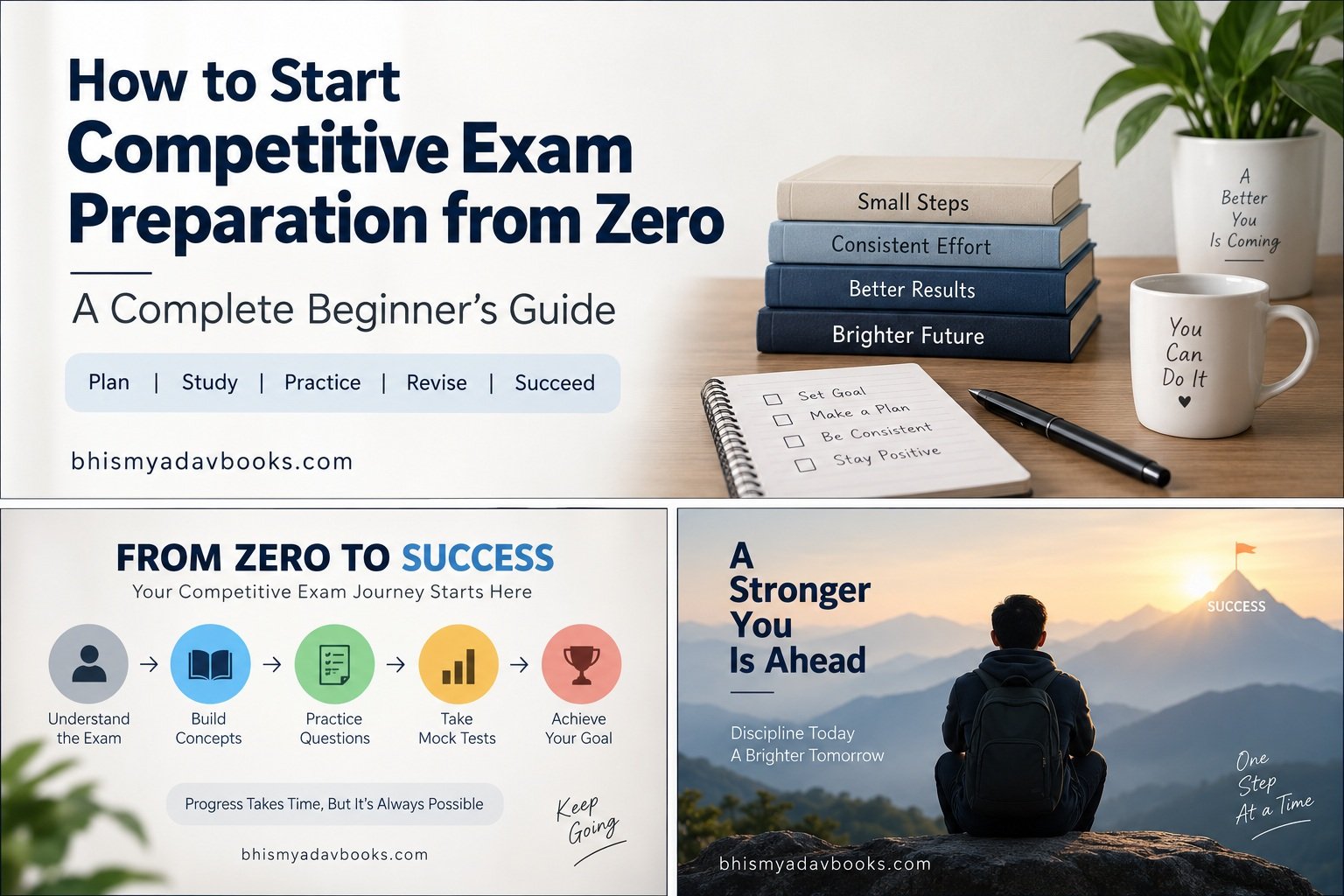
Building Your Foundation from Zero
Introduction
Starting competitive exam preparation from zero can feel overwhelming.
You may look at the huge syllabus, difficult subjects, thousands of questions, lengthy books, previous-year papers, mock tests, and successful candidates sharing their preparation stories online. You may even wonder:
“Where should I start?”
This question is extremely common among beginners.
The good news is that you do not need to know everything before you begin. You do not need an extraordinary memory, ten hours of free time every day, or a room full of expensive books.
What you need first is clarity, consistency, patience, and a realistic plan.
Competitive exams are not usually cleared by studying randomly for a few days. They require a systematic approach in which you understand the examination, learn the fundamentals, practice questions, revise repeatedly, and gradually improve your speed and accuracy.
If you are genuinely starting from zero, your first objective should not be to finish the entire syllabus immediately.
Your first objective should be to build a strong foundation.
We have some amazing books at our Shop page you may want to buy.
This guide explains how to do exactly that.
Table of Contents
How to Start Competitive Exam Preparation from Zero: A Complete Beginner’s Guide
What Does “Starting from Zero” Really Mean?
Before creating a study plan, it is important to understand what “zero preparation” actually means.
Starting from zero does not necessarily mean that you know absolutely nothing.
You may already have some knowledge from school, college, previous exams, or general reading. However, you may not understand the competitive-exam pattern, syllabus, question style, time management, or preparation strategy.
For example, you might know basic mathematics but struggle with questions involving percentages, ratios, averages, or time and work.
You may understand English but have difficulty solving grammar or comprehension questions within a limited amount of time.
You may know general facts but have no organized strategy for General Awareness or Current Affairs.
Therefore, starting from zero generally means:
- You have not yet developed an organized preparation system.
- You are unfamiliar with the examination pattern.
- Your fundamentals may need strengthening.
- You do not have a fixed study routine.
- You may not know which books or resources to use.
- You have little or no experience with mock tests.
- You need to develop examination-specific skills.
This is completely manageable.
The key is to start correctly rather than start intensely.
Step 1: Choose Your Target Examination
One of the biggest mistakes beginners make is preparing for every competitive examination simultaneously.
They may say:
“I will prepare for SSC, Banking, Railway, UPSC, State PSC, Defence, and other exams together.”
This sounds ambitious, but it often creates confusion.
Different examinations have different:
- Syllabi
- Difficulty levels
- Question patterns
- Selection processes
- Time limits
- Subject weightage
- Eligibility requirements
You should therefore begin by identifying your primary target examination.
It could be:
- SSC examinations
- Banking examinations
- Railway examinations
- UPSC Civil Services
- State Public Service Commission examinations
- Teaching examinations
- Defence examinations
- Police examinations
- Insurance examinations
- Other specialized competitive examinations
Choose one primary target.
You can keep related examinations as secondary targets later if their syllabus overlaps substantially.
Why One Target Is Better for Beginners
Suppose you study mathematics, reasoning, English, and general awareness for an examination where these subjects are important.
Your preparation may automatically help you with several other examinations having similar sections.
This is much better than trying to follow five completely different syllabi.
Focus creates efficiency.
Instead of asking:
“How can I prepare for every exam?”
ask:
“Which examination do I want to clear first?”
That question gives your preparation direction.
Step 2: Understand the Examination Before Studying
Do not immediately open a textbook and start reading.
First understand the examination.
This is one of the most important steps in competitive exam preparation.
Find out:
- What is the complete syllabus?
- How many stages are there?
- What subjects are included?
- How many questions are asked?
- How much time is available?
- Is there negative marking?
- What is the approximate difficulty level?
- What type of questions are frequently asked?
- What are the previous-year trends?
- What are the eligibility requirements?
This information becomes your preparation map.
The Syllabus Is Your Roadmap
Many students collect dozens of books and online courses without carefully reading the official syllabus.
This is backwards.
The syllabus should come before the study material.
Take the syllabus and divide it into major subjects.
For example:
Quantitative Aptitude
- Number System
- Simplification
- Percentage
- Ratio and Proportion
- Average
- Profit and Loss
- Simple and Compound Interest
- Time and Work
- Time, Speed and Distance
- Algebra
- Geometry
- Mensuration
- Data Interpretation
Reasoning
- Analogy
- Classification
- Series
- Coding-Decoding
- Blood Relations
- Direction Sense
- Ranking
- Syllogism
- Statement and Conclusion
- Puzzles
- Seating Arrangement
English
- Grammar
- Vocabulary
- Reading Comprehension
- Error Detection
- Sentence Improvement
- Cloze Test
- Para Jumbles
- Fill in the Blanks
General Awareness
- History
- Geography
- Polity
- Economy
- Science
- Current Affairs
- Static General Knowledge
The exact subjects will vary according to the examination.
The purpose of this exercise is to convert a frighteningly large syllabus into small, manageable topics.
Step 3: Do Not Be Afraid of the Syllabus
When beginners see a syllabus containing hundreds of topics, they often become anxious.
They think:
“How will I ever complete all this?”
The answer is simple:
You do not complete it all at once.
You complete it one topic at a time.
Imagine looking at a staircase with 100 steps.
You cannot jump from the ground to the top.
You climb:
Step 1 → Step 2 → Step 3 → Step 4 → …
Competitive exam preparation works exactly the same way.
Instead of thinking:
“I have to complete mathematics.”
think:
“Today I will understand percentages.”
Instead of:
“I have to complete reasoning.”
think:
“Today I will practice analogy questions.”
Instead of:
“I have to finish English.”
think:
“Today I will learn one grammar concept and practice 30 questions.”
This mental shift makes preparation much less stressful.
Step 4: Assess Your Current Level
Before preparing seriously, conduct a simple self-assessment.
Take one previous-year paper or a basic mock test appropriate for your target examination.
Do not worry about your score.
The purpose is not to judge yourself.
The purpose is to understand where you currently stand.
Record:
- Questions attempted
- Correct answers
- Incorrect answers
- Questions left unanswered
- Time taken
- Topics you understood
- Topics you found difficult
You may discover that you are good at reasoning but weak in mathematics.
Or perhaps your mathematics is acceptable but your English vocabulary is weak.
Maybe your knowledge is good but your speed is poor.
This information is valuable.
Create Three Categories
Divide your topics into:
Category A — Strong
You understand these topics reasonably well.
Category B — Average
You understand the basics but need practice.
Category C — Weak
You have little understanding and need to start from the fundamentals.
Your study plan should give special attention to Category C while continuing to practice Categories A and B.
Step 5: Start with the Fundamentals
If you are genuinely starting from zero, do not immediately solve the hardest questions.
Build your foundation first.
This is especially important for mathematics, reasoning, grammar, and other concept-based subjects.
Mathematics Example
If percentages are difficult, do not immediately attempt advanced percentage questions.
First understand:
- What percentage means
- Conversion between fractions and percentages
- Conversion between decimals and percentages
- Basic percentage increase
- Basic percentage decrease
- Percentage comparison
Then solve simple questions.
After that, move toward moderate and difficult questions.
The same principle applies to other subjects.
English Example
If grammar is weak, begin with:
- Parts of speech
- Subject and predicate
- Articles
- Pronouns
- Tenses
- Subject-verb agreement
- Prepositions
- Conjunctions
Once the basics become clear, move toward examination-level questions.
Reasoning Example
If you are new to reasoning, begin with relatively straightforward concepts such as:
- Analogy
- Classification
- Series
- Coding-decoding
- Direction sense
- Blood relations
Then gradually move toward more complex topics such as puzzles and seating arrangements where applicable.
Strong basics make advanced preparation easier.
Step 6: Select Limited Study Resources
Another major problem beginners face is collecting too many resources.
They download:
- Multiple PDFs
- Several video courses
- Different books
- Telegram notes
- Question banks
- Short tricks
- Current-affairs magazines
- YouTube playlists
Eventually they have hundreds of resources but very little actual preparation.
Remember:
More study material does not automatically mean better preparation.
You need the right study material used consistently.
For each major subject, try to establish a basic resource system:
One primary learning source + one practice source + previous-year questions.
For example:
Primary Learning Source
A reliable textbook, course, or structured lecture series.
Practice Source
A question bank or topic-wise practice set.
Previous-Year Questions
Actual questions from the examination whenever available.
This keeps your preparation organized.
Step 7: Understand the Difference Between Learning and Practicing
A common beginner mistake is spending all day reading.
Reading feels productive.
But competitive examinations test your ability to solve questions accurately within limited time.
Therefore, preparation should have two major components:
Learning
You understand the concept.
Practice
You apply the concept to questions.
Suppose you spend two hours learning percentages.
Your work is not finished.
You should then solve questions based on percentages.
If you cannot solve them, identify why.
Maybe the concept is unclear.
Maybe you made a calculation error.
Maybe you forgot a formula.
Maybe you misunderstood the question.
Each mistake teaches you something.
Step 8: Introduce Previous-Year Questions Early
Do not wait until you finish the entire syllabus before looking at previous-year questions.
Previous-year questions can teach you what the examination actually expects.
They help you understand:
- Frequently tested concepts
- Question difficulty
- Repeated patterns
- Important topics
- Typical traps
- Expected calculation level
- Time requirements
A textbook may contain thousands of theoretical questions.
But the examination may repeatedly emphasize certain patterns.
Previous-year papers reveal these patterns.
A Simple Method
After completing a topic:
Learn → Practice → Solve Previous-Year Questions → Analyze Mistakes → Revise
For example:
Percentage
- Learn the concept.
- Solve basic examples.
- Practice 30–50 questions.
- Attempt previous-year questions.
- Record mistakes.
- Revise after a few days.
This cycle is far more effective than simply reading the chapter and moving on.
Step 9: Create a Realistic Daily Study Routine
You do not need to study 12–14 hours from your first day.
In fact, starting with an unrealistic schedule often causes burnout.
If you currently study for one hour per day, suddenly planning ten hours every day may work for two or three days.
Then you become exhausted.
The better strategy is gradual improvement.
For example:
Week 1
2–3 focused study hours daily.
Week 2
3–4 hours.
Week 3
4–5 hours.
Week 4
5–6 focused hours, depending on your circumstances.
The exact number is less important than consistency.
Someone studying four focused hours every day can make better progress than someone who studies twelve distracted hours once every few days.
Step 10: Divide Your Day into Study Blocks
Instead of saying:
“I will study mathematics for five hours.”
divide your day into smaller blocks.
For example:
Morning — Mathematics
Concept learning and problem solving.
Afternoon — Reasoning
Topic practice and previous-year questions.
Evening — English
Grammar, vocabulary, reading, and practice.
Night — General Awareness / Revision
Current affairs, static topics, or revision.
The actual schedule should depend on your availability.
If you are a college student or working professional, your routine may look completely different.
The important principle is:
Assign a specific purpose to each study session.
Step 11: Use the First 30 Days to Build Momentum
Do not expect dramatic results during your first week.
The first month should primarily be about establishing your system.
Your goals should include:
- Understanding the examination
- Completing the syllabus analysis
- Selecting resources
- Establishing a timetable
- Strengthening fundamentals
- Beginning question practice
- Starting an error notebook
- Introducing revision
- Solving previous-year questions
The first 30 days are about creating momentum.
Once your routine becomes habitual, studying becomes easier.
Step 12: Maintain an Error Notebook
An error notebook is one of the most useful tools for competitive exam preparation.
Whenever you make an important mistake, record it.
For example:
Mathematics
- Formula forgotten
- Calculation mistake
- Wrong method
- Concept misunderstood
English
- Grammar rule forgotten
- Vocabulary mistake
- Sentence misunderstood
Reasoning
- Pattern misunderstood
- Condition overlooked
- Calculation error
General Awareness
- Fact forgotten
- Similar facts confused
Do not simply record the question.
Record why you got it wrong.
This turns mistakes into learning opportunities.
Over time, your error notebook becomes a personalized revision guide.
Step 13: Do Not Compare Your Beginning with Someone Else’s Middle
This is especially important for beginners.
You may see someone online claiming:
“I study 14 hours every day.”
Another person may say:
“I completed the syllabus in two months.”
Someone else may post a very high mock-test score.
Do not let these things discourage you.
You do not know:
- When they started
- What their academic background is
- How much they already knew
- How many attempts they have made
- How much of their story is complete
Your preparation is your own journey.
If today you can solve five questions correctly and next month you can solve fifteen, that is progress.
If your mock-test score increases from 40 to 55, that is progress.
If you reduce careless mistakes, that is progress.
Measure yourself against your previous performance.
Step 14: Focus on Consistency Before Intensity
The biggest advantage in competitive exam preparation is not studying extremely hard for a few days.
It is showing up repeatedly.
Think of preparation like building a wall.
One brick does not create a wall.
But thousands of bricks placed consistently can create something strong.
Every study session is a brick.
Every practice question is a brick.
Every revision session is a brick.
Every mock test is a brick.
Every mistake you correct is another brick.
Eventually, these small efforts become a strong preparation base.
The Beginner’s Golden Rule
If you remember only one principle from this article, remember this:
Do not try to become an expert on your first day. Try to become slightly better every day.
Starting from zero is not a weakness.
Everyone who eventually became good at something was once a beginner.
Your job is not to eliminate the entire syllabus today.
Your job is to take the first correct step.
Start with the examination.
Understand the syllabus.
Assess yourself.
Build your fundamentals.
Choose your resources.
Create a realistic routine.
Practice questions.
Analyze mistakes.
Revise.
Repeat.
That is how zero gradually becomes preparation—and preparation eventually becomes performance.
How to Start Competitive Exam Preparation from Zero: A Complete Beginner’s Guide
Creating Your Study Plan and Preparing Each Subject
Step 15: Create a Study Plan Based on Your Actual Situation
There is no universal timetable that works for every student.
A college student may have several free hours during the day.
A working professional may have only three or four hours.
Someone preparing full-time may be able to study for six to eight focused hours.
Therefore, do not blindly copy another aspirant’s timetable.
Instead, create a plan around your own circumstances.
Start by writing down:
- Your target examination
- Your examination date, if known
- Your available study hours
- Your strongest subjects
- Your weakest subjects
- Your daily responsibilities
- Your preferred study time
- Your current preparation level
Then build your schedule.
Example for a Full-Time Aspirant
A full-time student might organize the day like this:
Session 1: Mathematics — 2 hours
Session 2: Reasoning — 1.5 hours
Session 3: English — 1.5 hours
Session 4: General Awareness — 1 hour
Session 5: Revision and practice — 1 hour
This provides approximately seven focused study hours.
Example for a Working Student
Someone with limited time might use:
Morning: 1 hour — vocabulary/current affairs
Evening: 2 hours — mathematics/reasoning
Night: 1 hour — English/revision
The number of hours is less important than how effectively those hours are used.
Step 16: Use the 3-Level Study System
A simple way to organize competitive exam preparation is to divide your work into three levels.
Level 1: Learn
Understand the concept.
Level 2: Practice
Solve questions related to that concept.
Level 3: Test
Attempt questions under time pressure.
For example, suppose you are studying Profit and Loss.
Day 1 — Learn
Understand:
- Cost Price
- Selling Price
- Profit
- Loss
- Profit Percentage
- Loss Percentage
- Marked Price
- Discount
Day 2 — Practice
Solve basic and moderate questions.
Day 3 — Test
Attempt a timed set of Profit and Loss questions.
Then analyze your performance.
This three-level approach gradually takes you from knowledge to examination ability.
Step 17: Prioritize Subjects Instead of Treating Everything Equally
Not every topic deserves the same amount of time.
You should consider three factors:
1. Your weakness
If you are weak in a subject, you need more learning time.
2. Exam importance
Topics that frequently appear in the examination deserve attention.
3. Improvement potential
Some topics can improve significantly with regular practice.
Create a simple priority system:
| Priority | Meaning |
| High | Weak + important |
| Medium | Average + important |
| Low | Strong or less frequently tested |
Start with high-priority areas.
This prevents you from spending excessive time polishing subjects you already understand while ignoring your weaknesses.
Step 18: How to Prepare Mathematics from Zero
Mathematics is one of the subjects that causes significant anxiety among competitive-exam beginners.
Many students say:
“I was never good at mathematics.”
But competitive-exam mathematics is not necessarily about advanced mathematics.
For many examinations, success depends heavily on:
- Understanding concepts
- Knowing formulas
- Recognizing question patterns
- Performing calculations accurately
- Solving efficiently
- Managing time
If your mathematics is weak, do not begin with difficult questions.
Start with arithmetic fundamentals.
Suggested Foundation Sequence
A beginner can generally work through topics such as:
- Basic calculations
- Number System
- Simplification
- HCF and LCM
- Fractions and decimals
- Percentage
- Ratio and proportion
- Average
- Profit and loss
- Simple interest
- Compound interest
- Time and work
- Time, speed and distance
- Mixture and alligation
- Algebra
- Geometry
- Mensuration
- Data interpretation
The exact order should be adjusted according to your examination syllabus.
Do Not Chase Shortcuts Too Early
Beginners often search for:
“Fastest trick to solve percentage questions.”
Shortcuts can be useful later.
But if you do not understand the underlying concept, shortcuts become confusing.
First learn the standard method.
Once you understand the concept and have solved enough questions, learn efficient approaches.
Concept first. Speed second.
Step 19: Build Your Calculation Speed
Mathematics preparation is not only about understanding formulas.
Calculation speed matters too.
You can gradually improve your calculation ability by practicing:
- Multiplication
- Division
- Fractions
- Squares
- Cubes
- Percentage conversions
- Decimal calculations
- Approximation
Do not attempt to improve everything in one day.
Spend 10–15 minutes regularly on basic calculations.
Over several weeks, you may notice that questions that previously took several minutes become much easier.
Step 20: How to Prepare Reasoning from Zero
Reasoning can initially appear strange because many questions do not resemble traditional academic subjects.
The good news is that reasoning often improves significantly through pattern recognition and practice.
Start with relatively straightforward topics.
For example:
- Analogy
- Classification
- Number series
- Alphabet series
- Coding-decoding
- Direction sense
- Blood relations
- Ranking
- Order and sequence
Then gradually move toward more complex topics according to your examination.
The Right Way to Study Reasoning
Do not spend hours memorizing explanations.
Instead:
Understand the pattern → See examples → Solve easy questions → Solve moderate questions → Attempt timed sets.
If you make a mistake, identify the reason.
Was the pattern misunderstood?
Did you miss a condition?
Did you make a calculation error?
Did you rush?
This analysis is more valuable than simply checking the correct answer.
Step 21: How to Prepare English from the Basics
English preparation can be divided into several components:
Grammar
Learn fundamental rules.
Vocabulary
Develop word knowledge gradually.
Reading
Improve comprehension and familiarity with English.
Practice
Solve examination-style questions.
Do not try to memorize hundreds of words every day.
Instead, learn a manageable number of useful words and revise them repeatedly.
For example:
Daily vocabulary routine
- Learn 10 new words.
- Understand their meanings.
- Learn synonyms and antonyms where relevant.
- Create simple sentences.
- Review older words.
Ten words learned and retained are more valuable than fifty words forgotten within a week.
Step 22: Improve English Through Reading
Reading is one of the simplest ways to improve English comprehension.
Read material appropriate to your level.
You can gradually read:
- Short articles
- Editorial-style writing
- Essays
- News reports
- Non-fiction
- Examination passages
When you encounter unfamiliar words, do not stop every few seconds to look up everything.
Try to understand the meaning from context first.
Then verify important words.
This develops your ability to understand passages under examination conditions.
Step 23: How to Prepare General Awareness
General Awareness can feel endless.
There is always another historical event, geographical fact, scientific discovery, government scheme, economic term, or current event to learn.
The solution is organization.
Break General Awareness into broad categories.
History
- Ancient History
- Medieval History
- Modern History
- Important events
- Important personalities
Geography
- Physical geography
- Indian geography
- World geography
- Rivers
- Mountains
- Climate
- Resources
Polity
- Constitution
- Fundamental Rights
- Parliament
- President
- Judiciary
- Constitutional bodies
Economy
- Basic economic concepts
- Banking
- Inflation
- Budget
- Monetary policy
- Fiscal policy
Science
- Physics
- Chemistry
- Biology
- Everyday science
Current Affairs
- National developments
- International developments
- Economy
- Science and technology
- Sports
- Awards
- Important appointments
- Government initiatives
The exact focus should depend on your examination.
Step 24: Do Not Turn Current Affairs into an Endless Activity
Current Affairs can consume enormous amounts of time.
You may start reading one article and end up watching videos for three hours.
Avoid this.
Create a fixed current-affairs window.
For example:
30–45 minutes daily
or another duration appropriate for your examination.
Then revise.
The important cycle is:
Read → Make concise notes → Revise → Practice questions.
Reading current affairs once does not mean you remember them.
Revision is essential.
Step 25: Create a Weekly Study Target
Daily goals are useful, but weekly goals provide a larger picture.
Instead of saying:
“I will study hard this week.”
create measurable targets.
For example:
Mathematics
- Complete Percentage
- Complete Ratio
- Solve 150 questions
- Analyze mistakes
Reasoning
- Complete Series
- Complete Coding-Decoding
- Solve 100 questions
English
- Revise Tenses
- Practice Error Detection
- Learn and revise vocabulary
General Awareness
- Complete one history topic
- Revise selected static GK
- Cover the week’s current affairs
This gives your preparation direction.
Step 26: Use Monthly Targets Carefully
Monthly planning is useful for major milestones.
For example:
Month 1: Fundamentals
Month 2: Core syllabus
Month 3: More practice
Month 4: Previous-year questions and sectional tests
Month 5: Mock tests and revision
However, do not create an unrealistic monthly target such as:
“I will finish the entire syllabus, solve 10,000 questions, revise everything five times, and take 100 mocks in one month.”
A plan that looks impressive on paper may be impossible to execute.
Your plan should be challenging but realistic.
Step 27: Use the 80/20 Principle Wisely
You may hear people say:
“Study only the most important topics.”
This can be useful, but do not interpret it as ignoring large parts of the syllabus.
The practical idea is to identify topics that:
- Appear frequently
- Carry meaningful weight
- Have predictable question patterns
- Can improve through practice
Master these first.
Once your high-priority areas become strong, expand your preparation.
This creates a strong foundation before you spend time on lower-priority areas.
Step 28: Make a Daily To-Do List
Before starting your study day, write down a small list.
For example:
Today’s Targets
☐ Learn Percentage concepts
☐ Solve 40 Percentage questions
☐ Practice 30 Reasoning questions
☐ Revise Tenses
☐ Learn 10 vocabulary words
☐ Read current affairs
☐ Revise yesterday’s mistakes
At the end of the day, check your progress.
This creates a sense of accountability.
But avoid making a list so large that completing it becomes impossible.
Step 29: Follow the “Minimum Daily Target” Rule
Some days will not go according to plan.
You may be tired.
You may have family responsibilities.
You may have college work.
You may feel mentally exhausted.
Instead of completely abandoning preparation, establish a minimum daily target.
For example:
“Even on a difficult day, I will study for at least one focused hour.”
This keeps the habit alive.
A bad study day is better than completely breaking your routine for a week.
Step 30: Learn How to Study Without Distractions
Your phone can easily destroy a study session.
You open your phone to check one message.
Then you see a notification.
You open social media.
One video leads to another.
Suddenly 40 minutes have disappeared.
Create a distraction-free environment.
During focused study:
- Keep unnecessary notifications off.
- Put the phone away when possible.
- Study at a dedicated place.
- Keep only necessary materials on your desk.
- Avoid switching between multiple resources.
- Use breaks intentionally.
You do not need perfect concentration for six hours.
You need focused periods of concentration.
Step 31: Try Focused Study Sessions
One practical approach is to divide study time into focused sessions.
For example:
50 minutes study + 10 minutes break
or:
45 minutes study + 10 minutes break
The exact duration is not important.
The principle is important:
Study with full attention, then take a short break.
During the break, avoid activities that can easily turn a ten-minute break into an hour.
Stretch, walk, drink water, relax your eyes, or simply sit quietly.
Step 32: Revision Must Begin from Day One
One of the biggest mistakes beginners make is postponing revision.
They think:
“I will revise after completing the syllabus.”
This creates a problem.
By the time the syllabus is completed, much of the early material may have been forgotten.
Instead, revise continuously.
A simple system is:
First Revision
After learning the topic.
Second Revision
After a few days.
Third Revision
After a few weeks.
Final Revision
Closer to the examination.
The exact intervals can vary.
The important point is that learning without revision is incomplete preparation.
Step 33: Use Active Recall
Do not always revise by rereading.
Close the book and ask yourself:
- What did I learn?
- What are the important formulas?
- Can I explain the concept?
- What mistakes did I make?
- Can I solve a question without looking at the solution?
This is called active recall.
For General Awareness, you might cover your notes and try to remember important facts.
For mathematics, write formulas from memory.
For English, test yourself on grammar rules and vocabulary.
For reasoning, solve questions without looking at examples.
The goal is to make your brain retrieve information, not merely recognize it.
Step 34: Do Not Ignore Previous-Year Papers
Previous-year questions should become a regular part of your preparation.
They help answer one critical question:
“What does the examination actually ask?”
You may spend ten hours studying a topic that appears rarely while neglecting another topic that appears regularly.
Previous-year papers help you identify the difference.
Create a separate notebook or digital document for important previous-year questions.
Mark:
- Repeated concepts
- Difficult questions
- Frequently tested topics
- Questions you got wrong
- Questions requiring special methods
This collection becomes extremely valuable during revision.
Step 35: Start Mock Tests at the Right Time
Beginners sometimes make two opposite mistakes.
Mistake 1: Taking full mocks too early
If you have not learned the basics, a mock test may simply produce a very low score and unnecessary frustration.
Mistake 2: Waiting until the final week
This is also a problem because you need time to improve speed and examination strategy.
A balanced approach is:
Foundation → Topic Tests → Sectional Tests → Full-Length Mocks
Start with topic-level tests.
Then move to sectional tests.
Once you have covered a meaningful portion of the syllabus, introduce full-length mocks.
Step 36: Analyze Every Mock Test
Taking a mock test is only half the job.
The real learning begins when you analyze it.
After every test, ask:
Which questions were wrong?
Identify them.
Why were they wrong?
Was it a concept problem, calculation mistake, careless error, or time pressure?
Which questions took too long?
Mark them.
Which questions should have been attempted but were skipped?
Understand why.
Which topics are repeatedly causing problems?
Add them to your revision list.
Your mock-test score tells you what happened.
Your analysis tells you why it happened.
Step 37: Track Accuracy and Speed Separately
Suppose you attempt 80 questions and get 55 correct.
That number alone does not tell the complete story.
You should know:
- How many you attempted
- How many were correct
- How many were incorrect
- How much time you used
- Which sections consumed the most time
A student may have excellent accuracy but very low speed.
Another may have excellent speed but make too many mistakes.
Both require different strategies.
Therefore, track both:
Accuracy + Speed
Your goal is gradually to improve both without sacrificing one completely for the other.
Step 38: Do Not Become Obsessed with Mock Scores
A low mock score does not mean you cannot clear the examination.
A mock test is a diagnostic tool.
If you score poorly, ask:
“What is this test teaching me?”
Perhaps you discovered that:
- Your arithmetic is weak.
- You spend too much time on puzzles.
- Your vocabulary needs improvement.
- You make careless mistakes.
- You need better time allocation.
That information is valuable.
The purpose of a mock test is not to make you feel successful.
It is to show you where you need improvement.
Step 39: Build Preparation Around Improvement
Your preparation should follow this cycle:
Study → Practice → Test → Analyze → Revise → Improve
Then repeat.
This is much better than:
Study → Study → Study → Study → Panic
Competitive exam preparation is a continuous feedback process.
Every test gives you information.
Every mistake gives you information.
Every revision tells you what you remember and what you forgot.
Use that information to adjust your next study session.
A Simple Beginner Weekly Plan
Here is a general example that can be adapted to your target examination.
Monday
Mathematics: New concept
Reasoning: New topic
English: Grammar
General Awareness: Study + notes
Revision: Previous day’s topics
Tuesday
Mathematics: Practice
Reasoning: Practice
English: Vocabulary + comprehension
General Awareness: Current Affairs
Revision
Wednesday
Mathematics: New concept
Reasoning: New topic
English: Grammar practice
General Awareness: Static topic
Topic test
Thursday
Mathematics: Practice
Reasoning: Practice
English: Error detection
Current Affairs
Revision
Friday
Mathematics: Mixed questions
Reasoning: Mixed questions
English: Reading
General Awareness
Sectional practice
Saturday
Previous-year questions
Weak-topic practice
Revision
Timed test
Sunday
Mock/sectional test
Detailed analysis
Weekly revision
Planning for next week
This is only a framework.
Your actual timetable should reflect your examination and personal schedule.
The Most Important Thing: Do Not Keep Changing Your Strategy
Beginners often change their strategy every few days.
Monday:
“I will prepare using books.”
Wednesday:
“Online classes are better.”
Friday:
“I should follow a different teacher.”
Next week:
“Maybe I should join another course.”
This constant switching consumes time.
Choose reliable resources and give them enough time to work.
Your strategy should be reviewed periodically, not changed emotionally every time you experience difficulty.
Your Preparation Does Not Need to Be Perfect
There will be days when:
- You cannot complete your target.
- You forget something you studied.
- Your mock score falls.
- A topic seems impossible.
- Your concentration is poor.
- You feel behind others.
These situations are normal.
Do not interpret temporary difficulty as permanent inability.
Competitive exam preparation is a long process.
Your goal is not perfection.
Your goal is steady improvement.
If you start from zero today and continue learning, practicing, revising, and testing yourself consistently, your level can change dramatically over time.
The most important thing is to begin.
Do not wait until you feel ready. Preparation itself is what makes you ready.
How to Start Competitive Exam Preparation from Zero: A Complete Beginner’s Guide
Consistency, Revision, Concentration, Mock Tests, and Overcoming Common Problems
Step 40: Understand That Motivation Will Not Always Be There
When you first decide to prepare for a competitive examination, motivation may be extremely high.
You may purchase books, create a timetable, organize your desk, download study materials, and imagine yourself clearing the examination.
For the first few days, everything feels exciting.
Then reality arrives.
The syllabus looks bigger.
Some topics become difficult.
Your mock-test score may be disappointing.
Friends may be enjoying their free time.
Social media may become tempting.
You may start asking:
“Am I really capable of doing this?”
This is completely normal.
The solution is not to wait for motivation to return.
Instead, build a system that allows you to study even when motivation is low.
Motivation Gets You Started
Discipline Keeps You Moving
Consistency Gets You Results
You do not need to feel inspired every morning.
You simply need to follow your planned routine as often as possible.
Step 41: Build a Study Habit
The easiest way to become consistent is to turn studying into a habit.
At the beginning, studying requires conscious effort.
You have to tell yourself:
“I need to study now.”
After practicing the same routine repeatedly, studying can become a normal part of your day.
Create a fixed study trigger.
For example:
Wake up → Freshen up → Breakfast → Study
or:
Return from college → Rest briefly → Study
or:
Finish work → Dinner → Study session
The exact routine does not matter.
What matters is creating a predictable connection between a daily activity and your study session.
Step 42: Start Even When You Do Not Feel Like Studying
One of the most powerful habits is learning to begin without waiting for the perfect mood.
Tell yourself:
“I will study for just 15 minutes.”
Often, starting is harder than continuing.
After 15 minutes, you may naturally continue for another 30 or 60 minutes.
If you still cannot continue, at least you completed a small session instead of doing nothing.
This approach can be particularly useful when procrastination becomes a problem.
Step 43: Understand Procrastination
Procrastination is not simply laziness.
Sometimes students procrastinate because a task feels too large.
For example:
“I have to complete mathematics.”
That statement is overwhelming.
Instead say:
“I will study percentages for 45 minutes.”
Now the task is specific.
Instead of:
“I have to revise General Awareness.”
say:
“I will revise Indian Polity notes for 30 minutes.”
Instead of:
“I need to improve English.”
say:
“I will solve 25 error-detection questions.”
Specific tasks are easier to start than vague goals.
Step 44: Break Large Goals into Small Tasks
Suppose your syllabus contains 100 topics.
Thinking about all 100 at once can create anxiety.
Break it down.
Yearly Goal
Clear the examination.
Monthly Goal
Complete selected portions of the syllabus.
Weekly Goal
Complete specific chapters.
Daily Goal
Complete specific topics or question sets.
Current Task
Solve the next five questions.
This creates a ladder from a huge objective to a manageable action.
You don’t need to finish the entire journey today.
You only need to take today’s step.
Step 45: Use the “Next Question” Mentality
When preparation becomes difficult, avoid thinking about the entire examination.
Think about the next task.
Not:
“How will I clear this examination?”
Instead:
“What should I study for the next 45 minutes?”
Not:
“How will I complete this huge syllabus?”
Instead:
“Which topic am I completing today?”
Not:
“What if I fail?”
Instead:
“Can I solve the next question correctly?”
This reduces unnecessary mental pressure.
Step 46: Deal with Difficult Subjects Properly
Every student has a subject they dislike.
Perhaps mathematics feels difficult.
Perhaps English grammar is confusing.
Perhaps General Awareness feels endless.
Perhaps reasoning puzzles take too much time.
Avoiding the difficult subject will not make it disappear.
Instead, give it regular but manageable exposure.
For example, if mathematics is your weakest subject, do not necessarily spend eight hours on mathematics every day.
You could spend:
60–90 minutes daily
on mathematics consistently.
Over several months, that regular practice can produce substantial improvement.
The key is:
Weak subjects need consistency, not fear.
Step 47: Do Not Study Only Your Favorite Subjects
This is a common trap.
If you enjoy reasoning, you may spend three hours solving reasoning questions.
If you dislike mathematics, you may keep postponing it.
At the end of the day, you feel productive because you studied a lot.
But your overall preparation may not have improved proportionally.
A good study plan should include both:
- Subjects you enjoy
- Subjects you need to improve
Your strongest subject can provide confidence.
Your weakest subject can provide improvement.
You need both.
Step 48: Use the “Weak Area First” Strategy
If your concentration is usually strongest early in the day, consider using your best study period for your most difficult subject.
For example:
Morning: Mathematics
Afternoon: Reasoning
Evening: English
Night: General Awareness and revision
This is only an example.
The principle is:
Use your highest-energy period for your highest-priority task.
Do not automatically spend your freshest hours on easy activities.
Step 49: Improve Concentration Gradually
Many students say:
“I cannot concentrate for more than 20 minutes.”
That does not mean you cannot become focused.
Concentration can improve with practice.
Start with manageable periods.
Week 1
25–30 minutes of focused study.
Week 2
35–40 minutes.
Week 3
45–50 minutes.
Later
Longer focused sessions with appropriate breaks.
During a focused session, avoid switching tasks unnecessarily.
One chapter.
One problem set.
One lecture.
One revision activity.
This trains your brain to stay with a task.
Step 50: Keep Your Study Environment Simple
Your study environment can influence your concentration.
You do not need an expensive study room.
You need a place where distractions are limited.
Keep your desk relatively clean.
Have:
- Your notebook
- Required books
- Pen/pencil
- Water
- Necessary digital device if required
Avoid keeping unnecessary entertainment within immediate reach.
The simpler your environment, the easier it becomes to begin.
Step 51: Control Your Phone
For many students, the smartphone is one of the biggest sources of lost study time.
The problem is not always the phone itself.
The problem is uncontrolled switching between:
- Messages
- Social media
- Videos
- News
- Short-form content
- Notifications
If you need your phone for studying, use it intentionally.
For example:
Study video → Watch → Take notes → Close the application
Do not allow a study device to become an entertainment device during the same session.
When possible, keep unnecessary notifications disabled during study periods.
Step 52: Avoid Constant Multitasking
You may think you can:
- Watch a lecture
- Reply to messages
- Check notifications
- Take notes
- Browse another website
simultaneously.
But your attention is being divided.
Competitive exam preparation requires mental processing.
When solving a difficult question, give the question your attention.
When reading a chapter, read it.
When analyzing a mock test, analyze it.
Single-tasking is usually more effective than constant switching.
Step 53: Revision Is the Bridge Between Learning and Remembering
You can study a chapter for three hours and still forget much of it later.
This does not mean you are unintelligent.
Forgetting is a normal part of learning.
The solution is revision.
Imagine learning a formula today.
If you never see it again, you may forget it.
If you revise it several times over an extended period, retrieval becomes easier.
Therefore, your preparation should include:
New Learning + Practice + Revision
Not simply new learning every day.
Step 54: Create a Revision Calendar
A simple revision system can look like this:
Daily Revision
Spend 20–30 minutes revising recently studied material.
Weekly Revision
Review the major topics studied during the week.
Monthly Revision
Review important formulas, facts, vocabulary, mistakes, and notes.
Pre-Exam Revision
Focus on high-value material, errors, previous-year questions, formulas, and frequently tested concepts.
The exact timing can be adjusted.
The important thing is to schedule revision instead of leaving it to chance.
Step 55: Keep Your Notes Short
Beginners sometimes turn every chapter into a 30-page notebook.
This defeats the purpose of revision.
Your revision notes should be concise.
For mathematics:
- Formulas
- Important methods
- Short reminders
- Common mistakes
For English:
- Grammar rules
- Vocabulary
- Frequently confused words
- Important patterns
For General Awareness:
- Key facts
- Dates where relevant
- Important names
- Short explanations
For reasoning:
- Important approaches
- Patterns
- Mistakes
- Useful observations
The goal is not to rewrite the textbook.
The goal is to create a resource you can revise quickly.
Step 56: Practice Questions in Increasing Difficulty
Do not solve only difficult questions because they make you feel like you are preparing seriously.
A better progression is:
Easy → Moderate → Difficult → Examination Level
Easy questions establish the concept.
Moderate questions develop application.
Difficult questions challenge your understanding.
Examination-level questions develop exam readiness.
If you jump directly to very difficult questions, you may create unnecessary frustration.
Step 57: Learn from Every Wrong Answer
A wrong answer is not automatically a wasted attempt.
It becomes useful when you analyze it.
Suppose you answered a mathematics question incorrectly.
Ask:
Did I not know the concept?
If yes, revise the concept.
Did I know the concept but apply it incorrectly?
Practice more questions.
Did I calculate incorrectly?
Improve calculation accuracy.
Did I misread the question?
Slow down slightly and improve reading.
Did I run out of time?
Work on speed and question selection.
This transforms mistakes into a feedback mechanism.
Step 58: Classify Your Mistakes
A useful error-analysis system is to classify mistakes into four categories.
Type 1: Concept Error
You did not understand the underlying idea.
Solution: Learn the concept again.
Type 2: Application Error
You understood the concept but could not apply it.
Solution: Practice similar questions.
Type 3: Careless Error
You knew the answer but made an avoidable mistake.
Solution: Improve attention and checking habits.
Type 4: Time Error
You could solve the question but took too long.
Solution: Practice timed sets and efficient methods.
This classification makes your preparation more intelligent.
Step 59: Use Mock Tests as Training
A mock test should not be treated like a final judgment.
Think of it as training.
Each mock can help you improve:
- Time management
- Question selection
- Accuracy
- Speed
- Sectional strategy
- Mental endurance
At first, your score may be low.
That is acceptable.
Your objective is to improve gradually.
For example:
Mock 1: 52
Mock 2: 57
Mock 3: 61
Mock 4: 59
Mock 5: 65
The drop from 61 to 59 does not mean you are failing.
Performance naturally fluctuates.
Look at the longer trend.
Step 60: Learn Question Selection
Competitive examinations are not only about solving questions.
They are also about deciding which questions to solve.
Suppose you see a difficult puzzle that might consume six minutes.
At the same time, there are several easier questions elsewhere.
Spending too much time on one question can reduce your overall score.
Therefore, develop the ability to recognize:
Quick Questions
Solve immediately.
Moderate Questions
Solve if time permits.
Time-Consuming Questions
Return to them later if appropriate.
This skill develops through mock tests.
Step 61: Do Not Get Emotionally Attached to Difficult Questions
Sometimes a student spends several minutes on a question because they think:
“I have already spent three minutes, so I must solve it.”
This is a trap.
The time you already spent is gone.
The relevant question is:
“Is continuing worth the remaining time?”
If not, move on according to the rules and strategy appropriate for your examination.
Good examination strategy includes knowing when to continue and when to move forward.
Step 62: Learn Time Management Before the Actual Examination
Time management should not be discovered on examination day.
Practice it during preparation.
If a section has a fixed time limit, practice solving similar sets under that limit.
For example:
20 questions → fixed time
Then analyze:
- How many did you solve?
- How many were correct?
- Which questions consumed time?
- Which questions should have been skipped?
- How much time did you spend reading?
With repeated practice, your sense of time improves.
Step 63: Avoid the “Perfect Timetable” Trap
You can spend an entire day creating a beautiful timetable.
You can make color-coded charts.
You can divide every hour.
You can create dozens of checklists.
But none of these things matter if you do not study.
A simple timetable that you follow is better than a perfect timetable that remains on paper.
Remember:
Planning should support preparation, not replace it.
Step 64: Avoid Constantly Changing Books and Teachers
You may discover a new teacher or book every week.
The temptation is strong because every new resource appears to offer a better shortcut.
But constantly switching creates fragmented learning.
You may learn one topic from five different sources without mastering any of them.
Select reliable resources.
Stay with them long enough to understand the subject.
Supplement only when necessary.
Step 65: Avoid Collecting PDFs Instead of Studying
Digital resources are useful.
But collecting them can become a form of procrastination.
You may have:
- 200 PDFs
- 50 saved videos
- 15 study apps
- Multiple notebooks
yet still feel unprepared.
Ask yourself:
“How much of the material I already have have I actually completed?”
Use what you have before searching endlessly for something new.
Step 66: Do Not Follow Every Study Trend
Every few days there may be a new strategy:
- New shortcut
- New study method
- New app
- New timetable
- New teacher
- New course
- New note-making technique
Not every new idea is useful for you.
Your preparation should have a stable core.
For example:
Syllabus → Concepts → Practice → Previous-Year Questions → Revision → Tests → Analysis
You can improve the details without changing the entire system every week.
Step 67: Learn to Handle a Bad Study Day
A bad study day does not mean a bad preparation journey.
Perhaps you planned six hours but managed only two.
Do not think:
“The entire day is wasted, so I will restart tomorrow.”
Instead ask:
“What can I still complete today?”
Maybe you can:
- Revise 20 formulas
- Solve 20 questions
- Review mistakes
- Read a short chapter
- Practice vocabulary
A small recovery is better than giving up.
Step 68: Do Not Let One Bad Mock Destroy Your Confidence
Your mock score is feedback.
It is not your identity.
A poor test can happen because:
- The paper was difficult.
- You were tired.
- Your strategy was poor.
- You had a weak section.
- You made unusual mistakes.
- You mismanaged time.
Analyze it objectively.
Then ask:
“What will I change before my next mock?”
That question is much more useful than:
“Why am I so bad?”
Step 69: Protect Your Confidence Through Preparation
Confidence should not come from repeatedly telling yourself:
“I will definitely succeed.”
Real confidence comes from evidence.
You study consistently.
You improve your scores.
You solve more questions.
Your accuracy increases.
Your weak topics become stronger.
You complete your weekly targets.
This creates genuine confidence.
Therefore, do not focus only on positive thinking.
Focus on positive action.
Step 70: Take Care of Your Physical Energy
Competitive exam preparation is mentally demanding.
You cannot expect your brain to perform well if you consistently neglect basic physical needs.
Try to maintain:
- Adequate sleep
- Regular meals
- Hydration
- Some physical activity
- Short breaks
- Reasonable study hours
Studying late into every night may seem productive, but exhaustion can reduce concentration and memory.
Your goal is not simply to spend more hours with books.
Your goal is to learn effectively.
Step 71: Give Yourself Short Breaks
Breaks are not necessarily wasted time.
They can help you return to study with better attention.
During a break, you can:
- Walk
- Stretch
- Drink water
- Rest your eyes
- Take a few deep breaths
- Have a light snack
Try not to replace a study distraction with another distraction that consumes the entire break.
A short break should remain short.
Step 72: Maintain Social Balance
Competitive exam preparation may require sacrifice.
But completely isolating yourself is not always necessary.
You can maintain reasonable interaction with family and friends while protecting your study schedule.
Tell people around you about your preparation routine when necessary.
If others understand your schedule, they may be more likely to respect your focused study periods.
The goal is not to disappear from the world.
The goal is to create enough uninterrupted time for serious preparation.
Step 73: Do Not Compare Your Study Hours with Others
One aspirant may study eight hours.
Another may study five.
Another may study three because of work or college.
Hours alone do not determine quality.
A distracted eight-hour day may produce less learning than four focused hours.
Instead of asking:
“How many hours did they study?”
ask:
“How effectively did I use my available time?”
Step 74: Avoid the Guilt Cycle
A common pattern looks like this:
Missed study session → Guilt → Stress → Avoidance → More missed sessions → More guilt
Break the cycle.
If you miss one session, simply return to your schedule at the next opportunity.
Do not punish yourself by creating an impossible workload for the next day.
Consistency does not mean never making mistakes.
It means returning quickly after mistakes.
Step 75: Understand That Progress Is Often Invisible
Competitive exam preparation can feel like nothing is changing.
You study for weeks.
Yet the syllabus still seems large.
You forget some things.
Your mock scores fluctuate.
This can be discouraging.
But learning often develops quietly.
One day you may notice:
- Questions look more familiar.
- You recognize patterns faster.
- You remember formulas more easily.
- Reading becomes quicker.
- Your mistakes decrease.
- Your confidence increases.
Progress is often easier to see when you compare yourself with your earlier performance rather than looking only at today’s results.
Step 76: Keep a Progress Record
Maintain a simple weekly record.
You can track:
| Area | This Week | Last Week |
| Study hours | 32 | 27 |
| Questions solved | 520 | 410 |
| Mock score | 68 | 61 |
| Accuracy | 78% | 73% |
| Topics completed | 8 | 6 |
The numbers do not need to be perfect.
The purpose is to identify trends.
If your accuracy is improving but speed is not, adjust accordingly.
If your study hours are increasing but mock scores are not, examine your learning and practice methods.
Step 77: Build a Long-Term Mindset
Competitive examinations can involve months of preparation.
Sometimes it may take more than one attempt.
You should therefore avoid thinking only about immediate results.
Instead think:
“What kind of student am I becoming through this preparation?”
You are developing:
- Discipline
- Problem-solving ability
- Concentration
- Reading ability
- Memory
- Time management
- Analytical thinking
- Patience
These skills can remain valuable even beyond one examination.
Step 78: Remember Why You Started
During difficult periods, remember your reason.
Perhaps you want:
- A stable career
- Professional growth
- Financial independence
- Personal achievement
- To fulfill a long-term goal
- To support your family
- To prove something to yourself
Your reason does not need to be dramatic.
It simply needs to matter to you.
Write it somewhere you can see it.
When preparation becomes difficult, reconnect with that purpose.
Step 79: Do Not Make Fear Your Main Motivation
Fear can make you study temporarily.
For example:
“If I don’t study today, I will fail.”
This may work for a few days.
But long-term preparation needs something stronger.
A healthier approach is:
“I am preparing today because every good study session increases my readiness.”
You are not studying merely to avoid failure.
You are studying to become capable of performing well.
Step 80: Accept That You Will Forget Things
You may revise a chapter and forget parts of it later.
That is normal.
Do not react by thinking:
“I studied this already, so why can’t I remember it?”
Instead:
Review it again.
Learning is not a one-time event.
It is repeated exposure and retrieval.
The important thing is not whether you forget.
The important thing is whether you return to the material and strengthen it.
Step 81: Build a Revision Priority List
Not everything needs equal revision time.
Create three categories:
A — Must Revise Frequently
- Important formulas
- Repeated mistakes
- Frequently tested concepts
- High-priority topics
B — Revise Regularly
- Moderate-strength topics
- Standard notes
- Vocabulary
C — Occasional Revision
- Strong topics
- Low-priority material
This allows you to use your limited revision time efficiently.
Step 82: Use Previous-Year Questions as a Final Reality Check
As your preparation progresses, previous-year questions become even more important.
Ask:
Can I solve actual examination questions without depending heavily on explanations?
If yes, your preparation is becoming practical.
If no, identify the gap.
Maybe you know the theory but cannot apply it.
Maybe you need more practice.
Maybe you need to improve speed.
This reality check prevents false confidence.
Step 83: Avoid Studying Only for Completion
A dangerous mindset is:
“I finished the chapter, so I’m done.”
Finishing a chapter does not necessarily mean mastering it.
A topic is closer to examination-ready when you can:
- Explain the concept
- Solve standard questions
- Handle variations
- Solve previous-year questions
- Recall important formulas or rules
- Maintain reasonable accuracy
- Solve within an appropriate time
Completion is not the same as mastery.
Step 84: Follow a Complete Preparation Cycle
By this stage, your preparation system should look like this:
1. Understand
Learn the concept.
2. Practice
Solve questions.
3. Apply
Solve previous-year questions.
4. Test
Attempt timed questions.
5. Analyze
Find mistakes.
6. Revise
Strengthen weak areas.
7. Retest
Check whether performance improved.
This cycle should continue throughout your preparation.
The Beginner’s Biggest Advantage
If you are starting from zero, you may feel that you are behind everyone else.
But beginners have one major advantage:
You can build your preparation correctly from the beginning.
You do not have to unlearn a chaotic strategy.
You can establish good habits from Day One.
You can learn how to:
- Study systematically
- Make concise notes
- Practice regularly
- Analyze mistakes
- Revise intelligently
- Take tests
- Manage time
- Stay consistent
You do not need to become perfect immediately.
You need to become better organized and more capable every month.
A Powerful Rule for Competitive Exam Beginners
When preparation becomes difficult, remember this sequence:
Don’t panic.
↓
Identify the problem.
↓
Break it into smaller parts.
↓
Work on one weakness.
↓
Practice.
↓
Test yourself.
↓
Analyze.
↓
Repeat.
This is how beginners gradually become serious aspirants.
How to Start Competitive Exam Preparation from Zero: A Complete Beginner’s Guide
90-Day Roadmap, Final Revision, Exam Strategy, and the Path to Success
Step 85: Start with a 90-Day Preparation Roadmap
A 90-day plan can provide an excellent starting framework for someone preparing from zero.
Ninety days is long enough to build meaningful progress but short enough to create a sense of urgency.
Do not treat this as a rigid universal timetable.
Different examinations have different syllabi and difficulty levels.
Instead, use the following structure as a framework.
Days 1–30: Build the Foundation
Your first month should focus primarily on understanding and learning.
Main objectives:
- Understand the syllabus
- Learn examination pattern
- Select study resources
- Assess your strengths and weaknesses
- Build basic concepts
- Start regular practice
- Begin revision
- Create an error notebook
Do not worry too much about speed during this stage.
Your priority is understanding.
Mathematics
Focus on fundamental arithmetic and the basic concepts required by your examination.
Reasoning
Start with fundamental question types and learn the patterns.
English
Build grammar fundamentals, vocabulary, and reading ability.
General Awareness
Begin with core static topics and establish a manageable current-affairs routine.
The goal of the first 30 days is:
“I understand what I am preparing for and have established a study habit.”
Days 31–60: Strengthen Concepts and Increase Practice
The second month should gradually move from learning toward application.
You should now begin solving more questions.
Your daily routine can include:
Concept learning → Practice → Previous-year questions → Revision
At this stage, start identifying topics that repeatedly cause mistakes.
For example:
Mathematics: Time and Work is weak.
Reasoning: Puzzles take too long.
English: Error detection accuracy is low.
General Awareness: Polity facts are difficult to remember.
These topics should become part of your focused improvement plan.
Increase Question Practice
If you were previously solving 30 questions per day, gradually increase your workload if your schedule allows.
However, do not chase a particular number merely to feel productive.
Quality of analysis matters more than the number of questions completed.
Days 61–90: Testing and Performance Improvement
During the third month, testing should become more important.
You should increasingly use:
- Topic tests
- Sectional tests
- Previous-year papers
- Timed question sets
- Full-length mock tests, where appropriate
Your goal now is to convert knowledge into performance.
You should start asking:
Can I solve this correctly?
Then:
Can I solve it quickly enough?
Then:
Can I maintain accuracy under pressure?
These questions move you closer to actual examination conditions.
Step 86: What If You Have Six Months?
If your examination is six months away, you have more time to build a deeper preparation system.
A broad six-month framework could look like this:
Month 1: Orientation and Fundamentals
- Understand examination
- Study syllabus
- Build basics
- Establish routine
Month 2: Core Concepts
- Continue syllabus
- Increase practice
- Start previous-year questions
Month 3: Syllabus Expansion
- Cover more topics
- Strengthen weak subjects
- Increase question practice
Month 4: Syllabus Completion + Testing
- Finish remaining major topics
- Increase sectional tests
- Start regular full-length tests where appropriate
Month 5: Intensive Practice
- Previous-year questions
- Mock tests
- Error analysis
- Weak-area improvement
- Revision
Month 6: Final Revision
- High-priority topics
- Formulas
- Rules
- Vocabulary
- Important facts
- Previous-year questions
- Mock tests
- Error notebook
Again, the exact schedule depends on your examination.
Step 87: Do Not Wait for the Syllabus to Finish Before Testing
This point deserves special attention.
Many students say:
“I will start taking mocks after I finish the syllabus.”
That may not be the best strategy.
Testing helps reveal weaknesses.
If you wait until the syllabus is completely finished, you may discover those weaknesses too late.
Instead, use testing progressively.
Early Stage
Topic tests.
Middle Stage
Sectional tests.
Advanced Stage
Full-length mocks.
This creates a gradual transition from learning to examination performance.
Step 88: Create a Mock-Test Strategy
As your examination approaches, mock tests should become an important part of your preparation.
But do not take mocks simply to increase the number on your test history.
Every mock should answer questions such as:
- What improved?
- What remains weak?
- Which mistakes are recurring?
- Where am I losing time?
- Which questions should I skip?
- Which sections require more attention?
A useful mock-test cycle is:
Take Test → Analyze → Identify Problems → Practice → Revise → Take Another Test
This is far more valuable than:
Take Test → Check Score → Take Another Test
Step 89: Keep a Mock-Test Analysis Sheet
Create a simple table.
| Mock | Score | Accuracy | Main Problem | Action |
| 1 | 58 | 72% | Calculation errors | Practice arithmetic |
| 2 | 63 | 76% | Time management | Timed sets |
| 3 | 67 | 80% | English accuracy | Grammar revision |
| 4 | 65 | 78% | Reasoning speed | More practice |
This makes improvement measurable.
You may notice that your score gradually rises.
More importantly, you will understand why it rises.
Step 90: Revise Your Error Notebook Frequently
As the examination approaches, your error notebook can become one of your most valuable resources.
Why?
Because it contains the exact things that caused problems for you.
A standard book tells you what everyone needs to know.
Your error notebook tells you:
“What do I personally keep getting wrong?”
Review it regularly.
Look for repeated patterns.
If you repeatedly make the same mistake, the problem has not been solved yet.
Do not simply read the error.
Solve similar questions until the error disappears.
Step 91: Build a High-Priority Revision List
As the examination gets closer, you cannot spend equal time on everything.
Create a final revision list containing:
Mathematics
- Important formulas
- Frequently tested concepts
- Common question patterns
- Your repeated mistakes
Reasoning
- Important patterns
- Common question types
- Difficult areas
- Speed-related issues
English
- Grammar rules
- Vocabulary
- Frequently confused words
- Important question types
General Awareness
- Important facts
- Core static topics
- Current affairs relevant to the examination
- Frequently revised areas
The exact list will depend on the examination.
Step 92: Do Not Start Large New Topics at the Last Moment
One of the most common mistakes near an examination is suddenly trying to learn everything.
Students think:
“I have only two weeks left, so I should study 50 new topics.”
This can create unnecessary stress.
Near the examination, prioritize:
Revision + Practice + Previous-Year Questions + Mock Tests + Weak Areas
If there are small high-value topics you can reasonably learn, do so.
But avoid destroying your revision schedule by constantly adding new material.
Step 93: Use the Final Month Wisely
The final month should generally be about converting preparation into performance.
A possible structure:
First Week
Revision + sectional tests.
Second Week
Revision + previous-year papers + mock tests.
Third Week
Weak areas + revision + full-length practice.
Final Week
High-priority revision + light testing + confidence building.
Again, adapt this to the specific examination.
Some examinations have multiple stages, so your preparation may need to account for the next stage as well.
Step 94: The Final Week Is Not the Time for Panic
When the examination is only a few days away, anxiety can become intense.
You may suddenly think:
“I haven’t studied enough.”
Almost every serious aspirant experiences some version of this feeling.
Do not respond by studying randomly.
Use your existing preparation.
Review:
- Important formulas
- Error notebook
- Short notes
- Previous-year questions
- Frequently tested concepts
- Vocabulary
- Key facts
Avoid unnecessarily comparing your preparation with others.
Step 95: Avoid All-Night Studying Before the Exam
The night before an examination is not the time to attempt a massive syllabus rescue mission.
You need your mind to be alert.
If you spend the entire night studying and arrive at the examination exhausted, your preparation may not translate into performance.
Try to maintain a reasonable sleep schedule appropriate to your circumstances.
Your brain needs rest to function effectively.
Step 96: Prepare Your Examination Materials in Advance
Do not create unnecessary stress on examination day.
Before the examination, check the official instructions and prepare whatever is required, such as:
- Admit card
- Valid identification, if required
- Photograph or other documents if specified
- Examination center details
- Travel plan
- Required stationery, if permitted
- Any other officially specified items
Always follow the official examination instructions because requirements vary.
Step 97: Plan Your Travel
If your examination center is unfamiliar, check the route in advance.
Know:
- Where the center is located
- Approximate travel time
- Available transportation
- Expected traffic
- Reporting time
- Any entry restrictions
Do not assume that you can figure everything out at the last minute.
Arriving early can reduce unnecessary stress.
Step 98: Do Not Discuss Difficult Questions Immediately After the Exam
After leaving the examination hall, you may hear people discussing questions.
Someone says:
“That answer was definitely B.”
Another says:
“I attempted 95 questions.”
Someone else says:
“The paper was extremely easy.”
This can create unnecessary anxiety.
Your examination performance is already complete.
If there is another stage, focus on what comes next.
Avoid spending hours emotionally replaying every question.
Step 99: Understand That One Examination Does Not Define Your Ability
Competitive examinations are highly competitive.
There can be:
- Limited vacancies
- Difficult papers
- Unexpected question patterns
- High competition
- Examination-specific factors
If you do not clear one examination, it does not automatically mean that you are incapable.
Analyze what happened.
Maybe your preparation was insufficient.
Maybe your strategy needs improvement.
Maybe you need more practice.
Maybe you need another attempt.
The important thing is to learn rather than simply label yourself a failure.
Step 100: If You Fail, Perform a Serious Analysis
If you do not qualify, avoid immediately jumping into another preparation cycle without analysis.
Ask:
Did I complete enough of the syllabus?
Were my fundamentals strong?
Did I practice sufficient questions?
Did I solve previous-year papers?
Did I take enough mock tests?
Was my accuracy adequate?
Did I manage time correctly?
Which subjects caused the biggest problems?
Did I follow my timetable consistently?
What will I change next time?
Your answers can transform disappointment into a better strategy.
Step 101: Do Not Measure Preparation Only by the Number of Hours
A student may say:
“I studied ten hours today.”
But what happened during those ten hours?
Perhaps:
- Two hours were spent checking messages.
- One hour was spent organizing notes.
- Another hour was spent searching for new resources.
- Several hours were spent passively watching lectures.
The actual focused study time may have been much lower.
Instead of obsessing over hours, consider:
- Concepts learned
- Questions solved
- Accuracy
- Revision completed
- Mock performance
- Mistakes corrected
These are more meaningful indicators of preparation quality.
Step 102: Follow the “Study, Solve, Revise, Test” Formula
If you want a simple framework to remember throughout your preparation, use this:
STUDY
Learn the concept.
SOLVE
Practice questions.
REVISE
Strengthen memory.
TEST
Measure performance.
Then repeat.
This four-step cycle can be adapted to almost every competitive-exam subject.
Step 103: Build Your Own Preparation System
There is no single perfect preparation method.
You may discover that:
- You learn mathematics better in the morning.
- You prefer printed notes for General Awareness.
- You remember vocabulary better through flashcards.
- You need more practice than lectures.
- You concentrate better in 45-minute sessions.
- You need weekly rather than daily planning.
Observe what works.
Keep the methods that improve your results.
Remove methods that waste time.
Your preparation system should gradually become your own.
Step 104: Avoid These 15 Beginner Mistakes
Let’s summarize the biggest mistakes to avoid.
1. Preparing Without Choosing a Target
Without a target, your preparation lacks direction.
2. Ignoring the Official Syllabus
You may waste time studying irrelevant material.
3. Collecting Too Many Books
More resources can create confusion.
4. Watching Lectures Without Practice
Understanding theory is not enough.
5. Ignoring Previous-Year Questions
You need to understand the real examination pattern.
6. Postponing Revision
Forgetting is inevitable without repeated review.
7. Avoiding Weak Subjects
Weak areas rarely improve by themselves.
8. Taking Mock Tests Without Analysis
A score alone does not teach you how to improve.
9. Comparing Yourself Constantly
Comparison can destroy confidence and focus.
10. Changing Strategy Every Week
Consistency is more valuable than novelty.
11. Creating Unrealistic Timetables
An impossible schedule eventually collapses.
12. Studying Only When Motivated
Motivation fluctuates.
13. Ignoring Sleep and Rest
Exhaustion can damage concentration and performance.
14. Spending Too Much Time on Social Media
Distraction silently consumes preparation time.
15. Giving Up After a Bad Result
One result is not the end of your journey.
Step 105: A Complete Beginner’s Checklist
If you are starting your preparation today, use this checklist.
Before Starting
☐ Choose your target examination
☐ Understand eligibility requirements
☐ Read the syllabus
☐ Understand examination pattern
☐ Check previous-year papers
☐ Assess your current level
☐ Identify weak subjects
☐ Select limited study resources
During Preparation
☐ Follow a realistic timetable
☐ Study fundamentals
☐ Practice questions
☐ Solve previous-year questions
☐ Revise regularly
☐ Maintain an error notebook
☐ Take topic tests
☐ Take sectional tests
☐ Take full-length mocks when appropriate
☐ Analyze mistakes
☐ Track accuracy
☐ Improve speed
☐ Maintain consistency
Before Examination
☐ Revise important topics
☐ Review mistakes
☐ Practice previous-year questions
☐ Take appropriate mock tests
☐ Avoid unnecessary new resources
☐ Check official examination instructions
☐ Prepare required documents
☐ Plan travel
☐ Maintain adequate rest
Step 106: What Should You Do Today?
If you have read this entire guide and are still wondering:
“What should I actually do today?”
Here is your answer.
Do these seven things.
1. Choose Your Examination
Write down the exact examination you are targeting.
2. Find the Syllabus
Obtain the current official syllabus from the appropriate examination authority.
3. Study the Pattern
Understand the stages, sections, marks, time limits, and applicable rules.
4. Take a Diagnostic Test
Attempt a previous-year paper or suitable test without worrying about the score.
5. Identify Your Weaknesses
Write down the subjects and topics requiring the most attention.
6. Create Tomorrow’s Study Plan
Keep it realistic.
7. Start One Topic
Do not spend another week planning.
Begin.
A Sample First Day for a Complete Beginner
If you have absolutely no idea how to begin, your first day could look like this:
Session 1 — Examination Research
Understand the syllabus and pattern.
Session 2 — Mathematics
Study one fundamental topic.
Session 3 — Reasoning
Learn one basic question type.
Session 4 — English
Study one grammar concept and learn a small vocabulary set.
Session 5 — General Awareness
Begin one basic topic.
Final Session
Write down:
- What you learned
- What you found difficult
- What you need to revise tomorrow
That is enough.
You do not need to complete half the syllabus on Day One.
You simply need to establish the beginning.
Your First 30 Days Matter More Than Your First 30 Hours
Beginners often become obsessed with rapid progress.
They want to complete enormous amounts of material immediately.
But competitive exam preparation is a long-term process.
Your first goal should be to prove to yourself:
“I can follow my preparation routine consistently.”
If you can study regularly for 30 days, you have already built something valuable.
Then build another 30 days.
Then another.
Small periods of consistent effort eventually produce significant results.
Starting from Zero Is Not Starting from Nothing
This is perhaps the most important message of this entire article.
When you start from zero, you may think you have no advantage.
But you have something extremely valuable:
The opportunity to build correctly.
You can begin with:
- A clear target
- A structured syllabus
- A realistic timetable
- Good study habits
- Focused practice
- Regular revision
- Previous-year questions
- Mock tests
- Error analysis
- Patience
You do not need to know everything today.
You need to know what to do next.
The Journey from Zero to Preparation
Your journey may look something like this:
Zero Knowledge
↓
Understand the Examination
↓
Understand the Syllabus
↓
Build Fundamentals
↓
Practice Questions
↓
Solve Previous-Year Questions
↓
Revise
↓
Take Tests
↓
Analyze Mistakes
↓
Improve Weak Areas
↓
Increase Speed and Accuracy
↓
Take Full-Length Mocks
↓
Revise Again
↓
Enter the Examination with Preparation
This process is not glamorous.
There is no magical shortcut.
But it works because it is systematic.
Never Underestimate Small Daily Progress
Suppose you improve just a little every day.
One day you understand a difficult concept.
Another day you solve ten additional questions.
Another day you reduce careless mistakes.
Another day you improve your reading speed.
Another day you remember a formula without checking your notes.
Another day you perform better in a mock test.
Individually, these achievements may seem small.
Together, they create a transformation.
That is why consistency matters so much.
What If You Feel You Are Too Late?
Many aspirants begin with the thought:
“Everyone else started before me.”
Maybe they did.
But that does not change what you can do today.
Worrying about when others started does not improve your preparation.
Your useful question is:
“What can I accomplish from this point forward?”
If you have six months, use six months.
If you have three months, use three months.
If you have one month, use one month intelligently.
Your available time may influence the strategy, but it does not eliminate the value of preparation.
What If You Are Weak in Every Subject?
Do not panic.
This simply means you need to begin with fundamentals.
Start with one subject.
Then another.
Do not try to repair everything simultaneously.
For example:
Morning: Mathematics fundamentals
Afternoon: Reasoning basics
Evening: English basics
Night: General Awareness
Gradually strengthen each area.
You may be surprised by how much can change after several months of consistent work.
What If You Have Very Little Time?
If you are working, studying in college, or managing other responsibilities, you may not have eight hours every day.
That does not automatically make preparation impossible.
Use smaller study windows.
For example:
Morning: 45 minutes
Lunch break: 20 minutes
Evening: 90 minutes
Night: 60 minutes
You can also use weekends for longer practice and mock tests.
The key is to make the best use of the time you genuinely have.
What If You Miss Several Days?
Return.
That is all.
Do not spend another week feeling guilty about the previous week.
Restart from the next available session.
If necessary, reduce the workload temporarily and rebuild momentum.
The ability to restart is one of the most important skills in long-term preparation.
The Real Secret of Competitive Exam Preparation
There is no single secret trick.
The real advantage comes from combining ordinary things consistently:
Clear Direction
Strong Fundamentals
Regular Practice
Previous-Year Questions
Revision
Mock Tests
Error Analysis
Time Management
Consistency
=
Strong Preparation
None of these individually guarantees success.
But together, they create a powerful preparation system.
Recommended books for Job Aspirants
Final Motivation: Start Before You Feel Ready
If you are reading this because you are standing at the beginning of your competitive exam journey, remember something simple:
You do not need to know everything before you start.
You do not need perfect confidence.
You do not need the perfect timetable.
You do not need every book.
You do not need to study 12 hours on your first day.
You simply need to begin.
Open the syllabus.
Choose your first topic.
Study the fundamentals.
Solve your first set of questions.
Make your first mistake.
Learn from it.
Revise.
Try again.
Then continue tomorrow.
One day, the beginner who was once afraid of the syllabus will look at questions that once seemed impossible and realize:
“I can solve these now.”
That transformation does not happen overnight.
It happens through hundreds of ordinary study sessions.
So if you are starting from zero, do not be ashamed of zero.
Zero is a starting point, not a final result.
Your preparation can begin today.
Your first step may be small.
Take it anyway.
Your first mock score may be low.
Take it anyway.
Your first difficult topic may frustrate you.
Learn it anyway.
You may forget what you studied.
Revise it again.
You may fail an attempt.
Analyze it and continue.
The students who eventually reach their goals are not necessarily those who never struggle.
They are often the ones who continue working through the struggle.
Conclusion
Starting competitive exam preparation from zero may initially feel difficult because everything is unfamiliar.
But the process becomes manageable when you break it into clear stages.
First, choose your target examination.
Then understand the syllabus and examination pattern.
Assess your current level.
Build your fundamentals.
Select limited and reliable study resources.
Create a realistic daily routine.
Study one topic at a time.
Practice questions regularly.
Solve previous-year papers.
Revise repeatedly.
Maintain an error notebook.
Take tests.
Analyze your mistakes.
Improve your weak areas.
Gradually increase your speed and accuracy.
As the examination approaches, focus on revision, mock tests, previous-year questions, and examination strategy.
Most importantly, remain consistent.
Do not allow a difficult chapter, a low mock score, a missed study day, or someone else’s progress to convince you that your goal is impossible.
Every expert was once a beginner.
Every strong preparation started with a first day.
And every long journey began with one step.
If you are starting from zero today, that is perfectly okay.
What matters is where you decide to go from here.
Start small. Stay consistent. Learn from your mistakes. Keep improving. Never stop believing that disciplined effort can change your level of preparation.
Your competitive-exam journey starts with one decision:
Start Today.