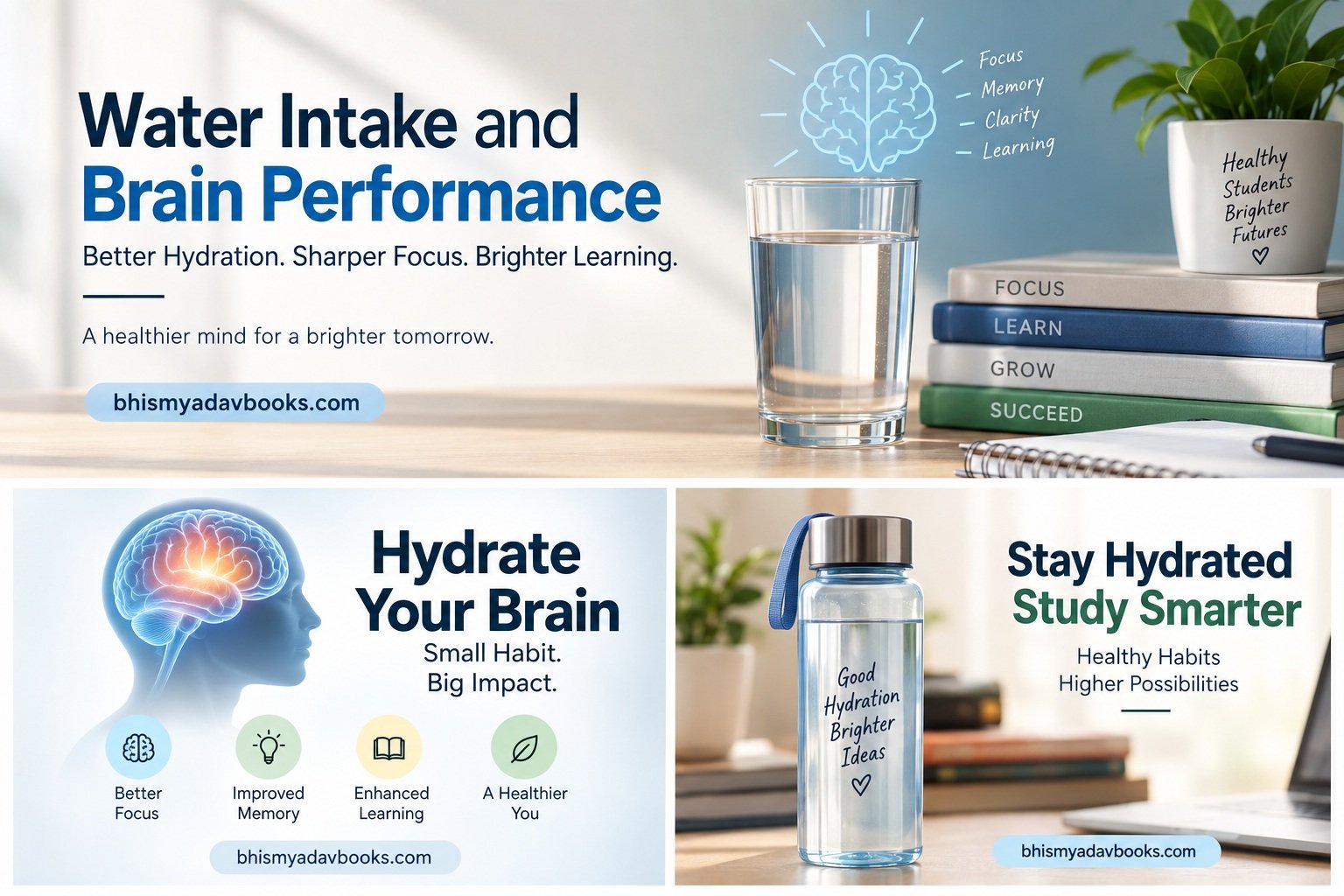
Introduction
Understanding the Connection Between Water and the Brain
For students, academic performance depends on much more than studying for long hours. Concentration, memory, alertness, mood, energy, and the ability to process information all influence how effectively a student learns. Among the basic habits that support overall health, adequate hydration is often overlooked.
Water is essential for the human body, and the brain is particularly dependent on a well-functioning fluid balance. Students spend hours reading textbooks, attending classes, solving mathematical problems, writing assignments, preparing for competitive examinations, and using computers or smartphones. During these activities, maintaining healthy hydration habits can be a simple part of a broader strategy for supporting physical and mental well-being.
We have some amazing books at our Shop page you may want to buy.
The relationship between water intake and brain performance does not mean that drinking increasingly large amounts of water will automatically make someone smarter or dramatically improve examination scores. Instead, hydration is one of the basic physiological factors that helps the body and brain function normally. When fluid losses become significant, especially during heat, exercise, illness, or long periods without drinking, students may experience symptoms such as thirst, tiredness, headache, or difficulty concentrating.
This makes hydration an important topic within Health for Students.
Table of Contents
Water Intake and Brain Performance: How Hydration Affects Students’ Focus, Memory, and Learning
1. Why Water Is Important for the Human Body
Water is one of the fundamental components of the human body. It participates in numerous physiological processes, including temperature regulation, transportation of nutrients, digestion, circulation, and waste removal.
The body continuously loses water through processes such as:
- Urination
- Sweating
- Breathing
- Normal bodily functions
- Physical activity
- Exposure to hot environments
Because water is continually lost, the body needs regular fluid replacement.
For students, this can become especially important during long school or college days. A student may become so focused on lectures, assignments, gaming, reading, or examination preparation that drinking water is forgotten.
Hydration therefore should not be considered something that matters only when a person feels extremely thirsty.
A consistent daily routine can make it easier to maintain normal hydration.
Water and the Brain
The brain contains a substantial amount of water and depends on a carefully regulated internal environment. Nerve cells require appropriate conditions to communicate and perform their functions.
The brain does not operate separately from the rest of the body. Blood circulation, temperature regulation, electrolyte balance, energy metabolism, and fluid balance all contribute to normal brain function.
This is why basic health habits can influence the quality of studying.
A student who regularly sleeps poorly, skips meals, rarely drinks fluids, and spends an entire day sitting indoors may experience reduced well-being even if they spend many hours studying.
Hydration is only one piece of the puzzle, but it is a relatively simple one to address.
2. What Does Hydration Actually Mean?
Hydration refers to having an appropriate amount of water and fluids in the body.
It is sometimes misunderstood as simply drinking as much water as possible. That is not the goal.
The goal is to maintain normal fluid balance.
The amount of fluid an individual needs can vary considerably depending on factors such as:
- Age
- Body size
- Physical activity
- Climate
- Temperature
- Humidity
- Diet
- Health status
- Pregnancy or breastfeeding
- Illness
- Medication
- Sweating
For this reason, there is no single universal number of glasses of water that is perfect for every student.
A student living in a hot climate and participating in outdoor sports may have very different fluid needs from a student spending most of the day in an air-conditioned classroom.
3. How Dehydration Can Affect Students
Dehydration occurs when the body loses more fluid than it replaces.
Mild fluid loss may not always produce dramatic symptoms. However, as dehydration becomes more significant, physical and cognitive symptoms can appear.
Possible signs include:
- Thirst
- Dry mouth
- Fatigue
- Headache
- Dizziness
- Reduced physical performance
- Difficulty concentrating
- Feeling unusually tired
- Changes in mood
- Reduced alertness
The exact effects differ between individuals and depend on the severity and circumstances.
For a student, even feeling tired or distracted can make studying more difficult.
Imagine a student preparing for an important examination.
They have a textbook open and have planned to study for two hours. After thirty minutes, they begin feeling tired and develop a headache. Instead of focusing on the chapter, they repeatedly check their phone and reread the same paragraph.
There could be many reasons for this situation. Lack of sleep, stress, hunger, an uncomfortable environment, excessive screen use, or inadequate fluid intake could all potentially contribute.
This illustrates an important point:
Hydration should not be treated as a magic solution for concentration problems.
Instead, it should be viewed as one component of a healthy study routine.
4. Water Intake and Concentration
Concentration allows students to direct their attention toward a particular task.
Whether solving algebra problems, reading a biology chapter, memorizing vocabulary, or understanding a programming concept, sustained attention is important.
When a student is thirsty or experiencing symptoms associated with inadequate hydration, studying may become less comfortable.
Some research has examined whether hydration status can affect cognitive performance, attention, mood, and related functions. Findings vary depending on the study design, participant characteristics, degree of dehydration, and activity involved.
This means it is better to avoid exaggerated claims such as:
“Drinking water immediately increases intelligence.”
There is no reason to expect ordinary water consumption to produce such a dramatic effect.
A more reasonable approach is to recognize that avoiding significant dehydration can support normal physical and cognitive functioning.
5. Hydration and Memory
Memory is central to education.
Students need memory to:
- Remember definitions
- Recall formulas
- Learn historical events
- Understand scientific concepts
- Remember vocabulary
- Apply previously learned principles
- Retrieve information during examinations
Memory involves several processes, including encoding, storage, and retrieval.
Hydration is not a replacement for active learning techniques, revision, practice testing, or adequate sleep. Nevertheless, maintaining appropriate hydration is part of taking care of the body that supports these cognitive processes.
A student who is physically uncomfortable, thirsty, fatigued, or suffering from a dehydration-related headache may find it harder to study effectively.
Therefore, the practical lesson is simple:
Do not wait until dehydration becomes a problem before thinking about hydration.
6. Can Drinking Water Make You More Alert?
Sometimes students interpret tiredness as a need for caffeine or energy drinks.
However, tiredness has many possible causes.
For example:
- Insufficient sleep
- Poor sleep quality
- Long study sessions
- Stress
- Skipping meals
- Lack of physical activity
- Excessive screen time
- Illness
- Inadequate hydration
If a student is thirsty, drinking water can address the immediate need for fluid.
But if the real problem is sleeping five hours every night, water alone will not solve the underlying issue.
This distinction is important when discussing water and brain performance.
Healthy academic performance comes from multiple habits working together.
7. Why Students Often Forget to Drink Water
Students have busy schedules.
A typical day may involve:
Morning → School/College → Travel → Classes → Homework → Coaching → Self-study → Screen time → Sleep
When students are concentrating on academic work, hydration may become an afterthought.
There are several common reasons students may drink less than they need:
7.1 Being Busy
Students may avoid interrupting their study sessions to get water.
7.2 Not Carrying a Water Bottle
If water is not easily available, students may simply forget about it.
7.3 Excessive Screen Time
Long periods spent gaming, watching videos, or working on computers can make students lose track of time.
7.4 Avoiding Bathroom Breaks
Some students intentionally reduce fluid intake because they do not want to take bathroom breaks during classes or study sessions.
7.5 Hot Weather
In warm conditions, fluid losses through sweating can increase.
7.6 Confusing Thirst With Hunger or Fatigue
Sometimes students may interpret general discomfort as tiredness or hunger without considering whether they have had enough fluids.
8. Water During Long Study Sessions
Long study sessions require planning.
Instead of sitting at a desk for four or five hours without movement, students can create a healthier study environment.
A simple routine might include:
Study → Short break → Drink water if needed → Stretch → Resume studying
This approach has benefits beyond hydration.
Short breaks can reduce continuous sedentary time and give the mind an opportunity to reset.
Students do not need to turn hydration into a complicated tracking exercise.
Keeping a reusable water bottle nearby can make drinking water more convenient.
9. Does Everyone Need the Same Amount of Water?
No.
Fluid requirements differ from person to person.
The commonly repeated advice to “drink eight glasses every day” can be a useful simple reminder for some people, but it should not be treated as a precise medical requirement for everyone.
Water also comes from foods and other beverages.
Foods such as fruits, vegetables, soups, and other water-containing foods contribute to total fluid intake.
Individual hydration needs can also change throughout the day.
For example, a student may need more fluids when:
- Exercising
- Playing sports
- Walking long distances
- Spending time outdoors in hot weather
- Experiencing increased sweating
- Having a fever or illness, depending on medical advice
The practical objective is maintaining appropriate hydration rather than reaching an arbitrary number at all costs.
10. The Role of Weather and Climate
Climate can strongly influence hydration needs.
Students living in hot and humid environments may sweat more, particularly during outdoor activities.
India experiences substantial variations in temperature and climate across different regions and seasons. During particularly hot periods, students who spend time outdoors may need to pay additional attention to fluid replacement.
However, hydration requirements should still be individualized.
A student should not assume that drinking extremely large amounts of water is automatically healthier.
More water is not always better.
The body regulates water balance through complex physiological mechanisms, and excessive water consumption can also be dangerous in extreme circumstances.
The goal is balanced hydration.
11. Water vs. Sugary Drinks
Students have access to many beverages, including:
- Soft drinks
- Packaged juices
- Energy drinks
- Sweetened tea
- Sweetened coffee
- Flavored beverages
- Sports drinks
These beverages can contribute fluid, but they may also contain substantial amounts of added sugar or caffeine depending on the product.
Plain water is a simple option for regular hydration because it provides fluid without added sugar.
This does not mean every other beverage must be completely avoided. Rather, students should understand that water can be the foundation of everyday hydration.
For many students, replacing some sugary beverages with water can also support healthier dietary habits.
12. Hydration Is Part of a Bigger Study Strategy
Students sometimes search for a single habit that will dramatically improve academic performance.
In reality, effective learning usually depends on multiple factors.
Important foundations include:
Sleep
Adequate sleep supports attention, learning, memory, and recovery.
Nutrition
Regular balanced meals provide energy and nutrients required by the body.
Physical Activity
Regular movement supports overall physical and mental well-being.
Hydration
Adequate fluid intake supports normal physiological functioning.
Study Technique
Active recall, spaced repetition, practice questions, and focused study sessions can make learning more effective.
Stress Management
Excessive stress can interfere with concentration and well-being.
Breaks
Regular breaks can make long study periods more manageable.
Hydration belongs within this larger framework.
13. A Simple Hydration Routine for Students
Students do not need an elaborate system.
A practical routine could look like this:
Morning:
Drink fluids according to thirst and normal daily habits.
During classes:
Keep water accessible where permitted.
Before physical activity:
Make sure you have access to fluids.
During long study sessions:
Keep a water bottle nearby and drink when thirsty.
During hot weather:
Pay additional attention to thirst and fluid losses.
After exercise:
Replace fluids lost through sweating.
Evening:
Continue normal hydration without deliberately drinking excessive amounts immediately before bed.
The exact amount will vary between individuals.
14. The Key Message for Students
The connection between water intake and brain performance is best understood through basic physiology rather than exaggerated productivity claims.
Water is essential for normal body function, and maintaining appropriate hydration is part of maintaining overall health.
Students should not expect water alone to transform concentration, memory, or examination performance.
Instead, they should combine sensible hydration with:
- Good sleep
- Balanced nutrition
- Regular physical activity
- Effective study methods
- Appropriate breaks
- Stress management
- Healthy screen habits
A water bottle on the study table cannot replace good preparation—but it can be a simple reminder to take care of basic physical needs while learning.
Water Intake and Brain Performance: How Hydration Affects Students’ Focus, Memory, and Learning
Hydration, Focus, Mood, Memory, and Study Performance
15. Hydration and Focus During Study
Focus is the ability to direct attention toward a specific activity while limiting distractions.
For students, focus may be required for several different activities:
- Reading a textbook
- Watching an educational lecture
- Solving numerical problems
- Writing assignments
- Practicing mock tests
- Learning a new language
- Programming
- Revising notes
- Preparing for competitive examinations
A student may sit at a desk for several hours but accomplish relatively little if attention repeatedly moves away from the task.
There are many reasons concentration can decline.
These can include:
- Lack of sleep
- Hunger
- Stress
- Excessive noise
- Phone notifications
- Boredom
- Poor study planning
- Mental fatigue
- Physical discomfort
- Inadequate fluid intake
Hydration should therefore be considered one factor among many.
If a student is thirsty or experiencing symptoms associated with dehydration, drinking water may help address that physical need. But if the student is distracted because of social media notifications or has slept only a few hours, water alone will not restore concentration.
This is an important distinction.
Hydration Supports the Foundation, Not the Entire Result
Think about studying as building a house.
- Sleep provides recovery.
- Nutrition provides nutrients and energy.
- Physical activity supports overall health.
- Study techniques organize learning.
- A quiet environment supports concentration.
- Hydration supports normal physiological function.
Removing one of these foundations may make the overall process more difficult.
Water is therefore not a “study hack” in the exaggerated sense. It is simply one of the basic habits that students can manage as part of their daily health routine.
16. Water and Mental Alertness
Mental alertness refers to the state of being awake, attentive, and ready to respond to information.
Students often experience periods of reduced alertness during the day.
This can happen after:
- A poor night’s sleep
- A heavy meal
- Long lectures
- Extended screen use
- Continuous studying
- Physical exertion
- Stressful situations
- Hot weather
Thirst and inadequate hydration can also contribute to feelings of discomfort and fatigue.
If a student notices thirst during studying, drinking water is a straightforward response.
However, it is important not to confuse hydration with stimulation.
Caffeine can temporarily increase alertness in some people, while water primarily provides fluid. They serve different purposes.
A student who is extremely sleepy because they stayed awake until 3 a.m. should not expect several glasses of water to substitute for sleep.
Healthy Alertness Requires Healthy Habits
A better approach is to build a daily routine that supports alertness naturally.
For example:
Sleep → Wake up → Eat appropriately → Hydrate → Study → Move regularly → Take breaks → Repeat
The exact routine can vary according to school, college, work, and personal circumstances.
17. Hydration and Mood
Academic performance is not only about memory and intelligence.
Mood can influence how students approach their studies.
A student who feels physically uncomfortable may become:
- Irritated
- Tired
- Restless
- Less motivated
- Easily distracted
Hydration status can be one factor associated with how a person feels physically and mentally.
Research has examined relationships between hydration, mood, fatigue, and cognitive performance, but effects can vary according to the population and experimental conditions.
Therefore, it is more accurate to say that maintaining appropriate hydration is part of supporting overall well-being rather than claiming that drinking water directly creates a positive mood.
Students should also consider other important factors when experiencing persistent changes in mood, such as sleep, academic pressure, relationships, lifestyle, and other health concerns.
18. Can Dehydration Cause Headaches?
Headaches can have many causes.
Possible contributing factors include:
- Dehydration
- Lack of sleep
- Stress
- Eye strain
- Illness
- Hunger
- Caffeine changes
- Certain medical conditions
- Environmental factors
Some people may experience headaches when they become dehydrated.
For a student who develops a headache after spending several hours in a hot environment without drinking, fluid intake may be one factor worth considering.
However, not every headache is caused by dehydration.
This distinction is particularly important.
If headaches are frequent, severe, unusual, persistent, or accompanied by concerning symptoms, students should seek appropriate medical advice rather than repeatedly assuming that they simply need more water.
19. Water and Examination Preparation
Examination preparation can involve long study sessions.
During intense preparation, students may create detailed schedules such as:
6:00 AM — Wake up
7:00 AM — Revision
9:00 AM — Classes
2:00 PM — Practice questions
5:00 PM — Mock test
8:00 PM — Revision
While planning study hours, students often focus on subjects and chapters but forget basic health needs.
A good study timetable should include:
- Meals
- Water access
- Short breaks
- Physical movement
- Sleep
- Reasonable study periods
There is little value in planning ten hours of studying if the student becomes physically exhausted after three hours.
The Water Bottle Method
One simple strategy is to keep a water bottle near the study desk.
This creates a visual reminder.
The objective is not to force yourself to drink continuously.
Instead:
Keep water available → Notice thirst → Drink appropriately → Continue studying.
This can be especially useful during revision sessions when students become deeply focused on their books or computer screens.
20. Hydration During Mock Tests
Mock tests are an important part of competitive examination preparation.
During a mock test, students need sustained attention and mental effort.
If the test is conducted at home, students can manage their own environment.
If it is conducted in an examination center, students must follow the center’s rules regarding water bottles, breaks, and personal belongings.
Students should become familiar with those rules before examination day.
The purpose of hydration during examination preparation is not to create an advantage over other candidates.
It is simply to avoid unnecessary physical discomfort.
A student should also avoid suddenly drinking an unusually large amount of water immediately before a test because frequent bathroom needs can become distracting.
A consistent routine is generally more practical than last-minute overconsumption.
21. Why Drinking Too Much Water Is Not Better
One of the most important hydration lessons is:
More is not always better.
Some students may hear that water is healthy and conclude that drinking extremely large quantities must be even healthier.
That is incorrect.
Excessive water consumption can dilute the sodium concentration in the blood, a potentially serious condition known as hyponatremia.
Severe cases can be dangerous.
This does not mean students should be afraid of drinking water.
It means hydration should be balanced.
The body has sophisticated systems that regulate water and electrolyte balance. Normal drinking according to thirst and individual circumstances is very different from deliberately consuming excessive quantities.
Students should avoid extreme online “water challenges” or hydration trends that encourage excessive consumption.
22. Water Intake and Electrolytes
Water is not the only component involved in fluid balance.
Electrolytes such as sodium and potassium are important for normal physiological functions, including nerve and muscle activity.
Under ordinary circumstances, a balanced diet and normal fluid intake generally provide electrolytes for most healthy people.
However, electrolyte needs can change under certain conditions, including:
- Heavy sweating
- Prolonged intense exercise
- Significant fluid losses
- Certain illnesses
- Certain medical conditions
Sports drinks are sometimes marketed as necessary for hydration, but they are not automatically required for ordinary classroom studying.
For a student sitting at a desk reading a textbook, plain water is usually a simple hydration option.
For athletes participating in prolonged or intense physical activity, fluid and electrolyte needs may be different.
23. Water During Exercise and Sports
Many students participate in sports, running, cycling, gym activities, or other forms of exercise.
Exercise increases fluid loss through sweating.
Therefore, active students need to pay attention to fluid replacement.
A student who spends an hour playing football under hot conditions will have different hydration considerations from someone spending an hour reading in a classroom.
During physical activity, students should have access to suitable fluids and avoid becoming excessively dehydrated.
After exercise, replacing fluids lost through sweating is also important.
The amount needed depends on factors such as:
- Exercise intensity
- Duration
- Temperature
- Humidity
- Sweat rate
- Individual body characteristics
Students participating in intense athletic activities can seek guidance from qualified sports or healthcare professionals when needed.
24. Hydration in Hot Weather
Hot weather deserves special attention.
When environmental temperatures rise, the body uses sweating as one mechanism for controlling temperature.
Sweat causes fluid loss.
If fluid losses are not replaced appropriately, dehydration can develop.
Students who walk or cycle to school, play sports outdoors, work outside, or travel long distances in hot weather may therefore need to pay closer attention to hydration.
Practical habits include:
- Carrying water when appropriate
- Drinking according to thirst
- Taking appropriate breaks in hot environments
- Avoiding prolonged unnecessary exposure to extreme heat
- Wearing suitable clothing
- Paying attention to signs of heat-related illness
Water alone is not a treatment for serious heat illness.
Symptoms such as confusion, fainting, severe weakness, or other serious signs require prompt medical attention.
25. Hydration and Screen-Based Learning
Modern students spend substantial amounts of time using digital devices.
Learning may involve:
- Laptops
- Desktop computers
- Tablets
- Smartphones
- Digital textbooks
- Online classes
- Educational applications
Screen-based learning has many advantages, but long uninterrupted sessions can contribute to eye strain, poor posture, fatigue, and reduced movement.
A student may sit in front of a screen for several hours and suddenly realize they have not moved or taken a drink.
A simple solution is to combine hydration with regular breaks.
For example:
45–50 Minutes of Focused Study
Then:
5–10 Minutes of Break
During the break:
- Stand up
- Stretch
- Look away from the screen
- Walk briefly
- Drink water if thirsty
- Return to studying
This creates a healthier rhythm.
26. Water and Reading Efficiency
Reading requires sustained attention.
When students read difficult material, they may need to process information repeatedly.
For example, a student studying physics might read a paragraph about electromagnetic induction several times before understanding it.
A student studying agriculture may need to remember several scientific terms.
A medical student may need to learn complicated anatomical structures.
In such situations, concentration is essential.
Hydration cannot make difficult material automatically easy, but maintaining comfortable physical conditions can help students focus on the task.
If a student is thirsty, distracted by a headache, or physically uncomfortable, studying may become more difficult.
Therefore, keeping water available is a simple environmental adjustment.
27. Hydration and Active Learning
Active learning techniques are widely used by students because they require the learner to interact with information rather than simply reread it.
Examples include:
Active Recall
Close the book and attempt to remember what you learned.
Practice Questions
Solve questions without immediately looking at the answer.
Spaced Repetition
Review information at increasing intervals.
Teaching Others
Explain a concept in your own words.
Flashcards
Use questions and answers to test memory.
Mock Tests
Practice under examination-like conditions.
Hydration supports the overall study environment, but these learning methods do the actual academic work.
A useful principle is:
Hydration supports studying; effective learning techniques structure studying.
Both matter, but they serve different roles.
28. Common Hydration Mistakes Made by Students
Students can develop several habits that make hydration unnecessarily difficult.
Mistake 1: Drinking Only When Extremely Thirsty
Some students ignore mild thirst for hours.
Keeping water available can make regular hydration easier.
Mistake 2: Drinking Huge Amounts at Once
There is generally no need to consume excessive amounts of water simply because you have not drunk for several hours.
Normal, sensible intake is more practical.
Mistake 3: Replacing Water With Sugary Drinks
Sweetened beverages can add significant amounts of sugar to the diet.
Water can be a simpler everyday choice.
Mistake 4: Ignoring Hydration During Sports
Exercise and heat can increase fluid losses.
Students should account for those circumstances.
Mistake 5: Forgetting Water During Study
Long study sessions can make students lose track of time.
Keeping a bottle nearby can help.
Mistake 6: Treating Water as a Cure-All
Water is essential, but it cannot replace:
- Sleep
- Food
- Medical care
- Exercise
- Effective study techniques
Mistake 7: Following Extreme Online Challenges
Internet trends should not automatically be treated as health advice.
29. A Student-Friendly Hydration Checklist
Before starting a long study session, students can ask themselves:
☐ Do I have water available?
☐ Have I eaten appropriately today?
☐ Did I get enough sleep?
☐ Am I studying in a comfortable environment?
☐ Have I planned short breaks?
☐ Am I physically active during the day?
☐ Am I responding to thirst rather than deliberately ignoring it?
☐ Am I avoiding excessive fluid consumption?
This checklist takes only a few seconds.
It can help students think about health alongside academic productivity.
30. The Relationship Between Hydration and Productivity
Productivity is often measured by how much work a student completes.
However, productive studying is not simply about the number of hours spent at a desk.
A student who studies for two highly focused hours may learn more than someone who sits at a desk for six hours while repeatedly checking social media.
Physical comfort is one component of productive study.
Appropriate hydration can contribute to that comfort.
The bigger productivity system includes:
Planning + Focus + Breaks + Sleep + Nutrition + Hydration + Active Learning
When these components work together, students can build a more sustainable academic routine.
31. Does Drinking Water Improve Exam Scores?
There is no simple rule stating that drinking a particular amount of water will increase examination marks.
Academic results depend on numerous factors, including:
- Prior knowledge
- Preparation time
- Learning strategies
- Practice
- Sleep
- Stress
- Examination difficulty
- Individual circumstances
- Test-taking skills
Hydration may influence how a person feels and functions physically, particularly when dehydration is present, but it should not be marketed as a direct method for increasing marks.
Students should focus on evidence-based preparation strategies rather than searching for a single shortcut.
32. Hydration as a Daily Health Habit
One of the strongest reasons to pay attention to hydration is its simplicity.
Students do not need expensive equipment.
They do not need a specialized supplement.
They do not need a complicated productivity application.
A clean reusable water bottle may be enough to make water easily available throughout the day.
The habit can become automatic:
Carry water → Study → Take breaks → Drink when appropriate → Continue learning.
Small habits repeated consistently can become part of a healthy lifestyle.
33. What Students Should Remember
The main lessons from this section are straightforward:
- Hydration is important for normal body function.
- Dehydration can contribute to physical discomfort and may affect aspects of cognitive functioning.
- Water is not a substitute for sleep or effective studying.
- Students have different fluid requirements.
- Hot weather and exercise can increase fluid losses.
- Excessive water consumption can also be harmful.
- Plain water is a simple everyday hydration option.
- Keeping water accessible can make healthy hydration easier.
- Students should avoid extreme hydration trends.
- Persistent or severe symptoms should not automatically be blamed on dehydration.
34. Building a Better Study Environment
A productive study environment is more than a desk and a textbook.
Try creating a setup that includes:
Comfortable chair + Good lighting + Organized materials + Water + Minimal distractions + Planned breaks
This setup supports both physical comfort and focused learning.
Students preparing for board examinations, college examinations, entrance tests, government examinations, or competitive exams can incorporate these habits into their existing study schedules.
The goal is not perfection.
The goal is consistency.
Water Intake and Brain Performance: How Hydration Affects Students’ Focus, Memory, and Learning
Creating a Practical Hydration Routine for Students
35. Creating a Daily Hydration Routine
A daily hydration routine can help students remember their basic health needs while managing a busy academic schedule.
Instead of thinking about water as a separate task, students can connect hydration with activities they already perform.
For example:
Wake up → Morning routine → Breakfast → Classes → Study → Lunch → Study → Exercise → Evening study → Dinner → Sleep
Water can naturally fit into these activities.
The routine should remain flexible.
Students should respond to thirst and changing circumstances rather than forcing themselves to drink a predetermined amount regardless of their needs.
36. Start the Day With Healthy Hydration Habits
After sleeping overnight, students begin the day without drinking fluids for several hours.
A normal morning routine should include appropriate fluid intake according to thirst and individual needs.
There is no need to turn morning hydration into an extreme ritual.
Some online advice recommends drinking very large quantities of water immediately after waking up. Such practices are unnecessary for most healthy people.
Instead, students can simply:
- Wake up
- Pay attention to thirst
- Drink water as appropriate
- Eat breakfast
- Continue normal hydration throughout the day
A balanced approach is generally more practical than trying to consume a large quantity of water at one time.
37. Hydration During Breakfast
Breakfast can also contribute to daily fluid intake.
Foods such as fruits, milk, yogurt, oats, and other water-containing foods contribute fluids as part of the overall diet.
Students may choose water with breakfast or another suitable beverage depending on their dietary habits.
The important point is that hydration does not come exclusively from plain drinking water.
Total fluid intake can include water from:
- Drinking water
- Milk
- Certain beverages
- Fruits
- Vegetables
- Soups
- Other water-containing foods
However, students should also pay attention to added sugar in sweetened beverages.
38. Keep Water Accessible During Classes
Students often forget about hydration because water is not immediately available.
Keeping a suitable water bottle nearby can solve this problem.
Depending on school, college, or classroom rules, students may be able to carry a reusable bottle.
Having water available can be especially useful during:
- Long lectures
- Laboratory sessions
- Coaching classes
- Library study
- Examination preparation
- Outdoor activities
The purpose is convenience.
If water is easy to access, students are less likely to ignore thirst simply because they do not want to leave their study area.
39. Hydration During Long Study Sessions
Long study sessions can create a unique problem.
Students may become deeply involved in a chapter and lose awareness of time.
They might think:
“I will take a break after finishing this topic.”
Then another chapter begins.
Suddenly, several hours have passed.
This can happen during examination preparation, particularly when students are trying to complete a large syllabus.
A better approach is to organize study sessions around focused periods and short breaks.
For example:
Focus Session
Study for a planned period.
Short Break
Stand up, stretch, look away from the screen, and drink water if thirsty.
Return to Study
Continue with the next task.
This approach addresses more than hydration.
It also reduces continuous sitting and gives students a chance to reset their attention.
40. Use Study Breaks Wisely
A break does not have to mean immediately opening social media.
Students can use short breaks for activities that support overall well-being.
A five- or ten-minute break might include:
- Standing
- Walking around the room
- Stretching
- Looking away from the screen
- Drinking water
- Taking a few slow breaths
- Preparing the next study task
If every break becomes thirty minutes of scrolling, the study schedule can quickly fall behind.
Therefore, students should distinguish between a recovery break and a distraction session.
41. Hydration During Competitive Exam Preparation
Competitive examination preparation can last for months or even years.
Students preparing for exams such as government recruitment examinations, entrance tests, technical examinations, or other competitive assessments often spend many hours studying.
Long preparation periods make sustainable habits particularly important.
A student might create a daily routine such as:
Morning: Revision
Late morning: Classes or practice
Afternoon: Problem solving
Evening: Mock test
Night: Revision
Hydration can be integrated naturally into this routine.
Students should keep water accessible during self-study and pay attention to thirst, especially during hot weather.
There is no advantage in deliberately restricting normal fluid intake just to avoid taking short breaks.
42. Water Before a Mock Test
Before starting a long mock test at home, students can make sure they are reasonably hydrated.
However, they should avoid suddenly drinking a very large amount of water immediately before the test.
Why?
Because excessive fluid intake can create frequent bathroom needs.
The objective is comfort and normal hydration—not maximum water consumption.
A better approach is to maintain ordinary hydration throughout the day.
If the mock test is being conducted under formal examination conditions, students should follow the examination authority’s rules regarding drinking water and bathroom breaks.
43. Hydration on Examination Day
Examination day can be stressful.
Students may wake up early, travel to the examination center, wait for security checks, and sit for several hours.
Because of nervousness, some students may completely forget their normal routines.
Preparation the day before can help.
Students can:
- Sleep adequately
- Eat a suitable meal
- Follow their normal hydration routine
- Check examination rules
- Carry permitted items
- Avoid experimenting with unfamiliar foods or beverages
There is generally no reason to dramatically change normal drinking habits on examination morning.
Consistency is often more comfortable than experimentation.
44. Avoid Excessive Drinking Before an Exam
Some students may think:
“If water is good for the brain, I should drink as much as possible before the examination.”
This is not a good principle.
Drinking excessive amounts can result in discomfort and, in extreme situations, dangerous disturbances in blood sodium levels.
Instead, students should aim for normal hydration.
The goal is to arrive at the examination feeling comfortable and prepared—not overly full of water.
45. Hydration During Travel
Students often travel significant distances for school, college, coaching, internships, examinations, or other educational activities.
Travel can make normal hydration more difficult.
A simple strategy is to carry a suitable water bottle when practical.
Students should consider:
- Travel duration
- Weather
- Availability of drinking water
- Physical activity
- Personal needs
Long travel during hot weather can increase fluid losses.
Students should pay attention to thirst and signs of dehydration.
46. Hydration and Outdoor Activities
Outdoor activities can increase fluid loss because of heat and sweating.
Students who participate in:
- Football
- Cricket
- Basketball
- Running
- Cycling
- Hiking
- Athletics
- Outdoor physical education
may need more fluids than they would during quiet desk-based study.
Fluid needs during physical activity vary significantly.
The amount a person needs depends on exercise duration, intensity, weather, individual sweating, and other factors.
Students participating in prolonged or intense exercise should follow appropriate sports hydration guidance.
47. Water During Hot Summer Days
Summer can change normal hydration requirements.
Higher temperatures may increase sweating.
Students who spend time outdoors should therefore pay greater attention to:
- Thirst
- Sweating
- Physical fatigue
- Heat exposure
- Access to fluids
Practical measures include drinking appropriately, taking breaks, seeking shade when necessary, and avoiding unnecessary exposure to extreme heat.
Hydration should be combined with broader heat-safety practices.
Water is not a substitute for moving to a cooler environment when someone is experiencing heat-related illness.
48. Hydration During Winter
Hydration remains important during winter.
Some students assume that dehydration is only a summer concern because they sweat less visibly.
However, the body continues to lose water through normal physiological processes, including breathing and urination.
Cold and dry environments can also influence fluid losses.
Students should therefore continue normal hydration throughout the year.
The exact amount needed will still depend on individual circumstances.
49. Water and Caffeine for Students
Many students consume caffeine through:
- Tea
- Coffee
- Cola
- Energy drinks
- Other caffeinated beverages
Caffeine can increase alertness temporarily, which is one reason students may use it during study sessions.
However, caffeine should not be treated as a replacement for sleep.
Students should also remember that beverages containing caffeine may contain added sugar, depending on the product.
The effects of caffeine vary between individuals.
Some students may experience:
- Difficulty sleeping
- Restlessness
- Increased heart rate
- Anxiety
- Stomach discomfort
Excessive caffeine consumption can therefore interfere with the very study habits students are trying to improve.
50. Water vs. Energy Drinks
Energy drinks are heavily marketed toward alertness and performance.
However, students should understand that an energy drink is not simply “water with extra brain power.”
Many energy drinks contain caffeine and added sugar, and some contain other stimulants.
They may not be appropriate for children or adolescents, and individual circumstances matter.
For ordinary hydration during studying, plain water is a straightforward choice.
If a student feels extremely tired every day and repeatedly needs stimulant beverages to study, the underlying cause should be considered.
Possible factors include:
- Insufficient sleep
- Poor sleep schedule
- Stress
- Excessive workload
- Illness
- Poor nutrition
A beverage cannot replace adequate recovery.
51. Hydration and Sleep
Sleep is one of the most important parts of student health.
A student may carefully manage water intake but still struggle academically if they regularly sleep too little.
During sleep, the body and brain undergo important restorative processes.
Students should therefore avoid drinking excessive quantities of water immediately before bed simply because they are trying to meet a daily target.
Frequent nighttime urination can interrupt sleep.
A balanced approach is better:
Hydrate normally during the day → Reduce unnecessary large fluid intake immediately before sleep → Maintain a healthy sleep schedule.
Students with medical conditions that require specific fluid management should follow professional medical advice.
52. How to Recognize Possible Dehydration
Students should become familiar with common signs that may occur with dehydration.
Possible signs include:
- Thirst
- Dry mouth
- Fatigue
- Dizziness
- Headache
- Reduced urination
- Darker urine
- Weakness
- Reduced physical performance
These signs are not perfectly specific.
For example, fatigue and headache can have many causes.
Therefore, students should look at the overall situation rather than assuming that every symptom means dehydration.
53. Urine Color as a Hydration Clue
Urine color can provide a general clue about hydration status.
Dark yellow urine can occur when urine is concentrated, while pale yellow urine is commonly associated with better hydration.
However, urine color can be affected by:
- Certain foods
- Vitamins
- Medications
- Health conditions
- Time of day
Therefore, it should not be treated as a precise measurement.
Students do not need to constantly inspect their urine.
It is simply one possible indicator to consider alongside thirst and other signs.
54. Should Students Track Every Glass of Water?
Usually, healthy students do not need to obsessively record every glass of water.
Tracking can sometimes be useful for people who have specific health or athletic goals, particularly when advised by a qualified professional.
For most students, simpler strategies are sufficient:
Keep water available + Respond to thirst + Consider activity and weather + Maintain a balanced diet.
Overtracking can turn a simple health habit into unnecessary stress.
55. Choosing a Water Bottle for Study
A water bottle is a practical tool for students.
When choosing one, students can consider:
- Appropriate size
- Leak resistance
- Ease of cleaning
- Portability
- Durability
- Personal preference
A reusable bottle can reduce dependence on disposable plastic bottles.
Students should clean bottles regularly, especially bottles that are repeatedly refilled.
The bottle does not need to be expensive.
Its most important purpose is to make water conveniently available.
56. Hydration and Healthy Eating
Hydration and nutrition are connected to overall health.
Many foods naturally contain water.
Examples include:
- Watermelon
- Orange
- Cucumber
- Tomato
- Melon
- Soups
- Yogurt
- Other fruits and vegetables
A balanced diet can therefore contribute to overall fluid intake.
However, water-rich foods should not be considered a reason to ignore drinking fluids.
Food and beverages work together as part of total fluid intake.
57. Hydration During Illness
Illness can change fluid requirements.
Fever, vomiting, diarrhea, or heavy sweating can increase fluid losses.
Students who are ill should pay attention to hydration and follow appropriate medical guidance.
In some illnesses, oral rehydration solutions may be recommended because they provide both fluids and electrolytes.
Oral rehydration solutions are different from ordinary sweetened beverages.
If a student is significantly unwell, unable to keep fluids down, confused, extremely weak, fainting, or showing signs of severe dehydration, medical attention may be necessary.
58. When Students Should Seek Medical Advice
Hydration is usually a simple aspect of everyday health, but persistent or severe symptoms deserve attention.
Students should seek appropriate medical advice when they experience issues such as:
- Repeated unexplained dizziness
- Persistent headaches
- Frequent fainting
- Severe weakness
- Persistent vomiting
- Inability to keep fluids down
- Significant changes in urination
- Confusion
- Symptoms of severe heat illness
- Ongoing excessive thirst without an obvious explanation
These symptoms can have causes unrelated to ordinary dehydration.
Students should not attempt to diagnose themselves solely by increasing water intake.
59. Building a Simple Hydration Schedule
Instead of creating a rigid drinking schedule, students can use daily activities as reminders.
For example:
Morning
Drink according to thirst and normal routine.
During Classes
Keep water accessible when permitted.
Lunch
Include fluids with the meal according to normal habits.
Afternoon Study
Keep a bottle nearby.
Exercise
Pay attention to fluid losses from sweating.
Evening
Continue normal hydration.
Before Bed
Avoid unnecessary excessive drinking immediately before sleep.
This flexible approach is easier to maintain than a strict hourly drinking requirement.
60. The “Water + Break” Study Habit
Students can combine hydration with healthy breaks.
A simple sequence is:
Study → Pause → Check thirst → Drink if needed → Move → Resume
This creates an opportunity to address several needs at once.
The break also provides a natural interruption to prolonged sitting.
For students who study primarily on computers, these short pauses can be particularly useful.
61. Hydration for Students Who Study at Night
Night study is common during examination periods.
Students may stay up late to finish chapters or assignments.
However, staying awake late does not necessarily improve learning.
If a student studies at night, they should continue normal hydration but avoid excessive fluid intake.
More importantly, students should protect their sleep schedule whenever possible.
If night studying becomes a regular habit that reduces sleep, the problem is not likely to be solved by drinking more water.
62. Hydration and Morning Study
Morning study can be productive for many students.
After waking, students can follow their normal hydration routine before beginning study.
A simple setup might include:
Water bottle + Study materials + Comfortable desk + Good lighting + Planned study goal
This eliminates unnecessary interruptions.
Students should still take appropriate breaks rather than attempting to study continuously for several hours.
63. Hydration During Library Study
Libraries provide an excellent environment for focused study, but students may remain seated for long periods.
If the library permits water bottles, keeping one nearby can be convenient.
Students should also stand and move during appropriate breaks.
A productive library session could look like:
Focused reading → Notes → Practice questions → Short break → Hydration → Resume
This approach supports both academic productivity and physical comfort.
64. A Practical Student Hydration Checklist
Before beginning a long study session:
☐ Is drinking water available?
☐ Have I eaten appropriately?
☐ Am I studying in a comfortable environment?
☐ Have I slept adequately?
☐ Have I planned breaks?
☐ Am I likely to exercise or spend time outdoors today?
☐ Is the weather particularly hot?
☐ Am I drinking according to my needs rather than following an extreme challenge?
This simple checklist can help students build awareness without becoming obsessed with hydration.
65. Water Intake and Brain Performance: What the Evidence Really Suggests
The relationship between hydration and cognition is more nuanced than many internet headlines suggest.
Studies have investigated the effects of dehydration and fluid intake on areas such as:
- Attention
- Memory
- Mood
- Executive functions
- Reaction time
- Mental fatigue
Results are not identical across all studies.
Differences in age, physical activity, environmental conditions, hydration status, study design, and the degree of fluid loss can influence findings.
Therefore, students should be cautious about claims such as:
“One glass of water increases IQ.”
or:
“Drinking a specific amount guarantees better memory.”
Such statements oversimplify human physiology.
A more scientifically reasonable conclusion is that maintaining appropriate hydration is part of supporting normal health and may help avoid cognitive and physical difficulties associated with significant fluid loss.
66. Five Simple Hydration Rules for Students
Students can remember five basic principles:
Rule 1: Keep Water Accessible
If water is nearby, it is easier to respond to thirst.
Rule 2: Drink According to Your Needs
Do not blindly follow a universal number.
Rule 3: Consider Heat and Exercise
Sweating increases fluid loss.
Rule 4: Avoid Extremes
Do not deliberately consume excessive amounts of water.
Rule 5: Build Hydration Into a Healthy Lifestyle
Combine hydration with good sleep, nutrition, movement, and effective study methods.
67. Hydration and Long-Term Student Health
Student life is an excellent time to develop healthy habits that can continue into adulthood.
A person who learns to:
- Drink appropriately
- Eat balanced meals
- Sleep regularly
- Exercise
- Manage stress
- Take breaks
- Maintain good study habits
is developing more than an examination strategy.
They are building a healthier lifestyle.
Hydration is a small habit, but small habits can become powerful when maintained consistently.
Water Intake and Brain Performance: How Hydration Affects Students’ Focus, Memory, and Learning
Hydration Myths, FAQs, Practical Tips, and Final Takeaways
68. Hydration Myths Students Should Know
There is a large amount of hydration advice available online. Some of it is useful, while some claims are exaggerated or misleading.
Students should learn to distinguish practical health advice from unrealistic promises.
Let’s examine some common myths.
69. Myth: Everyone Must Drink Exactly Eight Glasses of Water
The “eight glasses” rule is often repeated as if it were a universal scientific requirement.
In reality, fluid requirements vary between individuals.
Factors such as:
- Age
- Body size
- Activity level
- Climate
- Diet
- Sweating
- Health status
can influence how much fluid a person needs.
Eight glasses may be a convenient reminder for some people, but it should not be treated as an exact requirement for every student.
The better approach is to maintain appropriate hydration according to individual circumstances.
70. Myth: More Water Always Means Better Brain Performance
Water is essential for normal brain and body function.
However, drinking more water than the body needs does not automatically produce better concentration, memory, or intelligence.
There is a difference between:
Avoiding dehydration
and
Overhydrating.
Students should aim for a balanced fluid intake rather than maximum water consumption.
Excessive water intake can be harmful in extreme circumstances because it can disturb the body’s electrolyte balance.
71. Myth: Water Makes You Smarter
Water does not magically increase intelligence.
A student cannot drink a glass of water and suddenly acquire advanced knowledge of mathematics, physics, history, medicine, agriculture, or computer science.
Learning requires:
- Attention
- Practice
- Understanding
- Revision
- Memory
- Problem solving
- Adequate sleep
Hydration supports basic health, but education still requires actual learning.
This distinction is important because online productivity content sometimes turns ordinary health habits into exaggerated “brain hacks.”
72. Myth: Water Can Replace Sleep
This is one of the most harmful misconceptions.
If a student sleeps only four or five hours and drinks additional water to compensate, the water will not replace the functions of sleep.
Sleep plays an important role in:
- Recovery
- Learning
- Memory
- Attention
- Mood
- General health
A healthy study routine therefore needs both hydration and adequate sleep.
Students should not use water, coffee, energy drinks, or other beverages as substitutes for regular sleep.
73. Myth: Feeling Tired Always Means You Need More Water
Fatigue has many possible causes.
A student may feel tired because of:
- Poor sleep
- Stress
- Heavy academic workload
- Lack of physical activity
- Inadequate nutrition
- Illness
- Long screen sessions
- Dehydration
If drinking water does not resolve persistent fatigue, students should not simply continue increasing their water intake.
Persistent symptoms may require professional medical evaluation.
74. Myth: Dark Urine Always Means Serious Dehydration
Urine color can provide useful information about hydration, but it is not a perfect diagnostic tool.
Urine can become darker for several reasons, including:
- Concentrated urine
- Certain foods
- Vitamins
- Medications
- Time of day
Therefore, students should consider urine color alongside thirst, activity, weather, and other symptoms.
A single observation should not automatically lead to a conclusion about health.
75. Myth: Only Athletes Need to Think About Hydration
Athletes can lose substantial fluid through sweating, so hydration is particularly important during prolonged physical activity.
But ordinary students also need fluids every day.
A student sitting in a classroom still loses water through normal bodily processes.
Therefore, hydration is relevant to everyone, not just athletes.
The difference is that fluid requirements can become higher when physical activity and environmental heat increase fluid loss.
76. Myth: Energy Drinks Are Better for Studying Than Water
Energy drinks are designed and marketed differently from ordinary drinking water.
Many contain caffeine and added sugar.
Caffeine can temporarily increase alertness, but excessive caffeine can contribute to problems such as:
- Sleep disruption
- Restlessness
- Increased heart rate
- Anxiety
- Stomach discomfort
For normal hydration during study, plain water is a simple choice.
Students should not confuse stimulation with hydration.
77. Myth: You Should Avoid Drinking Water While Studying to Prevent Distractions
Some students avoid drinking water because they do not want to interrupt their study sessions.
This can create an unnecessary problem.
A short break to drink water, stretch, and move can actually make a long study session more manageable.
The solution is not to ignore basic physical needs.
Instead, students can plan short breaks.
Study → Short break → Hydrate if needed → Move → Resume
This is more sustainable than attempting to sit continuously for several hours.
78. Myth: Drinking Water Before an Exam Guarantees Better Marks
There is no simple formula connecting a specific quantity of water to examination marks.
Exam performance depends on many factors.
These include:
- Preparation
- Understanding
- Practice
- Revision
- Sleep
- Stress
- Examination conditions
- Individual circumstances
Appropriate hydration can help students avoid unnecessary physical discomfort, but it cannot replace academic preparation.
79. Myth: All Hydration Advice on Social Media Is Reliable
Social media contains useful information as well as exaggerated health claims.
Students should be cautious about posts promising:
- Instant memory improvement
- Guaranteed concentration
- Guaranteed exam success
- “Detox” effects
- Extreme water challenges
- Very high daily water targets
Health information should ideally come from reliable medical, scientific, or public-health sources.
A catchy video is not necessarily evidence-based simply because it has millions of views.
80. How Students Can Build a Sustainable Hydration Habit
A good hydration habit should be simple enough to maintain.
Here is a practical framework:
Step 1: Keep Water Available
Carry a suitable reusable bottle when appropriate.
Step 2: Respond to Thirst
Drink when you are thirsty rather than deliberately ignoring the signal.
Step 3: Consider Your Environment
Hot weather and exercise may increase fluid losses.
Step 4: Include Water in Your Study Setup
Keep water accessible during long study sessions.
Step 5: Avoid Extremes
Do not force yourself to consume excessive amounts.
Step 6: Combine Hydration With Healthy Habits
Support hydration with good nutrition, sleep, exercise, and breaks.
81. A Practical Daily Hydration Plan for Students
There is no single perfect schedule for everyone, but students can use the following as a flexible framework.
Morning
Wake up and drink according to thirst and normal habits.
Have breakfast and include appropriate fluids.
During Classes
Keep water accessible if school or college rules allow it.
Drink according to thirst.
Lunch
Have fluids with your meal according to your normal needs.
Include water-rich foods such as fruits or vegetables as part of a balanced diet.
Afternoon
During study or coaching sessions, keep water available.
Pay additional attention to hydration during hot weather.
Evening
If exercising or playing sports, account for increased fluid loss.
Night Study
Keep water nearby but avoid unnecessarily consuming very large amounts immediately before bedtime.
Before Sleep
Allow your body to settle into a normal sleep routine rather than deliberately drinking excessive fluids.
This is a framework rather than a rigid prescription.
82. A Hydration Plan for Competitive Exam Aspirants
Competitive examination aspirants may study for many hours each day.
A practical routine can look like this:
Session 1 — Morning Revision
Keep water nearby and study in a distraction-free environment.
Break
Stand, stretch, and drink if thirsty.
Session 2 — Concept Learning
Continue studying with normal hydration.
Lunch
Eat a balanced meal and maintain regular fluid intake.
Session 3 — Practice Questions
Keep water accessible.
Break
Move around rather than remaining seated continuously.
Session 4 — Mock Test
Follow the rules of the test environment.
Evening
Exercise or walk when possible.
Night Revision
Keep the session focused and avoid excessive late-night caffeine.
Sleep
Protect sufficient sleep for recovery and learning.
This approach treats hydration as one component of a larger preparation system.
83. Water and Different Types of Students
Students have different routines.
A school student may spend most of the day in classrooms.
A college student may travel between buildings.
A competitive examination aspirant may spend many hours at a desk.
An athlete may train outdoors.
A student working part-time may have an entirely different schedule.
Therefore, hydration habits should be adapted to individual circumstances.
There is no need for every student to follow exactly the same routine.
84. Hydration for Students Who Travel Long Distances
Long-distance commuting can make regular hydration more difficult.
Students who travel by:
- Bus
- Train
- Bicycle
- Motorcycle
- Walking
- Car
can plan ahead.
Carrying water can be useful when practical.
During hot weather, students should pay additional attention to fluid availability.
However, students should also consider restroom access when planning their fluid intake during long journeys.
The goal is balance rather than drinking a large amount immediately before leaving.
85. Hydration and Study Productivity: A Balanced Approach
Students sometimes search for productivity tricks because they want to complete more work in less time.
Hydration can support physical comfort, but productivity requires a broader system.
A balanced academic routine includes:
Clear goals + Focused sessions + Active learning + Breaks + Sleep + Nutrition + Hydration
If any one habit becomes extreme, the overall routine can become counterproductive.
For example:
- Studying all night can reduce sleep.
- Drinking excessive water can cause discomfort.
- Consuming excessive caffeine can interfere with sleep.
- Taking too many breaks can reduce productive study time.
- Studying continuously without breaks can lead to fatigue.
Balance is the central principle.
86. The Importance of Listening to Your Body
Students often create strict schedules.
Schedules are useful, but the body provides signals that should not be completely ignored.
Thirst, fatigue, hunger, discomfort, dizziness, and excessive heat can indicate that a student should pause and reassess the situation.
A productive student is not someone who ignores every physical signal in the name of studying.
A productive student learns how to balance academic goals with basic health needs.
87. When a Student May Need Individual Hydration Advice
Most healthy students can follow ordinary hydration habits without needing a personalized water prescription.
However, some people have medical conditions or take medications that affect fluid balance.
Examples can include certain:
- Kidney conditions
- Heart conditions
- Hormonal disorders
- Electrolyte disorders
In such situations, fluid intake may need individualized medical guidance.
Students with known medical conditions should follow advice from their healthcare professional rather than applying generic internet recommendations.
88. Hydration and Mental Performance: The Bigger Picture
When discussing water intake and brain performance, it is important to understand the bigger picture.
The brain does not work independently of the rest of the body.
Learning is influenced by:
- Sleep
- Nutrition
- Hydration
- Physical activity
- Stress
- Environment
- Practice
- Motivation
- Health
A student cannot optimize one variable while completely ignoring the others.
For example:
Excellent hydration + severe sleep deprivation = still an unhealthy study routine.
Similarly:
Good sleep + poor nutrition + long periods without fluids = still an incomplete health routine.
Healthy habits work together.
89. Frequently Asked Question: How Much Water Should a Student Drink?
There is no single amount that is ideal for every student.
Fluid requirements depend on factors such as age, body size, activity, climate, diet, and health.
Students should generally maintain normal hydration, pay attention to thirst, and increase attention to fluid replacement during situations involving increased fluid loss.
People with specific medical conditions should follow individualized medical advice.
90. Frequently Asked Question: Is Water Good for Concentration?
Adequate hydration is part of normal physiological functioning, and dehydration can be associated with fatigue, headache, and changes in aspects of cognitive performance.
However, water should not be viewed as a guaranteed concentration enhancer.
If concentration problems persist, students should also examine:
- Sleep
- Study environment
- Stress
- Nutrition
- Screen distractions
- Study methods
91. Frequently Asked Question: Should I Drink Water While Studying?
Yes, students can keep water available during study and drink according to their needs.
There is no reason to avoid normal hydration simply because you are studying.
Short breaks can also provide opportunities to move and rest your eyes.
92. Frequently Asked Question: Should I Drink More Water During Exams?
Students should generally maintain their normal hydration routine.
There is no need to suddenly consume excessive water on examination day.
Students should also follow the examination center’s rules regarding water bottles and bathroom breaks.
93. Frequently Asked Question: Can Water Replace Coffee?
Water and coffee serve different purposes.
Water provides fluid.
Coffee contains caffeine, which can temporarily increase alertness but may also affect sleep and cause side effects in some people.
Water cannot replace caffeine’s stimulant effect, and caffeine cannot replace the body’s need for appropriate hydration or sleep.
94. Frequently Asked Question: Are Energy Drinks Necessary for Students?
Energy drinks are not necessary for ordinary hydration.
Many contain caffeine and sugar.
Students should consider their age, individual sensitivity to caffeine, sleep schedule, and overall dietary habits.
Younger students in particular should be cautious about caffeinated energy products.
95. Frequently Asked Question: Can Drinking Water Improve Memory?
Maintaining appropriate hydration supports normal body function, and dehydration can affect physical and cognitive functioning.
However, there is no simple amount of water that guarantees improved memory.
Memory improves through a combination of:
- Learning
- Practice
- Revision
- Sleep
- Attention
- Healthy lifestyle habits
96. Frequently Asked Question: Is Cold Water Better for the Brain?
There is no need to believe that cold water provides a special brain-performance advantage.
Water temperature is largely a matter of personal preference and circumstances.
Some people prefer cool water because it feels refreshing, especially during hot weather.
Others prefer room-temperature water.
The important factor for ordinary hydration is appropriate fluid intake rather than a specific temperature.
97. Frequently Asked Question: Can Water Help With Study Fatigue?
If thirst or dehydration is contributing to discomfort or fatigue, drinking water may help address that factor.
But study fatigue can also result from:
- Long study sessions
- Poor sleep
- Mental overload
- Stress
- Poor nutrition
- Lack of movement
Students should look at the complete situation instead of assuming that every episode of fatigue is caused by insufficient water.
98. Frequently Asked Question: Should Students Drink Water Before Sleeping?
Students can maintain normal hydration during the evening.
However, deliberately drinking a very large amount immediately before sleeping may increase the need to urinate during the night and disturb sleep.
A healthy approach is to stay appropriately hydrated throughout the day rather than trying to consume a large quantity at bedtime.
99. Frequently Asked Question: Is Water Enough After Exercise?
For ordinary short-duration exercise, water may be sufficient for many people.
Longer or more intense activities, particularly in hot conditions with substantial sweating, can involve greater fluid and electrolyte losses.
Individual circumstances matter.
Athletes participating in demanding training can seek guidance from qualified sports-health professionals regarding their specific hydration requirements.
100. Frequently Asked Question: What Is the Best Drink for Everyday Hydration?
For many healthy people, plain water is a simple everyday option.
Other foods and beverages also contribute to total fluid intake.
The best overall approach is to consider the complete diet, activity level, climate, and individual needs rather than relying on a single beverage.
101. A 10-Point Hydration Checklist for Students
Students can remember the following simple checklist:
- Keep water accessible.
- Drink according to your needs and thirst.
- Pay more attention to hydration during hot weather.
- Replace fluids lost through exercise appropriately.
- Do not deliberately overdrink water.
- Limit dependence on sugary beverages.
- Do not use energy drinks as a substitute for sleep.
- Take regular study breaks.
- Maintain a balanced diet.
- Seek medical advice for persistent or severe symptoms.
These principles are simple enough to apply to everyday student life.
102. How Parents and Teachers Can Encourage Healthy Hydration
Hydration is not only the student’s responsibility.
Parents, teachers, schools, colleges, and educational institutions can create environments where students can access safe drinking water.
Useful measures can include:
- Providing clean drinking water
- Allowing reasonable access to water
- Educating students about hydration
- Encouraging healthy beverage choices
- Providing appropriate breaks
- Paying attention to heat during outdoor activities
A supportive environment can make healthy habits easier to maintain.
103. Schools and Colleges Can Promote Better Hydration Habits
Educational institutions can include hydration awareness as part of broader student-health education.
Students can learn:
- Why water matters
- How dehydration may affect the body
- Why excessive water consumption is also harmful
- How heat affects fluid needs
- Why sleep and nutrition matter
- How to recognize warning signs
Health education should focus on practical knowledge rather than fear or extreme rules.
104. Hydration and the Future of Student Health
Healthy habits developed during student years can continue into adulthood.
A student who learns to maintain appropriate hydration, sleep properly, eat balanced meals, stay physically active, and manage study stress is building a foundation for long-term health.
The objective is not to create a perfect lifestyle.
Instead, students can develop habits that are:
Simple → Practical → Sustainable → Flexible
These characteristics make healthy routines easier to maintain.
105. Final Takeaways: Water Intake and Brain Performance
The relationship between water intake and brain performance is important, but it should be understood realistically.
Water is essential for life and normal physiological functioning.
Students who become significantly dehydrated may experience symptoms that can interfere with comfort and potentially with aspects of physical and cognitive performance.
At the same time, drinking excessive amounts of water does not guarantee better memory, concentration, intelligence, or examination scores.
The healthiest approach is balance.
Remember These Key Points
1. Hydration matters.
Water is essential for normal body function.
2. Students have different needs.
There is no single perfect amount for everyone.
3. Thirst matters.
Pay attention to normal signals from your body.
4. Heat and exercise change the situation.
Sweating can increase fluid losses.
5. Avoid extremes.
Excessive water consumption can also be dangerous.
6. Water is not a study shortcut.
Learning still requires practice, revision, concentration, and effective study methods.
7. Sleep remains essential.
Water cannot replace adequate sleep.
8. Nutrition matters.
A balanced diet contributes to overall health and fluid intake.
9. Breaks are useful.
Use study breaks to move, rest your eyes, and drink if needed.
10. Persistent symptoms need attention.
Do not assume every headache, fatigue episode, or concentration problem is caused by dehydration.
106. A Simple Formula for Healthy Student Performance
Students can remember the following formula:
Hydration + Sleep + Nutrition + Movement + Focused Study + Breaks = A Healthier Learning Routine
This is not a mathematical formula for examination success.
It is a simple reminder that academic performance depends on multiple factors.
Water is one part of the foundation.
Recommended books for Job Aspirants
Final Conclusion
Students spend a significant part of their lives learning.
Whether preparing for school examinations, university courses, entrance tests, government recruitment examinations, technical certifications, or competitive exams, maintaining physical and mental well-being can make the learning process more sustainable.
Water intake and brain performance are connected through the body’s need for appropriate fluid balance. When students maintain healthy hydration, they are supporting one of the basic requirements for normal physiological functioning.
The key is not to obsess over a particular number of glasses.
Instead:
Keep water accessible.
Respond to thirst.
Pay attention to heat and exercise.
Avoid excessive drinking.
Take regular study breaks.
Sleep properly.
Eat a balanced diet.
Use effective learning techniques.
And most importantly, remember that water is a foundation—not a shortcut.
A healthy student routine is built from many small habits working together. Appropriate hydration is one of those habits, and because it is simple and practical, it can easily become part of everyday study life.
When students take care of their bodies while taking care of their education, they create a more sustainable environment for learning, concentration, revision, and long-term academic development.