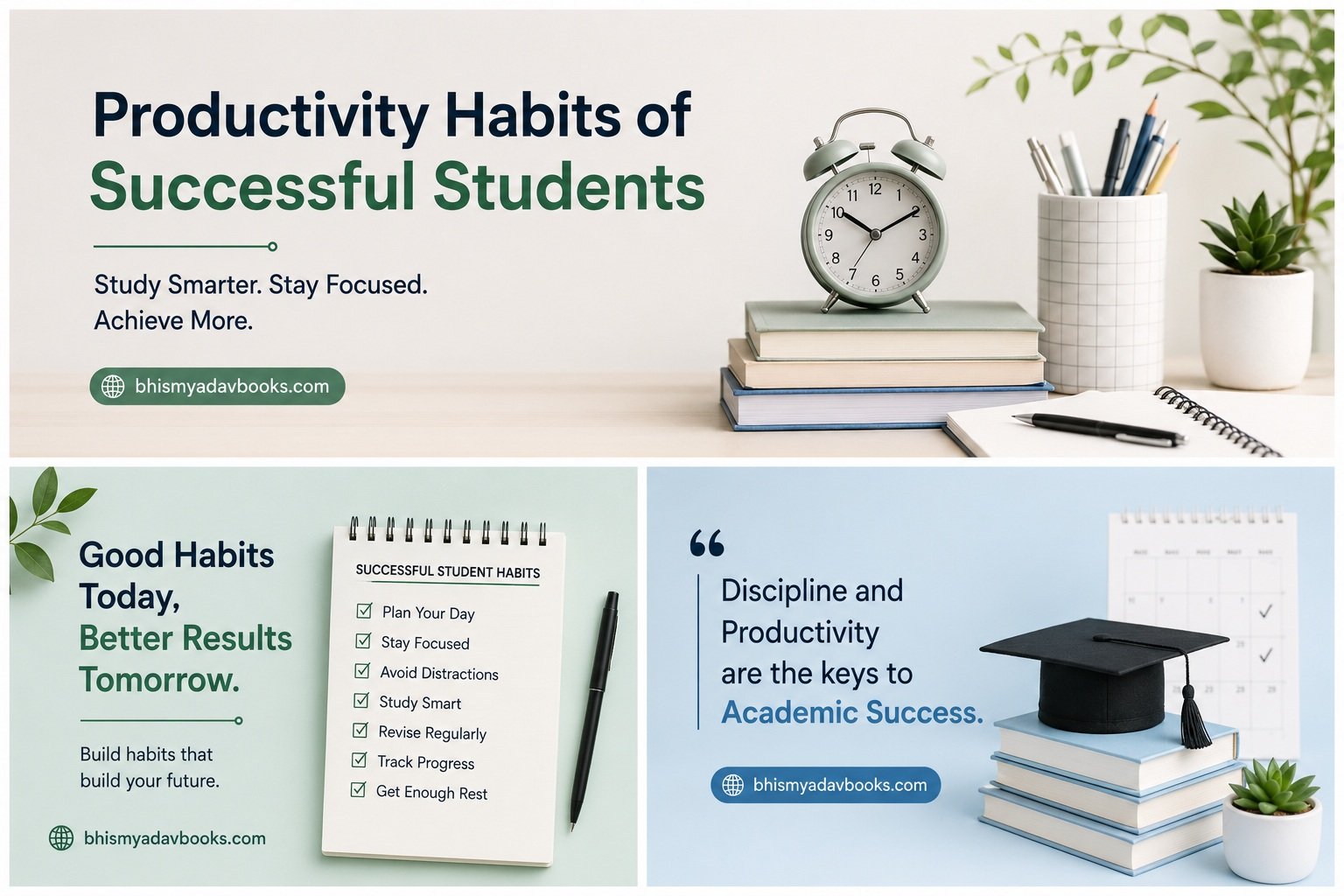
Introduction
Why do some students consistently complete their assignments on time, prepare properly for examinations, maintain good grades, and still find time for rest and personal activities?
It is easy to assume that successful students are naturally more intelligent, have exceptional memory, or simply study for more hours. In reality, academic productivity often depends less on the number of hours spent studying and more on how those hours are used.
Successful students usually develop systems and habits that help them decide what to study, when to study, how to maintain concentration, and how to make consistent progress.
These habits are not limited to school or college toppers. They can be useful for school students, university students, competitive exam aspirants, job aspirants, and anyone involved in long-term learning.
The good news is that productivity is not something you either have or do not have.
Productivity can be developed.
A student who frequently procrastinates today can gradually become more disciplined. A student who struggles with distractions can improve concentration. Someone who constantly feels overwhelmed by a large syllabus can learn to break it into manageable tasks.
The objective is not to become busy every minute of the day.
True productivity means using your available time and energy intelligently so that important work gets completed without unnecessary stress.
We have some amazing books at our Shop page you may want to buy.
Table of Contents
In this guide, we will explore the most important productivity habits of successful students, why they work, and how you can incorporate them into your own study routine.
Productivity Habits of Successful Students: 15 Powerful Habits to Study Smarter and Achieve More
What Does Productivity Mean for a Student?
Student productivity is often misunderstood.
Studying for ten or twelve hours does not automatically mean that a student has been productive.
Imagine two students.
One sits at a desk for eight hours. During those eight hours, the student frequently checks social media, watches short videos, responds to messages, changes subjects repeatedly, and studies without clear goals.
Another student studies for four focused hours. Before beginning, the student identifies important topics, removes distractions, completes specific tasks, practices questions, and reviews what was learned.
Who was more productive?
In most cases, the second student.
Therefore, productivity can be understood as:
Completing meaningful academic work efficiently while maintaining sufficient focus, energy, and consistency.
For students, productive work may include:
- Understanding an important chapter
- Revising previously studied material
- Practicing numerical problems
- Solving mock tests
- Preparing assignments
- Creating useful notes
- Reviewing mistakes
- Memorizing important concepts
- Preparing for examinations
- Developing academic or professional skills
Productivity is not about filling every available minute with work.
It is about making sure that your most important work actually gets done.
Why Productivity Habits Matter for Students
Academic success is rarely the result of one extraordinary study session.
It is usually the result of hundreds of ordinary study sessions performed consistently.
Consider a student who studies effectively for two hours every day.
Over 30 days, that becomes approximately:
2 hours × 30 days = 60 hours of focused study
Over six months, the accumulated effort becomes substantial.
This is why habits are powerful.
A habit reduces the need to make the same decision repeatedly. When studying becomes part of your routine, you spend less mental energy convincing yourself to begin.
Good productivity habits can help students:
- Complete the syllabus systematically
- Reduce last-minute exam pressure
- Improve concentration
- Avoid unnecessary procrastination
- Remember concepts more effectively
- Manage multiple subjects
- Create time for revision
- Maintain a healthier study-life balance
- Build confidence through consistent progress
Most importantly, productivity habits create predictability.
Instead of wondering, “Will I study today?” the question becomes, “What will I study today?”
That small change can transform your approach to learning.
1. Successful Students Plan Their Day Before It Begins
One of the most valuable productivity habits is simple:
Decide what you need to accomplish before you start working.
Without a plan, students often waste the first part of their study session deciding what to study.
They open one book, switch to another subject, check pending assignments, look at messages, and eventually realize that a significant amount of time has passed.
A simple daily plan removes this uncertainty.
Why Daily Planning Works
Your brain has limited attention.
If you continuously ask yourself:
“What should I do next?”
you are using mental energy that could have been spent studying.
Planning gives direction to your day.
Instead of writing:
Study mathematics
write:
Complete 20 algebra practice questions and review incorrect answers.
Instead of:
Study science
write:
Revise Chapter 5 and create a one-page summary.
The second version is measurable.
At the end of the study session, you know whether the task was completed.
Create a Simple Daily Study Plan
You do not need a complicated productivity application.
A notebook, planner, calendar, or simple digital task list can work.
Before sleeping or at the beginning of the morning, identify three to five important tasks.
For example:
Today’s Study Plan
- Revise yesterday’s mathematics lesson.
- Complete 25 mathematics practice questions.
- Read one chapter of history.
- Review 30 vocabulary words.
- Spend 30 minutes revising weak topics.
This gives your study day structure.
Avoid Overloading Your To-Do List
One common mistake students make is creating an unrealistic list.
They may write fifteen tasks and complete only four.
This creates unnecessary frustration.
A shorter list of important tasks is often more effective than a huge list of low-priority activities.
A useful question is:
“If I complete only three academic tasks today, which three will make the biggest difference?”
Start there.
2. They Set Clear Academic Goals
Productive students do not study without direction.
They usually have some understanding of what they are working toward.
Goals can exist at several levels.
Long-Term Goals
Examples:
- Score above 90% in final examinations
- Clear a competitive examination
- Improve mathematics performance
- Complete a professional certification
- Get admission to a preferred university
- Develop strong communication skills
These goals provide direction.
However, long-term goals alone are not enough.
“Get good marks” does not tell you what to do at 7:00 PM today.
Therefore, long-term goals need to be converted into smaller targets.
Monthly Goals
For example:
- Complete five chapters of mathematics
- Finish the first section of the science syllabus
- Attempt four mock tests
- Revise 500 vocabulary words
Weekly Goals
Examples:
- Complete Chapter 4
- Practice 100 questions
- Revise Chapters 1–3
- Take one timed mock test
Daily Goals
Examples:
- Read pages 40–60
- Solve 30 questions
- Revise 20 formulas
- Practice one essay
- Review yesterday’s mistakes
This creates a clear hierarchy:
Long-Term Goal → Monthly Target → Weekly Target → Daily Action
Successful students understand that ambitious goals are achieved through small repeated actions.
3. They Prioritize Important Tasks
Not every academic task has equal importance.
A productive student learns to identify which tasks deserve attention first.
Suppose you have:
- An examination tomorrow
- An assignment due next week
- Notes that need organizing
- A chapter you enjoy reading
- A difficult topic you have been avoiding
What should you do first?
The answer should be based on importance and urgency, not simply on what feels easiest.
Students often fall into a productivity trap:
They complete easy tasks because completing them feels satisfying.
Organizing notes, highlighting headings, arranging books, and making attractive timetables can create the feeling of productivity.
But if an important chapter remains unstudied, the most important work has not been done.
Use the Most Important Task Method
Every day, identify your Most Important Tasks (MITs).
For example:
MIT 1: Prepare for tomorrow’s physics test.
MIT 2: Complete the mathematics assignment.
MIT 3: Revise the weak chemistry topic.
Complete these before spending excessive time on low-priority activities.
This habit helps prevent an extremely common student problem:
Being busy without making meaningful progress.
4. They Start Difficult Work When Their Energy Is High
Every student has periods when concentration is naturally better.
For some students, this may be early morning.
For others, it may be afternoon or evening.
The important point is to identify your high-energy study period.
Then use that time for demanding work.
For example:
If your concentration is strongest from 6:00 AM to 8:00 AM, avoid spending that period organizing files or reading easy notes.
Use it for:
- Mathematics
- Numerical problems
- Difficult concepts
- Mock tests
- Analytical subjects
- Writing practice
- Complex chapters
Save lower-energy periods for simpler activities such as:
- Organizing notes
- Reading familiar material
- Flashcard review
- Planning
- Light revision
This is sometimes called energy management.
Time management asks:
“When do I have time?”
Energy management asks:
“When am I capable of doing my best work?”
Successful students consider both.
5. They Study at Consistent Times
Motivation is unreliable.
Some days you may feel excited to study.
Other days you may not.
If your entire study routine depends on motivation, consistency becomes difficult.
A more reliable approach is to create a regular study schedule.
For example:
6:30 AM – 7:30 AM: Revision
4:30 PM – 6:00 PM: Main study session
7:30 PM – 8:30 PM: Practice questions
9:00 PM – 9:20 PM: Quick review
Your exact schedule will depend on school, college, coaching classes, work, commuting, sleep, and personal responsibilities.
The specific timing is less important than consistency.
Why Consistent Study Times Help
When an activity is repeatedly performed at approximately the same time, it gradually becomes part of your routine.
At first, you may need significant discipline to begin.
After several weeks, starting becomes easier because your brain begins associating that time and environment with studying.
Think of it like brushing your teeth.
Most people do not spend twenty minutes debating whether they should brush their teeth.
It is simply part of the routine.
Studying can gradually become similar.
6. They Use Time Blocking
A long to-do list tells you what needs to be done.
Time blocking tells you when you are going to do it.
This is an important difference.
Suppose your task list contains:
- Mathematics
- Science revision
- English vocabulary
- Mock test
Without assigning time, these tasks can remain pending all day.
Instead, schedule them.
Example Student Time-Blocking Schedule
6:30–7:00 AM: Review formulas
7:00–8:00 AM: Mathematics practice
4:30–5:30 PM: Science Chapter 6
5:30–5:45 PM: Break
5:45–6:30 PM: English vocabulary
7:30–8:30 PM: Mock test
8:30–8:50 PM: Analyze mistakes
Now every task has a place.
Time blocking also prevents one subject from consuming your entire day.
For students preparing multiple subjects, this can be particularly useful.
Add Buffer Time
Do not schedule every minute.
Unexpected tasks happen.
A chapter may take longer than expected. A class may finish late. You may need extra rest.
Leave some flexible time in your schedule.
A productive timetable should provide structure without becoming impossible to follow.
7. They Break Large Tasks Into Small Steps
Large tasks create psychological resistance.
Consider these two instructions:
“Complete the entire mathematics syllabus.”
and
“Study quadratic equations for 30 minutes and solve 10 questions.”
Which feels easier to begin?
Usually the second.
The first task is vague and overwhelming.
The second task is specific and manageable.
This principle can be applied to almost any academic goal.
Instead of:
Prepare for final examinations
Break it into:
- List all subjects.
- List chapters for each subject.
- Mark strong and weak chapters.
- Prioritize high-value topics.
- Create weekly targets.
- Study one topic at a time.
- Practice questions.
- Revise regularly.
- Attempt mock tests.
- Analyze mistakes.
Suddenly, an enormous goal becomes a sequence of manageable actions.
Use the “Next Action” Question
Whenever you feel overwhelmed, ask:
“What is the smallest useful action I can take right now?”
It might be:
- Open the textbook.
- Read two pages.
- Solve five questions.
- Write one paragraph.
- Review ten flashcards.
Starting creates momentum.
Once you begin, continuing often becomes easier.
8. They Protect Their Attention
Time is important, but attention may be even more important.
You can have three free hours and still accomplish very little if your attention is constantly interrupted.
Modern students face an enormous number of distractions:
- Smartphones
- Social media
- Messaging applications
- Short-form videos
- Games
- Notifications
- Streaming platforms
- Unnecessary browsing
- Background conversations
Every interruption has a cost.
If you check your phone every few minutes, your study session becomes fragmented.
You may technically spend two hours at your desk while completing far less than two hours of genuine focused work.
Successful students learn to protect their attention.
Create a Distraction-Free Study Environment
Before studying:
- Put your phone away.
- Turn off unnecessary notifications.
- Close unrelated browser tabs.
- Keep only required books and materials nearby.
- Tell family members or roommates when you need uninterrupted study time, where practical.
- Keep water nearby.
- Prepare stationery before beginning.
The goal is to reduce reasons to leave your desk.
Keep Your Smartphone Out of Reach
Keeping your phone face-down on the desk may not be enough.
You know it is there.
A better option is to place it:
- In another room
- Inside a drawer
- In your bag
- At a distance from the study table
If you genuinely need your phone for studying, use focus mode or block distracting applications during study sessions.
Your phone is a useful tool.
But during focused study, you should control when you use it rather than allowing notifications to control your attention.
Productivity Is a System, Not a Single Trick
The habits discussed so far have one thing in common:
They reduce unnecessary decisions and distractions.
Successful students generally do not depend on one magical productivity technique.
Instead, they create a system:
Plan → Prioritize → Schedule → Focus → Complete → Review
Once this system becomes habitual, studying becomes more predictable.
You know what needs to be done.
You know when you will do it.
You know which tasks matter most.
And you create an environment that makes completing those tasks easier.
However, planning and concentration are only part of student productivity.
A student also needs effective methods for learning, managing procrastination, taking breaks, remembering information, maintaining energy, and tracking progress.
These are the habits we will explore in the next section.
9. Successful Students Learn to Control Procrastination
Procrastination is one of the biggest obstacles to student productivity.
Almost every student experiences it.
You know you need to study, but you tell yourself:
“I’ll start after checking my phone.”
“I still have plenty of time.”
“I’ll begin after dinner.”
“I’ll study properly from tomorrow.”
“I don’t feel motivated right now.”
One small delay becomes another, and suddenly an entire evening disappears.
The important thing to understand is that procrastination does not always mean laziness.
Students procrastinate for many reasons.
A task may feel:
- Too difficult
- Too large
- Too boring
- Too confusing
- Too stressful
- Too far from its deadline
- Unclear
- Emotionally uncomfortable
Sometimes students avoid studying because they are afraid of discovering how much they do not know.
The solution is not simply telling yourself to “work harder.”
You need strategies that make starting easier.
Use the Five-Minute Start
When you do not feel like studying, tell yourself:
“I only need to study for five minutes.”
Open your book.
Read one page.
Solve one question.
Write one paragraph.
Review one concept.
The objective is not to complete the entire task in five minutes.
The objective is to overcome the resistance to starting.
Beginning is often the hardest part.
Once you have studied for five minutes, you may naturally continue for another twenty or thirty minutes.
Make the First Step Extremely Easy
Suppose you need to write a long assignment.
Thinking about the entire assignment may feel overwhelming.
Instead, your first task could simply be:
Open the document and write the heading.
Then:
Write three points for the introduction.
Then:
Draft the first paragraph.
Small actions create momentum.
A productive student learns that you do not always need motivation before taking action.
Sometimes action creates motivation.
10. They Use Focused Study Sessions
Sitting at a desk for four uninterrupted hours is not necessarily the best way to study.
Concentration naturally fluctuates.
After working intensely for a period of time, your attention may begin to decline.
Successful students often structure study into focused blocks separated by short breaks.
One popular approach is:
25 minutes study + 5 minutes break
After several rounds, take a longer break.
However, 25 minutes is not a universal rule.
Some students work better with:
40 minutes study + 10 minutes break
Others prefer:
50 minutes study + 10 minutes break
Students with strong concentration may prefer:
60–90 minutes of deep study followed by a longer break.
The best duration is the one that allows you to remain genuinely focused.
What Should Happen During a Focus Session?
Before beginning, decide exactly what you will work on.
For example:
For the next 45 minutes, I will solve questions 1–25 from Chapter 7.
Then:
- Start the timer.
- Remove distractions.
- Work only on that task.
- Avoid checking messages.
- Stop or take a break when the session ends.
This gives the brain a clear boundary.
Instead of thinking:
“I have to study all evening,”
you think:
“I need to focus for the next 45 minutes.”
That feels much more manageable.
Track Focused Hours, Not Desk Hours
This is an important distinction.
Suppose you sit at your desk for six hours but spend two hours checking your phone, eating snacks, browsing the internet, and talking.
You did not complete six focused hours.
A more meaningful measure is:
How much genuinely focused study did I complete?
Tracking focused time can help you understand your real productivity.
11. They Take Breaks Without Losing Momentum
Some students believe taking breaks is a sign of laziness.
It is not.
Breaks can be part of a productive study system.
The key is taking the right kind of break.
A useful break should help you return to studying with better concentration.
Good break activities include:
- Walking around for a few minutes
- Stretching
- Drinking water
- Looking away from screens
- Taking a few slow breaths
- Eating a light snack
- Standing near a window
- Resting your eyes
The problem begins when a five-minute break turns into forty-five minutes.
This commonly happens when students open social media or start watching videos.
You tell yourself:
“Only one video.”
Then another appears.
And another.
Soon your break becomes longer than your study session.
Use Timed Breaks
If you struggle with long breaks, use a timer.
For example:
Study: 50 minutes
Break: 10 minutes
When the timer ends, return to your desk.
This creates boundaries around both work and rest.
Avoid Highly Stimulating Activities During Short Breaks
Short-form videos, gaming, and endless scrolling can make returning to a textbook feel comparatively boring.
During short study breaks, choose activities that allow your mind to relax rather than activities designed to capture your attention.
Remember:
The purpose of a study break is recovery, not escape.
12. They Practice Active Learning
One of the biggest differences between productive and unproductive studying is the way students interact with information.
Many students use passive methods such as:
- Reading the same chapter repeatedly
- Highlighting large sections
- Copying paragraphs into notebooks
- Watching lectures without taking useful notes
- Looking at solutions without attempting questions
These activities can create familiarity.
But familiarity is not always the same as learning.
You may read a page and think:
“Yes, I understand this.”
Then during an examination, you struggle to recall it without looking at the book.
Successful students increasingly shift toward active learning.
Active learning requires you to do something with the information.
Ask Questions While Studying
After reading a section, close the book and ask:
- What did I just learn?
- Can I explain it in my own words?
- What are the key points?
- Why does this concept work?
- How is it connected to another topic?
- Could I answer a question about it without looking?
This forces your brain to retrieve and process information.
Explain Concepts in Simple Language
Imagine you are teaching the topic to a younger student.
Can you explain it clearly without using the textbook?
If you cannot explain a concept simply, you may not understand it deeply enough yet.
Try this process:
- Study the concept.
- Close your notes.
- Explain it aloud.
- Identify where your explanation becomes unclear.
- Reopen your notes.
- Study the weak area.
- Explain it again.
This transforms studying from passive reading into active understanding.
13. They Use Active Recall
Active recall is one of the most useful learning habits for students.
Instead of repeatedly looking at information, you deliberately try to retrieve it from memory.
For example, suppose you are learning the parts of a cell.
A passive approach would be:
Read the list five times.
An active recall approach would be:
Read the material, close the book, and write down as many parts as you can remember.
Then compare your answer with the textbook.
The effort required to retrieve information strengthens your ability to recall it later.
Simple Active Recall Techniques
Flashcards
Write a question on one side and the answer on the other.
For example:
Question: What is photosynthesis?
Try answering before checking the other side.
Blank Page Method
After studying a topic, take a blank page and write everything you remember.
Then compare your notes with the original material.
Identify missing points.
Study them again.
Self-Testing
Create questions from your notes.
Instead of writing:
The mitochondria produces energy for the cell.
Turn it into:
What is the primary function of mitochondria?
Questions make revision more active.
Practice Questions
For mathematics, physics, reasoning, quantitative aptitude, and similar subjects, solving questions is essential.
Reading a solved problem is not equivalent to solving it yourself.
Attempt the question first.
Then check the solution.
14. They Review Information Regularly
Productive students understand that learning does not end when a chapter is completed.
Without revision, much of what you learn may gradually become harder to recall.
This is why revision should be part of your study schedule rather than something reserved for the final days before an examination.
A simple revision cycle might look like:
Day 1: Learn the topic.
Day 2: Quick review.
Day 7: Review again.
Day 15: Test yourself.
Day 30: Review difficult areas.
The exact intervals do not have to be identical for every subject.
The principle is more important:
Review information over time instead of relying on one long study session.
Why Spaced Revision Is Useful
Imagine studying a chapter for three hours once and never looking at it again for two months.
When the exam approaches, much of it may feel unfamiliar.
Now imagine reviewing the same chapter briefly several times across those two months.
Each review reminds your brain that the information remains important.
This makes long-term preparation more manageable.
Add Revision to Your Daily Schedule
A simple rule is:
New Learning + Old Revision
For example:
4:00–5:00 PM: Learn a new chapter.
5:15–5:45 PM: Revise yesterday’s material.
8:00–8:20 PM: Review older formulas.
This prevents revision from accumulating into an enormous task.
15. They Avoid Multitasking While Studying
Multitasking sounds productive.
You might imagine that studying while replying to messages, watching videos, listening to conversations, and checking notifications allows you to accomplish several things simultaneously.
In reality, your attention is often switching rapidly between tasks.
Every switch creates a mental cost.
You read a paragraph.
A message arrives.
You reply.
You return to the paragraph.
Now you need to remember where you were.
A notification appears.
You check it.
Again, your attention shifts.
After an hour, you may have spent a lot of time “studying” but absorbed very little.
Practice Single-Tasking
During a study block, choose one task.
For example:
For the next 40 minutes, I am only studying chemistry.
Not:
Chemistry + messages + social media + email + random browsing.
Single-tasking improves the quality of attention.
It can also make studying faster because you spend less time repeatedly rebuilding concentration.
Keep a Distraction List
Sometimes unrelated thoughts appear while studying:
“I need to buy something.”
“I should reply to that email.”
“I need to search for that video.”
“I forgot to call someone.”
Instead of immediately acting on the thought, write it on a small piece of paper.
Call it your distraction list.
After the study session, review the list and handle anything important.
This allows you to acknowledge the thought without abandoning your current task.
16. They Create a Study Environment That Encourages Productivity
Your environment influences your behavior more than you may realize.
A cluttered desk covered with unrelated objects can make concentration more difficult.
A television playing nearby creates another source of distraction.
A smartphone beside your notebook invites checking.
You do not need a luxurious study room.
You need an environment that makes focused studying easier.
Keep Your Study Space Simple
Ideally, your desk should contain only what you need for the current session:
- Textbook
- Notebook
- Pen or pencil
- Required stationery
- Water
- Computer or tablet, if necessary
Remove unrelated items.
A clean workspace reduces visual distractions.
Use the Same Place Regularly
If possible, study in a consistent location.
Over time, your brain begins associating that environment with focused work.
This could be:
- A desk in your room
- A library
- A quiet corner
- A study room
- A dedicated table
Avoid studying in bed whenever possible.
Your bed should primarily signal sleep and rest.
A dedicated study space creates a clearer psychological boundary between work and relaxation.
17. They Prepare Their Study Materials in Advance
Small interruptions can destroy momentum.
Imagine beginning a mathematics session and realizing your calculator is somewhere else.
You get up to find it.
While walking, you notice your phone.
You check a message.
Then another notification.
Ten minutes later, you have forgotten what you were doing.
Successful students reduce these unnecessary interruptions by preparing before they begin.
Before your study session, collect:
- Books
- Notes
- Pens
- Calculator
- Laptop charger
- Water
- Practice papers
- Flashcards
- Required files
Then begin.
This is a simple habit, but it reduces friction.
18. They Use Deadlines, Even When None Exist
Students often work differently when a deadline is approaching.
An assignment that could have been completed over two weeks is suddenly finished in one evening.
Why?
Because the deadline creates urgency.
Productive students learn to create their own deadlines.
Suppose an exam is three months away.
Instead of thinking:
“I have three months,”
create intermediate deadlines:
Week 1: Complete Chapters 1–3.
Week 2: Complete Chapters 4–6.
Week 3: First revision.
Week 4: Practice questions.
And so on.
Now progress becomes measurable.
Create Earlier Personal Deadlines
If an assignment is officially due on Friday, set your personal deadline for Wednesday.
This provides a buffer for unexpected problems.
If something goes wrong on Wednesday, you still have time.
Students who consistently work until the last possible moment leave no margin for mistakes.
19. They Use Accountability
It is easier to ignore a goal that exists only in your head.
Accountability creates an additional reason to follow through.
You might tell a friend:
“I’m completing Chapters 5 and 6 today. Ask me tonight whether I finished.”
Or you could study with a serious study partner.
The important word is serious.
A study partner should improve productivity, not turn study time into conversation time.
Accountability Methods for Students
You can use:
- A study partner
- A friend
- A sibling
- A teacher
- A mentor
- A study group
- A progress tracker
You can also create personal accountability.
At the end of each day, record:
Planned Tasks: 5
Completed Tasks: 4
Focused Study: 3 hours
Main Problem: Phone distraction
Tomorrow’s Improvement: Keep phone outside the room
This simple reflection makes your habits visible.
20. They Measure Progress, Not Just Effort
“I studied for five hours.”
That tells you how long you studied.
It does not tell you what you achieved.
A better question is:
What did I complete during those five hours?
Productive students track outcomes.
For example:
- Chapters completed
- Questions solved
- Mock tests attempted
- Accuracy percentage
- Topics revised
- Flashcards reviewed
- Assignments completed
Suppose two students both study for three hours.
Student A completes:
- 10 practice questions
Student B completes:
- 50 practice questions
- Reviews mistakes
- Revises two weak concepts
Time alone does not explain productivity.
Results matter.
Create a Weekly Progress Review
Once a week, ask yourself:
What did I complete this week?
List your achievements.
What did I fail to complete?
Be specific.
Why did I fall behind?
Possible reasons:
- Unrealistic schedule
- Phone distraction
- Poor sleep
- Difficult chapter
- Too many commitments
- Lack of planning
What should I change next week?
Maybe you need to:
- Reduce daily targets
- Start earlier
- Increase practice time
- Reduce phone use
- Add more revision
- Focus on weak subjects
This turns productivity into an improvement process.
Busy Students vs. Productive Students
There is an important difference between being busy and being productive.
A busy student may:
- Create elaborate notes
- Continuously reorganize study materials
- Spend hours making timetables
- Watch many motivational videos
- Highlight entire chapters
- Jump between subjects
- Study without measuring progress
A productive student asks:
“Is this activity helping me achieve my academic goal?”
Sometimes the answer is yes.
Sometimes it is no.
For example, creating notes can be useful.
But spending three hours decorating notes when you have not practiced important exam questions may not be the best use of time.
Similarly, watching educational videos can help explain difficult concepts.
But watching ten videos about “how to study” instead of actually studying becomes productive procrastination.
Use productivity techniques to support studying.
Do not allow productivity itself to become another distraction.
Build a Personal Productivity System
At this point, you may have noticed that successful students do not rely on a single habit.
Their productivity comes from a combination of behaviors.
A practical student productivity system might look like this:
Step 1: Decide your academic goals.
Step 2: Convert goals into weekly targets.
Step 3: Plan important tasks each day.
Step 4: Schedule focused study blocks.
Step 5: Remove distractions.
Step 6: Use active learning and practice questions.
Step 7: Take controlled breaks.
Step 8: Revise information regularly.
Step 9: Track completed work.
Step 10: Review your progress every week.
This creates a continuous cycle:
Plan → Study → Practice → Review → Improve
Productivity becomes less dependent on mood and more dependent on your system.
A Simple Example of a Productive Study Session
Suppose you have two hours available.
Instead of opening a book and studying randomly, structure the session.
0–5 Minutes: Preparation
- Put phone away.
- Prepare books and stationery.
- Write down the session goal.
Goal: Complete 30 mathematics questions and analyze mistakes.
5–50 Minutes: Focus Session 1
Solve the first set of questions without unnecessary interruptions.
50–60 Minutes: Break
Walk, stretch, drink water.
Avoid getting trapped in social media.
60–105 Minutes: Focus Session 2
Complete remaining questions.
105–115 Minutes: Mistake Review
Identify incorrect answers.
Ask:
- Why was my answer wrong?
- Did I misunderstand the concept?
- Was it a calculation mistake?
- Did I misread the question?
115–120 Minutes: Plan the Next Session
Write down what needs additional revision.
In only two hours, you have completed a structured cycle of:
Practice → Feedback → Correction → Planning
That is productive studying.
The Goal Is Sustainable Productivity
It is tempting to create an extreme routine after reading productivity advice.
You may decide:
“From tomorrow, I will wake up at 4:00 AM, study for twelve hours, exercise every day, stop using my phone completely, and finish the entire syllabus in one month.”
Such plans often last only a few days.
Sustainable productivity is different.
Instead of changing everything at once, improve gradually.
Start with:
- One daily plan
- One distraction-free study session
- One revision block
- One weekly review
Once these become consistent, add additional habits.
A productivity system that you can maintain for six months is far more valuable than an extreme routine you abandon after four days.
21. Successful Students Build a Productive Morning Routine
The way you begin your morning can influence the rest of your day.
A productive morning does not necessarily mean waking up at 4:00 AM.
There is no universal wake-up time that guarantees academic success.
A student who sleeps properly and wakes at 7:00 AM may be far more productive than someone who forces themselves to wake at 4:00 AM after sleeping for only four hours.
The objective of a morning routine is to create a calm and intentional start to the day.
A Simple Productive Morning Routine for Students
Your routine might include:
- Wake up at a consistent time.
- Drink water.
- Freshen up.
- Do a few minutes of stretching or movement.
- Review your daily priorities.
- Complete a short revision session.
- Eat breakfast.
- Prepare for school, college, coaching, work, or your main study session.
You do not need a complicated two-hour routine.
A simple routine that you can repeat consistently is better.
Avoid Starting the Day With Endless Scrolling
One useful productivity habit is delaying unnecessary phone use after waking up.
If the first thing you do is open social media, messages, videos, and news feeds, your attention immediately becomes reactive.
Instead of deciding what deserves your attention, you allow other people and algorithms to decide.
Try completing your basic morning routine before checking nonessential notifications.
Even 30–60 minutes of intentional time before entering the digital world can make your morning feel more controlled.
Use Morning Time for Quick Revision
Morning can be an excellent period for reviewing previously learned material.
You might spend 20–30 minutes on:
- Formulas
- Vocabulary
- Flashcards
- Important facts
- Definitions
- Previous-day notes
- Difficult concepts
This does not have to be your main study session.
Think of it as a quick academic warm-up.
22. They Create an Evening Shutdown Routine
Just as a morning routine can help you begin the day, an evening routine can help you finish it properly.
Many students stop studying only when they become exhausted.
They close their books, leave everything on the desk, and go to sleep without thinking about the next day.
The following morning, they need to decide everything again.
A short evening shutdown routine can prevent this.
A 10-Minute Evening Productivity Routine
Before ending your academic work for the day:
Step 1: Review What You Completed
Look at your daily plan.
Mark completed tasks.
Do not focus only on what remains unfinished.
Recognize what you actually accomplished.
Step 2: Move Unfinished Tasks
If something remains incomplete, decide when you will handle it.
Do not allow unfinished tasks to exist vaguely in your mind.
Step 3: Identify Tomorrow’s Priorities
Write your top three tasks for the next day.
For example:
- Complete chemistry Chapter 7.
- Solve 40 quantitative aptitude questions.
- Revise today’s mathematics mistakes.
Step 4: Prepare Your Materials
Keep required books, notes, and stationery ready.
Step 5: End the Study Day
Once the routine is complete, allow yourself to mentally disconnect from studying.
This creates a clear boundary between academic work and rest.
23. They Understand That Sleep Supports Productivity
Students sometimes sacrifice sleep because they believe more waking hours automatically mean more productive hours.
But studying while severely tired is rarely efficient.
You may read the same paragraph repeatedly.
You may make simple calculation errors.
You may struggle to remember information.
You may become easily distracted.
Sleep supports attention, memory, learning, emotional regulation, and overall functioning.
For teenagers, the American Academy of Sleep Medicine recommends 8–10 hours of sleep per 24 hours, while adults are generally advised to get 7 or more hours regularly. Individual needs can vary.
Avoid Making All-Nighters a Study Strategy
An occasional late night may happen because of an unexpected deadline.
But repeatedly relying on all-night study sessions is not a sustainable productivity system.
A better strategy is:
Start earlier + study consistently + revise regularly.
This reduces the need for emergency preparation.
Create a Consistent Sleep Schedule
Where practical, try to sleep and wake at approximately consistent times.
A regular schedule can make it easier to maintain energy throughout the day.
Your study timetable should be designed around adequate rest rather than treating sleep as whatever time remains after everything else.
24. They Use Physical Activity to Support Mental Performance
Studying is mentally demanding, but students often spend long periods sitting.
Regular movement can support general health, mood, and mental well-being.
You do not necessarily need an intense gym routine.
Depending on your health, circumstances, and preferences, physical activity might include:
- Walking
- Cycling
- Jogging
- Sports
- Stretching
- Yoga
- Bodyweight exercises
- Gym workouts
Even short movement breaks can be useful after long periods of sitting.
Add Movement Between Study Blocks
For example:
Study: 50 minutes
Break: 10 minutes
During the break:
- Stand up.
- Walk around.
- Stretch your shoulders.
- Move your legs.
- Drink water.
This is usually more refreshing than spending the entire break scrolling through your phone.
25. They Manage Energy, Not Just Time
Every person has the same 24 hours in a day.
But not every hour has the same quality.
At 9:00 AM, you may be energetic and focused.
At 3:00 PM, you may feel tired.
At 8:00 PM, your concentration may improve again.
Productive students pay attention to these patterns.
Identify Your Personal Energy Pattern
For one week, observe your concentration at different times.
You could rate your energy from 1 to 5.
For example:
6–8 AM: 4/5
10 AM–12 PM: 5/5
2–4 PM: 2/5
6–8 PM: 4/5
Your pattern may look completely different.
Once you identify your strongest periods, schedule demanding academic work there when your responsibilities allow it.
High-Energy Tasks
Use your strongest concentration periods for:
- Difficult mathematics
- Numerical problems
- Complex concepts
- Mock tests
- Essay writing
- Analytical reasoning
- Learning new material
Lower-Energy Tasks
Use lower-energy periods for:
- Organizing notes
- Flashcards
- Light reading
- Reviewing familiar concepts
- Planning
- Checking completed work
This helps you match the difficulty of the task to the quality of your attention.
26. They Know Their Productivity Triggers
Habits often become easier when they are connected to existing routines.
For example:
After breakfast → 30-minute revision
After returning from school → Rest → Study session
After dinner → Review flashcards
Before sleeping → Plan tomorrow
The first activity acts as a trigger for the next one.
This technique is often called habit stacking.
Instead of relying on the thought:
“I should revise sometime today,”
you create a specific connection:
“After breakfast, I will revise for 20 minutes.”
The more specific the cue, the easier the habit can become to remember.
Design a Study-Starting Ritual
You can also create a small ritual that tells your brain it is time to focus.
For example:
- Sit at your desk.
- Put your phone away.
- Fill your water bottle.
- Open the required book.
- Write the study objective.
- Start a timer.
- Begin.
Repeat this sequence consistently.
Over time, the routine itself can become a signal for focused work.
27. They Do Not Wait for Motivation
One of the most important productivity lessons for students is this:
You will not always feel motivated.
Motivation fluctuates.
After watching an inspiring video, you may feel ready to study for six hours.
Two days later, that excitement may disappear.
If studying happens only when motivation is high, progress becomes inconsistent.
Successful students develop routines that allow them to study even when enthusiasm is low.
Use the Minimum Study Rule
On a difficult day, instead of abandoning your routine completely, establish a minimum.
For example:
“Even on a bad day, I will study for at least 20 minutes.”
Or:
“I will complete at least 10 practice questions.”
The exact minimum should be realistic for your situation.
The purpose is to protect consistency.
You may begin intending to study for only 20 minutes and continue for an hour.
But even if you stop after 20 minutes, you maintained the habit.
Reduce the Target, Not the Habit
Imagine your normal goal is:
Study mathematics for 90 minutes.
Today you are exhausted.
Instead of doing nothing, study for 30 minutes.
Your output is lower, but the routine remains alive.
This is an important principle:
On difficult days, reduce the workload before abandoning the habit.
28. They Build Discipline Through Repetition
Discipline is sometimes imagined as an extraordinary personality trait.
In practice, much of student discipline comes from repeated behavior.
Every time you follow your planned study session despite a small distraction, you reinforce the behavior.
Every time you put your phone away before studying, the decision becomes slightly more familiar.
Every time you complete your daily revision, you strengthen the routine.
You do not need perfect discipline.
You need enough discipline to repeatedly make the next useful decision.
Make Good Habits Easier
Do not rely entirely on willpower.
Change your environment.
Want to read more?
Keep your book on the desk.
Want to use flashcards every morning?
Prepare them the previous night.
Want to stop checking your phone?
Keep it outside the study area.
Want to exercise?
Prepare your clothes beforehand.
Productivity improves when desirable behaviors are easy to begin.
Make Distractions More Difficult
Similarly, increase the effort required to access distractions.
You can:
- Log out of distracting websites.
- Remove unnecessary applications from your home screen.
- Disable nonessential notifications.
- Keep the phone away from the desk.
- Use website blockers during study sessions.
- Keep gaming devices outside your study area.
Even a small amount of extra friction can interrupt an automatic habit.
29. They Use Technology as a Tool, Not a Distraction
Technology can dramatically improve student productivity.
It can also destroy it.
The difference lies in how it is used.
Useful digital tools can help with:
- Scheduling
- Note-taking
- Flashcards
- Practice tests
- Online lectures
- Research
- Document storage
- Reminders
- Task management
- Progress tracking
But the same device may contain:
- Social media
- Games
- Streaming applications
- Short videos
- Notifications
- Group chats
Therefore, successful students create boundaries.
Separate Study Apps From Entertainment Apps
If possible, organize your device so that study tools are easily accessible while entertainment applications are less visible.
You might create a folder called:
Study
containing:
- Calendar
- Notes
- Calculator
- Flashcards
- Cloud storage
- PDF reader
- Educational apps
Then move entertainment apps away from the home screen.
This does not remove temptation completely, but it can reduce automatic checking.
Use Focus Mode
Many smartphones and computers include features that can limit notifications or access to distracting apps temporarily.
Use them during study blocks.
For example:
Focus Mode: 6:00 PM–8:00 PM
During this period, only essential calls or study applications are available.
Avoid Collecting Too Many Productivity Apps
Students sometimes spend more time experimenting with productivity tools than actually studying.
You do not need:
- Five calendars
- Seven note-taking apps
- Three habit trackers
- Multiple task managers
A simple system is usually enough.
For example:
Calendar: Important dates and exams
Task list: Daily academic tasks
Notes app: Quick information
Flashcard tool: Revision
The purpose of technology is to simplify your system.
If your productivity system requires constant maintenance, it may be too complicated.
30. They Limit Decision Fatigue
Students make many decisions every day.
What should I study?
Which subject first?
How long should I study?
Where should I study?
Should I revise or learn something new?
Repeated decisions consume mental energy.
Routines reduce this burden.
For example, instead of deciding every morning whether to revise, create a rule:
Morning = revision
Instead of choosing a difficult subject randomly:
First evening study block = hardest subject
Instead of deciding whether to use your phone:
Phone remains outside the room during focus sessions.
These rules simplify behavior.
The fewer unnecessary decisions you need to make, the more attention remains for actual learning.
31. They Review Their Week
Daily planning helps you execute tasks.
Weekly reviewing helps you improve the system itself.
Choose one day each week for a short review.
For many students, Sunday works well, but any day is fine.
Ask yourself:
1. What did I accomplish?
Write down completed chapters, tests, assignments, and other meaningful progress.
2. What remains incomplete?
Identify unfinished work.
3. Which subject received too little attention?
Maybe you spent most of the week studying mathematics while neglecting science.
4. What distracted me most?
Was it:
- Phone use?
- Social media?
- Gaming?
- Friends?
- Poor planning?
- Tiredness?
- An unrealistic schedule?
5. Which study method worked best?
Maybe practice questions helped more than rereading notes.
6. What needs to change next week?
Choose one or two improvements.
Do not attempt to redesign your entire life every Sunday.
Small adjustments are easier to maintain.
32. They Conduct a Monthly Academic Review
Weekly reviews focus on short-term execution.
Monthly reviews provide a broader view.
At the end of each month, examine your progress toward major academic goals.
You might track:
| Area | Monthly Target | Completed | Next Step |
| Mathematics | 5 chapters | 4 chapters | Finish Chapter 5 |
| Science | 4 chapters | 4 chapters | Start revision |
| Mock Tests | 8 tests | 6 tests | Increase to 2 per week |
| Vocabulary | 500 words | 420 words | Review weak words |
This allows you to make decisions based on evidence rather than feelings.
You might feel that you “didn’t study enough,” but your tracker may show substantial progress.
Or you may feel busy while the tracker reveals that important targets were repeatedly postponed.
Both insights are valuable.
33. They Track Their Mistakes
One of the most productive habits for exam preparation is maintaining a record of mistakes.
When you answer a practice question incorrectly, do not simply check the correct answer and move on.
Ask why the mistake happened.
Common categories include:
Conceptual Error
You did not understand the underlying concept.
Action: Study the concept again.
Memory Error
You understood it previously but could not recall the information.
Action: Add it to your revision system.
Calculation Error
You knew the method but made a numerical mistake.
Action: Slow down and practice calculation accuracy.
Reading Error
You misunderstood the question.
Action: Practice careful reading.
Time-Management Error
You spent too long on one question.
Action: Practice timed tests.
Guessing Error
You selected an option without sufficient reasoning.
Action: Improve elimination techniques or avoid unnecessary guessing depending on the exam format.
A mistake log turns errors into learning opportunities.
Before an examination, reviewing your mistake log can be more useful than randomly rereading everything.
34. They Learn From Mock Tests
Mock tests are not only tools for measuring scores.
They are diagnostic tools.
After every mock test, analyze:
- Total score
- Accuracy
- Questions attempted
- Correct answers
- Incorrect answers
- Unattempted questions
- Time spent per section
- Weak topics
- Repeated mistakes
Suppose your score remains low because you consistently lose marks in one chapter.
That tells you exactly where to focus.
Without analysis, you might continue studying topics you already know well.
Use the Test–Analyze–Improve Cycle
A productive mock-test system looks like:
Take Test → Analyze Errors → Revise Weak Topics → Practice → Retest
This is far more useful than simply taking test after test without examining mistakes.
35. They Recover Quickly After Falling Behind
Even the best productivity system will occasionally fail.
You may become sick.
A family responsibility may appear.
A difficult assignment may consume more time than expected.
You may spend an entire weekend procrastinating.
You may miss several study sessions.
The biggest mistake is turning a small setback into a long-term collapse.
A student misses Monday and thinks:
“My schedule is ruined.”
Then Tuesday is also wasted.
By Wednesday, restarting feels difficult.
Instead, use a simple rule:
Restart at the next available opportunity.
Do not wait for:
- Monday
- Next month
- A new semester
- New Year
- The perfect timetable
If you waste your morning, restart in the afternoon.
If you waste Monday, restart Tuesday.
If you lose a week, restart the following day.
Avoid the “Perfect Streak” Mentality
Consistency does not mean never missing a study session.
It means returning to your routine quickly when you do.
A useful principle is:
Try not to miss twice.
One missed session is an interruption.
Repeated missed sessions can become a new habit.
36. They Adjust Their Plans When Necessary
A timetable is a tool.
It is not a law.
If your schedule repeatedly fails, do not simply blame yourself.
Examine the schedule.
Maybe you planned six hours of study when you realistically have four.
Maybe your most difficult subject is scheduled when you are always tired.
Maybe you underestimated commuting time.
Maybe your breaks are too short.
Maybe you are attempting too many subjects each day.
Productive students adjust their systems based on reality.
A useful plan should be:
- Challenging
- Realistic
- Flexible
- Measurable
- Sustainable
If a timetable works only on perfect days, it is not a very useful timetable.
37. They Protect Time for Rest
Productivity does not mean working every waking minute.
Students need time for:
- Sleep
- Meals
- Exercise
- Family
- Friends
- Hobbies
- Relaxation
- Personal responsibilities
Constantly working without sufficient recovery can make it harder to maintain concentration and motivation.
Rest should not always be treated as something you must “earn.”
It is part of maintaining your ability to perform.
Schedule Guilt-Free Leisure
If you know that you have completed your important study targets, allow yourself to enjoy your free time.
For example:
4:00–7:00 PM: Study
7:00–8:00 PM: Dinner and rest
8:00–9:00 PM: Revision
After 9:00 PM: Relaxation
Clear boundaries can reduce the feeling that you should always be studying.
When it is time to work, work.
When it is time to rest, rest.
38. They Focus on Consistency Over Intensity
Consider two students.
Student A
Studies for 10 hours on Sunday.
Does almost nothing Monday through Saturday.
Student B
Studies for 2 focused hours every day.
Over a week:
Student A: 10 hours
Student B: 14 hours
But the difference is not only the number of hours.
Student B is repeatedly interacting with the material, reviewing concepts, and maintaining a study habit.
Consistency compounds.
Even relatively small daily efforts become significant over months.
This is why one of the most important productivity habits of successful students is:
Do something useful consistently.
You do not need extraordinary study days.
You need enough productive ordinary days.
39. They Focus on Progress Instead of Perfection
Perfectionism can look like productivity.
A student may spend hours making notes look perfect.
Another may repeatedly redesign a timetable because it does not feel ideal.
Someone may delay starting an assignment because they want the first draft to be excellent.
Perfectionism can become another form of procrastination.
Productive students understand:
Done well is often better than planned perfectly but never completed.
Your first notes do not need to be beautiful.
Your first practice test does not need to produce a high score.
Your first timetable does not need to be perfect.
Start.
Observe.
Improve.
Productivity is an iterative process.
40. They Compare Themselves With Their Previous Performance
Constantly comparing your study hours, grades, routines, and productivity with other students can be discouraging.
Another student may have:
- Different responsibilities
- Different academic strengths
- Different resources
- Different goals
- Different learning speed
- Different family circumstances
A more useful comparison is:
Am I improving compared with my previous performance?
For example:
Last month:
Mock test accuracy: 62%
This month:
Mock test accuracy: 74%
That is progress.
Last week:
Focused study: 12 hours
This week:
Focused study: 15 hours
That is progress.
Previously:
Phone checks during study: 15 times
Now:
Phone checks: 3 times
That is progress.
Small improvements accumulate.
A Sustainable Productivity Routine for Students
Putting these habits together might produce a daily routine like this:
Morning
6:30 AM: Wake up
6:45 AM: Freshen up and light movement
7:00–7:30 AM: Revision or flashcards
7:30 AM onward: Breakfast and daily responsibilities
Afternoon
After school, college, coaching, or work:
4:00–4:30 PM: Rest and snack
4:30–5:20 PM: Difficult subject
5:20–5:30 PM: Break
5:30–6:20 PM: Practice questions
6:20–6:40 PM: Review mistakes
Evening
7:30–8:20 PM: Second subject
8:20–8:30 PM: Break
8:30–9:00 PM: Revision
Before Bed
10 minutes: Review today’s progress and plan tomorrow.
This is only an example.
Do not copy another person’s timetable blindly.
Adapt your routine around your own responsibilities, energy levels, academic goals, and available time.
The Real Secret Behind Student Productivity
Productivity is rarely the result of one extraordinary technique.
It comes from many small decisions:
Choosing to begin instead of delaying.
Choosing one important task instead of ten trivial ones.
Choosing focused practice instead of passive rereading.
Choosing to put the phone away.
Choosing to review mistakes.
Choosing to sleep instead of repeatedly studying until exhaustion.
Choosing to return after an unproductive day.
Individually, these decisions may appear small.
Repeated over months and years, they can produce major differences in academic performance and personal discipline.
The goal is not to become a perfectly productive student.
The goal is to become slightly more organized, focused, and consistent than you were before.
How to Build Productive Study Habits Step by Step
A habit becomes valuable when it is repeated consistently.
Reading about productivity may give you ideas, but productivity improves when those ideas become behaviors.
Here is a practical process.
Step 1: Identify Your Biggest Productivity Problem
Do not begin by trying to fix everything.
Ask yourself:
“What is currently preventing me from studying effectively?”
Your answer might be:
- I check my phone constantly.
- I procrastinate before beginning.
- I do not have a study timetable.
- I forget what I study.
- I study for long hours but solve too few questions.
- I rarely revise.
- I sleep too late.
- I waste too much time on social media.
- I do not know which topics to prioritize.
- I keep changing my study plan.
Choose the problem that is having the greatest effect on your performance.
Then address that problem first.
For example, if your smartphone is responsible for most of your lost study time, improving your note-taking system may not be your highest priority.
Start with attention management.
Step 2: Choose One Small Habit
Suppose your problem is inconsistent studying.
Do not immediately create a five-hour daily timetable.
Start with:
“Every day at 7:00 PM, I will study for 30 minutes.”
Once this becomes consistent, increase the duration.
If your problem is revision, start with:
“Every evening, I will revise for 15 minutes.”
If your problem is smartphone distraction:
“My phone will stay outside my study area during the first study block.”
Small habits have less psychological resistance.
The objective is to create consistency before increasing difficulty.
Step 3: Make the Habit Specific
Vague goals are difficult to follow.
Consider:
“I will study more.”
What does “more” mean?
Compare it with:
“I will solve 20 mathematics questions between 6:00 PM and 6:45 PM.”
The second statement tells you:
- What to study
- How much to complete
- When to begin
- When to stop
The clearer your habit, the easier it is to execute.
A useful formula is:
I will [ACTION] at [TIME] in [PLACE].
For example:
“I will revise chemistry for 30 minutes at 7:00 PM at my study desk.”
Step 4: Attach the New Habit to an Existing Habit
Existing routines can act as reminders.
For example:
After breakfast → Review vocabulary
After returning from college → Rest → Begin first study block
After dinner → Revise formulas
Before sleeping → Plan tomorrow
You are connecting a new behavior to something that already happens regularly.
This reduces the chance of forgetting it.
Step 5: Remove Friction
Make productive behavior easy.
If you want to study in the morning, prepare your materials at night.
Keep:
- Books ready
- Notebook ready
- Pens available
- Required files open or organized
- Water bottle nearby
- Study desk clean
When study time arrives, you should be able to begin immediately.
Now do the opposite for distractions.
Make them harder to access.
For example:
- Keep your phone in another room.
- Log out of distracting websites.
- Disable unnecessary notifications.
- Remove entertainment applications from the home screen.
- Use focus mode during study hours.
Good productivity systems reduce friction for desirable behaviors and increase friction for undesirable ones.
Step 6: Track the Habit
Tracking makes progress visible.
A simple habit tracker might look like:
| Day | Daily Planning | Focused Study | Revision | Phone Controlled |
| Monday | ✓ | ✓ | ✓ | ✓ |
| Tuesday | ✓ | ✓ | ✓ | ✓ |
| Wednesday | ✓ | ✓ | ✗ | ✓ |
| Thursday | ✓ | ✓ | ✓ | ✗ |
| Friday | ✓ | ✓ | ✓ | ✓ |
You do not need a complicated application.
A notebook is enough.
The objective is not to create a perfect streak.
It is to understand your behavior.
Step 7: Review and Improve
At the end of each week, ask:
- Which habit worked?
- Which habit failed?
- What caused the failure?
- Was the target realistic?
- What distracted me?
- What should I change next week?
Productivity is not a fixed system.
It should evolve as your circumstances change.
Daily Productivity Checklist for Students
A checklist can simplify your routine.
You do not have to complete every item perfectly every day. Use it as a guide.
Morning Checklist
☐ Wake up at a reasonably consistent time.
☐ Avoid unnecessary phone scrolling immediately after waking.
☐ Review today’s priorities.
☐ Complete a short revision session if your schedule allows.
☐ Prepare for the day’s academic responsibilities.
Before Studying
☐ Decide what you will accomplish.
☐ Prepare books and stationery.
☐ Keep water nearby.
☐ Put the phone away or activate focus mode.
☐ Close unnecessary browser tabs.
☐ Set a timer if you use focused study blocks.
During Studying
☐ Work on one task at a time.
☐ Use active learning.
☐ Test yourself regularly.
☐ Solve practice questions.
☐ Record important mistakes.
☐ Take controlled breaks.
After Studying
☐ Mark completed tasks.
☐ Record unfinished work.
☐ Review important mistakes.
☐ Decide the next action.
☐ Prepare tomorrow’s priorities.
This checklist creates a repeatable process:
Prepare → Focus → Practice → Review → Plan
Productivity Mistakes Students Should Avoid
Knowing what not to do can be just as important as learning productive habits.
Here are several common mistakes.
Mistake 1: Creating an Unrealistic Timetable
A student who currently studies for one hour a day may create a timetable requiring eight hours.
The plan looks impressive.
But it is rarely sustainable.
After failing to follow it, the student feels guilty and concludes:
“I have no discipline.”
The problem may not be discipline.
The problem may be the timetable.
Build gradually.
If you currently study for one focused hour, try increasing to 90 minutes.
Once that becomes comfortable, increase again.
Mistake 2: Copying Another Student’s Routine
Productivity videos often show routines such as:
“Wake up at 4:30 AM.”
“Study for 10 hours.”
“Exercise at 5:00 AM.”
“Read 50 pages.”
These routines may work for the person sharing them.
They may not work for you.
Your routine must consider:
- School or college schedule
- Coaching classes
- Job responsibilities
- Commute
- Family responsibilities
- Sleep needs
- Energy levels
- Academic goals
Use other routines for inspiration.
Do not treat them as universal rules.
Mistake 3: Spending Too Much Time Planning
Planning is useful.
Overplanning is procrastination disguised as productivity.
Some students repeatedly:
- Redesign timetables
- Change productivity apps
- Organize notebooks
- Watch study videos
- Create elaborate trackers
- Research study techniques
But they spend very little time actually studying.
Remember:
The purpose of a productivity system is to help you do the work.
Once your plan is good enough, begin.
Mistake 4: Measuring Productivity Only by Study Hours
Hours matter, but they are only one metric.
Instead of saying:
“I studied for five hours,”
also ask:
“What did I accomplish?”
Track:
- Chapters completed
- Questions solved
- Topics revised
- Mock tests completed
- Mistakes corrected
- Accuracy improved
A focused three-hour session may produce more meaningful progress than six distracted hours.
Mistake 5: Ignoring Weak Subjects
Students naturally prefer subjects they understand.
Studying a strong subject feels comfortable because progress comes easily.
Weak subjects create discomfort.
Therefore, students may repeatedly postpone them.
But academic improvement often comes from working on weaknesses.
Identify your weak areas and give them scheduled attention.
Do not spend all your time polishing what is already strong.
Mistake 6: Using Passive Study Methods
Reading the same chapter repeatedly can feel productive.
But recognition is not the same as recall.
Combine reading with:
- Self-testing
- Practice questions
- Flashcards
- Writing from memory
- Explaining concepts
- Mock tests
Ask yourself:
“Can I produce this information without looking at the answer?”
That is a stronger test of learning.
Mistake 7: Ignoring Mistakes
A wrong answer contains information.
It tells you where your knowledge, memory, reading, calculation, or strategy failed.
Simply checking the correct option and moving on wastes that information.
Review mistakes.
Classify them.
Correct the underlying problem.
Then test yourself again.
Mistake 8: Sacrificing Sleep Repeatedly
Students may believe sleeping less creates more study time.
But additional waking hours are not automatically productive hours.
A sustainable routine should leave enough room for sleep and recovery.
Long-term academic success requires maintaining your ability to concentrate and learn.
Mistake 9: Trying to Be Productive Every Minute
You are a student, not a machine.
You need breaks.
You need meals.
You need sleep.
You may need exercise, family time, social interaction, hobbies, and entertainment.
Productivity is about using working time effectively—not eliminating every nonacademic activity from your life.
Mistake 10: Giving Up After One Bad Day
You planned to study for four hours.
You studied for one.
That does not mean your entire productivity system has failed.
Do not respond by abandoning the next day too.
Restart.
One unproductive day matters far less than the habit of repeatedly returning to your routine.
A 7-Day Productivity Challenge for Students
If you want to apply the ideas from this article, try this simple seven-day challenge.
Do not attempt to become perfect.
The objective is to experience how small changes affect your study routine.
Day 1: Plan Your Day
Before studying, write down your three most important academic tasks.
Complete the most important one first.
At night, check how many tasks you completed.
Day 2: Remove Your Biggest Distraction
Identify your biggest distraction.
For many students, it will be the smartphone.
During your main study block:
- Put the phone away.
- Disable notifications.
- Avoid unnecessary websites.
Complete at least one distraction-free study session.
Day 3: Practice Active Recall
Choose one topic.
Study it normally.
Then close your book and write everything you remember.
Compare your answer with your notes.
Identify what you forgot.
Review those areas.
Day 4: Use Focused Study Blocks
Try:
45 minutes study + 10 minutes break
Complete three rounds if your schedule allows.
During the 45-minute period, work on only one academic task.
Day 5: Attack a Weak Topic
Choose one subject or chapter you have been avoiding.
Spend your best concentration period working on it.
Do not try to master the entire subject.
Complete one meaningful section.
Day 6: Take a Practice Test
Attempt a short test under timed conditions.
Then spend time analyzing the results.
Write down:
- Correct answers
- Incorrect answers
- Weak topics
- Careless mistakes
- Time-management problems
Create an improvement plan.
Day 7: Conduct a Weekly Review
Ask yourself:
- What did I accomplish?
- Which habit helped me most?
- What distracted me?
- Which subject needs more attention?
- What should I improve next week?
Then plan the following week.
If one of these habits produced a noticeable improvement, continue using it.
Productivity Habits for Competitive Exam Aspirants
Productivity becomes especially important when preparing for competitive examinations.
Competitive exam aspirants often face:
- Large syllabi
- Multiple subjects
- Limited preparation time
- High competition
- Negative marking
- Speed requirements
- Accuracy requirements
- Frequent mock tests
Therefore, studying randomly is rarely enough.
You need a structured system.
1. Understand the Exam Pattern
Before creating a study plan, understand:
- Subjects
- Sections
- Number of questions
- Marks
- Time limit
- Negative marking
- Syllabus
- Previous-year trends
Your preparation strategy should reflect the actual examination.
2. Divide the Syllabus
Do not treat the syllabus as one enormous task.
Divide it into:
Subjects → Chapters → Topics → Daily Tasks
Then mark each topic:
Strong
Average
Weak
This helps you prioritize.
3. Balance Learning, Practice and Revision
Competitive exam preparation should generally include all three.
Learning
Understand concepts and methods.
Practice
Solve questions and apply concepts.
Revision
Maintain previously learned information.
Ignoring any one of these can create problems.
4. Practice Under Time Pressure
Knowing how to solve a question is different from solving it quickly during an examination.
Include timed practice.
For example:
20 questions in 20 minutes
or
One full section under examination conditions
Then analyze both speed and accuracy.
5. Maintain an Error Notebook
Record recurring mistakes.
You might create categories:
Mathematics Errors
Reasoning Errors
General Awareness Errors
English Errors
Before mock tests, review this notebook.
The objective is to avoid repeating the same mistakes.
6. Track Accuracy
For many competitive examinations, accuracy is extremely important.
Suppose you attempt 100 questions.
If 80 are correct:
Accuracy = 80%
Track this over time.
Your objective should not simply be:
“Attempt more questions.”
It should be:
Improve speed while maintaining strong accuracy.
7. Analyze Every Mock Test
Do not judge a mock test only by the score.
Ask:
- Which questions were wrong?
- Which questions took too long?
- Which topics were weak?
- Which errors were careless?
- Did I choose sections in the right order?
- Did I spend too much time on difficult questions?
A mock test should influence your next study sessions.
8. Revise High-Value Information Regularly
Some information requires frequent review.
Depending on the examination, this might include:
- Formulas
- Vocabulary
- Facts
- Dates
- Rules
- Shortcuts
- Concepts
- Frequently tested information
Keep these materials concise and easy to revise.
9. Practice Previous-Year Questions
Previous-year questions can help you understand:
- Question style
- Difficulty
- Repeated concepts
- Important topics
- Time requirements
Use them as part of your preparation rather than waiting until the end.
10. Keep Your Strategy Simple
Competitive exam preparation can become confusing because there are countless:
- Books
- Teachers
- Courses
- YouTube channels
- Apps
- Notes
- Strategies
Collecting too many resources creates another problem.
Choose reliable resources and use them thoroughly.
Completing one good book with practice and revision is often better than partially reading ten books.
How Successful Students Handle Exam Season
As examinations approach, productivity becomes more important.
Instead of dramatically increasing study hours overnight, focus on better prioritization.
Four Weeks Before the Exam
Focus on:
- Completing remaining syllabus
- Identifying weak areas
- Regular revision
- Practice questions
Two Weeks Before the Exam
Increase emphasis on:
- Revision
- Mock tests
- Previous-year questions
- Weak topics
- Error review
Final Week
Focus on:
- High-value revision
- Important formulas
- Key concepts
- Mistake notebook
- Selected practice
Avoid creating unnecessary panic by starting large amounts of completely new material unless it is genuinely necessary.
The Day Before the Exam
Your approach will depend on the examination, but generally prioritize:
- Concise revision
- Important information
- Required exam materials
- Travel or logistics
- Adequate rest
A calm and prepared mind is more useful than an exhausted mind after an unnecessary all-night study session.
How to Know Whether Your Productivity System Is Working
Your productivity system should create measurable improvements over time.
Look for signs such as:
- You begin studying with less resistance.
- Your daily tasks become clearer.
- You check your phone less often.
- You complete more important work.
- You remember more after revision.
- Your practice accuracy improves.
- You repeat fewer mistakes.
- You finish assignments earlier.
- Your mock-test performance improves.
- You feel less dependent on last-minute studying.
You do not need every indicator to improve immediately.
Productivity develops gradually.
Recommended books for Job Aspirants
Frequently Asked Questions About Productivity Habits of Successful Students
1. What are the most important productivity habits of successful students?
Some of the most useful habits include daily planning, setting clear goals, prioritizing important tasks, studying at consistent times, removing distractions, using active recall, revising regularly, solving practice questions, tracking mistakes, getting sufficient rest, and reviewing progress.
The exact combination will vary from student to student.
2. How many hours do successful students study every day?
There is no universal number.
Required study time depends on factors such as:
- Academic level
- Examination difficulty
- Existing knowledge
- Available time
- Learning speed
- School or college schedule
- Individual goals
Rather than copying another student’s study hours, focus on consistent, high-quality study sessions and measurable progress.
3. How can I become more productive while studying?
Begin by removing distractions and defining a clear goal for each study session.
Instead of saying:
“I will study chemistry.”
say:
“I will complete Chapter 4 and solve 20 questions.”
Use focused study blocks, take controlled breaks, test yourself, and review your progress afterward.
4. How can students stop procrastinating?
Make the first step smaller.
If studying for two hours feels difficult, begin with five minutes.
Break large tasks into manageable actions.
Instead of:
“Complete the whole syllabus,”
focus on:
“Read five pages and solve five questions.”
Starting often reduces resistance.
5. Is studying early in the morning more productive?
For some students, yes.
For others, no.
Your most productive study time depends on your sleep schedule, responsibilities, and natural energy patterns.
The best time to study is generally when you can maintain strong concentration consistently without sacrificing adequate sleep.
6. Is the Pomodoro Technique good for students?
It can be useful, particularly for students who struggle with long study sessions.
A common version uses:
25 minutes of focused work + 5 minutes of rest.
However, you can adjust the duration.
For example:
45 minutes study + 10 minutes break
or
50 minutes study + 10 minutes break.
Choose a structure that helps you maintain concentration.
7. How can I avoid my phone while studying?
Try:
- Keeping the phone in another room
- Using focus mode
- Turning off notifications
- Removing distracting apps from the home screen
- Using website or app blockers
- Checking messages only during designated times
Physical distance is often one of the simplest solutions.
8. Should I study one subject or multiple subjects every day?
This depends on your goals and schedule.
Studying multiple subjects can help maintain balance, especially when preparing for examinations containing several sections.
However, switching subjects too frequently can reduce deep focus.
A practical approach is to assign substantial study blocks to two or three important subjects rather than changing subjects every few minutes.
9. How can I stay productive when I do not feel motivated?
Do not depend entirely on motivation.
Create a minimum study target.
For example:
“Even on low-motivation days, I will study for 20 minutes.”
Starting may create momentum.
If not, you have still protected the habit.
10. What is the best productivity habit for students?
There is no single best habit for everyone.
However, one of the strongest foundations is:
Planning important tasks and completing them in distraction-free focused sessions.
This combines direction with execution.
11. Is multitasking good for studying?
Generally, focused single-tasking is a better approach for demanding academic work.
Switching repeatedly between studying, messaging, videos, and social media fragments attention.
Choose one academic task and work on it for a defined period.
12. How can I improve concentration while studying?
Try:
- Keeping your phone away
- Studying in a consistent location
- Using focused study blocks
- Taking appropriate breaks
- Setting specific study goals
- Keeping only required materials nearby
- Getting adequate sleep
- Practicing concentration regularly
Concentration can improve with consistent practice.
13. Should students make daily to-do lists?
Yes, if they are kept realistic.
A useful list should focus on specific actions.
Instead of:
Study mathematics
write:
Solve 30 algebra questions and review mistakes.
Specific tasks are easier to measure.
14. How can I study smarter instead of longer?
Use learning methods that require active engagement.
Examples include:
- Active recall
- Self-testing
- Practice questions
- Spaced revision
- Teaching concepts
- Error analysis
- Mock tests
Measure what you learn and complete rather than simply counting hours at your desk.
15. How long does it take to build productive study habits?
There is no fixed number of days that applies to everyone.
Habit development depends on the behavior, your environment, frequency, difficulty, and consistency.
Instead of worrying about an exact number of days, focus on repeating the habit until it becomes a normal part of your routine.
Final Productivity Formula for Students
If the entire article had to be reduced to one practical system, it could be summarized as:
Set Goals → Plan Tasks → Prioritize → Remove Distractions → Focus → Practice → Revise → Track Mistakes → Review Progress → Improve
Repeat the cycle.
You do not need to master every productivity technique.
You need a small collection of useful habits that you can follow consistently.
Final Thoughts: Productivity Is Built One Day at a Time
Successful students are not productive because every day goes perfectly.
They have bad days.
They procrastinate occasionally.
They become distracted.
They get tired.
They sometimes perform poorly on tests.
The important difference is what happens afterward.
They return.
They review what went wrong.
They adjust the plan.
They begin again.
That is what sustainable productivity looks like.
Do not wait until you have the perfect timetable, perfect motivation, perfect study environment, or perfect collection of resources.
Start with what you have.
Plan tomorrow’s three most important tasks.
Complete one distraction-free study session.
Review what you learned.
Then repeat the process the next day.
Over weeks, these actions become habits.
Over months, those habits produce progress.
And over years, the discipline developed through studying can extend far beyond academic life.
The productivity habits of successful students are ultimately not about squeezing more work into every hour.
They are about learning to direct your time, energy, and attention toward what matters most.
Study with purpose.
Work with focus.
Review your progress.
Rest when necessary.
And keep moving forward.