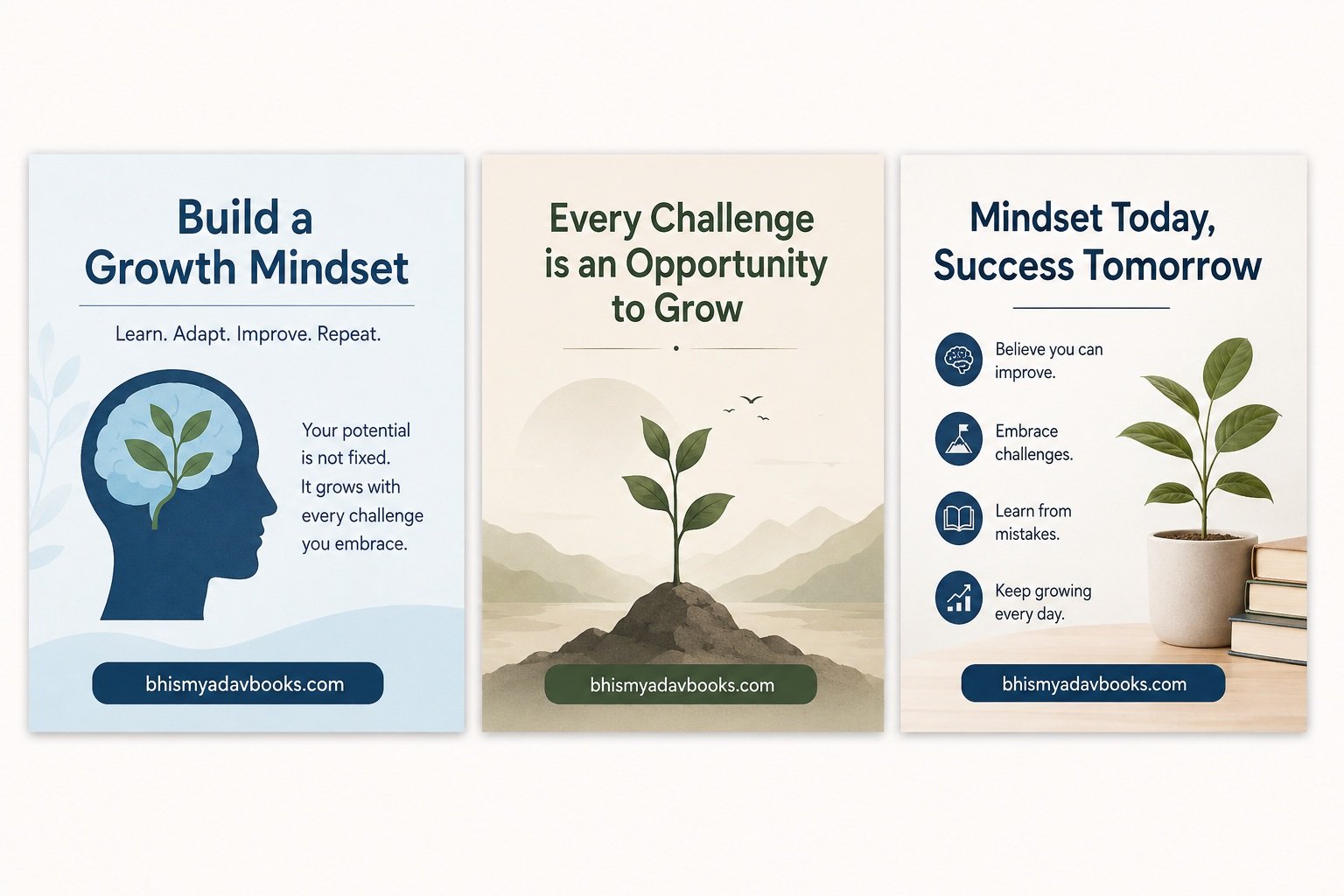
Understanding the Growth Mindset and Why It Matters
Success is rarely an accident. While talent, intelligence, and opportunities certainly play important roles, one factor consistently separates highly successful people from everyone else—their mindset. The way you think about challenges, failures, learning, and improvement determines whether you continue growing or remain stuck in the same place.
A growth mindset is the belief that your abilities, intelligence, and skills can be developed through consistent effort, effective learning strategies, perseverance, and feedback. Instead of believing that talent alone determines success, people with a growth mindset understand that improvement is always possible.
This simple but powerful belief changes how students prepare for exams, how professionals develop their careers, how entrepreneurs overcome setbacks, and how individuals achieve lifelong success.
In today’s competitive world, knowledge changes rapidly, technology evolves constantly, and new skills become essential every year. Having a growth mindset allows you to adapt, learn continuously, and stay ahead regardless of your starting point.
We have some amazing books at our Shop page you may want to buy.
This comprehensive guide will explain everything you need to know about building a growth mindset and transforming it into your greatest advantage.
Table of Contents
Build a Growth Mindset: The Ultimate Guide to Achieving Long-Term Success in Studies, Career, and Life
What Is a Growth Mindset?
The term growth mindset describes the belief that intelligence, talents, and abilities are not fixed characteristics but can improve through learning, practice, discipline, and persistence.
People with this mindset believe:
- Intelligence grows through learning.
- Skills improve with consistent practice.
- Mistakes are opportunities to learn.
- Challenges develop strength.
- Hard work creates improvement.
- Feedback helps growth.
- Success comes through continuous learning.
Instead of asking:
“Am I smart enough?”
They ask:
“How can I become smarter?”
This small difference completely changes the way people approach learning and success.
Fixed Mindset vs Growth Mindset
Understanding the difference is the first step toward personal transformation.
| Fixed Mindset | Growth Mindset |
| Intelligence is fixed | Intelligence can grow |
| Avoids challenges | Welcomes challenges |
| Gives up easily | Keeps trying |
| Sees effort as unnecessary | Believes effort leads to mastery |
| Ignores feedback | Learns from feedback |
| Feels threatened by others’ success | Gets inspired by others’ success |
| Avoids mistakes | Learns from mistakes |
People with a fixed mindset often stop trying after failure because they believe they have reached their limits.
People with a growth mindset believe every failure teaches something valuable.
Why Growth Mindset Is Important
A growth mindset influences every area of life.
Academic Success
Students who believe they can improve:
- Study consistently
- Ask questions
- Practice more
- Learn from mistakes
- Score higher over time
Instead of fearing difficult subjects, they see them as opportunities to become stronger learners.
Career Growth
Employers value people who:
- Learn new technologies
- Adapt quickly
- Solve problems
- Accept feedback
- Improve continuously
A growth mindset helps professionals stay relevant in changing industries.
Better Relationships
People who believe they can improve communication, patience, and understanding build healthier relationships because they work on themselves instead of blaming others.
Personal Development
Growth-minded individuals constantly improve:
- Health
- Communication
- Leadership
- Financial knowledge
- Emotional intelligence
- Productivity
- Confidence
The Science Behind Growth Mindset
Modern neuroscience proves that the brain changes throughout life.
This ability is called neuroplasticity.
Every time you learn something new:
- New neural connections form.
- Existing connections become stronger.
- Skills become easier with repetition.
This means your brain literally becomes better through learning.
Examples include:
- Learning mathematics
- Practicing public speaking
- Coding
- Learning languages
- Playing music
- Sports
- Writing
The more you practice correctly, the stronger your brain becomes.
Common Myths About Success
Many people unknowingly hold beliefs that limit their potential.
Myth 1: Successful People Are Born Talented
Reality:
Every expert was once a beginner.
Doctors, scientists, athletes, programmers, and entrepreneurs all spent years learning and improving.
Myth 2: Failure Means You Are Not Good Enough
Reality:
Failure is information.
Every mistake teaches what needs improvement.
Many successful inventors failed hundreds or even thousands of times before succeeding.
Myth 3: Smart People Never Struggle
Reality:
Highly successful people struggle constantly.
The difference is that they keep learning instead of giving up.
Myth 4: Hard Work Isn’t Enough
Hard work alone isn’t enough.
But smart effort combined with learning, feedback, and consistency creates extraordinary results.
Characteristics of People with a Growth Mindset
People who build long-term success often display these qualities.
They Love Learning
Instead of trying to appear intelligent, they focus on becoming more knowledgeable every day.
Learning becomes a lifelong habit.
They Welcome Challenges
They understand that easy tasks produce little growth.
Difficult tasks build stronger abilities.
They Learn from Criticism
Constructive criticism becomes valuable guidance instead of personal attacks.
They ask:
“What can I improve?”
They Stay Curious
Curiosity keeps learning enjoyable.
They ask questions like:
- Why?
- How?
- What if?
- Can this be improved?
Curiosity drives innovation.
They Celebrate Progress
Rather than comparing themselves with others, they compare themselves with yesterday.
Even small improvements matter.
Signs You May Have a Fixed Mindset
Many people unknowingly limit themselves.
Warning signs include:
- Fear of failure
- Avoiding difficult tasks
- Feeling jealous of successful people
- Giving up quickly
- Saying “I’m just not good at this.”
- Ignoring feedback
- Believing intelligence cannot change
- Avoiding learning opportunities
Fortunately, these beliefs can change.
Why Students Need a Growth Mindset
Students face constant challenges:
- Competitive exams
- Difficult subjects
- Low marks
- Pressure
- Time management
- Career uncertainty
A growth mindset helps students:
- Stay motivated
- Improve study habits
- Learn from mistakes
- Build confidence
- Develop resilience
- Score better over time
Instead of fearing exams, they focus on becoming better learners every day.
Real-Life Examples of Growth Mindset
Thomas Edison
Edison performed thousands of experiments before inventing the practical light bulb.
Instead of calling them failures, he viewed them as discoveries of methods that did not work.
Michael Jordan
One of the greatest basketball players in history was cut from his high school basketball team.
Instead of quitting, he practiced harder.
J.K. Rowling
Before publishing the Harry Potter series, her manuscript was rejected multiple times.
Persistence eventually changed literary history.
Steve Jobs
Steve Jobs was removed from Apple, the company he founded.
Rather than giving up, he continued innovating and later returned to transform Apple into one of the world’s most valuable companies.
Benefits of Building a Growth Mindset
When practiced consistently, a growth mindset provides lasting benefits:
Better confidence
Confidence grows through repeated achievement.
Higher motivation
You become excited about learning instead of fearing mistakes.
Improved problem-solving
Challenges become puzzles instead of obstacles.
Greater resilience
Failures become temporary instead of permanent.
Better emotional control
Growth-minded individuals recover faster from disappointments.
Increased creativity
Trying new ideas becomes less frightening.
Lifelong learning
Continuous learning keeps you competitive throughout life.
The First Step Toward Building a Growth Mindset
Transformation begins with one decision.
Replace this thought:
“I can’t do this.”
With:
“I can’t do this yet.”
That single word—yet—changes your future.
It reminds you that learning is a journey rather than a fixed destination.
Every expert, leader, scientist, entrepreneur, athlete, and successful student once started as a beginner. Their greatest advantage was not extraordinary talent but the willingness to learn, adapt, and keep improving despite setbacks.
Build a Growth Mindset: The Ultimate Guide to Achieving Long-Term Success in Studies, Career, and Life
Practical Strategies to Build a Growth Mindset
Understanding what a growth mindset is only marks the beginning of your journey. The real transformation occurs when you consistently apply growth-oriented habits in your daily life. Every successful student, entrepreneur, athlete, scientist, and leader has one thing in common—they deliberately practice habits that strengthen their ability to learn, adapt, and improve.
The encouraging news is that a growth mindset is not an inborn gift. It is a skill that can be developed through awareness, discipline, and consistent action. By making small improvements every day, you gradually reshape your thinking, increase your confidence, and unlock your true potential.
This section explores practical techniques that you can start using immediately to build a growth mindset and create a strong foundation for long-term success.
1. Believe That Improvement Is Always Possible
The first step toward developing a growth mindset is changing your beliefs.
Many people unknowingly limit themselves by saying:
- “I’m not intelligent enough.”
- “I’m bad at mathematics.”
- “I can’t speak confidently.”
- “I’ll never learn coding.”
- “I’m not creative.”
These statements create invisible barriers that stop progress before it even begins.
Instead, replace them with empowering beliefs such as:
- “I can improve with practice.”
- “Every day I become better.”
- “Learning takes time.”
- “Every expert started as a beginner.”
- “I haven’t mastered this skill yet.”
Your beliefs influence your actions. When you believe improvement is possible, you naturally put in more effort and remain persistent even when progress is slow.
2. Replace Negative Self-Talk with Positive Learning Statements
Your inner dialogue shapes your confidence.
Negative thoughts often sound like:
- I always fail.
- This is too difficult.
- Others are smarter than me.
- I’ll never understand this.
Instead, consciously replace them with constructive statements.
Examples
| Negative Thought | Growth Mindset Alternative |
| I failed. | I learned something valuable. |
| This is impossible. | This is challenging, but I can improve. |
| I’m not smart. | I can become smarter through learning. |
| I made mistakes. | Mistakes help me grow. |
| I can’t do it. | I can’t do it yet. |
Practicing positive self-talk reduces fear and encourages continuous learning.
3. Embrace Challenges Instead of Avoiding Them
Most people choose easy tasks because they fear failure.
Unfortunately, easy tasks rarely lead to meaningful growth.
Every challenge develops important qualities such as:
- Problem-solving skills
- Patience
- Confidence
- Creativity
- Mental resilience
For students, this may involve attempting difficult questions instead of skipping them.
For professionals, it may involve learning a new software tool or taking responsibility for a demanding project.
Growth always lies outside your comfort zone.
4. Learn to Love the Learning Process
Many people focus only on results:
- High marks
- Promotions
- Better salary
- Awards
- Recognition
While goals are important, focusing only on outcomes often creates stress and disappointment.
Instead, learn to enjoy:
- Reading new concepts
- Solving problems
- Practicing skills
- Asking questions
- Exploring new ideas
When you enjoy learning itself, success becomes a natural outcome.
5. Develop Daily Learning Habits
A growth mindset is strengthened through consistent daily actions.
Consider adopting habits like:
Read Every Day
Reading expands your knowledge, improves vocabulary, and introduces new ideas.
Aim for:
- 20–30 minutes daily
- Educational books
- Biographies
- Research articles
- Industry news
Learn One New Skill Every Month
Examples include:
- Public speaking
- Excel
- Graphic design
- Coding
- Writing
- Communication
- Financial literacy
- Time management
Continuous skill development keeps your mind active and adaptable.
Keep a Learning Journal
At the end of each day, write:
- What did I learn today?
- What mistake taught me something?
- What challenge did I overcome?
- What can I improve tomorrow?
This simple habit encourages reflection and continuous improvement.
6. Stop Comparing Yourself with Others
Comparison often leads to frustration and low confidence.
Remember:
Everyone has different:
- Background
- Opportunities
- Learning speed
- Experiences
- Strengths
Instead of comparing yourself with others, compare yourself with your past performance.
Ask:
- Am I better than last month?
- Have my skills improved?
- Did I learn something new today?
Progress matters more than perfection.
7. Accept Mistakes as Learning Opportunities
Many students fear making mistakes.
However, mistakes are essential for growth.
Every error answers an important question:
“What needs improvement?”
For example:
A student solving mathematics problems incorrectly gains valuable insight into weak concepts.
A public speaker who forgets lines learns how to prepare more effectively.
An entrepreneur whose business idea fails gains experience that can lead to future success.
Mistakes are teachers—not enemies.
8. Build Resilience Through Small Wins
Confidence grows gradually.
Start with achievable goals such as:
- Reading one chapter
- Solving ten practice questions
- Learning ten new vocabulary words
- Writing one page daily
- Exercising for twenty minutes
Each completed task strengthens self-belief and motivates you to tackle larger challenges.
Small victories create lasting momentum.
9. Seek Constructive Feedback
People with a fixed mindset often avoid feedback because they fear criticism.
People with a growth mindset actively seek feedback because they want to improve.
Ask mentors, teachers, colleagues, or friends:
- How can I improve?
- What mistakes should I correct?
- Which skills should I develop next?
Constructive feedback accelerates learning and prevents repeated mistakes.
10. Learn from Successful People
Instead of feeling jealous of successful individuals, study their habits.
Read biographies of:
- Scientists
- Entrepreneurs
- Athletes
- Authors
- Business leaders
Notice recurring patterns such as:
- Discipline
- Persistence
- Lifelong learning
- Consistency
- Adaptability
Success leaves clues, and learning from others shortens your own learning curve.
11. Develop Patience
Growth takes time.
Consider these examples:
- Learning a language takes months or years.
- Mastering a musical instrument requires daily practice.
- Building a successful business often takes several years.
- Preparing for competitive examinations demands long-term dedication.
Avoid expecting overnight success.
Remember that consistent effort eventually produces remarkable results.
12. Set Learning Goals Instead of Only Performance Goals
Many people focus exclusively on results.
Examples:
- Score 95%.
- Get promoted.
- Earn more money.
While these are valuable objectives, they should be supported by learning goals.
Examples of learning goals:
- Practice mathematics for one hour daily.
- Improve typing speed by ten words per minute.
- Read one educational book each month.
- Learn one programming concept every day.
Performance improves naturally when learning becomes your priority.
13. Build Strong Problem-Solving Skills
Whenever you encounter a challenge, avoid saying:
“This problem is impossible.”
Instead, ask:
- What exactly is the problem?
- What information do I already have?
- What can I learn?
- What is the next logical step?
Breaking large problems into smaller parts makes them easier to solve and reduces anxiety.
14. Turn Failures into Valuable Lessons
Failure becomes powerful only when you analyze it.
After every setback, ask yourself:
- What went wrong?
- Which decisions were correct?
- Which decisions need improvement?
- What will I do differently next time?
Reflection transforms setbacks into stepping stones for future success.
15. Build Consistency Instead of Chasing Motivation
Motivation is temporary.
Some days you’ll feel energetic; other days you won’t.
Successful people rely on habits rather than emotions.
Examples:
- Study at the same time each day.
- Exercise regularly.
- Read before bedtime.
- Practice important skills daily.
- Review your goals every morning.
Consistency beats occasional bursts of enthusiasm.
16. Celebrate Progress
Many people overlook small improvements because they focus only on major achievements.
Recognize milestones such as:
- Completing a difficult chapter
- Improving test scores
- Learning a new concept
- Speaking more confidently
- Finishing a challenging project
Celebrating progress keeps motivation high and reinforces positive habits.
17. Surround Yourself with Growth-Oriented People
Your environment strongly influences your mindset.
Spend time with people who:
- Encourage learning
- Share knowledge
- Support your goals
- Inspire positive habits
- Believe in continuous improvement
Positive environments accelerate personal growth.
18. Practice Gratitude
Gratitude shifts your attention from limitations to opportunities.
Each day, write down three things you’re thankful for.
Examples:
- Access to education
- Supportive family and friends
- Good health
- Opportunities to learn
- Helpful mentors
Gratitude fosters optimism, resilience, and emotional well-being.
19. Develop Emotional Intelligence
A growth mindset also involves understanding emotions.
Improve by:
- Listening carefully
- Managing stress
- Responding calmly
- Showing empathy
- Accepting constructive criticism
Strong emotional intelligence enhances relationships and leadership abilities.
20. Commit to Lifelong Learning
The world’s fastest-growing professionals never stop learning.
No matter your age or career stage, continue expanding your knowledge through:
- Books
- Online courses
- Workshops
- Mentors
- Podcasts
- Educational videos
- Practical experience
Learning is an investment that continues to generate rewards throughout your life.
Daily Growth Mindset Checklist
Use this checklist every day to reinforce positive habits:
- ✔ Read something educational.
- ✔ Learn one new concept.
- ✔ Complete one challenging task.
- ✔ Accept mistakes without self-criticism.
- ✔ Ask one meaningful question.
- ✔ Practice gratitude.
- ✔ Reflect on today’s lessons.
- ✔ Help someone learn something new.
- ✔ Take one step toward your long-term goals.
- ✔ End the day believing you can improve tomorrow.
Following these habits consistently will strengthen your confidence, increase resilience, and help you develop a mindset that supports lasting success in every area of life.
Build a Growth Mindset: The Ultimate Guide to Achieving Long-Term Success in Studies, Career, and Life
Overcoming Mental Barriers and Applying a Growth Mindset in Real Life
Developing a growth mindset is not simply about thinking positively—it is about changing the way you respond to challenges, setbacks, criticism, and uncertainty. Even after understanding the principles and adopting productive habits, you will occasionally encounter situations that test your determination.
Every successful person has experienced moments of self-doubt, disappointment, and failure. What separates them from others is not the absence of obstacles but their willingness to learn, adapt, and keep moving forward.
In this section, we will explore the most common barriers to developing a growth mindset and practical strategies to overcome them. You’ll also discover how students, job aspirants, professionals, entrepreneurs, and lifelong learners can apply growth mindset principles to achieve long-term success.
Common Obstacles That Prevent a Growth Mindset
Many people unknowingly hold beliefs and habits that limit their growth. Recognizing these barriers is the first step toward overcoming them.
1. Fear of Failure
Fear of failure is one of the biggest reasons people avoid opportunities.
Examples include:
- Not applying for a dream job
- Avoiding competitive exams
- Refusing leadership roles
- Hesitating to start a business
- Staying silent during presentations
How to Overcome It
Instead of asking:
“What if I fail?”
Ask yourself:
“What will I learn if I try?”
Every attempt gives you valuable experience, whether the outcome is successful or not.
2. Fear of Criticism
Many individuals avoid feedback because they worry about what others will think.
However, constructive criticism is one of the fastest ways to improve.
Practical Tips
- Listen carefully before reacting.
- Separate the feedback from your emotions.
- Identify useful suggestions.
- Ignore personal attacks.
- Apply what helps you improve.
Successful people view criticism as guidance rather than rejection.
3. Perfectionism
Perfectionism often leads to procrastination.
People delay starting because they want everything to be perfect.
Remember:
Done is better than perfect.
Progress creates momentum.
Perfection often prevents growth.
4. Negative Environment
Your surroundings influence your mindset.
Negative environments may include:
- Constant criticism
- Discouraging friends
- Lack of motivation
- Toxic workplaces
- People who discourage learning
What You Can Do
Spend more time with:
- Positive learners
- Motivated classmates
- Supportive colleagues
- Mentors
- Educational communities
Your environment either supports your growth or limits it.
5. Comparing Yourself with Others
Social media has made comparison easier than ever.
However, comparing your beginning with someone else’s years of experience creates unnecessary frustration.
Instead of asking:
“Why are they ahead?”
Ask:
“What can I learn from their journey?”
Use successful people as inspiration, not as a reason to doubt yourself.
Growth Mindset for Students
Students benefit enormously from adopting a growth mindset because education is built on continuous learning.
During Exam Preparation
Instead of saying:
“I’m weak in science.”
Say:
“I need more practice in science.”
Small changes in language create powerful changes in attitude.
While Studying Difficult Subjects
When facing complex topics:
- Break them into smaller sections.
- Study consistently.
- Solve practice questions.
- Ask teachers for clarification.
- Review mistakes regularly.
Remember:
Difficulty often means your brain is growing.
After Receiving Low Marks
Many students lose confidence after poor exam results.
Instead:
- Review your mistakes.
- Identify weak concepts.
- Improve your study plan.
- Practice regularly.
- Attempt similar questions again.
Every examination becomes valuable feedback for future success.
Growth Mindset for Competitive Exam Aspirants
Preparing for competitive examinations requires patience, consistency, and resilience.
Whether you’re preparing for:
- UPSC
- SSC
- Banking
- Railway Exams
- Defence Exams
- State PSC
- Teaching Exams
- Engineering Entrance Exams
You will likely experience setbacks.
Common Challenges
- Low mock test scores
- Large syllabus
- Time pressure
- Multiple attempts
- Self-doubt
- Competition
Growth Mindset Strategies
- Focus on improving every mock test.
- Track progress weekly.
- Analyze mistakes carefully.
- Avoid comparing preparation with others.
- Celebrate gradual improvement.
Success often comes to those who continue learning after others have given up.
Growth Mindset for Professionals
Today’s workplace changes rapidly.
New technologies emerge every year.
Professionals with a growth mindset continuously improve their skills.
Examples include learning:
- Artificial Intelligence
- Data Analysis
- Cloud Computing
- Digital Marketing
- Leadership
- Communication
- Project Management
Continuous learning improves employability and career growth.
Growth Mindset for Entrepreneurs
Business owners regularly face uncertainty.
Common challenges include:
- Financial risks
- Competition
- Customer feedback
- Product failures
- Market changes
Successful entrepreneurs ask:
“What can I improve?”
instead of
“Why did this happen to me?”
Every business setback provides valuable information for future decisions.
Daily Practices That Strengthen a Growth Mindset
Developing a growth mindset requires consistent daily effort.
Here are simple habits you can adopt.
Read Educational Content Daily
Books expose you to new ideas and perspectives.
Recommended reading includes:
- Personal development
- Leadership
- Psychology
- Productivity
- Communication
- Business
- Science
- Technology
Even twenty minutes of reading each day creates long-term benefits.
Ask Better Questions
Curious people learn faster.
Replace passive thinking with active questions such as:
- Why does this happen?
- How can I improve?
- What can I learn?
- Is there another solution?
- How do experts solve this problem?
Curiosity drives continuous improvement.
Reflect Every Evening
Spend five minutes answering:
- What did I learn today?
- What mistake taught me something?
- What challenged me?
- How can I improve tomorrow?
Reflection transforms everyday experiences into valuable lessons.
Practice One New Skill Regularly
Examples include:
- Public speaking
- Writing
- Programming
- Graphic design
- Foreign languages
- Financial planning
- Presentation skills
Skill development increases confidence and adaptability.
How to Handle Failure Positively
Failure becomes useful only when you respond wisely.
Follow these five steps.
Step 1: Accept It
Don’t deny what happened.
Acceptance allows improvement.
Step 2: Analyze the Situation
Ask:
- What caused this outcome?
- Which decisions were correct?
- Which mistakes should I avoid?
Step 3: Learn the Lesson
Every setback contains valuable information.
Identify one specific improvement.
Step 4: Make Adjustments
Modify your strategy.
Examples include:
- Better study schedule
- More practice
- Improved planning
- Stronger time management
Step 5: Try Again
Persistence often makes the difference between success and failure.
Remember:
Most successful people simply continued longer than everyone else.
The Power of Continuous Improvement
Imagine improving by just 1% every day.
Small improvements seem insignificant in the short term but produce remarkable results over months and years.
Examples:
- Reading ten pages daily
- Learning five new words daily
- Solving five additional questions daily
- Saving a small amount of money regularly
- Exercising for thirty minutes daily
Consistency compounds into extraordinary success.
Growth Mindset Habits of Highly Successful People
Many accomplished individuals share similar daily habits.
They Set Clear Goals
Successful people know what they want to achieve.
They write goals, review them regularly, and track progress.
They Keep Learning
Learning never stops after school or college.
Successful people invest in books, courses, workshops, and mentors.
They Welcome Feedback
Instead of defending mistakes, they correct them.
Continuous feedback accelerates improvement.
They Manage Their Time Wisely
Time is treated as a valuable resource.
Common habits include:
- Planning daily tasks
- Prioritizing important work
- Reducing distractions
- Maintaining routines
They Stay Consistent
Consistency beats occasional bursts of motivation.
Daily effort eventually produces extraordinary achievements.
Real-Life Examples of Growth Mindset
Colonel Harland Sanders
The founder of Kentucky Fried Chicken received hundreds of rejections before his recipe was accepted.
Instead of giving up, he kept improving his approach.
His persistence eventually built one of the world’s most recognized restaurant brands.
Walt Disney
Before achieving success, Walt Disney experienced business failures and faced criticism regarding his creativity.
He continued learning, innovating, and creating.
Today his work continues to inspire millions worldwide.
Oprah Winfrey
Early career setbacks did not stop Oprah Winfrey from pursuing excellence.
She consistently improved her communication skills and became one of the world’s most influential media personalities.
Sachin Tendulkar
Sachin Tendulkar’s remarkable cricket career was built on discipline, continuous practice, learning from failures, and maintaining humility despite extraordinary success.
His journey demonstrates that consistent improvement matters more than natural talent alone.
Powerful Growth Mindset Affirmations
Read these affirmations every morning.
- I am capable of continuous improvement.
- Every challenge helps me grow.
- My mistakes teach valuable lessons.
- Learning makes me stronger every day.
- I embrace new opportunities.
- I enjoy solving difficult problems.
- I am becoming more confident through practice.
- Persistence leads me toward success.
- I control my attitude and effort.
- Every day I become a better version of myself.
Repeating positive affirmations helps reinforce productive beliefs and strengthens resilience.
Weekly Growth Mindset Challenge
Follow this seven-day challenge to build momentum.
Monday
Learn one completely new concept.
Tuesday
Attempt a task outside your comfort zone.
Wednesday
Read one educational article or chapter.
Thursday
Ask for feedback from someone you trust.
Friday
Review mistakes made during the week.
Saturday
Practice a skill for at least one hour.
Sunday
Reflect on your progress and plan improvements for the next week.
Repeating this cycle each week gradually transforms your mindset and habits.
How Parents and Teachers Can Encourage a Growth Mindset
Children and students develop confidence when adults encourage effort rather than only results.
Instead of saying:
“You’re naturally smart.”
Say:
- “You worked really hard.”
- “Your practice is paying off.”
- “I like how you kept trying.”
- “You found a better strategy.”
Praising effort, persistence, and learning encourages children to embrace challenges instead of fearing them.
Build a Growth Mindset: The Ultimate Guide to Achieving Long-Term Success in Studies, Career, and Life
30-Day Action Plan, Common Mistakes, FAQs, and Final Success Blueprint
Developing a growth mindset is not a one-time achievement—it is a lifelong commitment. The habits you build today influence your future career, relationships, financial stability, and overall happiness. While reading about personal growth is valuable, real transformation begins when knowledge is consistently applied.
This final section provides a practical roadmap to help you strengthen your mindset every day. You’ll also discover common mistakes that slow personal growth, frequently asked questions, and actionable strategies that will help you continue improving for years to come.
30-Day Growth Mindset Action Plan
This step-by-step plan helps you turn theory into action.
Week 1: Build Awareness
The first week focuses on understanding your current mindset.
Day 1
Write down your biggest strengths and weaknesses.
Day 2
Notice every negative thought you have throughout the day.
Day 3
Replace every “I can’t” with “I can’t do this yet.”
Day 4
Read a chapter from a personal development book.
Day 5
Attempt a task you’ve been avoiding.
Day 6
Write about one mistake and what it taught you.
Day 7
Reflect on everything you learned during the week.
Goal: Become aware of limiting beliefs and begin replacing them with empowering ones.
Week 2: Build Better Habits
Consistency creates long-term success.
Day 8
Wake up 30 minutes earlier and use the time for learning.
Day 9
Spend 20–30 minutes reading an educational book.
Day 10
Learn one completely new concept.
Day 11
Watch an educational lecture or webinar.
Day 12
Ask a mentor or teacher for feedback.
Day 13
Complete one difficult task without giving up.
Day 14
Review your weekly progress.
Goal: Develop habits that encourage continuous learning.
Week 3: Expand Your Comfort Zone
Growth happens when you challenge yourself.
Day 15
Speak in front of others.
Day 16
Learn a new software tool or practical skill.
Day 17
Solve challenging problems.
Day 18
Teach someone what you’ve learned.
Day 19
Read about a successful person’s journey.
Day 20
Write down three lessons from your failures.
Day 21
Celebrate your progress.
Goal: Build confidence through action.
Week 4: Make Growth a Lifestyle
The final week helps transform new habits into a lifelong routine.
Day 22
Set three learning goals for the next three months.
Day 23
Create a daily study or learning schedule.
Day 24
Reduce distractions such as excessive social media use.
Day 25
Practice gratitude by writing three positive experiences.
Day 26
Review your strengths and identify new opportunities for improvement.
Day 27
Help someone solve a problem.
Day 28
Review your journal and notice your progress.
Day 29
Create a vision for the next year.
Day 30
Commit to lifelong learning and celebrate completing the challenge.
Goal: Make continuous improvement part of your identity.
Long-Term Habits That Strengthen a Growth Mindset
Building a growth mindset requires consistency over months and years.
Develop these lifelong habits:
- Read books regularly.
- Learn one new skill every few months.
- Keep a personal journal.
- Reflect on your mistakes.
- Ask thoughtful questions.
- Seek constructive feedback.
- Set clear goals.
- Review your progress every week.
- Stay physically active.
- Maintain curiosity throughout life.
These habits create a strong foundation for continuous personal and professional growth.
Common Mistakes to Avoid
Many people unknowingly slow their progress by repeating the following mistakes.
1. Expecting Instant Results
Personal growth takes time.
Just as a tree doesn’t grow overnight, meaningful improvement requires patience and consistent effort.
2. Avoiding Difficult Work
Easy tasks provide comfort but rarely lead to significant growth.
Challenge yourself regularly to build new skills and confidence.
3. Ignoring Feedback
Constructive feedback reveals blind spots.
Listen carefully, evaluate suggestions objectively, and apply what is useful.
4. Comparing Yourself Constantly
Your journey is unique.
Measure your progress against your past performance instead of comparing yourself with others.
5. Quitting Too Early
Many people stop just before meaningful improvement begins.
Persistence often separates successful individuals from those who give up.
6. Fear of Making Mistakes
Mistakes are evidence that you are learning.
Analyze them, adjust your approach, and move forward with greater knowledge.
7. Depending Only on Motivation
Motivation fluctuates.
Build routines and habits that keep you moving forward even on difficult days.
Growth Mindset and Long-Term Success
A growth mindset influences every major area of life.
Education
Students become better learners by:
- Practicing consistently
- Asking questions
- Reviewing mistakes
- Seeking improvement
Career
Professionals advance by:
- Learning emerging technologies
- Developing communication skills
- Accepting feedback
- Solving complex problems
Business
Entrepreneurs succeed by:
- Experimenting with new ideas
- Learning from customers
- Improving products
- Adapting to market changes
Health
Personal growth includes physical and mental well-being.
Healthy habits such as regular exercise, balanced nutrition, and adequate sleep improve focus, resilience, and productivity.
Relationships
Growth-minded individuals build stronger relationships by:
- Listening actively
- Showing empathy
- Communicating respectfully
- Learning from disagreements
Books That Help Develop a Growth Mindset
If you want to continue improving, consider reading books on psychology, learning, productivity, and personal development.
Recommended topics include:
- Growth mindset
- Emotional intelligence
- Habit formation
- Time management
- Leadership
- Communication
- Decision-making
- Financial literacy
- Productivity
- Lifelong learning
Reading consistently broadens your perspective and reinforces positive habits.
Daily Growth Mindset Checklist
Use this checklist every day.
✔ Read something educational.
✔ Learn one new idea.
✔ Complete one challenging task.
✔ Replace negative thoughts with positive alternatives.
✔ Accept mistakes without discouragement.
✔ Practice gratitude.
✔ Ask meaningful questions.
✔ Help someone else learn.
✔ Review your progress.
✔ Sleep with a plan for tomorrow.
Repeating these actions daily strengthens your mindset and keeps you focused on long-term improvement.
Recommended books for Job Aspirants
Frequently Asked Questions (FAQs)
1. What is a growth mindset?
A growth mindset is the belief that intelligence, skills, and abilities can be developed through learning, effort, and persistence.
2. Why is a growth mindset important?
It helps people overcome challenges, learn from failures, improve continuously, and achieve long-term success in education, careers, and personal life.
3. Can anyone develop a growth mindset?
Yes. Regardless of age or background, anyone can strengthen a growth mindset through consistent learning, practice, and reflection.
4. How long does it take to develop a growth mindset?
There is no fixed timeline. Small daily improvements, maintained consistently over months and years, gradually reshape your thinking and habits.
5. How does a growth mindset help students?
Students become more confident learners, improve problem-solving skills, recover from setbacks more quickly, and perform better in academics.
6. How does a growth mindset help professionals?
Professionals adapt to industry changes, develop valuable skills, accept constructive feedback, and increase career opportunities.
7. What is the biggest obstacle to developing a growth mindset?
Fear of failure is one of the most common barriers. Viewing failures as learning opportunities helps overcome this challenge.
8. Can a growth mindset improve confidence?
Yes. Confidence grows naturally as you practice consistently, overcome challenges, and achieve small milestones.
9. Is talent more important than effort?
Talent may provide an initial advantage, but consistent effort, learning, and persistence are usually more important for long-term success.
10. How can I practice a growth mindset every day?
Read regularly, learn new skills, reflect on your experiences, seek feedback, embrace challenges, and remain curious.
Final Success Blueprint
If you remember only a few lessons from this guide, let them be these:
- Believe that improvement is always possible.
- Welcome challenges instead of avoiding them.
- Learn from every mistake.
- Replace excuses with action.
- Practice consistently.
- Focus on progress, not perfection.
- Keep learning throughout your life.
- Surround yourself with positive, growth-oriented people.
- Stay patient during difficult times.
- Never stop becoming a better version of yourself.
Success is rarely the result of a single breakthrough. It is the outcome of thousands of small decisions made consistently over time.
Every book you read, every skill you learn, every challenge you face, and every mistake you analyze contributes to your personal growth. The journey may not always be easy, but it will always be worthwhile.
A growth mindset empowers you to see opportunities where others see obstacles, to transform failures into lessons, and to build a future defined not by your current abilities but by your willingness to improve.
Whether you are a student preparing for competitive exams, a professional aiming for career advancement, an entrepreneur building a business, or simply someone striving to become a better version of yourself, the principles of a growth mindset will serve as a lifelong guide.
Remember: your potential is not fixed—it expands every time you choose to learn, adapt, and persist. Start today, stay consistent, and let every challenge become a stepping stone toward lasting success.
Conclusion
Building a growth mindset is one of the most valuable investments you can make in yourself. It influences how you think, learn, solve problems, and respond to life’s challenges. By replacing limiting beliefs with empowering ones, embracing continuous learning, and practicing consistent self-improvement, you create a strong foundation for long-term success.
The road to success is not about being the smartest or the most talented—it’s about being willing to learn, improve, and keep moving forward despite setbacks. Make growth a daily habit, remain curious, and never stop believing in your ability to become better. Your future achievements begin with the mindset you choose today.
Final Word
“Success is not determined by where you begin—it is determined by how committed you are to learning, growing, and never giving up.”