Introduction
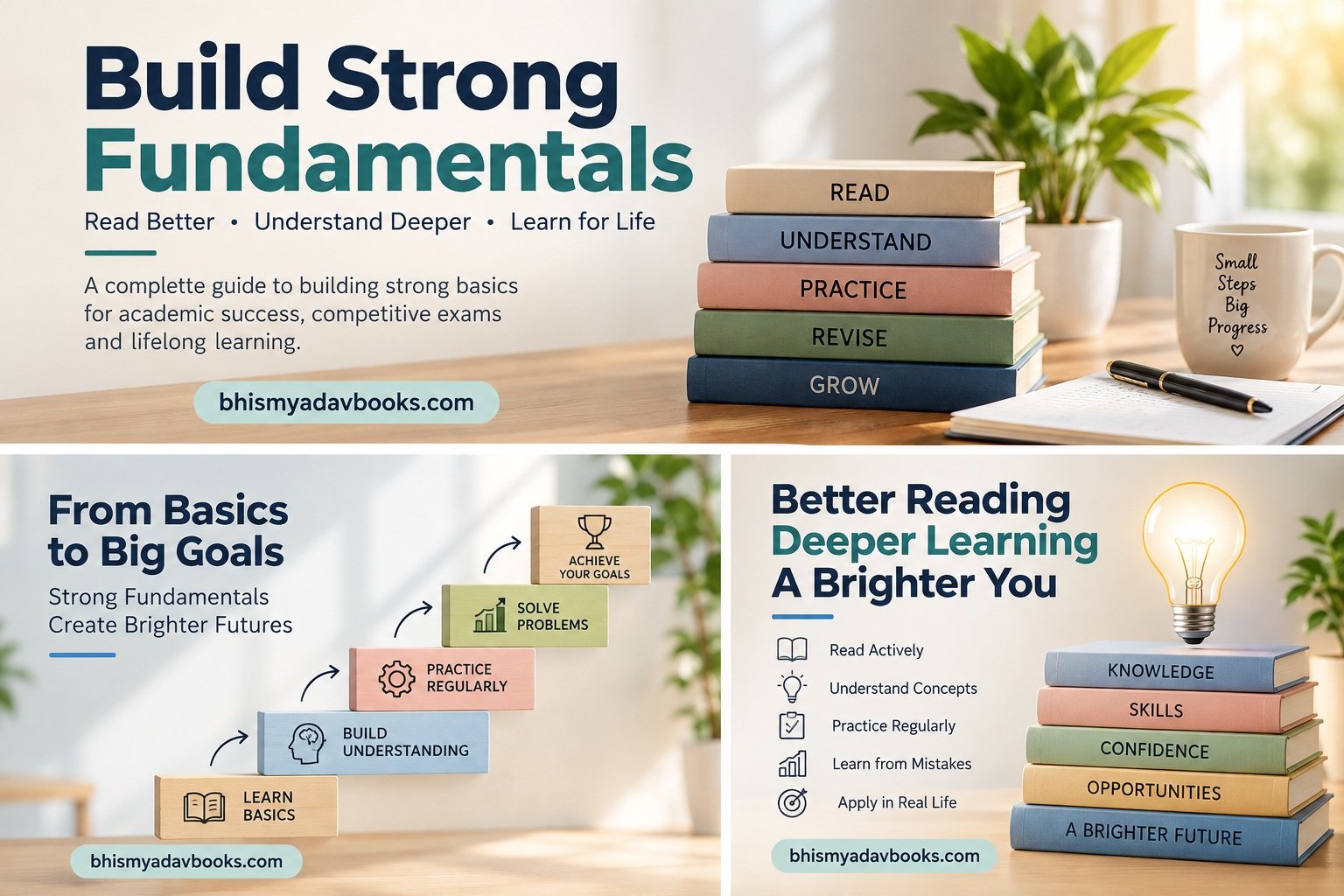
Strong fundamentals are the foundation of meaningful learning. Whether you are a school student, college student, job aspirant, competitive-exam candidate, or simply someone who enjoys learning new things, your ability to understand advanced topics depends heavily on how well you understand the basics.
Many learners try to move quickly through a syllabus. They focus on completing chapters, memorizing formulas, watching lectures at high speed, and solving as many questions as possible. While these activities can be useful, they become much more effective when the underlying concepts are clear.
A learner with strong fundamentals can approach a difficult topic with confidence because new information has somewhere to connect. Instead of memorizing isolated facts, the learner understands relationships, reasons, processes, and applications.
We have some amazing books at our Shop page you may want to buy.
This is why building strong fundamentals should be considered a long-term learning strategy rather than a short-term exam technique.
At Bhism Yadav Books, the goal of learning is not simply to collect information. It is to strengthen fundamental knowledge so that students and learners can understand subjects more clearly and apply what they learn in practical situations.
Table of Contents
How to Build Strong Fundamentals: A Complete Guide to Better Reading, Learning & Exam Success
What Does It Mean to Build Strong Fundamentals?
Fundamentals are the basic ideas, principles, definitions, rules, processes, and skills that support more advanced knowledge.
Think of learning as constructing a building.
The foundation may not be visible once the building is complete, but its quality affects everything above it. If the foundation is weak, adding more floors can create problems. Similarly, if your basic concepts are unclear, advanced chapters can become increasingly difficult.
For example, a student learning mathematics needs to understand basic arithmetic before moving comfortably into algebra. Algebra provides a foundation for many areas of higher mathematics.
Similarly:
- Basic grammar supports advanced writing.
- Basic vocabulary supports reading comprehension.
- Basic computer concepts support programming.
- Basic scientific principles support advanced science.
- Basic economic concepts support financial analysis.
- Basic geography supports understanding environmental and geopolitical topics.
- Basic reasoning skills support competitive-exam problem solving.
Strong fundamentals therefore mean understanding the building blocks of a subject well enough to use them confidently.
Why Strong Fundamentals Are Important
1. Fundamentals Make Difficult Topics Easier
Advanced topics often look difficult because they contain several basic concepts at the same time.
Suppose you are studying a complex physics problem. The question may involve multiple equations, units, graphs, and physical principles.
If you understand each basic component, the problem becomes manageable.
But if you have forgotten the fundamentals, every part of the question seems unfamiliar.
This creates a common learning problem:
Weak basics → difficulty understanding advanced topics → memorization → confusion → poor performance.
A stronger approach is:
Strong basics → better understanding → meaningful practice → confidence → advanced learning.
This progression can apply to almost every academic subject.
2. Fundamentals Improve Long-Term Memory
Memorizing information without understanding it can produce short-term results, but information that is connected to concepts is generally easier to recall and apply.
Imagine learning the fact that water freezes at a particular temperature.
You could memorize the number.
But if you also understand how temperature affects the physical state of water, why freezing occurs, and how pressure can influence physical behavior, the information becomes part of a larger knowledge structure.
The brain can then retrieve the information through multiple connections.
This is one reason conceptual learning is so valuable.
Instead of asking only:
“What is the answer?”
try asking:
“Why is this the answer?”
That small change can transform the way you study.
Fundamentals Are More Than Definitions
One of the biggest misunderstandings about fundamental learning is that fundamentals are simply definitions.
Definitions are important, but they are only one component.
Strong fundamental knowledge usually includes several layers.
Definition
You should know what a concept means.
Explanation
You should be able to explain the concept in your own words.
Purpose
You should understand why the concept is important.
Relationship
You should know how it connects with other concepts.
Application
You should be able to use it to solve a problem or understand a situation.
Example
You should be able to identify or create a simple example.
Limitation
You should understand where the concept may not apply or where additional knowledge is required.
This approach creates deeper understanding.
For example, learning a scientific law only by memorizing its statement provides limited knowledge.
Understanding its meaning, variables, conditions, applications, examples, and limitations provides much stronger fundamentals.
Fundamentals vs. Memorization
Memorization has an important role in education. Students need to remember formulas, terminology, dates, vocabulary, classifications, procedures, and other information.
The problem occurs when memorization becomes the entire learning strategy.
Consider two students preparing for an examination.
Student A memorizes a large number of answers.
Student B first understands the concepts and then memorizes important information.
If the examination questions remain exactly as expected, both students may perform reasonably well.
But if the questions are changed, combined, or presented in an unfamiliar way, Student B may have an advantage because conceptual understanding provides flexibility.
This is especially important in examinations that test reasoning, application, analysis, and problem solving.
Therefore, the goal should not be:
Understanding OR memorization
but:
Understanding + appropriate memorization + practice + revision.
Why Do Learners Struggle With Fundamentals?
Before building stronger fundamentals, it helps to understand why basic concepts sometimes become weak.
1. Moving Too Quickly
Many learners are more interested in completing the syllabus than understanding it.
They might spend several hours studying but very little time checking whether they actually understand what they read.
Completing a chapter is not the same as learning a chapter.
A better question is:
“Can I explain what I just studied without looking at the book?”
If the answer is no, the topic may require another round of learning.
2. Avoiding Difficult Topics
It is natural to prefer subjects and chapters that feel comfortable.
However, difficult topics often contain exactly the concepts that need additional attention.
Avoiding them creates knowledge gaps.
For example, a student may skip a basic mathematical concept because it seems difficult. Later, several advanced chapters depend on that concept.
The original problem then becomes much larger.
Instead of avoiding difficult topics, divide them into smaller parts.
Ask:
- What exactly do I not understand?
- Which prerequisite concept is missing?
- Can I find a simpler explanation?
- Can I solve one basic example?
- Can I explain the idea in my own words?
This converts a large problem into several smaller learning tasks.
3. Studying Without Revision
A learner may understand a concept today and forget much of it several weeks later.
This is normal.
Learning therefore requires revisiting.
Revision should not always mean reading the same chapter repeatedly from beginning to end.
Instead, use active methods such as:
- Recalling important ideas without looking.
- Solving practice questions.
- Explaining concepts aloud.
- Writing short summaries.
- Creating flashcards.
- Revisiting mistakes.
- Teaching the concept to someone else.
These methods require your brain to retrieve information rather than simply recognize it on a page.
The First Step: Identify Your Knowledge Gaps
Before trying to strengthen your fundamentals, identify where your foundation is weak.
Take a subject and divide it into major topics.
For example:
Mathematics
- Number System
- Arithmetic
- Algebra
- Geometry
- Mensuration
- Trigonometry
- Statistics
Then examine each area.
Ask yourself:
- Which topics do I understand well?
- Which topics do I understand partially?
- Which topics confuse me?
- Which topics do I avoid?
- Which topics create mistakes in practice questions?
You can classify topics into three groups:
Strong
You understand the concept and can solve basic questions independently.
Developing
You understand the basic idea but make occasional mistakes.
Weak
You struggle to explain the concept or solve even basic problems.
Start with the weak and developing areas, particularly when they are prerequisites for other topics.
This creates a structured approach to learning rather than randomly studying whatever feels interesting.
Build From Simple to Complex
One of the most effective principles for building fundamentals is:
Simple → Intermediate → Advanced
Do not begin with the most difficult material simply because it appears important.
First establish the foundation.
For example, when learning programming, you may begin with:
- What is programming?
- Variables
- Data types
- Operators
- Conditions
- Loops
- Functions
- Data structures
- Algorithms
- Advanced programming concepts
Skipping the first few stages can make later topics unnecessarily difficult.
The same principle works for many subjects.
When a topic feels confusing, step backward.
Ask:
“What should I already know before learning this?”
That question often reveals the missing foundation.
Read Actively, Not Passively
Reading is one of the most powerful tools for building fundamental knowledge, but simply moving your eyes across a page does not guarantee learning.
Active reading requires interaction with the material.
Before reading a chapter, look at:
- The title
- Headings
- Subheadings
- Diagrams
- Tables
- Important terms
- Questions
- Summary sections
Then ask:
What am I expected to learn from this chapter?
While reading, look for:
- Main ideas
- Definitions
- Examples
- Causes
- Effects
- Relationships
- Differences
- Applications
After reading a section, close the book and ask yourself:
“What did I just learn?”
Try to explain the idea without looking at the text.
If you can explain it clearly, your understanding is developing.
If you cannot, return to the section and identify the exact point of confusion.
Use the “Explain It Simply” Method
A powerful way to test fundamental understanding is to explain a concept in simple language.
Imagine you have learned a technical topic.
Instead of repeating the textbook definition, pretend that you are explaining it to someone who has never studied the subject.
Use simple words.
For example, if you cannot explain a complicated concept without repeatedly looking at your notes, you may understand the words but not the idea.
The goal is not to eliminate technical terminology.
The goal is to understand what the terminology actually represents.
A strong learner should gradually be able to move between three levels:
Technical explanation → simple explanation → practical example
This flexibility is a sign of deeper understanding.
Create Connections Between Concepts
Knowledge becomes more useful when individual facts are connected.
Suppose you are studying agriculture.
Instead of learning soil, water, fertilizers, crops, weather, and irrigation as completely separate topics, look for relationships.
For example:
Soil properties → water retention → root development → nutrient availability → crop growth
Now the information becomes a connected system.
The same technique works in history, science, technology, economics, healthcare, geography, and many other fields.
Whenever you learn something new, ask:
“What does this connect to?”
This single question can make reading more meaningful.
Build a Personal Fundamentals Notebook
Creating a dedicated fundamentals notebook can be extremely useful.
It does not need to contain every detail from every chapter.
Instead, include the information that forms the foundation of your understanding.
For each topic, record:
Topic:
Name of the concept.
Meaning:
Simple explanation.
Key points:
Three to five important ideas.
Formula or rule:
Where applicable.
Example:
One easy example.
Common mistake:
A mistake you frequently make.
Connection:
Related concepts.
Questions:
Anything you still need to clarify.
This notebook becomes a personalized reference guide.
Over time, it can become much more useful than repeatedly reading entire textbooks.
Practical Strategies to Build Strong Fundamentals
1. Start With a Clear Learning Objective
Before opening a book, decide what you want to learn.
Instead of saying:
“I will study science for two hours.”
set a more specific objective:
“I will understand the basic principles of photosynthesis and explain the process without looking at my notes.”
The second objective is measurable.
You know what success looks like.
Learning objectives can include:
- Understand a concept.
- Memorize important terminology.
- Solve ten problems.
- Explain a process.
- Compare two concepts.
- Identify common mistakes.
- Complete a specific chapter section.
- Revise previously learned material.
Clear objectives prevent unfocused study sessions.
2. Break Large Topics Into Smaller Concepts
Large chapters can feel overwhelming because they contain many ideas.
Instead of treating an entire chapter as one learning task, divide it into smaller sections.
For example, a computer fundamentals chapter might contain:
- What is a computer?
- Hardware
- Software
- Input devices
- Output devices
- Memory
- Storage
- Operating systems
- Networks
- Basic security
Study these as connected but manageable units.
This approach reduces cognitive overload and makes it easier to identify exactly where your understanding is weak.
3. Use Active Recall
Active recall is one of the most useful techniques for strengthening learning.
The basic idea is simple:
Try to remember information without looking at the answer.
Suppose you have just read a section about the solar system.
Close the book and ask:
- How many planets are in the solar system?
- What is the difference between terrestrial and gas-giant planets?
- Which planets have rings?
- What causes day and night?
- Why do planets orbit the Sun?
Do not immediately check your notes.
First attempt to retrieve the information from memory.
Then compare your answer with the source.
This process helps you discover what you actually know rather than what merely looks familiar while reading.
4. Use Questions While Reading
Instead of reading a page passively, convert important statements into questions.
For example:
Statement:
Photosynthesis is the process through which green plants use light energy to produce chemical energy.
Turn it into questions:
- What is photosynthesis?
- Why is sunlight important?
- Which organisms perform photosynthesis?
- What materials are required?
- What is produced?
- Why is photosynthesis important?
Now your reading becomes an investigation.
Questions encourage your brain to search for relationships and explanations.
5. Practice Before You Feel Completely Ready
Some learners wait until they believe they have completely understood a chapter before attempting questions.
That can be inefficient.
Practice itself can reveal gaps in understanding.
Suppose you study a mathematical formula.
You may think:
“I understand this.”
But when you solve a problem, you discover that you do not know when to apply the formula.
That is valuable information.
Practice questions therefore serve two purposes:
- They strengthen knowledge.
- They diagnose weaknesses.
Do not be afraid of getting questions wrong.
A mistake made during practice can become a learning opportunity.
6. Maintain a Mistake Log
A mistake log is particularly useful for students preparing for examinations.
Whenever you make an important mistake, record:
Question:
What was the question?
Your answer:
What did you choose or calculate?
Correct answer:
What should the answer have been?
Reason for mistake:
Why did the error happen?
Lesson:
What should you remember next time?
Mistakes generally fall into categories such as:
- Conceptual mistake
- Calculation mistake
- Reading mistake
- Memory mistake
- Formula mistake
- Unit mistake
- Careless mistake
- Time-management mistake
- Misinterpretation of the question
Identifying the type of mistake is more useful than simply writing the correct answer.
7. Understand Why You Made a Mistake
Consider two students who answer a question incorrectly.
Student A simply checks the answer and moves on.
Student B asks:
“Why did I get this wrong?”
Student B may discover that the underlying problem was a weak fundamental concept.
For example, an incorrect answer in an advanced mathematics problem may actually result from a basic arithmetic error.
Similarly, a difficult science question may become confusing because the learner does not understand a fundamental definition.
This is why mistake analysis is closely connected to fundamental learning.
When you make an error, move backward until you find its root.
8. Use the Prerequisite Chain
Many subjects are hierarchical.
One concept depends on another.
For example:
Basic arithmetic → algebra → equations → functions → calculus
If the first stage is weak, later stages can become difficult.
Therefore, when struggling with a topic, ask:
“What knowledge is required before I can understand this?”
This creates a prerequisite chain.
You can write it down:
Current topic → required concept → basic concept → foundation
Then work backward.
This prevents you from repeatedly studying an advanced topic without fixing the underlying gap.
9. Learn Through Examples
Examples turn abstract concepts into understandable situations.
Whenever you learn a new concept, look for at least one simple example.
For example, if you learn the concept of opportunity cost in economics, connect it with an everyday decision.
If you have two hours available and choose to study instead of watching a movie, the opportunity cost can be understood as the value of the alternative you gave up.
Examples create mental connections.
After understanding a textbook example, try creating your own.
Ask:
“Can I think of another situation where this concept applies?”
If you can, your understanding is becoming more flexible.
10. Compare Similar Concepts
Confusion often occurs because two concepts appear similar.
For example:
- Mass vs. weight
- Speed vs. velocity
- Weather vs. climate
- Hardware vs. software
- Savings vs. investment
- Data vs. information
- RAM vs. storage
- Renewable vs. non-renewable resources
Create comparison tables for such concepts.
A simple structure can be:
| Feature | Concept A | Concept B |
| Meaning | … | … |
| Purpose | … | … |
| Example | … | … |
| Key difference | … | … |
Comparison forces you to identify the defining characteristics of each concept.
11. Use the “Why” Method
When learning a concept, repeatedly ask why.
For example:
Plants need sunlight.
Why?
Because sunlight provides energy for photosynthesis.
Why is photosynthesis important?
Because it enables plants to produce chemical energy and contributes to the production of oxygen.
Why are plants important to ecosystems?
Because they form the foundation of many food chains and participate in major cycles.
The purpose is not to ask “why” endlessly.
The purpose is to move beyond memorization and discover relationships.
12. Use the “How” Method
The word how is particularly useful for processes.
Instead of only memorizing:
“Digestion is the process of breaking down food.”
ask:
- How does digestion begin?
- How is food mechanically broken down?
- How do enzymes help?
- How are nutrients absorbed?
- How does the body use those nutrients?
Process-based questions create deeper understanding.
This method is useful for:
- Science
- Biology
- Computer science
- Engineering
- Agriculture
- Geography
- History
- Economics
- Healthcare
- Technology
13. Use the “What If” Method
Once you understand the basic concept, change one condition.
Ask:
“What if this condition changes?”
For example, after learning how a system works, ask what would happen if one component were removed.
This encourages application.
In science:
What if temperature increases?
In economics:
What if demand increases while supply remains unchanged?
In mathematics:
What if one variable changes?
In computing:
What happens if memory is insufficient?
This approach moves learning from simple recall toward reasoning.
14. Teach What You Learn
One of the strongest tests of understanding is teaching.
You do not need an actual classroom.
You can teach:
- A friend
- A family member
- A study partner
- An imaginary student
- Yourself aloud
Choose a topic and explain it without reading.
If you become stuck, identify the exact point where your explanation breaks down.
That is often where your understanding needs improvement.
Teaching also forces you to organize information logically.
You cannot simply repeat scattered facts.
You must decide:
- What should be explained first?
- What comes next?
- What example should be used?
- What common confusion should be clarified?
This organization strengthens fundamentals.
15. Read Different Explanations of Difficult Concepts
Sometimes a concept is not difficult; the explanation is simply not suitable for your current level.
If one book or lecture does not make sense, try another explanation.
You might use:
- A beginner-level book
- A textbook
- A reference book
- Educational articles
- Diagrams
- Practice questions
- Lectures
- Simulations
- Practical examples
However, avoid collecting too many resources without completing any of them.
The goal is clarity, not resource accumulation.
Choose one primary resource and use additional resources when a particular concept remains unclear.
16. Build a Layered Learning System
A useful approach is to learn information in layers.
Layer 1: Basic Awareness
Know what the topic is.
Layer 2: Basic Understanding
Understand the major concepts.
Layer 3: Detailed Understanding
Learn important relationships and processes.
Layer 4: Application
Solve problems or apply the knowledge.
Layer 5: Analysis
Compare situations and explain why outcomes differ.
Layer 6: Mastery
Teach, apply, analyze, and adapt the knowledge confidently.
You do not need to reach the highest layer for every topic immediately.
The required depth depends on your purpose.
For general knowledge, basic awareness may be enough.
For competitive examinations, deeper understanding and application may be necessary.
For professional work or advanced study, mastery may require significantly more depth.
17. Combine Reading With Writing
Writing can strengthen learning because it requires you to organize your thoughts.
After reading a section, write a short summary without copying the textbook.
Try to answer:
- What is the main idea?
- What are the three most important points?
- What example explains the concept?
- What confused me?
- What should I revise later?
Keep the summary concise.
The goal is not to rewrite the entire chapter.
18. Create Concept Maps
A concept map visually connects ideas.
For example:
Learning
→ Reading
→ Understanding
→ Recall
→ Practice
→ Revision
→ Application
Another example:
Computer
→ Hardware
→ Software
→ Input
→ Processing
→ Output
→ Storage
Concept maps help you see relationships that may be difficult to notice in linear notes.
They can be especially useful for subjects containing many connected concepts.
19. Revise Using Increasing Intervals
Learning becomes stronger when revision is distributed over time.
Instead of studying something once and forgetting it, revisit it periodically.
A simple example could be:
- First review: same day
- Second review: next day
- Third review: after several days
- Fourth review: after one or two weeks
- Fifth review: later in the month
The exact schedule can vary.
The important principle is to avoid leaving all revision until the day before the examination.
Regular review gives you multiple opportunities to retrieve and reinforce the knowledge.
20. Do Not Confuse Recognition With Understanding
This is a common learning trap.
You open a textbook and think:
“Yes, I remember this.”
That may only mean the information looks familiar.
True understanding is better tested through retrieval.
Close the book and ask:
Can I explain it?
Then ask:
Can I give an example?
Then:
Can I solve a basic problem?
Then:
Can I explain why it works?
If you can do these things, your understanding is stronger than simple recognition.
Build Fundamentals Through Consistent Practice
Strong fundamentals are not created by one long study session.
Consistency matters more.
A learner who studies a concept for a reasonable amount of time repeatedly can often build stronger long-term knowledge than someone who studies intensely once and then stops.
A practical daily cycle could look like:
Reading
Learn a new concept.
Recall
Close the book and reproduce the main ideas.
Practice
Solve questions or apply the concept.
Review
Check mistakes.
Revision
Revisit older concepts.
Even a modest daily routine can accumulate significant knowledge over time.
Fundamentals for Competitive Examination Preparation
For job aspirants and competitive-exam candidates, fundamentals have an additional importance.
Competitive examinations often contain questions that test:
- Basic concepts
- Speed
- Accuracy
- Logical reasoning
- Application
- Interpretation
- Problem solving
A candidate who focuses exclusively on shortcuts may struggle when the question format changes.
Shortcuts can be useful after the underlying concept is understood.
For example:
Concept → Standard method → Practice → Shortcut → Speed
is generally more useful than learning a shortcut without understanding the underlying method.
Fundamental knowledge also makes it easier to identify which shortcut is appropriate for a particular question.
Use Previous Questions as Learning Tools
Previous examination questions are not only for testing.
They can also help identify the fundamentals that an examination repeatedly requires.
When solving previous questions, categorize them.
For example:
Question → Topic → Concept → Mistake → Correct approach
After solving many questions, patterns become visible.
You may discover that several apparently different questions depend on the same fundamental concept.
That concept deserves additional attention.
Avoid the “Too Many Resources” Problem
The internet provides thousands of books, videos, websites, courses, notes, applications, and study materials.
More resources do not automatically produce better learning.
In fact, excessive resource switching can create confusion.
You may spend more time searching for the “perfect explanation” than actually studying.
A practical system is:
One primary book/resource + one supplementary resource + practice material
Add another resource only when necessary.
Remember:
Learning requires processing information, not merely collecting it.
Use Difficulty as a Signal
When a topic feels difficult, do not immediately conclude:
“I am bad at this subject.”
Difficulty can provide useful information.
It may indicate:
- A missing prerequisite.
- An unclear definition.
- Insufficient practice.
- Weak memory.
- Poor explanation.
- Lack of examples.
- Too much information at once.
Instead of judging yourself, diagnose the problem.
Ask:
“What exactly is making this difficult?”
This turns frustration into an actionable learning question.
Create a Practical System to Build Strong Fundamentals
Create a Strong Fundamentals Study System
A good learning system does not need to be complicated.
At its core, it should answer five questions:
- What should I learn?
- Why do I need to learn it?
- How will I learn it?
- How will I test my understanding?
- When will I revise it?
Once these questions are answered, studying becomes more purposeful.
A simple fundamentals system can follow this sequence:
Plan → Read → Understand → Recall → Practice → Analyze → Revise → Apply
Repeat this process consistently.
1. Start With a Learning Map
Before beginning a subject, create a learning map.
A learning map is simply a list of topics arranged from basic to advanced.
For example, someone learning computer science might organize their learning as:
Level 1: Computer Basics
- What is a computer?
- Hardware
- Software
- Input and output
- Memory
- Storage
- Operating systems
Level 2: Programming Basics
- Programming languages
- Variables
- Data types
- Operators
- Conditions
- Loops
- Functions
Level 3: Intermediate Concepts
- Data structures
- Algorithms
- File handling
- Databases
- Networking
Level 4: Advanced Concepts
- Operating-system concepts
- Distributed systems
- Artificial intelligence
- Machine learning
- System architecture
The exact structure will differ by subject.
The important principle is to build upward from the foundation.
2. Identify Prerequisite Knowledge
Before beginning a difficult topic, determine what you need to know first.
Suppose you want to learn calculus.
You may need a foundation in:
- Arithmetic
- Fractions
- Algebra
- Equations
- Functions
- Graphs
If algebra is weak, calculus may feel unnecessarily difficult.
Therefore, instead of repeatedly trying to understand calculus, strengthen the relevant algebra fundamentals first.
This is called learning through prerequisites.
The question to remember is:
“What do I need to know before I can understand this?”
This question can save considerable time.
3. Organize Subjects Into Learning Categories
Students often treat every subject in exactly the same way.
That is not always effective.
Different subjects require different combinations of reading, recall, practice, and application.
For example:
Mathematics
Focus on:
- Concepts
- Formulas
- Worked examples
- Problem solving
- Speed
- Accuracy
Science
Focus on:
- Concepts
- Processes
- Diagrams
- Definitions
- Cause and effect
- Applications
History
Focus on:
- Events
- Chronology
- Causes
- Consequences
- Important people
- Relationships
Geography
Focus on:
- Concepts
- Maps
- Locations
- Processes
- Data
- Relationships
Computer Science
Focus on:
- Definitions
- Architecture
- Processes
- Logic
- Programming
- Practical applications
Understanding the nature of a subject helps you choose the appropriate learning method.
4. Build a Daily Reading Habit
Reading should become a regular part of your learning routine.
You do not necessarily need to spend several hours reading every day.
Consistency is more important than occasionally reading for extremely long periods.
For example, you could establish a daily reading block dedicated to learning fundamentals.
During this period:
- Keep your phone away when possible.
- Select one topic.
- Read slowly enough to understand.
- Mark important concepts.
- Write short notes.
- Ask questions.
- Test your recall afterward.
The objective is not to maximize the number of pages.
The objective is to maximize understanding.
5. Use the 3-Stage Reading Method
A useful approach is to divide reading into three stages.
Stage 1: Preview
Before reading deeply, scan the chapter.
Look at:
- Title
- Headings
- Subheadings
- Images
- Tables
- Summary
- Questions
This creates a mental framework.
Stage 2: Active Reading
Now read the material carefully.
Look for:
- Main concepts
- Definitions
- Examples
- Causes
- Effects
- Relationships
- Important details
Write brief notes where necessary.
Stage 3: Recall
After finishing a section, close the book.
Try to reproduce the main ideas.
Ask:
What was the main concept?
What are the important points?
Can I explain it?
What example illustrates it?
What part is still unclear?
This third stage is extremely important.
6. Make Notes That Support Understanding
Good notes should reduce the amount of work required during revision.
They should not simply reproduce the textbook.
Instead of writing:
“Copy everything the author said.”
try:
“What would I need to remember if I had only five minutes to review this topic?”
Your notes might contain:
- Definitions
- Key formulas
- Important facts
- Diagrams
- Examples
- Comparisons
- Common mistakes
- Questions
Short, meaningful notes are usually easier to revise than pages of copied text.
7. Use Different Note Formats
Not every concept needs the same type of notes.
Bullet Points
Useful for:
- Facts
- Characteristics
- Lists
- Definitions
Tables
Useful for:
- Comparisons
- Classifications
- Differences
- Advantages and disadvantages
Flowcharts
Useful for:
- Processes
- Procedures
- Sequences
Diagrams
Useful for:
- Science
- Geography
- Engineering
- Technology
Mind Maps
Useful for:
- Connecting multiple ideas
- Reviewing chapters
- Visualizing relationships
Choose the format according to the nature of the information.
8. Use Books as Learning Tools, Not Just Reading Material
A textbook is not simply something to finish.
It is a learning tool.
When reading a book, interact with it.
Ask questions.
Underline selectively.
Write short notes.
Mark difficult concepts.
Return to examples.
Solve exercises.
Review summaries.
If the book contains questions, attempt them without immediately looking at the answers.
The goal is to turn reading into an active process.
9. Learn From Multiple Levels of Books
Sometimes one book cannot serve every purpose.
A useful approach is to use different types of resources for different stages.
Beginner Resource
Provides simple explanations.
Standard Textbook
Provides structured and detailed knowledge.
Reference Book
Provides additional depth.
Practice Material
Provides questions and applications.
This does not mean you need dozens of books.
In many cases, one good primary book combined with suitable practice material is sufficient.
The important point is to select resources according to your current level.
10. Strengthen Weak Areas First
Many learners spend most of their time studying topics they already like.
This creates a comfortable but incomplete learning pattern.
Suppose a student has:
- Mathematics: weak
- Reasoning: average
- English: strong
The student may repeatedly study English because it feels easier.
Meanwhile, the weak mathematics foundation remains unchanged.
A better strategy is to maintain strengths while deliberately improving weaknesses.
You can divide your study time into:
Weak areas + Developing areas + Strong areas
For example:
- 50% weak areas
- 30% developing areas
- 20% strong areas
The exact percentages do not need to be fixed.
The principle is to give additional attention to areas that need improvement.
11. Do Not Ignore Easy Topics
At the same time, do not completely abandon strong subjects.
Easy topics still need periodic revision.
The purpose of revision is to maintain existing knowledge while building new knowledge.
A balanced learning system therefore contains:
New learning + weak-area improvement + maintenance revision
12. Use a Weekly Fundamentals Review
Once a week, spend some time reviewing your learning progress.
Ask:
What did I learn this week?
List the important concepts.
What did I understand well?
Identify strengths.
What remains unclear?
Identify knowledge gaps.
What mistakes did I make?
Review your mistake log.
What needs revision?
Create a short revision list.
What should I learn next?
Plan the following week.
This weekly review prevents small knowledge gaps from becoming large problems.
13. Measure Understanding, Not Just Study Hours
Study time is easy to measure.
Learning is harder to measure.
Someone may study for five hours but retain little.
Another learner may study for two focused hours and understand several important concepts.
Therefore, track outcomes as well as time.
You can measure:
- Topics understood
- Questions solved
- Accuracy
- Concepts recalled
- Mistakes corrected
- Chapters revised
- Problems explained
- Weak areas improved
For example:
Monday: Studied percentages for 90 minutes.
This is useful information.
But:
Monday: Studied percentages, solved 30 questions, identified three mistakes, and achieved 80% accuracy.
This provides much more information about learning progress.
14. Track Accuracy Over Time
Accuracy is particularly important for exam preparation.
Suppose you solve 50 questions.
Your result is:
35 correct = 70% accuracy
After targeted revision and practice:
42 correct = 84% accuracy
Later:
46 correct = 92% accuracy
This gives you evidence that your understanding is improving.
However, do not focus only on the percentage.
Study the incorrect questions carefully.
The mistakes often contain the most useful information.
15. Track the Type of Mistakes
Create categories such as:
| Mistake Type | Number |
| Conceptual | 5 |
| Calculation | 3 |
| Memory | 2 |
| Reading | 1 |
| Careless | 4 |
Now you have a more useful picture.
If conceptual mistakes are high, review fundamentals.
If calculation mistakes are high, practice calculations.
If reading mistakes are high, slow down and improve question interpretation.
If careless mistakes are high, examine your solving process.
This turns mistakes into data.
16. Build a Revision Calendar
Without a revision plan, learners often remember new information while forgetting older material.
Create a simple calendar.
For each topic, record:
Topic | First Study | First Revision | Second Revision | Practice
For example:
Percentage | Monday | Tuesday | Saturday | Sunday
You do not need a complicated application.
A notebook or spreadsheet can work perfectly well.
The goal is to make revision deliberate rather than accidental.
17. Combine Old and New Topics
One useful strategy is to combine new learning with older material.
For example:
Session 1: New mathematics concept
Session 2: Previous mathematics revision
Session 3: New reasoning concept
Session 4: Previous reasoning practice
This prevents the learning process from becoming focused only on new information.
Older knowledge remains active while new knowledge is added.
18. Use Mixed Practice
Once you understand individual topics, begin mixing them.
Suppose you are studying mathematics.
Instead of solving:
- 20 percentage questions
- Then 20 ratio questions
- Then 20 average questions
you can eventually practice a mixed set containing all three.
Why?
Because real examinations often do not tell you which method to use.
You need to identify the appropriate concept yourself.
Mixed practice therefore develops recognition and decision-making.
19. Move From Guided Practice to Independent Practice
Learning should gradually become less dependent on examples.
A useful progression is:
Step 1
Watch or read a worked example.
Step 2
Solve a similar problem with guidance.
Step 3
Solve a similar problem independently.
Step 4
Solve a slightly different problem.
Step 5
Solve a mixed problem without knowing which method is required.
This progression builds confidence without creating unnecessary frustration.
20. Apply Knowledge to Real Situations
Fundamentals become more meaningful when you see their practical applications.
For example:
Mathematics
Use percentages to understand discounts, interest, and statistics.
Physics
Connect concepts with vehicles, machines, electricity, or everyday motion.
Computer Science
Connect programming concepts with software and applications.
Geography
Connect climate concepts with real-world weather patterns.
Economics
Connect supply and demand with markets and prices.
Agriculture
Connect soil, water, weather, and crop management with farming practices.
Applications answer an important question:
“Why should I learn this?”
Understanding purpose can increase motivation and retention.
21. Develop the Habit of Asking Better Questions
Strong learners are not simply people who find many answers.
They also ask useful questions.
Instead of asking:
“What is this?”
ask:
- Why does it work?
- How does it work?
- What causes it?
- What happens if conditions change?
- What is it connected to?
- How is it different from another concept?
- Where is it used?
- What mistakes are common?
- Can I solve a problem using it?
Good questions guide good learning.
22. Avoid Learning Only for the Examination
Examinations are important, but fundamentals have value beyond a single test.
If you study only to reproduce answers, much of your knowledge may disappear after the examination.
If you study to understand, the knowledge can support:
- Future courses
- Professional work
- Competitive examinations
- Problem solving
- General awareness
- Technical skills
- Lifelong learning
A strong foundation compounds over time.
What you learn today can make tomorrow’s learning easier.
23. Build a “Question Bank” for Yourself
Whenever you encounter an important concept, create questions.
Your personal question bank can include:
Basic Questions
What is it?
Understanding Questions
Why does it work?
Application Questions
How is it used?
Comparison Questions
How is it different from another concept?
Problem-Solving Questions
Can I apply it to a new situation?
Revision Questions
What are the three most important points?
Over time, this becomes a personalized learning resource.
24. Practice Explaining Without Notes
Once a week, select several concepts and explain them without looking at your books.
For each concept, try to provide:
- Definition
- Simple explanation
- Example
- Application
- Related concept
- Common mistake
If you cannot explain one section, mark it for revision.
This is an excellent way to discover hidden knowledge gaps.
25. Create a “Fundamentals First” Rule
When encountering a difficult advanced topic, resist the temptation to memorize the final answer immediately.
Instead ask:
Which fundamental concept controls this problem?
Then return to that concept.
For example, if an advanced reasoning question is difficult, identify the underlying logical principle.
If a science question is difficult, identify the relevant scientific law.
If a mathematics question is difficult, identify the mathematical operation or relationship involved.
This habit gradually trains you to search for underlying principles rather than surface patterns.
26. Build Patience Into Your Learning Process
Fundamental knowledge takes time.
You may understand a concept after one reading.
Another concept may require five attempts.
A third may become clear only after you encounter several examples.
This is normal.
Learning should not be judged by how quickly you understand every topic.
Instead, ask:
“Am I understanding more today than I did before?”
Progress can be gradual.
Consistency allows small improvements to accumulate.
27. Deal With Learning Plateaus
Sometimes progress seems to stop.
You practice regularly but your results do not improve.
This may happen because:
- You are practicing the same type of questions.
- Your fundamentals contain a hidden gap.
- You are not reviewing mistakes.
- Your study method is too passive.
- You need more challenging applications.
- You are not revising older material.
When progress stalls, do not simply increase study hours.
First change the method.
For example:
More reading → more recall
More repetition → mistake analysis
More easy questions → mixed questions
More memorization → conceptual explanation
A plateau can be a signal that your learning strategy needs adjustment.
28. Protect Your Attention
Strong fundamentals require concentration.
Constant interruptions reduce the quality of learning.
During focused study:
- Silence unnecessary notifications.
- Keep unrelated tabs closed.
- Keep your study materials ready.
- Use a clean workspace.
- Decide what you will study before starting.
- Take reasonable breaks.
You do not need perfect concentration for hours.
Even focused blocks of study can be productive when used consistently.
29. Take Breaks Without Abandoning the Routine
Breaks are part of an effective study system.
After a focused session, step away briefly.
You can:
- Walk
- Stretch
- Drink water
- Rest your eyes
- Take a short breathing break
Then return to the next learning task.
The objective is to maintain sustainable concentration rather than forcing yourself through exhaustion.
30. Build a Long-Term Learning Mindset
The ultimate purpose of strong fundamentals is not simply to finish a chapter.
It is to become a person who can learn new things more effectively.
Once your foundation improves, you may notice that:
- New concepts become easier to understand.
- Technical vocabulary becomes less intimidating.
- Problems become easier to break down.
- You can identify relevant information faster.
- You make fewer basic mistakes.
- Revision becomes easier.
- Confidence improves through actual understanding.
This is the compounding effect of fundamental knowledge.
A Practical Daily Fundamentals Routine
Here is an example of a simple daily structure.
Session 1: Previous Revision
Spend some time recalling concepts studied earlier.
Session 2: New Concept
Read and understand one new topic.
Session 3: Active Recall
Close your materials and reproduce the main ideas.
Session 4: Practice
Solve questions or complete practical exercises.
Session 5: Mistake Analysis
Review incorrect answers.
Session 6: Quick Summary
Write the most important lessons from the day.
The exact duration can be adjusted according to your schedule.
The important thing is the sequence.
A Practical Weekly Fundamentals Routine
At the end of each week:
Review
Revisit major concepts.
Test
Take a short self-test.
Analyze
Study incorrect answers.
Identify
Find weak concepts.
Repair
Revise the relevant fundamentals.
Plan
Choose the next week’s learning objectives.
This creates a continuous improvement cycle.
Turn Strong Fundamentals Into Long-Term Learning Success
Strong Fundamentals and Academic Success
Academic success is often associated with high marks, examination scores, and completing a syllabus. These are important outcomes, but they are usually supported by something deeper: understanding.
When fundamental concepts are clear, students can approach new chapters with greater confidence.
For example, a student who understands basic mathematical operations, equations, ratios, percentages, and algebraic relationships will generally have a stronger starting point when encountering more advanced mathematical problems.
Similarly, a student with strong vocabulary, grammar, reading comprehension, and writing fundamentals has a better foundation for understanding advanced English material.
The same principle applies across subjects.
Strong fundamentals can help you:
- Understand new concepts faster.
- Remember information more meaningfully.
- Solve unfamiliar problems.
- Identify relationships between topics.
- Correct mistakes more effectively.
- Revise more efficiently.
- Adapt when questions are presented differently.
This makes fundamental learning an important part of long-term academic development.
Strong Fundamentals for Competitive Examinations
For job aspirants and competitive-exam candidates, fundamental knowledge can be particularly important because examinations may require candidates to apply concepts rather than simply reproduce memorized information.
A strong preparation system can follow this progression:
Fundamentals → Conceptual Understanding → Practice → Accuracy → Speed
Speed should not always come first.
Suppose you attempt questions very quickly but repeatedly make conceptual mistakes. Increasing speed further may simply increase the number of incorrect answers.
Instead, first develop accuracy.
Once the method becomes familiar, speed can gradually improve through practice.
This is particularly useful for areas such as:
- Quantitative aptitude
- Reasoning
- General science
- English
- Computer awareness
- General knowledge
- Technical subjects
The exact requirements differ between examinations, but the principle remains useful: understand the underlying concept before depending heavily on shortcuts.
Build Fundamentals Before Learning Shortcuts
Shortcuts can save time, especially in competitive examinations.
However, shortcuts become more useful when you understand the standard method first.
Consider a mathematical problem.
You should ideally understand:
What is being asked → Which concept applies → What is the standard method → How can the process be simplified?
This creates flexibility.
If a question appears in an unfamiliar format, you can return to the underlying principle.
A learner who knows only a shortcut may become confused when the question changes.
Therefore:
Learn the concept first. Learn the shortcut second.
Strong Fundamentals Improve Problem Solving
Problem solving is not simply about knowing formulas.
It involves identifying what information is available, determining what is being asked, selecting an appropriate method, and applying it correctly.
Fundamental knowledge helps with each stage.
For example:
Step 1: Understand the Question
What is being asked?
Step 2: Identify the Topic
Which concept is involved?
Step 3: Recall the Principle
What rule, formula, or process applies?
Step 4: Apply It
Work through the problem.
Step 5: Check
Does the answer make sense?
This process becomes easier when the foundation is strong.
Learn to Identify the Root of a Problem
One of the most useful learning habits is identifying the root cause of difficulty.
Suppose you repeatedly make mistakes in a particular chapter.
Do not immediately solve hundreds of additional questions.
First ask:
What is causing these mistakes?
Perhaps you do not understand a basic definition.
Perhaps you are applying the wrong formula.
Perhaps you understand the concept but cannot recognize when to use it.
Perhaps your calculation skills are weak.
Perhaps you are misreading the question.
Each problem requires a different solution.
This is why diagnosis should come before repetition.
Turn Mistakes Into Learning Opportunities
Mistakes are unavoidable during learning.
The important question is what happens afterward.
A useful mistake-analysis process is:
1. Identify the mistake
What went wrong?
2. Find the cause
Why did it happen?
3. Correct the concept
What should you understand?
4. Practice a similar problem
Can you now solve it correctly?
5. Revisit later
Can you still solve it after some time?
This turns a wrong answer into a learning event.
A mistake that is properly analyzed can sometimes become more educational than a question you answered correctly without much thought.
Develop Conceptual Confidence
Confidence in learning should ideally come from understanding rather than simply feeling positive.
There is a significant difference between:
“I think I know this.”
and:
“I can explain this, solve a basic problem, and apply it to a new situation.”
The second form of confidence is supported by evidence.
You can build it through:
- Active recall
- Practice
- Self-testing
- Explanation
- Application
- Revision
- Mistake correction
Every time you successfully retrieve and apply a concept, you strengthen your learning foundation.
Use Self-Testing Regularly
Self-testing should not be limited to formal examinations.
After completing a topic, create a small test.
For example:
10 questions
- 3 basic questions
- 3 understanding questions
- 2 application questions
- 2 mixed or challenging questions
Then analyze the results.
If you score poorly, do not simply repeat the test.
Return to the relevant concepts.
If you score well, revisit the topic later to make sure the knowledge remains available.
Use the “Explain, Apply, Connect” Test
A simple three-part test can help evaluate your fundamentals.
Explain
Can you explain the concept in your own words?
Apply
Can you use it to solve a problem or practical situation?
Connect
Can you connect it with another concept?
If you can do all three, your understanding is becoming more robust.
If you can only repeat the textbook definition, more work may be needed.
Build a Personal Knowledge Base
As you continue learning, your notes can become a personal knowledge base.
Organize information into categories such as:
- Definitions
- Formulas
- Concepts
- Examples
- Diagrams
- Mistakes
- Questions
- Revision notes
- Applications
Digital tools can be used, but a physical notebook can work equally well.
The important factor is organization.
A useful knowledge base should make it easier to answer:
“What do I already know about this topic?”
and:
“What do I still need to learn?”
Review Old Knowledge Before Adding Too Much New Knowledge
Learning only new material can create an illusion of progress.
You may finish many chapters while forgetting what you studied earlier.
Therefore, maintain a balance.
A simple learning cycle can be:
Old knowledge → New knowledge → Practice → Old knowledge → New knowledge → Application
This keeps the foundation active.
The stronger the foundation remains, the easier it becomes to add new layers.
Use Interconnected Learning
Do not always study subjects as completely separate worlds.
Look for connections.
For example:
Mathematics + Economics
Percentages, ratios, averages, graphs, and statistics can support economic understanding.
Science + Geography
Climate, atmosphere, water, soil, and environmental systems are interconnected.
Computer Science + Mathematics
Logic, algorithms, statistics, and mathematical thinking contribute to many areas of computing.
English + Every Subject
Reading comprehension affects your ability to understand questions, instructions, textbooks, and reference materials.
When you connect knowledge across subjects, your understanding becomes broader.
Reading Is a Skill That Can Be Improved
Reading is not simply a passive activity.
Good readers learn to adjust their reading style according to their purpose.
Reading for Overview
Move quickly through headings and major ideas.
Reading for Understanding
Slow down and examine concepts carefully.
Reading for Revision
Focus on notes, summaries, formulas, and key ideas.
Reading for Research
Compare information across multiple reliable sources.
Reading for Examination Preparation
Focus on relevant concepts, applications, examples, and practice questions.
Developing reading flexibility can make learning more efficient.
Do Not Read Everything at the Same Speed
Some parts of a book deserve more attention than others.
You may move quickly through familiar information but slow down for:
- New terminology
- Difficult concepts
- Important diagrams
- Mathematical derivations
- Complex processes
- Important examples
- Areas where you repeatedly make mistakes
Efficient reading is not about reading as fast as possible.
It is about giving appropriate attention to the information that matters most.
Build the Habit of Lifelong Learning
Fundamental learning should not stop when an examination ends.
The world continues to change.
New technologies appear.
Industries evolve.
Scientific knowledge expands.
New tools and methods are developed.
People who develop strong learning habits are better prepared to continue acquiring knowledge.
Lifelong learning can involve:
- Reading books
- Taking courses
- Learning technical skills
- Studying new subjects
- Practicing languages
- Understanding technology
- Following scientific developments
- Exploring practical skills
The stronger your learning foundation becomes, the easier it can be to approach unfamiliar subjects.
Fundamentals and Career Development
Strong fundamentals can also support professional development.
Suppose you want to learn a new technical skill.
If your foundational knowledge is strong, you may find it easier to understand advanced material.
For example:
Basic computer knowledge → programming → software development → advanced systems
or:
Basic mathematics → statistics → data analysis → advanced analytics
The exact path varies, but the principle remains the same.
Advanced skills are often built from layers of foundational knowledge.
Do Not Compare Your Learning Speed With Others
Every learner has different prior knowledge, study habits, resources, and responsibilities.
One student may understand a topic quickly because they have already studied its prerequisites.
Another may need more time because the foundation is still developing.
Instead of asking:
“Why am I slower than someone else?”
ask:
“What can I understand better today than I understood before?”
This creates a more useful measure of progress.
Learning is not a race against another person.
It is a process of developing your own knowledge and abilities.
Create a 30-Day Fundamentals Challenge
If you want to start immediately, a simple 30-day approach can help.
Days 1–5: Identify the Foundation
Choose one subject.
List all major topics.
Mark each topic:
- Strong
- Developing
- Weak
Identify prerequisite gaps.
Days 6–10: Repair Basic Concepts
Select the most important weak fundamentals.
Read beginner-friendly explanations.
Create short notes.
Practice basic questions.
Do not rush into advanced problems.
Days 11–15: Active Recall
After studying each topic, close your materials.
Explain the concept.
Write what you remember.
Answer self-created questions.
Review missing information.
Days 16–20: Practice
Begin solving more questions.
Record mistakes.
Identify repeated error patterns.
Return to fundamentals when necessary.
Days 21–25: Mixed Practice
Combine multiple topics.
Solve questions without knowing in advance which method will be required.
This tests whether you can recognize the correct concept independently.
Days 26–28: Revision
Review your notes.
Revisit weak areas.
Test older concepts.
Repeat difficult questions.
Days 29–30: Final Assessment
Take a comprehensive self-test.
Then analyze:
- Accuracy
- Weak topics
- Common mistakes
- Concepts forgotten
- Concepts mastered
- Areas requiring additional practice
Use the results to create your next learning cycle.
A Simple Fundamentals Checklist
Before considering a topic well understood, ask yourself:
Understanding
☐ Can I define the concept?
☐ Can I explain it simply?
☐ Do I understand why it works?
Application
☐ Can I give an example?
☐ Can I solve a basic problem?
☐ Can I apply it in a new situation?
Connection
☐ Do I know what it depends on?
☐ Can I connect it with another concept?
☐ Do I understand its practical use?
Retention
☐ Can I recall it without notes?
☐ Can I answer questions about it?
☐ Can I remember it after several days?
Improvement
☐ Do I know my common mistakes?
☐ Have I corrected those mistakes?
☐ Do I know what I need to revise next?
If you can answer these questions confidently, your foundation is becoming stronger.
Common Mistakes to Avoid While Building Fundamentals
Even a good learning plan can become ineffective if certain habits are allowed to continue.
Mistake 1: Trying to Finish Everything Quickly
Speed of completion is not the same as quality of learning.
Mistake 2: Memorizing Without Understanding
Memorization without context can make application difficult.
Mistake 3: Ignoring Weak Basics
Advanced learning becomes harder when foundational gaps remain.
Mistake 4: Avoiding Practice
Understanding a concept and applying it are different skills.
Mistake 5: Repeating the Same Mistake
An incorrect answer should be analyzed rather than simply discarded.
Mistake 6: Collecting Too Many Resources
More books and videos do not automatically mean more learning.
Mistake 7: Never Revising
Knowledge requires reinforcement.
Mistake 8: Studying Only Easy Topics
Comfortable study does not always produce balanced progress.
Mistake 9: Measuring Only Study Hours
Hours spent studying do not necessarily represent knowledge gained.
Mistake 10: Giving Up Too Quickly
Some concepts require multiple explanations and repeated practice.
The Fundamentals Learning Formula
A simple way to remember the entire approach is:
Read → Understand → Recall → Practice → Analyze → Revise → Apply → Repeat
Each stage has a purpose.
Read
Introduce yourself to the concept.
Understand
Discover what it means and why it matters.
Recall
Retrieve the knowledge without assistance.
Practice
Use the concept.
Analyze
Identify mistakes and gaps.
Revise
Strengthen weak areas.
Apply
Use the knowledge in unfamiliar situations.
Repeat
Continue the cycle until the knowledge becomes reliable.
This is not a rigid formula. Different subjects and learners may require different approaches.
But it provides a strong framework for developing fundamental knowledge.
How Bhism Yadav Books Can Support Fundamental Learning
The purpose of educational content should go beyond simply providing information.
A useful learning resource should help readers understand basic concepts, organize knowledge, develop curiosity, and gradually move toward more advanced ideas.
This is particularly important for students and job aspirants who are building their knowledge across multiple subjects.
At Bhism Yadav Books, the focus on fundamental knowledge can support learners who want to strengthen their basics before moving toward advanced concepts.
Whether you are preparing for an examination, improving your general knowledge, learning a technical subject, or developing a new skill, a fundamentals-first approach can provide a reliable starting point.
Recommended books for Job Aspirants
Final Thoughts: Build the Foundation Before the Future
Strong fundamentals are not created by one book, one course, one lecture, or one study session.
They are built gradually.
Every concept you understand becomes part of your foundation.
Every mistake you analyze can reveal a learning gap.
Every question you solve strengthens application.
Every revision session reinforces memory.
Every connection you make between ideas makes your knowledge more organized.
Over time, these small efforts can produce a significant difference.
The most important lesson is simple:
Do not rush past the basics. Strong fundamentals make advanced learning easier, more meaningful, and more practical.
Whether you are a school student, college learner, job aspirant, competitive-exam candidate, educator, or lifelong learner, give your fundamentals the attention they deserve.
Read carefully.
Ask questions.
Understand concepts.
Practice regularly.
Learn from mistakes.
Revise what you have studied.
Connect new knowledge with what you already know.
And most importantly, keep learning consistently.
Conclusion
Building strong fundamentals is one of the most valuable investments you can make in your education.
A strong foundation can help you approach difficult subjects with greater clarity, solve problems more systematically, prepare more effectively for examinations, and continue learning new skills throughout your life.
Remember these core principles:
Understand before memorizing.
Build from simple to complex.
Identify prerequisite knowledge.
Read actively.
Use recall and practice.
Learn from mistakes.
Revise regularly.
Connect concepts.
Apply what you learn.
Measure progress through understanding, not just study time.
Most importantly, make fundamental learning a habit rather than a temporary activity.
A strong educational foundation is built one concept at a time—and every concept you truly understand makes the next step easier.