Introduction
Learning does not have an expiration date.
Many people think of learning as something that happens mainly in school, college, coaching centers, or professional training programs. Once examinations are finished and a degree or qualification has been earned, they believe the major part of learning is complete.
But the world does not work that way.
Technology changes. Industries evolve. New ideas appear. Skills that were valuable yesterday may need to be updated tomorrow. Even our personal goals, interests, responsibilities, and understanding of the world continue to change throughout life.
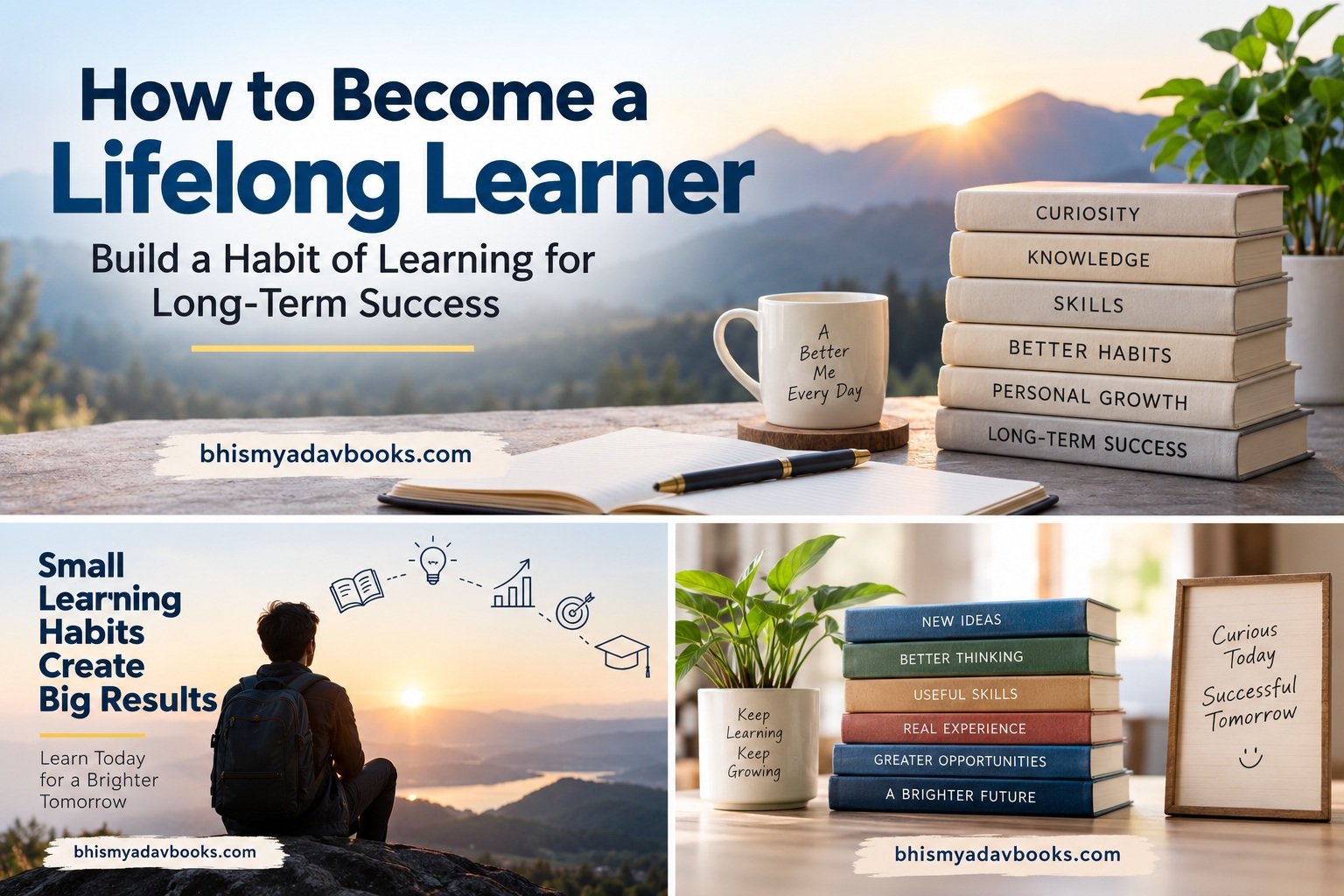
This is why lifelong learning has become such an important habit for personal development and long-term success.
A lifelong learner is someone who continues to learn, explore, question, practice, and improve throughout life. Lifelong learning does not necessarily mean spending hours every day studying textbooks. It can mean reading a book, learning a new skill, watching an educational lecture, practicing a language, understanding a new technology, discussing ideas with knowledgeable people, learning from mistakes, or simply becoming curious about something unfamiliar.
The goal is not to know everything.
The goal is to remain willing and capable of learning.
We have some amazing books at our Shop page you may want to buy.
Whether you are a student preparing for competitive examinations, a professional developing your career, an entrepreneur building a business, or simply someone who wants to improve yourself, becoming a lifelong learner can create a powerful foundation for long-term growth.
Table of Contents
How to Become a Lifelong Learner
What Is Lifelong Learning?
Lifelong learning is the continuous process of acquiring knowledge, developing skills, improving understanding, and learning from experiences throughout life.
It can happen formally or informally.
Formal learning may include:
- School and college education
- University courses
- Professional certifications
- Training programs
- Workshops
- Online courses
- Skill-development programs
Informal learning may include:
- Reading books
- Listening to educational podcasts
- Watching useful videos
- Learning from experienced people
- Practicing a skill
- Exploring a new subject
- Reflecting on personal experiences
- Learning from mistakes
- Asking questions
- Working on practical projects
The important thing is that learning becomes a continuous part of your lifestyle rather than something you do only when an examination is approaching.
Why Should You Become a Lifelong Learner?
Lifelong learning offers benefits that extend far beyond academic performance.
It can improve your knowledge, confidence, adaptability, problem-solving ability, creativity, and professional development.
1. The World Is Constantly Changing
One of the strongest reasons to continue learning is that the environment around us changes continuously.
New technologies are introduced. Businesses adopt new systems. Communication methods evolve. Scientific knowledge expands. New careers emerge while existing professions change.
A person who stops learning may eventually find that their knowledge and skills are no longer sufficient for their goals.
Continuous learning helps you stay adaptable.
Instead of asking, “Why has everything changed?” a lifelong learner develops the habit of asking:
“What do I need to learn next?”
That difference in mindset can have a major effect on long-term development.
2. Learning Improves Adaptability
Adaptability means being able to adjust when circumstances change.
Suppose a student learns only one method of solving a problem. If the problem changes slightly, the student may struggle.
Another student develops a deeper understanding of the underlying concept. When the question changes, they can adapt their knowledge to the new situation.
The same principle applies outside education.
Lifelong learners do not depend entirely on familiar routines. They develop the ability to understand new situations and acquire the knowledge necessary to respond to them.
3. Learning Builds Confidence
Confidence does not always come from knowing everything.
Often, confidence comes from knowing that you can learn what you do not yet understand.
Imagine encountering a completely unfamiliar subject.
A person with a fixed mindset might think:
“I don’t know this, so I probably can’t do it.”
A lifelong learner is more likely to think:
“I don’t know this yet. I can learn it.”
That small change in thinking can encourage experimentation and persistence.
Every new skill you acquire becomes evidence that you are capable of growth.
4. Learning Keeps Your Mind Active
Reading, studying, practicing, questioning, and solving problems require mental effort.
Learning new subjects also exposes you to different ideas and perspectives.
For example, someone who normally studies mathematics might explore history. A computer student might learn basic economics. An agriculture student might explore environmental science. A professional might study communication or psychology.
Cross-disciplinary learning can help you see connections that may not be obvious when you remain inside a single subject.
The Difference Between Studying and Lifelong Learning
Studying and lifelong learning are closely related, but they are not exactly the same.
Studying often has a specific objective.
For example:
- Preparing for an examination
- Completing an assignment
- Passing a certification
- Learning material for a test
Lifelong learning is broader.
It may have no examination at all.
You might learn photography because you are interested in it. You might study personal finance because you want to understand money better. You might learn programming because you want to build an application.
There may be no certificate at the end.
The learning itself is the goal.
This is an important distinction because many people associate learning with pressure.
They think:
Study → Examination → Result → Finished
A lifelong learner develops a different cycle:
Curiosity → Learning → Practice → Understanding → Application → Reflection → More Curiosity
This cycle can continue throughout life.
Develop a Learning Mindset
Before creating a study timetable or collecting books, develop the right mindset.
Your beliefs about learning influence how consistently you learn.
1. Accept That You Don’t Know Everything
Nobody knows everything.
Recognizing this is not a weakness. It is the starting point for growth.
When you accept that your knowledge has limits, you become more willing to ask questions.
Instead of pretending to understand something, say:
“I don’t understand this yet.”
The word yet is important.
It leaves room for improvement.
2. Become Comfortable With Questions
Curiosity is one of the most powerful characteristics of lifelong learners.
Ask:
- Why does this happen?
- How does this work?
- What caused it?
- Is there another way?
- What can I learn from this?
- Where can I verify this information?
- How can I apply this knowledge?
Questions turn passive information into active learning.
For example, instead of simply memorizing a scientific fact, ask why the fact is true.
Instead of memorizing a mathematical formula, understand where it comes from and when it should be used.
Instead of memorizing a business concept, think about how it appears in real life.
Questions create deeper understanding.
Build Curiosity Into Your Daily Life
You do not need to wait for a special course or educational opportunity to learn.
You can turn everyday experiences into learning opportunities.
Suppose you see a new machine.
Instead of ignoring it, you might wonder:
How does this machine work?
You see an unfamiliar word.
Look it up.
You hear an unfamiliar concept.
Research it.
Someone explains an idea that you don’t understand.
Ask questions.
You make a mistake.
Analyze what happened.
This approach transforms ordinary life into a continuous learning environment.
Read Regularly
Reading remains one of the simplest ways to develop lifelong learning habits.
You do not need to read dozens of books every month.
Consistency matters more than quantity.
Even 15–20 minutes of focused reading each day can become a meaningful habit over time.
You can read:
- Educational books
- Biographies
- Science books
- History
- Technology
- Economics
- Psychology
- Literature
- Professional material
- Reference books
- Essays
- Research-based articles
Choose material that supports your current goals while occasionally exploring unfamiliar subjects.
Don’t Read Only for Information
Read to understand.
When you finish a section, ask:
“What did I actually learn?”
Then try to explain the idea in your own words.
This simple technique can improve retention considerably.
Learn Actively Instead of Passively
One of the biggest differences between weak and strong learning is the level of participation.
Passive learning happens when information simply enters your attention.
For example, you watch an educational video from beginning to end but cannot explain what you learned afterward.
Active learning requires participation.
You might:
- Take notes
- Ask questions
- Solve problems
- Explain concepts
- Create examples
- Practice skills
- Test yourself
- Apply knowledge to real situations
For example, if you are learning programming, watching programming tutorials is not enough.
Write code.
If you are learning mathematics, solve problems.
If you are learning a language, speak and write it.
If you are learning design, create designs.
If you are learning writing, write regularly.
Knowledge becomes stronger when it is used.
Follow the Learn–Practice–Apply Cycle
A useful lifelong learning framework is:
Learn
Acquire new information or understand a concept.
Practice
Repeat the skill until you become more comfortable with it.
Apply
Use what you learned in a real situation.
Reflect
Think about what worked, what failed, and what you should improve.
Then return to learning.
This creates a continuous improvement cycle.
For example:
Learn: Study basic HTML.
Practice: Create simple web pages.
Apply: Build a small website.
Reflect: Identify weaknesses and learn CSS.
Then the cycle begins again.
This approach is much more powerful than collecting information without using it.
Don’t Try to Learn Everything at Once
One common mistake is trying to become knowledgeable about too many subjects simultaneously.
A person may decide to learn:
- Programming
- Digital marketing
- Photography
- Graphic design
- Finance
- A new language
- Public speaking
- Fitness
- Psychology
all at the same time.
The result is often enthusiasm for a few days followed by confusion and exhaustion.
Instead, create priorities.
Choose one primary learning goal and perhaps one or two secondary interests.
For example:
Primary: Programming
Secondary: Communication
Exploration: Astronomy
This structure provides direction while still allowing curiosity.
Set Learning Goals
A goal gives your learning direction.
Instead of saying:
“I want to learn more.”
create a clearer objective.
For example:
“I will learn the fundamentals of Python and build three small projects within three months.”
This goal is easier to understand and measure.
You can create different types of learning goals.
Knowledge Goal
“I will understand the basic principles of economics.”
Skill Goal
“I will learn to create a basic website.”
Practice Goal
“I will solve ten reasoning problems every day.”
Reading Goal
“I will read one educational book every month.”
Application Goal
“I will use my newly learned spreadsheet skills to create a personal budget.”
Specific goals make learning measurable.
Create a Personal Learning System
Motivation can help you start learning.
A system helps you continue.
Your personal learning system can be simple.
For example:
Daily: 20 minutes of reading
Three times a week: 30 minutes of skill practice
Weekly: Review what you learned
Monthly: Complete one small project
Every three months: Evaluate your progress and choose the next learning goal
This system does not require extraordinary discipline.
It requires consistency.
The objective is to make learning a normal part of your routine.
Make Learning a Habit
A habit becomes easier when it is attached to something you already do.
For example:
- Read after breakfast.
- Study after your evening tea.
- Listen to an educational podcast while traveling.
- Review notes before sleeping.
- Practice a skill at the same time every day.
This creates a predictable learning trigger.
Instead of repeatedly asking:
“When should I learn?”
your routine answers the question automatically.
Start small.
Ten minutes of daily learning is better than planning three hours and doing nothing.
Once the habit becomes stable, increase the duration gradually.
How to Become a Lifelong Learner: Build a Habit of Learning for Long-Term Success
Building a Sustainable Lifelong Learning System
1. Decide What You Want to Learn
One of the first challenges of lifelong learning is deciding what deserves your attention.
There are thousands of subjects you could study, millions of books you could read, and countless online courses available.
Trying to learn everything is impossible.
Therefore, you need to make thoughtful choices.
Start by asking yourself:
- What skills will help me achieve my goals?
- What subjects genuinely interest me?
- What knowledge is useful in my career or education?
- What weaknesses do I want to improve?
- What skills could help me solve real-world problems?
- What have I always wanted to understand?
- What knowledge could improve my personal life?
Your answers can help you identify meaningful learning priorities.
Use the 3-Category Learning Method
You can divide your learning interests into three categories.
Category 1: Essential Learning
These are subjects directly connected to your current responsibilities.
For a student, this could include:
- Mathematics
- Science
- Reasoning
- Language
- General knowledge
- Computer fundamentals
For a professional, essential learning might include:
- Industry knowledge
- Technical skills
- Communication
- Leadership
- Data analysis
- Professional certifications
Category 2: Growth Learning
These are skills that can expand your future opportunities.
Examples include:
- Programming
- Public speaking
- Writing
- Financial literacy
- Digital skills
- Project management
- Entrepreneurship
Category 3: Curiosity Learning
These are subjects you explore simply because they interest you.
Examples:
- Astronomy
- History
- Philosophy
- Psychology
- Photography
- Music
- Geography
- Nature
This category is important because learning should not always feel like work.
Curiosity keeps the learning process enjoyable.
2. Create a Learning Priority List
Once you have identified areas of interest, rank them according to importance.
For example:
| Priority | Learning Area | Reason |
| 1 | Communication | Career development |
| 2 | Computer skills | Professional usefulness |
| 3 | Financial literacy | Personal development |
| 4 | History | Personal interest |
| 5 | Photography | Creative exploration |
This prevents you from jumping randomly between subjects.
You can change your priorities later.
Your learning plan should be flexible rather than permanent.
3. Use the “One Skill at a Time” Principle
When learning a difficult skill, concentration is valuable.
Instead of trying to master several complex skills simultaneously, focus on one major skill for a specific period.
For example:
Month 1: Basic programming
Month 2: Programming projects
Month 3: Data handling
Month 4: Web development
This creates continuity.
You don’t have to completely stop learning other things. You can still read about other interests casually.
However, your primary learning effort should have a clear direction.
4. Create a Daily Learning Routine
A lifelong learning habit becomes easier when you have a predictable routine.
Your routine does not have to be complicated.
For example:
Morning
15 minutes of reading
Afternoon
10 minutes reviewing notes
Evening
30 minutes of focused learning
Weekend
1–2 hours of deeper study or project work
Even a small amount of consistent learning can accumulate over time.
The key principle is:
Consistency beats intensity.
Studying for five hours once a month is less useful as a habit than learning for 20–30 minutes several times a week.
5. Start With Small Learning Sessions
Many people fail to build learning habits because they begin with unrealistic expectations.
They decide:
“From tomorrow, I will study for four hours every day.”
The first few days may go well.
Then life becomes busy.
The routine breaks.
The person feels guilty and eventually stops.
A better strategy is to begin with a manageable commitment.
Try:
15 minutes per day.
Once that becomes comfortable, increase it to:
20 minutes → 30 minutes → 45 minutes
You are not trying to prove how much you can study in one day.
You are building a habit that can continue for years.
6. Protect Your Learning Time
Learning requires attention.
If you are constantly checking messages, notifications, social media, or unrelated websites, your learning quality will decline.
Create a protected learning period.
During that time:
- Silence unnecessary notifications.
- Keep your phone away when possible.
- Close unrelated browser tabs.
- Use headphones if they improve concentration.
- Keep only the required materials nearby.
- Decide what you want to accomplish before starting.
Even 25 minutes of uninterrupted concentration can be highly productive.
7. Use Focused Learning Sessions
You can divide learning into focused sessions.
For example:
25-Minute Session
5 minutes: Review previous material
15 minutes: Learn something new
5 minutes: Write a summary
Or:
60-Minute Session
10 minutes: Review
30 minutes: New learning
15 minutes: Practice
5 minutes: Reflection
The exact duration is less important than having a clear structure.
8. Learn With a Purpose
Before starting a learning session, ask:
“What should I understand or be able to do by the end of this session?”
For example:
Instead of:
“Study Python.”
Use:
“By the end of this session, I will understand how Python functions work and write three simple examples.”
This creates a specific target.
At the end of the session, you can check whether you achieved it.
9. Take Better Notes
Good notes are not transcripts.
You do not need to write down every sentence you read or hear.
Instead, capture:
- Important ideas
- Definitions
- Examples
- Questions
- Formulas
- Connections
- Mistakes
- Practical applications
Try explaining concepts in your own words.
For example:
Topic: Photosynthesis
Instead of copying a long textbook paragraph, write:
Plants use light energy to convert water and carbon dioxide into chemical energy, producing glucose and releasing oxygen.
Then add:
Question: Why is chlorophyll important?
This turns your notebook into a learning tool rather than a collection of copied sentences.
10. Use the Feynman Technique
The Feynman Technique is a simple way to test your understanding.
Choose a concept.
Then try to explain it as if you were teaching it to someone who knows nothing about the subject.
Use simple language.
If you cannot explain it clearly, identify the part you do not understand.
Return to the source.
Learn that section again.
Then try explaining it once more.
For example, if you are learning about gravity, don’t simply memorize a definition.
Ask yourself:
“Can I explain gravity to a twelve-year-old using a simple example?”
If you can, your understanding is probably becoming stronger.
Teaching is therefore not only a way to help others.
It is also a powerful learning method.
11. Practice Active Recall
Reading something repeatedly can create the feeling that you know it.
But recognition is not the same as recall.
Active recall means trying to retrieve information from memory without looking at the answer.
For example, after studying a chapter, close the book and ask:
- What were the main ideas?
- What definitions did I learn?
- What examples were given?
- What problem does this concept solve?
- Can I explain it without looking?
You can also create questions from your notes.
This forces your brain to retrieve information.
12. Review Information Regularly
Learning does not end when you finish a chapter.
Without review, some information becomes harder to remember.
Create a simple review cycle.
For example:
Day 1: Learn
Day 2: Quick review
Day 7: Review again
Day 30: Test yourself
This general approach is related to the principle of spaced repetition.
You can use flashcards, notes, quizzes, or self-testing to support review.
The goal is not to repeatedly reread everything.
The goal is to revisit important information at useful intervals.
13. Apply What You Learn
One of the strongest ways to make learning meaningful is application.
Suppose you learn:
Budgeting
Create a personal budget.
Suppose you learn:
Programming
Build a small application.
Suppose you learn:
Writing
Publish an article.
Suppose you learn:
Communication
Practice explaining a difficult idea clearly.
Suppose you learn:
Photography
Take photographs using the techniques you studied.
Application transforms theoretical knowledge into practical ability.
14. Build Small Projects
Projects are particularly useful for lifelong learners.
A project gives you a reason to combine different pieces of knowledge.
For example, someone learning web development could build:
Project 1: Personal webpage
Project 2: Simple calculator
Project 3: Blog website
Project 4: Small productivity tool
Projects also expose gaps in your knowledge.
You may discover:
“I understand HTML, but I don’t know enough CSS.”
That discovery gives you a clear next learning objective.
This creates a natural learning cycle.
15. Learn From Your Mistakes
Mistakes are valuable sources of information.
Instead of simply saying:
“I failed.”
ask:
- What exactly went wrong?
- Why did it happen?
- What did I misunderstand?
- What assumption was incorrect?
- What can I change next time?
- What should I learn to prevent the same mistake?
This turns failure into feedback.
A lifelong learner does not need to enjoy every mistake.
They need to learn from them.
16. Develop Digital Learning Skills
Modern learners have access to enormous amounts of information.
You can learn from:
- Online courses
- Digital libraries
- Educational websites
- Research papers
- E-books
- Video lectures
- Podcasts
- Online communities
- Interactive learning platforms
- Documentation
- Educational applications
But access to information creates another challenge:
Not all information is reliable.
Therefore, digital literacy is an important part of lifelong learning.
17. Learn to Evaluate Information
When you discover information online, ask:
Who created it?
Is the author identifiable?
What evidence supports the claim?
Does the source provide references or data?
When was it published?
Older information may be outdated in rapidly changing fields.
Is the source trying to sell something?
Commercial interests can influence how information is presented.
Can the claim be verified elsewhere?
Compare important information with reliable independent sources.
This is especially important for subjects involving science, health, finance, technology, law, and current events.
18. Don’t Confuse Information With Knowledge
The internet can give you access to enormous amounts of information.
But collecting information is not the same as learning.
You might save hundreds of articles and videos without actually understanding any of them.
Knowledge develops when information is:
Understood → Connected → Practiced → Applied → Remembered
Therefore, don’t measure your learning progress by the number of videos watched or books purchased.
Measure it by what you can understand and do.
19. Avoid the “Course Collection” Trap
Online learning platforms make it easy to enroll in courses.
You might find yourself thinking:
“I have 25 courses. I must be learning a lot.”
But if you have completed only a small portion of them, the collection itself provides little benefit.
Instead of collecting courses, finish useful ones.
A completed course plus practical application is generally more valuable than dozens of unfinished courses.
Before starting a course, ask:
“Why am I taking this?”
And after finishing it:
“What will I build, practice, or apply using what I learned?”
20. Create a Personal Knowledge Library
Over time, you will collect useful learning resources.
Organize them.
You could maintain folders such as:
- Books
- Notes
- Courses
- Research
- Projects
- Ideas
- Questions
- References
You can also maintain a digital knowledge system.
The exact software does not matter.
What matters is that you can find your information later.
A useful knowledge system should help you answer:
“Where did I learn this?”
and
“Where can I find my notes about it?”
21. Keep a Learning Journal
A learning journal can be extremely useful.
At the end of each learning session, write three things:
What I learned
Summarize the main idea.
What I found difficult
Identify confusion or weaknesses.
What I will do next
Choose the next action.
For example:
What I learned: Basic Python functions
Difficulty: Passing arguments
Next step: Practice five function examples tomorrow
This creates continuity between learning sessions.
22. Learn From Other People
Books and courses are valuable, but people are also powerful sources of knowledge.
Learn from:
- Teachers
- Mentors
- Colleagues
- Professionals
- Researchers
- Experienced friends
- Subject specialists
Ask thoughtful questions.
Listen carefully.
Observe how experienced people approach problems.
Sometimes one conversation can reveal a practical lesson that would take months to discover alone.
23. Become Comfortable Asking for Help
Some people avoid asking questions because they fear appearing uninformed.
But asking a good question is a sign of active learning.
If you don’t understand something, ask.
If you tried something and failed, ask for feedback.
If you are unsure about your approach, ask someone experienced.
However, don’t simply ask:
“How do I do this?”
when you could investigate first.
A stronger question might be:
“I tried these two approaches. The first produced this result and the second produced this error. Which concept am I misunderstanding?”
That shows effort and makes the discussion more useful.
24. Find a Learning Community
Learning becomes easier when you are surrounded by people who also enjoy learning.
You can join:
- Study groups
- Professional communities
- Book clubs
- Online learning groups
- Workshops
- Academic communities
- Technical communities
A good learning community can provide:
- Motivation
- Feedback
- Different perspectives
- Accountability
- Resources
- Collaboration opportunities
You don’t need to compete with everyone.
The purpose is to learn together.
25. Balance Depth and Breadth
Lifelong learners should develop both depth and breadth.
Breadth means understanding many different areas.
Depth means developing strong expertise in a specific area.
For example, a technology professional might understand:
- Programming
- Business
- Communication
- Design
- Cybersecurity
while developing deep expertise in software engineering.
Breadth helps you understand connections.
Depth helps you develop expertise.
A useful lifelong learning strategy is to maintain one or two areas of deep specialization while continuing to explore other subjects.
26. Don’t Be Afraid to Change What You Learn
Your interests can change.
The skills you need can change.
Your career can change.
Your circumstances can change.
Therefore, your learning plan should be flexible.
If you discover that a particular subject is not useful for your current goals, you can reduce your focus.
If a new opportunity appears, you can change direction.
Lifelong learning is not a rigid curriculum.
It is a continuous journey.
27. Protect Your Curiosity
Perhaps the most important part of lifelong learning is curiosity.
Don’t allow learning to become nothing more than another obligation.
Explore questions simply because they interest you.
Read outside your profession.
Learn something unrelated to your normal work.
Try a new skill.
Visit a museum.
Study a historical event.
Explore astronomy.
Learn how a machine works.
Ask why something is designed the way it is.
Curiosity keeps the mind open.
28. Measure Progress by Growth, Not Comparison
Avoid comparing your learning journey with someone else’s.
Someone may read ten books a month.
Another person may spend three months mastering one difficult subject.
Both approaches can be valuable.
Your learning speed depends on:
- Background knowledge
- Available time
- Difficulty of the subject
- Learning method
- Personal responsibilities
- Experience
Instead of asking:
“Am I learning faster than someone else?”
ask:
“Do I understand more today than I did before?”
That is a more meaningful measure of personal growth.
29. Build a Monthly Learning Review
At the end of every month, review your progress.
Ask yourself:
What did I learn?
List important concepts and skills.
What did I complete?
Record books, courses, projects, or practice sessions.
What did I apply?
Identify real-world uses.
What did I struggle with?
Write down difficult areas.
What should I stop doing?
Remove ineffective activities.
What should I continue?
Keep useful habits.
What should I learn next?
Choose your next priority.
This monthly review prevents your learning journey from becoming directionless.
30. Think in Years, Not Days
Lifelong learning is a long-term process.
You will not become an expert in a week.
You may not notice dramatic improvement after five days.
But consistent learning over months and years can produce substantial results.
Imagine spending only:
30 minutes per day
learning a valuable skill.
That is approximately:
3.5 hours per week
or more than:
180 hours per year.
The exact number of productive hours will vary, but the principle is clear:
Small amounts of consistent effort accumulate.
This is why lifelong learning is closely connected with long-term success.
How to Become a Lifelong Learner: Build a Habit of Learning for Long-Term Success
Overcoming Barriers and Staying Consistent
1. Lack of Motivation
Motivation is one of the most common obstacles to consistent learning.
When you are excited about a new subject, learning can feel easy. You may spend hours reading, watching lessons, or practicing.
But enthusiasm naturally changes.
Some days you will feel energetic.
Other days you will not want to study at all.
If your entire learning system depends on motivation, your progress will become inconsistent.
Build Systems Instead of Depending on Motivation
Rather than asking:
“Do I feel motivated today?”
ask:
“What is the smallest learning action I can complete today?”
Perhaps it is:
- Reading five pages
- Solving three problems
- Practicing for ten minutes
- Reviewing yesterday’s notes
- Watching one educational lesson
- Writing a short summary
Small actions keep the habit alive.
You don’t have to produce your maximum effort every day.
You simply need to avoid abandoning the learning process completely.
2. Procrastination
Procrastination means delaying an important activity even when you know you should do it.
Learning is especially vulnerable to procrastination because the benefits are often long-term.
Watching entertainment may provide immediate pleasure.
Studying may provide benefits months or years later.
This difference can make learning feel less attractive in the moment.
Use the Five-Minute Starting Rule
Tell yourself:
“I will learn for only five minutes.”
Open your book.
Start the lesson.
Write the first note.
Solve the first problem.
Often, beginning is harder than continuing.
Once you start, you may naturally continue beyond five minutes.
Even if you stop after five minutes, you have maintained the habit.
3. Fear of Failure
Some people avoid learning difficult subjects because they are afraid of failing.
They may think:
“What if I can’t understand this?”
“What if I’m not intelligent enough?”
“What if I make mistakes?”
But mistakes are a normal part of learning.
Nobody learns a complex skill perfectly on the first attempt.
Instead of viewing mistakes as evidence of inability, treat them as information.
A mistake can tell you:
- What you misunderstood
- What you need to practice
- Which assumption was incorrect
- Which concept requires more explanation
- Which method isn’t working
Failure becomes more useful when you analyze it.
4. The Fear of Looking Uninformed
Another barrier is the fear of asking questions.
People sometimes avoid saying:
“I don’t understand.”
because they believe others may judge them.
But learning requires admitting what you don’t know.
A student who asks a question may understand the concept better than someone who remains silent.
A professional who asks for clarification may avoid a major mistake.
A beginner who asks for feedback can improve faster.
Never confuse not knowing with being incapable of knowing.
Everyone begins somewhere.
5. Lack of Time
“I don’t have time to learn.”
This is one of the most common reasons people give for not developing new skills.
And sometimes the problem is genuine.
Students have examinations.
Professionals have jobs.
Parents have responsibilities.
Entrepreneurs have businesses.
Life can become extremely busy.
The solution is not always to find several free hours.
Instead, look for small learning opportunities.
Use Small Time Blocks
You might learn during:
- A commute
- A lunch break
- Early morning
- Evening
- Waiting periods
- Weekends
- Short breaks
You could read for 15 minutes instead of scrolling through social media.
You could listen to an educational podcast while traveling.
You could review flashcards during a short break.
You could spend 30 minutes on a weekend project.
Small time blocks can become valuable when used consistently.
6. Confusing Busy With Productive
Being busy does not necessarily mean you are making progress.
You might spend three hours watching educational videos but remember very little.
You might spend an hour organizing notes without actually understanding the subject.
You might spend weeks collecting resources without completing anything.
Ask yourself:
“What did I actually learn or accomplish?”
This question helps distinguish activity from progress.
7. Too Much Information
Modern learners face a problem that previous generations rarely experienced at the same scale:
information overload.
There are endless:
- Videos
- Articles
- Books
- Courses
- Podcasts
- Tutorials
- Social media posts
- Newsletters
- Forums
- Research papers
The problem is no longer simply finding information.
The problem is deciding which information deserves your attention.
Choose Fewer, Better Resources
For each learning goal, choose a limited number of primary resources.
For example:
One main book
One supporting course
One practice resource
One reference source
You can explore more later.
This reduces confusion and helps you complete what you started.
8. Constantly Switching Learning Resources
Imagine you are learning programming.
On Monday, you watch one instructor.
On Tuesday, you discover another course.
On Wednesday, you find a new tutorial.
On Thursday, you download an e-book.
By Friday, you have five different explanations of the same topic but have completed none of them.
This is sometimes called resource hopping.
Different explanations can be useful, especially when you’re stuck.
But constantly switching resources can interrupt your learning flow.
Choose a primary resource and stay with it long enough to build a foundation.
9. Digital Distractions
Technology is both a powerful learning tool and a major source of distraction.
Your computer or smartphone can provide access to excellent educational resources.
The same device can also provide:
- Social media
- Games
- Entertainment
- Notifications
- Messaging
- Short-form videos
A five-minute break can easily become an hour.
Create a Distraction-Free Environment
When learning:
- Turn off unnecessary notifications.
- Put your phone on silent.
- Close entertainment websites.
- Use full-screen learning materials.
- Keep only relevant tabs open.
- Set a specific learning duration.
You don’t have to eliminate entertainment.
You simply need to protect the time dedicated to learning.
10. Social Media and the Attention Problem
Short-form content is designed to capture attention quickly.
After consuming many short pieces of content, sustained concentration on a difficult chapter can feel uncomfortable.
This does not mean social media is automatically harmful.
The important issue is balance.
If you notice that you constantly switch away from difficult material, gradually practice longer periods of focused attention.
Start with:
10 minutes
then:
20 minutes
then:
30 minutes
Over time, your ability to concentrate can become stronger.
11. Lack of Immediate Results
Learning often produces delayed results.
You might practice a language for several weeks without feeling fluent.
You might study programming for months before creating something impressive.
You might read many books before noticing how your thinking has changed.
This can be discouraging.
Remember that learning progress is not always visible immediately.
Think of learning like planting a tree.
You may not notice significant growth every day.
But consistent care can produce major change over a longer period.
12. The Learning Plateau
Sometimes your progress appears to stop.
At the beginning of a new skill, improvement may happen quickly.
Then progress becomes slower.
This is often called a learning plateau.
For example:
You learn the basics of a language quickly.
You learn common vocabulary.
You understand simple sentences.
Then suddenly, improvement becomes much slower.
This does not necessarily mean you have stopped learning.
It may mean that your next level requires:
- More deliberate practice
- More difficult challenges
- Better feedback
- Deeper understanding
- More real-world application
13. Change Your Learning Method
If the same method isn’t producing progress, change the method.
For example:
If reading isn’t enough, try teaching.
If watching videos isn’t enough, start practicing.
If memorization isn’t working, use active recall.
If theory feels confusing, build a project.
If studying alone is difficult, join a study group.
Different problems require different learning approaches.
14. Seek Feedback
Feedback helps you identify mistakes that you cannot see yourself.
You can seek feedback from:
- Teachers
- Mentors
- Experienced professionals
- Peers
- Study groups
- Online communities
For example, someone learning writing may believe their work is clear.
Another reader may identify areas that are confusing.
That feedback creates an opportunity to improve.
Good feedback should answer:
What is working?
What needs improvement?
What should I try next?
15. Learn to Deal With Difficult Subjects
Some subjects are simply difficult.
You may need several attempts before understanding them.
Don’t interpret difficulty as evidence that you should immediately quit.
Instead, break the subject into smaller components.
For example, if advanced mathematics seems overwhelming:
Instead of:
“I need to learn advanced mathematics.”
Break it into:
- Basic algebra
- Functions
- Graphs
- Trigonometry
- Calculus fundamentals
- Advanced applications
Each step becomes more manageable.
16. Use the “Next Small Step” Method
When you feel overwhelmed, ask:
“What is the next small step?”
Not:
“How will I master this entire subject?”
For example:
“I need to learn programming.”
becomes:
“Today I will learn variables.”
Then:
“Tomorrow I will practice conditional statements.”
Then:
“Next I will learn loops.”
Large goals become manageable when converted into small actions.
17. Don’t Chase Perfection
Perfectionism can prevent learning.
You may refuse to start a project because you don’t know enough.
You may avoid writing because your first draft won’t be perfect.
You may avoid speaking a new language because you might make mistakes.
But beginners are supposed to produce imperfect work.
Your first attempt is not supposed to represent your final ability.
Use this cycle:
Create → Evaluate → Improve → Repeat
Improvement comes from iteration.
18. Accept Being a Beginner
Being a beginner can feel uncomfortable.
You may make obvious mistakes.
You may work slowly.
Other people may know more than you.
That’s normal.
Every expert was once a beginner.
Instead of asking:
“Why am I not good at this?”
ask:
“What can I learn from this stage?”
Being a beginner is temporary if you continue practicing.
19. Don’t Compare Your Beginning With Someone Else’s Experience
You may watch an expert perform a skill and think:
“I’ll never be able to do that.”
But you are comparing your beginning with someone else’s years of experience.
A better comparison is:
You today vs. you six months ago.
Ask:
- What can I do now that I couldn’t do before?
- What do I understand now?
- What mistakes have I stopped making?
- What skills have improved?
Personal progress is more meaningful than comparison.
20. Build Accountability
Accountability can increase consistency.
Tell someone about your learning goal.
For example:
“I am going to complete this programming course this month.”
Then provide an update later.
You could also:
- Join a study group
- Work with a learning partner
- Maintain a progress tracker
- Publish your projects
- Keep a learning journal
When your progress becomes visible, it can be easier to maintain momentum.
21. Track Your Progress
Progress tracking doesn’t have to be complicated.
You can maintain a simple table:
| Date | Topic | Time | What I Learned | Next Step |
| Sept 1 | Python | 30 min | Variables | Practice |
| Sept 2 | Python | 25 min | Conditions | Solve problems |
| Sept 3 | Python | 40 min | Loops | Build example |
The purpose isn’t to create paperwork.
The purpose is to make your learning visible.
22. Celebrate Small Wins
Long-term learning contains many small achievements.
Examples:
- Finishing a chapter
- Understanding a difficult concept
- Completing a project
- Solving a problem independently
- Explaining something clearly
- Reading your first book on a subject
- Completing a course
- Improving a skill
Recognize these achievements.
You don’t need to celebrate extravagantly.
Simply acknowledging progress can help maintain motivation.
23. Create Learning Milestones
Instead of setting only one large goal, create milestones.
For example:
Goal: Learn web development.
Milestone 1
Understand HTML.
Milestone 2
Learn CSS.
Milestone 3
Learn basic JavaScript.
Milestone 4
Build a website.
Milestone 5
Publish the project.
Each milestone provides a sense of progress.
24. Learn During Difficult Periods
There will be periods when your normal learning routine becomes impossible.
Perhaps you have:
- Exams
- Work deadlines
- Family responsibilities
- Travel
- Financial difficulties
- Major projects
- Other temporary commitments
During such periods, reduce your learning target rather than abandoning learning completely.
If you normally study for an hour, perhaps study for ten minutes.
If you normally read 20 pages, read two.
The goal is to maintain continuity.
When your schedule becomes normal again, increase the routine.
25. Avoid the “All or Nothing” Mindset
An all-or-nothing mindset sounds like:
“I missed three days, so my routine is ruined.”
This is unnecessary.
Missing a few days does not erase your previous progress.
Simply restart.
Think:
Miss one day → return the next day.
Miss one week → restart the following week.
The important thing is not whether you ever break your routine.
The important thing is whether you return to it.
26. Turn Mistakes Into Learning Questions
Instead of becoming frustrated by mistakes, convert them into questions.
For example:
Mistake: Your program produces an error.
Ask:
“Why did this error occur?”
Mistake: You forget a concept.
Ask:
“Which part of the concept did I fail to understand?”
Mistake: You perform poorly on a test.
Ask:
“Which topics caused most of my errors?”
This approach transforms frustration into investigation.
27. Maintain Intellectual Humility
A lifelong learner should be confident enough to learn but humble enough to recognize limitations.
You can be knowledgeable while still saying:
“I don’t know.”
You can have experience while still listening to another perspective.
You can be an expert in one field while being a beginner in another.
Intellectual humility keeps the door to learning open.
28. Learn to Unlearn
Sometimes learning requires changing an old belief or method.
You may discover that something you previously believed was incomplete or incorrect.
This can be uncomfortable.
But growth sometimes requires replacing outdated understanding with better evidence.
Ask:
“Is my current understanding still supported by reliable evidence?”
Being willing to update your knowledge is an important lifelong learning skill.
29. Stay Patient
Long-term learning requires patience.
There may be periods when progress feels slow.
There may be concepts that take weeks to understand.
There may be skills that require thousands of repetitions.
Don’t expect instant mastery.
Focus on steady improvement.
A useful mindset is:
“I don’t need to become excellent today. I need to improve today.”
That principle is sustainable.
30. Keep Learning Enjoyable
Learning should not always feel like an examination.
Explore subjects that make you curious.
Read interesting books.
Watch educational documentaries.
Build creative projects.
Discuss ideas.
Visit educational places.
Experiment.
Ask questions.
Follow your curiosity.
When learning becomes enjoyable, consistency becomes easier.
31. Develop the Habit of Reflection
Learning becomes deeper when you reflect on what you have experienced.
At the end of the week, ask:
What did I learn?
What surprised me?
What was difficult?
What mistakes did I make?
What should I practice next?
How can I apply what I learned?
Reflection connects experience with understanding.
Without reflection, you may repeat the same mistakes.
With reflection, experience becomes a teacher.
32. Protect Your Energy
Learning requires mental energy.
If you are exhausted, distracted, or constantly overloaded, deep learning becomes harder.
Therefore, lifelong learning also requires taking care of the conditions that support learning.
Maintain reasonable:
- Sleep
- Rest
- Breaks
- Physical activity
- Nutrition
- Recreation
The objective is not to study every waking hour.
A sustainable learner understands the importance of recovery.
33. Know When to Take a Break
Rest is not the opposite of productivity.
Sometimes your brain needs time away from a difficult problem.
You may understand something better after taking a break and returning later.
If you have been struggling with a concept for a long period, step away temporarily.
Come back later with a fresh perspective.
34. Keep a “Questions List”
Whenever something makes you curious, write it down.
For example:
- How do satellites stay in orbit?
- How does artificial intelligence learn?
- Why do some materials conduct electricity?
- How does the human brain process language?
- How does a spacecraft navigate?
- How does a country’s economy work?
You don’t have to research every question immediately.
Keep a list.
When you have free learning time, choose one question.
This transforms curiosity into action.
35. Develop a “Learning for Life” Identity
Perhaps the strongest transformation happens when learning becomes part of how you see yourself.
Instead of saying:
“I am studying because I have an exam.”
you begin thinking:
“I am someone who keeps learning.”
This identity changes your relationship with education.
You no longer stop learning simply because an examination is finished.
You continue because learning itself has become part of your life.
How to Become a Lifelong Learner: Build a Habit of Learning for Long-Term Success
Creating Your Lifelong Learning Roadmap
1. Create Your Personal Lifelong Learning Vision
Before creating a detailed learning plan, think about the person you want to become.
Ask yourself:
- What kind of knowledge do I want to develop?
- What skills do I want to master?
- What problems do I want to become capable of solving?
- What subjects genuinely interest me?
- What type of career do I want?
- What personal qualities do I want to develop?
- What would I like to understand better about the world?
Your answers create a personal learning vision.
For example:
“I want to become a knowledgeable, adaptable, creative person who continuously develops useful skills and remains curious about the world.”
Your vision doesn’t need to be complicated.
It simply provides direction.
2. Identify Your Current Learning Needs
Your learning needs will change throughout life.
A student may need academic knowledge.
A job seeker may need professional skills.
A new employee may need workplace knowledge.
An entrepreneur may need business and financial skills.
A manager may need leadership and communication skills.
A retired person may want to explore personal interests.
Therefore, your learning plan should reflect your current stage of life.
Create four lists:
What I Know
List subjects and skills you already understand.
What I Need to Know
Identify knowledge required for your current goals.
What I Want to Improve
Identify weaknesses that are limiting your progress.
What I Want to Explore
List subjects you are curious about.
This simple exercise can reveal where your learning attention should go.
3. Create a Personal Learning Map
A personal learning map gives structure to your goals.
For example:
Knowledge
- Science
- History
- Economics
- Technology
Professional Skills
- Communication
- Computer skills
- Data analysis
- Project management
Personal Skills
- Time management
- Financial literacy
- Decision-making
- Emotional awareness
Creative Skills
- Writing
- Photography
- Design
- Music
You don’t have to study everything simultaneously.
The map simply shows the areas that may be important to you over time.
4. Choose One Major Learning Goal
After creating your learning map, select one major goal.
For example:
“I will learn Python programming and build three practical projects within six months.”
This is better than saying:
“I want to learn technology.”
A clear goal gives you direction.
Once you complete it, choose another.
This creates a continuous sequence of learning goals.
5. Use the 90-Day Learning Cycle
A three-month cycle can provide enough time to make meaningful progress without making your plan feel endless.
Month 1: Foundation
Learn the basic concepts.
Read introductory material.
Understand terminology.
Practice simple examples.
Month 2: Practice
Solve problems.
Complete exercises.
Build small projects.
Identify weaknesses.
Month 3: Application
Create a meaningful project.
Teach someone else.
Apply the skill in a real situation.
Review what you have learned.
Then decide whether to continue deeper or move to a related skill.
6. Build a Weekly Learning Schedule
Your weekly schedule should be realistic.
For example:
| Day | Activity |
| Monday | Learn new concept |
| Tuesday | Practice |
| Wednesday | Learn new concept |
| Thursday | Practice |
| Friday | Review |
| Saturday | Project |
| Sunday | Reflection and planning |
This is only an example.
Your schedule should match your responsibilities.
A person with a full-time job may have less learning time than a student.
The goal is not to copy someone else’s schedule.
The goal is to create one you can maintain.
7. Use the 1–1–1 Learning Rule
A simple framework is:
1 New Concept
Learn one important concept.
1 Practice Session
Use or practice that concept.
1 Application
Use it in a practical situation.
For example:
New concept: Learn basic SQL queries.
Practice: Solve ten SQL exercises.
Application: Use SQL to analyze a small dataset.
This prevents learning from becoming purely theoretical.
8. Combine Books, Courses, Practice, and Experience
Different learning methods serve different purposes.
Books
Excellent for depth and structured understanding.
Courses
Useful for guided learning.
Videos
Helpful for demonstrations and visual explanations.
Practice
Develops skill.
Projects
Combine multiple concepts.
Mentors
Provide experience and feedback.
Real-world experience
Shows how knowledge works outside educational environments.
The strongest learning systems combine several of these methods.
9. Read Books Strategically
You don’t have to finish every book you start.
Before reading a book, ask:
Why am I reading this?
Then identify what you want from it.
You might want:
- A specific skill
- Background knowledge
- New ideas
- Different perspectives
- Practical strategies
Take useful notes.
Mark important sections.
Summarize major concepts.
After finishing, ask:
“What will I do differently because I read this?”
That question turns reading into action.
10. Create a Personal Reading Habit
A simple reading habit might be:
10–20 pages per day.
You can read:
- In the morning
- During lunch
- Before sleeping
- During weekends
- While traveling when appropriate
You can also alternate between different types of books.
For example:
Monday–Friday: Professional or educational book
Weekend: History, biography, science, or personal interest
This keeps reading interesting.
11. Learn Skills Through Projects
Projects are one of the best ways to transform knowledge into ability.
Suppose you are learning:
Programming
Build an application.
Writing
Create a blog.
Graphic Design
Design a small portfolio.
Finance
Create a personal budgeting system.
Data Analysis
Analyze a dataset.
Public Speaking
Record presentations and review them.
Language
Have conversations and write short passages.
Projects create evidence of what you can actually do.
12. Teach What You Learn
Teaching is a powerful learning method.
You can teach:
- A friend
- A colleague
- A study group
- A younger student
- Your audience online
You can also teach yourself by writing explanations.
For example:
“Today I learned how a database index works.”
Now explain it in simple language.
If your explanation is unclear, return to the subject.
Teaching exposes gaps in understanding.
13. Share Your Learning Journey
You can document what you learn through:
- Articles
- Notes
- Videos
- Presentations
- Projects
- Social media posts
- Personal websites
Sharing does not mean pretending to be an expert.
You can simply document your learning.
For example:
“What I learned while building my first Python project.”
This can help others while also reinforcing your own understanding.
14. Develop Transferable Skills
Some skills remain useful across many careers and situations.
These include:
Communication
The ability to explain ideas clearly.
Critical Thinking
The ability to evaluate information and reasoning.
Problem Solving
The ability to identify problems and develop solutions.
Writing
The ability to communicate through clear written language.
Digital Literacy
The ability to use modern digital tools effectively.
Research
The ability to find, evaluate, and organize information.
Adaptability
The ability to learn when circumstances change.
These skills can support almost any field.
15. Learn How to Learn
One of the most valuable skills you can develop is the ability to learn efficiently.
Understand:
- How memory works
- How practice works
- How to take notes
- How to ask questions
- How to find reliable information
- How to test yourself
- How to use feedback
- How to break complex subjects into smaller pieces
Once you become better at learning itself, every future subject becomes easier to approach.
16. Develop Critical Thinking
Lifelong learning requires more than collecting information.
You also need to evaluate it.
When encountering a claim, ask:
What is the evidence?
What assumptions are being made?
Is there another explanation?
Is the source reliable?
Can the information be independently verified?
What might I be missing?
Critical thinking helps protect you from misinformation and encourages deeper understanding.
17. Learn Across Different Fields
Some of the most interesting ideas appear when different subjects connect.
For example:
Technology + Education
can produce educational software.
Agriculture + Technology
can produce precision farming systems.
Astronomy + Engineering
can produce spacecraft technologies.
Psychology + Education
can improve learning methods.
Business + Technology
can create new services.
Exploring multiple subjects can help you recognize connections that would otherwise remain hidden.
18. Develop a T-Shaped Skill Profile
A useful model for lifelong development is the T-shaped skill profile.
The horizontal part represents broad knowledge across multiple areas.
The vertical part represents deep expertise in one area.
For example:
A software professional might understand:
- Business
- Design
- Communication
- Cybersecurity
- Data
while developing deep expertise in software engineering.
This combination of breadth and depth can make your knowledge more flexible.
19. Learn From Real Problems
Real problems are excellent teachers.
Instead of always asking:
“What course should I take?”
sometimes ask:
“What problem do I need to solve?”
Then identify the knowledge required to solve it.
For example:
You want to build a website.
You discover that you need:
- HTML
- CSS
- JavaScript
- Hosting
- Basic security
The problem naturally creates your learning roadmap.
This is often more motivating than studying abstract topics without a purpose.
20. Build a Portfolio of Learning
Keep evidence of your development.
Your portfolio could include:
- Completed projects
- Articles
- Certificates
- Research
- Designs
- Programs
- Presentations
- Notes
- Publications
A portfolio demonstrates application rather than simply claiming that you have learned something.
For students and professionals, this can also become useful when applying for opportunities.
21. Revisit Old Knowledge
Lifelong learning isn’t always about learning something completely new.
Sometimes you should return to old subjects.
After gaining more experience, you may understand an old concept differently.
A topic that seemed confusing five years ago may become obvious after you develop related knowledge.
Periodic review can therefore reveal new connections.
22. Keep Updating Your Skills
Knowledge can become outdated.
This is particularly noticeable in rapidly changing fields such as:
- Technology
- Computing
- Artificial intelligence
- Engineering
- Digital marketing
- Cybersecurity
- Business
If a field changes rapidly, schedule periodic updates.
Ask:
“What has changed since I learned this?”
This keeps your knowledge current.
23. Learn From Both Success and Failure
Success can teach you what works.
Failure can teach you what doesn’t.
After completing an important project, review both.
Ask:
What worked?
Identify successful strategies.
What didn’t work?
Identify problems.
What surprised me?
Record unexpected discoveries.
What would I change?
Identify improvements.
What will I do next?
Create the next action.
This turns experience into knowledge.
24. Keep Your Learning Flexible
Your lifelong learning plan should not become another source of unnecessary pressure.
Some periods of life will allow extensive learning.
Other periods will require you to focus on work, family, education, or other responsibilities.
Adjust accordingly.
During busy periods, maintain a small learning habit.
During quieter periods, increase your learning activities.
Flexibility helps make lifelong learning sustainable.
25. Continue Learning Through Different Stages of Life
Lifelong learning changes as your life changes.
As a Student
Focus on:
- Fundamentals
- Study skills
- Curiosity
- Communication
- Problem solving
During Early Career
Focus on:
- Professional skills
- Practical experience
- Communication
- Technology
- Industry knowledge
During Career Development
Focus on:
- Leadership
- Specialization
- Adaptability
- Strategic thinking
- New technologies
Later in Life
Focus can include:
- Personal interests
- Creative skills
- History
- Science
- Languages
- Mentoring
- Community learning
There is no age at which learning has to stop.
26. Become a Mentor
As your knowledge increases, help others.
Mentoring can benefit both people.
The learner receives guidance.
The mentor gains an opportunity to:
- Organize knowledge
- Explain concepts
- Reflect on experience
- Discover new perspectives
- Improve communication
Teaching others can therefore become another stage of lifelong learning.
27. Build a Culture of Learning Around You
Your environment influences your habits.
If your environment encourages curiosity, learning becomes easier.
Keep books accessible.
Follow educational resources.
Discuss ideas with knowledgeable people.
Create a workspace that supports concentration.
Encourage family members and friends to learn.
A learning-friendly environment can make education feel natural rather than forced.
28. Avoid the Need to Know Everything
Lifelong learning does not mean becoming an expert in every field.
You don’t need to know everything about:
- Science
- Technology
- History
- Economics
- Art
- Business
- Psychology
- Engineering
Instead, develop the ability to understand the basics, identify reliable resources, ask good questions, and learn more when necessary.
The goal is not total knowledge.
The goal is continuous capability to learn.
29. Develop a Long-Term Learning Philosophy
Your personal philosophy might be:
Stay curious.
Ask questions.
Stay humble.
Recognize what you don’t know.
Stay consistent.
Learn regularly.
Stay practical.
Apply knowledge.
Stay adaptable.
Update your understanding.
Stay patient.
Accept slow progress.
Stay open-minded.
Consider new evidence and perspectives.
These principles can guide your learning for decades.
30. Create Your Lifelong Learning Checklist
Use this simple checklist every month.
Learning Goals
☐ Did I choose a clear learning goal?
☐ Did I focus on an important subject?
Learning Habit
☐ Did I maintain a regular schedule?
☐ Did I protect my learning time?
Understanding
☐ Did I actively recall important concepts?
☐ Did I explain what I learned in my own words?
Practice
☐ Did I practice the skill?
☐ Did I complete a project or practical exercise?
Application
☐ Did I use my knowledge in a real situation?
Reflection
☐ What did I learn?
☐ What did I struggle with?
☐ What should I improve?
Next Step
☐ What will I learn next?
This simple review can keep your learning journey moving forward.
31. A Practical Lifelong Learning Roadmap
Here is a simple roadmap you can follow.
Step 1: Choose
Select one meaningful learning goal.
Step 2: Research
Find reliable learning resources.
Step 3: Plan
Break the goal into smaller topics.
Step 4: Learn
Study the fundamentals.
Step 5: Practice
Work through exercises.
Step 6: Apply
Use the knowledge in a practical situation.
Step 7: Teach
Explain what you learned.
Step 8: Review
Test your understanding.
Step 9: Reflect
Identify strengths and weaknesses.
Step 10: Improve
Work on the weak areas.
Step 11: Complete
Finish a meaningful project.
Step 12: Continue
Choose your next learning goal.
This creates a continuous cycle:
Choose → Learn → Practice → Apply → Teach → Review → Improve → Continue
That is the essence of lifelong learning.
32. Example of a One-Year Learning Plan
Imagine a student wants to become a stronger and more adaptable learner.
A possible plan could look like this:
January–March
Focus on:
- Reading habit
- Communication
- Fundamental computer skills
April–June
Focus on:
- Programming fundamentals
- Problem solving
- Practical projects
July–September
Focus on:
- Financial literacy
- Writing
- Research skills
October–December
Focus on:
- Advanced development in one selected skill
- Portfolio project
- Year-end review
The specific subjects can be changed according to individual goals.
The important point is to create a sequence rather than attempting everything simultaneously.
33. The Long-Term Effect of Small Learning Habits
Consider what happens when you learn something small every day.
One day may not produce a dramatic difference.
One week may not feel transformative.
One month may show only modest progress.
But over several years, consistent learning can create a substantial collection of:
- Knowledge
- Skills
- Experience
- Projects
- Connections
- Confidence
- Better problem-solving ability
This is why lifelong learning belongs in the Long-Term Success category.
Success is rarely created by one extraordinary learning session.
It is often built through thousands of small decisions to improve.
34. Lifelong Learning and Career Growth
Continuous learning can help people adapt to changing career requirements.
Employers and industries may introduce new tools, processes, and expectations.
Someone who continues developing skills can better understand these changes.
However, career learning should not mean chasing every new trend.
Instead, develop strong fundamentals first.
For example, someone working in technology should understand fundamental concepts rather than learning every new tool without understanding the principles behind them.
Strong fundamentals make future learning easier.
35. Lifelong Learning and Personal Growth
Learning is not only about earning money or improving your career.
It can also make life more interesting.
Learning history can help you understand societies.
Learning science can help you understand nature.
Learning art can improve creativity.
Learning languages can open communication opportunities.
Learning philosophy can encourage deeper reflection.
Learning financial literacy can improve everyday decision-making.
Learning about different cultures can broaden your perspective.
Knowledge can enrich life even when it has no immediate financial benefit.
36. Lifelong Learning and Confidence
Confidence can grow when you repeatedly prove to yourself that you can learn difficult things.
You learn something unfamiliar.
You practice.
You struggle.
You improve.
Eventually, you realize:
“I can learn difficult things if I give myself enough time and effort.”
That realization can influence how you approach future challenges.
You become less afraid of unfamiliar subjects.
37. Become Curious About the World
Perhaps the simplest definition of a lifelong learner is:
Someone who remains curious.
Look around you.
Almost everything can become a learning opportunity.
How does a computer process information?
How does an airplane fly?
How does a satellite communicate?
How does a plant grow?
How does a business operate?
How does a country’s economy function?
How does language evolve?
How do people make decisions?
Why does a particular technology work?
The world is full of questions.
You don’t need to answer all of them.
Choose one.
Start learning.
38. Your Learning Journey Has No Final Chapter
There will always be another subject to explore.
Another skill to practice.
Another book to read.
Another question to investigate.
Another problem to solve.
Another perspective to understand.
That is what makes lifelong learning different from traditional education.
Traditional education may have graduation ceremonies.
Lifelong learning has no final graduation.
There is always another opportunity to grow.
Recommended books for Job Aspirants
Final Conclusion: Keep Learning, Keep Growing
Becoming a lifelong learner is one of the most valuable habits you can develop for long-term success.
It doesn’t require extraordinary intelligence.
It doesn’t require expensive courses.
It doesn’t require studying for ten hours every day.
It begins with curiosity.
Then comes consistency.
Read something useful.
Ask questions.
Learn a new concept.
Practice a skill.
Apply your knowledge.
Make mistakes.
Learn from those mistakes.
Teach someone else.
Review your progress.
Then begin again.
Over time, these simple actions can transform the way you think, work, solve problems, and respond to change.
The most important lesson is this:
You do not have to know everything. You only need to remain willing to learn.
Your education does not have to end when school ends.
It does not have to end when college ends.
It does not have to end when you get a job.
It does not have to end when you reach a particular age.
Learning can remain a part of your life for as long as you choose to keep exploring.
The world will continue to change.
New technologies will appear.
New challenges will emerge.
New opportunities will develop.
The people who remain curious and willing to learn can continue adapting to these changes.
So start where you are.
Choose one subject.
Read one page.
Learn one concept.
Practice one skill.
Ask one question.
Complete one small project.
Then do it again tomorrow.
Because long-term success is not only about reaching a destination.
It is also about becoming a person who can continue growing along the way.