Introduction
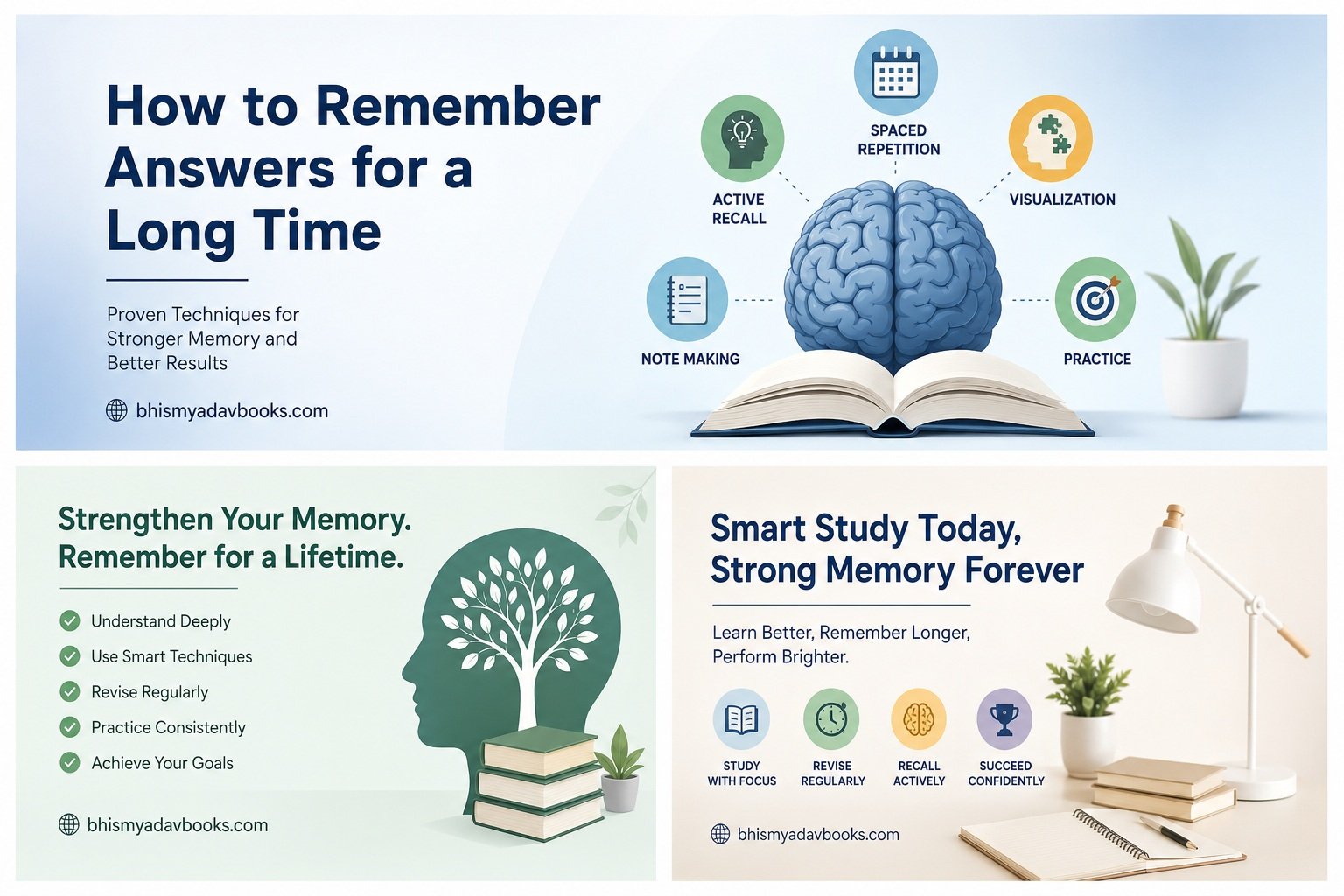
Remembering answers during exams is one of the biggest challenges students face. Many students study for several hours, complete their syllabus, and solve numerous practice questions. However, when they enter the examination hall, they suddenly forget important facts, formulas, dates, definitions, or concepts.
This problem is not caused by a lack of intelligence. Instead, it usually happens because students use ineffective study methods that help them remember information only for a short period.
We have some amazing books at our Shop page you may want to buy.
Table of Contents
How to Remember Answers for a Long Time: The Complete Guide for Students and Competitive Exam Aspirants
The good news is that memory can be improved through proper learning techniques. Scientific research shows that our brain is capable of storing vast amounts of information if it is encoded, organized, and revised correctly.
Whether you are preparing for:
- SSC Exams
- Banking Exams
- Railway Exams
- UPSC
- State PSC
- NDA
- CDS
- CAT
- CUET
- NEET
- JEE
- School examinations
- College entrance examinations
the techniques explained in this guide will help you remember answers for months and even years.
Why Do We Forget What We Study?
Many students believe they have poor memory. In reality, memory problems are often caused by poor learning habits rather than poor intelligence.
Common reasons include:
- Reading without understanding
- Cramming one day before exams
- Lack of revision
- No self-testing
- Poor concentration
- Mobile phone distractions
- Sleep deprivation
- Studying for long hours without breaks
- Anxiety and stress
- Information overload
If these issues are corrected, memory automatically improves.
Understanding How Memory Works
Before learning memory techniques, it is important to understand how memory actually works.
Memory has three stages:
1. Encoding
Encoding means receiving new information.
For example:
You read a chapter on Indian History.
Your brain receives the information.
If you simply read passively, encoding remains weak.
If you understand, visualize, and explain the topic, encoding becomes strong.
Strong encoding leads to strong memory.
2. Storage
After encoding, information is stored inside the brain.
The stronger the connections between neurons, the longer you remember the information.
Repeated revision strengthens these neural connections.
3. Retrieval
Retrieval means recalling information whenever needed.
During examinations, students retrieve stored information.
Many students fail because they never practice retrieval before exams.
Reading repeatedly is not retrieval.
Answering questions from memory is retrieval.
Types of Memory Every Student Should Know
Short-Term Memory
Short-term memory lasts only a few seconds or minutes.
Example:
Remembering a phone number just long enough to dial it.
Most students study using only short-term memory.
That is why they forget answers quickly.
Working Memory
Working memory is used while solving problems.
Examples include:
- Solving Mathematics
- Reading comprehension
- Logical reasoning
- Coding problems
Working memory has limited capacity.
Overloading it causes confusion.
Long-Term Memory
Long-term memory stores information for months or years.
Competitive exams require long-term memory.
The goal of effective studying is to transfer information from short-term memory into long-term memory.
The Forgetting Curve
German psychologist Hermann Ebbinghaus discovered that people forget information rapidly if they do not revise it.
According to the Forgetting Curve:
After studying once:
- Within 20 minutes, some information is forgotten.
- Within one day, much more is forgotten.
- Within one week, most information disappears.
- After one month, only a small portion remains.
This explains why students forget entire chapters after a few weeks.
Fortunately, revision resets the forgetting curve.
Why Revision Is More Important Than Reading
Many students read the same chapter five or six times.
Unfortunately, repeated reading gives a false feeling of confidence.
Instead of reading repeatedly, students should:
- Recall
- Revise
- Test themselves
- Solve questions
This creates stronger memories.
Active Learning vs Passive Learning
Passive Learning
Examples include:
- Reading textbooks
- Watching videos continuously
- Highlighting pages
- Listening to lectures without notes
Passive learning creates weak memory.
Active Learning
Examples include:
- Solving questions
- Teaching others
- Writing answers
- Making notes
- Creating flashcards
- Practicing quizzes
Active learning creates strong memory.
Students who actively learn remember information much longer.
The Science Behind Long-Term Memory
Every time you remember something, your brain strengthens that memory.
Imagine a forest.
Walking once creates a tiny path.
Walking daily creates a wide road.
Similarly,
Every revision strengthens memory pathways.
This is why repeated recall is more effective than repeated reading.
Memory Improvement Is Like Building Muscles
Just as muscles become stronger through exercise, memory becomes stronger through practice.
Daily habits gradually improve memory.
No medicine can replace consistent study habits.
Students with average intelligence but disciplined revision often outperform highly intelligent students who study irregularly.
Common Myths About Memory
Myth 1: I Have a Weak Memory
Reality:
Most students simply use poor study techniques.
Memory can improve significantly through training.
Myth 2: Studying for Longer Hours Means Better Memory
Reality:
Quality matters more than quantity.
Four focused hours are often better than ten distracted hours.
Myth 3: Reading Again and Again Is Enough
Reality:
Reading creates familiarity.
Practice creates memory.
Myth 4: Intelligent Students Never Forget
Reality:
Even top rankers revise regularly.
Nobody remembers everything without revision.
Myth 5: Last-Minute Cramming Works
Reality:
Cramming may help for a few hours.
Long-term retention requires systematic revision.
Benefits of Strong Memory
Students with good memory experience numerous advantages.
These include:
- Faster learning
- Better exam performance
- Improved confidence
- Reduced stress
- Better interview performance
- Improved communication
- Higher productivity
- Better academic results
- Strong conceptual understanding
- Faster revision before examinations
Memory improvement is not only useful for examinations but also throughout your career.
Qualities of Students Who Remember Answers Easily
Successful students usually have these habits:
- They study daily.
- They revise regularly.
- They test themselves.
- They sleep properly.
- They avoid distractions.
- They maintain healthy lifestyles.
- They organize notes effectively.
- They understand concepts before memorizing.
- They remain consistent.
- They believe memory improves through practice.
These habits can be developed by anyone.
The Golden Rule of Memory Improvement
“Do not try to memorize information immediately. First understand it deeply, then revise it repeatedly, and finally test yourself without looking at your notes.”
This simple principle forms the foundation of every effective memory technique used by top-performing students around the world.
10 Scientifically Proven Memory Techniques to Remember Answers for a Long Time
Now it is time to learn the most effective memory improvement techniques used by:
- UPSC Toppers
- SSC Rank Holders
- IIT & NEET Students
- Medical Students
- Chartered Accountants
- Competitive Exam Aspirants worldwide
These methods are supported by cognitive psychology and educational research and can help you retain information for months or even years.
1. Active Recall – The Most Powerful Memory Technique
What is Active Recall?
Active Recall means trying to remember information without looking at your notes or textbook.
Instead of repeatedly reading the answer, you force your brain to retrieve it.
Every successful retrieval strengthens memory.
Example
Instead of reading:
“Who wrote the Constitution of India?”
Close the book and ask yourself:
“Who was the Chairman of the Drafting Committee?”
If you answer:
Dr. B. R. Ambedkar
your brain creates stronger memory connections.
Why Active Recall Works
Your brain treats retrieval like exercise.
Every recall acts like a workout for memory.
The more often you retrieve information, the stronger it becomes.
How to Practice Active Recall
After studying one topic:
- Close the book.
- Write everything you remember.
- Compare with your notes.
- Correct mistakes.
- Repeat after a few hours.
Do this every day.
Active Recall for Competitive Exams
For History:
Instead of reading:
“Battle of Plassey took place in 1757.”
Ask yourself:
- When did the Battle of Plassey occur?
- Who fought it?
- Why was it important?
For Biology:
Instead of rereading diagrams:
Draw them from memory.
For Mathematics:
Solve problems without seeing examples.
For English:
Recall difficult vocabulary without checking the list.
2. Spaced Repetition – Beat the Forgetting Curve
Most students revise only before examinations.
This is one of the biggest mistakes.
What is Spaced Repetition?
Spaced repetition means revising information at increasing intervals.
Instead of studying one chapter for five hours in one day,
study it for one hour over five different days.
Your brain remembers much longer.
Ideal Revision Schedule
After first study:
- First Revision → Same day
- Second Revision → Next day
- Third Revision → After 3 days
- Fourth Revision → After 7 days
- Fifth Revision → After 15 days
- Sixth Revision → After 30 days
This simple schedule dramatically improves retention.
Example
Suppose you study Indian Polity today.
Revise:
- Tonight
- Tomorrow
- After 3 days
- After 1 week
- After 15 days
- After 1 month
Now you are likely to remember it for years.
3. The Feynman Technique
Named after Nobel Prize-winning physicist Richard Feynman, this method helps students understand deeply instead of memorizing blindly.
Step 1
Study one topic.
Example:
Photosynthesis
Step 2
Explain it in your own words.
Imagine teaching a Class 5 student.
If you cannot explain it simply,
you probably do not understand it well.
Step 3
Identify weak areas.
Return to the textbook.
Learn again.
Step 4
Simplify further.
Remove complicated language.
Use everyday examples.
Benefits
- Better understanding
- Better memory
- Easier revision
- Strong concepts
4. Visualization Technique
Our brains remember images much better than plain text.
Instead of memorizing words,
convert them into pictures.
Example
Suppose you must remember:
Water Cycle
Imagine:
☀️ Sun heating the ocean
☁️ Clouds forming
🌧 Rain falling
🌊 Rivers flowing
The visual story becomes easy to remember.
Competitive Exam Example
Remember:
Ashoka → Lion Capital
Visualize:
A king standing beside four lions.
The image stays much longer than text.
5. Mind Mapping
Mind maps organize information visually.
Instead of long paragraphs,
connect ideas through branches.
Example
Indian Constitution
Center:
Indian Constitution
Branches:
- Fundamental Rights
- Fundamental Duties
- Directive Principles
- Parliament
- Judiciary
- President
- Prime Minister
Each branch can have sub-branches.
This makes revision much faster.
Benefits
- Organizes ideas
- Easy revision
- Better understanding
- Strong memory
6. Mnemonics
Mnemonics convert difficult information into memorable words or sentences.
Example
To remember rainbow colors:
VIBGYOR
- Violet
- Indigo
- Blue
- Green
- Yellow
- Orange
- Red
Geography Example
Great Lakes
HOMES
- Huron
- Ontario
- Michigan
- Erie
- Superior
Biology Example
Taxonomy
Kingdom
Phylum
Class
Order
Family
Genus
Species
Mnemonic:
King Philip Came Over For Good Soup
Students can create their own mnemonics for competitive exams.
7. Memory Palace Technique
One of the oldest memory methods.
Used by world memory champions.
How It Works
Imagine your home.
Assign each room to one topic.
Example:
Living Room
→ Indian History
Kitchen
→ Geography
Bedroom
→ Biology
Study Room
→ Mathematics
Now place important facts inside each room mentally.
During exams,
walk through your house in your imagination.
You can often recall the information.
Example
Suppose you must remember:
Five Mughal Emperors.
Imagine each emperor sitting in a different room.
The sequence becomes easier to recall.
8. Chunking Method
The brain remembers small groups better than long lists.
Example
Instead of remembering:
19471950195219561962
Break it into:
1947
1950
1952
1956
1962
Much easier.
Mobile Number Example
987432
Remember:
987
432
History Example
Divide important events into decades.
Instead of memorizing 100 events together,
study them decade by decade.
9. Interleaving Technique
Most students study:
History
for three continuous hours.
This reduces concentration.
Instead,
alternate subjects.
Example:
History → Mathematics → Science → English
Changing subjects improves attention and strengthens learning.
Sample Schedule
8:00–9:00
Mathematics
9:15–10:15
General Knowledge
10:30–11:30
Reasoning
11:45–12:45
English
Your brain stays active.
10. Pomodoro Technique
Long study sessions reduce productivity.
The Pomodoro Method helps maintain focus.
Standard Pomodoro
Study
25 minutes
Break
5 minutes
Repeat four times.
Then take a longer break of 20–30 minutes.
Advanced Pomodoro
Many competitive exam aspirants prefer:
50 minutes study
10 minutes break
Repeat.
Choose whichever suits your concentration.
Combine All Techniques for Maximum Memory
The best results come from combining multiple techniques.
For example:
- Read the chapter carefully.
- Understand the concepts.
- Make short notes.
- Create a mind map.
- Use mnemonics.
- Explain using the Feynman Technique.
- Practice Active Recall.
- Revise using Spaced Repetition.
- Solve MCQs.
- Teach someone else.
This combination creates extremely strong long-term memory.
Daily Memory Improvement Routine
Here is a practical routine you can follow every day:
Morning (30–45 Minutes)
- Revise yesterday’s topics using Active Recall.
- Review flashcards or short notes.
Study Session 1 (1–2 Hours)
- Learn one new topic.
- Understand concepts deeply.
- Make concise notes.
Short Break
- Walk, stretch, drink water.
Study Session 2 (1–2 Hours)
- Solve practice questions.
- Write answers from memory.
Evening Revision (30–45 Minutes)
- Use Spaced Repetition to revise older topics.
- Create or update mind maps.
Before Sleeping (15 Minutes)
- Mentally recall the important concepts learned during the day without looking at your notes.
Common Mistakes That Weaken Memory
Avoid these habits if you want to remember answers for a long time:
- Reading without understanding.
- Highlighting entire pages instead of making concise notes.
- Memorizing without practice.
- Skipping revision.
- Studying for many hours without breaks.
- Multitasking with mobile phones or social media.
- Ignoring weak subjects.
- Depending only on coaching notes.
- Studying only before exams.
- Losing sleep during preparation.
Replacing these habits with the techniques above will significantly improve long-term retention.
Brain-Boosting Habits and Daily Practices to Remember Answers for a Long Time
In this section, we will explore the daily habits followed by top-performing students and competitive exam toppers that help them retain information for months and even years.
11. Sleep – The Secret Weapon for Long-Term Memory
Many students sacrifice sleep to study late into the night, believing that more study hours equal better performance. In reality, lack of sleep weakens memory.
Why Sleep Is Important
When you sleep, your brain processes and stores the information learned during the day. This process is called memory consolidation.
Without enough sleep:
- New information is not stored effectively.
- Concentration decreases.
- Problem-solving ability reduces.
- Revision becomes less effective.
- Exam performance suffers.
Ideal Sleep Duration
Recommended sleep:
- School Students: 8–10 hours
- College Students: 7–9 hours
- Competitive Exam Aspirants: 7–8 hours
Studying for 10 hours after sleeping only 4 hours is usually less effective than studying for 7 focused hours after proper sleep.
Tips for Better Sleep
- Sleep and wake up at the same time every day.
- Avoid mobile phones at least 30–60 minutes before bedtime.
- Avoid caffeine late in the evening.
- Keep your bedroom quiet and dark.
- Revise important concepts briefly before sleeping.
12. Healthy Nutrition for Better Memory
Your brain consumes about 20% of your body’s energy. A healthy diet directly supports concentration, learning, and memory.
Brain-Friendly Foods
Include:
- Almonds
- Walnuts
- Peanuts
- Pumpkin seeds
- Sunflower seeds
- Green leafy vegetables
- Fruits (especially berries, oranges, bananas, apples)
- Eggs
- Milk
- Yogurt
- Paneer
- Fish (for those who consume it)
- Whole grains
- Lentils
- Oats
Stay Hydrated
Even mild dehydration can reduce concentration.
Aim to drink 2–3 liters of water daily, depending on your activity level and climate.
Foods to Limit
Avoid excessive intake of:
- Sugary drinks
- Junk food
- Deep-fried snacks
- Excessive sweets
- Highly processed foods
- Too many energy drinks
These foods may cause energy crashes and reduce focus.
13. Exercise Improves Memory
Physical activity benefits both the body and the brain.
Exercise increases blood circulation, allowing more oxygen and nutrients to reach brain cells.
Benefits
- Better concentration
- Improved learning
- Reduced stress
- Sharper memory
- Increased energy
Simple Exercises
- Brisk walking
- Cycling
- Running
- Skipping rope
- Yoga
- Stretching
- Bodyweight exercises
Even 20–30 minutes of daily exercise can make a noticeable difference.
14. Meditation and Deep Breathing
Stress is one of the biggest enemies of memory.
Meditation helps calm the mind and improves attention.
Simple Breathing Exercise
- Sit comfortably.
- Close your eyes.
- Inhale slowly through your nose.
- Hold for a few seconds.
- Exhale gently through your mouth.
- Repeat for 5–10 minutes.
Practicing this daily before studying can improve focus and reduce anxiety.
15. Study in a Distraction-Free Environment
Your study environment affects your ability to remember information.
Ideal Study Setup
- Clean desk
- Comfortable chair
- Good lighting
- Minimal noise
- Organized study materials
- Water bottle nearby
Reduce Digital Distractions
Common distractions include:
- Social media
- Short videos
- Mobile games
- Constant notifications
Consider:
- Keeping your phone on silent.
- Using focus modes.
- Studying with only the necessary apps or tabs open.
16. Make Effective Notes
Writing your own notes improves understanding and memory.
Characteristics of Good Notes
- Short
- Organized
- Clear headings
- Bullet points
- Keywords
- Diagrams
- Tables
- Flowcharts
- Highlighted formulas
Avoid copying entire textbook pages.
Cornell Note-Taking Method
Divide each page into three sections:
- Notes
- Keywords or Questions
- Summary
This structure makes revision quicker and encourages active recall.
17. Create Flashcards
Flashcards are excellent for revision.
Front Side
Question
Example:
“What is the capital of Australia?”
Back Side
Answer
Canberra
Review flashcards regularly using spaced repetition.
They work well for:
- Vocabulary
- Dates
- Formulas
- Definitions
- Current affairs
- Scientific terms
- Constitutional Articles
18. Teach Someone Else
Teaching is one of the most powerful ways to remember information.
If you can explain a topic clearly to another person, you truly understand it.
You can teach:
- Friends
- Family members
- Study partners
- Even an imaginary student
This strengthens both understanding and recall.
19. Write Instead of Only Reading
Reading creates familiarity.
Writing creates memory.
After studying:
- Close the book.
- Write everything you remember.
- Compare with your notes.
- Correct mistakes.
Repeat this regularly to strengthen retrieval.
20. Solve Practice Questions Daily
Knowledge becomes stronger when applied.
After every chapter:
- Solve MCQs.
- Attempt descriptive questions.
- Practice previous year papers.
- Take sectional quizzes.
Mistakes reveal weak areas and guide your revision.
21. Use Previous Year Question Papers
Previous year papers help you:
- Understand exam patterns.
- Identify frequently asked topics.
- Improve time management.
- Build confidence.
After solving each paper, analyze your mistakes and revise those topics.
22. Keep a Mistake Notebook
Instead of ignoring errors, record them.
Include:
- Wrong answers
- Incorrect formulas
- Confusing concepts
- Frequently forgotten facts
Revise this notebook regularly. Many toppers consider it one of their most valuable study resources.
23. Build a Smart Revision Planner
Revision should be planned, not random.
Sample Weekly Revision Plan
Monday
- Mathematics
- Current Affairs
Tuesday
- English
- Reasoning
Wednesday
- General Science
- History
Thursday
- Geography
- Polity
Friday
- Economics
- Computer Awareness
Saturday
- Mixed Revision
- Mock Test
Sunday
- Full-Length Mock Test
- Mistake Analysis
- Weekly Review
This balanced approach ensures every subject receives regular attention.
24. Study During Your Peak Focus Hours
Everyone has different energy levels.
Some students concentrate best in the morning, while others perform better in the evening.
Identify your most productive hours and schedule difficult subjects during that time.
Reserve low-energy periods for lighter tasks like revision or reading.
25. Avoid Multitasking
Many students believe they can:
- Watch videos
- Chat with friends
- Listen to music
- Browse social media
- Study
all at the same time.
In reality, multitasking reduces concentration and weakens memory.
Focus on one task at a time for better learning.
26. Manage Exam Stress
Anxiety can make it difficult to recall even well-prepared answers.
Ways to Reduce Stress
- Prepare consistently instead of cramming.
- Practice mock tests under timed conditions.
- Use deep breathing before exams.
- Avoid comparing yourself with others.
- Maintain a positive routine.
Confidence grows from preparation.
27. Build Consistency Instead of Chasing Motivation
Motivation comes and goes.
Consistency builds lasting results.
Even studying 2–3 focused hours every day is often more effective than studying 12 hours only on weekends.
Create a realistic timetable and follow it regularly.
A Sample Daily Routine for Better Memory
| Time | Activity |
| 5:30–6:00 AM | Wake up, hydrate, light stretching |
| 6:00–7:00 AM | Revise previous day’s topics |
| 7:00–8:00 AM | Breakfast and preparation |
| 8:00–10:00 AM | Study difficult subject |
| 10:00–10:15 AM | Short break |
| 10:15–12:00 PM | Practice questions |
| 12:00–1:00 PM | Lunch and rest |
| 1:00–3:00 PM | Second study session |
| 3:00–3:30 PM | Walk or exercise |
| 3:30–5:00 PM | Revision or mock test |
| 5:00–6:00 PM | Relaxation or hobbies |
| 6:00–8:00 PM | Third study session |
| 8:00–9:00 PM | Dinner |
| 9:00–9:30 PM | Quick revision and planning |
| 10:00 PM | Sleep |
Adjust the schedule according to your personal responsibilities and exam goals.
Daily Memory Improvement Checklist
Use this checklist every day:
✅ Slept at least 7–8 hours
✅ Drank enough water
✅ Exercised for 20–30 minutes
✅ Studied without major distractions
✅ Used Active Recall
✅ Revised previous topics
✅ Solved practice questions
✅ Updated mistake notebook
✅ Created or reviewed flashcards
✅ Planned the next day’s study
Completing these habits consistently will strengthen long-term memory over time.
Motivational Advice for Students
Many students believe that toppers are born with extraordinary memory.
The truth is that most toppers develop their memory through disciplined habits, regular revision, and consistent practice.
Do not be discouraged if you forget something today. Forgetting is a normal part of learning. What matters is revising, practicing, and recalling the information repeatedly.
Every revision session makes your memory stronger.
Every mock test increases your confidence.
Every mistake teaches you something valuable.
Success is not the result of perfect memory—it is the result of persistent effort, smart study techniques, and consistency.
Advanced Memory Strategies, Subject-Wise Techniques, 30-Day Memory Improvement Plan, FAQs & Conclusion
In this section, we will learn advanced strategies used by toppers, subject-wise memorization methods, a practical 30-day improvement plan, and answers to common questions.
Advanced Memory Strategies Used by Toppers
Top-performing students rarely depend on intelligence alone. They develop systems that help them remember information efficiently.
1. The 80/20 Rule (Pareto Principle)
The Pareto Principle suggests that approximately 20% of the topics contribute to 80% of exam success.
How to Apply It
- Analyze previous year question papers.
- Identify frequently asked topics.
- Master these topics first.
- Then move to less frequently tested areas.
This strategy helps you prepare smarter instead of simply studying longer.
2. Reverse Learning Technique
Instead of starting with theory:
- Solve a question first.
- Identify what you don’t know.
- Learn the concept.
- Solve similar questions.
This approach improves understanding and strengthens memory because learning happens with a clear purpose.
3. Daily Recall Session
Before sleeping, ask yourself:
- What did I study today?
- Which formulas did I learn?
- Which current affairs did I read?
- Which mistakes did I make?
Mentally recalling the day’s learning strengthens long-term retention.
4. Weekly Self-Test
Every week:
- Attempt a mock test.
- Avoid using notes.
- Analyze incorrect answers.
- Revise weak areas.
Weekly testing converts short-term knowledge into long-term memory.
5. Monthly Grand Revision
At the end of each month:
- Revise all subjects.
- Review your mistake notebook.
- Solve mixed-topic questions.
- Attempt a full-length mock test.
Monthly revision prevents information from fading over time.
Subject-Wise Memory Techniques
Different subjects require different approaches.
Mathematics
Remembering mathematics is less about memorization and more about practice.
Tips
- Understand formulas before memorizing them.
- Practice daily.
- Maintain a formula notebook.
- Solve problems of varying difficulty.
- Review mistakes regularly.
Science
Science becomes easier when concepts are connected.
Tips
- Draw diagrams.
- Use flowcharts.
- Understand processes step by step.
- Explain concepts aloud.
- Relate ideas to everyday life.
History
History contains many dates, events, and personalities.
Tips
- Create timelines.
- Group events by century or theme.
- Use mnemonics.
- Connect events logically.
- Revise regularly.
Geography
Geography is highly visual.
Tips
- Study maps frequently.
- Draw simple maps from memory.
- Connect locations with physical features.
- Use colored diagrams.
Indian Polity
Polity includes Articles, Amendments, and Constitutional bodies.
Tips
- Create tables.
- Group related Articles.
- Solve MCQs after every chapter.
- Revise constitutional provisions weekly.
Economics
Economics becomes easier when linked with real-life examples.
Tips
- Understand concepts before memorizing definitions.
- Read economic news.
- Create summary notes.
- Practice numerical questions where applicable.
English
Vocabulary improves through regular exposure.
Tips
- Learn 10–15 new words daily.
- Use each word in a sentence.
- Revise weekly.
- Read newspapers and books.
Current Affairs
Many students forget current affairs quickly.
Better Strategy
- Read daily.
- Make concise notes.
- Revise every week.
- Solve quizzes.
- Review monthly compilations.
Memory Techniques for Objective Exams
For SSC, Banking, Railway, UPSC, CDS, NDA, and State PSC exams:
- Practice MCQs daily.
- Analyze incorrect answers.
- Revise weak topics.
- Take timed mock tests.
- Maintain an error log.
Repeated exposure to questions improves recall speed.
Memory Techniques for Descriptive Exams
For essay-based examinations:
- Prepare outlines.
- Practice writing complete answers.
- Memorize key headings instead of entire paragraphs.
- Use examples, diagrams, and structured points.
Understanding the structure of an answer is more valuable than memorizing every sentence.
30-Day Memory Improvement Challenge
Follow this plan consistently to strengthen your memory.
Week 1 – Build Strong Foundations
Goals:
- Remove distractions.
- Organize study materials.
- Begin Active Recall.
- Start using the Pomodoro Technique.
- Sleep on time.
Week 2 – Strengthen Learning
Goals:
- Start Spaced Repetition.
- Create flashcards.
- Build mind maps.
- Solve daily quizzes.
- Begin a mistake notebook.
Week 3 – Improve Recall
Goals:
- Teach topics to others.
- Solve previous year papers.
- Write answers without notes.
- Take two mock tests.
Week 4 – Master Long-Term Retention
Goals:
- Complete full syllabus revision.
- Attempt full-length mock exams.
- Analyze mistakes.
- Strengthen weak subjects.
- Build confidence before exams.
Signs That Your Memory Is Improving
You will notice positive changes such as:
- Recalling formulas quickly.
- Solving questions faster.
- Remembering current affairs for longer.
- Improved confidence.
- Reduced dependence on notes.
- Better mock test scores.
- Less exam anxiety.
- Faster revision.
These improvements may appear gradually, so stay consistent.
Common Memory Mistakes to Avoid
Many students unintentionally weaken their memory through poor study habits.
Avoid these common mistakes:
- Studying without a clear plan.
- Reading passively for long hours.
- Ignoring revision.
- Depending only on highlighting.
- Using mobile phones during study sessions.
- Skipping mock tests.
- Not reviewing mistakes.
- Studying only before exams.
- Sleeping too little.
- Comparing your progress with others.
Replacing these habits with effective strategies leads to lasting improvement.
Recommended books for Job Aspirants
Frequently Asked Questions (FAQs)
1. Can memory really be improved?
Yes. Memory improves with proper study techniques, regular revision, sufficient sleep, and consistent practice.
2. How many times should I revise a topic?
A practical schedule is:
- Same day
- Next day
- After 3 days
- After 7 days
- After 15 days
- After 30 days
This helps move information into long-term memory.
3. Is studying for long hours necessary?
Not always. Focused study with effective techniques is generally more productive than many distracted hours.
4. Which memory technique is the most effective?
A combination works best:
- Active Recall
- Spaced Repetition
- Practice Questions
- Mind Maps
- Flashcards
- Mock Tests
5. How can I remember formulas?
- Understand the derivation or logic when possible.
- Write formulas repeatedly.
- Solve practice problems.
- Revise your formula notebook regularly.
6. Is it normal to forget after studying?
Yes. Forgetting is a natural process. Regular revision and retrieval practice strengthen memory over time.
7. How can I improve concentration?
- Remove distractions.
- Study in focused sessions.
- Exercise regularly.
- Sleep adequately.
- Practice mindfulness or deep breathing.
8. Do mock tests improve memory?
Yes. Mock tests strengthen retrieval skills, reveal weak areas, and prepare you for actual exam conditions.
Final Revision Checklist
Before your examination, ensure that you have:
✅ Completed the syllabus.
✅ Revised important topics multiple times.
✅ Solved previous year papers.
✅ Attempted mock tests.
✅ Reviewed your mistake notebook.
✅ Revised formulas, dates, and definitions.
✅ Practiced Active Recall.
✅ Slept well before the exam.
Final Thoughts
Remembering answers for a long time is not about having a “gifted memory.” It is about using the right techniques consistently.
Every student forgets information from time to time. What separates successful students from others is not that they never forget—it is that they review, practice, and strengthen their memory through disciplined habits.
If you consistently apply the methods discussed in this guide—Active Recall, Spaced Repetition, Mind Mapping, Flashcards, Mock Tests, Healthy Sleep, Exercise, and Regular Revision—you will notice steady improvements in your ability to remember concepts, solve problems, and perform confidently in examinations.
Progress may seem slow in the beginning, but every focused study session and every revision builds stronger neural connections. Over weeks and months, these small efforts lead to remarkable improvements in long-term memory.
Whether you are preparing for SSC, Banking, Railway, UPSC, State PSC, NDA, CDS, CAT, NEET, JEE, CUET, school examinations, or college entrance tests, these strategies will help you learn more effectively and retain knowledge for much longer.
Remember this simple principle:
“Understand deeply, revise regularly, recall actively, practice consistently, and trust the process. Strong memory is built one study session at a time.”
Conclusion
Memory is not fixed—it can be trained. By combining effective learning techniques with healthy daily habits and a structured revision plan, you can significantly improve your ability to remember answers for a long time.
Start with one or two techniques today, apply them consistently, and gradually build a complete study system. Over time, you will find that revision becomes easier, recall becomes faster, and your confidence grows with every exam.
At Bhism Yadav Books, our goal is to help students and competitive exam aspirants build strong fundamentals, develop smart study habits, and achieve lasting academic success. Keep learning, stay consistent, and remember that every small step you take today brings you closer to your goals.