Introduction
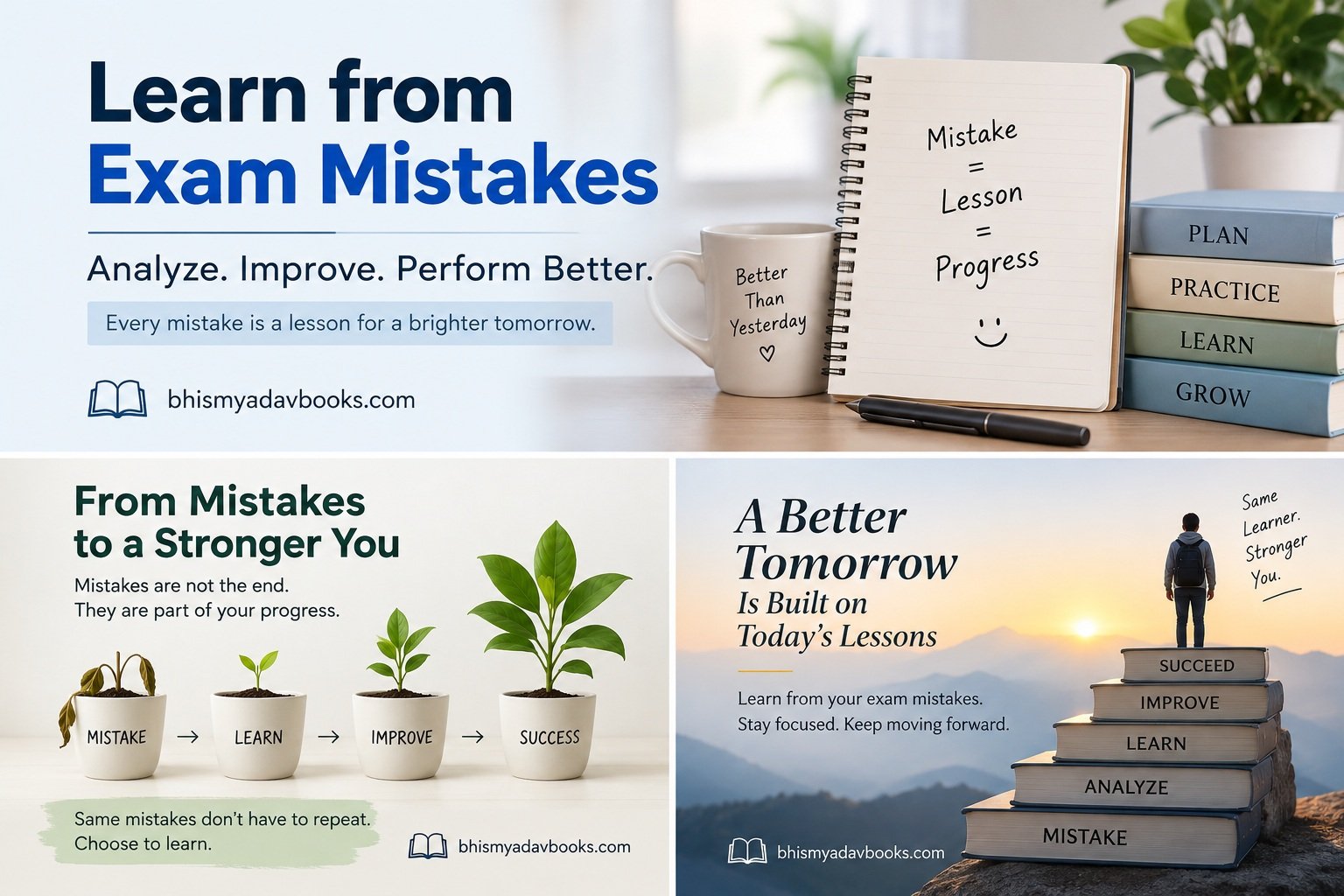
Exams are not only tests of knowledge. They are also tests of preparation, discipline, time management, concentration, decision-making, and emotional control. Even students and job aspirants who study seriously can make mistakes during preparation or inside the examination hall.
A wrong answer, missed question, poor time management, incomplete revision, careless calculation, or misunderstanding of a concept can affect the final result. However, making a mistake does not mean that your preparation has been wasted. In many cases, exam mistakes can become some of the most valuable lessons in your preparation journey.
The important question is not simply, “Why did I make this mistake?”
The better question is:
“What can I learn from this mistake so that I do not repeat it?”
This change in mindset can make a major difference.
Instead of treating every mistake as proof that you are weak, treat it as information. A mistake tells you that something in your preparation, understanding, strategy, attention, or execution needs improvement.
We have some amazing books at our Shop page you may want to buy.
For students preparing for school examinations, entrance tests, government examinations, banking examinations, railway examinations, SSC examinations, technical examinations, or other competitive exams, learning from mistakes can gradually improve performance.
You do not need to become perfect overnight.
You need to become better at identifying and correcting your weaknesses.
Table of Contents
Learn from Exam Mistakes: How to Turn Failure into Success
Why Learning from Exam Mistakes Is Important
Many students make the same mistake repeatedly.
They solve a mock test.
They check the score.
They see which questions were wrong.
Then they move on to the next test.
This approach may provide a score, but it does not necessarily provide learning.
Suppose you answered five mathematics questions incorrectly in a mock test. If you simply look at the correct answers and continue studying, you may make the same mistakes again.
But imagine that you carefully examine those five questions.
Perhaps:
- Two mistakes happened because you did not understand the concept.
- One happened because you misunderstood the question.
- One happened because of a calculation error.
- One happened because you ran out of time.
Now you know something much more useful.
Your problem is not simply “I got five questions wrong.”
Your actual problems are:
Conceptual weakness + question interpretation + calculation accuracy + time management.
That information gives you a direction for improvement.
This is why learning from exam mistakes is an important part of effective preparation.
Mistakes Are Feedback, Not Just Failure
One of the biggest psychological problems students face is viewing mistakes only as failures.
A student may score poorly in a mock test and immediately think:
“I am not good at this subject.”
Another student may think:
“I need to understand why I lost these marks.”
The second approach is more useful because it converts the result into actionable information.
A mock test is not merely a measurement tool. It can also be a diagnostic tool.
Your mistakes can reveal:
- weak topics
- forgotten formulas
- poor revision
- lack of practice
- careless reading
- slow calculations
- poor time allocation
- guessing habits
- exam anxiety
- lack of concentration
- misunderstanding of instructions
Once you identify the actual cause, you can work on it.
This creates a continuous improvement cycle:
Study → Practice → Make Mistakes → Analyze → Correct → Practice Again → Improve
The goal is not to eliminate every mistake immediately.
The goal is to ensure that the same mistake becomes less likely to happen again.
Common Types of Exam Mistakes
Before learning how to correct mistakes, you need to understand that not every mistake has the same cause.
Two students may get the same question wrong for completely different reasons.
Therefore, classifying your mistakes is extremely useful.
1. Conceptual Mistakes
A conceptual mistake happens when you do not properly understand the underlying idea.
For example, suppose you are solving a physics problem involving Newton’s laws.
You may remember a formula but not understand when and how to apply it.
As a result, you select the wrong equation.
The problem is not necessarily lack of memory.
The problem is incomplete understanding.
Conceptual mistakes require concept revision and additional practice.
Simply memorizing the answer will not solve the problem.
2. Memory-Based Mistakes
Some questions are based on facts, definitions, formulas, dates, terminology, vocabulary, or other information that must be remembered.
You may know the topic but forget a specific detail during the exam.
For example:
- forgetting a mathematical formula
- confusing two scientific terms
- forgetting an important historical date
- mixing up two similar definitions
- forgetting a rule or exception
These mistakes indicate that your revision or recall practice may need improvement.
A useful solution is to use:
- short revision notes
- flashcards
- repeated recall
- spaced revision
- practice questions
Reading the same information repeatedly is not always enough.
You should also practice recalling information without looking at the answer.
3. Calculation Mistakes
Calculation errors are common in mathematics, quantitative aptitude, physics, accounting, and other numerical subjects.
You may understand the question perfectly but still arrive at the wrong answer.
For example:
- adding numbers incorrectly
- multiplying incorrectly
- missing a negative sign
- copying a number incorrectly
- using the wrong unit
- making a decimal error
- applying the correct formula incorrectly
These mistakes can be frustrating because you may know the concept but still lose marks.
The solution is not simply “be more careful.”
You need to identify the exact pattern of your calculation errors.
If you repeatedly make errors with percentages, fractions, signs, or decimal calculations, practice those areas separately.
4. Careless Mistakes
Careless mistakes are different from conceptual mistakes.
You may know the correct answer but mark another option because you:
- read too quickly
- missed the word “not”
- misunderstood the instruction
- marked the wrong option
- copied the wrong value
- skipped a step
- changed a correct answer unnecessarily
These mistakes often happen when students become overconfident, rushed, tired, or distracted.
Careless mistakes should not simply be dismissed as “silly mistakes.”
If they happen repeatedly, they are a real preparation issue.
You need to identify why they occur.
5. Time Management Mistakes
Knowing the answer is not enough if you cannot solve the paper within the available time.
Some students spend too much time on difficult questions.
For example, they may spend five or six minutes trying to solve one challenging problem while several easier questions remain unanswered.
Eventually, they rush through the remaining section.
This creates unnecessary losses.
Time management should therefore be practiced before the actual examination.
Mock tests are particularly useful for this purpose.
After every test, ask:
- Which section consumed the most time?
- Which questions took too long?
- Did I spend too much time on difficult questions?
- Did I leave easy questions unanswered?
- Did I have enough time for revision?
- Did I panic when the clock was moving?
These questions can help you improve your examination strategy.
6. Guessing Mistakes
Guessing can sometimes be part of an exam strategy, depending on the examination’s rules and marking scheme.
However, random guessing can also reduce your score when incorrect answers carry negative marking.
A common mistake is choosing an option simply because the student feels that it “looks right.”
Instead, learn to distinguish between:
educated elimination and random guessing.
If you can eliminate two options using logic or knowledge, your decision is different from selecting an answer without any reasoning.
Always understand the specific marking rules of the examination you are preparing for.
7. Revision Mistakes
Many students study a chapter once and then move on.
Weeks later, they discover that they remember very little.
This is not necessarily because they are incapable of learning.
It may be because they did not revise at appropriate intervals.
A strong preparation plan should include:
Learning + Practice + Revision + Testing
If revision is missing, previously learned material can gradually become difficult to recall.
Therefore, whenever you make a mistake because you forgot something you previously studied, ask yourself:
“Did I actually revise this topic, or did I only read it once?”
This question can reveal an important weakness in your study system.
8. Question-Reading Mistakes
Sometimes the student knows the subject but fails to understand what the question is asking.
For example, a question may ask for:
- the incorrect statement
- the most appropriate answer
- the closest value
- the difference between two quantities
- the minimum value
- the maximum value
If you read quickly, you may solve the wrong problem.
This is particularly dangerous in competitive examinations where several options can look similar.
Develop the habit of identifying important words in a question before solving it.
9. Strategy Mistakes
An examination is not only about knowledge.
It is also about deciding:
- which question to attempt first
- which question to skip temporarily
- when to move to another section
- when to review an answer
- how much time to spend on a difficult question
A poor strategy can reduce your score even when your knowledge level is reasonable.
That is why mock tests should not be used only to measure marks.
Use them to experiment with different strategies and understand which approaches work for you.
10. Emotional Mistakes
Exams can create pressure.
A difficult question may suddenly make you think:
“I don’t know anything.”
That thought can affect the next several questions.
You may become nervous, rush your calculations, or lose concentration.
Sometimes the problem is not lack of preparation but a temporary emotional reaction.
Learning how to remain calm during difficult questions is therefore an important examination skill.
If you encounter a question that seems extremely difficult, you can often move on temporarily and return to it later, depending on the examination rules.
One difficult question does not determine your entire performance.
The Difference Between Making a Mistake and Repeating a Mistake
Everyone makes mistakes.
Even highly prepared students can make occasional errors.
The bigger concern is repeating the same mistake without analyzing it.
Imagine that you make a percentage calculation error in three consecutive mock tests.
If you simply note the wrong answers and move on, the problem may continue.
But if you record the error and practice ten or twenty similar questions, you create an opportunity to correct it.
This leads to an important principle:
A mistake becomes valuable when it changes your future behavior.
If the same mistake keeps appearing, it is giving you a repeated signal.
Do not ignore that signal.
Create an Exam Mistake Notebook
One of the simplest ways to learn from mistakes is to maintain a dedicated Exam Mistake Notebook.
You can use a physical notebook, spreadsheet, or digital document.
The purpose is not to write every question you get wrong.
The purpose is to record useful information about your mistakes.
A simple format can contain these columns:
| Question | Subject | Topic | Mistake Type | Why I Made It | Correct Concept | Action |
| Q1 | Maths | Percentage | Calculation | Rushed | Recheck percentage calculation | Practice 20 questions |
| Q2 | Reasoning | Series | Concept | Pattern unclear | Revise series patterns | Practice |
| Q3 | Science | Biology | Memory | Forgot fact | Revise notes | Flashcards |
This notebook becomes a personal map of your weaknesses.
Over time, you may notice patterns.
Perhaps most of your mistakes come from only three or four topics.
That means you do not necessarily need to restart your entire preparation.
You need to focus strategically on the areas producing the most errors.
Ask “Why?” Five Times
When analyzing an exam mistake, do not stop at the first explanation.
Suppose you got a question wrong.
You might say:
Why was the answer wrong?
“I forgot the formula.”
Then ask:
Why did I forget the formula?
“I studied it several weeks ago.”
Why?
“I didn’t revise it.”
Why?
“I don’t have a revision schedule.”
Why?
“My timetable focuses only on completing new chapters.”
Now you have discovered something important.
The real problem was not simply the formula.
The deeper problem was the absence of a structured revision system.
This type of analysis can transform mistakes into improvements in your overall study system.
Don’t Let One Bad Exam Define Your Ability
A poor examination result can feel discouraging.
You may compare yourself with friends.
You may see someone scoring much higher.
You may start questioning your preparation.
But one examination result is only one data point.
It can tell you something about your performance under particular conditions on a particular day.
It does not automatically define your future potential.
Instead of asking:
“Why am I bad at this?”
ask:
“What exactly caused this result?”
Was it:
- insufficient preparation?
- weak concepts?
- poor revision?
- lack of practice?
- time management?
- exam anxiety?
- careless errors?
- poor strategy?
A specific problem can usually be addressed more effectively than a general negative conclusion.
Turn Every Mock Test into a Learning Session
A mock test should not end when you see your score.
In fact, the most important part may begin after the test.
Use this four-step process:
Step 1: Take the Test
Attempt the mock test under realistic conditions.
Try to follow the actual examination time limit.
Avoid unnecessary distractions.
Step 2: Check the Result
Identify:
- correct answers
- incorrect answers
- unanswered questions
- questions that took too long
Step 3: Analyze the Mistakes
Classify each mistake.
Was it:
- conceptual?
- factual?
- calculation-based?
- careless?
- time-related?
- strategic?
- due to misunderstanding?
Step 4: Correct the Weakness
Do something specific.
For example:
Concept mistake → revise concept + solve practice questions
Calculation mistake → practice calculations
Memory mistake → active recall + revision
Time mistake → timed practice
Careless mistake → slow down and verify key details
This turns a mock test from a simple score-producing activity into a learning tool.
Learn from Exam Mistakes: How to Turn Failure into Success
Analyze, Correct, and Prevent Exam Mistakes
How to Analyze Your Exam Mistakes Properly
Checking the answer key is only the first step.
Suppose you attempted 100 questions and got 75 correct.
You may think:
“My score is 75.”
But there is much more information hidden inside those 100 questions.
You should also ask:
- How many questions did I get wrong?
- How many did I leave unanswered?
- How many wrong answers were caused by weak concepts?
- How many were caused by carelessness?
- How many questions took too much time?
- How many answers did I guess?
- How many questions did I actually know but mark incorrectly?
- Which topics produced the highest number of mistakes?
This analysis can tell you much more about your preparation than the final score alone.
Use the 4-Category Mistake Analysis System
A simple way to analyze mistakes is to divide them into four major categories.
Category 1: I Didn’t Know
You genuinely did not know the concept, fact, formula, or method.
Example
You see a question from a chapter you have never studied.
You choose an answer randomly.
This is a knowledge gap.
What to do
Return to the relevant topic and learn the basic concept.
Then solve several questions related to it.
Do not simply memorize the particular question.
You want to understand the underlying topic so that you can answer different questions based on the same concept.
Category 2: I Knew It but Forgot It
You studied the topic previously but could not recall it during the examination.
This indicates a retention or revision problem.
What to do
Use active recall.
Close your book and try to remember:
- formulas
- definitions
- facts
- rules
- processes
- important points
Then compare your memory with your notes.
Regular revision is particularly important for information-heavy subjects.
Category 3: I Knew It but Made a Mistake
This is one of the most frustrating categories.
You understood the question.
You knew the method.
But you still selected the wrong answer.
For example, you may have calculated:
48 × 6 = 288
but accidentally wrote or selected another number.
This is usually an execution or accuracy problem.
What to do
Do not simply write:
“Careless mistake.”
Be more specific.
Write:
“I multiplied correctly but copied the final number incorrectly.”
That information is much more useful.
Category 4: I Knew It but Ran Out of Time
This is a time-management problem.
You may have known the answer but could not reach the question before the examination ended.
The solution is not necessarily to study more theory.
You may need to improve:
- calculation speed
- question selection
- skipping strategy
- section timing
- practice under time pressure
This is why timed mock tests are important.
Create a Personal Mistake Code
If you take many mock tests, writing long explanations for every mistake can become difficult.
You can create simple codes.
For example:
C = Concept mistake
M = Memory mistake
K = Calculation mistake
R = Reading mistake
T = Time-management mistake
S = Strategy mistake
G = Guessing mistake
After every mock test, record the appropriate code beside each incorrect answer.
After five or ten tests, count the codes.
You may discover something like:
- C = 18
- M = 12
- K = 15
- R = 9
- T = 7
- S = 4
- G = 3
This gives you a clearer picture of your preparation.
Instead of saying:
“I am making too many mistakes.”
you can say:
“Most of my errors are coming from conceptual and calculation problems.”
That is a much more useful diagnosis.
Identify Your Most Frequent Mistake
Not every mistake deserves the same amount of attention.
Suppose you made 20 mistakes:
- 3 from vocabulary
- 2 from general knowledge
- 10 from mathematics
- 5 from reasoning
Your mathematics mistakes deserve significant attention because they represent a larger pattern.
This does not mean you should completely ignore the other subjects.
It means you should prioritize the areas where improvement can address repeated errors.
Your goal is to find the high-frequency mistakes.
Identify Your Most Expensive Mistakes
Frequency is not the only factor.
Some mistakes may happen rarely but cost significant time or marks.
For example, imagine that you repeatedly spend five minutes on one difficult question.
Even if that happens only a few times, the total time lost can be substantial.
Similarly, one misunderstanding of a major concept can cause mistakes across multiple questions.
Therefore, ask two questions:
How often does this mistake happen?
and
How much does this mistake affect my performance?
This helps you prioritize your corrective actions.
Build an Error Log
An error log is one of the most useful tools for serious exam preparation.
You can create a simple table like this:
| Date | Test | Subject | Topic | Question | Mistake | Cause | Correction |
| Sept 10 | Mock 1 | Maths | Ratio | Q14 | Wrong answer | Concept | Revise ratio |
| Sept 11 | Mock 2 | Reasoning | Series | Q22 | Wrong pattern | Concept | Practice series |
| Sept 12 | Mock 3 | Maths | Profit & Loss | Q31 | Calculation | Rushed | Timed practice |
| Sept 13 | Mock 4 | GK | History | Q17 | Forgot fact | Revision gap | Flashcards |
Review this error log regularly.
For example, you could review it once every week.
Look for repeated patterns.
Don’t Just Collect Mistakes—Correct Them
Some students create beautiful notebooks containing hundreds of mistakes but never actually correct them.
The notebook itself does not improve performance.
The corrective action does.
Suppose you record:
“I don’t understand percentage questions.”
That is not enough.
Write a specific action:
“Study percentage fundamentals for 30 minutes and solve 25 basic questions.”
Now the mistake has been connected to an action.
Similarly:
Problem: I forget formulas.
Action: Review formulas every Sunday and practice recall without notes.
Problem: I run out of time.
Action: Complete two timed quantitative sets this week.
Problem: I misread questions.
Action: Spend a few seconds identifying keywords such as NOT, EXCEPT, MOST, LEAST, and INCORRECT.
The more specific your correction, the easier it becomes to implement.
Use the “Mistake → Action” Rule
Whenever you identify a mistake, immediately connect it to one corrective action.
For example:
Mistake
Forgot a formula.
Action
Write the formula from memory five times and solve five questions using it.
Mistake
Made repeated calculation errors.
Action
Practice 20 calculation questions with a focus on accuracy.
Mistake
Spent too much time on one question.
Action
Practice recognizing when to skip and return later.
Mistake
Changed a correct answer unnecessarily.
Action
Change an answer only when you identify a specific reason that the original answer was wrong.
This approach prevents mistake analysis from becoming passive.
Review Your Mistake Notebook Every Week
Do not create an error log and forget about it.
Set aside a fixed period every week for review.
You might spend 30–60 minutes reviewing:
- repeated mistakes
- unresolved concepts
- forgotten formulas
- difficult topics
- time-management problems
- careless errors
During the review, mark mistakes that have already been corrected.
For example:
❌ Uncorrected
✅ Corrected
🔁 Repeated
The Repeated category deserves special attention.
If the same mistake appears again, it means your previous correction was not sufficient.
You may need a different method.
Repeated Mistakes Need Deeper Analysis
Suppose you make the same type of mistake three times.
Do not simply write:
“I need to be careful.”
That statement is too general.
Ask:
What exactly happened?
Maybe you always confuse two formulas.
Or perhaps you understand the formula but do not recognize when to use it.
Or perhaps you rush whenever you see a long question.
Or perhaps your basic calculation speed is weak.
The goal is to find the specific behavior causing the error.
Understand the Difference Between Knowledge and Performance
A student may know a topic during normal study but struggle to use it during an examination.
This difference is important.
There are at least three levels:
Level 1: Recognition
You see the correct answer and recognize it.
Level 2: Understanding
You can explain the concept.
Level 3: Application
You can apply the concept to a new question under time pressure.
Competitive examinations often require the third level.
Therefore, after studying a topic, do not ask only:
“Do I understand this chapter?”
Also ask:
“Can I solve unfamiliar questions from this chapter quickly and accurately?”
Practice helps bridge the gap between understanding and performance.
Practice Questions After Making a Mistake
When you make a mistake, solving only the same question again may not be enough.
Instead, solve several questions based on the same concept.
Suppose you incorrectly solve a question involving simple interest.
Do not just memorize the correct answer.
Solve:
- basic simple-interest questions
- different principal values
- different interest rates
- different time periods
- word problems
- questions requiring formula rearrangement
This tests whether you have actually understood the concept.
Use Delayed Reattempts
Immediately after seeing the answer, a question may seem easy because you remember the solution.
That does not necessarily mean you have learned the concept.
A better approach is to return to the topic later.
For example:
Day 1: Analyze the mistake.
Day 2: Relearn the concept.
Day 4: Solve similar questions.
Day 7: Attempt another set without looking at notes.
Day 14: Test yourself again.
This type of repeated retrieval can help strengthen your ability to recall and apply the concept.
Never Memorize the Correct Option Without Understanding
Suppose a multiple-choice question has four options:
A
B
C
D
You selected B.
The correct answer is C.
Simply remembering:
“The answer is C.”
is not useful if the question appears differently in the actual examination.
Instead, understand:
- why C is correct
- why A is incorrect
- why B is incorrect
- why D is incorrect
When you understand the reasoning behind the answer, you become better prepared for variations of the question.
Learn from Correct Answers Too
Mistake analysis should not focus exclusively on incorrect answers.
There are situations where you answered correctly but were uncertain.
For example, you may have selected an answer by guessing.
Mark these questions separately.
A useful classification is:
Correct + Confident → Strong understanding
Correct + Uncertain → Needs revision
Wrong + Understood after review → Execution issue
Wrong + Did not understand → Knowledge gap
This gives you a more accurate picture of your preparation.
Don’t Ignore Questions You Guessed Correctly
Suppose you answer a question correctly but had no idea why the answer was correct.
Your score counts it as correct.
Your preparation, however, should treat it as an area for review.
Otherwise, you may get a similar question later and answer incorrectly.
Therefore, during mock-test analysis, mark:
G = Guess
Then review those questions.
This is especially important when preparing for examinations with negative marking.
Learn to Recognize Your Weak Topics
After several tests, you will begin to see patterns.
Perhaps:
- Algebra repeatedly causes errors.
- Geography facts are difficult to remember.
- Reasoning questions take too long.
- Reading comprehension causes careless errors.
- General science requires more revision.
Write these topics down.
Create a Weak Topic List.
For example:
Mathematics
- Percentage
- Ratio
- Time and Work
Reasoning
- Number Series
- Coding-Decoding
General Awareness
- Polity
- Geography
English
- Vocabulary
- Error Detection
Now your study plan can become more targeted.
Avoid the “I Studied It Once” Trap
One of the most common exam-preparation mistakes is confusing exposure with mastery.
You may read a chapter once and feel familiar with it.
But familiarity is not the same as mastery.
Mastery usually requires:
Understand → Recall → Practice → Test → Correct → Repeat
This is why students should not measure preparation only by the number of chapters completed.
Instead of saying:
“I completed 20 chapters.”
ask:
“How many of those chapters can I solve questions from accurately under time pressure?”
That is a more useful measure of preparation.
How to Recover After a Poor Mock-Test Score
A low mock-test score can affect motivation.
You may feel that your preparation is going in the wrong direction.
Instead of immediately taking another test, pause and analyze the result.
Ask:
1. What went wrong?
Write the actual problems.
2. Which mistakes were avoidable?
Separate knowledge gaps from careless or strategic mistakes.
3. Which problems are easiest to fix?
For example, improving question-reading habits may be easier than learning an entirely new topic.
4. What will I change before my next test?
Create two or three specific actions.
For example:
- revise weak mathematics topics
- practice 30 calculation questions
- complete one timed reasoning set
Then implement those changes.
The next mock test becomes an opportunity to measure whether the changes worked.
Don’t Compare Every Mock-Test Score With Someone Else
Different students may have:
- different preparation levels
- different study schedules
- different strengths
- different weaknesses
- different amounts of prior knowledge
Therefore, someone else’s score does not always tell you what you personally need to improve.
Your own previous performance can provide useful information.
For example:
Mock 1: 62
Mock 2: 67
Mock 3: 71
The numbers alone are not everything.
More importantly, ask:
- Did conceptual errors decrease?
- Did calculation errors decrease?
- Did time management improve?
- Did the number of unanswered questions decrease?
- Did confidence improve?
Your goal should be to understand your own progress and remaining weaknesses.
Create a “Never Repeat” List
Maintain a small list of mistakes that you are determined to prevent from happening again.
For example:
My Never-Repeat List
- Do not ignore negative-marking rules.
- Do not spend excessive time on one difficult question.
- Read “NOT” and “EXCEPT” carefully.
- Check units in numerical questions.
- Do not change answers without a clear reason.
- Do not skip revision.
- Do not begin the next mock test without analyzing the previous one.
Read this list before taking a mock test.
It acts as a quick reminder of lessons learned from previous errors.
Build Confidence Through Evidence
Confidence should not depend entirely on motivation.
One of the strongest ways to build confidence is to collect evidence of improvement.
Suppose your error log shows:
Week 1: 15 calculation mistakes
Week 2: 11
Week 3: 7
Week 4: 4
That is evidence that your accuracy is improving.
Similarly:
Average time per question: 2.5 minutes → 2.1 minutes → 1.8 minutes
These numbers can show progress more clearly than simply telling yourself:
“I think I am improving.”
Your preparation becomes measurable.
Turn Failure into a Study Plan
A poor result should lead to a better plan.
For example:
Problem
Weak mathematics fundamentals.
Study response
Spend 45 minutes daily revising fundamental concepts.
Problem
Poor speed.
Study response
Complete timed question sets.
Problem
Weak memory.
Study response
Use active recall and spaced revision.
Problem
Careless mistakes.
Study response
Analyze exactly where attention is being lost.
Problem
Exam pressure.
Study response
Take realistic timed mocks and practice staying calm when difficult questions appear.
This is how failure can become useful.
The Most Important Rule: Do Not Repeat a Mistake Blindly
You do not need to be perfect.
You will continue making new mistakes as you encounter new and difficult problems.
That is normal.
The goal is to reduce repeated mistakes.
Think of your preparation as a continuous improvement process:
Mistake → Analysis → Correction → Practice → Retest
Then repeat the process.
Every cycle should make your preparation stronger.
A Simple 7-Day Mistake-Correction Plan
Here is a practical weekly system you can use.
Day 1 — Mock Test
Take one complete mock test under realistic conditions.
Day 2 — Detailed Analysis
Analyze every incorrect, unanswered, and guessed question.
Day 3 — Concept Correction
Study the concepts responsible for your mistakes.
Day 4 — Targeted Practice
Solve questions specifically from your weak areas.
Day 5 — Timed Practice
Solve similar questions under time pressure.
Day 6 — Mistake Review
Review your error notebook and weak-topic list.
Day 7 — Retest
Take another short test covering the areas where you previously made mistakes.
This creates a continuous feedback loop.
Your Mistakes Can Become Your Competitive Advantage
Every serious aspirant has weaknesses.
The difference is often in how those weaknesses are handled.
One student makes mistakes and ignores them.
Another student studies the mistakes carefully and changes their preparation.
Over time, the second student may have fewer repeated errors because each mistake has contributed to a correction.
Your mistake notebook can therefore become one of the most valuable resources in your preparation.
Your textbooks teach you the subject.
Your practice sets develop your skills.
Your mock tests measure performance.
But your mistake analysis tells you what to improve next.
Learn from Exam Mistakes: How to Turn Failure into Success
Build Confidence, Motivation, and a Better Study Strategy
Why Exam Mistakes Can Affect Motivation
Examination preparation is often a long process.
Students may study for weeks or months before seeing the final result they want.
During this period, there can be:
- difficult chapters
- low mock-test scores
- forgotten concepts
- repeated mistakes
- slow progress
- comparison with other students
- missed study targets
- unexpected questions
- periods of low motivation
If every mistake is interpreted negatively, preparation can become emotionally exhausting.
For example:
Mistake → Low score → Negative thinking → Less motivation → Reduced study → More mistakes
This creates a negative cycle.
The goal is to replace it with a positive cycle:
Mistake → Analysis → Correction → Practice → Improvement → Confidence → Better preparation
The difference is not the absence of mistakes.
The difference is how you respond to them.
Do Not Confuse a Poor Result With Personal Failure
A poor examination result can be disappointing.
However, there is an important difference between saying:
“I performed poorly in this test.”
and saying:
“I am a failure.”
The first statement describes an event.
The second turns an event into an identity.
A test result provides information about performance in a particular examination under particular conditions.
It can reveal areas that require improvement.
It does not automatically tell you everything about your future.
When you receive a disappointing result, try to describe the problem specifically.
Instead of:
“I am bad at mathematics.”
write:
“I made repeated errors in percentage and ratio questions.”
Instead of:
“I cannot solve reasoning questions.”
write:
“I am taking too long on certain reasoning question types.”
Specific problems are easier to address than vague negative conclusions.
Give Yourself Permission to Make Mistakes
Many students become afraid of mistakes.
They want every practice session to produce a high score.
But practice is exactly where mistakes can be useful.
Imagine a student who never makes mistakes during practice because they only attempt easy questions.
That student may feel confident.
But the confidence may not reflect their ability to handle unfamiliar or difficult questions.
Another student may attempt challenging questions and make several errors.
That student may initially feel less confident.
However, if those errors are analyzed and corrected, the student gains valuable information.
Therefore, do not judge every mistake as something negative.
Ask:
“What did this mistake teach me?”
Use Difficult Questions as Training Opportunities
When you encounter a difficult question, your first reaction may be frustration.
Instead, try to treat it as a training opportunity.
Ask:
- What concept does this question test?
- What made the question difficult?
- Which step did I not understand?
- Was the difficulty conceptual or computational?
- Can I solve a simpler version?
- Can I solve another question based on the same concept?
This approach turns difficulty into practice.
Over time, difficult questions can become less intimidating because you become familiar with the thinking patterns required to solve them.
Develop a Growth-Oriented Study Mindset
A useful approach to learning is to focus on improvement rather than fixed ability.
Compare these two thoughts:
Fixed mindset
“I am weak in mathematics.”
Improvement mindset
“My mathematics performance is currently weak in these topics, so I need targeted practice.”
The second statement leaves room for improvement.
It also leads naturally to action.
You can apply this approach to every subject.
Instead of:
“I have a terrible memory.”
Try:
“I need a better revision and recall system.”
Instead of:
“I am too slow.”
Try:
“I need more timed practice.”
Instead of:
“I always make silly mistakes.”
Try:
“I need to identify exactly when and why my attention drops.”
This changes the focus from self-judgment to problem-solving.
Build a Daily Mistake-Review Routine
You do not need to spend hours reviewing mistakes every day.
A small, consistent routine can be effective.
For example, reserve 15–30 minutes at the end of your study session.
During this period:
Step 1
Review questions you got wrong that day.
Step 2
Identify the cause of each mistake.
Step 3
Write the correction.
Step 4
Solve one or two similar questions.
Step 5
Mark the mistake for later review if necessary.
This routine prevents mistakes from accumulating.
Use the “One Mistake, One Lesson” Method
For every important mistake, write one lesson.
For example:
Mistake: Forgot to convert minutes into hours.
Lesson: Always check units before applying the formula.
Mistake: Spent too long on a difficult question.
Lesson: If progress is not being made, move on and return later when appropriate.
Mistake: Forgot a biology fact.
Lesson: Add important factual information to weekly revision.
Mistake: Misread “incorrect statement.”
Lesson: Carefully identify question keywords before selecting an answer.
These short lessons are easy to remember.
Before the next mock test, review them.
Create a “Lessons Learned” Page
Along with your error log, maintain one page titled:
Lessons I Have Learned From My Mistakes
Every time you discover an important lesson, add it.
For example:
- Read the entire question before solving.
- Check units in numerical problems.
- Do not spend too long on one question.
- Revise formulas regularly.
- Practice weak topics instead of repeatedly studying comfortable topics.
- Review guessed answers.
- Never skip mock-test analysis.
- Do not change an answer without a clear reason.
- Maintain sufficient time for the final review when the exam format allows it.
- Stay calm when encountering unfamiliar questions.
Read this page regularly.
Over time, it becomes your personal examination strategy guide.
Turn Repeated Mistakes Into Practice Sets
Suppose your error log shows that you repeatedly make mistakes in a particular topic.
Instead of randomly solving more questions from the entire syllabus, create a focused practice session.
For example:
Weak area: Time and Work
Create a practice set containing:
- basic questions
- intermediate questions
- difficult questions
- word problems
- questions requiring multiple steps
Then solve the set under controlled conditions.
Afterward, analyze the results again.
This gives you a mini improvement cycle:
Identify weakness → Targeted practice → Test → Analyze → Repeat
Use Difficulty Levels Strategically
When correcting a weak topic, do not immediately jump to the hardest questions.
Start with fundamentals.
For example:
Level 1 — Basic
Understand the fundamental concept.
Level 2 — Standard
Solve normal examination-style questions.
Level 3 — Advanced
Attempt questions requiring multiple concepts or more complex reasoning.
Level 4 — Timed
Solve mixed questions under time pressure.
This progression can help you build both understanding and speed.
Learn From Questions You Almost Solved
Not every mistake is completely wrong.
Sometimes you may reach the correct method but make one error near the end.
For example:
- You identify the correct formula.
- You substitute the values correctly.
- You perform the calculation.
- You make one arithmetic error.
This is different from not knowing the formula at all.
Record the exact point where your solution failed.
This allows you to target the actual weakness.
Don’t Overcorrect After One Mistake
Sometimes students make one mistake in a topic and immediately decide:
“I need to study this entire chapter again.”
That may not always be necessary.
First determine the cause.
If you made one accidental calculation error in an otherwise strong topic, you may need only a short accuracy practice session.
On the other hand, if you cannot explain the underlying concept, deeper revision may be necessary.
The correction should match the cause.
Use Mistakes to Improve Your Study Timetable
Your error analysis should influence your timetable.
Suppose your analysis shows:
Mathematics: Major weakness
Reasoning: Moderate weakness
English: Strong
General Awareness: Needs revision
Your timetable should reflect this.
You might allocate more time to mathematics and revision-heavy subjects while maintaining your stronger areas through practice.
This does not mean abandoning subjects you are already good at.
It means allocating time according to actual needs.
Don’t Spend All Your Time Studying Comfortable Topics
One common preparation mistake is repeatedly studying topics you already enjoy.
Why?
Because they feel productive.
You solve questions correctly.
Your confidence increases.
But your weak areas remain weak.
Suppose you are excellent at arithmetic but weak in algebra.
If you spend most of your study time solving arithmetic because it feels comfortable, your overall weakness may remain unchanged.
Use your mistake log to identify uncomfortable areas.
Then deliberately include them in your schedule.
The “Weakest First” Session
You can occasionally begin your study day with your weakest important topic.
For example:
First session: Weak mathematics topic
Second session: Reasoning practice
Third session: Revision
Fourth session: Strong subject practice
The idea is to give difficult areas attention before the day becomes tiring.
However, your schedule should remain realistic.
If starting with the hardest topic consistently causes you to avoid studying altogether, use shorter sessions or begin with a brief warm-up.
The objective is consistency.
Avoid Punishing Yourself With Excessive Study
After a poor test, some students decide:
“Tomorrow I will study for 12 hours.”
Then they become exhausted and cannot maintain the schedule.
This creates another cycle:
Poor result → Extreme study plan → Exhaustion → Missed targets → Frustration
A sustainable plan is usually more useful.
Instead of dramatically increasing study hours, identify the specific weakness and create a manageable corrective action.
For example:
30 minutes of targeted mathematics practice every day for two weeks
may be more practical than deciding to study mathematics for six hours on one day.
Focus on Consistency After a Poor Result
A poor result can create an urge to make major changes.
Sometimes the student changes:
- books
- teachers
- study schedule
- subjects
- preparation strategy
all at once.
This makes it difficult to know what actually helped.
Before making major changes, examine the evidence.
Ask:
- Was the problem the study material?
- Was the problem lack of practice?
- Was revision insufficient?
- Did I understand the concepts?
- Did I actually follow my study plan?
- Did I analyze previous mistakes?
Sometimes the solution is not a completely new strategy.
It may simply be better execution of the existing strategy.
Don’t Change Study Materials Every Time You Make Mistakes
Another common mistake is constantly switching resources.
A student struggles with a chapter and immediately downloads another book, watches another teacher, or searches for another course.
This can create information overload.
Before changing resources, determine whether the existing material is genuinely insufficient.
If the concept is explained adequately, the problem may simply require:
- more practice
- revision
- active recall
- question analysis
Changing resources cannot replace practice.
Use the “Three Questions” After Every Test
After completing a mock test, answer these three questions:
Question 1: What went well?
Identify strengths.
For example:
- good time management
- strong performance in reasoning
- fewer calculation mistakes
- improved accuracy
Question 2: What went wrong?
Identify specific weaknesses.
Question 3: What will I change before the next test?
This is the most important question.
Your answer should contain specific actions.
For example:
“Before my next test, I will revise percentage formulas, solve 30 related questions, and complete one timed practice set.”
Now the next test has a purpose.
Track Progress Beyond Marks
Marks are important, but they are not the only useful indicators.
You can track:
Accuracy
Percentage of attempted questions answered correctly.
Speed
Average time taken per question or section.
Repeated Errors
Number of mistakes that appeared previously.
Concept Coverage
Number of weak topics successfully corrected.
Confidence
How many questions you can solve without unnecessary hesitation.
Revision
Whether previously studied topics are being revisited.
These indicators can reveal progress even before large changes appear in your total score.
Use a Weekly Performance Dashboard
You can create a simple weekly table:
| Metric | Week 1 | Week 2 | Week 3 | Week 4 |
| Mock-test score | 62 | 66 | 69 | 73 |
| Accuracy | 72% | 75% | 79% | 83% |
| Calculation errors | 12 | 9 | 7 | 4 |
| Concept errors | 15 | 12 | 9 | 7 |
| Unanswered questions | 10 | 8 | 6 | 5 |
The exact numbers will differ for every student.
The purpose is to identify trends.
If some indicators are improving, your corrective actions may be working.
If a particular category remains unchanged, you may need to modify your approach.
Learn to Celebrate Corrected Mistakes
Students often celebrate high scores but ignore improvement in weaknesses.
You should also recognize when a repeated mistake disappears.
For example:
Week 1: 8 calculation mistakes
Week 2: 6
Week 3: 3
Week 4: 1
That is meaningful progress.
You have converted a weakness into a stronger skill.
This can provide motivation without depending entirely on the final examination result.
What to Do When You Repeat a Mistake
If you make the same mistake again, do not simply become angry with yourself.
Instead, increase the level of analysis.
Ask:
Did I misunderstand the concept?
If yes, relearn it.
Did I forget the concept?
If yes, improve revision.
Did I understand but fail to apply it?
If yes, practice application.
Did I know the answer but rush?
If yes, work on accuracy.
Did I run out of time?
If yes, improve speed and question selection.
Did I panic?
If yes, practice under realistic timed conditions.
The repeated mistake is giving you information about what your current method is failing to address.
Use Failure as a Feedback System
Think about your preparation like a feedback system.
You take an action.
You receive a result.
You analyze the result.
You adjust the action.
Then you test again.
For example:
Study method → Mock test → Error analysis → New study method → New mock test
This is much more effective than repeating the same study routine without checking whether it is working.
Don’t Let Comparison Destroy Your Motivation
During competitive exam preparation, you may encounter students who:
- score higher
- study faster
- finish the syllabus earlier
- solve difficult questions easily
- share impressive mock-test results
It is natural to notice these things.
But constant comparison can distract you from your own improvement.
Instead of asking:
“Why is their score higher?”
ask:
“What can I learn about my own preparation from my performance?”
Your preparation needs to address your weaknesses.
Someone else’s study pattern may not be appropriate for you.
Build Confidence Through Preparation, Not Empty Motivation
Motivational quotes can provide temporary encouragement.
But long-term confidence usually comes from preparation.
When you know that you have:
- revised the syllabus
- practiced important question types
- analyzed your mistakes
- completed timed tests
- reviewed weak areas
- corrected repeated errors
you have evidence supporting your confidence.
This type of confidence is more useful than simply telling yourself:
“I will definitely succeed.”
The focus should be:
“I am preparing systematically and improving the areas that need attention.”
What If You Fail the Actual Examination?
Sometimes a student does everything reasonably well and still does not get the desired result.
Examinations contain uncertainty.
There may be:
- difficult questions
- unexpected topics
- intense competition
- time pressure
- circumstances affecting performance
If a result is disappointing, allow yourself some time to process it.
Then return to analysis.
Ask:
- What did I do well?
- What went wrong?
- What mistakes were repeated?
- What could I have controlled?
- What should I change next time?
- What should I continue doing?
This transforms an emotional experience into useful information.
Do Not Waste a Failed Attempt
For exams that allow multiple attempts, an unsuccessful attempt can become a valuable source of information if you analyze it carefully.
You have experienced:
- the actual examination environment
- the question style
- time pressure
- section difficulty
- your own reactions
- areas where preparation was insufficient
Use those observations to improve the next preparation cycle.
A failed attempt should not automatically be considered wasted effort.
Its value depends partly on what you learn from it.
Make Your Next Attempt Different
If you are preparing for another attempt, do not simply repeat the same plan.
Identify what needs to change.
For example:
Previous approach
Read theory extensively but solved relatively few questions.
New approach
Reduce passive reading and increase question practice.
Previous approach
Completed mock tests but did not analyze them.
New approach
Spend dedicated time analyzing every mock test.
Previous approach
Focused on finishing the syllabus.
New approach
Balance syllabus completion with revision and testing.
Previous approach
Ignored weak areas.
New approach
Schedule targeted practice for recurring weaknesses.
The goal is not to completely redesign everything.
Change the parts that the evidence shows need improvement.
A Powerful Mental Rule for Exam Aspirants
Remember this simple rule:
Do not ask only how many questions you got wrong. Ask why you got them wrong.
The first question gives you a number.
The second gives you a direction.
And direction is what helps you improve.
Learn from Exam Mistakes: How to Turn Failure into Success
Complete Mistake-Correction System, Exam Strategy, and Final Motivation
The Complete Learn From Exam Mistakes System
You can use the following seven-step system throughout your preparation:
Step 1: Attempt
Take a practice set or mock test under realistic conditions.
Step 2: Record
Record incorrect, unanswered, and uncertain questions.
Step 3: Classify
Identify the reason for each mistake.
Step 4: Analyze
Find the specific weakness behind the mistake.
Step 5: Correct
Study the relevant concept or skill again.
Step 6: Practice
Solve similar questions to reinforce the correction.
Step 7: Retest
Attempt another test later to determine whether the mistake has been corrected.
This creates a continuous improvement cycle:
Attempt → Record → Classify → Analyze → Correct → Practice → Retest
Then repeat.
Step 1: Attempt Tests Under Realistic Conditions
A mock test is most useful when it resembles the actual examination environment as closely as possible.
Depending on your examination, try to follow:
- the official time limit
- the question format
- the number of questions
- the marking scheme
- section structure
- permitted resources
- examination-style instructions
Avoid constantly stopping the timer to check answers.
The purpose is to experience the pressure of completing the paper within a limited amount of time.
Step 2: Record More Than Wrong Answers
After finishing the test, do not record only incorrect answers.
Also record:
Incorrect Questions
Questions where your selected answer was wrong.
Unanswered Questions
Questions you could not attempt.
Guessed Questions
Questions where you selected an answer without sufficient confidence.
Time-Consuming Questions
Questions that consumed an unusually large amount of time.
Confusing Questions
Questions where you understood the topic but struggled to interpret what was being asked.
This gives you a much broader view of your performance.
Step 3: Classify Every Important Mistake
Use a simple classification system.
C — Concept
You did not understand the concept.
M — Memory
You knew the concept but could not recall it.
K — Calculation
You made a numerical or computational error.
R — Reading
You misunderstood the question or missed an important word.
T — Time
You could not complete the question efficiently.
S — Strategy
You selected an inefficient approach.
G — Guess
You answered without sufficient knowledge or reasoning.
This system makes your error analysis faster and more organized.
Step 4: Find the Root Cause
Classification tells you what type of mistake occurred.
Root-cause analysis tells you why it occurred.
Suppose you mark a question as:
M — Memory mistake
Now ask why.
Perhaps:
- you never revised the information
- you read it only once
- you confused it with another fact
- you did not practice recall
- you studied too much information at once
The correction should address the actual cause.
Step 5: Correct the Problem
Your correction should be specific.
For example:
Concept mistake
Review the topic and explain it in your own words.
Memory mistake
Use active recall and spaced revision.
Calculation mistake
Solve a focused set of numerical problems.
Reading mistake
Practice identifying important words and conditions.
Time mistake
Use timed question sets.
Strategy mistake
Experiment with different question-selection approaches.
Guessing mistake
Improve elimination and decision-making based on the examination’s marking rules.
Step 6: Practice the Corrected Skill
Understanding the explanation once is not always enough.
You need to demonstrate that you can apply the correction.
Suppose you made a mistake in a percentage question.
After revising the concept, solve multiple percentage questions.
Try different variations.
The objective is to move from:
“I understand the explanation.”
to:
“I can solve the problem independently.”
Step 7: Retest Yourself
This is the step many students skip.
After correcting a mistake, test yourself later.
Do not immediately look at the solution.
Attempt a fresh question.
If you solve it correctly, the correction may be working.
If you make another mistake, analyze it again.
The process is not complete until you can apply the concept independently.
The 24-Hour Rule
When practical, review important mistakes within approximately 24 hours of taking a test.
The purpose is not to memorize the answer.
It is to reconstruct your thinking while the test experience is still relatively fresh.
Ask yourself:
- What was I thinking when I selected that answer?
- Where did my reasoning go wrong?
- Did I misunderstand the question?
- Did I forget something?
- Did I rush?
- Did I spend too much time?
This can make the analysis more meaningful.
The 7-Day Rule
After the initial correction, review important mistakes again approximately one week later.
Why?
Because immediate familiarity can sometimes create the illusion of learning.
A delayed review gives you an opportunity to test genuine recall.
For example:
Day 1: Analyze mistake.
Day 2: Correct concept.
Day 4: Solve practice questions.
Day 7: Retest.
If you can solve the new question correctly after several days, the learning is becoming more stable.
The 30-Day Review
For important recurring mistakes, conduct a monthly review.
Look through your error log and ask:
- Which mistakes have disappeared?
- Which mistakes keep returning?
- Which subjects remain weak?
- Has my accuracy improved?
- Has my speed improved?
- Which corrective methods worked?
- Which methods did not work?
This turns your mistake notebook into a long-term preparation tool.
Complete Daily Routine for Learning From Mistakes
You can incorporate mistake analysis into your daily study schedule.
A simple structure could be:
Morning
5–10 minutes: Review important formulas, facts, or lessons from previous mistakes.
Main Study Session
Learn new concepts or revise weak topics.
Practice Session
Solve questions related to the day’s topic.
Mistake Review
Spend 15–30 minutes analyzing errors.
Evening Revision
Review key lessons learned during the day.
The exact duration should depend on your schedule.
The important part is consistency.
Complete Weekly Routine
A weekly mistake-management routine can look like this:
Monday to Friday
Study, practice, and record mistakes.
Saturday
Review the week’s error log.
Identify recurring mistakes.
Sunday
Take a mock test or comprehensive practice test.
Analyze it afterward.
Then use the results to plan the following week.
This creates a structured feedback cycle.
Monthly Preparation Review
At the end of each month, conduct a larger review.
Ask:
Knowledge
Which topics have I mastered?
Which topics remain weak?
Accuracy
Are careless mistakes decreasing?
Speed
Am I solving questions faster?
Memory
Am I remembering previously studied information?
Strategy
Is my approach to mock tests improving?
Consistency
Am I following my study plan?
Mistakes
Which errors continue to appear?
This review can help you adjust your preparation before problems become larger.
Create a Personal Exam Mistake Checklist
Before submitting an answer or moving to another section, develop habits appropriate to your examination format.
Your checklist might include:
- Did I read the complete question?
- Did I notice words such as NOT, EXCEPT, MOST, or LEAST?
- Did I check the units?
- Did I copy the numbers correctly?
- Did I use the correct formula?
- Did I avoid unnecessary calculations?
- Am I spending too much time on this question?
- Am I guessing without sufficient basis?
- If I changed my answer, do I have a clear reason?
Do not apply every item mechanically to every question.
The checklist should become a mental habit that reduces common errors.
How to Avoid Careless Mistakes
Careless mistakes can be reduced by developing deliberate habits.
Read Before Solving
Do not begin calculating before understanding what the question asks.
Slow Down at Critical Points
You do not need to solve every question slowly.
Instead, slow down when:
- the wording is confusing
- several options look similar
- the question contains multiple conditions
- a calculation involves several steps
Check Units
In numerical problems, units can provide an important error check.
Check Signs
Negative and positive signs can completely change an answer.
Verify the Final Step
If time permits and the examination format allows it, quickly check the final calculation.
Small habits can prevent avoidable losses.
How to Improve Time Management Through Mistake Analysis
Time management should be treated as a skill.
After every mock test, identify:
Questions that were too slow
Then ask:
Why?
Maybe:
- you did not know the shortcut
- you lacked practice
- you misunderstood the question
- you spent too much time calculating
- you were determined to solve a difficult question immediately
Then choose the appropriate correction.
For example:
Problem: Spending too long on difficult questions.
Practice: Learn to temporarily skip questions and return later when the exam allows.
Problem: Slow calculations.
Practice: Regular timed calculation exercises.
Problem: Slow reading.
Practice: Regular reading and timed question-solving exercises.
Learn When to Leave a Difficult Question
One of the most important examination skills is recognizing when to move on.
Suppose a question has already consumed significant time and you are not making progress.
Continuing indefinitely may not be efficient.
If the examination permits it, mark the question and return later.
This is not giving up.
It is managing limited examination time.
A difficult question should not be allowed to consume time that could have been used to answer several easier questions.
But Do Not Abandon Difficult Topics
There is an important distinction between:
Skipping a difficult question temporarily
and
Avoiding difficult topics during preparation.
During the examination, moving on can be a useful strategy.
During preparation, difficult topics need attention.
If a topic repeatedly causes mistakes, add it to your targeted study plan.
Learn From the Questions You Got Right
Your final score may hide useful information.
Imagine two students both answer 80 questions correctly.
Student A confidently solved all 80.
Student B guessed 15 of them.
Their scores may be identical.
Their preparation situations are not necessarily identical.
Therefore, review uncertain correct answers.
Ask:
“Could I solve this type of question again if the wording changed?”
If the answer is no, mark it for revision.
Build an “Almost Correct” Category
Some of your mistakes may be close to correct.
Create a category called:
Almost Correct
Use it for questions where:
- the method was correct but the calculation failed
- the concept was understood but one detail was forgotten
- the reasoning was mostly correct but the final option was wrong
These mistakes can often be corrected more quickly than fundamental knowledge gaps.
However, do not ignore them.
Small recurring errors can still reduce performance significantly.
Learn From the Examination Environment
Not every lesson comes from questions.
After a mock test, think about the environment.
Did you:
- lose concentration?
- become distracted?
- feel uncomfortable?
- become nervous after seeing difficult questions?
- lose time because you kept checking the clock?
- struggle to maintain focus for the entire duration?
These observations can help you prepare for the actual examination experience.
Practice should not only simulate questions.
When possible, it should also simulate the discipline required to remain focused for the entire test.
Prepare for an Unexpected Question
One of the biggest mistakes students make is expecting the examination to contain only familiar questions.
Real examinations can contain unfamiliar combinations or questions that look different from what you practiced.
When this happens, do not immediately panic.
Ask:
What concepts does this question appear to involve?
Break the problem into smaller parts.
Look for information you do understand.
Eliminate clearly incorrect options when appropriate.
Use logical reasoning.
An unfamiliar question does not necessarily mean that you cannot solve it.
What to Do When You Suddenly Forget Something
It is possible to know something during preparation but temporarily forget it during an examination.
If this happens, avoid immediately panicking.
Depending on the examination format, you can move to another question and return later.
Sometimes the information becomes easier to recall after your attention shifts.
During preparation, include regular recall exercises so that important information becomes easier to retrieve.
The Final Week Before the Examination
The final week should not become a period of uncontrolled panic.
This is generally the time to consolidate what you already know.
Focus on:
- important formulas
- key facts
- weak topics
- error notebook
- previous mistakes
- mock-test analysis
- revision
- timed practice
Avoid constantly adding large amounts of new material unless your examination strategy specifically requires it.
The objective is to strengthen existing knowledge and reduce avoidable mistakes.
The Day Before the Examination
The day before an examination should be used thoughtfully.
Review your:
- short notes
- important formulas
- important facts
- common mistakes
- examination instructions
- required materials
Avoid turning the entire day into an exhausting study marathon.
Adequate rest and a calm routine can help you approach the examination with better concentration.
Exam-Day Mistake Prevention
On examination day, remember the lessons from your error notebook.
Before starting:
- read the instructions carefully
- understand the marking scheme
- note the available time
- decide on a sensible approach
During the examination:
- read questions carefully
- avoid unnecessary rushing
- manage your time
- do not become emotionally affected by one difficult question
- return to difficult questions when appropriate
- check answers when time permits
Your goal is not to eliminate every possible mistake.
Your goal is to reduce avoidable mistakes.
After the Actual Examination
Once the examination is over, avoid immediately judging yourself based on emotions.
If you remember questions, record them if useful.
When official answers or reliable solutions become available, analyze your performance objectively.
Look at:
- correct answers
- incorrect answers
- uncertain answers
- time-management issues
- questions that surprised you
- topics that appeared more frequently than expected
This information can be valuable, especially if you have another examination or attempt ahead.
A Complete Exam Mistake Worksheet
You can create a worksheet like this:
Question Number:
Subject:
Topic:
My Answer:
Correct Answer:
Mistake Type:
- Concept
- Memory
- Calculation
- Reading
- Time
- Strategy
- Guess
Why Did I Make the Mistake?
What Is the Correct Concept?
What Will I Do to Correct It?
When Will I Review It Again?
This simple format can turn every mistake into a structured learning activity.
The Golden Rule of Exam Preparation
If there is one principle to remember from this entire article, it is:
Never make the same mistake twice without learning something new from it.
You may make a new mistake tomorrow.
That is part of learning.
But if yesterday’s mistake appears again and you still do not understand why it happened, the opportunity for improvement has been missed.
Your error log exists to prevent that.
Ten Powerful Rules for Learning From Exam Mistakes
Rule 1: Record Your Mistakes
If you do not record important errors, you may forget them.
Rule 2: Identify the Cause
Do not label everything as a careless mistake.
Rule 3: Correct the Root Problem
Treat the actual weakness, not just the symptom.
Rule 4: Practice Similar Questions
Demonstrate that you can apply the correction.
Rule 5: Retest Later
Delayed testing helps determine whether the correction has become reliable.
Rule 6: Review Repeated Errors
Recurring mistakes deserve special attention.
Rule 7: Track Progress
Use accuracy, speed, and error counts to monitor improvement.
Rule 8: Protect Your Motivation
A poor result is information about performance, not a complete definition of your ability.
Rule 9: Keep Your Study Plan Realistic
Consistent preparation is more sustainable than extreme short-term efforts.
Rule 10: Keep Improving
Preparation should become more effective over time.
A Motivational Message for Students and Job Aspirants
If you have made mistakes in your preparation, do not assume that your journey is over.
If you scored poorly in a mock test, do not throw away your preparation.
If you failed an examination, do not automatically treat the experience as meaningless.
Stop for a moment.
Look at what happened.
Find the mistakes.
Understand them.
Write them down.
Correct them.
Practice again.
Then move forward.
Every serious learner encounters difficulty.
The important difference is what happens afterward.
You can allow a mistake to reduce your confidence, or you can use it to improve your preparation.
You can look at a low score and say:
“I am not capable.”
Or you can look at it and ask:
“What does this result tell me about what I need to improve?”
The second question creates a path forward.
Your Mistakes Can Become Your Study Guide
Imagine that your entire preparation is a journey.
Your books tell you what to learn.
Your teachers explain how to understand it.
Your practice questions show how to apply it.
Your mock tests show how you perform under pressure.
And your mistakes show where you need to improve.
That means mistakes are not separate from preparation.
They are part of preparation.
Your error notebook can eventually become a personalized revision resource containing exactly the concepts, formulas, facts, question types, and strategies that have challenged you.
Before the examination, this can become one of your most targeted revision materials.
From Mistakes to Mastery
The journey can be represented simply:
Mistake
↓
Understand Why It Happened
↓
Learn the Correct Concept
↓
Practice
↓
Test Again
↓
Reduce Repeated Errors
↓
Improve Accuracy
↓
Improve Confidence
↓
Improve Performance
This process requires patience.
Improvement may not appear immediately.
Some mistakes may return several times before they disappear.
That does not mean your effort is useless.
Keep analyzing.
Keep practicing.
Keep adjusting.
Recommended books for Job Aspirants
Final Checklist: Are You Learning From Your Exam Mistakes?
Before completing your preparation, ask yourself:
Preparation
- Do I maintain an error log?
- Do I regularly review my mistakes?
- Do I know my weakest topics?
- Do I revise previously studied material?
Practice
- Do I solve questions after learning a concept?
- Do I practice under time limits?
- Do I solve different variations of difficult questions?
Analysis
- Do I identify the cause of every important mistake?
- Do I distinguish conceptual errors from careless errors?
- Do I review guessed correct answers?
- Do I track repeated mistakes?
Improvement
- Do I take corrective action after mistakes?
- Do I retest myself later?
- Are my repeated mistakes decreasing?
- Is my accuracy improving?
Mindset
- Can I remain calm after a poor result?
- Do I treat mistakes as feedback?
- Do I avoid unnecessary comparison?
- Do I maintain a realistic and sustainable study routine?
If you can answer “yes” to most of these questions, you are not simply preparing for an examination.
You are building a system for continuous improvement.
Conclusion: Learn From Exam Mistakes and Keep Moving Forward
Examination preparation is rarely a perfectly straight path.
There will be days when you solve questions quickly.
There will be days when difficult concepts seem impossible.
There will be mock tests with excellent scores.
There may also be tests where your performance is disappointing.
There may be questions you knew but answered incorrectly.
There may be concepts you forget.
There may be careless errors.
There may be moments when you question your preparation.
These experiences are part of learning.
What matters is what you do with them.
A mistake can remain a mistake, or it can become a lesson.
A low score can remain a disappointment, or it can become feedback.
A difficult topic can remain a weakness, or it can become an opportunity for focused practice.
The choice is in how you respond.
So, when you make an exam mistake, do not simply erase it from your memory.
Study it.
Ask why it happened.
Understand the correct approach.
Practice it again.
Record the lesson.
Review it later.
Then move forward.
You do not need a preparation journey without mistakes.
You need a preparation journey in which mistakes become fewer, lessons become stronger, and your strategy becomes better over time.
Remember:
Your mistakes do not have to define your examination journey. They can help shape it.
Keep studying.
Keep practicing.
Keep analyzing.
Keep improving.
And most importantly, keep moving forward.