Introduction
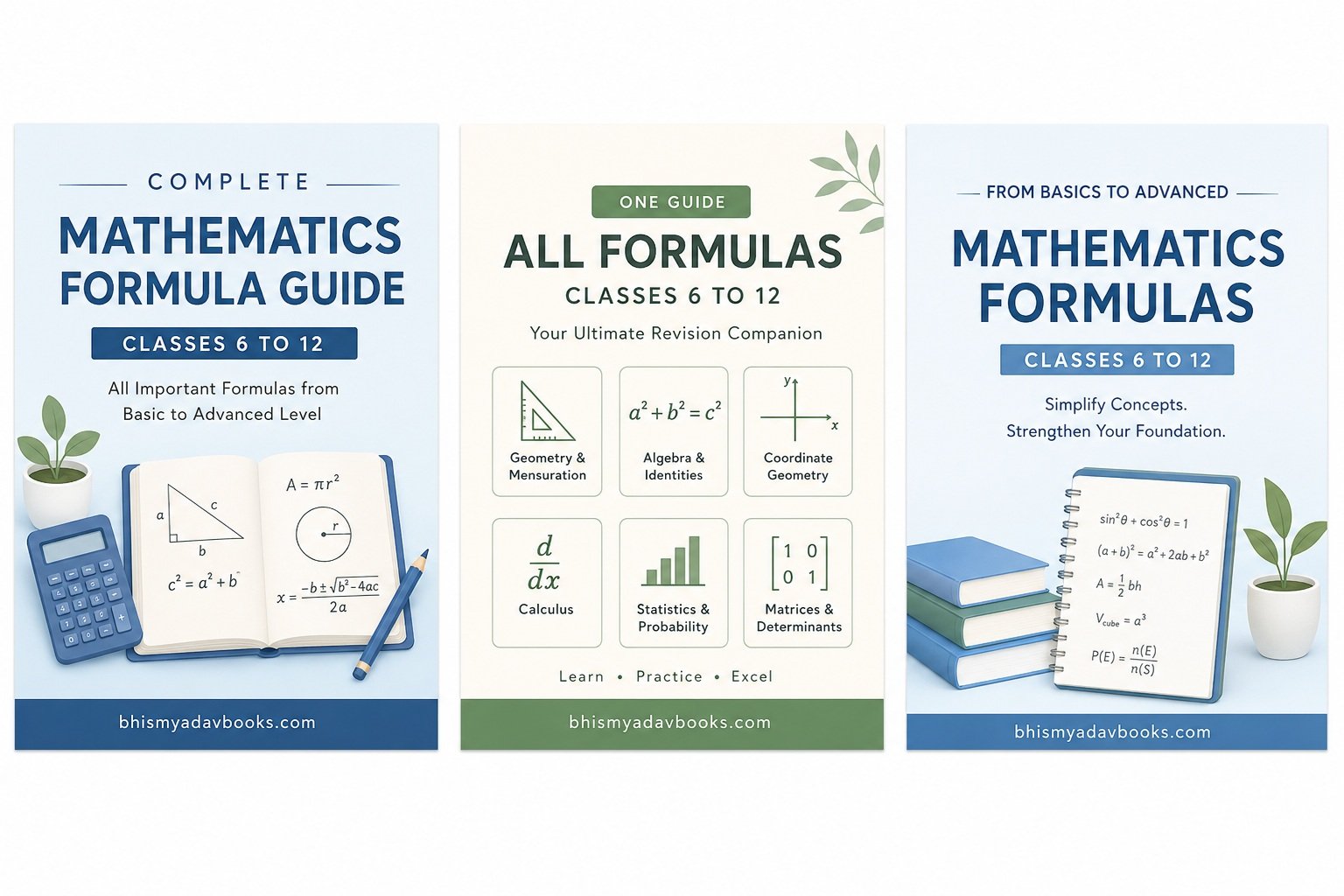
Algebraic Formulas list for Classes 6 to 12
Mathematics is one of the most important subjects for every student. Whether you are preparing for school examinations, Olympiads, scholarship exams, NTSE, Navodaya, Sainik School, or future competitive examinations like SSC, Banking, Railway, UPSC, JEE, and NEET, having a strong command over mathematical formulas is essential.
Many students lose marks not because they do not understand the concepts but because they forget the formulas during examinations. A well-organized formula sheet helps students revise quickly before exams and improves confidence while solving questions.
We have some amazing books at our Shop page you may want to buy.
Table of Contents
Fundamental Mathematics Formulas (Classes 6 & 7)
This comprehensive article has been prepared especially for students of Classes 6 to 12. Every important chapter is covered with easy-to-remember formulas arranged chapter-wise.
Chapter 1: Numbers and Number System
The Number System is the backbone of Mathematics. Every advanced topic begins with understanding numbers.
Even Numbers
Formula
2n
Example
2, 4, 6, 8, 10
Odd Numbers
Formula
2n + 1
Example
1, 3, 5, 7, 9
Sum of First n Natural Numbers
n(n+1)/2
Example
Sum of first 20 numbers
20 × 21 ÷ 2 = 210
Sum of First n Even Numbers
n(n+1)
Example
First 5 even numbers
5 × 6 = 30
Sum of First n Odd Numbers
n²
Example
First 8 odd numbers
8² = 64
Square of a Number
Number × Number
Example
18² = 324
Cube of a Number
Number × Number × Number
Example
7³ = 343
Prime Numbers
A prime number has exactly two factors:
- 1
- The number itself
Examples
2, 3, 5, 7, 11, 13
Composite Numbers
A composite number has more than two factors.
Examples
4, 6, 8, 10, 12
Chapter 2: Factors and Multiples
Highest Common Factor (HCF)
HCF = Greatest common factor of two or more numbers
Example
HCF (18, 24)
= 6
Least Common Multiple (LCM)
LCM = Smallest common multiple
Example
LCM (8,12)
=24
Relationship
LCM × HCF = Product of the Numbers
Applicable for two numbers.
Divisibility Rules
Divisible by 2
Last digit is even.
Example
246
Divisible by 3
Sum of digits divisible by 3.
Example
327
3+2+7=12
12 divisible by 3
Divisible by 4
Last two digits divisible by 4.
Example
816
16 divisible by 4
Divisible by 5
Ends in
0 or 5
Divisible by 6
Divisible by both 2 and 3.
Divisible by 8
Last three digits divisible by 8.
Divisible by 9
Sum of digits divisible by 9.
Divisible by 10
Ends in 0.
Chapter 3: Fractions
A fraction represents a part of a whole.
General Form
Numerator / Denominator
Addition
a/b + c/d
= (ad + bc)/bd
Subtraction
a/b − c/d
= (ad − bc)/bd
Multiplication
a/b × c/d
= ac/bd
Division
a/b ÷ c/d
= a/b × d/c
Reciprocal
Reciprocal of
a/b
=
b/a
Equivalent Fractions
Multiply numerator and denominator by the same number.
Example
2/3
=
4/6
=
6/9
Chapter 4: Decimals
Fraction to Decimal
Divide numerator by denominator.
Example
3/4
=0.75
Decimal to Fraction
Example
0.25
=25/100
=1/4
Percentage to Decimal
Percentage ÷100
Example
40%
=0.40
Decimal to Percentage
Decimal ×100
Example
0.75
=75%
Chapter 5: Ratio and Proportion
Ratio
Ratio
=a:b
=a/b
Equivalent Ratio
Multiply both numbers by the same value.
Example
2:5
=
4:10
=
6:15
Proportion
a:b = c:d
Cross multiplication
ad = bc
Unitary Method
Value of One Unit
=
Total Value ÷ Number of Units
Chapter 6: Percentage
Percentage
(Value / Total Value) ×100
Increase Percentage
(New − Old)/Old ×100
Decrease Percentage
(Old − New)/Old ×100
Percentage to Fraction
25%
=1/4
50%
=1/2
75%
=3/4
20%
=1/5
10%
=1/10
Chapter 7: Profit and Loss
Profit
Selling Price − Cost Price
Loss
Cost Price − Selling Price
Profit Percentage
Profit/Cost Price ×100
Loss Percentage
Loss/Cost Price ×100
Selling Price
Cost Price + Profit
or
Cost Price − Loss
Chapter 8: Simple Interest
Simple Interest
SI
=(P×R×T)/100
Where
P = Principal
R = Rate
T = Time
Amount
Principal + Simple Interest
Chapter 9: Speed, Time and Distance
Speed
Distance ÷ Time
Distance
Speed × Time
Time
Distance ÷ Speed
Unit Conversion
1 km
=1000 m
1 hour
=60 minutes
1 minute
=60 seconds
km/h to m/s
Multiply by
5/18
m/s to km/h
Multiply by
18/5
Chapter 10: Integers
Addition Rule
Same sign
Add numbers
Keep sign
Example
(+5)+(+3)=8
(-7)+(-4)=−11
Different Signs
Subtract
Keep larger sign
Example
7+(−5)=2
Multiplication Rules
Positive × Positive = Positive
Negative × Negative = Positive
Positive × Negative = Negative
Negative × Positive = Negative
Division Rules
Same as multiplication rules.
Chapter 11: Introduction to Algebra
Variable
Represented by letters
x, y, z
Constant
Fixed value
Example
10
25
100
Expression
3x+5
Equation
3x+5=20
Perimeter of Rectangle
2(l+b)
Perimeter of Square
4a
Algebraic Identity
(a+b)²
=a²+2ab+b²
Algebraic Identity
(a−b)²
=a²−2ab+b²
Difference of Squares
(a+b)(a−b)
=a²−b²
Geometry, Mensuration, Algebra & Statistics Formulas (Classes 7–9)
In this section, we cover the important formulas related to Geometry, Mensuration, Exponents, Algebra, Statistics, Coordinate Geometry, and Linear Equations. These topics form the backbone of Class 8 and Class 9 Mathematics and are frequently used in school examinations, Olympiads, NTSE, foundation courses, and competitive examinations.
Chapter 12: Lines and Angles
Understanding angles is essential for Geometry.
Types of Angles
- Acute Angle = Less than 90°
- Right Angle = 90°
- Obtuse Angle = Between 90° and 180°
- Straight Angle = 180°
- Reflex Angle = Between 180° and 360°
- Complete Angle = 360°
Complementary Angles
Sum = 90°
Example:
30° + 60° = 90°
Supplementary Angles
Sum = 180°
Example:
110° + 70° = 180°
Angles Around a Point
360°
Angles on a Straight Line
180°
Vertically Opposite Angles
Always Equal
Parallel Lines
When two parallel lines are cut by a transversal:
- Corresponding Angles = Equal
- Alternate Interior Angles = Equal
- Alternate Exterior Angles = Equal
- Co-interior Angles = 180°
Chapter 13: Triangles
Triangles are among the most important topics in Mathematics.
Sum of Interior Angles
180°
Exterior Angle Property
Exterior Angle = Sum of Opposite Interior Angles
Triangle Inequality
Sum of any two sides > Third side
Area of Triangle
Area = (1/2) × Base × Height
Equilateral Triangle
Perimeter = 3a
Area = (√3/4)a²
Isosceles Triangle
Two sides are equal.
Scalene Triangle
All sides are different.
Right Triangle (Pythagoras Theorem)
Hypotenuse² = Base² + Perpendicular²
or
c² = a² + b²
Chapter 14: Quadrilaterals
Sum of Interior Angles
360°
Rectangle
Perimeter = 2(l + b)
Area = l × b
Diagonal = √(l² + b²)
Square
Perimeter = 4a
Area = a²
Diagonal = a√2
Parallelogram
Area = Base × Height
Perimeter = 2(a + b)
Rhombus
Area = (1/2) × d₁ × d₂
Perimeter = 4a
Trapezium
Area = (1/2)(a + b) × h
Where
a and b are parallel sides.
Kite
Area = (1/2)d₁d₂
Chapter 15: Circle
Circle formulas are frequently asked in examinations.
Circumference
2πr
Diameter
2r
Radius
Diameter ÷ 2
Area of Circle
πr²
Semicircle
Area = (1/2)πr²
Perimeter = πr + 2r
Arc Length
(θ/360°) × 2πr
Sector Area
(θ/360°) × πr²
Chapter 16: Practical Geometry
Important properties:
- Radius of the same circle are equal.
- Diameter is the longest chord.
- Perpendicular from center bisects the chord.
- Equal chords subtend equal angles.
Chapter 17: Perimeter and Area
Rectangle
Area = Length × Breadth
Perimeter = 2(l+b)
Square
Area = Side²
Perimeter = 4 × Side
Triangle
Area = 1/2 × Base × Height
Parallelogram
Area = Base × Height
Rhombus
Area = 1/2 × d₁ × d₂
Trapezium
Area = 1/2 × (Sum of Parallel Sides) × Height
Chapter 18: Mensuration
Cube
Volume = a³
Total Surface Area = 6a²
Lateral Surface Area = 4a²
Diagonal = a√3
Cuboid
Volume = l × b × h
Total Surface Area = 2(lb + bh + hl)
Lateral Surface Area = 2h(l+b)
Diagonal = √(l²+b²+h²)
Cylinder
Volume = πr²h
Curved Surface Area = 2πrh
Total Surface Area = 2πr(r+h)
Cone
Volume = (1/3)πr²h
Curved Surface Area = πrl
Total Surface Area = πr(r+l)
Slant Height
l = √(r²+h²)
Sphere
Volume = (4/3)πr³
Surface Area = 4πr²
Hemisphere
Volume = (2/3)πr³
Curved Surface Area = 2πr²
Total Surface Area = 3πr²
Chapter 19: Exponents and Powers
Product Rule
aᵐ × aⁿ = aᵐ⁺ⁿ
Quotient Rule
aᵐ ÷ aⁿ = aᵐ⁻ⁿ
Power Rule
(aᵐ)ⁿ = aᵐⁿ
Product Power
(ab)ⁿ = aⁿbⁿ
Quotient Power
(a/b)ⁿ = aⁿ/bⁿ
Zero Exponent
a⁰ = 1
Negative Exponent
a⁻ⁿ = 1/aⁿ
Chapter 20: Squares and Square Roots
Square
n² = n × n
Square Root
√a × √a = a
Perfect Squares
1² = 1
2² = 4
3² = 9
4² = 16
5² = 25
10² = 100
20² = 400
30² = 900
50² = 2500
100² = 10000
Download Full Free PDF from here
Tips to Memorize Mathematics Formulas
- Understand the concept instead of memorizing formulas blindly.
- Prepare a chapter-wise formula notebook for quick revision.
- Revise formulas daily for 10–15 minutes.
- Solve practice problems immediately after learning a formula.
- Create flashcards or sticky notes for frequently used formulas.
- Group similar formulas (such as area, volume, and trigonometric identities) to remember them more effectively.
- Practice previous years’ question papers to identify frequently tested formulas.
- Teach the formulas to someone else, as explaining concepts reinforces memory.
Recommended books for Students
Frequently Asked Questions (FAQs)
Q1. Why should students learn Mathematics formulas?
Mathematics formulas simplify calculations, improve problem-solving speed, and help students score higher in school and competitive examinations.
Q2. Which formulas are most important for board examinations?
Students should focus on:
- Algebraic Identities
- Quadratic Equations
- Trigonometric Ratios and Identities
- Coordinate Geometry
- Mensuration
- Calculus
- Probability
- Matrices and Determinants
Q3. Are these formulas useful for competitive examinations?
Yes. These formulas are useful for:
- JEE Main & Advanced
- CUET
- NDA
- SSC
- Banking Exams
- Railway Recruitment Exams
- Defence Exams
- State-level Entrance Tests
- Various Scholarship and Olympiad Examinations
Q4. How often should students revise formulas?
A quick revision of important formulas every day or at least 3–4 times a week helps improve retention and boosts confidence before examinations.
Q5. Is understanding concepts more important than memorizing formulas?
Yes. Understanding how and why a formula works enables students to apply it correctly in different types of problems, making learning more effective than rote memorization.
Conclusion
Mathematics is built on concepts, and formulas are the tools that make solving problems efficient and accurate. A strong command of chapter-wise formulas from Classes 6 to 12 enables students to perform well in school examinations while also preparing them for higher education and competitive exams.
Instead of trying to memorize everything at once, revise formulas chapter by chapter, practice numerical problems regularly, and maintain your own personalized formula notebook. Consistent practice and conceptual understanding will significantly improve speed, accuracy, and confidence.
Keep this comprehensive formula guide handy for quick revision before tests and examinations. With regular practice, these formulas will become second nature and help you build a solid foundation for success in Mathematics.