100 Quality Assurance Manager Interview Questions and Answers for Jobs and Employment
Introduction
A Quality Assurance Manager plays a critical role in ensuring that products, services, processes, and organizational systems consistently meet established quality standards. Companies across manufacturing, pharmaceuticals, healthcare, food production, automotive, aerospace, engineering, technology, and other industries employ quality assurance professionals to protect customers and improve business performance.
Preparing for a Quality Assurance Manager interview requires more than memorizing quality terminology. Employers often evaluate a candidate’s technical knowledge, leadership ability, problem-solving skills, understanding of quality management systems, audit experience, risk-based thinking, and ability to drive continuous improvement.
We have some amazing books in our Shop page you may want to buy.
Table of Contents
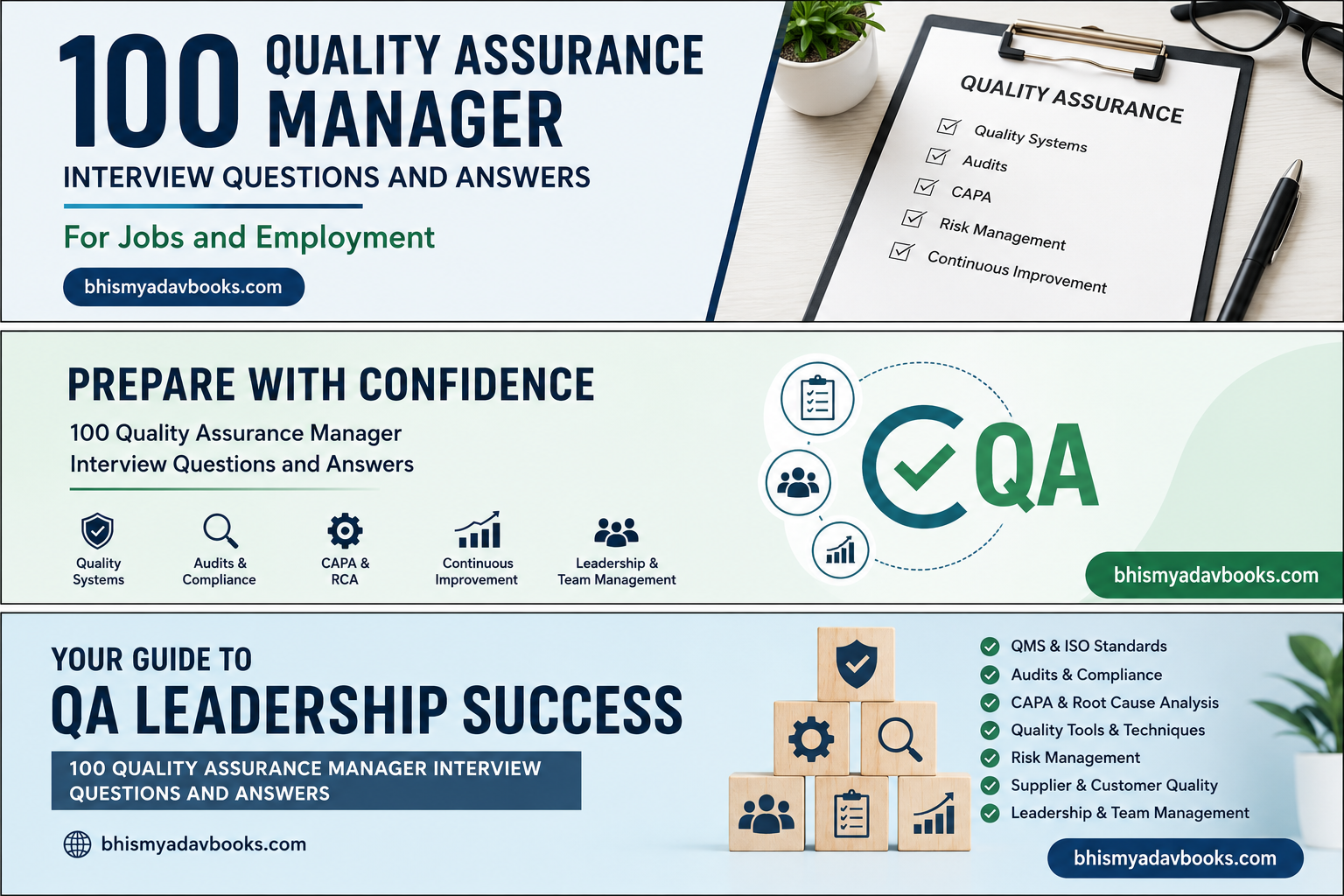
This comprehensive guide from Bhism Yadav Books presents 100 Quality Assurance Manager interview questions and answers for jobs and employment. The answers are written in a clear and practical manner to help candidates understand important quality assurance concepts and develop confident interview responses.
Candidates should adapt these sample answers according to their professional experience, industry, organization, and specific job requirements.
Basic Quality Assurance Manager Interview Questions and Answers
(Questions 1-30)
1. What is quality assurance?
Answer: Quality assurance is a systematic and process-oriented approach used to ensure that products or services consistently meet established quality requirements. It focuses on preventing defects by developing standards, procedures, controls, and monitoring systems.
2. What does a Quality Assurance Manager do?
Answer: A Quality Assurance Manager develops and maintains quality systems, supervises quality teams, conducts audits, manages corrective and preventive actions, monitors quality performance, ensures regulatory compliance, and supports continuous improvement throughout the organization.
3. Why do you want to work as a Quality Assurance Manager?
Answer: I am interested in quality assurance because it combines technical knowledge, problem-solving, leadership, and continuous improvement. I enjoy identifying opportunities to improve processes and creating systems that consistently deliver reliable products and services.
4. What is the difference between quality assurance and quality control?
Answer: Quality assurance is process-oriented and focuses on preventing defects. Quality control is product-oriented and focuses on detecting defects through inspection and testing. Both functions work together to achieve overall quality objectives.
5. What is a Quality Management System?
Answer: A Quality Management System, or QMS, is a structured framework of policies, processes, procedures, responsibilities, and records used to manage and improve organizational quality.
6. What are the major responsibilities of a QA Manager?
Answer: Major responsibilities include QMS management, audit planning, compliance monitoring, CAPA management, quality training, supplier quality oversight, documentation control, customer complaint analysis, risk management, and team leadership.
7. What skills are important for a Quality Assurance Manager?
Answer: Important skills include leadership, analytical thinking, communication, problem-solving, auditing, documentation, risk assessment, regulatory knowledge, data analysis, and continuous improvement.
8. How do you define quality?
Answer: I define quality as the consistent ability of a product, service, or process to meet customer expectations, regulatory requirements, and defined specifications.
9. Why is quality assurance important for a company?
Answer: Quality assurance reduces defects, improves customer satisfaction, supports regulatory compliance, minimizes waste, protects brand reputation, and improves operational efficiency.
10. What is your management style?
Answer: My management style is collaborative, structured, and performance-focused. I establish clear expectations, encourage open communication, support professional development, and use measurable quality objectives to guide the team.
Quality Management System Interview Questions
11. What are the main elements of a QMS?
Answer: Major QMS elements include quality policy, quality objectives, documented procedures, risk management, internal audits, CAPA, document control, training, supplier management, customer feedback, and management review.
12. What is ISO 9001?
Answer: ISO 9001 is an internationally recognized quality management system standard. It provides requirements for organizations seeking to consistently deliver products and services that meet customer and applicable requirements.
13. What is the process approach in quality management?
Answer: The process approach manages activities as interconnected processes. Inputs, activities, resources, controls, and outputs are evaluated to improve overall system performance.
14. What is risk-based thinking?
Answer: Risk-based thinking involves identifying potential risks and opportunities before problems occur. Organizations evaluate risks and implement appropriate controls based on their potential impact.
15. How do you implement a QMS?
Answer: I begin by understanding organizational processes and requirements. I perform a gap analysis, establish quality policies and objectives, develop procedures, assign responsibilities, train employees, conduct audits, and monitor performance.
16. What is a quality policy?
Answer: A quality policy is a formal statement describing an organization’s commitment to quality, customer satisfaction, compliance, and continuous improvement.
17. What are quality objectives?
Answer: Quality objectives are measurable targets established to support the quality policy. Examples include reducing defects, improving on-time delivery, reducing complaints, or improving audit performance.
18. How do you measure QMS effectiveness?
Answer: I measure QMS effectiveness using KPIs, audit results, defect trends, CAPA effectiveness, customer complaints, supplier performance, process capability, and management review outcomes.
19. What is a management review?
Answer: A management review is a formal evaluation of the QMS by senior leadership. It examines performance data, audit findings, customer feedback, risks, resources, and improvement opportunities.
20. How do you maintain a QMS?
Answer: I maintain a QMS through regular audits, document reviews, employee training, KPI monitoring, CAPA management, risk assessments, and management reviews.
Audit Interview Questions and Answers
21. What is a quality audit?
Answer: A quality audit is a systematic and documented examination used to determine whether activities and processes comply with established requirements.
22. What are the different types of quality audits?
Answer: Common types include internal audits, supplier audits, customer audits, certification audits, process audits, product audits, and regulatory audits.
23. How do you prepare for an internal audit?
Answer: I define the audit scope, review applicable procedures and previous findings, prepare an audit checklist, communicate with process owners, and gather relevant documentation.
24. What is an audit finding?
Answer: An audit finding is a conclusion based on collected audit evidence. It may identify conformity, nonconformity, an observation, or an opportunity for improvement.
25. What is a nonconformity?
Answer: A nonconformity is the failure to meet a specified requirement, procedure, standard, customer expectation, or regulatory requirement.
26. How do you handle audit nonconformities?
Answer: I document the issue clearly, determine its impact, assign responsibility, conduct root cause analysis, develop corrective actions, and verify effectiveness.
27. How do you conduct a supplier audit?
Answer: I review supplier performance and requirements, develop an audit plan, evaluate processes and controls, inspect records, interview personnel, document findings, and monitor corrective actions.
28. What qualities make a good auditor?
Answer: A good auditor should be objective, ethical, observant, analytical, professional, organized, and capable of communicating findings clearly.
29. How do you deal with disagreement during an audit?
Answer: I remain professional and focus on objective evidence. I explain the requirement and evidence clearly and allow the process owner to provide additional information before finalizing the finding.
30. How do you follow up on audit findings?
Answer: I track corrective actions, review supporting evidence, evaluate implementation, and perform effectiveness checks before formally closing findings.
CAPA and Root Cause Analysis Questions
(Questions 31-60)
31. What is CAPA?
Answer: CAPA stands for Corrective and Preventive Action. It is a structured system for investigating problems, correcting root causes, and preventing recurrence or potential quality issues.
32. What is the difference between corrective action and preventive action?
Answer: Corrective action addresses the cause of an existing problem. Preventive action addresses potential causes to reduce the likelihood of future problems.
33. What is root cause analysis?
Answer: Root cause analysis is a systematic method of identifying the fundamental cause of a problem rather than simply treating its symptoms.
34. What root cause analysis tools do you use?
Answer: I use tools such as the 5 Whys, fishbone diagram, Pareto analysis, fault tree analysis, process mapping, and data trend analysis.
35. Explain the 5 Whys technique.
Answer: The 5 Whys technique involves repeatedly asking why a problem occurred until the underlying cause is identified. The number five is a guideline rather than a strict requirement.
36. What is a fishbone diagram?
Answer: A fishbone or Ishikawa diagram is a root cause analysis tool that organizes possible causes into categories such as people, methods, machines, materials, measurement, and environment.
37. How do you determine whether a CAPA is effective?
Answer: I establish measurable effectiveness criteria before implementation and later review relevant data, recurrence rates, audit results, or process performance.
38. What would you do if a problem repeatedly occurs?
Answer: I would review previous investigations, verify whether the true root cause was identified, evaluate corrective action implementation, analyze additional data, and reopen or initiate a stronger CAPA.
39. How do you prioritize CAPAs?
Answer: I prioritize CAPAs based on risk, customer impact, regulatory significance, safety concerns, recurrence frequency, and potential business consequences.
40. What is containment action?
Answer: Containment action is an immediate temporary measure used to control a quality problem and prevent additional impact while root cause analysis and permanent corrective action are completed.
Quality Tools and Techniques Interview Questions
41. What are the seven basic quality tools?
Answer: The seven basic quality tools commonly include check sheets, histograms, Pareto charts, cause-and-effect diagrams, control charts, scatter diagrams, and process flowcharts or stratification.
42. What is a Pareto chart?
Answer: A Pareto chart displays problems in descending order of frequency or impact. It helps teams focus on the most significant causes.
43. What is the Pareto principle?
Answer: The Pareto principle suggests that approximately 80 percent of effects may result from 20 percent of causes. In quality management, it helps prioritize improvement efforts.
44. What is Statistical Process Control?
Answer: Statistical Process Control, or SPC, uses statistical methods to monitor process performance and identify unusual variation.
45. What is a control chart?
Answer: A control chart displays process data over time with a center line and control limits. It helps distinguish common-cause variation from special-cause variation.
46. What is process capability?
Answer: Process capability measures the ability of a stable process to produce outputs within specification limits.
47. What are Cp and Cpk?
Answer: Cp measures the potential capability of a process based on process spread. Cpk also considers how well the process is centered within specification limits.
48. What is a histogram?
Answer: A histogram is a graphical representation of data distribution. It helps identify patterns, spread, central tendency, and unusual variations.
49. What is a scatter diagram?
Answer: A scatter diagram displays the relationship between two variables and can help identify possible correlation.
50. How do you use data in quality decision-making?
Answer: I collect reliable data, verify its accuracy, analyze trends, compare results with targets, and use statistical and quality tools to support evidence-based decisions.
Continuous Improvement Interview Questions
51. What is continuous improvement?
Answer: Continuous improvement is the ongoing effort to improve products, processes, systems, and services through systematic and incremental changes.
52. What is the PDCA cycle?
Answer: PDCA stands for Plan, Do, Check, and Act. It is a continuous improvement method used to plan changes, test them, evaluate results, and standardize successful improvements.
53. What is Kaizen?
Answer: Kaizen is a continuous improvement philosophy that encourages employees at all levels to make small and ongoing improvements.
54. What is Lean?
Answer: Lean is an operational improvement approach focused on maximizing customer value while reducing waste and unnecessary activities.
55. What is Six Sigma?
Answer: Six Sigma is a data-driven methodology designed to reduce process variation and defects through structured problem-solving.
56. What does DMAIC stand for?
Answer: DMAIC stands for Define, Measure, Analyze, Improve, and Control. It is commonly used in Six Sigma improvement projects.
57. How do you identify improvement opportunities?
Answer: I analyze KPI trends, customer complaints, audit findings, process delays, defects, waste, employee feedback, and supplier performance.
58. How do you encourage a quality culture?
Answer: I encourage a quality culture through leadership involvement, employee training, transparent communication, recognition of improvement ideas, and clear accountability.
59. How do you manage resistance to quality improvements?
Answer: I explain the reason for the change, involve employees in planning, provide training, address concerns, and demonstrate measurable benefits.
60. Give an example of a quality improvement project.
Answer: In an interview, I would describe a real project using the situation, task, action, and result format. For example, I might explain how defect data was analyzed, a major root cause identified, corrective controls implemented, and defect rates reduced.
Risk Management and Compliance Questions
(Questions 61-100)
61. What is quality risk management?
Answer: Quality risk management is the systematic process of identifying, analyzing, evaluating, controlling, and reviewing risks that may affect quality.
62. What is FMEA?
Answer: Failure Mode and Effects Analysis is a structured method used to identify potential failure modes, evaluate their effects, and prioritize risk reduction activities.
63. What is a Risk Priority Number?
Answer: In traditional FMEA approaches, the Risk Priority Number is calculated using severity, occurrence, and detection ratings. It can support prioritization, although organizations should also evaluate individual risk factors and context.
64. How do you manage regulatory compliance?
Answer: I identify applicable requirements, integrate them into procedures, provide training, conduct compliance audits, monitor changes, and maintain appropriate records.
65. How do you stay updated on quality requirements?
Answer: I monitor standards organizations, regulatory communications, professional publications, industry associations, training programs, and internal compliance updates.
66. What is change control?
Answer: Change control is a formal process used to evaluate, approve, implement, document, and review changes that may affect quality or compliance.
67. Why is document control important?
Answer: Document control ensures employees use current and approved procedures while obsolete documents are properly removed or identified.
68. What is traceability?
Answer: Traceability is the ability to track the history, application, location, or movement of products, materials, processes, or records.
69. How do you manage quality records?
Answer: I ensure records are accurate, complete, legible, protected, easily retrievable, and retained according to organizational and regulatory requirements.
70. What is data integrity?
Answer: Data integrity means maintaining the accuracy, completeness, consistency, and reliability of data throughout its lifecycle.
Supplier and Customer Quality Questions
71. How do you manage supplier quality?
Answer: I establish supplier requirements, evaluate supplier capability, monitor performance, conduct audits, manage supplier corrective actions, and perform periodic reviews.
72. What is supplier qualification?
Answer: Supplier qualification is the process of evaluating and approving suppliers based on their ability to consistently meet quality and business requirements.
73. What supplier quality KPIs do you monitor?
Answer: I may monitor defect rates, on-time delivery, complaint frequency, audit results, corrective action response time, and incoming inspection performance.
74. How do you handle a poorly performing supplier?
Answer: I review performance data, communicate concerns, request root cause analysis and corrective action, monitor improvements, and escalate when necessary.
75. What is a Supplier Corrective Action Request?
Answer: A Supplier Corrective Action Request is a formal request requiring a supplier to investigate a quality problem, identify root causes, and implement corrective actions.
76. How do you manage customer complaints?
Answer: I document the complaint, assess risk, investigate the issue, identify root causes, implement appropriate actions, communicate results, and monitor recurrence.
77. Why is customer feedback important?
Answer: Customer feedback provides valuable information about product performance, service quality, emerging risks, and improvement opportunities.
78. How do you reduce customer complaints?
Answer: I analyze complaint trends, prioritize recurring problems, conduct root cause analysis, improve process controls, and verify corrective action effectiveness.
79. What is customer satisfaction?
Answer: Customer satisfaction represents the degree to which customer expectations and requirements are fulfilled.
80. How do you communicate a serious quality issue to a customer?
Answer: I communicate promptly, accurately, and professionally. I explain confirmed facts, immediate containment actions, investigation status, and planned follow-up without making unsupported assumptions.
Leadership and Team Management Questions
81. How do you manage a quality assurance team?
Answer: I establish clear roles, objectives, priorities, and performance expectations. I also provide coaching, training, regular feedback, and opportunities for professional development.
82. How do you handle conflict within your team?
Answer: I discuss the issue with the individuals involved, understand different perspectives, focus on facts, and work toward a fair solution that supports team and quality objectives.
83. How do you motivate quality employees?
Answer: I recognize achievements, provide meaningful responsibilities, encourage improvement ideas, offer learning opportunities, and connect individual work with organizational goals.
84. How do you train employees on quality procedures?
Answer: I use structured training plans, practical examples, demonstrations, assessments, refresher training, and effectiveness evaluations.
85. How do you delegate tasks?
Answer: I consider employee skills, workload, development needs, and task criticality. I clearly explain expectations, deadlines, and required outcomes.
86. How do you manage multiple quality priorities?
Answer: I prioritize work according to risk, customer impact, compliance requirements, urgency, and available resources.
87. How do you communicate quality performance to senior management?
Answer: I use concise reports and dashboards that present KPIs, trends, major risks, audit findings, CAPA status, customer issues, and recommended actions.
88. How do you handle an underperforming employee?
Answer: I clarify expectations, discuss performance gaps, identify possible causes, provide coaching or training, establish an improvement plan, and monitor progress.
89. How do you work with production or operations teams?
Answer: I maintain collaborative relationships and emphasize shared objectives. Quality should work with operations to develop effective controls rather than functioning only as an inspection department.
90. What makes a successful Quality Assurance Manager?
Answer: A successful QA Manager combines technical quality knowledge with leadership, communication, business understanding, ethical judgment, and a strong commitment to continuous improvement.
Advanced and Behavioral Quality Assurance Manager Interview Questions
91. Tell me about yourself.
Answer: I am a quality professional with experience in quality systems, process improvement, audits, CAPA, and cross-functional collaboration. I focus on using data and structured problem-solving to improve quality performance and support business objectives.
92. What is your greatest strength?
Answer: My greatest strength is structured problem-solving. I can analyze complex quality issues, identify critical factors, and coordinate teams to implement sustainable solutions.
93. What is your greatest weakness?
Answer: Earlier in my career, I sometimes spent too much time reviewing minor details. I have improved by using risk-based prioritization and focusing resources on issues with the greatest quality and business impact.
94. Describe a difficult quality problem you handled.
Answer: I would answer using a real professional example. I would explain the problem, its impact, investigation methods, root cause, corrective actions, and measurable results.
95. How would you respond to a major quality failure?
Answer: I would immediately assess risk, contain affected products or processes, notify relevant stakeholders, preserve evidence, initiate a formal investigation, and implement corrective actions based on verified root causes.
96. What would you do if senior management asked you to ignore a quality issue?
Answer: I would clearly explain the quality, customer, regulatory, and business risks using objective evidence. I would follow established escalation and governance procedures while maintaining professional integrity.
97. How do you balance quality and production targets?
Answer: I believe quality and productivity should be managed together. Effective processes prevent defects and reduce rework. I work with operations to develop controls that protect quality while supporting efficient production.
98. Where do you see yourself in five years?
Answer: I see myself developing further as a quality leader, managing larger quality systems, leading strategic improvement initiatives, and contributing to organizational excellence.
99. Why should we hire you as a Quality Assurance Manager?
Answer: You should consider me because I bring a structured approach to quality management, strong problem-solving skills, leadership ability, and a focus on measurable continuous improvement. I can collaborate across departments while maintaining strong quality standards.
100. Do you have any questions for us?
Answer: Yes. I would like to understand the organization’s current quality priorities, major quality challenges, QMS maturity, team structure, and expectations for this role during the first six to twelve months.
Recommended books for Quality Assurance Manager Interview Preparation
Quality Assurance in Industries by G S Patnaik (Author)
Important Quality Assurance Manager Interview Preparation Tips
Preparing for a QA Manager interview requires a combination of technical knowledge and practical examples. Candidates should review the job description carefully and identify the specific quality standards, regulations, and technical skills required by the employer.
Study the company’s industry and understand its products, customers, and potential quality risks. Manufacturing companies may focus heavily on process control, supplier quality, Lean, Six Sigma, and production defects. Pharmaceutical and healthcare employers may place greater emphasis on regulatory compliance, documentation, validation, risk management, and data integrity.
Prepare several professional examples using the STAR method: Situation, Task, Action, and Result. Interviewers often ask candidates to describe real quality failures, difficult audits, CAPA investigations, team conflicts, customer complaints, and improvement projects.
Candidates should also review important quality concepts such as QMS, ISO 9001, CAPA, root cause analysis, FMEA, SPC, process capability, internal auditing, supplier quality, change control, document control, and continuous improvement.
Whenever possible, use measurable results in interview answers. For example, explaining that an improvement reduced defects by a specific percentage or shortened CAPA closure time is generally more powerful than simply stating that the process was improved.
Most importantly, answer questions according to your actual professional experience. Sample answers should be used as learning references and adapted to the specific industry and job position.
Conclusion
A Quality Assurance Manager is responsible for protecting product and service quality while developing systems that support compliance, customer satisfaction, and continuous improvement. Employers look for candidates who understand quality management principles and can successfully lead teams, analyze data, manage risks, conduct audits, and solve complex quality problems.
These 100 Quality Assurance Manager interview questions and answers cover important topics including quality assurance fundamentals, QMS, ISO 9001, audits, CAPA, root cause analysis, quality tools, continuous improvement, risk management, supplier quality, customer complaints, and leadership.
Regular practice with these questions can help candidates improve their understanding of quality management and communicate their professional experience more confidently during employment interviews.
Continue exploring career preparation, fundamental knowledge, educational resources, and interview guides at Bhism Yadav Books.