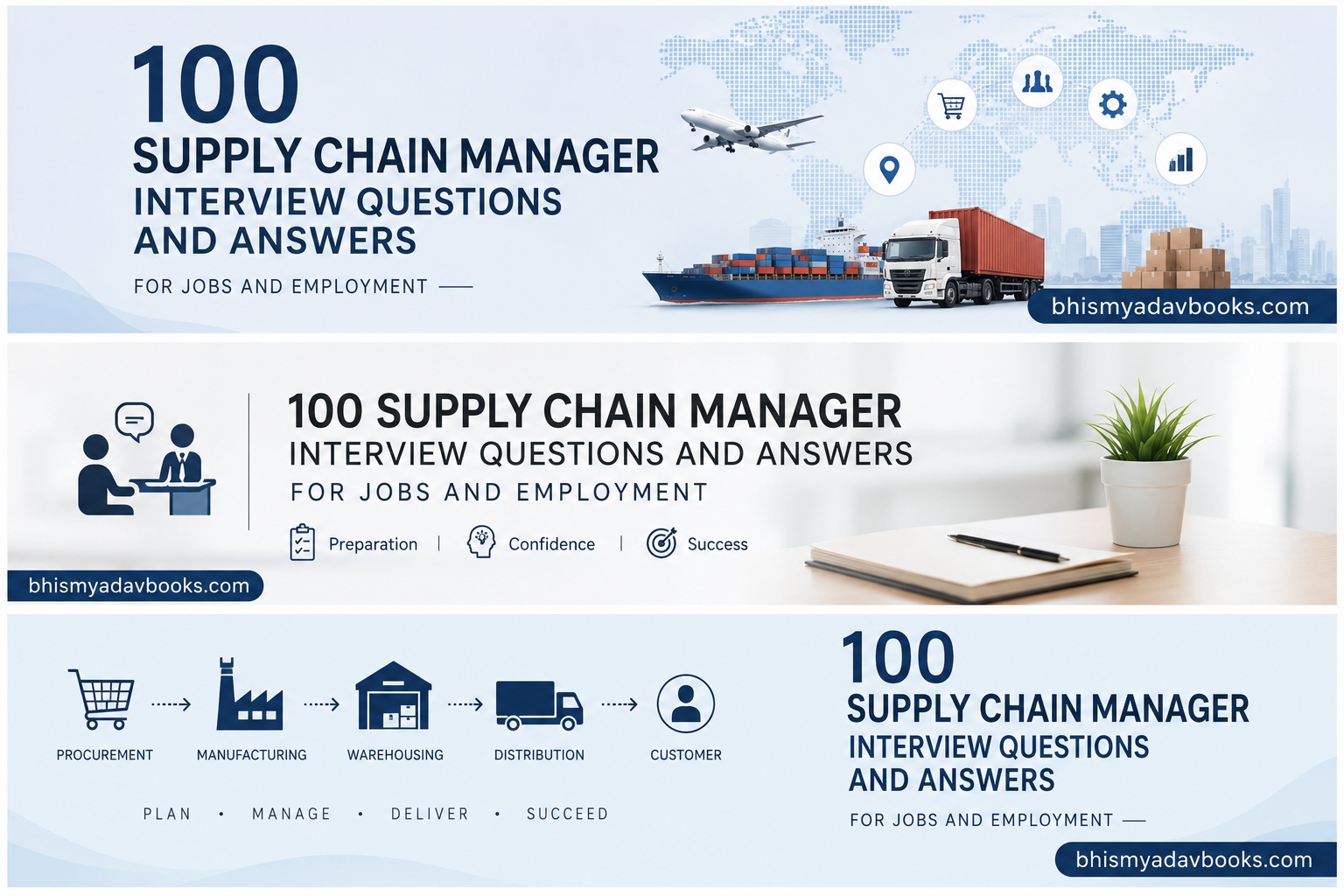
100 Supply Chain Manager Interview Questions and Answers for Jobs and Employment
Introduction
Supply chain management is one of the most important functions in manufacturing, retail, e-commerce, healthcare, technology, automotive, food, and many other industries. Organizations depend on efficient supply chains to purchase materials, manage suppliers, maintain inventory, coordinate transportation, fulfill customer orders, and control operational costs.
A Supply Chain Manager is responsible for planning, coordinating, and improving the movement of goods, information, and resources from suppliers to customers. The position often requires a combination of analytical ability, commercial awareness, leadership, negotiation, risk management, and technical knowledge.
During a Supply Chain Manager job interview, candidates may face questions about procurement, demand forecasting, inventory control, logistics, warehouse operations, supplier management, key performance indicators, enterprise software, cost reduction, sustainability, and team leadership.
We have some amazing books at our Shop page you may want to buy.
Table of Contents
This comprehensive guide from Bhism Yadav Books presents 100 Supply Chain Manager interview questions and sample answers for jobs and employment. Candidates can use these questions to strengthen their fundamental knowledge, practice interview responses, and prepare for supply chain management roles.
100 Supply Chain Manager Interview Questions and Answers
(Questions 1-30)
1. What is supply chain management?
Sample Answer: Supply chain management is the coordinated management of activities involved in sourcing materials, procurement, production, inventory, transportation, warehousing, and delivery to customers. Its purpose is to ensure that products and services move efficiently through the supply network while maintaining quality, controlling costs, and meeting customer requirements.
2. What are the major components of a supply chain?
Sample Answer: The major components include planning, sourcing, procurement, manufacturing or operations, inventory management, warehousing, logistics, distribution, order fulfillment, and returns management. Information flow and supplier relationships are also important parts of an effective supply chain.
3. What does a Supply Chain Manager do?
Sample Answer: A Supply Chain Manager plans and coordinates supply chain activities. Responsibilities may include managing suppliers, monitoring inventory, improving logistics, controlling costs, analyzing performance, coordinating with internal departments, reducing risks, and ensuring products are delivered according to customer expectations.
4. Why do you want to work as a Supply Chain Manager?
Sample Answer: I am interested in supply chain management because it combines strategic planning, analytics, problem-solving, negotiation, and leadership. I enjoy identifying operational challenges and developing practical solutions that improve efficiency, reduce costs, and create better customer outcomes.
5. What skills are important for a Supply Chain Manager?
Sample Answer: Important skills include analytical thinking, communication, negotiation, leadership, forecasting, inventory management, supplier relationship management, project management, financial awareness, risk management, and knowledge of supply chain technologies.
6. How do you define an efficient supply chain?
Sample Answer: An efficient supply chain delivers the required product in the correct quantity, condition, place, and time while controlling total costs. It should also be flexible, visible, reliable, and capable of responding to demand changes and unexpected disruptions.
7. What is supply chain planning?
Sample Answer: Supply chain planning is the process of forecasting demand and coordinating materials, capacity, inventory, production, and distribution. Effective planning helps an organization balance customer requirements with available resources and operational capabilities.
8. What is demand forecasting?
Sample Answer: Demand forecasting is the process of estimating future customer demand using historical data, market information, seasonality, trends, and business intelligence. Accurate forecasts help organizations make better purchasing, inventory, production, and staffing decisions.
9. How do you improve forecast accuracy?
Sample Answer: I improve forecast accuracy by analyzing historical data, reviewing forecast errors, considering seasonality, collaborating with sales and marketing teams, identifying market changes, and selecting suitable forecasting methods. I also continuously compare actual demand with forecasts.
10. What is the difference between qualitative and quantitative forecasting?
Sample Answer: Qualitative forecasting uses expert opinions, market research, and professional judgment. Quantitative forecasting uses numerical data and statistical models. Organizations often combine both approaches to improve decision-making.
11. What is inventory management?
Sample Answer: Inventory management is the process of planning, ordering, storing, tracking, and controlling materials and products. Its objective is to maintain sufficient inventory to meet demand without creating unnecessary holding costs or excessive stock.
12. Why is inventory control important?
Sample Answer: Inventory control is important because excessive inventory increases storage and capital costs, while insufficient inventory can cause stockouts and lost sales. Effective control creates a balance between service levels and total inventory costs.
13. What is safety stock?
Sample Answer: Safety stock is additional inventory maintained to protect an organization against uncertainty in demand or supply. It acts as a buffer when actual demand exceeds forecasts or supplier deliveries are delayed.
14. What is reorder point?
Sample Answer: The reorder point is the inventory level at which a new purchase or production order should be initiated. It is generally calculated using demand during lead time and required safety stock.
15. What is economic order quantity?
Sample Answer: Economic Order Quantity, or EOQ, is a model used to determine an order quantity that balances ordering costs and inventory holding costs. It can help organizations make more economical replenishment decisions.
16. What is inventory turnover?
Sample Answer: Inventory turnover measures how frequently inventory is sold or consumed during a specific period. A suitable turnover rate can indicate efficient inventory management, although the ideal level depends on the industry and product category.
17. How would you reduce excess inventory?
Sample Answer: I would analyze inventory by product category, demand history, aging, and movement. I would improve forecasting, adjust order quantities, review safety stock policies, work with suppliers on flexible orders, and develop plans for slow-moving or obsolete inventory.
18. How do you prevent stockouts?
Sample Answer: I prevent stockouts through accurate forecasting, appropriate safety stock, supplier performance monitoring, reorder point management, inventory visibility, and early identification of demand or supply changes.
19. What is ABC inventory analysis?
Sample Answer: ABC analysis classifies inventory according to importance or value. A items generally require close monitoring, B items require moderate control, and C items can often be managed using simpler inventory policies.
20. What is cycle counting?
Sample Answer: Cycle counting is a continuous inventory verification process in which selected inventory items are physically counted according to a schedule. It helps improve inventory accuracy without always requiring a complete physical inventory shutdown.
21. What is procurement?
Sample Answer: Procurement is the process of identifying requirements, selecting suppliers, negotiating commercial terms, purchasing goods or services, and managing supplier relationships. Strategic procurement focuses on value, quality, risk, and long-term business requirements.
22. What is the difference between procurement and purchasing?
Sample Answer: Purchasing mainly focuses on the transactional process of buying goods and services. Procurement is broader and includes supplier selection, sourcing strategy, negotiations, contracts, risk assessment, and supplier relationship management.
23. How do you select a supplier?
Sample Answer: I evaluate suppliers based on quality, cost, delivery performance, capacity, financial stability, technical capability, compliance, location, risk, and service. The selection criteria should align with the organization’s strategic requirements.
24. What is supplier relationship management?
Sample Answer: Supplier relationship management is a structured approach to managing interactions with suppliers. It includes performance reviews, communication, collaboration, problem resolution, risk management, and continuous improvement.
25. How do you evaluate supplier performance?
Sample Answer: I use measurable criteria such as on-time delivery, quality defects, lead time, cost performance, responsiveness, compliance, and service. Supplier scorecards can provide a consistent method for monitoring and discussing performance.
26. What would you do if a supplier repeatedly delivered late?
Sample Answer: I would first analyze the frequency, causes, and business impact of the delays. I would discuss the issue with the supplier, agree on corrective actions, establish measurable targets, and closely monitor progress. If performance did not improve, I would consider alternative suppliers.
27. How do you negotiate with suppliers?
Sample Answer: I prepare by understanding market conditions, spend data, supplier capabilities, business requirements, and alternatives. During negotiations, I focus on total value rather than price alone and seek terms that support a sustainable business relationship.
28. What is strategic sourcing?
Sample Answer: Strategic sourcing is a systematic approach to evaluating an organization’s purchasing requirements and supplier market. Its purpose is to develop sourcing strategies that improve value, quality, supply reliability, and risk management.
29. What is supplier diversification?
Sample Answer: Supplier diversification involves developing supply sources across multiple suppliers, regions, or markets. It can reduce dependency on a single supplier and improve supply chain resilience.
30. What is a supplier scorecard?
Sample Answer: A supplier scorecard is a performance management tool that measures suppliers using predefined KPIs. Common measures include quality, delivery, cost, responsiveness, and continuous improvement.
(Questions 31-60)
31. What is logistics management?
Sample Answer: Logistics management involves planning and controlling the movement and storage of goods. It includes transportation, warehousing, distribution, order fulfillment, and related information flows.
32. What is the difference between logistics and supply chain management?
Sample Answer: Logistics focuses primarily on transportation, storage, and movement of goods. Supply chain management is broader and coordinates sourcing, suppliers, procurement, operations, inventory, logistics, and customer requirements.
33. How do you reduce transportation costs?
Sample Answer: I analyze freight spend, shipment patterns, routes, carrier performance, vehicle utilization, and delivery requirements. Opportunities may include shipment consolidation, route optimization, carrier negotiations, modal changes, and improved planning.
34. What is route optimization?
Sample Answer: Route optimization is the process of identifying efficient transportation routes based on factors such as distance, delivery windows, vehicle capacity, traffic, and cost. It can improve delivery performance and reduce fuel consumption.
35. What is third-party logistics?
Sample Answer: Third-party logistics, or 3PL, refers to outsourcing logistics activities to a specialized external provider. A 3PL may provide transportation, warehousing, distribution, and fulfillment services.
36. How do you select a logistics provider?
Sample Answer: I evaluate cost, geographic coverage, service capability, technology, delivery performance, capacity, financial stability, compliance, scalability, and customer support.
37. What is lead time?
Sample Answer: Lead time is the total time required to complete a process, such as the time between placing an order and receiving the goods. Reducing lead time can improve responsiveness and reduce inventory requirements.
38. How can lead time be reduced?
Sample Answer: Lead time can be reduced through process improvement, supplier collaboration, better planning, simplified approvals, improved information sharing, local sourcing where suitable, and elimination of unnecessary delays.
39. What is on-time delivery?
Sample Answer: On-time delivery measures whether products or orders are delivered according to the agreed date or time window. It is an important indicator of supply chain reliability.
40. What is OTIF?
Sample Answer: OTIF means On Time In Full. It measures whether an order is delivered at the agreed time and in the complete required quantity. It is widely used to evaluate customer service and supply chain performance.
41. What is warehouse management?
Sample Answer: Warehouse management includes receiving, storing, locating, picking, packing, and dispatching goods. Effective warehouse management focuses on accuracy, safety, space utilization, productivity, and order fulfillment.
42. How would you improve warehouse efficiency?
Sample Answer: I would analyze warehouse layout, product movement, picking methods, travel time, inventory accuracy, labor productivity, and technology. Improvements may include slotting optimization, standardized processes, barcode systems, and employee training.
43. What is warehouse slotting?
Sample Answer: Warehouse slotting is the process of assigning products to suitable storage locations. Fast-moving products may be placed in easily accessible areas to reduce picking and travel time.
44. What is cross-docking?
Sample Answer: Cross-docking is a logistics process where incoming goods are transferred to outbound transportation with limited or no long-term storage. It can reduce inventory handling and warehousing requirements.
45. What is a Warehouse Management System?
Sample Answer: A Warehouse Management System, or WMS, is software used to manage warehouse operations. It can support receiving, inventory tracking, location management, picking, packing, and shipping.
46. What is supply chain visibility?
Sample Answer: Supply chain visibility is the ability to access timely information about inventory, orders, shipments, suppliers, and operations across the supply network. Better visibility supports faster and more informed decisions.
47. Why is data important in supply chain management?
Sample Answer: Data helps managers identify trends, measure performance, forecast demand, control inventory, monitor suppliers, and evaluate costs. Reliable data improves the quality and speed of supply chain decisions.
48. What supply chain KPIs do you monitor?
Sample Answer: I may monitor OTIF, inventory turnover, forecast accuracy, order cycle time, supplier on-time delivery, defect rates, transportation cost, inventory accuracy, fill rate, and total supply chain cost.
49. What is order cycle time?
Sample Answer: Order cycle time measures the time from receiving a customer order to completing delivery. Reducing unnecessary delays in the order cycle can improve customer satisfaction.
50. What is fill rate?
Sample Answer: Fill rate measures the percentage of customer demand fulfilled directly from available inventory. It is commonly used as an indicator of inventory availability and customer service.
51. What is forecast error?
Sample Answer: Forecast error is the difference between forecast demand and actual demand. Analyzing forecast error helps organizations understand forecasting performance and improve future planning.
52. What is MAPE?
Sample Answer: MAPE stands for Mean Absolute Percentage Error. It measures forecasting error as a percentage and is commonly used to evaluate forecast accuracy. However, its limitations should be considered when actual values are very small or zero.
53. What is supply chain risk management?
Sample Answer: Supply chain risk management is the process of identifying, assessing, monitoring, and reducing risks that could affect supply continuity or performance. Risks may involve suppliers, transportation, technology, geopolitical events, natural disasters, or demand changes.
54. How do you identify supply chain risks?
Sample Answer: I review supplier dependencies, geographic concentration, lead times, inventory exposure, transportation routes, financial conditions, regulatory requirements, and historical disruptions. I then evaluate risks according to probability and business impact.
55. How do you manage a supply chain disruption?
Sample Answer: I first assess the impact on customers, inventory, operations, and suppliers. I establish clear communication, prioritize critical requirements, activate alternative sources or logistics options, and continuously monitor the situation.
56. What is a business continuity plan?
Sample Answer: A business continuity plan defines how an organization will maintain critical operations during a disruption. In supply chain management, it may include alternative suppliers, backup transportation, emergency inventory, and communication procedures.
57. What is supply chain resilience?
Sample Answer: Supply chain resilience is the ability of a supply chain to prepare for, respond to, and recover from disruptions. Resilient supply chains combine risk awareness, flexibility, visibility, and contingency planning.
58. How would you handle a sudden supplier shutdown?
Sample Answer: I would immediately determine affected materials and inventory coverage. I would contact approved alternative suppliers, evaluate substitute materials where possible, prioritize critical demand, and communicate with operations and customers.
59. What is single sourcing?
Sample Answer: Single sourcing means purchasing a product or service from one selected supplier. It can create benefits such as stronger relationships and volume advantages, but it may also increase dependency risk.
60. What is dual sourcing?
Sample Answer: Dual sourcing means using two suppliers for a requirement. It can improve supply continuity and provide greater flexibility, although supplier allocation and commercial management must be carefully planned.
(Questions 61-100)
61. What is Sales and Operations Planning?
Sample Answer: Sales and Operations Planning, or S&OP, is a collaborative process that aligns demand, supply, inventory, capacity, and financial plans. It helps different departments work toward a coordinated business plan.
62. What is Integrated Business Planning?
Sample Answer: Integrated Business Planning, or IBP, extends planning by connecting strategic, operational, and financial decision-making. It supports broader organizational alignment and scenario analysis.
63. How do you collaborate with sales teams?
Sample Answer: I work with sales teams to understand customer demand, promotions, major opportunities, and market changes. Regular communication helps improve forecasts and identify supply requirements earlier.
64. How do you work with finance teams?
Sample Answer: I collaborate with finance on budgets, inventory investment, working capital, cost analysis, savings initiatives, and financial planning. Supply chain decisions often have significant financial consequences.
65. How do you communicate with senior management?
Sample Answer: I provide concise, data-based information focused on business impact. I explain key risks, performance trends, financial implications, and recommended actions rather than presenting operational data without context.
66. What is ERP software?
Sample Answer: Enterprise Resource Planning software integrates important business processes and data. In supply chain management, ERP systems can support procurement, inventory, planning, production, orders, and financial transactions.
67. What supply chain software have you used?
Sample Answer: I would answer according to my actual experience and discuss relevant ERP, WMS, TMS, planning, analytics, or spreadsheet tools. I would also explain how I used the software to support specific supply chain processes.
68. What is a Transportation Management System?
Sample Answer: A Transportation Management System, or TMS, is software used to plan, execute, and monitor transportation activities. It can support carrier selection, freight management, routing, and shipment tracking.
69. How can automation improve supply chains?
Sample Answer: Automation can reduce repetitive work, improve accuracy, increase processing speed, and provide better visibility. Examples include automated order processing, warehouse systems, data integration, and exception alerts.
70. How is artificial intelligence used in supply chain management?
Sample Answer: Artificial intelligence can support demand forecasting, inventory optimization, predictive maintenance, risk analysis, route planning, and anomaly detection. AI should be supported by reliable data and appropriate business controls.
71. What is the bullwhip effect?
Sample Answer: The bullwhip effect occurs when small changes in customer demand create increasingly larger demand variations upstream in the supply chain. Poor information sharing, order batching, and inaccurate forecasting can contribute to this effect.
72. How can the bullwhip effect be reduced?
Sample Answer: It can be reduced through improved information sharing, better forecasting, shorter lead times, stable ordering policies, supplier collaboration, and greater visibility of actual customer demand.
73. What is Just-in-Time inventory?
Sample Answer: Just-in-Time, or JIT, is an inventory approach that aims to receive or produce materials close to the time they are needed. It can reduce inventory costs but requires reliable suppliers and strong operational coordination.
74. What is lean supply chain management?
Sample Answer: Lean supply chain management focuses on reducing waste and improving value. It aims to eliminate unnecessary inventory, waiting, transportation, processing, and other inefficient activities.
75. What is Six Sigma?
Sample Answer: Six Sigma is a structured approach to reducing process variation and defects using data and analytical methods. Supply chain teams may use Six Sigma principles to improve quality and process performance.
76. What is continuous improvement?
Sample Answer: Continuous improvement is the ongoing effort to make processes more efficient, reliable, and effective. It involves identifying problems, measuring performance, implementing improvements, and reviewing results.
77. Describe your approach to cost reduction.
Sample Answer: I focus on sustainable cost reduction rather than simply reducing purchase prices. I analyze total cost, inventory, transportation, process efficiency, specifications, supplier performance, and demand patterns.
78. What is total cost of ownership?
Sample Answer: Total Cost of Ownership, or TCO, considers all costs associated with purchasing and using a product or service. It may include purchase price, transportation, inventory, maintenance, quality, and disposal costs.
79. How do you measure cost savings?
Sample Answer: I establish a clear baseline, define the savings methodology, document the implemented change, and compare results against the baseline. I also work with finance when formal validation is required.
80. How do you prioritize supply chain projects?
Sample Answer: I evaluate projects according to business impact, customer requirements, risk, financial value, resource needs, urgency, and strategic alignment. I use a structured prioritization process to focus on high-value initiatives.
81. Describe your leadership style.
Sample Answer: My leadership style is collaborative and performance-focused. I establish clear expectations, encourage communication, support employee development, and use measurable objectives to evaluate progress.
82. How do you motivate a supply chain team?
Sample Answer: I provide clear goals, explain how the team’s work supports business success, recognize good performance, encourage ideas, and provide development opportunities. I also address barriers that prevent employees from performing effectively.
83. How do you handle poor employee performance?
Sample Answer: I discuss the performance issue privately, clarify expectations, identify underlying causes, and agree on an improvement plan. I provide appropriate support and monitor progress through regular reviews.
84. How do you manage conflict between team members?
Sample Answer: I listen to each person’s perspective and focus the discussion on facts, responsibilities, and business objectives. I encourage professional communication and work toward a practical resolution.
85. How do you delegate responsibilities?
Sample Answer: I delegate according to skills, workload, development needs, and project requirements. I clearly explain the expected outcome, timeline, authority, and reporting requirements.
86. How do you manage multiple priorities?
Sample Answer: I evaluate priorities according to customer impact, operational risk, urgency, and strategic importance. I use structured planning, communicate priorities clearly, and review progress regularly.
87. Tell me about a difficult supply chain problem you solved.
Sample Answer: I would answer using a real professional example and the STAR method. I would explain the situation, my responsibility, the actions I took, and the measurable result achieved.
88. What is the STAR interview method?
Sample Answer: STAR stands for Situation, Task, Action, and Result. It is a structured method for answering behavioral interview questions by explaining the context, responsibility, actions, and outcome.
89. How do you handle pressure?
Sample Answer: I remain focused on facts and priorities. I break complex problems into manageable actions, communicate with stakeholders, assign responsibilities, and monitor progress until the situation is controlled.
90. Describe a time you made a difficult decision.
Sample Answer: I would select an actual example where I had to evaluate incomplete information, business risks, and available alternatives. I would explain my decision-making process and the outcome.
91. How do you handle supply chain mistakes?
Sample Answer: I identify the immediate impact, take corrective action, and communicate appropriately. I then investigate the root cause and implement preventive actions to reduce the possibility of recurrence.
92. What is root cause analysis?
Sample Answer: Root cause analysis is a structured process for identifying the fundamental cause of a problem rather than only addressing symptoms. Methods may include the Five Whys, process analysis, and cause-and-effect diagrams.
93. What is the Five Whys technique?
Sample Answer: The Five Whys is a problem-solving technique that involves repeatedly asking why a problem occurred. The purpose is to move beyond the immediate symptom and identify an underlying cause.
94. How do you support sustainability in supply chain management?
Sample Answer: I consider transportation efficiency, packaging, waste, energy use, supplier practices, and sourcing decisions. Sustainability initiatives should be measurable and aligned with business and compliance requirements.
95. What is green supply chain management?
Sample Answer: Green supply chain management integrates environmental considerations into sourcing, operations, logistics, packaging, and product lifecycle decisions. Its purpose is to reduce negative environmental impacts.
96. What is reverse logistics?
Sample Answer: Reverse logistics manages the movement of products from customers back through the supply chain. It may include returns, repairs, recycling, refurbishment, and disposal.
97. What supply chain trends should managers understand?
Sample Answer: Supply Chain Managers should understand digital transformation, artificial intelligence, advanced analytics, automation, supply chain visibility, resilience, sustainability, and changing customer expectations.
98. Where do you see yourself in five years?
Sample Answer: In five years, I aim to have expanded my supply chain leadership experience and contributed to significant operational improvements. I would like to take on greater strategic responsibilities while continuing to develop my knowledge.
99. Why should we hire you as a Supply Chain Manager?
Sample Answer: You should consider me because I can combine supply chain knowledge, analytical thinking, communication, and leadership. I focus on understanding business requirements and delivering practical improvements in cost, service, inventory, and operational performance.
100. Do you have any questions for us?
Sample Answer: Yes. I would like to understand the organization’s major supply chain priorities, current challenges, performance expectations for this position, team structure, and the key objectives for the successful candidate during the first six to twelve months.
Recommended Books for Supply Chain Manager Interview Preparation
Supply Chain Management by Sunil Chopra (Author), Dharam Vir Kalra (Author), Gourav Dwivedi (Author)
Operations and Supply Chain Management Essentials You Always Wanted To Know by Vibrant Publishers (Author)
How to Prepare for a Supply Chain Manager Interview
Candidates preparing for a Supply Chain Manager interview should review the complete supply chain process rather than studying individual definitions alone. Interviewers often want to understand how a candidate applies supply chain concepts to practical business situations.
Study the fundamentals of procurement, strategic sourcing, supplier management, inventory control, demand forecasting, warehousing, logistics, and distribution. You should also understand important metrics such as OTIF, inventory turnover, forecast accuracy, fill rate, order cycle time, and supplier on-time delivery.
Prepare several real examples from your education or professional experience. Examples may involve reducing costs, solving a supplier issue, improving inventory accuracy, managing a delayed shipment, leading a team, or implementing a process improvement.
Use the STAR method when answering behavioral interview questions. Explain the situation clearly, describe your responsibility, discuss the specific actions you took, and present the result. Whenever possible, use measurable outcomes.
Candidates should never claim experience with software, systems, or supply chain projects they have not actually used. Sample answers in this article are intended for interview practice and should be customized according to individual qualifications and experience.
Important Supply Chain Manager Interview Topics
Supply Chain Manager candidates should have a basic understanding of end-to-end supply chain management, demand planning, procurement, inventory optimization, logistics, warehouse management, supplier relationships, and operational performance.
Modern supply chain roles also require familiarity with data and technology. ERP systems, warehouse management systems, transportation management systems, dashboards, spreadsheets, analytics, automation, and artificial intelligence are increasingly important.
Risk management has also become a major supply chain responsibility. Managers should understand supplier dependency, transportation disruption, inventory risk, business continuity, alternative sourcing, and supply chain resilience.
Leadership is equally important. A Supply Chain Manager may need to coordinate employees, suppliers, logistics providers, finance teams, sales teams, operations teams, and senior management. Clear communication and professional decision-making are essential.
Frequently Asked Questions About Supply Chain Manager Interviews
Are Supply Chain Manager interviews difficult?
The difficulty of an interview depends on the company, industry, and seniority of the position. Candidates may face technical, analytical, behavioral, and leadership questions. Strong preparation can help candidates communicate their knowledge more confidently.
What should I study for a supply chain interview?
Study supply chain fundamentals, inventory management, procurement, demand forecasting, logistics, warehouse operations, supplier management, KPIs, risk management, and relevant technology.
What are common Supply Chain Manager interview questions?
Common questions focus on inventory reduction, supplier performance, cost savings, demand forecasting, supply disruptions, logistics efficiency, team leadership, and performance measurement.
Should I memorize interview answers?
It is better to understand the concepts and prepare personal examples rather than memorize every answer word for word. Interviewers may ask follow-up questions, so candidates should be able to explain their reasoning.
How should experienced candidates answer behavioral questions?
Experienced candidates should use genuine professional examples. The STAR method can help organize answers and demonstrate the candidate’s individual contribution and results.
Conclusion
Preparing for a Supply Chain Manager interview requires knowledge of procurement, logistics, inventory, demand planning, supplier management, warehouse operations, risk, technology, and leadership. Employers may look for candidates who can understand the complete supply chain and make practical decisions based on business requirements and reliable data.
These 100 Supply Chain Manager interview questions and answers for jobs and employment provide a comprehensive foundation for interview preparation. Candidates should customize the sample answers according to their education, skills, professional experience, and the requirements of the position.
Regular practice can help improve communication and make it easier to explain complex supply chain concepts during an interview.
For more educational content, career preparation resources, interview questions, and fundamental learning materials, explore Bhism Yadav Books.
Disclaimer: The sample answers provided in this article are for educational and interview preparation purposes. Actual interview questions and job requirements may vary depending on the employer, industry, country, and position.