Posted on Leave a comment

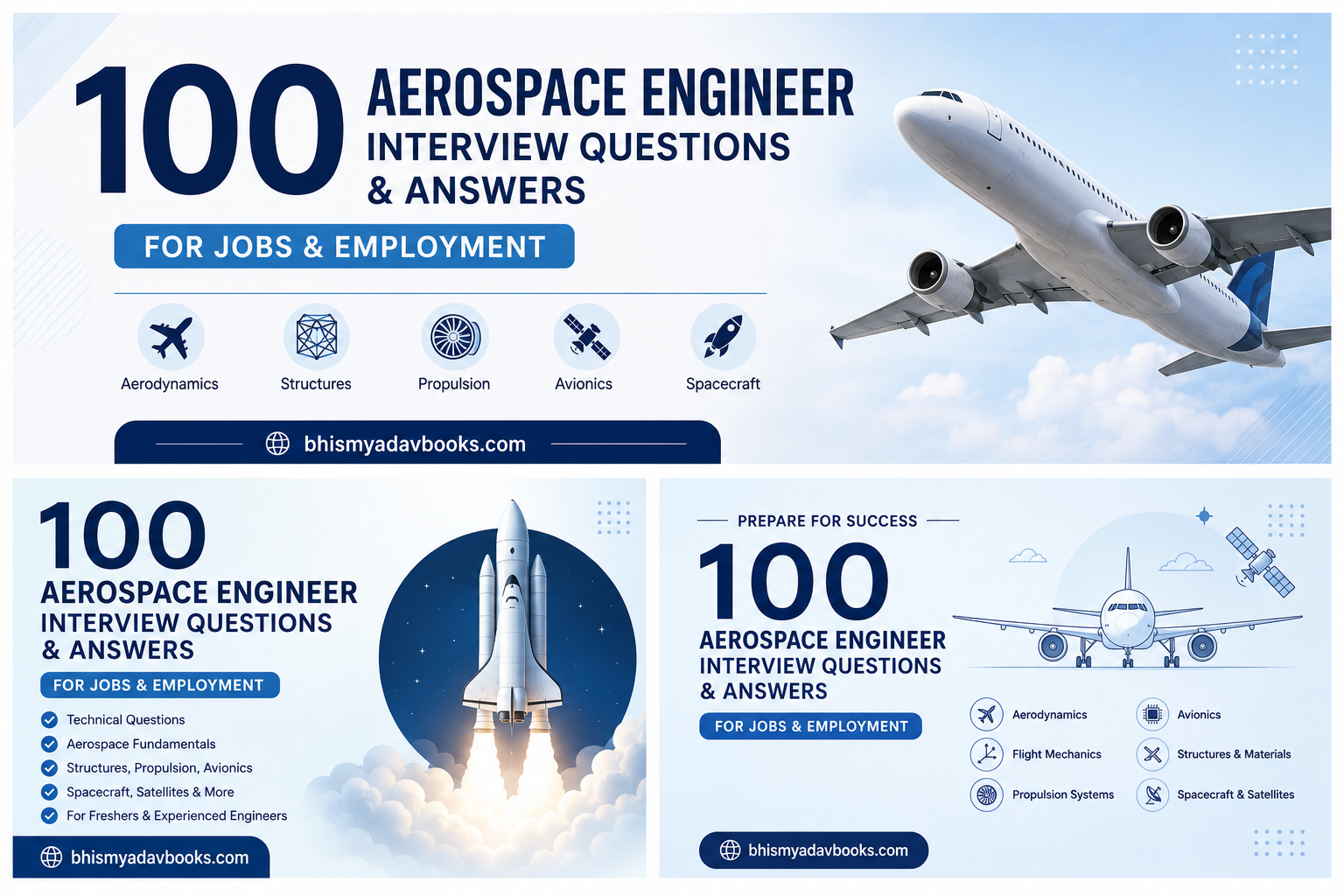
100 Aerospace Engineer Interview Questions and Answers for Jobs & Employment (2026 Ultimate Guide) you Must Read

Aerospace Engineer Interview Questions and Answers

100 Aerospace Engineer Interview Questions and Answers for Jobs & Employment (2026 Ultimate Guide)

Aerospace Engineering is one of the most exciting and technically challenging engineering disciplines. It combines principles of mechanical engineering, electrical engineering, materials science, computer science, and physics to design, develop, test, and maintain aircraft, spacecraft, missiles, satellites, and other aerospace systems.

With the rapid growth of commercial aviation, private space exploration, defense technology, unmanned aerial vehicles (UAVs), and satellite communications, the demand for skilled aerospace engineers continues to increase worldwide. Companies seek professionals who possess strong analytical abilities, problem-solving skills, mathematical knowledge, and practical engineering expertise.

Preparing for an aerospace engineering interview requires more than memorizing textbook definitions. Interviewers often evaluate your understanding of aerodynamics, aircraft structures, propulsion systems, flight mechanics, avionics, materials engineering, and your ability to apply engineering principles to real-world challenges.

Whether you are a recent graduate preparing for campus placements, a fresher applying for your first aerospace engineering role, or an experienced engineer seeking career advancement, this comprehensive guide will help you prepare effectively.

This article includes 100 carefully selected Aerospace Engineer interview questions and answers, covering beginner, intermediate, and advanced topics frequently asked during technical interviews.

What is Aerospace Engineering?

Aerospace Engineering is the branch of engineering that focuses on the design, development, testing, manufacturing, operation, and maintenance of aircraft and spacecraft.

The field is broadly divided into two major areas:

Aeronautical Engineering

Aeronautical engineering deals with aircraft that operate within Earth’s atmosphere.

Examples include:

  • Commercial airplanes
  • Fighter aircraft
  • Helicopters
  • Gliders
  • Unmanned aerial vehicles (UAVs)

Astronautical Engineering

Astronautical engineering focuses on vehicles that operate beyond Earth’s atmosphere.

Examples include:

  • Satellites
  • Spacecraft
  • Rockets
  • Space stations
  • Planetary probes
  • Launch vehicles

Many modern aerospace engineers work across both disciplines due to advances in reusable launch systems, satellite technology, and high-altitude flight.

Why Choose a Career in Aerospace Engineering?

A career in aerospace engineering offers opportunities to work on technologies that shape the future of transportation, defense, and space exploration.

Our website has some Amazing books in our Shop page for you.

Benefits include:

  • High-demand technical skills
  • Opportunities in aviation and space industries
  • Competitive salaries
  • Challenging engineering problems
  • International career prospects
  • Opportunities in research and development
  • Exposure to cutting-edge technologies
  • Contribution to scientific advancement

Career Opportunities in Aerospace Engineering

Graduates can pursue various roles, including:

  • Aerospace Engineer
  • Aircraft Design Engineer
  • Flight Test Engineer
  • Structural Engineer
  • Propulsion Engineer
  • Avionics Engineer
  • Systems Engineer
  • Manufacturing Engineer
  • Spacecraft Engineer
  • Satellite Engineer
  • Maintenance Engineer
  • Research Scientist
  • Quality Assurance Engineer
  • Computational Fluid Dynamics (CFD) Engineer
  • Finite Element Analysis (FEA) Engineer

Skills Required for Aerospace Engineers

Successful aerospace engineers typically possess expertise in:

Technical Skills

  • Aerodynamics
  • Flight Mechanics
  • Aircraft Structures
  • Thermodynamics
  • Fluid Mechanics
  • Propulsion Systems
  • Control Systems
  • Structural Analysis
  • Engineering Mathematics

Software Skills

Commonly used engineering tools include:

  • CATIA
  • SolidWorks
  • ANSYS
  • MATLAB
  • Simulink
  • AutoCAD
  • Python
  • C++
  • CAD/CAM Software

Soft Skills

  • Analytical thinking
  • Communication
  • Team collaboration
  • Problem-solving
  • Project management
  • Attention to detail
  • Technical documentation

Aerospace Industry Overview

Aerospace engineers work in a variety of industries, including:

  • Commercial aviation
  • Defense and military
  • Space exploration
  • Satellite communications
  • Research laboratories
  • Government agencies
  • Aircraft manufacturing
  • Drone technology
  • Missile development
  • Private aerospace companies

As aerospace technologies continue to evolve, engineers with multidisciplinary skills remain in high demand.

Top 25 Aerospace Engineer Interview Questions and Answers

1. What is Aerospace Engineering?

Answer

Aerospace Engineering is the branch of engineering concerned with the design, development, testing, manufacturing, and maintenance of aircraft, spacecraft, satellites, and related systems.

It combines concepts from mechanics, materials science, thermodynamics, fluid dynamics, control systems, and electronics to create safe and efficient aerospace vehicles.

2. What is the difference between Aeronautical Engineering and Astronautical Engineering?

Answer

Aeronautical Engineering focuses on vehicles that operate within Earth’s atmosphere, such as airplanes and helicopters.

Astronautical Engineering deals with spacecraft, satellites, rockets, and systems designed to operate beyond Earth’s atmosphere.

Although distinct, both disciplines share many engineering principles.

3. What are the four fundamental forces acting on an aircraft during flight?

Answer

The four primary forces are:

  • Lift – Upward force generated by the wings.
  • Weight – Downward force caused by gravity.
  • Thrust – Forward force produced by engines.
  • Drag – Air resistance opposing motion.

Balanced interaction among these forces determines an aircraft’s flight performance.

4. What is Lift?

Answer

Lift is the aerodynamic force that acts perpendicular to the direction of airflow and opposes the aircraft’s weight.

Lift is generated primarily by the wings as air flows over and under the airfoil.

Factors affecting lift include:

  • Airspeed
  • Wing shape
  • Angle of attack
  • Air density
  • Wing area

5. What is Drag?

Answer

Drag is the aerodynamic force that resists an aircraft’s forward motion.

Major types of drag include:

  • Parasite drag
  • Induced drag
  • Wave drag (at high speeds)

Reducing drag improves fuel efficiency and aircraft performance.

6. What is Thrust?

Answer

Thrust is the forward force produced by an aircraft’s propulsion system.

Sources of thrust include:

  • Jet engines
  • Propellers
  • Rocket engines

Thrust must exceed drag for acceleration and maintain equilibrium for steady flight.

7. What is Weight in Aviation?

Answer

Weight is the gravitational force acting downward on an aircraft.

It includes the combined weight of:

  • Aircraft structure
  • Fuel
  • Passengers
  • Cargo
  • Equipment

Engineers carefully manage weight to optimize performance, range, and safety.

8. What is Bernoulli’s Principle?

Answer

Bernoulli’s Principle states that as the velocity of a fluid increases, its pressure decreases.

In aviation, faster airflow over the upper surface of an airfoil contributes to lower pressure compared to the lower surface, helping generate lift.

However, lift is more accurately explained using Bernoulli’s Principle together with Newton’s laws of motion.

9. Explain Newton’s Third Law in aviation.

Answer

Newton’s Third Law states:

For every action, there is an equal and opposite reaction.

In flight, wings deflect air downward, and the equal and opposite reaction generates an upward lifting force.

This principle also explains rocket propulsion.

10. What is an Airfoil?

Answer

An airfoil is the cross-sectional shape of a wing, blade, or control surface designed to produce lift efficiently while minimizing drag.

Airfoil design significantly influences aircraft performance.

11. What is Angle of Attack?

Answer

The angle of attack is the angle between the wing’s chord line and the relative airflow.

Increasing the angle of attack generally increases lift until a critical angle is reached.

Beyond this point, airflow separates from the wing, causing a stall.

12. What is Stall?

Answer

A stall occurs when the wing exceeds its critical angle of attack, causing a sudden loss of lift.

Stalls can occur at any airspeed if the angle of attack becomes too high.

Recovery requires reducing the angle of attack and restoring smooth airflow.

13. What is Flight Stability?

Answer

Flight stability refers to an aircraft’s ability to maintain or return to its original flight condition after being disturbed by external forces such as turbulence.

Stable aircraft are generally easier to control and safer to operate.

14. What are the three types of aircraft stability?

Answer

Aircraft stability is categorized into:

  • Longitudinal Stability
  • Lateral Stability
  • Directional Stability

Each contributes to maintaining controlled flight about different axes.

15. What are the primary flight control surfaces?

Answer

The main control surfaces are:

  • Ailerons
  • Elevator
  • Rudder

Secondary control devices include:

  • Flaps
  • Slats
  • Spoilers
  • Trim tabs

These surfaces enable pilots to control roll, pitch, and yaw.

16. What is an Aileron?

Answer

Ailerons are movable surfaces located near the outer trailing edges of the wings.

They control the aircraft’s roll by increasing lift on one wing while decreasing it on the other.

17. What is an Elevator?

Answer

The elevator is located on the horizontal stabilizer.

It controls the aircraft’s pitch, allowing the nose to move upward or downward.

18. What is a Rudder?

Answer

The rudder is attached to the vertical stabilizer.

It controls the aircraft’s yaw, enabling left and right directional movement.

19. What are Flaps?

Answer

Flaps are high-lift devices located on the trailing edge of the wing.

They increase lift and drag during:

  • Takeoff
  • Landing

This allows aircraft to operate safely at lower speeds.

20. What is Wing Loading?

Answer

Wing loading is the ratio of an aircraft’s weight to its wing area.

A lower wing loading generally provides:

  • Better maneuverability
  • Lower stall speed
  • Improved takeoff and landing performance

Higher wing loading can improve cruise efficiency but may require higher takeoff and landing speeds.

21. What is Aspect Ratio?

Answer

Aspect ratio is the ratio of a wing’s span to its average chord.

High aspect ratio wings generally provide:

  • Better aerodynamic efficiency
  • Lower induced drag
  • Improved gliding performance

Examples include sailplanes and long-range transport aircraft.

22. What is Compressibility in Aerodynamics?

Answer

Compressibility refers to changes in air density that become significant at high speeds, particularly as aircraft approach the speed of sound.

These effects influence pressure distribution, drag, and aircraft stability.

23. What is Mach Number?

Answer

Mach Number is the ratio of an object’s speed to the local speed of sound.

Examples:

  • Mach 0.8 = 80% of the speed of sound
  • Mach 1 = Speed of sound
  • Mach 2 = Twice the speed of sound

Mach number is important for analyzing subsonic, transonic, supersonic, and hypersonic flight.

24. What are the different flight regimes?

Answer

Aircraft operate in several flight regimes:

  • Subsonic
  • Transonic
  • Supersonic
  • Hypersonic

Each regime presents unique aerodynamic and structural challenges that engineers must consider during design.

25. Why is Aerodynamics important in Aerospace Engineering?

Answer

Aerodynamics plays a central role in aircraft and spacecraft design. It helps engineers:

  • Generate sufficient lift
  • Reduce drag
  • Improve fuel efficiency
  • Increase flight stability
  • Enhance performance
  • Reduce noise
  • Improve safety
  • Optimize overall aircraft design

A strong understanding of aerodynamic principles is essential for every aerospace engineer.

100 Aerospace Engineer Interview Questions and Answers for Jobs & Employment (2026 Ultimate Guide)

Questions 26–50: Aircraft Structures, Materials, Propulsion Systems, and Aircraft Systems

This section focuses on aircraft structures, aerospace materials, stress analysis, propulsion systems, landing gear, hydraulic systems, fuel systems, and aircraft maintenance—topics that frequently appear in interviews for Aerospace Engineers, Aircraft Design Engineers, Propulsion Engineers, Structural Engineers, and Maintenance Engineers.

26. What is an Aircraft Structure?

Answer

An aircraft structure is the framework that supports all aircraft components and withstands aerodynamic, inertial, and operational loads during flight.

Major structural components include:

  • Fuselage
  • Wings
  • Empennage (tail assembly)
  • Landing gear
  • Engine mounts
  • Control surfaces

A well-designed structure must be lightweight, strong, durable, and resistant to fatigue.

27. What is the Fuselage?

Answer

The fuselage is the main body of an aircraft.

Its primary functions include:

  • Housing passengers and cargo
  • Supporting wings and tail
  • Accommodating cockpit and avionics
  • Carrying fuel in some aircraft
  • Providing structural integrity

The fuselage experiences bending, torsion, and compressive loads throughout flight.

28. What are the Main Components of an Aircraft Wing?

Answer

Aircraft wings consist of several structural elements:

  • Spars
  • Ribs
  • Stringers
  • Skin
  • Leading edge
  • Trailing edge
  • Wing tips

Together, these components distribute aerodynamic loads and provide structural strength while maintaining an efficient aerodynamic profile.

29. What are Spars and Ribs?

Answer

Spars are the primary longitudinal structural members of a wing, carrying most of the bending loads.

Ribs run perpendicular to the spars and maintain the wing’s aerodynamic shape while distributing loads.

Together, spars and ribs form the wing’s internal framework.

30. What is Stress?

Answer

Stress is the internal resisting force per unit area within a material when external loads are applied.

Common types include:

  • Tensile stress
  • Compressive stress
  • Shear stress
  • Torsional stress

Stress analysis helps engineers ensure structures can safely withstand operational loads.

31. What is Strain?

Answer

Strain is the deformation of a material caused by applied stress.

It represents the change in dimension relative to the original dimension.

Understanding strain helps engineers evaluate material behavior under loading conditions.

32. What is Hooke’s Law?

Answer

Hooke’s Law states that, within the elastic limit of a material, stress is directly proportional to strain.

This relationship allows engineers to predict material deformation under normal operating conditions.

33. What is Elastic Deformation?

Answer

Elastic deformation is a temporary change in shape that disappears once the applied load is removed.

Materials operating within the elastic range return to their original dimensions without permanent damage.

34. What is Plastic Deformation?

Answer

Plastic deformation occurs when stress exceeds the material’s elastic limit, causing permanent changes in shape.

Design engineers strive to keep aircraft structures within the elastic range during normal operation.

35. What is Fatigue in Aerospace Structures?

Answer

Fatigue is the progressive weakening of a material caused by repeated cyclic loading.

Even stresses below the material’s ultimate strength can lead to fatigue failure after many load cycles.

Aircraft experience fatigue due to:

  • Takeoff and landing cycles
  • Cabin pressurization
  • Turbulence
  • Engine vibrations

Regular inspections help detect fatigue before failure occurs.

36. Why is Fatigue Important in Aircraft Design?

Answer

Fatigue is a major design consideration because aircraft experience thousands of loading cycles throughout their service life.

Engineers address fatigue by:

  • Selecting suitable materials
  • Performing fatigue analysis
  • Designing fail-safe structures
  • Scheduling periodic inspections
  • Monitoring crack growth

Effective fatigue management enhances safety and extends aircraft lifespan.

37. What are Composite Materials?

Answer

Composite materials combine two or more distinct materials to achieve superior mechanical properties.

Common aerospace composites include:

  • Carbon Fiber Reinforced Polymer (CFRP)
  • Glass Fiber Reinforced Polymer (GFRP)
  • Kevlar composites

Advantages include:

  • High strength-to-weight ratio
  • Corrosion resistance
  • Reduced maintenance
  • Improved fuel efficiency

38. Why are Composite Materials Widely Used in Modern Aircraft?

Answer

Composite materials reduce aircraft weight while maintaining structural strength.

Benefits include:

  • Lower fuel consumption
  • Increased payload capacity
  • Improved corrosion resistance
  • Longer service life
  • Better fatigue performance

Many modern commercial aircraft incorporate composites extensively in wings, fuselage sections, and tail structures.

39. What is a Jet Engine?

Answer

A jet engine is a propulsion system that produces thrust by accelerating high-speed exhaust gases.

Basic operating stages include:

  1. Air intake
  2. Compression
  3. Combustion
  4. Expansion through turbine
  5. Exhaust

Jet engines enable high-speed, high-altitude flight.

40. What are the Main Types of Jet Engines?

Answer

Common jet engine types include:

  • Turbojet
  • Turbofan
  • Turboprop
  • Turboshaft
  • Ramjet
  • Scramjet

Each type is optimized for specific speed ranges and mission requirements.

41. What is a Turbofan Engine?

Answer

A turbofan engine uses a large fan at the front to generate additional thrust.

Advantages include:

  • Better fuel efficiency
  • Lower noise
  • Higher thrust
  • Improved passenger comfort

Most commercial airliners use high-bypass turbofan engines.

42. What is Rocket Propulsion?

Answer

Rocket propulsion generates thrust by expelling high-speed gases through a nozzle.

Unlike aircraft engines, rockets carry both fuel and oxidizer, allowing operation in the vacuum of space where atmospheric oxygen is unavailable.

Rocket propulsion powers launch vehicles, spacecraft, and missiles.

43. What is Specific Impulse?

Answer

Specific impulse is a measure of rocket engine efficiency.

It indicates how effectively a propulsion system uses propellant to produce thrust.

A higher specific impulse generally means better propellant efficiency and longer mission capability.

44. What is Aircraft Fuel System?

Answer

The fuel system stores, manages, and delivers fuel safely to the engines.

Major components include:

  • Fuel tanks
  • Fuel pumps
  • Fuel filters
  • Fuel lines
  • Fuel control units
  • Valves

Reliable fuel delivery is essential for safe engine operation.

45. What is a Hydraulic System in an Aircraft?

Answer

Hydraulic systems use pressurized fluid to operate high-force aircraft components.

Applications include:

  • Landing gear extension and retraction
  • Flight control surfaces
  • Braking systems
  • Cargo doors
  • Steering systems

Hydraulics allow large forces to be generated with relatively small pilot inputs.

46. What is a Pneumatic System?

Answer

Pneumatic systems use compressed air to perform mechanical work.

Typical applications include:

  • Engine starting
  • Cabin pressurization
  • Air conditioning
  • Environmental control systems
  • Ice protection

Some aircraft use both hydraulic and pneumatic systems depending on design requirements.

47. What is Landing Gear?

Answer

Landing gear supports the aircraft during ground operations.

Its primary functions include:

  • Supporting aircraft weight
  • Absorbing landing impact
  • Providing braking capability
  • Enabling taxiing
  • Facilitating takeoff

Landing gear may be fixed or retractable depending on aircraft type.

48. What is Aircraft Maintenance?

Answer

Aircraft maintenance involves inspection, repair, servicing, and replacement of aircraft components to ensure continued airworthiness.

Maintenance categories include:

  • Line maintenance
  • Base maintenance
  • Preventive maintenance
  • Corrective maintenance

Strict maintenance procedures are essential for aviation safety.

49. What is Preventive Maintenance?

Answer

Preventive maintenance consists of scheduled inspections and servicing performed before failures occur.

Examples include:

  • Lubrication
  • Filter replacement
  • Component inspection
  • Calibration
  • Routine testing

Preventive maintenance reduces downtime and improves reliability.

50. Why is Safety the Highest Priority in Aerospace Engineering?

Answer

Safety is the foundation of aerospace engineering because aircraft and spacecraft operate in environments where failures can have severe consequences.

Engineers prioritize safety by:

  • Following strict design standards
  • Performing structural analysis
  • Conducting rigorous testing
  • Implementing redundant systems
  • Monitoring fatigue and wear
  • Performing regular inspections
  • Complying with aviation regulations
  • Continuously improving designs based on operational data

Every engineering decision must balance performance, efficiency, cost, and safety to protect passengers, crew, and equipment.

100 Aerospace Engineer Interview Questions and Answers for Jobs & Employment (2026 Ultimate Guide)

Questions 51–75: Flight Mechanics, Avionics, Navigation, UAVs, Spacecraft Engineering, and Satellites

In this section, we’ll explore flight mechanics, avionics, aircraft navigation, unmanned aerial vehicles (UAVs), spacecraft engineering, orbital mechanics, satellites, and space exploration. These subjects are commonly discussed during interviews for Aerospace Engineers, Flight Test Engineers, Avionics Engineers, Spacecraft Engineers, and Research Engineers.

51. What is Flight Mechanics?

Answer

Flight mechanics is the branch of aerospace engineering that studies the motion of aircraft and spacecraft under the influence of aerodynamic forces, gravity, propulsion, and control inputs.

It helps engineers analyze:

  • Aircraft performance
  • Stability
  • Maneuverability
  • Flight trajectories
  • Fuel efficiency

Flight mechanics combines aerodynamics, dynamics, and control theory.

52. What is Aircraft Performance?

Answer

Aircraft performance refers to how effectively an aircraft performs various flight operations.

Performance parameters include:

  • Takeoff distance
  • Landing distance
  • Rate of climb
  • Cruise speed
  • Maximum speed
  • Service ceiling
  • Range
  • Endurance
  • Fuel consumption

Engineers optimize these factors during aircraft design.

53. What is Aircraft Stability?

Answer

Aircraft stability is the tendency of an aircraft to maintain or return to its original flight condition after a disturbance such as turbulence or wind gusts.

The three types are:

  • Longitudinal Stability
  • Lateral Stability
  • Directional Stability

Good stability improves safety and reduces pilot workload.

54. What is Aircraft Controllability?

Answer

Controllability is the ability of the pilot or flight control system to change the aircraft’s attitude and flight path.

Good controllability ensures:

  • Smooth maneuvering
  • Safe takeoff and landing
  • Efficient navigation
  • Emergency response capability

55. What is the Center of Gravity (CG)?

Answer

The center of gravity is the point where the aircraft’s total weight is considered to act.

A properly positioned CG is essential because it affects:

  • Stability
  • Fuel efficiency
  • Flight control
  • Takeoff performance
  • Landing characteristics

An improperly loaded aircraft may become difficult or unsafe to control.

56. What is the Center of Pressure?

Answer

The center of pressure is the point on an airfoil where the resultant aerodynamic lift force acts.

As the angle of attack changes, the center of pressure may shift, affecting aircraft stability and control.

57. What is Trim in Aviation?

Answer

Trim is the adjustment of flight control surfaces to maintain a desired flight condition without continuous pilot input.

Benefits include:

  • Reduced pilot workload
  • Improved fuel efficiency
  • Increased passenger comfort
  • Stable cruise flight

58. What is an Autopilot System?

Answer

An autopilot system automatically controls the aircraft’s flight path based on programmed commands and sensor inputs.

Modern autopilot systems can assist with:

  • Maintaining altitude
  • Holding heading
  • Navigation
  • Climb and descent
  • Instrument approaches

Autopilot improves precision and reduces pilot workload, but pilots remain responsible for monitoring the aircraft.

59. What is Avionics?

Answer

Avionics refers to the electronic systems used in aircraft and spacecraft.

Examples include:

  • Navigation systems
  • Communication systems
  • Flight management systems
  • Radar
  • GPS receivers
  • Weather monitoring systems
  • Collision avoidance systems

Reliable avionics are essential for safe and efficient flight.

60. What is the Flight Management System (FMS)?

Answer

A Flight Management System is an onboard computer that assists pilots with flight planning, navigation, performance optimization, and fuel management.

The FMS integrates information from multiple aircraft systems to support efficient flight operations.

61. What is Radar?

Answer

Radar (Radio Detection and Ranging) detects objects by transmitting radio waves and analyzing the reflected signals.

In aviation, radar is used for:

  • Air traffic control
  • Weather monitoring
  • Terrain awareness
  • Collision avoidance
  • Military surveillance

Radar improves situational awareness and operational safety.

62. What is GPS?

Answer

The Global Positioning System (GPS) is a satellite-based navigation system that provides accurate position, velocity, and timing information.

GPS enables:

  • Flight navigation
  • Route optimization
  • Precision approaches
  • Aircraft tracking

Modern aircraft often combine GPS with inertial navigation systems for enhanced accuracy.

63. What is an Inertial Navigation System (INS)?

Answer

An Inertial Navigation System determines an aircraft’s position using accelerometers and gyroscopes without relying on external signals.

Advantages include:

  • Independent navigation
  • High reliability
  • Operation even when GPS signals are unavailable

INS is widely used in both aircraft and spacecraft.

64. What is an Unmanned Aerial Vehicle (UAV)?

Answer

A UAV, commonly known as a drone, is an aircraft that operates without a pilot onboard.

Applications include:

  • Aerial photography
  • Agriculture
  • Infrastructure inspection
  • Defense
  • Environmental monitoring
  • Search and rescue
  • Package delivery

UAV technology continues to expand across commercial and industrial sectors.

65. What are the Main Components of a Drone?

Answer

Typical drone components include:

  • Airframe
  • Propulsion system
  • Flight controller
  • GPS module
  • Battery
  • Electronic speed controllers (ESCs)
  • Sensors
  • Communication system
  • Payload

The combination of these components enables stable and autonomous flight.

66. What is a Spacecraft?

Answer

A spacecraft is a vehicle designed to operate in outer space.

Types of spacecraft include:

  • Satellites
  • Space probes
  • Space stations
  • Crewed spacecraft
  • Planetary landers
  • Orbital vehicles

Spacecraft are designed to withstand extreme temperatures, radiation, and the vacuum of space.

67. What is a Satellite?

Answer

A satellite is an object that orbits a planet or other celestial body.

Artificial satellites perform functions such as:

  • Communication
  • Navigation
  • Weather forecasting
  • Earth observation
  • Scientific research
  • Defense

Satellites are a critical part of modern communication and navigation infrastructure.

68. What are the Different Types of Satellite Orbits?

Answer

Common orbital categories include:

  • Low Earth Orbit (LEO)
  • Medium Earth Orbit (MEO)
  • Geostationary Earth Orbit (GEO)
  • Highly Elliptical Orbit (HEO)
  • Polar Orbit
  • Sun-Synchronous Orbit (SSO)

Each orbit is selected based on mission requirements such as coverage, altitude, and revisit time.

69. What is Orbital Mechanics?

Answer

Orbital mechanics is the study of the motion of spacecraft and satellites under the influence of gravity.

It helps engineers determine:

  • Launch trajectories
  • Orbital transfers
  • Spacecraft maneuvers
  • Mission planning
  • Fuel requirements

Orbital mechanics is fundamental to successful space missions.

70. What is Escape Velocity?

Answer

Escape velocity is the minimum speed required for an object to overcome a planet’s gravitational attraction without additional propulsion.

For Earth, escape velocity is approximately 11.2 km/s.

Rockets must achieve this velocity (or an equivalent trajectory using propulsion) to leave Earth’s gravitational influence.

71. What is a Launch Vehicle?

Answer

A launch vehicle is a rocket used to transport payloads such as satellites or spacecraft into space.

Typical components include:

  • Payload fairing
  • Upper stage
  • Lower stage
  • Propellant tanks
  • Engines
  • Guidance system

Launch vehicles may be expendable or reusable.

72. What is a Thermal Protection System (TPS)?

Answer

A Thermal Protection System protects spacecraft from extreme temperatures encountered during atmospheric entry or high-speed flight.

Common TPS materials include:

  • Reinforced carbon-carbon
  • Ceramic tiles
  • Ablative materials
  • Heat-resistant composites

TPS is critical for spacecraft safety and mission success.

73. What is Re-entry?

Answer

Re-entry is the process of a spacecraft returning from space through Earth’s atmosphere.

During re-entry:

  • Air compression generates intense heat.
  • Aerodynamic forces increase significantly.
  • Thermal protection systems shield the spacecraft.

Careful trajectory planning is essential to ensure a safe landing.

74. What is a Space Mission?

Answer

A space mission is a planned operation conducted beyond Earth’s atmosphere for scientific, commercial, defense, or exploration purposes.

Examples include:

  • Satellite deployment
  • Lunar exploration
  • Mars missions
  • Space telescopes
  • Human spaceflight
  • Planetary exploration

Each mission requires extensive engineering, testing, and coordination.

75. Why is Systems Engineering Important in Aerospace?

Answer

Systems engineering integrates multiple engineering disciplines into a unified design process.

It ensures that:

  • All subsystems function together.
  • Requirements are met.
  • Risks are managed.
  • Safety is maintained.
  • Performance objectives are achieved.
  • Lifecycle costs are optimized.

Because aerospace projects are highly complex, systems engineering plays a central role in successful aircraft and spacecraft development.

100 Aerospace Engineer Interview Questions and Answers for Jobs & Employment (2026 Ultimate Guide)

Questions 76–100, Scenario-Based Questions, HR Interview Questions, Career Tips, FAQs, and Conclusion

In this section, we’ll cover advanced engineering tools, simulation techniques, aerospace standards, scenario-based technical questions, HR interview questions, career advice, SEO-friendly FAQs, and a strong conclusion to help you prepare for aerospace engineering jobs.

76. What is Computational Fluid Dynamics (CFD)?

Answer

Computational Fluid Dynamics (CFD) is a branch of fluid mechanics that uses numerical methods and computer simulations to analyze fluid flow around objects.

In aerospace engineering, CFD is used to:

  • Predict airflow over aircraft wings
  • Reduce aerodynamic drag
  • Improve lift
  • Optimize engine performance
  • Analyze heat transfer
  • Simulate high-speed flight

CFD helps engineers reduce development costs by minimizing the need for physical prototypes and wind tunnel testing.

77. What is Finite Element Analysis (FEA)?

Answer

Finite Element Analysis (FEA) is a numerical method used to evaluate how structures respond to forces, vibration, heat, and other physical effects.

Applications include:

  • Structural stress analysis
  • Fatigue analysis
  • Thermal analysis
  • Buckling analysis
  • Vibration analysis

FEA helps engineers identify weak points before manufacturing.

78. Why is Wind Tunnel Testing Important?

Answer

Wind tunnels allow engineers to test scale models or full-size aircraft under controlled airflow conditions.

Benefits include:

  • Measuring lift and drag
  • Evaluating stability
  • Studying airflow patterns
  • Validating CFD simulations
  • Improving aerodynamic efficiency

Wind tunnel testing remains an essential part of aircraft development.

79. What is CAD in Aerospace Engineering?

Answer

Computer-Aided Design (CAD) is used to create detailed 2D and 3D models of aerospace components.

Common applications include:

  • Aircraft structures
  • Engine components
  • Landing gear
  • Cabin interiors
  • Spacecraft assemblies

CAD improves design accuracy and collaboration.

80. What software is commonly used in Aerospace Engineering?

Answer

Frequently used software includes:

  • CATIA
  • SolidWorks
  • ANSYS
  • MATLAB
  • Simulink
  • AutoCAD
  • Abaqus
  • Siemens NX
  • Python
  • C++

Interviewers often ask about the purpose of these tools rather than expecting mastery of every package.

81. Why is MATLAB widely used in Aerospace Engineering?

Answer

MATLAB supports mathematical computation, data analysis, modeling, simulation, and control system design.

Typical applications include:

  • Flight dynamics
  • Control systems
  • Signal processing
  • Data visualization
  • Numerical analysis

82. What is ANSYS used for?

Answer

ANSYS is an engineering simulation platform used for:

  • Structural analysis
  • CFD simulations
  • Thermal analysis
  • Electromagnetic analysis
  • Multiphysics simulations

It helps engineers verify designs before manufacturing.

83. What is Failure Analysis?

Answer

Failure analysis investigates why a component failed so engineers can prevent similar failures.

Typical causes include:

  • Material defects
  • Fatigue
  • Corrosion
  • Overloading
  • Manufacturing errors
  • Improper maintenance

The findings improve future designs and operational safety.

84. What are Aerospace Standards?

Answer

Aerospace standards define engineering, manufacturing, quality, and safety requirements.

They help ensure:

  • Product reliability
  • Regulatory compliance
  • Consistent quality
  • Passenger safety

Engineers should understand the importance of following industry standards and documentation.

85. Why is Quality Assurance Important?

Answer

Quality assurance ensures aerospace components meet design specifications and safety requirements.

Benefits include:

  • Reduced defects
  • Improved reliability
  • Better customer confidence
  • Regulatory compliance
  • Lower maintenance costs

Quality is essential throughout design, manufacturing, and maintenance.

86. Scenario-Based Question: A wing component develops a fatigue crack during inspection. What steps would you take?

Sample Answer

I would:

  1. Report the defect immediately.
  2. Assess the crack size and location.
  3. Review maintenance manuals and engineering procedures.
  4. Perform non-destructive testing if required.
  5. Determine whether repair or replacement is appropriate.
  6. Investigate the root cause.
  7. Document findings and corrective actions.
  8. Verify compliance with safety regulations before returning the aircraft to service.

87. Scenario-Based Question: An aircraft consumes more fuel than expected. How would you investigate?

Sample Answer

Possible causes include:

  • Increased aerodynamic drag
  • Engine inefficiency
  • Improper aircraft weight distribution
  • Landing gear issues
  • Tire pressure
  • Flight planning
  • Weather conditions

I would review maintenance records, analyze engine performance data, inspect aerodynamic surfaces, and compare operational parameters with design specifications.

88. Scenario-Based Question: How would you improve aircraft efficiency?

Sample Answer

Potential improvements include:

  • Optimizing wing design
  • Reducing structural weight
  • Using advanced composite materials
  • Improving engine efficiency
  • Reducing aerodynamic drag
  • Enhancing flight control systems
  • Optimizing maintenance schedules

Any proposed changes would be evaluated through simulation and testing before implementation.

89. Scenario-Based Question: How would you explain lift to a non-technical person?

Sample Answer

“I would explain that an aircraft wing is shaped so that as it moves through the air, it creates conditions that produce an upward force called lift. Combined with the wing’s angle and the engine’s thrust, this upward force allows the aircraft to rise and remain in flight.”

Using simple language demonstrates strong communication skills.

90. Scenario-Based Question: What would you do if a simulation result differed significantly from experimental data?

Sample Answer

I would:

  • Verify input parameters.
  • Check boundary conditions.
  • Review assumptions.
  • Validate the simulation model.
  • Examine measurement accuracy.
  • Repeat simulations if necessary.
  • Compare with published data or previous tests.
  • Identify possible sources of uncertainty.

Engineering decisions should always be based on validated data.

91. HR Interview Question: Why do you want to become an Aerospace Engineer?

Sample Answer

“I have always been fascinated by aircraft and space technology. Aerospace engineering combines mathematics, physics, and innovation to solve complex engineering challenges. I enjoy designing systems that improve safety, efficiency, and performance, and I look forward to contributing to advancements in aviation and space exploration.”

92. HR Interview Question: What are your strengths?

Sample Answer

  • Analytical thinking
  • Problem-solving
  • Engineering mathematics
  • Teamwork
  • Communication
  • CAD and simulation tools
  • Continuous learning
  • Attention to detail

Support your answer with examples from academic projects or internships.

93. HR Interview Question: What is your biggest weakness?

Sample Answer

“I sometimes spend too much time refining technical details. I have learned to balance precision with project deadlines by prioritizing critical requirements and seeking timely feedback.”

This response shows self-awareness and professional growth.

94. HR Interview Question: Describe an engineering project you worked on.

Sample Answer

Structure your answer using the STAR method:

  • Situation: Describe the project context.
  • Task: Explain your responsibilities.
  • Action: Discuss your engineering approach, tools used, and challenges overcome.
  • Result: Highlight measurable outcomes and lessons learned.

95. HR Interview Question: Where do you see yourself in five years?

Sample Answer

“I aim to become a skilled aerospace engineer involved in advanced aircraft or spacecraft development. I hope to lead technical projects, continue learning emerging technologies, and contribute to innovative engineering solutions.”

96. What certifications can benefit an Aerospace Engineer?

Answer

Useful certifications include:

  • CAD/CATIA certifications
  • ANSYS training
  • MATLAB certification
  • Project Management certifications
  • Quality Management certifications
  • Six Sigma
  • Additive Manufacturing courses
  • UAV or Drone certifications (where applicable)

Continuous learning enhances technical credibility.

97. What technical skills are most valued by aerospace employers?

Answer

Employers often seek:

  • CAD modeling
  • CFD analysis
  • FEA analysis
  • Engineering mathematics
  • Aerodynamics
  • Aircraft structures
  • MATLAB
  • Programming (Python or C++)
  • Problem-solving
  • Technical documentation

Hands-on project experience is highly valued alongside theoretical knowledge.

98. How should you prepare for an Aerospace Engineering interview?

Answer

Preparation tips:

  • Review aerospace fundamentals.
  • Revise thermodynamics and fluid mechanics.
  • Practice numerical problems.
  • Understand your academic projects thoroughly.
  • Learn about the employer’s products and technologies.
  • Review engineering software you’ve used.
  • Practice explaining technical concepts clearly.

Confidence comes from understanding concepts rather than memorizing answers.

99. What advice would you give to fresh Aerospace Engineering graduates?

Answer

  • Build practical engineering projects.
  • Learn industry-standard software.
  • Develop programming skills.
  • Stay informed about aviation and space technologies.
  • Improve communication and teamwork.
  • Pursue internships whenever possible.
  • Keep learning through technical courses and certifications.

A combination of technical knowledge and practical experience significantly improves employability.

100. What is the key to succeeding as an Aerospace Engineer?

Answer

Success in aerospace engineering requires:

  • Strong engineering fundamentals
  • Curiosity and continuous learning
  • Attention to detail
  • Effective teamwork
  • Ethical decision-making
  • Safety-first thinking
  • Adaptability to new technologies
  • Commitment to quality

Engineers who combine technical excellence with practical problem-solving and clear communication are well-positioned for long-term career growth.

Common Aerospace Engineering Formulas to Review

Interviewers may ask candidates to explain or apply basic engineering formulas such as:

  • Lift Equation
  • Drag Equation
  • Stress = Force ÷ Area
  • Strain = Change in Length ÷ Original Length
  • Newton’s Second Law (F = ma)
  • Bernoulli’s Equation (conceptual understanding)
  • Thrust Equation
  • Wing Loading
  • Aspect Ratio
  • Mach Number

Understanding the meaning and application of these formulas is often more important than memorizing them.

Interview Preparation Tips

Recommended Book for Aerospace Engineer Interview

Fundamentals of Aerospace Engineering by Francisco Gallardo Lopez (Author), Jens Strahmann (Author), Edward G Gibson (Foreword)

To prepare effectively:

  • Understand aircraft structural components.
  • Study propulsion system operation.
  • Learn common aircraft systems such as hydraulics and fuel systems.
  • Practice explaining engineering concepts clearly.
  • Be prepared to discuss university projects or internships involving aerospace design, analysis, or testing.
  • Stay informed about recent developments in aviation and space technology.
  • Review flight mechanics fundamentals.
  • Understand aircraft stability and controllability.
  • Study avionics and navigation systems.
  • Learn basic orbital mechanics.
  • Understand spacecraft subsystems.
  • Be prepared to discuss drone technologies and satellite applications.
  • Practice explaining engineering concepts using practical examples.
  • Review projects completed during university or internships.

To strengthen your aerospace interview performance:

Employers often evaluate your ability to apply engineering principles to real-world aerospace challenges.

Interviewers appreciate candidates who demonstrate both theoretical knowledge and practical engineering thinking.

Common Aerospace Software Interviewers May Ask About

Be familiar with the purpose of tools such as:

  • CATIA
  • SolidWorks
  • ANSYS
  • MATLAB
  • Simulink
  • AutoCAD
  • Python
  • C++
  • LabVIEW
  • CFD software
  • FEA software

Interviewers may ask where these tools are used rather than expecting expert-level proficiency.

Frequently Asked Questions (FAQ)

Is Aerospace Engineering a good career?

Yes. Aerospace engineering offers opportunities in aviation, defense, space exploration, satellite technology, research, and advanced manufacturing. It can be a rewarding career for those interested in engineering and innovation.

Which programming languages are useful for Aerospace Engineers?

Commonly used languages include:

  • Python
  • C++
  • MATLAB (programming environment)
  • Java (for some applications)

Programming skills are valuable for simulation, automation, and data analysis.

Is mathematics important in Aerospace Engineering?

Yes. Mathematics is fundamental to aerodynamics, structural analysis, control systems, orbital mechanics, and many other aerospace disciplines.

Which software should students learn?

Students should become familiar with:

  • CATIA
  • SolidWorks
  • ANSYS
  • MATLAB
  • Simulink
  • AutoCAD

Practical experience with these tools strengthens job applications.

Do aerospace interviews include numerical questions?

Yes. Candidates may be asked to solve or explain engineering problems involving mechanics, fluid dynamics, thermodynamics, or structural analysis.

How can fresh graduates improve their chances of getting hired?

Graduates can improve their prospects by:

  • Completing internships
  • Building engineering projects
  • Learning industry-standard software
  • Practicing technical interviews
  • Developing communication skills
  • Staying updated with aerospace technologies

Final Thoughts

Aerospace engineering is a field where innovation, precision, and safety come together to shape the future of aviation and space exploration. Interview success depends on more than remembering formulas—it requires understanding engineering principles, demonstrating practical problem-solving, and communicating ideas effectively.

Whether your goal is to work in aircraft design, propulsion, avionics, structural analysis, satellite engineering, or space exploration, consistent learning and hands-on experience will help you stand out. Review these interview questions regularly, work on meaningful projects, and continue expanding your technical skills to build a successful aerospace engineering career.