Posted on Leave a comment

Solutions Architect Interview Questions and Answers for Jobs and Employment (2026) : Complete Guide Freshers and Experienced can’t miss

Solutions Architect Interview Questions and Answers

100 Solutions Architect Interview Questions and Answers for Jobs and Employment

Introduction

A Solutions Architect plays an important role in designing reliable, secure, scalable, and cost-effective technology solutions for organizations. Solutions Architects work between business teams and technical teams to transform business requirements into practical system designs.

Companies hiring Solutions Architects often look for candidates with strong knowledge of cloud computing, networking, databases, application architecture, security, scalability, disaster recovery, DevOps, and system integration. Communication and problem-solving skills are equally important because architects regularly communicate with developers, project managers, business stakeholders, security teams, and senior management.

Solutions Architect interviews can include technical questions, system design problems, behavioral questions, cloud architecture scenarios, and business-focused discussions. Candidates may be asked to design a highly available application, select an appropriate database, migrate an application to the cloud, improve system performance, or reduce infrastructure costs.

We have some amazing books in our Shop page you may want to buy.

This article presents 100 Solutions Architect interview questions and answers for jobs and employment. The questions cover fundamental concepts, cloud architecture, distributed systems, security, networking, databases, microservices, scalability, DevOps, disaster recovery, and practical architecture scenarios.


Basic Solutions Architect Interview Questions and Answers

(Questions 1-30)

1. What is a Solutions Architect?

A Solutions Architect is a technology professional responsible for designing technical solutions that meet business requirements. The architect evaluates business needs, selects suitable technologies, defines system components, and ensures that the proposed architecture is scalable, secure, reliable, and cost-effective.

2. What are the primary responsibilities of a Solutions Architect?

The main responsibilities include understanding business requirements, designing solution architecture, selecting technologies, defining integration strategies, evaluating technical risks, ensuring security, supporting development teams, documenting architecture, and communicating technical decisions to stakeholders.

3. What is solution architecture?

Solution architecture is the process of designing a technical solution for a specific business problem. It defines applications, infrastructure, data flows, integrations, security controls, and technologies required to implement the solution.

4. What is the difference between a Solutions Architect and an Enterprise Architect?

A Solutions Architect focuses on designing a solution for a specific project or business requirement. An Enterprise Architect works at the organization level and defines long-term technology strategies, architecture standards, and enterprise-wide technology frameworks.

5. What is the difference between a Solutions Architect and a Software Architect?

A Solutions Architect considers the complete technology solution, including applications, infrastructure, cloud services, databases, networking, security, and integrations. A Software Architect primarily focuses on software structure, design patterns, application components, and development technologies.

6. What skills are required for a Solutions Architect?

Important skills include cloud computing, networking, databases, system design, cybersecurity, distributed systems, application architecture, DevOps, APIs, integration technologies, communication, documentation, and business analysis.

7. How do you understand business requirements?

I communicate with stakeholders, identify business objectives, understand current challenges, define functional and non-functional requirements, document constraints, and confirm priorities. I then translate these requirements into technical architecture decisions.

8. What are functional requirements?

Functional requirements describe what a system must do. Examples include user registration, payment processing, report generation, product search, and order management.

9. What are non-functional requirements?

Non-functional requirements describe how a system should operate. Examples include availability, performance, scalability, security, reliability, maintainability, compliance, and recovery objectives.

10. Why are non-functional requirements important in architecture?

Non-functional requirements influence major architecture decisions. For example, a requirement for 99.99% availability may require multi-zone deployment, load balancing, redundancy, automated failover, and resilient data storage.

11. What is an architecture diagram?

An architecture diagram is a visual representation of system components and their relationships. It may show applications, databases, networks, APIs, cloud services, users, data flows, and external systems.

12. What is technical debt?

Technical debt refers to future costs created by choosing a quick or limited technical solution instead of a more maintainable design. Architects should identify technical debt and balance immediate business needs with long-term system quality.

13. What is a proof of concept?

A proof of concept, or POC, is a small implementation used to verify whether a technology or architectural approach is technically feasible before investing in full-scale development.

14. What is architecture governance?

Architecture governance is the process of ensuring that technology solutions follow organizational standards, security policies, architecture principles, and strategic objectives.

15. How do you document architecture decisions?

I use architecture diagrams, design documents, decision records, assumptions, constraints, risk assessments, and Architecture Decision Records. Each important decision should explain the problem, alternatives, selected approach, and consequences.


System Design and Architecture Questions

16. What is scalability?

Scalability is the ability of a system to handle increasing workloads by adding resources or improving resource utilization without significantly reducing performance.

17. What is vertical scaling?

Vertical scaling means increasing the capacity of an existing server by adding more CPU, memory, or storage. It is simple but is limited by the maximum capacity of the server.

18. What is horizontal scaling?

Horizontal scaling means adding more servers or instances to distribute workloads. It is commonly used in cloud and distributed architectures because it supports large-scale growth and high availability.

19. What is high availability?

High availability is the ability of a system to remain operational with minimal downtime. It can be achieved through redundancy, load balancing, failover mechanisms, health checks, and deployment across multiple availability zones or data centers.

20. What is fault tolerance?

Fault tolerance is the ability of a system to continue operating even when one or more components fail. Fault-tolerant systems use redundant components and automatic recovery mechanisms.

21. What is the difference between high availability and fault tolerance?

High availability focuses on minimizing downtime and restoring services quickly. Fault tolerance aims to continue operations without interruption when a component fails.

22. What is a load balancer?

A load balancer distributes incoming traffic across multiple servers or application instances. It improves availability, scalability, and performance by preventing a single server from handling all requests.

23. What is stateless architecture?

In stateless architecture, the server does not store client session information between requests. Each request contains the information required for processing. Stateless applications are generally easier to scale horizontally.

24. What is stateful architecture?

A stateful system maintains information about previous interactions or sessions. Databases, session-based applications, and some communication systems are examples of stateful systems.

25. What is caching?

Caching stores frequently accessed data in a fast storage layer to reduce response time and database load. Caches may exist at the browser, CDN, application, database, or distributed cache level.

26. What factors should be considered when designing a scalable system?

Important factors include expected traffic, data volume, request patterns, database scalability, caching, load balancing, asynchronous processing, stateless services, network capacity, monitoring, and cost.

27. What is a Content Delivery Network?

A Content Delivery Network, or CDN, is a distributed network of servers that caches and delivers content from locations closer to users. It reduces latency and decreases load on origin servers.

28. What is asynchronous processing?

Asynchronous processing allows a system to perform tasks independently without making the user wait for completion. Message queues and event systems are commonly used for background processing.

29. What is a message queue?

A message queue allows applications to communicate asynchronously. Producers send messages to a queue, and consumers process them independently. This improves decoupling, resilience, and scalability.

30. What is event-driven architecture?

Event-driven architecture is a design approach where system components communicate through events. When an event occurs, interested services react to it. Examples include order-created, payment-completed, and user-registered events.


Cloud Architecture Interview Questions

(Questions 31-55)

31. What is cloud computing?

Cloud computing is the delivery of computing resources such as servers, storage, databases, networking, and software through internet-based infrastructure with flexible provisioning and consumption-based pricing.

32. What are IaaS, PaaS, and SaaS?

Infrastructure as a Service provides virtualized infrastructure resources. Platform as a Service provides managed platforms for application development and deployment. Software as a Service provides complete software applications to users.

33. What is a public cloud?

A public cloud is a cloud environment operated by a third-party provider and shared across customers through logically isolated resources.

34. What is a private cloud?

A private cloud is a cloud environment dedicated to a single organization. It may be hosted in an organization’s data center or managed by an external provider.

35. What is a hybrid cloud?

A hybrid cloud combines private infrastructure with public cloud services. Applications and data may operate across both environments based on security, cost, performance, and regulatory requirements.

36. What is multi-cloud architecture?

Multi-cloud architecture uses services from multiple cloud providers. Organizations may adopt multi-cloud strategies to meet specific business needs, reduce concentration risk, or use specialized services.

37. How do you select a cloud provider?

I evaluate business requirements, available services, geographic coverage, compliance requirements, security capabilities, pricing, existing skills, integration needs, support, and operational maturity.

38. What is cloud elasticity?

Elasticity is the ability to automatically increase or decrease computing resources based on workload demand. It helps maintain performance while controlling costs.

39. What is auto scaling?

Auto scaling automatically adjusts the number or capacity of computing resources according to metrics or schedules. CPU utilization, request count, and queue length can be used as scaling signals.

40. What is a cloud availability zone?

An availability zone is an isolated infrastructure location within a cloud region. Deploying applications across multiple zones can improve resilience against localized failures.

41. What is a cloud region?

A cloud region is a geographic area containing cloud infrastructure and multiple data center locations. Region selection may depend on latency, compliance, service availability, and disaster recovery requirements.

42. How would you design a highly available cloud application?

I would deploy application instances across multiple availability zones, use a load balancer, configure auto scaling, use resilient database services, store files in durable object storage, implement monitoring, and automate recovery procedures.

43. What is serverless computing?

Serverless computing allows developers to execute applications or functions without directly managing servers. The cloud provider manages infrastructure provisioning, scaling, and much of the operational environment.

44. When should serverless architecture be used?

Serverless architecture is suitable for event-driven workloads, APIs, scheduled tasks, data processing, and applications with variable traffic. It may be less suitable for certain long-running or highly specialized workloads.

45. What is the shared responsibility model?

The shared responsibility model defines security responsibilities between a cloud provider and its customer. The provider protects the underlying cloud infrastructure, while the customer remains responsible for areas such as data, identities, permissions, and workload configuration, depending on the service model.


Networking Interview Questions for Solutions Architects

46. What is a virtual private cloud?

A virtual private cloud is a logically isolated network environment in a public cloud. It allows organizations to configure IP ranges, subnets, routes, gateways, and security controls.

47. What is a subnet?

A subnet is a smaller network created within a larger IP network. Subnets help organize resources, control network traffic, and separate public and private workloads.

48. What is the difference between a public and private subnet?

A public subnet has a route that supports direct access to an internet gateway for appropriate resources. A private subnet does not provide direct inbound internet access and is commonly used for application servers and databases.

49. What is DNS?

The Domain Name System translates human-readable domain names into IP addresses. DNS is essential for locating services and routing users to applications.

50. What is NAT?

Network Address Translation allows systems using private IP addresses to communicate with external networks through translated addresses. In cloud architectures, NAT services are often used for outbound internet connectivity from private subnets.

51. What is a firewall?

A firewall controls network traffic according to defined security rules. It can permit or deny traffic based on source, destination, protocol, and port.

52. What is network segmentation?

Network segmentation divides a network into separate security zones. It limits unnecessary communication and reduces the potential impact of a security breach.

53. What is a VPN?

A Virtual Private Network creates an encrypted connection between networks or users and a private environment. VPNs are commonly used for secure remote access and hybrid cloud connectivity.

54. What is latency?

Latency is the time required for data to travel from a source to a destination and receive a response. Application architecture, network distance, processing time, and service dependencies can affect latency.

55. How can application latency be reduced?

Latency can be reduced through caching, CDNs, regional deployment, optimized database queries, fewer network calls, connection reuse, asynchronous processing, and efficient application code.


Database and Data Architecture Questions

(Questions 56-75)

56. What is the difference between SQL and NoSQL databases?

SQL databases generally use relational tables and structured schemas. NoSQL databases may use document, key-value, column-family, or graph models and are often selected for flexible schemas or specific scalability requirements.

57. When would you choose a relational database?

I would choose a relational database when the application requires structured relationships, transactions, consistent schemas, complex queries, and strong relational integrity.

58. When would you choose a NoSQL database?

I would consider NoSQL for large-scale distributed workloads, flexible data models, high-volume key-value access, document-oriented data, or workloads requiring specific horizontal scaling characteristics.

59. What is database replication?

Database replication creates copies of data across multiple database systems. It can improve availability, disaster recovery, and read scalability.

60. What is database sharding?

Sharding distributes database data across multiple independent database partitions. Each shard stores a subset of the data. Sharding can improve scalability but increases operational and application complexity.

61. What is database indexing?

An index is a data structure that improves query performance by helping the database locate records efficiently. Excessive indexes may increase storage usage and slow write operations.

62. What is ACID?

ACID stands for Atomicity, Consistency, Isolation, and Durability. These properties define important transaction guarantees commonly associated with relational database systems.

63. What is eventual consistency?

Eventual consistency means replicas or distributed components may temporarily contain different data values, but they are expected to become consistent over time if no new updates occur.

64. How do you select the right database?

I analyze data structure, transaction requirements, query patterns, consistency needs, expected scale, availability requirements, operational complexity, team skills, and cost.

65. What is data partitioning?

Data partitioning divides a large dataset into smaller logical or physical sections. Partitioning can improve query performance, data management, and scalability.


Microservices and API Architecture Questions

66. What is microservices architecture?

Microservices architecture divides an application into small, independently deployable services. Each service focuses on a specific business capability and communicates with other services through APIs or messaging systems.

67. What is monolithic architecture?

A monolithic architecture combines application functions into a single deployable application. It can be simpler to develop initially but may become difficult to scale and maintain as the system grows.

68. What are the advantages of microservices?

Advantages include independent deployment, service-level scaling, technology flexibility, team autonomy, fault isolation, and easier management of large applications when implemented correctly.

69. What are the disadvantages of microservices?

Challenges include distributed system complexity, network latency, data consistency, service monitoring, deployment management, testing complexity, and increased operational requirements.

70. What is an API?

An Application Programming Interface defines how software systems communicate. APIs expose functions or data through documented requests and responses.

71. What is a REST API?

A REST API is an API designed around resources and standard HTTP operations. RESTful systems commonly use methods such as GET, POST, PUT, PATCH, and DELETE.

72. What is an API gateway?

An API gateway provides a central entry point for API requests. It may perform routing, authentication, authorization, rate limiting, request transformation, and monitoring.

73. What is API rate limiting?

Rate limiting controls the number of API requests a client can make within a specific period. It protects services from excessive traffic and resource exhaustion.

74. What is service discovery?

Service discovery allows applications to locate available service instances dynamically. It is particularly important in environments where service instances frequently scale or change.

75. What is a service mesh?

A service mesh is an infrastructure layer that manages service-to-service communication. It may provide traffic control, encryption, observability, and resilience capabilities.


Security Architecture Interview Questions

(Questions 76-100)

76. What is the principle of least privilege?

The principle of least privilege means users, applications, and systems should receive only the permissions required to perform their tasks.

77. What is Identity and Access Management?

Identity and Access Management, or IAM, is the framework used to manage digital identities, authentication, roles, and permissions.

78. What is authentication?

Authentication verifies the identity of a user or system. Passwords, security keys, certificates, and biometric methods are examples of authentication mechanisms.

79. What is authorization?

Authorization determines what an authenticated identity is permitted to access or perform.

80. What is multi-factor authentication?

Multi-factor authentication requires more than one category of authentication evidence. It significantly improves account security compared with password-only authentication.

81. What is encryption at rest?

Encryption at rest protects stored data by converting it into an encrypted format. Databases, disks, backups, and object storage should use appropriate encryption controls.

82. What is encryption in transit?

Encryption in transit protects data while it moves between systems. Protocols such as TLS are commonly used to secure network communications.

83. What is Zero Trust architecture?

Zero Trust is a security approach based on continuously verifying access rather than automatically trusting users or systems because of their network location.

84. How do you secure a cloud architecture?

I apply least privilege, strong identity controls, multi-factor authentication, network segmentation, encryption, centralized logging, vulnerability management, secure configuration, automated policy checks, backups, and continuous monitoring.

85. What is secrets management?

Secrets management is the secure storage and controlled distribution of sensitive information such as API keys, passwords, tokens, and certificates. Secrets should not be stored directly in application source code.


DevOps, Containers, and Infrastructure Questions

86. What is DevOps?

DevOps is a set of cultural practices and technical approaches that improve collaboration between development and operations teams. Automation, continuous delivery, monitoring, and shared responsibility are important DevOps principles.

87. What is CI/CD?

Continuous Integration and Continuous Delivery or Deployment automate software building, testing, and release processes. CI/CD pipelines help teams deliver changes consistently and frequently.

88. What is Infrastructure as Code?

Infrastructure as Code, or IaC, manages infrastructure through machine-readable configuration files. It improves repeatability, version control, automation, and consistency.

89. What is a container?

A container packages an application with its required dependencies in an isolated runtime environment. Containers provide consistency across development, testing, and production environments.

90. What is container orchestration?

Container orchestration automates container deployment, scaling, networking, scheduling, and recovery. It is useful for managing large numbers of containerized applications.

91. What is immutable infrastructure?

Immutable infrastructure means deployed infrastructure components are replaced instead of manually modified. This approach reduces configuration drift and improves deployment consistency.

92. What is blue-green deployment?

Blue-green deployment uses two production-like environments. One environment serves current traffic while the new version is deployed to the other. Traffic is switched after validation.

93. What is a canary deployment?

A canary deployment releases a new application version to a small percentage of users or traffic before gradually increasing exposure.


Disaster Recovery and Reliability Questions

94. What is disaster recovery?

Disaster recovery is the strategy and process used to restore technology services and data after a major disruption.

95. What is RTO?

Recovery Time Objective is the maximum targeted time within which a service should be restored after a disruption.

96. What is RPO?

Recovery Point Objective defines the maximum acceptable amount of data loss measured in time. An RPO of one hour generally means the recovery strategy should aim to avoid losing more than approximately one hour of data.

97. How would you design a disaster recovery strategy?

I would identify critical applications, define RTO and RPO requirements, analyze failure scenarios, select a recovery architecture, implement backups and replication, document recovery procedures, automate recovery where practical, and regularly test the disaster recovery plan.


Scenario-Based Solutions Architect Interview Questions

98. How would you design an architecture for an e-commerce website with rapidly increasing traffic?

I would begin by understanding traffic patterns, transaction volume, availability targets, and security requirements. The architecture could use a CDN for static content, a load balancer, horizontally scalable stateless application services, caching, asynchronous queues, and scalable data stores.

Product images and static files could be stored in durable object storage. Frequently accessed product information could be cached. Order and payment workflows should use secure and reliable services. Monitoring, centralized logging, automated scaling, backups, and disaster recovery should be included.

I would also test the architecture under expected and peak workloads before major sales events.

99. A company’s cloud bill has increased significantly. How would you reduce costs?

First, I would analyze billing and usage data to identify the largest cost areas. I would look for idle resources, oversized compute instances, unnecessary storage, inefficient data transfer, unused development environments, and poorly configured scaling policies.

I would right-size resources, use automatic scaling, apply storage lifecycle policies, remove unused resources, evaluate appropriate pricing commitments for predictable workloads, and improve cost allocation through tagging.

Cost optimization should not reduce required security, availability, or application performance.

100. How do you handle disagreement with stakeholders about an architecture decision?

I focus the discussion on documented business and technical requirements. I clearly explain the advantages, disadvantages, costs, risks, and long-term consequences of each architecture option.

When possible, I use data, benchmarks, proof-of-concept results, and architecture principles to support the decision. I listen to stakeholder concerns and identify whether there are requirements that were previously misunderstood.

The objective is not to defend a personal technology preference. The objective is to select the solution that provides the best balance of business value, technical feasibility, security, scalability, reliability, and cost.


Solutions Architect’s Handbook by Saurabh Shrivastava (Author), Neelanjali Srivastav (Author), Rajesh Sheth (Foreword) 

Additional Solutions Architect Interview Preparation Tips

Preparing for a Solutions Architect interview requires more than memorizing technical definitions. Interviewers want to understand how candidates analyze requirements and make architecture decisions.

Understand System Design Fundamentals

Candidates should understand scalability, high availability, fault tolerance, caching, load balancing, database replication, asynchronous processing, and distributed systems.

Practice designing applications such as e-commerce platforms, video streaming systems, online learning platforms, banking applications, and social media systems.

Learn Cloud Architecture Concepts

Modern Solutions Architect roles frequently involve cloud technologies. Candidates should understand regions, availability zones, virtual networks, load balancers, object storage, managed databases, serverless computing, containers, and identity management.

The exact cloud platform may vary depending on the employer.

Practice Explaining Architecture Decisions

A strong Solutions Architect should explain why a technology or design was selected. Instead of simply saying, “I will use a NoSQL database,” explain the application’s data model, access patterns, scalability requirements, and consistency needs.

Architecture decisions should always be connected to requirements.

Study Security Fundamentals

Security should be included from the beginning of the architecture process. Learn about least privilege, identity management, network segmentation, encryption, secrets management, secure APIs, vulnerability management, and logging.

Understand Cost Optimization

Solutions Architects must consider the financial impact of technical decisions. Learn to identify idle resources, oversized infrastructure, unnecessary data transfers, and inefficient storage configurations.

A technically impressive architecture may still be unsuitable if it is unnecessarily expensive.

Prepare Real-World Architecture Examples

Before attending an interview, prepare examples of systems you have designed, supported, migrated, or improved.

Be ready to explain the original problem, requirements, architecture options, final decision, challenges, implementation, and results.

Improve Communication Skills

Solutions Architects communicate with both technical and non-technical stakeholders. Practice explaining complex technology concepts in simple language.

An architect should be able to discuss technical details with engineers and business impact with management.


Frequently Asked Questions About Solutions Architect Interviews

Are Solutions Architect interviews difficult?

Solutions Architect interviews can be challenging because they evaluate technical knowledge, architecture decision-making, business understanding, and communication skills. Preparation and practical system design experience can significantly improve interview performance.

Do Solutions Architects need coding skills?

Coding requirements vary by organization. Solutions Architects may not write production application code every day, but understanding programming concepts, APIs, automation, scripts, and software development processes is highly valuable.

Which cloud platform should a Solutions Architect learn?

Candidates can develop strong expertise in one major cloud platform while understanding general cloud architecture principles. Knowledge of multiple cloud environments may be beneficial for hybrid and multi-cloud roles.

Is system design important for Solutions Architect interviews?

Yes. System design is one of the most important areas for Solutions Architect interviews. Candidates should practice converting requirements into scalable, secure, and reliable architecture designs.

What certifications are useful for Solutions Architect jobs?

Cloud architecture, security, networking, DevOps, and enterprise architecture certifications may support career development. However, certifications should be combined with practical knowledge and architecture experience.

How should I answer scenario-based architecture questions?

Begin by clarifying requirements. Identify users, traffic, data, availability, security, compliance, and budget requirements. Then describe the high-level architecture before discussing individual components.

Explain trade-offs and identify potential failure scenarios. Interviewers are often interested in the reasoning process rather than a single perfect architecture.


Conclusion

Solutions Architects are responsible for connecting business requirements with technology solutions. The role requires a broad understanding of cloud computing, system design, networking, databases, security, application integration, DevOps, scalability, and disaster recovery.

These 100 Solutions Architect interview questions and answers cover important topics commonly associated with Solutions Architect jobs and employment interviews. Candidates should use these questions to strengthen fundamental knowledge and practice explaining technical decisions clearly.

Successful interview preparation should combine theoretical concepts with practical architecture exercises. Practice designing scalable applications, identifying technical risks, comparing technology options, and explaining architecture decisions based on business requirements.

Whether you are preparing for a cloud Solutions Architect role, enterprise technology position, system architecture interview, or senior IT job, continuous learning and practical system design experience can help improve your confidence and professional knowledge.

Disclaimer: The interview questions and sample answers provided in this article are intended for educational and interview preparation purposes. Actual interview questions may vary depending on the employer, industry, technology platform, and job requirements.

Posted on Leave a comment

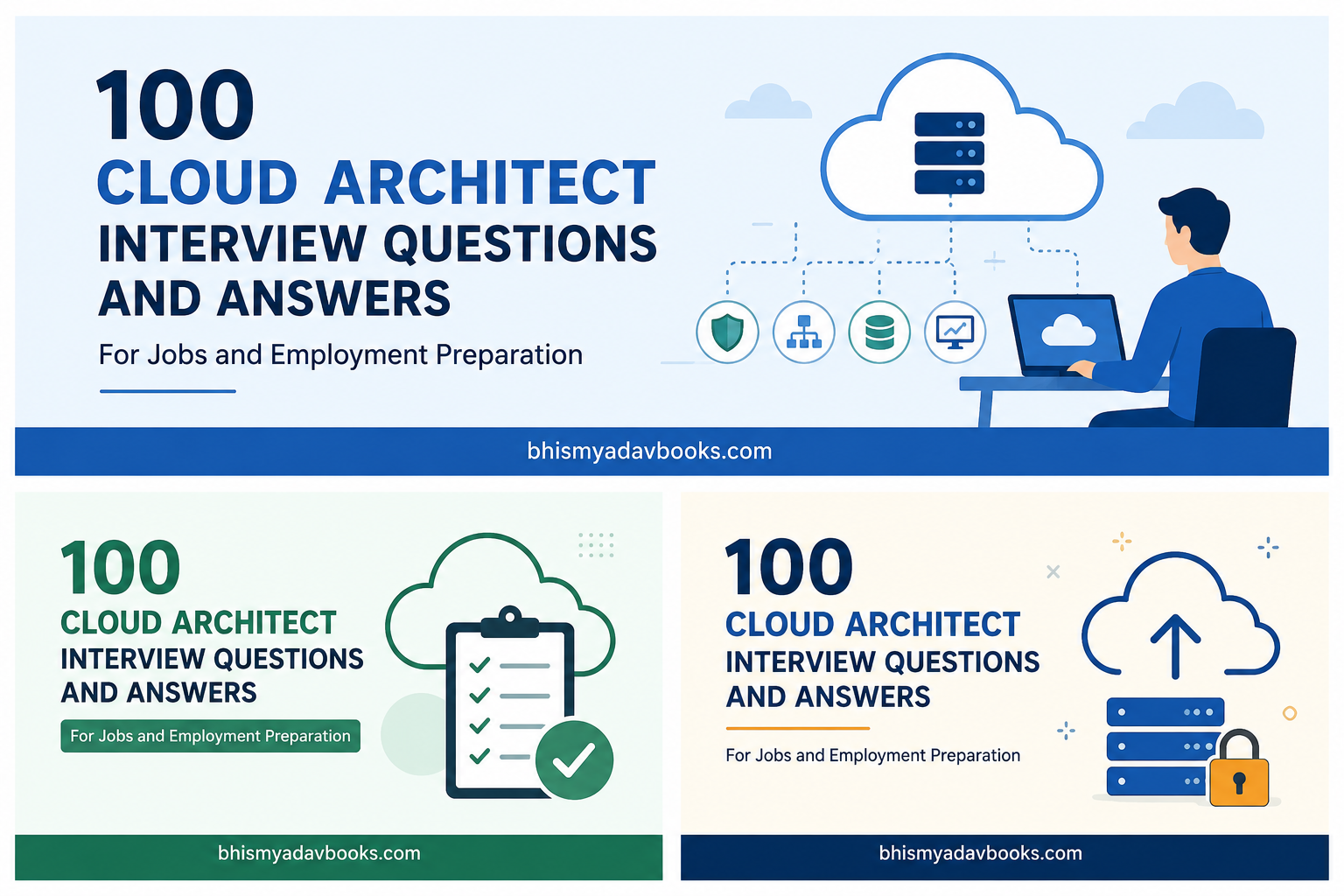
Cloud Architect Interview Questions and Answers for Jobs and Employment (2026) : Complete Guide Freshers and Experienced can’t miss

Cloud Architect Interview Questions and Answers

100 Cloud Architect Interview Questions and Answers for Jobs and Employment

Introduction

Cloud computing has transformed the way organizations build, deploy, operate, and scale information technology systems. Businesses increasingly use cloud platforms to host applications, store data, improve business continuity, support remote operations, and accelerate digital transformation. As cloud adoption grows, the role of a Cloud Architect has become increasingly important in the technology employment market.

A Cloud Architect designs and oversees an organization’s cloud computing architecture. The professional evaluates business requirements, selects suitable cloud services, creates scalable infrastructure designs, manages security requirements, supports migration projects, and ensures that cloud environments remain reliable and cost-effective.

Cloud Architect interviews can cover a wide range of technical and practical subjects. Candidates may face questions about cloud service models, networking, virtualization, containers, security, identity management, high availability, disaster recovery, infrastructure automation, monitoring, database architecture, and cost optimization. Senior candidates may also be asked scenario-based questions that test architecture decision-making and communication skills.

We have some amazing books in our Shop page you may want to buy.

This article presents 100 Cloud Architect interview questions and answers for jobs and employment preparation. The questions range from basic cloud concepts to advanced architecture scenarios. Job aspirants, cloud engineers, solution architects, DevOps professionals, system administrators, and students can use these questions to strengthen their fundamental understanding and prepare for technical interviews.


Basic Cloud Architect Interview Questions and Answers

(Questions 1-20)

1. What is cloud computing?

Answer: Cloud computing is the delivery of computing resources such as servers, storage, databases, networking, software, and analytics through remote data centers accessible over a network. Organizations can obtain resources on demand instead of purchasing and maintaining all physical infrastructure themselves. Cloud computing provides flexibility, scalability, automation, and consumption-based pricing.

2. Who is a Cloud Architect?

Answer: A Cloud Architect is a technology professional responsible for designing cloud computing environments and architecture strategies. The architect translates business and technical requirements into secure, scalable, reliable, and cost-efficient cloud solutions. Responsibilities may include platform selection, network design, security architecture, migration planning, disaster recovery, and architecture governance.

3. What are the main responsibilities of a Cloud Architect?

Answer: Major responsibilities include designing cloud infrastructure, evaluating business requirements, selecting cloud services, creating migration strategies, designing security controls, developing network architecture, supporting high availability, planning disaster recovery, optimizing cloud costs, and establishing architecture standards. A Cloud Architect also collaborates with developers, security teams, operations teams, and business stakeholders.

4. What are the major cloud service models?

Answer: The three major cloud service models are Infrastructure as a Service, Platform as a Service, and Software as a Service. IaaS provides infrastructure resources such as virtual machines and networks. PaaS provides managed application development and deployment platforms. SaaS provides complete applications delivered to users through the internet or another network.

5. What is Infrastructure as a Service?

Answer: Infrastructure as a Service, or IaaS, provides virtualized computing resources such as virtual machines, storage, and networking. The cloud provider manages the underlying physical infrastructure, while the customer usually manages operating systems, applications, configurations, and data.

6. What is Platform as a Service?

Answer: Platform as a Service, or PaaS, provides a managed environment for developing, testing, deploying, and operating applications. Developers can focus on application code while the cloud provider manages much of the infrastructure, operating system, runtime, and platform maintenance.

7. What is Software as a Service?

Answer: Software as a Service, or SaaS, delivers complete software applications to users. The service provider manages the application and supporting infrastructure. Users generally access the application through a web browser, mobile application, or supported client.

8. What is a public cloud?

Answer: A public cloud is a cloud environment operated by a third-party cloud provider. Computing resources are delivered to multiple customers using logically separated environments. Public clouds provide extensive service catalogs, global infrastructure, rapid scalability, and flexible pricing models.

9. What is a private cloud?

Answer: A private cloud is a cloud computing environment dedicated to a single organization. It may operate in an organization’s data center or be hosted by a service provider. Private clouds can provide greater infrastructure control and support specific security, compliance, or operational requirements.

10. What is a hybrid cloud?

Answer: A hybrid cloud combines private infrastructure or on-premises systems with public cloud services. Applications and data can be distributed between environments based on security, performance, compliance, and business requirements. Reliable networking and consistent governance are important components of hybrid cloud architecture.

11. What is multi-cloud architecture?

Answer: Multi-cloud architecture involves using services from two or more cloud providers. Organizations may adopt multi-cloud strategies to access specialized services, meet regional requirements, support organizational acquisitions, or reduce dependency on a single platform. However, multi-cloud environments can increase operational and governance complexity.

12. What is cloud scalability?

Answer: Cloud scalability is the ability of a system to increase or decrease computing capacity according to workload requirements. Resources such as processing power, memory, application instances, and storage can be adjusted to support changing demand.

13. What is elasticity in cloud computing?

Answer: Elasticity is the ability to dynamically provision and remove resources in response to workload changes. For example, an application can automatically add compute instances during high traffic and remove unnecessary instances when demand decreases.

14. What is the difference between scalability and elasticity?

Answer: Scalability focuses on the ability of a system to handle increased workloads by adding resources. Elasticity focuses on dynamically adjusting resources according to current demand. A scalable system can grow, while an elastic system can automatically expand and contract.

15. What is vertical scaling?

Answer: Vertical scaling involves increasing the capacity of an existing server or virtual machine. Examples include adding more CPU cores or memory. Vertical scaling is relatively simple but may be limited by the maximum capacity of the selected machine type.

16. What is horizontal scaling?

Answer: Horizontal scaling involves adding additional servers, virtual machines, containers, or application instances to distribute workloads. It is commonly used in cloud-native architectures because it supports scalability and improved availability.

17. Why is high availability important in cloud architecture?

Answer: High availability helps ensure that applications and services remain accessible despite infrastructure or component failures. Cloud Architects design systems with redundancy, health monitoring, load balancing, and automated recovery to reduce service interruptions.

18. What is fault tolerance?

Answer: Fault tolerance is the ability of a system to continue operating when one or more components fail. A fault-tolerant architecture uses redundant resources and automatic failover mechanisms to maintain service with minimal interruption.

19. What is a region in cloud computing?

Answer: A cloud region is a geographical area containing cloud provider infrastructure. Organizations select regions based on latency, data residency, service availability, disaster recovery, and business requirements.

20. What is an availability zone?

Answer: An availability zone is an isolated infrastructure location within a cloud region. Availability zones generally have independent power, cooling, and networking characteristics. Deploying applications across multiple zones can improve resilience against localized failures.


Cloud Architecture and Design Interview Questions

(Questions 21-50)

21. What are the characteristics of a good cloud architecture?

Answer: A good cloud architecture should be secure, reliable, scalable, maintainable, observable, and cost-efficient. It should align with business requirements and clearly define recovery objectives, security controls, data management strategies, and operational responsibilities.

22. How do you design a highly available cloud application?

Answer: I distribute application components across multiple failure domains, remove single points of failure, use load balancing, configure health checks, replicate critical data, and automate recovery. The architecture should also include monitoring and regularly tested recovery procedures.

23. What is a single point of failure?

Answer: A single point of failure is a component whose failure can cause an entire system or critical service to become unavailable. Examples may include a single application server, database instance, or network device without redundancy.

24. How can a Cloud Architect eliminate single points of failure?

Answer: Single points of failure can be reduced through redundancy, clustering, data replication, multiple availability zones, load balancing, and automated failover. Architects should analyze the complete request and dependency path to identify critical components.

25. What is a load balancer?

Answer: A load balancer distributes incoming network or application traffic among multiple backend resources. It improves scalability and availability by preventing a single server from processing all requests and can remove unhealthy resources from traffic distribution.

26. What is auto-scaling?

Answer: Auto-scaling automatically changes the number or capacity of computing resources according to defined metrics or schedules. Scaling decisions may use CPU utilization, memory metrics, request counts, queue depth, or business-specific indicators.

27. What is a three-tier architecture?

Answer: A three-tier architecture separates an application into presentation, application, and data tiers. The presentation tier manages user interaction, the application tier processes business logic, and the data tier manages persistent information.

28. What is microservices architecture?

Answer: Microservices architecture structures an application as a collection of independently deployable services. Each service usually focuses on a specific business capability. Microservices can improve deployment flexibility and independent scaling but introduce distributed system complexity.

29. What is monolithic architecture?

Answer: Monolithic architecture combines major application components into a single deployable unit. It can simplify initial development and operations for smaller applications. However, large monolithic systems may become difficult to scale and modify independently.

30. When would you choose microservices over a monolithic architecture?

Answer: I would consider microservices when the system contains clearly separated business domains, teams require independent deployment, and different components have distinct scaling requirements. I would avoid unnecessary microservices when application complexity and operational maturity do not justify a distributed architecture.

31. What is serverless computing?

Answer: Serverless computing allows developers to run application code or use managed services without directly managing servers. The cloud provider handles much of the infrastructure provisioning and scaling. Customers usually pay according to execution or service consumption.

32. What are the advantages of serverless architecture?

Answer: Advantages can include reduced infrastructure management, automatic scaling, rapid development, and consumption-based pricing. Serverless services are particularly useful for event-driven processing, APIs, scheduled tasks, and asynchronous workloads.

33. What are the limitations of serverless architecture?

Answer: Limitations may include execution limits, cold-start latency, platform-specific integrations, observability complexity, and reduced infrastructure control. Architects should evaluate workload characteristics before selecting a serverless design.

34. What is event-driven architecture?

Answer: Event-driven architecture is a design model in which system components produce and respond to events. An event represents a change or action, such as a new order or uploaded file. Event-driven designs can improve decoupling and asynchronous processing.

35. What is loose coupling?

Answer: Loose coupling reduces direct dependencies between system components. Services communicate through well-defined interfaces, queues, or events. If one component changes, other components may continue operating without extensive modification.

36. Why are message queues used in cloud architecture?

Answer: Message queues enable asynchronous communication between application components. They can buffer workload spikes, reduce direct dependencies, and improve resilience. Producers can submit messages while consumers process them according to available capacity.

37. What is an API gateway?

Answer: An API gateway provides a controlled entry point for application programming interfaces. It may perform request routing, authentication, authorization, throttling, logging, and API policy enforcement.

38. What is cloud-native architecture?

Answer: Cloud-native architecture is designed to take advantage of cloud capabilities such as automation, elasticity, managed services, containers, and distributed infrastructure. Cloud-native systems commonly emphasize automated deployment, observability, and resilience.

39. What is immutable infrastructure?

Answer: Immutable infrastructure means deployed infrastructure components are replaced rather than manually modified. When a configuration change is required, a new resource or image is created and deployed. This approach improves consistency and reduces configuration drift.

40. What is configuration drift?

Answer: Configuration drift occurs when infrastructure resources gradually develop different configurations from their approved or expected state. Infrastructure as Code, automated compliance checks, and immutable deployment practices can reduce configuration drift.


Cloud Networking Interview Questions and Answers

41. What is a virtual private cloud?

Answer: A virtual private cloud is a logically isolated network environment created within a public cloud platform. Architects define address ranges, subnets, routing, and network security controls to organize cloud resources.

42. What is a subnet?

Answer: A subnet is a logical subdivision of an IP network. Cloud Architects use subnets to organize resources and control network traffic. Application, database, management, and public-facing resources may be placed in different subnets.

43. What is the difference between a public and private subnet?

Answer: A public subnet contains resources that can have direct routing to an internet gateway or equivalent connectivity. A private subnet does not provide direct inbound internet access to its resources. Private subnets are commonly used for internal application and database components.

44. What is CIDR?

Answer: Classless Inter-Domain Routing, or CIDR, is a method for defining IP address ranges using prefix notation. For example, a network prefix indicates the number of bits used for the network portion of an address. Proper CIDR planning prevents overlapping networks.

45. Why is IP address planning important in cloud architecture?

Answer: IP planning is important because poorly selected address ranges can create network overlap and complicate hybrid or multi-cloud connectivity. Architects should estimate future growth and coordinate address allocation across environments.

46. What is a VPN?

Answer: A Virtual Private Network creates an encrypted communication connection over another network. Site-to-site VPN connections are commonly used to connect on-premises networks with cloud environments.

47. What is dedicated cloud connectivity?

Answer: Dedicated cloud connectivity provides a private or dedicated network connection between an organization’s infrastructure and a cloud provider. It can offer more predictable network performance and support high-volume hybrid connectivity requirements.

48. What is DNS?

Answer: The Domain Name System translates domain names into network addresses and other records. In cloud architecture, DNS supports service discovery, traffic routing, failover, and application accessibility.

49. What is a CDN?

Answer: A Content Delivery Network distributes cached content through geographically distributed locations. Users can retrieve content from locations closer to them, reducing latency and decreasing workload on origin infrastructure.

50. How can you improve application network performance?

Answer: I evaluate user locations, application dependencies, latency, and traffic patterns. Possible improvements include regional deployment, content delivery networks, optimized routing, caching, connection reuse, and reducing unnecessary network communication.


Cloud Security Interview Questions and Answers

(Questions 51-75)

51. What is the shared responsibility model?

Answer: The shared responsibility model defines security responsibilities between the cloud provider and the customer. The provider generally secures the underlying cloud infrastructure, while customers remain responsible for areas such as identities, data, application security, and configurations according to the service model.

52. What is Identity and Access Management?

Answer: Identity and Access Management, or IAM, controls identities and their permissions to access resources. IAM systems support users, roles, policies, groups, service identities, and authentication controls.

53. What is the principle of least privilege?

Answer: The principle of least privilege means providing only the minimum permissions required to perform an authorized task. Permissions should be reviewed and removed when they are no longer necessary.

54. What is multi-factor authentication?

Answer: Multi-factor authentication requires multiple authentication factors before granting access. It improves account security because a compromised password alone may not be sufficient to access an account.

55. What is encryption at rest?

Answer: Encryption at rest protects stored data using cryptographic methods. It can be applied to databases, storage volumes, object storage, backups, and other persistent data services.

56. What is encryption in transit?

Answer: Encryption in transit protects information while it moves between systems or networks. Secure communication protocols such as TLS are commonly used to protect network traffic.

57. What is key management?

Answer: Key management includes the creation, storage, rotation, use, and retirement of cryptographic keys. A secure key management strategy should define access controls and lifecycle procedures for encryption keys.

58. What is Zero Trust security?

Answer: Zero Trust is a security approach based on continuously evaluating access rather than automatically trusting a user or system because of network location. Identity, device state, context, and policy can be considered before granting access.

59. How do you secure a cloud storage bucket?

Answer: I disable unnecessary public access, apply least-privilege permissions, enable encryption, review access policies, enable logging, and monitor for unusual activity. Sensitive data may require additional classification and retention controls.

60. What is a Web Application Firewall?

Answer: A Web Application Firewall, or WAF, helps protect web applications from malicious HTTP and HTTPS traffic. It can inspect requests and apply rules designed to block or limit common application attacks.

61. What is a security group?

Answer: A security group is a virtual network security control that defines permitted inbound and outbound traffic for cloud resources. The exact implementation varies between cloud platforms.

62. How do you protect cloud administrator accounts?

Answer: I enforce strong authentication, require multi-factor authentication, restrict administrative permissions, use dedicated privileged identities, monitor administrative actions, and avoid using highly privileged accounts for routine work.

63. What is secrets management?

Answer: Secrets management is the secure storage and controlled distribution of passwords, API keys, certificates, and other sensitive credentials. Applications should retrieve secrets from approved secure systems instead of embedding them in source code.

64. Why are cloud security logs important?

Answer: Security logs provide records of authentication, configuration changes, API activities, and network events. They support incident investigation, security monitoring, auditing, and compliance.

65. How would you respond to a cloud security incident?

Answer: I would follow the approved incident response process, preserve evidence, identify affected resources, contain the incident, remove the threat, restore services, and investigate the root cause. Security controls and architecture should then be improved based on lessons learned.


Cloud Migration Interview Questions and Answers

66. What is cloud migration?

Answer: Cloud migration is the process of moving applications, data, infrastructure, or business services from an existing environment to a cloud platform or between cloud environments.

67. What should be assessed before cloud migration?

Answer: The assessment should examine application dependencies, infrastructure requirements, data volumes, security needs, compliance obligations, performance, licensing, costs, and business criticality. Migration decisions should be based on measurable requirements.

68. What is rehosting?

Answer: Rehosting moves an application to cloud infrastructure with minimal architectural changes. It is sometimes called lift and shift. Rehosting can accelerate migration but may not fully use cloud-native capabilities.

69. What is replatforming?

Answer: Replatforming involves making selected changes to an application or its supporting platform to gain cloud benefits without completely redesigning the application.

70. What is refactoring?

Answer: Refactoring involves significantly modifying or redesigning an application to improve its architecture and use cloud-native services. It may provide greater scalability and agility but requires more development effort.

71. What is repurchasing in cloud migration?

Answer: Repurchasing means replacing an existing application with a different product, often a SaaS solution. Data and business processes may need to be migrated to the new system.

72. What is retiring in a migration strategy?

Answer: Retiring means removing applications or infrastructure that are no longer required. Application portfolio analysis may identify duplicate, obsolete, or unused systems that should not be migrated.

73. What is retaining in cloud migration?

Answer: Retaining means keeping an application in its current environment for a defined period. Reasons may include technical limitations, regulatory requirements, migration priorities, or planned application retirement.

74. How do you minimize downtime during migration?

Answer: I use replication, staged migration, synchronization, testing, and carefully planned cutover procedures. The strategy depends on application architecture and acceptable downtime. A rollback plan should also be prepared.

75. What is a cloud migration wave?

Answer: A migration wave is a planned group of applications or workloads migrated during a specific period. Wave planning helps teams coordinate dependencies, resources, testing, and business communication.


Storage and Database Architecture Interview Questions

(Questions 76-100)

76. What are the major types of cloud storage?

Answer: Major cloud storage types include object storage, block storage, and file storage. Each type supports different workload requirements and access patterns.

77. What is object storage?

Answer: Object storage stores information as objects containing data and metadata. It is suitable for backups, media files, logs, archives, and large-scale unstructured data.

78. What is block storage?

Answer: Block storage divides storage into blocks that can be presented to computing systems as storage volumes. It is commonly used for operating systems, applications, and databases requiring low-level storage access.

79. What is file storage?

Answer: File storage organizes information using files and directories. It supports shared file access and is useful for applications requiring traditional file system interfaces.

80. How do you choose between SQL and NoSQL databases?

Answer: I evaluate the data model, consistency requirements, transaction patterns, query requirements, scalability, and operational needs. SQL databases are often suitable for structured relational data and complex transactions. NoSQL databases can support flexible data models and large-scale distributed workloads.

81. What is database replication?

Answer: Database replication creates copies of database information across multiple database systems or locations. It can support availability, read scaling, and disaster recovery.

82. What is database sharding?

Answer: Sharding distributes database information across multiple partitions or database systems. Each shard stores a portion of the data. Sharding can improve scalability but increases data management complexity.

83. What is caching?

Answer: Caching stores frequently requested data in a faster access layer. It can reduce database workload and improve application response time. Cache expiration and data consistency must be carefully managed.

84. What is a data lake?

Answer: A data lake is a storage environment designed to hold large amounts of structured, semi-structured, and unstructured information. Data lakes are commonly used for analytics, data engineering, and machine learning workloads.

85. What is data lifecycle management?

Answer: Data lifecycle management defines how data is created, stored, protected, archived, and deleted. Cloud storage policies can automate data movement between storage classes based on age or access patterns.


Disaster Recovery and Reliability Interview Questions

86. What is disaster recovery?

Answer: Disaster recovery is the process of restoring applications, infrastructure, and data after a significant disruption. A disaster recovery strategy defines recovery priorities, technical procedures, and responsibilities.

87. What is Recovery Time Objective?

Answer: Recovery Time Objective, or RTO, is the targeted maximum time for restoring a service after a disruption. A lower RTO generally requires faster recovery capabilities and may increase architecture costs.

88. What is Recovery Point Objective?

Answer: Recovery Point Objective, or RPO, defines the acceptable amount of data loss measured in time. For example, an RPO of one hour may require the organization to recover data to a point no more than approximately one hour before the disruption.

89. What is the difference between RTO and RPO?

Answer: RTO focuses on how quickly a service must be restored. RPO focuses on the acceptable data recovery point and potential data loss period. Both requirements influence backup, replication, and disaster recovery architecture.

90. What are common cloud disaster recovery strategies?

Answer: Common strategies include backup and restore, pilot light, warm standby, and multi-site active architectures. The appropriate strategy depends on business impact, RTO, RPO, technical complexity, and budget.

91. Why should disaster recovery plans be tested?

Answer: Testing verifies whether recovery procedures, backups, automation, permissions, and dependencies work as expected. An untested recovery plan may contain outdated instructions or hidden technical failures.

92. What is chaos engineering?

Answer: Chaos engineering is the controlled practice of introducing failures or adverse conditions to evaluate system resilience. Teams use the results to identify weaknesses and improve recovery capabilities.


DevOps, Automation, and Monitoring Interview Questions

93. What is Infrastructure as Code?

Answer: Infrastructure as Code, or IaC, is the practice of defining infrastructure through machine-readable configuration files. It supports repeatable deployments, version control, automation, and standardized environments.

94. What are the benefits of Infrastructure as Code?

Answer: Benefits include deployment consistency, faster provisioning, improved auditing, reduced manual configuration, and the ability to review infrastructure changes through development workflows.

95. What is CI/CD?

Answer: CI/CD refers to continuous integration and continuous delivery or deployment practices. Continuous integration regularly integrates and validates code changes. Continuous delivery and deployment automate the process of preparing or releasing software.

96. What is observability?

Answer: Observability is the ability to understand the internal state and behavior of a system using its outputs. Logs, metrics, and traces are commonly used to investigate system performance and failures.

97. What is the difference between monitoring and observability?

Answer: Monitoring tracks known system conditions using predefined metrics, thresholds, and alerts. Observability provides broader information that helps teams investigate complex and unexpected system behavior. Monitoring can tell a team that a problem exists, while observability helps engineers explore why the problem is occurring.

98. How do you optimize cloud costs?

Answer: I analyze resource utilization, remove unused resources, right-size compute capacity, use auto-scaling, select appropriate storage classes, review data transfer costs, and apply suitable pricing commitments where workloads are predictable. Cost optimization should be continuous and supported by tagging, budgets, and ownership reporting.

99. How would you design a global cloud application?

Answer: I would first evaluate user locations, latency targets, data consistency, regulatory requirements, and recovery objectives. The architecture might use multiple regions, global traffic routing, content delivery networks, replicated data, and automated failover. I would carefully evaluate data synchronization and operational complexity.

100. Why should we hire you as a Cloud Architect?

Answer: I combine cloud architecture knowledge with an understanding of security, scalability, networking, automation, reliability, and cost management. I focus on understanding business requirements before selecting technology. I can communicate architecture decisions with technical and non-technical stakeholders and design solutions that are practical, maintainable, and aligned with organizational objectives.


Google Cloud Certified Professional Cloud Architect Study Guide by  Dan Sullivan (Author)

AWS Certified Solutions Architect Study Guide by David Clinton (Author), Ben Piper (Author)

Cloud Architect Interview Preparation Tips

Preparing for a Cloud Architect interview requires more than memorizing definitions. Candidates should understand how different cloud services and architecture components work together to solve real business problems.

Study fundamental cloud computing concepts including service models, deployment models, elasticity, scalability, and shared responsibility. Build a strong understanding of networking topics such as IP addressing, CIDR, DNS, routing, VPN connectivity, load balancing, and content delivery.

Security is another important interview area. Candidates should understand Identity and Access Management, least privilege, encryption, secrets management, network security, logging, and incident response.

Practice architecture scenarios. An interviewer may ask you to design a highly available e-commerce platform, migrate an existing application, reduce cloud costs, or create a disaster recovery solution. Start by identifying requirements instead of immediately naming cloud services.

Ask questions about expected users, traffic patterns, data volume, security requirements, recovery objectives, budget, and compliance. Then explain your architecture decisions and their trade-offs.

Cloud Architects should also develop communication skills. Architecture work involves discussions with developers, security professionals, operations teams, managers, and business stakeholders. The ability to explain a complex technical design in clear language is an important professional skill.


Skills Required for a Cloud Architect Job

Cloud Architect positions can require a broad combination of technical and professional skills. Important areas include:

  • Cloud computing fundamentals
  • Cloud infrastructure architecture
  • Networking and connectivity
  • Identity and Access Management
  • Cloud security
  • Virtual machines and virtualization
  • Containers and container orchestration
  • Serverless computing
  • Database architecture
  • Cloud storage
  • High availability
  • Disaster recovery
  • Infrastructure as Code
  • CI/CD concepts
  • DevOps practices
  • Monitoring and observability
  • Cost optimization
  • Cloud migration
  • Technical documentation
  • Architecture communication

Candidates do not need to memorize every service available on every cloud platform. However, they should understand fundamental architecture principles and know how to evaluate services based on technical and business requirements.


Common Cloud Architect Interview Topics

Employers may evaluate candidates on cloud architecture design, cloud migration, security, networking, data management, and operational excellence. Entry-level interviews may focus more heavily on cloud fundamentals and basic infrastructure concepts.

Experienced Cloud Architect candidates may receive scenario-based questions involving large distributed applications, multiple regions, hybrid connectivity, regulatory requirements, or complex disaster recovery objectives.

Interviewers may also ask candidates to explain previous projects. Candidates should clearly describe the business problem, architecture requirements, selected solution, technical challenges, security controls, and project results.

When discussing architecture, avoid claiming that one technology is always the best choice. Professional Cloud Architects evaluate trade-offs. A technically advanced architecture can still be inappropriate if it creates unnecessary complexity or excessive cost.


Frequently Asked Questions About Cloud Architect Interviews

Is Cloud Architect a good career?

Cloud architecture can be a strong career option for professionals interested in cloud computing, infrastructure, security, networking, and system design. Organizations across many industries use cloud services and require professionals who can design and manage cloud architecture strategies.

What qualifications are required for a Cloud Architect?

Requirements vary between employers. A degree in computer science, information technology, engineering, or a related field may be preferred for some positions. Practical experience with cloud platforms, networking, security, infrastructure, and system architecture is also important.

Is coding required for a Cloud Architect?

Cloud Architects may not write application code every day, but programming and scripting knowledge can be valuable. Understanding APIs, automation, Infrastructure as Code, application architecture, and software development processes helps architects work effectively with engineering teams.

Which cloud platform should a Cloud Architect learn?

Candidates can begin with a major cloud platform and develop strong architecture fundamentals. The most important goal is to understand computing, networking, storage, security, databases, and distributed systems. Platform-specific knowledge can then be expanded according to career goals and employer requirements.

Are cloud certifications necessary for Cloud Architect jobs?

Cloud certifications are not always mandatory, but they can help candidates demonstrate structured knowledge of a cloud platform. Practical experience, architecture skills, problem-solving ability, and communication remain important during job interviews.

How can freshers prepare for Cloud Architect interviews?

Freshers should study cloud fundamentals, networking, Linux basics, security, databases, virtualization, containers, and automation. Building small cloud projects can help candidates understand how architecture concepts work in practice.


Conclusion

A Cloud Architect plays an important role in designing secure, scalable, reliable, and cost-efficient cloud computing environments. The position requires knowledge across infrastructure, networking, security, databases, automation, migration, and disaster recovery.

These 100 Cloud Architect interview questions and answers provide a structured foundation for job and employment interview preparation. Candidates should use the questions to review important concepts and then practice applying those concepts to real architecture scenarios.

Successful interview preparation should combine theoretical knowledge with practical learning. Build cloud projects, study architecture patterns, review security principles, and practice explaining technical decisions clearly. Instead of memorizing answers word for word, understand the reasoning behind each concept and adapt your response to the interviewer’s scenario.

Regular preparation can improve technical confidence and help candidates communicate their cloud architecture knowledge more effectively during interviews.

Bhism Yadav Books provides educational content focused on fundamental knowledge, basic concepts, interview preparation, and learning resources for students and job aspirants.