Posted on Leave a comment

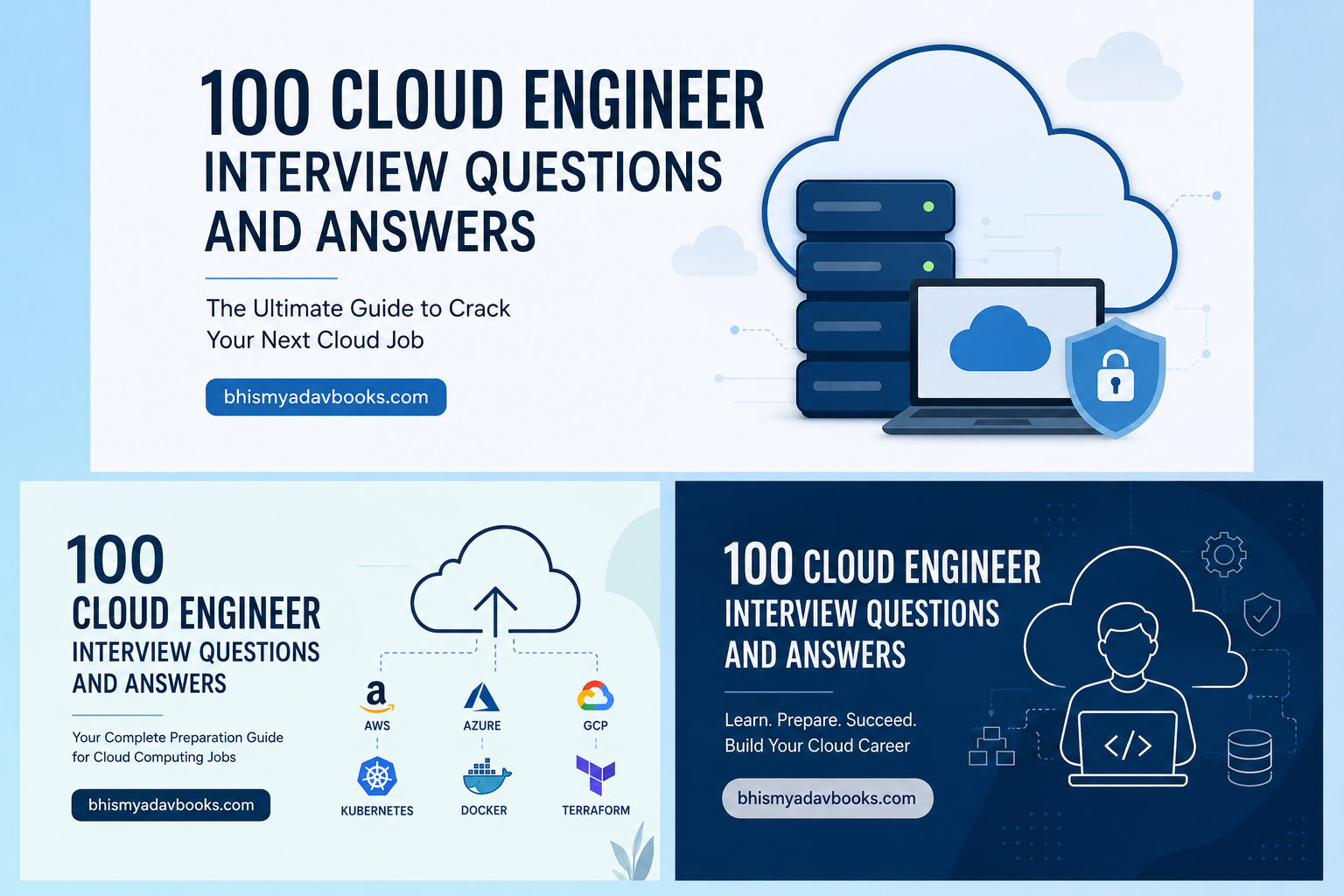
Cloud Engineer Interview Questions and Answers (2026): The Ultimate Guide to Crack Your Next Cloud Computing Job

Cloud Engineer Interview Questions

100 Cloud Engineer Interview Questions and Answers

Introduction

Cloud computing has become one of the fastest-growing technologies in the IT industry. Organizations of every size are migrating their applications, databases, and infrastructure to cloud platforms like Amazon Web Services (AWS), Microsoft Azure, and Google Cloud Platform (GCP). As a result, Cloud Engineers are among the highest-paid professionals worldwide.

We have some amazing books in our Shop page for you.

If you are preparing for a Cloud Engineer interview, this guide provides 100 carefully selected interview questions and answers covering beginner, intermediate, and advanced topics. Whether you’re a fresher or an experienced professional, these questions will help you strengthen your understanding of cloud technologies and increase your confidence during technical interviews.


Why Companies Hire Cloud Engineers

A Cloud Engineer is responsible for designing, deploying, managing, monitoring, and securing cloud infrastructure. Employers expect candidates to possess knowledge of:

  • Cloud Computing Concepts
  • Virtualization
  • Linux Administration
  • Networking
  • Cloud Security
  • Infrastructure as Code
  • Containers
  • Kubernetes
  • DevOps
  • CI/CD
  • Monitoring
  • Disaster Recovery

Cloud Engineer Interview Questions for Freshers

(Questions 1–25)

1. What is Cloud Computing?

Cloud computing is the delivery of computing services such as servers, storage, networking, databases, and software over the internet instead of using local infrastructure.


2. What are the benefits of Cloud Computing?

  • Scalability
  • High Availability
  • Cost Savings
  • Automatic Updates
  • Global Accessibility
  • Better Disaster Recovery

3. What are the different cloud deployment models?

  • Public Cloud
  • Private Cloud
  • Hybrid Cloud
  • Multi-Cloud

4. What is IaaS?

Infrastructure as a Service provides virtual servers, networking, and storage.

Example:
AWS EC2


5. What is PaaS?

Platform as a Service provides a platform to develop and deploy applications.

Example:
Google App Engine


6. What is SaaS?

Software delivered over the internet.

Example:
Microsoft Office 365


7. What is virtualization?

Virtualization creates multiple virtual machines on a single physical server.


8. What is a Virtual Machine?

A VM is a software-based computer running its own operating system.


9. What is a Hypervisor?

Software that manages virtual machines.

Examples:

  • VMware ESXi
  • Hyper-V
  • KVM

10. What is AWS?

Amazon Web Services is the world’s leading cloud computing platform.


11. What is Microsoft Azure?

Microsoft’s cloud platform for hosting applications and infrastructure.


12. What is Google Cloud Platform?

Google’s cloud service offering computing, AI, storage, networking, and analytics.


13. What is Elasticity?

The automatic adjustment of resources based on workload.


14. What is Scalability?

The ability to increase or decrease resources according to demand.


15. Difference between Vertical and Horizontal Scaling?

Vertical:
Increase CPU/RAM.

Horizontal:
Add more servers.


16. What is Load Balancing?

Distributing traffic among multiple servers.


17. What is Auto Scaling?

Automatically launching or terminating instances based on traffic.


18. What is High Availability?

Ensuring applications remain available with minimal downtime.


19. What is Fault Tolerance?

The ability to continue operating despite failures.


20. What is Cloud Storage?

Storage accessible over the internet.

Examples:

  • AWS S3
  • Azure Blob Storage
  • Google Cloud Storage

21. What is Object Storage?

Stores files as objects with metadata.


22. What is Block Storage?

Provides storage volumes attached to virtual machines.


23. What is File Storage?

Provides shared network-based storage.


24. What is CDN?

Content Delivery Network delivers content from geographically distributed servers.


25. What is DNS?

Domain Name System translates domain names into IP addresses.

100 Cloud Engineer Interview Questions and Answers (2026) Part 2

In Part 2, we’ll cover intermediate-level Cloud Engineer interview questions focusing on Linux administration, networking, AWS core services, Microsoft Azure, Google Cloud Platform (GCP), storage, Docker, security, and identity management. These topics are frequently asked in interviews for Cloud Engineer, Infrastructure Engineer, DevOps Engineer, and System Administrator roles.


Cloud Engineer Interview Questions

(Questions 26–50)

26. What is an Availability Zone (AZ)?

An Availability Zone (AZ) is one or more physically separate data centers within a cloud provider’s region. Each AZ has independent power, cooling, and networking to provide fault tolerance and high availability.

Example: AWS us-east-1 has multiple Availability Zones such as us-east-1a and us-east-1b.


27. What is a Cloud Region?

A Region is a geographical location containing multiple Availability Zones. Regions allow organizations to deploy applications closer to users, reducing latency and meeting compliance requirements.


28. What is Amazon EC2?

Amazon Elastic Compute Cloud (EC2) is a virtual server service that allows users to launch, manage, and scale virtual machines in AWS. It supports multiple operating systems, instance types, and storage options.


29. What is Amazon S3?

Amazon Simple Storage Service (S3) is an object storage service used to store files, images, videos, backups, logs, and static website content with high durability and scalability.


30. What are Amazon EBS Volumes?

Amazon Elastic Block Store (EBS) provides persistent block storage volumes that can be attached to EC2 instances. They are commonly used for operating systems, databases, and applications requiring low latency.


31. What is Amazon VPC?

Amazon Virtual Private Cloud (VPC) enables users to create an isolated virtual network within AWS. It provides complete control over IP ranges, routing tables, subnets, gateways, and security settings.


32. What is the difference between a Public Subnet and a Private Subnet?

Public Subnet

  • Has direct internet access through an Internet Gateway.
  • Hosts web servers, load balancers, and public-facing services.

Private Subnet

  • No direct internet access.
  • Used for databases, application servers, and backend services.

33. What is an Internet Gateway?

An Internet Gateway connects a VPC to the public internet, enabling resources in public subnets to send and receive internet traffic.


34. What is a NAT Gateway?

A NAT (Network Address Translation) Gateway allows instances in private subnets to access the internet for software updates or package downloads without exposing them to inbound internet traffic.


35. What is AWS IAM?

AWS Identity and Access Management (IAM) is used to securely manage users, groups, roles, and permissions. IAM follows the principle of least privilege to enhance security.


36. What is the Principle of Least Privilege?

The Principle of Least Privilege (PoLP) means users and applications should receive only the permissions required to perform their tasks, reducing security risks and limiting the impact of compromised accounts.


37. What are Security Groups?

Security Groups are virtual firewalls for AWS resources. They control inbound and outbound traffic at the instance level and are stateful, meaning return traffic is automatically allowed.


38. What are Network ACLs?

Network Access Control Lists (ACLs) are optional, stateless firewalls that operate at the subnet level. Both inbound and outbound rules must be explicitly configured.


39. What is Multi-Factor Authentication (MFA)?

MFA adds an extra layer of security by requiring users to verify their identity using two or more authentication methods, such as a password and a one-time code from a mobile device.


40. What is CloudTrail?

AWS CloudTrail records API calls and account activity, enabling auditing, compliance, troubleshooting, and security investigations.


41. What is CloudWatch?

Amazon CloudWatch monitors cloud resources and applications by collecting metrics, logs, and events. It can trigger alarms and automate responses based on predefined thresholds.


42. What is Microsoft Azure Virtual Machine?

Azure Virtual Machines provide scalable on-demand computing resources, allowing users to deploy Windows or Linux servers with customizable CPU, memory, storage, and networking.


43. What is Azure Resource Manager (ARM)?

Azure Resource Manager (ARM) is Azure’s deployment and management service. It allows users to create, update, and manage cloud resources using templates and automation.


44. What is Azure Active Directory (Azure AD)?

Azure Active Directory is Microsoft’s cloud-based identity and access management service that provides authentication, authorization, Single Sign-On (SSO), and multi-factor authentication.


45. What is Google Compute Engine?

Google Compute Engine (GCE) is Google Cloud’s Infrastructure as a Service (IaaS) offering that provides customizable virtual machines for hosting applications and services.


46. What is Google Cloud Storage?

Google Cloud Storage is a highly scalable object storage service used for backups, archives, static websites, multimedia files, analytics, and machine learning datasets.


47. What is Docker?

Docker is a containerization platform that packages an application and all its dependencies into lightweight, portable containers. Containers ensure consistent application behavior across development, testing, and production environments.


48. What is the difference between Docker Containers and Virtual Machines?

Docker ContainersVirtual Machines
Share the host operating system kernelInclude a complete guest operating system
LightweightResource intensive
Faster startupSlower startup
Lower resource consumptionHigher CPU and memory usage
Best for microservicesBest for complete OS isolation

49. What is Kubernetes?

Kubernetes is an open-source container orchestration platform that automates container deployment, scaling, load balancing, self-healing, rolling updates, and service discovery for containerized applications.


50. What is Infrastructure as Code (IaC)?

Infrastructure as Code (IaC) is the practice of provisioning and managing cloud infrastructure using configuration files instead of manual processes.

Popular IaC Tools:

  • Terraform
  • AWS CloudFormation
  • Azure Resource Manager (ARM) Templates
  • Pulumi
  • Ansible (configuration management)

Benefits:

  • Automation
  • Consistency
  • Faster deployments
  • Version control
  • Reduced human error
  • Easier disaster recovery

100 Cloud Engineer Interview Questions and Answers (2026) – Part 3

Welcome to Part 3 of this comprehensive Cloud Engineer interview guide. In this section, we cover advanced topics that are frequently asked in interviews for Cloud Engineer, DevOps Engineer, Site Reliability Engineer (SRE), Infrastructure Engineer, Platform Engineer, and Cloud Administrator roles.

You’ll learn about Infrastructure as Code (IaC), Terraform, Ansible, CI/CD, Jenkins, Git, Linux administration, monitoring, logging, serverless computing, cloud security, backup strategies, and disaster recovery.


Cloud Engineer Interview Questions

(Questions 51–75)

51. What is Terraform?

Terraform is an open-source Infrastructure as Code (IaC) tool developed by HashiCorp. It enables engineers to provision and manage cloud infrastructure using declarative configuration files.

Advantages:

  • Multi-cloud support
  • Version-controlled infrastructure
  • Repeatable deployments
  • Automation
  • Reduced manual configuration

52. What is a Terraform State File?

The Terraform state file (terraform.tfstate) stores information about the infrastructure Terraform manages. It maps configuration files to actual cloud resources and helps Terraform determine what changes are required during future deployments.


53. What is the difference between Terraform and CloudFormation?

Terraform

  • Supports AWS, Azure, GCP, VMware, Kubernetes, and more.
  • Uses HashiCorp Configuration Language (HCL).
  • Ideal for multi-cloud environments.

AWS CloudFormation

  • AWS-native Infrastructure as Code service.
  • Uses YAML or JSON templates.
  • Best suited for AWS-only deployments.

54. What is Ansible?

Ansible is an open-source automation tool used for configuration management, application deployment, software provisioning, and orchestration. It is agentless and communicates primarily over SSH.


55. What is Configuration Management?

Configuration management ensures that servers and systems remain in a consistent, predictable, and desired state by automating software installation, configuration, updates, and maintenance.


56. What is CI/CD?

CI/CD stands for:

  • Continuous Integration (CI): Automatically builds and tests code whenever developers commit changes.
  • Continuous Delivery/Deployment (CD): Automates the release process, enabling faster and more reliable software deployments.

57. What is Jenkins?

Jenkins is an open-source automation server widely used to implement Continuous Integration and Continuous Delivery (CI/CD) pipelines. It supports thousands of plugins for building, testing, and deploying applications.


58. What is Git?

Git is a distributed version control system that tracks changes to source code, supports collaboration among developers, and maintains a complete history of project modifications.


59. What is a Git Branch?

A Git branch is an independent line of development that allows developers to work on new features, bug fixes, or experiments without affecting the main codebase.


60. What is a Merge Conflict?

A merge conflict occurs when Git cannot automatically combine changes from different branches because the same section of a file has been modified differently. Developers must manually resolve the conflict.


61. What is a Linux Distribution?

A Linux distribution combines the Linux kernel with software packages, utilities, and package managers to create a complete operating system.

Popular distributions include:

  • Ubuntu
  • Red Hat Enterprise Linux (RHEL)
  • Rocky Linux
  • AlmaLinux
  • Debian
  • CentOS Stream

62. How do you check disk usage in Linux?

Common commands include:

df -h

Displays filesystem disk usage in a human-readable format.

du -sh /directory

Shows the size of a specific directory.


63. How do you check memory usage in Linux?

Useful commands include:

free -h

top

htop

These commands display available memory, swap usage, and running processes.


64. What is SSH?

Secure Shell (SSH) is a secure protocol used for remote login, command execution, and secure file transfer between systems using encrypted communication.


65. What is Load Balancing?

Load balancing distributes incoming client requests across multiple servers to improve application performance, reliability, and fault tolerance while preventing server overload.


66. What is Auto Scaling?

Auto Scaling automatically increases or decreases the number of compute instances based on workload, CPU utilization, memory usage, or custom monitoring metrics.

Benefits:

  • Cost optimization
  • High availability
  • Improved application performance
  • Reduced manual intervention

67. What is Serverless Computing?

Serverless computing allows developers to execute code without managing servers. The cloud provider automatically provisions infrastructure and scales resources as needed.

Examples:

  • AWS Lambda
  • Azure Functions
  • Google Cloud Functions

68. What are the advantages of Serverless Architecture?

  • No server management
  • Automatic scaling
  • Pay only for execution time
  • Faster application development
  • High availability
  • Reduced operational overhead

69. What is Cloud Monitoring?

Cloud monitoring continuously collects metrics, logs, and events to track the health, availability, and performance of cloud infrastructure and applications.

Popular monitoring tools include:

  • Amazon CloudWatch
  • Azure Monitor
  • Google Cloud Monitoring
  • Prometheus
  • Grafana

70. What is Centralized Logging?

Centralized logging aggregates logs from multiple systems into a single platform, making it easier to search, analyze, troubleshoot, and audit application and infrastructure events.

Common solutions include:

  • ELK Stack (Elasticsearch, Logstash, Kibana)
  • OpenSearch
  • Splunk
  • Grafana Loki

71. What is Disaster Recovery (DR)?

Disaster Recovery is a strategy for restoring IT systems and data after failures caused by hardware issues, cyberattacks, natural disasters, or human error.

A DR plan typically includes:

  • Regular backups
  • Recovery procedures
  • Failover environments
  • Recovery testing

72. What is the difference between Backup and Disaster Recovery?

Backup

  • Copies data for future restoration.
  • Focuses on protecting information.

Disaster Recovery

  • Restores entire applications, infrastructure, and business operations.
  • Focuses on minimizing downtime and ensuring business continuity.

73. What is High Availability (HA)?

High Availability is a system design approach that minimizes downtime through redundancy, load balancing, failover mechanisms, and fault-tolerant architectures.

Common techniques include:

  • Multiple Availability Zones
  • Redundant servers
  • Health checks
  • Automatic failover

74. What is Multi-Cloud?

A multi-cloud strategy involves using services from more than one cloud provider, such as AWS, Azure, and Google Cloud Platform.

Benefits:

  • Reduced vendor lock-in
  • Improved resilience
  • Better geographic coverage
  • Service optimization
  • Enhanced disaster recovery

75. What is Cloud Security?

Cloud security refers to the technologies, policies, controls, and best practices used to protect cloud infrastructure, applications, and data.

Key security practices include:

  • Identity and Access Management (IAM)
  • Multi-Factor Authentication (MFA)
  • Data encryption at rest and in transit
  • Least privilege access
  • Security monitoring
  • Network segmentation
  • Regular vulnerability assessments
  • Compliance auditing

100 Cloud Engineer Interview Questions and Answers (2026) – Part 4

Welcome to the final part of this comprehensive Cloud Engineer interview guide. This section covers advanced cloud architecture, Kubernetes, networking, security, cloud cost optimization, troubleshooting scenarios, behavioral interview questions, and practical tips that recruiters frequently ask during Cloud Engineer interviews.

Whether you’re interviewing for AWS, Azure, Google Cloud Platform (GCP), or a multi-cloud environment, mastering these questions will significantly improve your chances of landing your next cloud job.


Cloud Engineer Interview Questions

(Questions 76–100)

76. What is Kubernetes?

Kubernetes (K8s) is an open-source container orchestration platform used to automate the deployment, scaling, networking, and management of containerized applications.

Key Features:

  • Automatic scaling
  • Self-healing
  • Rolling updates
  • Load balancing
  • Service discovery
  • Secret and configuration management

77. What is a Kubernetes Pod?

A Pod is the smallest deployable unit in Kubernetes. It contains one or more containers that share the same network namespace and storage volumes.

Pods are ephemeral and are usually managed by higher-level controllers such as Deployments or StatefulSets.


78. What is a Kubernetes Deployment?

A Deployment manages Pods by ensuring the desired number of replicas are always running. It also supports rolling updates, rollbacks, and self-healing when Pods fail.


79. What is a Kubernetes Service?

A Kubernetes Service provides a stable network endpoint that allows applications to communicate with Pods, even if individual Pods are recreated or their IP addresses change.

Common Service types include:

  • ClusterIP
  • NodePort
  • LoadBalancer
  • ExternalName

80. What is Infrastructure Monitoring?

Infrastructure monitoring involves tracking the health and performance of servers, virtual machines, containers, storage, databases, and networks using metrics, logs, and alerts.

Popular tools include:

  • Prometheus
  • Grafana
  • Amazon CloudWatch
  • Azure Monitor
  • Google Cloud Monitoring

81. How do you optimize cloud costs?

Common cloud cost optimization techniques include:

  • Right-size virtual machines
  • Remove unused resources
  • Use Auto Scaling
  • Purchase Reserved or Savings Plans
  • Use Spot Instances where appropriate
  • Optimize storage classes
  • Schedule non-production environments to shut down automatically
  • Monitor cloud spending regularly
  • Implement resource tagging

82. What is Resource Tagging?

Resource tagging involves assigning metadata (key-value pairs) to cloud resources.

Benefits:

  • Cost tracking
  • Automation
  • Security management
  • Resource organization
  • Compliance reporting

83. What is Encryption at Rest?

Encryption at rest protects stored data using encryption algorithms, ensuring that data remains unreadable without proper decryption keys.

Examples include encrypted disks, object storage, and database storage.


84. What is Encryption in Transit?

Encryption in transit protects data while it travels across networks using secure communication protocols such as:

  • HTTPS
  • TLS
  • SSL
  • SSH

85. What is Zero Trust Security?

Zero Trust is a security model based on the principle of “Never Trust, Always Verify.”

Every user, device, and application must be authenticated and authorized before accessing resources, regardless of whether they are inside or outside the corporate network.


86. What is a Cloud Migration?

Cloud migration is the process of moving applications, databases, workloads, and infrastructure from on-premises environments to cloud platforms or between cloud providers.

Common migration strategies are known as the 6 Rs:

  • Rehost
  • Replatform
  • Refactor
  • Repurchase
  • Retire
  • Retain

87. What are Microservices?

Microservices are an architectural style where applications are divided into small, independently deployable services that communicate through APIs.

Advantages:

  • Independent deployments
  • Better scalability
  • Fault isolation
  • Easier maintenance
  • Faster development cycles

88. What is an API Gateway?

An API Gateway acts as the single entry point for client requests and manages routing, authentication, rate limiting, monitoring, and load balancing for backend services.


89. What is Blue-Green Deployment?

Blue-Green Deployment is a release strategy where two identical production environments are maintained.

  • Blue: Current production version
  • Green: New version

Traffic is switched to the Green environment after successful testing, enabling quick rollback if issues occur.


90. What is a Rolling Deployment?

A Rolling Deployment gradually replaces old application instances with new ones without causing downtime. This approach ensures continuous service availability during updates.


91. How would you troubleshoot a slow cloud application?

A systematic approach includes:

  1. Check CPU and memory utilization.
  2. Analyze application logs.
  3. Review network latency.
  4. Verify database performance.
  5. Inspect load balancer health.
  6. Examine Auto Scaling events.
  7. Monitor storage I/O.
  8. Review recent deployments or configuration changes.
  9. Analyze monitoring dashboards and alerts.
  10. Identify bottlenecks and implement corrective actions.

92. How do you secure cloud infrastructure?

Best practices include:

  • Implement IAM with least privilege
  • Enable Multi-Factor Authentication (MFA)
  • Encrypt sensitive data
  • Use private subnets where possible
  • Regularly patch systems
  • Conduct vulnerability assessments
  • Enable centralized logging
  • Monitor security events
  • Rotate credentials and secrets
  • Apply security policies consistently

93. Explain the Shared Responsibility Model.

The Shared Responsibility Model defines security responsibilities between the cloud provider and the customer.

Cloud Provider Responsibilities:

  • Physical data center security
  • Hardware
  • Networking infrastructure
  • Managed service availability

Customer Responsibilities:

  • Data protection
  • Identity and access management
  • Operating system configuration
  • Application security
  • Network configuration
  • Compliance settings

94. What is the difference between Containers and Kubernetes?

ContainersKubernetes
Package applicationsManage containers
Lightweight runtimeOrchestration platform
Run individual workloadsManage clusters
Docker is a container platformKubernetes automates deployment and scaling

95. What is a Typical CI/CD Pipeline?

A modern CI/CD pipeline generally follows these stages:

  1. Code Commit
  2. Source Control (Git)
  3. Build
  4. Unit Testing
  5. Security Scanning
  6. Artifact Creation
  7. Deployment to Test Environment
  8. Integration Testing
  9. Approval (if required)
  10. Deployment to Production
  11. Monitoring and Feedback

96. Which Cloud Platform Should You Learn First?

For beginners, AWS is often recommended because of its large market share and extensive ecosystem. However:

  • AWS: Widely adopted across industries.
  • Microsoft Azure: Popular among enterprises using Microsoft technologies.
  • Google Cloud Platform (GCP): Strong in data analytics, AI, and machine learning.

Learning cloud fundamentals first makes it easier to transition between providers.


97. What Are Recruiters Looking for in a Cloud Engineer?

Recruiters typically evaluate candidates based on:

  • Cloud platform expertise (AWS, Azure, GCP)
  • Linux administration
  • Networking fundamentals
  • Infrastructure as Code
  • Docker and Kubernetes
  • Automation and scripting
  • DevOps practices
  • Security awareness
  • Problem-solving ability
  • Communication and collaboration skills

98. What Common Mistakes Should Candidates Avoid?

Some common interview mistakes include:

  • Memorizing answers without understanding concepts.
  • Ignoring Linux and networking basics.
  • Lacking hands-on cloud experience.
  • Being unfamiliar with cloud security best practices.
  • Failing to explain troubleshooting steps logically.
  • Overlooking cost optimization and automation.
  • Not asking thoughtful questions at the end of the interview.

99. What Questions Can You Ask the Interviewer?

Good questions include:

  • Which cloud platforms does your organization use?
  • How is your infrastructure automated?
  • What monitoring and observability tools are in place?
  • How are deployments managed?
  • What are the biggest technical challenges facing the team?
  • Are there opportunities for cloud certifications and professional development?

100. Why Should We Hire You as a Cloud Engineer?

Sample Answer:

“I have a strong understanding of cloud computing fundamentals, Linux administration, networking, virtualization, containers, Infrastructure as Code, automation, and cloud security. I enjoy solving technical problems, continuously learning new technologies, and building reliable, scalable, and secure cloud solutions. I work well in collaborative environments and am committed to delivering high-quality infrastructure that supports business objectives.”


The Self-Taught Cloud Computing Engineer by Dr Logan Song (Author)

Computer Fundamentals by Bhism Narayan Yadav

Final Interview Preparation Tips

Before attending your Cloud Engineer interview:

  • Practice deploying applications on AWS, Azure, or GCP.
  • Build hands-on projects using Terraform and Docker.
  • Learn Kubernetes basics and common troubleshooting tasks.
  • Review Linux commands and networking concepts.
  • Understand IAM, cloud security, and encryption.
  • Practice explaining your projects clearly.
  • Be ready to solve scenario-based problems.
  • Stay updated on cloud services and best practices.
  • Revise CI/CD pipelines and automation tools.
  • Demonstrate curiosity, problem-solving skills, and a willingness to learn.

Frequently Asked Questions (FAQs)

Is Cloud Engineering a good career in 2026?

Yes. Cloud engineering remains one of the most in-demand IT careers due to the rapid adoption of cloud computing, hybrid cloud, and AI-driven infrastructure. Skilled Cloud Engineers enjoy excellent salary packages and strong job security.

Which cloud platform should I learn first?

AWS is a popular starting point because of its extensive ecosystem and market adoption. However, Azure and Google Cloud Platform are also excellent choices depending on your career goals and the technologies used by your target employers.

Do I need programming knowledge to become a Cloud Engineer?

Basic programming or scripting knowledge is highly beneficial. Python, Bash, and PowerShell are commonly used for automation, while understanding APIs and Infrastructure as Code tools can significantly improve your productivity.

Which certifications are valuable for Cloud Engineers?

Popular certifications include:

  • AWS Certified Solutions Architect – Associate
  • AWS Certified SysOps Administrator
  • Microsoft Certified: Azure Administrator Associate
  • Google Associate Cloud Engineer
  • Certified Kubernetes Administrator (CKA)
  • HashiCorp Terraform Associate

What salary can a Cloud Engineer expect?

Salaries vary by country, experience, certifications, and employer. Entry-level Cloud Engineers can earn competitive salaries, while experienced professionals with expertise in automation, Kubernetes, security, and multi-cloud architectures often command premium compensation.


Conclusion

Cloud computing continues to transform how organizations build, deploy, and manage modern applications. As businesses increasingly adopt AWS, Microsoft Azure, Google Cloud Platform, Kubernetes, Infrastructure as Code, and DevOps practices, the demand for skilled Cloud Engineers continues to grow.

This guide covered 100 of the most frequently asked Cloud Engineer interview questions and answers, ranging from cloud fundamentals and networking to advanced topics such as Kubernetes, Terraform, CI/CD, cloud security, monitoring, disaster recovery, and cost optimization. By combining these concepts with hands-on practice and real-world projects, you’ll be well-prepared for technical interviews and equipped to succeed in a rewarding cloud engineering career.