Posted on Leave a comment

Electronics Engineer Interview Questions and Answers for Jobs and Employment : Complete Guide Freshers and Experienced can’t miss

Electronics Engineer Interview Questions and Answers

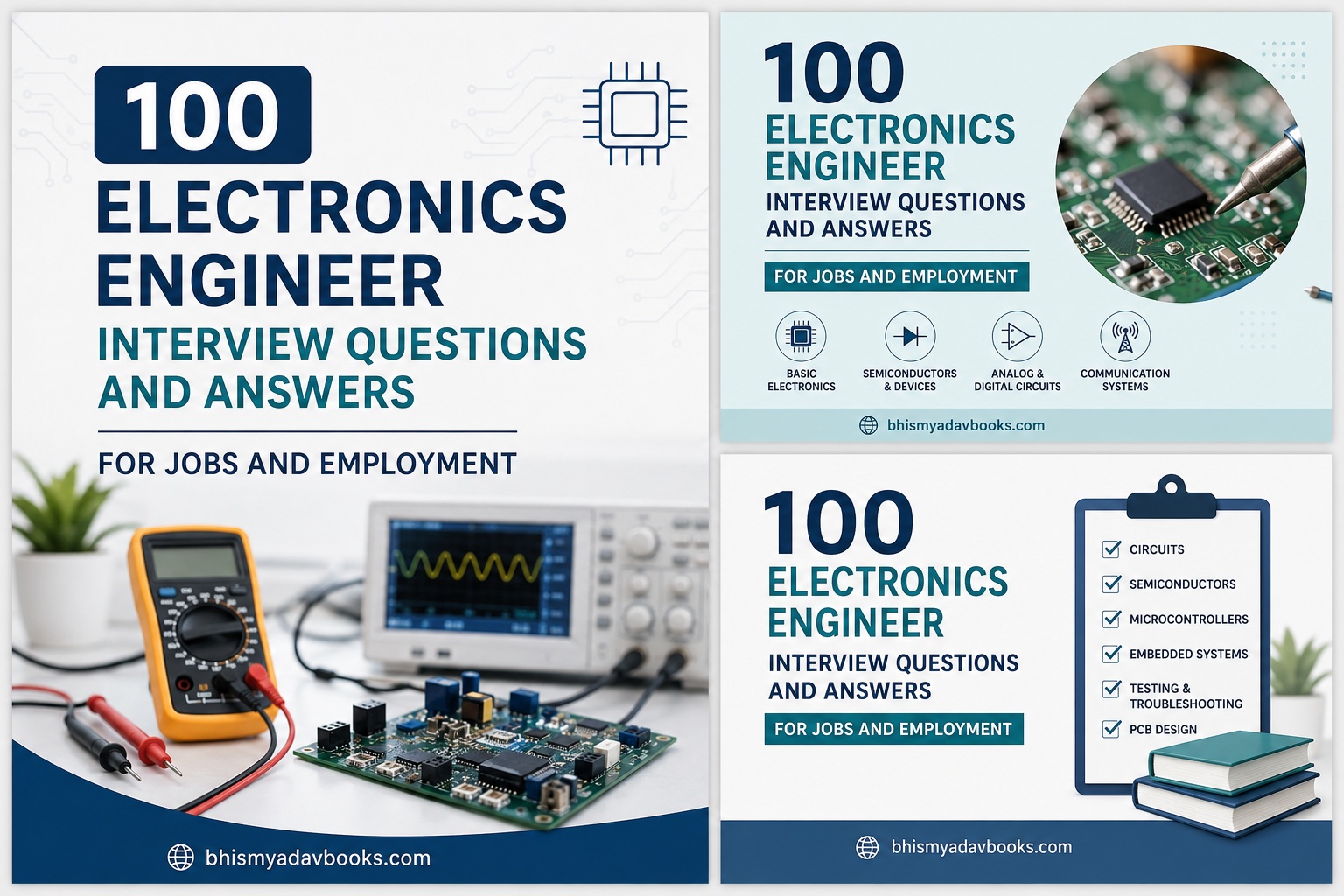
100 Electronics Engineer Interview Questions and Answers for Jobs and Employment

Introduction

Electronics engineering is one of the most important engineering fields in modern technology. From smartphones and computers to industrial automation, medical equipment, communication networks, automobiles, aerospace systems, and consumer electronics, electronic circuits and systems are used almost everywhere.

An Electronics Engineer may work in circuit design, embedded systems, semiconductor technology, communication systems, instrumentation, control systems, PCB development, product testing, research, maintenance, manufacturing, or technical support. Because the field is broad, employers often test candidates on both fundamental concepts and practical problem-solving skills.

Preparing for an electronics engineering interview requires a clear understanding of basic electrical quantities, electronic components, semiconductor devices, analog circuits, digital electronics, communication principles, microprocessors, microcontrollers, embedded systems, PCB design, and testing techniques.

We have some amazing books in our Shop page you may want to buy.

This article presents 100 Electronics Engineer interview questions and answers for jobs and employment. The questions are useful for fresh graduates, diploma holders, experienced engineers, technicians, and job aspirants preparing for technical interviews.


Basic Electronics Interview Questions and Answers

(Questions 1-30)

1. What is electronics engineering?

Answer: Electronics engineering is a branch of engineering concerned with the design, development, testing, and application of electronic circuits, devices, and systems. It deals mainly with components such as diodes, transistors, integrated circuits, sensors, microcontrollers, and communication devices.

2. What is electric current?

Answer: Electric current is the rate of flow of electric charge through a conductor. It is measured in amperes or amps. Current is represented by the symbol I.

3. What is voltage?

Answer: Voltage is the electrical potential difference between two points. It provides the force required to move electric charges through a circuit. Voltage is measured in volts.

4. What is resistance?

Answer: Resistance is the opposition offered by a material or component to the flow of electric current. It is measured in ohms and represented by the symbol R.

5. State Ohm’s Law.

Answer: Ohm’s Law states that the current flowing through a conductor is directly proportional to the voltage applied across it and inversely proportional to its resistance, provided physical conditions remain constant.

The mathematical expression is:

V = I × R

6. What is electrical power?

Answer: Electrical power is the rate at which electrical energy is consumed or transferred in a circuit. It is measured in watts.

Power can be calculated using:

P = V × I

7. What is the difference between AC and DC?

Answer: Alternating Current, or AC, periodically changes its direction and magnitude. Direct Current, or DC, flows in only one direction. Household electrical supplies generally use AC, while batteries and many electronic circuits use DC.

8. What is frequency?

Answer: Frequency is the number of complete cycles of a periodic signal occurring in one second. It is measured in hertz or Hz.

9. What is a circuit?

Answer: An electrical or electronic circuit is a closed path through which electric current can flow. It may contain power sources, resistors, capacitors, inductors, semiconductors, and other components.

10. What is the difference between an open circuit and a short circuit?

Answer: An open circuit has a broken current path, resulting in no current flow. A short circuit creates a very low-resistance path and may cause excessive current to flow.


Electronic Components Interview Questions

11. What is a resistor?

Answer: A resistor is a passive electronic component used to limit current, divide voltage, and control signal levels in circuits. Its resistance is measured in ohms.

12. What is a capacitor?

Answer: A capacitor is a component that stores electrical energy in an electric field. Capacitors are commonly used for filtering, coupling, decoupling, timing, and energy storage.

13. What is capacitance?

Answer: Capacitance is the ability of a capacitor to store electric charge. It is measured in farads.

14. What is an inductor?

Answer: An inductor is a passive component that stores energy in a magnetic field when current flows through it. Inductors are widely used in filters, power supplies, and radio-frequency circuits.

15. What is inductance?

Answer: Inductance is the property of a conductor or coil that opposes changes in current by producing an induced voltage. It is measured in henries.

16. What is impedance?

Answer: Impedance is the total opposition offered by a circuit to alternating current. It consists of resistance and reactance and is measured in ohms.

17. What is reactance?

Answer: Reactance is the opposition offered by capacitors and inductors to alternating current. Capacitive reactance decreases with increasing frequency, while inductive reactance increases with frequency.

18. What is a transformer?

Answer: A transformer is an electrical device that transfers AC electrical energy between circuits through electromagnetic induction. It can increase or decrease voltage levels.

19. What is a relay?

Answer: A relay is an electrically operated switching device. It allows a low-power electrical signal to control a higher-power circuit.

20. What is a fuse?

Answer: A fuse is a protective component designed to interrupt a circuit when excessive current flows. The fuse element melts and disconnects the electrical path.


Semiconductor Interview Questions and Answers

21. What is a semiconductor?

Answer: A semiconductor is a material whose electrical conductivity lies between that of a conductor and an insulator. Silicon and germanium are common semiconductor materials.

22. What is doping in semiconductors?

Answer: Doping is the process of intentionally adding impurities to a pure semiconductor to modify its electrical conductivity.

23. What is an N-type semiconductor?

Answer: An N-type semiconductor is formed by adding donor impurities to a pure semiconductor. Electrons are the majority charge carriers.

24. What is a P-type semiconductor?

Answer: A P-type semiconductor is formed by adding acceptor impurities. Holes are the majority charge carriers.

25. What is a PN junction?

Answer: A PN junction is formed when P-type and N-type semiconductor materials are joined. It is the fundamental structure used in semiconductor devices such as diodes.

26. What is a diode?

Answer: A diode is a semiconductor device that primarily allows current to flow in one direction while blocking current in the opposite direction.

27. What is forward bias?

Answer: Forward bias occurs when the positive terminal of a voltage source is connected to the P-side and the negative terminal to the N-side of a PN junction. This condition allows significant current flow.

28. What is reverse bias?

Answer: Reverse bias occurs when the positive terminal is connected to the N-side and the negative terminal to the P-side. Under normal conditions, very little current flows.

29. What is a Zener diode?

Answer: A Zener diode is designed to operate safely in the reverse breakdown region. It is commonly used for voltage regulation and voltage reference applications.

30. What is an LED?

Answer: An LED, or Light Emitting Diode, is a semiconductor device that emits light when forward current flows through it.


Transistor Interview Questions

(Questions 31-60)

31. What is a transistor?

Answer: A transistor is a semiconductor device used for signal amplification and electronic switching. It is one of the fundamental building blocks of modern electronic systems.

32. What is a BJT?

Answer: BJT stands for Bipolar Junction Transistor. It is a current-controlled semiconductor device that uses both electrons and holes as charge carriers.

33. What are the terminals of a BJT?

Answer: The three terminals of a BJT are emitter, base, and collector.

34. What is the difference between NPN and PNP transistors?

Answer: NPN and PNP transistors differ in their semiconductor layer arrangement and current direction. An NPN transistor generally turns on with a positive base voltage relative to the emitter, while a PNP transistor operates with opposite polarity.

35. What is transistor biasing?

Answer: Transistor biasing is the process of establishing suitable DC voltage and current conditions for a transistor to operate at a desired point.

36. What is the operating point of a transistor?

Answer: The operating point, also called the Q-point or quiescent point, represents the DC voltage and current conditions of a transistor when no input signal is applied.

37. What is a FET?

Answer: A Field Effect Transistor is a voltage-controlled semiconductor device. It controls current using an electric field.

38. What is a MOSFET?

Answer: MOSFET stands for Metal-Oxide-Semiconductor Field-Effect Transistor. It is widely used for switching and amplification because of its high input impedance and efficient operation.

39. What is the difference between BJT and MOSFET?

Answer: A BJT is primarily a current-controlled device, while a MOSFET is voltage-controlled. MOSFETs usually have higher input impedance and are widely used in digital circuits and power electronics.

40. What is transistor saturation?

Answer: Saturation is a transistor operating condition in which the transistor is fully turned on and allows maximum current flow based on the external circuit.


Analog Electronics Interview Questions

41. What is an amplifier?

Answer: An amplifier is an electronic circuit that increases the amplitude of an electrical signal while maintaining its basic waveform characteristics.

42. What is gain?

Answer: Gain is the ratio of an amplifier’s output signal to its input signal. It may refer to voltage gain, current gain, or power gain.

43. What is an operational amplifier?

Answer: An operational amplifier, or op-amp, is a high-gain differential voltage amplifier with high input impedance and low output impedance.

44. What are the ideal characteristics of an op-amp?

Answer: An ideal op-amp has infinite voltage gain, infinite input impedance, zero output impedance, infinite bandwidth, and zero input offset voltage.

45. What is an inverting amplifier?

Answer: An inverting amplifier is an op-amp configuration in which the output signal is amplified and shifted by 180 degrees relative to the input signal.

46. What is a non-inverting amplifier?

Answer: A non-inverting amplifier produces an amplified output signal that remains in phase with the input signal.

47. What is a comparator?

Answer: A comparator is a circuit that compares two input voltage levels and produces an output indicating which input is higher.

48. What is feedback in an amplifier?

Answer: Feedback is the process of returning a portion of the output signal to the input of an amplifier.

49. What is negative feedback?

Answer: Negative feedback returns an output signal that opposes the input. It can improve amplifier stability, bandwidth, and linearity while reducing gain.

50. What is positive feedback?

Answer: Positive feedback reinforces the input signal. It is commonly used in oscillators and switching circuits.


Digital Electronics Interview Questions

51. What is digital electronics?

Answer: Digital electronics deals with circuits and systems that process signals using discrete logic levels, generally represented by binary 0 and 1.

52. What is a logic gate?

Answer: A logic gate is a digital electronic circuit that performs a logical operation on one or more binary inputs.

53. Name the basic logic gates.

Answer: The basic logic gates are AND, OR, and NOT gates. Other common gates include NAND, NOR, XOR, and XNOR.

54. What is an AND gate?

Answer: An AND gate produces a logic 1 output only when all its inputs are logic 1.

55. What is an OR gate?

Answer: An OR gate produces a logic 1 output when at least one input is logic 1.

56. What is a NOT gate?

Answer: A NOT gate, also called an inverter, produces the opposite logical value of its input.

57. Why are NAND and NOR called universal gates?

Answer: NAND and NOR gates are called universal gates because any Boolean logic function can be implemented using only NAND gates or only NOR gates.

58. What is Boolean algebra?

Answer: Boolean algebra is a mathematical system used to represent and simplify logical operations involving binary variables.

59. What is a truth table?

Answer: A truth table lists all possible input combinations of a digital circuit and shows the corresponding outputs.

60. What is a flip-flop?

Answer: A flip-flop is a digital storage circuit capable of storing one bit of binary information.


Digital Circuit and Logic Interview Questions

(Questions 61-100)

61. What are the common types of flip-flops?

Answer: Common flip-flops include SR, JK, D, and T flip-flops.

62. What is a register?

Answer: A register is a group of flip-flops used to temporarily store binary data.

63. What is a counter?

Answer: A counter is a sequential digital circuit that counts electrical pulses or clock events.

64. What is a multiplexer?

Answer: A multiplexer, or MUX, selects one input from multiple input signals and transfers it to a single output.

65. What is a demultiplexer?

Answer: A demultiplexer transfers a single input signal to one of several outputs based on control inputs.

66. What is an encoder?

Answer: An encoder is a combinational circuit that converts multiple input signals into a coded binary output.

67. What is a decoder?

Answer: A decoder converts coded binary information into a specific output signal.

68. What is the difference between combinational and sequential circuits?

Answer: The output of a combinational circuit depends only on current inputs. The output of a sequential circuit depends on current inputs and previous states.

69. What is a clock signal?

Answer: A clock signal is a periodic electrical waveform used to synchronize operations in digital circuits.

70. What is propagation delay?

Answer: Propagation delay is the time required for a change at the input of a digital circuit to produce a corresponding change at the output.


Communication Electronics Interview Questions

71. What is modulation?

Answer: Modulation is the process of modifying a carrier signal according to an information signal for efficient transmission.

72. Why is modulation required?

Answer: Modulation enables efficient signal transmission, reduces antenna size, increases communication range, and allows multiple signals to use different carrier frequencies.

73. What is amplitude modulation?

Answer: Amplitude Modulation, or AM, changes the amplitude of a carrier wave according to the information signal.

74. What is frequency modulation?

Answer: Frequency Modulation, or FM, changes the frequency of a carrier signal according to the information signal.

75. What is phase modulation?

Answer: Phase Modulation changes the phase of a carrier signal based on the instantaneous value of the information signal.

76. What is bandwidth?

Answer: Bandwidth is the range of frequencies occupied by a signal or supported by a communication channel.

77. What is noise?

Answer: Noise is an unwanted electrical disturbance that interferes with the desired signal.

78. What is signal-to-noise ratio?

Answer: Signal-to-noise ratio, or SNR, compares the power of a desired signal with the power of background noise. A higher SNR generally indicates better signal quality.

79. What is an antenna?

Answer: An antenna is a device that converts electrical signals into electromagnetic waves for transmission or converts received electromagnetic waves into electrical signals.

80. What is a transceiver?

Answer: A transceiver is an electronic device that combines transmitter and receiver functions in a single system.


Microprocessor and Embedded Systems Interview Questions

81. What is a microprocessor?

Answer: A microprocessor is a programmable integrated circuit that performs arithmetic, logical, and control operations according to stored instructions.

82. What is a microcontroller?

Answer: A microcontroller is a compact integrated circuit containing a processor, memory, and input/output peripherals on a single chip.

83. What is the difference between a microprocessor and a microcontroller?

Answer: A microprocessor generally requires external memory and peripherals, while a microcontroller integrates the processor, memory, and peripherals into one chip.

84. What is an embedded system?

Answer: An embedded system is a computer-based system designed to perform a dedicated function within a larger electronic or mechanical product.

85. What is firmware?

Answer: Firmware is software stored in non-volatile memory that controls the basic operation of an electronic or embedded device.

86. What is an interrupt?

Answer: An interrupt is a signal that temporarily pauses normal processor execution and directs the processor to perform a specific service routine.

87. What is a timer in a microcontroller?

Answer: A timer is a hardware peripheral used for measuring time intervals, generating delays, counting events, or producing periodic signals.

88. What is PWM?

Answer: Pulse Width Modulation is a technique that controls average power by changing the width or duty cycle of digital pulses.

89. What is ADC?

Answer: An Analog-to-Digital Converter converts a continuous analog signal into a digital numerical value.

90. What is DAC?

Answer: A Digital-to-Analog Converter converts digital data into a corresponding analog electrical signal.


PCB, Testing, and Practical Electronics Interview Questions

91. What is a PCB?

Answer: PCB stands for Printed Circuit Board. It mechanically supports and electrically connects electronic components using conductive tracks and pads.

92. What is a schematic diagram?

Answer: A schematic diagram is a symbolic representation of an electronic circuit showing components and their electrical connections.

93. What is PCB routing?

Answer: PCB routing is the process of creating conductive paths or traces between electronic component connections on a printed circuit board.

94. What is a ground plane?

Answer: A ground plane is a large conductive area on a PCB connected to the circuit ground. It provides a low-impedance return path and can help reduce electromagnetic noise.

95. What is decoupling?

Answer: Decoupling is the technique of reducing unwanted voltage fluctuations and noise in power supply lines. Decoupling capacitors are usually placed close to integrated circuit power pins.

96. What is EMI?

Answer: EMI stands for Electromagnetic Interference. It is unwanted electromagnetic energy that affects the operation of electronic equipment.

97. What is ESD?

Answer: ESD stands for Electrostatic Discharge. It is a sudden transfer of static electrical charge that can damage sensitive electronic components.

98. How do you troubleshoot an electronic circuit?

Answer: I first understand the circuit function and review the schematic. Then I perform a visual inspection, verify the power supply and ground connections, check important voltages and signals, isolate circuit sections, and test suspected components. I use tools such as a digital multimeter, oscilloscope, logic analyzer, and bench power supply when required.

99. What tools are commonly used by an Electronics Engineer?

Answer: Common tools include digital multimeters, oscilloscopes, function generators, logic analyzers, spectrum analyzers, soldering stations, bench power supplies, LCR meters, PCB design software, simulation software, and debugging tools.

100. Why should we hire you as an Electronics Engineer?

Answer: You should hire me because I have a strong understanding of electronics fundamentals and a systematic approach to solving technical problems. I can analyze circuits, identify faults, understand technical documentation, and learn new technologies. I also value safety, quality, teamwork, and continuous improvement. I am prepared to apply my engineering knowledge to practical projects and contribute to the organization’s technical goals.


A Handbook on Electronics Engineering by MADE EASY Team (Author, Contributor) 

How to Prepare for an Electronics Engineer Interview

Preparing for an Electronics Engineer interview requires a combination of theoretical knowledge and practical understanding. Candidates should revise basic circuit theory, semiconductor devices, analog electronics, digital logic, communication systems, and embedded electronics.

Do not simply memorize definitions. Interviewers may present practical situations and ask you to explain how you would identify a problem.

For example, you may be asked why an electronic circuit is overheating, why an amplifier output is distorted, or why a microcontroller is continuously resetting. A good candidate should explain the troubleshooting process in a logical sequence.

Practice reading electronic schematics and identifying important circuit sections such as power supplies, regulators, amplifiers, filters, oscillators, and digital interfaces.

You should also become familiar with test equipment. Understand how to safely use a multimeter and oscilloscope. Learn the purpose of a function generator, logic analyzer, spectrum analyzer, and bench power supply.

If you are applying for an embedded electronics position, revise microcontroller architecture, interrupts, timers, PWM, ADC, communication interfaces, and basic programming concepts.

For PCB-related positions, understand schematic capture, component placement, PCB routing, ground planes, decoupling, signal integrity, EMI, and ESD protection.


Skills Required for Electronics Engineer Jobs

Employers may look for different skills depending on the industry and job role. Important skills include:

  • Electronic circuit analysis
  • Analog electronics
  • Digital electronics
  • Semiconductor fundamentals
  • Microcontrollers and embedded systems
  • PCB schematic and layout understanding
  • Electronic testing and measurement
  • Circuit troubleshooting
  • Soldering and hardware debugging
  • Communication protocols
  • Technical documentation
  • Problem-solving ability
  • Attention to detail
  • Teamwork
  • Safety awareness
  • Continuous learning

Candidates should carefully read the job description and focus their preparation on the technical skills mentioned by the employer.


Common Electronics Engineer Job Roles

Electronics engineering graduates and experienced professionals may apply for positions such as:

  • Electronics Engineer
  • Electronics Design Engineer
  • Hardware Engineer
  • Embedded Systems Engineer
  • PCB Design Engineer
  • Test Engineer
  • Validation Engineer
  • Electronics Maintenance Engineer
  • Instrumentation Engineer
  • Communication Engineer
  • Semiconductor Engineer
  • Field Service Engineer
  • Product Development Engineer
  • Research and Development Engineer
  • Technical Support Engineer

The exact responsibilities of an Electronics Engineer vary according to the organization, product, and industry.


Frequently Asked Questions About Electronics Engineer Interviews

Are electronics engineering interviews difficult?

The difficulty depends on the job position and experience level. Fresher interviews usually focus on basic electronics, circuit theory, semiconductors, analog circuits, and digital electronics. Experienced candidates may receive questions about design, debugging, product development, testing, and previous projects.

What should a fresher study for an electronics interview?

Freshers should revise Ohm’s Law, Kirchhoff’s Laws, resistors, capacitors, inductors, diodes, transistors, operational amplifiers, logic gates, flip-flops, communication fundamentals, and microcontrollers.

Are practical questions asked in electronics interviews?

Yes. Employers frequently ask troubleshooting and practical circuit questions. Candidates may be asked to explain how they would test a circuit or identify a faulty component.

Should I mention my electronics projects during an interview?

Yes. Projects can demonstrate your practical knowledge. Explain the objective of the project, your responsibilities, the components used, technical challenges, and how you solved problems.

Is PCB knowledge important for Electronics Engineers?

PCB knowledge is useful for many hardware and electronics design positions. Even if you are not a professional PCB designer, understanding schematics, component placement, traces, grounding, and decoupling can improve your interview performance.


Final Thoughts

Electronics engineering interviews evaluate more than memorized definitions. Employers want candidates who understand fundamental concepts and can apply them to practical engineering problems.

These 100 Electronics Engineer interview questions and answers for jobs and employment cover important areas including basic electronics, electronic components, semiconductor devices, transistors, analog electronics, digital electronics, communication systems, embedded systems, PCB design, and troubleshooting.

Use these questions as a foundation for your interview preparation. Revise the concepts, practice explaining answers in your own words, and connect theoretical principles with practical examples.

Consistent preparation can improve your technical confidence and help you communicate your engineering knowledge more clearly during interviews.

Bhism Yadav Books provides educational content focused on strengthening fundamental knowledge and basic concepts for students, job aspirants, examination candidates, and lifelong learners.

Keep learning, strengthen your fundamentals, and prepare confidently for your next Electronics Engineer job interview.

Disclaimer: The interview questions and sample answers in this article are provided for educational and job preparation purposes. Actual interview questions may vary depending on the employer, industry, job role, location, and candidate experience.