Posted on Leave a comment

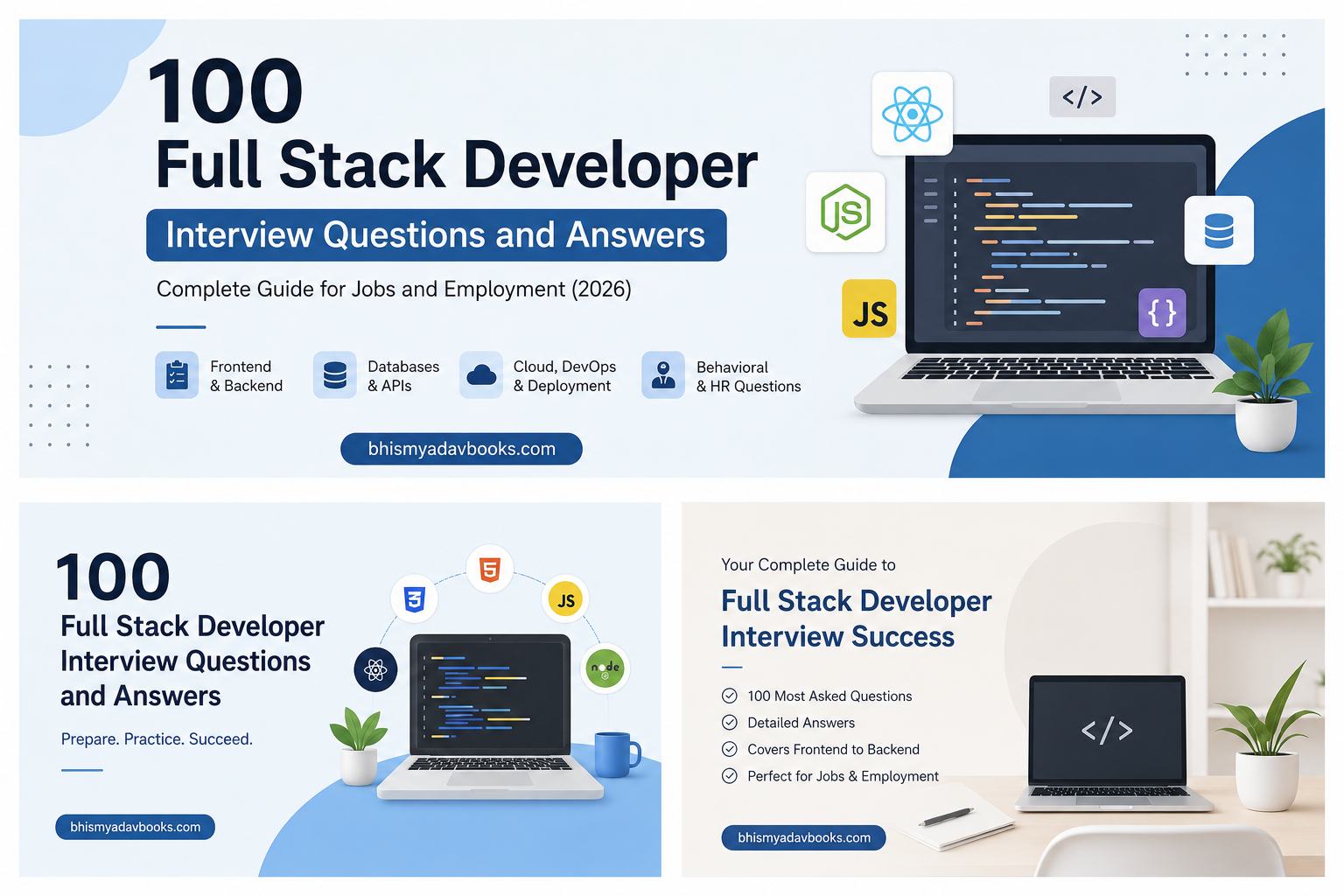
Full Stack Developer Interview Questions and Answers (2026) – Complete Guide for Jobs and Employment you can’t miss

Full Stack Developer Interview Questions

100 Full Stack Developer Interview Questions and Answers

Introduction

Full Stack Developers are among the most sought-after professionals in today’s technology industry. Companies ranging from startups to multinational organizations require developers who can build complete web applications from the user interface to the database and server infrastructure.

A Full Stack Developer possesses knowledge of frontend technologies such as HTML, CSS, JavaScript, and React while also understanding backend technologies like Node.js, Python, Java, PHP, databases, APIs, cloud platforms, authentication, and deployment.

Because of this broad skill set, Full Stack Developer interviews are comprehensive and evaluate candidates on programming, problem-solving, architecture, databases, security, DevOps, and communication.

We have some amazing books in our Shop page for you.

This guide presents 100 carefully selected Full Stack Developer interview questions and answers that help beginners, experienced developers, and job seekers prepare for technical interviews confidently.


Frontend Development Questions

(Questions 1-30)

1. What is Full Stack Development?

Answer:

Full Stack Development refers to building both the frontend (client-side) and backend (server-side) of an application, including databases, APIs, authentication, deployment, and maintenance.


2. What technologies are commonly used in Full Stack Development?

Answer:

Typical technologies include:

  • HTML5
  • CSS3
  • JavaScript
  • TypeScript
  • React
  • Angular
  • Vue.js
  • Node.js
  • Express.js
  • Python
  • Java
  • PHP
  • MySQL
  • PostgreSQL
  • MongoDB
  • Docker
  • Git
  • AWS
  • Azure

3. What is HTML?

Answer:

HTML (HyperText Markup Language) is the standard language used to structure web pages.


4. What is CSS?

Answer:

CSS styles HTML elements by controlling colors, layouts, spacing, fonts, and responsiveness.


5. What is JavaScript?

Answer:

JavaScript is a programming language used to make websites interactive by handling events, animations, calculations, and API communication.


6. What is responsive web design?

Answer:

Responsive web design ensures that web applications adapt to desktops, tablets, and mobile devices using flexible layouts and media queries.


7. What are semantic HTML elements?

Answer:

Semantic tags describe their purpose clearly.

Examples:

  • header
  • nav
  • article
  • section
  • footer
  • aside

8. What is the DOM?

Answer:

The Document Object Model represents HTML elements as objects that JavaScript can manipulate dynamically.


9. What are events in JavaScript?

Answer:

Events represent user interactions such as:

  • Click
  • Mouse movement
  • Keyboard input
  • Form submission

10. What is event bubbling?

Answer:

Event bubbling means events propagate from the target element upward through parent elements.


11. Explain event delegation.

Answer:

Event delegation attaches one event listener to a parent element instead of multiple child elements, improving performance.


12. What is AJAX?

Answer:

AJAX allows web pages to exchange data with servers without refreshing the page.


13. What is Fetch API?

Answer:

Fetch API is the modern JavaScript method for making asynchronous HTTP requests.


14. What is JSON?

Answer:

JSON (JavaScript Object Notation) is a lightweight format for exchanging structured data.


15. What are ES6 features?

Answer:

Major ES6 features include:

  • let
  • const
  • Arrow functions
  • Classes
  • Modules
  • Template literals
  • Promises
  • Destructuring

16. What are closures?

Answer:

A closure allows a function to access variables from its outer scope even after the outer function has finished executing.


17. What is hoisting?

Answer:

Hoisting moves variable and function declarations to the top of their scope during compilation.


18. Difference between let, const, and var?

Answer:

  • var has function scope.
  • let has block scope.
  • const cannot be reassigned.

19. What is TypeScript?

Answer:

TypeScript is a strongly typed superset of JavaScript that improves code quality and maintainability.


20. What is React?

Answer:

React is a JavaScript library used for building reusable user interface components.


21. What are React components?

Answer:

Components are reusable pieces of UI that encapsulate logic and presentation.


22. What is JSX?

Answer:

JSX is a syntax extension that allows developers to write HTML-like code inside JavaScript.


23. What are React Hooks?

Answer:

Hooks allow functional components to use state and lifecycle features.

Examples:

  • useState
  • useEffect
  • useMemo
  • useContext

24. What is Virtual DOM?

Answer:

Virtual DOM is a lightweight copy of the real DOM used by React to improve rendering performance.


25. What is state management?

Answer:

State management controls application data using tools like Context API, Redux, or Zustand.


26. Difference between props and state?

Answer:

Props are read-only inputs passed to components, while state is mutable data managed within a component.


27. What is React Router?

Answer:

React Router enables client-side navigation without reloading the page.


28. What is lazy loading?

Answer:

Lazy loading loads components only when required, reducing the initial page load time.


29. What is code splitting?

Answer:

Code splitting divides application bundles into smaller chunks for faster loading.


30. Why is accessibility important?

Answer:

Accessibility ensures web applications are usable by people with disabilities and improves SEO.


100 Full Stack Developer Interview Questions and Answers (2026) – Complete Guide for Jobs and Employment

Part 2: Backend Development Interview Questions

(Questions 31–55)


31. What is Backend Development?

Answer:

Backend development focuses on the server-side of an application. It handles business logic, authentication, database operations, APIs, file processing, and communication between the frontend and the database. A well-designed backend ensures security, scalability, and high performance.


32. What is Node.js?

Answer:

Node.js is an open-source JavaScript runtime environment built on Google’s V8 JavaScript engine. It allows developers to run JavaScript outside the browser, making it possible to build fast and scalable server-side applications using a single programming language across the entire stack.


33. What is Express.js?

Answer:

Express.js is a lightweight and flexible web framework for Node.js. It simplifies backend development by providing features such as routing, middleware support, request handling, response management, and REST API development.


34. What is Middleware?

Answer:

Middleware is a function that executes during the request-response cycle. It can:

  • Validate requests
  • Authenticate users
  • Log requests
  • Handle errors
  • Parse request bodies
  • Modify responses

Middleware improves code organization and reusability.


35. What is a REST API?

Answer:

A REST (Representational State Transfer) API allows applications to communicate over HTTP using standard methods such as:

  • GET
  • POST
  • PUT
  • PATCH
  • DELETE

REST APIs are stateless, scalable, and widely used for web and mobile applications.


36. What is an API Endpoint?

Answer:

An endpoint is a specific URL where a client sends requests to access a particular resource or service.

Example:

GET /api/users
POST /api/login
DELETE /api/products/10

Each endpoint performs a specific function.


37. What is CRUD?

Answer:

CRUD represents the four basic database operations:

  • Create
  • Read
  • Update
  • Delete

Nearly every web application performs CRUD operations on its data.


38. Explain HTTP Methods.

Answer:

Common HTTP methods include:

  • GET – Retrieve data
  • POST – Create new data
  • PUT – Replace existing data
  • PATCH – Update part of a resource
  • DELETE – Remove data

Choosing the correct method improves API consistency and readability.


39. What are HTTP Status Codes?

Answer:

Status codes indicate the result of an HTTP request.

Examples include:

  • 200 – OK
  • 201 – Created
  • 400 – Bad Request
  • 401 – Unauthorized
  • 403 – Forbidden
  • 404 – Not Found
  • 500 – Internal Server Error

Proper status codes help clients understand request outcomes.


40. What is Authentication?

Answer:

Authentication verifies a user’s identity before granting access to an application. Common authentication methods include:

  • Username and password
  • One-Time Password (OTP)
  • OAuth
  • JSON Web Tokens (JWT)
  • Multi-Factor Authentication (MFA)

41. What is Authorization?

Answer:

Authorization determines what an authenticated user is allowed to access. For example:

  • Administrator
  • Manager
  • Customer
  • Guest

A user may successfully log in but still have limited permissions.


42. What is JWT?

Answer:

JWT (JSON Web Token) is a secure token used for user authentication. After successful login, the server generates a signed token that the client sends with future requests, allowing stateless authentication.


43. What is Session-Based Authentication?

Answer:

In session-based authentication:

  • The server creates a session after login.
  • A session ID is stored in a cookie.
  • The server validates the session for each request.

This approach is commonly used in traditional web applications.


44. What is CORS?

Answer:

CORS (Cross-Origin Resource Sharing) is a browser security feature that controls whether a web application can request resources from another domain. Proper CORS configuration prevents unauthorized cross-origin requests.


45. What is an Environment Variable?

Answer:

Environment variables store configuration values outside the source code.

Examples include:

  • Database credentials
  • API keys
  • Secret tokens
  • Server ports

Keeping sensitive information in environment variables improves application security.


46. What is npm?

Answer:

npm (Node Package Manager) is the default package manager for Node.js. It allows developers to install, update, remove, and manage project dependencies efficiently.


47. What is package.json?

Answer:

The package.json file contains important project information such as:

  • Project name
  • Version
  • Dependencies
  • Scripts
  • License
  • Author
  • Configuration settings

It serves as the central configuration file for Node.js applications.


48. What is Asynchronous Programming?

Answer:

Asynchronous programming enables multiple operations to execute without blocking the main thread. This approach improves application responsiveness and is especially useful for tasks like file handling, database queries, and API requests.


49. What are Promises?

Answer:

A Promise represents the eventual completion or failure of an asynchronous operation. A Promise can be in one of three states:

  • Pending
  • Fulfilled
  • Rejected

Promises simplify asynchronous programming compared to nested callbacks.


50. What is async/await?

Answer:

async and await provide a cleaner way to write asynchronous code.

Benefits include:

  • Improved readability
  • Easier error handling
  • Reduced callback nesting
  • Better code maintenance

They are built on top of Promises.


51. What is Error Handling in Backend Development?

Answer:

Error handling ensures applications respond gracefully when unexpected situations occur.

Good practices include:

  • Returning meaningful error messages
  • Logging errors
  • Using try-catch blocks
  • Handling validation failures
  • Avoiding exposure of sensitive server information

Effective error handling improves both security and user experience.


52. What is Input Validation?

Answer:

Input validation checks whether user-provided data is correct before processing it.

Examples include:

  • Required fields
  • Email format validation
  • Password length requirements
  • Numeric value checks
  • File type restrictions

Proper validation prevents invalid data from entering the system.


53. Why is Password Hashing Important?

Answer:

Passwords should never be stored in plain text. Instead, they should be hashed using secure algorithms such as:

  • bcrypt
  • Argon2
  • PBKDF2

Hashing protects user credentials even if the database is compromised.


54. What is Rate Limiting?

Answer:

Rate limiting restricts the number of requests a client can make within a specified period.

Benefits include:

  • Preventing brute-force attacks
  • Reducing API abuse
  • Protecting server resources
  • Improving application stability

Many APIs implement rate limiting to maintain reliable service.


55. What are Microservices?

Answer:

Microservices are an architectural style where an application is divided into small, independent services. Each service focuses on a specific business function and communicates with others through APIs or messaging systems.

Advantages:

  • Independent deployment
  • Better scalability
  • Easier maintenance
  • Fault isolation
  • Technology flexibility
  • Faster development by multiple teams

100 Full Stack Developer Interview Questions and Answers (2026) – Complete Guide for Jobs and Employment

Part 3: Databases, APIs, Security, Git, and Cloud Interview Questions

(Questions 56–80)

A Full Stack Developer is expected to understand how data is stored, retrieved, secured, and deployed. This section covers the most frequently asked interview questions related to databases, APIs, version control, cloud computing, and web security.


56. What is a Database?

Answer:

A database is an organized collection of data that enables efficient storage, retrieval, updating, and deletion of information. Databases are fundamental to modern applications because they ensure data consistency, integrity, and availability. Popular database systems include MySQL, PostgreSQL, MongoDB, Oracle Database, and Microsoft SQL Server.


57. What is the Difference Between SQL and NoSQL Databases?

Answer:

SQL databases are relational and store data in tables with predefined schemas. They support complex joins and ACID transactions, making them ideal for structured data.

NoSQL databases are non-relational and store data as documents, key-value pairs, graphs, or wide-column stores. They offer flexible schemas and horizontal scalability, making them suitable for large-scale applications.

Examples:

  • SQL: MySQL, PostgreSQL, SQL Server
  • NoSQL: MongoDB, Cassandra, Redis

58. What is a Primary Key?

Answer:

A primary key is a column or a combination of columns that uniquely identifies each record in a database table.

Characteristics:

  • Unique for every row
  • Cannot contain NULL values
  • Improves indexing and query performance
  • Ensures data integrity

59. What is a Foreign Key?

Answer:

A foreign key is a field in one table that references the primary key of another table. It establishes relationships between tables and helps maintain referential integrity by preventing invalid data references.


60. What is Normalization?

Answer:

Normalization is the process of organizing data to reduce redundancy and improve consistency.

Benefits include:

  • Eliminates duplicate data
  • Improves data integrity
  • Simplifies maintenance
  • Optimizes storage

Common normal forms include:

  • First Normal Form (1NF)
  • Second Normal Form (2NF)
  • Third Normal Form (3NF)

61. What is Denormalization?

Answer:

Denormalization intentionally introduces redundancy into a database to improve read performance. It reduces the need for complex joins and is commonly used in data warehouses and high-performance applications where faster queries are more important than storage efficiency.


62. What is an Index in a Database?

Answer:

An index is a data structure that speeds up data retrieval operations.

Advantages:

  • Faster SELECT queries
  • Improved search performance
  • Reduced database response time

Disadvantages:

  • Requires additional storage
  • Slightly slows INSERT, UPDATE, and DELETE operations because indexes must also be updated

63. What is a SQL JOIN?

Answer:

A JOIN combines rows from two or more tables based on related columns.

Common JOIN types:

  • INNER JOIN
  • LEFT JOIN
  • RIGHT JOIN
  • FULL OUTER JOIN
  • CROSS JOIN

JOINs are frequently used to retrieve related information stored in different tables.


64. What is a Transaction?

Answer:

A transaction is a sequence of database operations treated as a single unit of work. Either all operations succeed, or none are applied, ensuring data consistency.

For example, transferring money between two bank accounts should either complete entirely or not happen at all.


65. What are ACID Properties?

Answer:

ACID properties guarantee reliable database transactions.

  • Atomicity: All operations succeed or fail together.
  • Consistency: Data remains valid before and after the transaction.
  • Isolation: Concurrent transactions do not interfere with one another.
  • Durability: Committed changes remain even after a system failure.

66. What is MongoDB?

Answer:

MongoDB is a popular NoSQL document database that stores data in flexible BSON (Binary JSON) documents instead of tables. It is well suited for applications with evolving data structures and large-scale distributed systems.


67. What is Mongoose?

Answer:

Mongoose is an Object Data Modeling (ODM) library for MongoDB and Node.js. It provides features such as:

  • Schema definition
  • Data validation
  • Middleware
  • Query building
  • Model creation

It simplifies interactions with MongoDB databases.


68. What is an ORM?

Answer:

An Object-Relational Mapping (ORM) tool allows developers to interact with relational databases using programming language objects instead of writing raw SQL.

Popular ORMs include:

  • Prisma
  • Sequelize
  • TypeORM
  • Hibernate
  • Entity Framework

ORMs improve developer productivity and reduce repetitive database code.


69. What is API Versioning?

Answer:

API versioning allows developers to introduce changes without breaking existing client applications.

Common approaches include:

  • URL versioning (/api/v1/users)
  • Header versioning
  • Query parameter versioning

Versioning ensures backward compatibility as APIs evolve.


70. What is GraphQL?

Answer:

GraphQL is a query language and runtime for APIs that allows clients to request exactly the data they need.

Advantages include:

  • Reduced over-fetching
  • Reduced under-fetching
  • Strong typing
  • Flexible queries
  • Better performance for complex applications

71. What is Git?

Answer:

Git is a distributed version control system that tracks changes in source code, enabling developers to collaborate efficiently, maintain version history, and manage code across multiple environments.


72. What is GitHub?

Answer:

GitHub is a cloud-based platform for hosting Git repositories. It provides collaboration features such as:

  • Pull requests
  • Code reviews
  • Branch management
  • Issue tracking
  • GitHub Actions for automation

It is widely used for open-source and enterprise software development.


73. What is a Git Branch?

Answer:

A branch is an independent line of development that allows developers to work on new features or bug fixes without affecting the main codebase.

Common branches include:

  • Main
  • Development
  • Feature branches
  • Release branches
  • Hotfix branches

74. What is a Merge Conflict?

Answer:

A merge conflict occurs when Git cannot automatically combine changes made in different branches because the same lines of code have been modified.

Developers must manually resolve the conflict before completing the merge.


75. What is Docker?

Answer:

Docker is a containerization platform that packages applications and their dependencies into lightweight, portable containers.

Benefits include:

  • Consistent development environments
  • Faster deployments
  • Easy scalability
  • Improved portability across operating systems and cloud platforms

76. What is Cloud Computing?

Answer:

Cloud computing provides computing resources such as servers, storage, databases, networking, and software over the internet.

Major cloud providers include:

  • Amazon Web Services (AWS)
  • Microsoft Azure
  • Google Cloud Platform (GCP)

Cloud computing enables scalable, cost-effective application deployment.


77. What is Continuous Integration (CI)?

Answer:

Continuous Integration is a software development practice where developers frequently merge code into a shared repository. Automated tests and builds run after each integration to detect issues early and maintain code quality.


78. What is Continuous Deployment (CD)?

Answer:

Continuous Deployment automatically releases tested code changes to production environments without manual intervention.

Benefits include:

  • Faster software delivery
  • Reduced deployment errors
  • Consistent release process
  • Improved customer feedback cycles

79. What are Common Web Security Best Practices?

Answer:

Important security practices include:

  • Validate all user input
  • Hash passwords securely
  • Use HTTPS
  • Implement authentication and authorization
  • Prevent SQL Injection
  • Prevent Cross-Site Scripting (XSS)
  • Protect against Cross-Site Request Forgery (CSRF)
  • Apply rate limiting
  • Keep dependencies updated
  • Store secrets in environment variables
  • Follow the principle of least privilege

Security should be considered throughout the software development lifecycle.


80. How Do You Optimize a Full Stack Web Application?

Answer:

Performance optimization involves improving both frontend and backend efficiency.

Frontend optimizations:

  • Minify CSS and JavaScript
  • Compress images
  • Enable lazy loading
  • Use browser caching
  • Reduce HTTP requests
  • Implement code splitting

Backend optimizations:

  • Optimize database queries
  • Use proper indexing
  • Implement server-side caching
  • Compress API responses
  • Load balance traffic
  • Optimize API design
  • Monitor application performance
  • Scale infrastructure when needed

A combination of frontend, backend, and infrastructure optimizations results in faster, more reliable web applications.


100 Full Stack Developer Interview Questions and Answers (2026) – Complete Guide for Jobs and Employment

Part 4: System Design, DevOps, Behavioral Questions, Interview Tips, Conclusion, and FAQs

(Questions 81–100)

In the final section of this guide, you’ll find advanced interview questions that assess system design knowledge, software engineering best practices, DevOps concepts, and behavioral skills. Many companies ask these questions to evaluate not only your technical expertise but also your communication, teamwork, and problem-solving abilities.


System Design and Advanced Development Questions

81. What is System Design?

Answer:

System design is the process of defining the architecture, components, modules, interfaces, and data flow of a software application. A good system design focuses on scalability, reliability, maintainability, security, and performance. Interviewers often expect candidates to explain how they would design applications such as e-commerce platforms, chat systems, or social media websites.


82. What is Scalability?

Answer:

Scalability is the ability of a system to handle increasing workloads without sacrificing performance.

There are two primary types:

  • Vertical Scaling: Increasing the resources (CPU, RAM, storage) of a single server.
  • Horizontal Scaling: Adding more servers to distribute the workload.

Modern cloud-based applications typically favor horizontal scaling for better fault tolerance and flexibility.


83. What is Load Balancing?

Answer:

A load balancer distributes incoming network traffic across multiple servers to ensure no single server becomes overloaded.

Benefits include:

  • High availability
  • Improved performance
  • Better reliability
  • Increased fault tolerance
  • Efficient resource utilization

84. What is Caching?

Answer:

Caching stores frequently accessed data in fast storage so that future requests can be served quickly.

Common caching technologies include:

  • Redis
  • Memcached
  • Browser Cache
  • CDN Cache

Caching significantly reduces database load and improves application response times.


85. What is a Content Delivery Network (CDN)?

Answer:

A CDN is a network of geographically distributed servers that delivers static assets such as images, CSS, JavaScript, and videos from locations closest to the user.

Advantages:

  • Faster page loading
  • Reduced server load
  • Lower latency
  • Improved website availability
  • Better global performance

86. What is Logging?

Answer:

Logging is the practice of recording application events, errors, warnings, and system activities.

Logs help developers:

  • Diagnose issues
  • Monitor application health
  • Detect security incidents
  • Analyze user behavior
  • Troubleshoot production problems

87. What is Monitoring?

Answer:

Monitoring involves continuously tracking application performance, server health, and system metrics.

Common metrics include:

  • CPU usage
  • Memory utilization
  • Disk usage
  • Network traffic
  • API response times
  • Error rates
  • Uptime

Monitoring enables proactive issue detection and improves system reliability.


88. What is CI/CD?

Answer:

CI/CD stands for Continuous Integration and Continuous Delivery/Deployment.

A CI/CD pipeline automates:

  • Building the application
  • Running tests
  • Performing code quality checks
  • Packaging software
  • Deploying to staging
  • Deploying to production

Automation reduces human errors and accelerates software releases.


89. What are Design Patterns?

Answer:

Design patterns are reusable solutions to common software design problems.

Popular design patterns include:

  • Singleton
  • Factory
  • Observer
  • Strategy
  • Adapter
  • Builder
  • Repository

Using design patterns improves maintainability, readability, and code reusability.


90. What Makes a Good Full Stack Developer?

Answer:

A successful Full Stack Developer possesses:

  • Strong frontend development skills
  • Solid backend knowledge
  • Database expertise
  • API development experience
  • Security awareness
  • Cloud deployment knowledge
  • Problem-solving ability
  • Communication skills
  • Adaptability
  • Continuous learning mindset

Behavioral and HR Interview Questions

91. Tell Me About Yourself.

Answer:

Provide a concise introduction covering your education, technical skills, relevant experience, notable projects, and career goals. Keep your response focused on professional achievements and explain why you are interested in the role.


92. Why Do You Want to Become a Full Stack Developer?

Answer:

A strong answer emphasizes your interest in building complete web applications, solving end-to-end problems, collaborating across teams, and continuously learning new technologies.


93. Describe a Challenging Project You Worked On.

Answer:

Use the STAR method:

  • Situation
  • Task
  • Action
  • Result

Explain the challenge, the actions you took, and the measurable outcome. Highlight technical decisions, teamwork, and lessons learned.


94. How Do You Handle Tight Deadlines?

Answer:

Demonstrate that you:

  • Prioritize tasks
  • Break work into manageable milestones
  • Communicate risks early
  • Collaborate with teammates
  • Focus on delivering high-quality features on time

Employers value organization and clear communication under pressure.


95. How Do You Stay Updated with New Technologies?

Answer:

A good developer continuously learns by:

  • Reading technical blogs
  • Following official documentation
  • Watching conference talks
  • Building personal projects
  • Contributing to open-source software
  • Taking online courses
  • Participating in developer communities

Continuous learning is essential in the rapidly evolving software industry.


Coding Best Practices

96. What Are Coding Best Practices?

Answer:

Professional developers should:

  • Write clean and readable code
  • Use meaningful variable and function names
  • Keep functions small and focused
  • Follow consistent coding standards
  • Write reusable components
  • Add appropriate comments where necessary
  • Handle errors gracefully
  • Write automated tests
  • Refactor code regularly

These practices improve maintainability and collaboration.


97. Why Is Testing Important?

Answer:

Testing verifies that software behaves as expected and helps prevent bugs from reaching production.

Common testing types include:

  • Unit Testing
  • Integration Testing
  • Functional Testing
  • End-to-End Testing
  • Regression Testing

A strong testing strategy improves software quality and developer confidence.


98. What Are Common Full Stack Developer Interview Mistakes?

Answer:

Candidates should avoid:

  • Memorizing answers without understanding concepts
  • Ignoring data structures and algorithms
  • Weak communication skills
  • Poor problem-solving explanations
  • Not asking clarifying questions
  • Forgetting security fundamentals
  • Limited knowledge of databases
  • Neglecting version control
  • Lack of practical project experience

Interviewers often evaluate reasoning and communication as much as technical knowledge.


99. How Should You Prepare for a Full Stack Developer Interview?

Answer:

An effective preparation plan includes:

  • Reviewing HTML, CSS, and JavaScript fundamentals
  • Practicing React or another frontend framework
  • Building RESTful APIs
  • Strengthening database concepts
  • Revising authentication and security
  • Solving coding challenges
  • Practicing SQL queries
  • Learning Git workflows
  • Understanding cloud deployment basics
  • Conducting mock interviews

Consistent practice and hands-on project experience are key to success.


100. What Is the Most Important Skill for a Full Stack Developer?

Answer:

While technical expertise is essential, the most valuable skill is the ability to solve real-world problems efficiently.

Successful Full Stack Developers combine:

  • Analytical thinking
  • Strong programming fundamentals
  • Effective communication
  • Adaptability
  • Team collaboration
  • Continuous learning
  • Attention to detail

Employers value developers who can learn quickly, deliver reliable solutions, and contribute positively to their teams.


Final Interview Tips

Recommended books for Full Stack Developer Interview

The Full Stack Developer by Chris Northwood (Author) 

Computer Fundamentals by Bhism Narayan Yadav

Before attending your interview, remember to:

  • Review frontend and backend fundamentals.
  • Practice coding problems daily.
  • Revise SQL and database design concepts.
  • Understand REST APIs and authentication.
  • Be familiar with Git workflows.
  • Learn basic cloud deployment concepts.
  • Build and showcase personal projects.
  • Practice explaining technical concepts clearly.
  • Research the company and the job role.
  • Stay confident, honest, and professional during the interview.

Frequently Asked Questions (FAQs)

1. Is Full Stack Development a good career in 2026?

Yes. Full Stack Developers remain in high demand across startups, enterprises, SaaS companies, fintech, healthcare, e-commerce, and cloud-native businesses due to their ability to work across both frontend and backend technologies.

2. Which programming languages should a Full Stack Developer learn?

Popular choices include JavaScript, TypeScript, Python, Java, C#, PHP, and Go. JavaScript and TypeScript are especially valuable because they can be used for both frontend and backend development.

3. Which frontend framework is most commonly used?

React is one of the most widely used frontend libraries, although Angular and Vue.js are also popular in many organizations.

4. Which databases should I know for Full Stack interviews?

Candidates should understand at least one relational database (such as MySQL or PostgreSQL) and one NoSQL database (such as MongoDB).

5. Are coding questions asked in Full Stack Developer interviews?

Yes. Most interviews include coding exercises covering arrays, strings, objects, recursion, searching, sorting, data structures, algorithms, and problem-solving.

6. How important are Git and GitHub?

They are essential. Almost every software development team uses version control systems for collaboration, code reviews, and release management.

7. Is cloud knowledge required?

Basic knowledge of cloud platforms, deployment, containers, and CI/CD pipelines is increasingly expected for modern Full Stack Developer roles.

8. How can beginners prepare for Full Stack interviews?

Start with web fundamentals (HTML, CSS, JavaScript), learn a frontend framework, build backend APIs, understand databases, create full-stack projects, and practice technical interview questions regularly.

9. Do employers expect knowledge of DevOps?

While not always mandatory, familiarity with Docker, CI/CD, cloud services, and deployment workflows is a significant advantage.

10. How long does it take to become interview-ready?

With consistent study and practical project work, many learners become ready for junior Full Stack Developer interviews within 6–12 months, though the timeline varies depending on prior programming experience and learning pace.


Conclusion

Full Stack Developers play a vital role in designing, developing, deploying, and maintaining modern web applications. Employers seek professionals who can work across the entire software stack while writing secure, scalable, and maintainable code.

The 100 interview questions and answers presented in this guide cover the core concepts that recruiters commonly assess during technical interviews. By mastering frontend development, backend programming, databases, APIs, authentication, cloud computing, DevOps, security, system design, and behavioral interview techniques, you will be well prepared for opportunities ranging from entry-level positions to senior engineering roles.

Preparation is the key to success. Build real-world projects, contribute to open-source repositories, practice coding regularly, and stay current with emerging technologies. The more hands-on experience you gain, the more confident and capable you will become during interviews.

We hope this comprehensive guide from Bhism Yadav Books helps you secure your next Full Stack Developer job and advance your software engineering career.


Posted on Leave a comment

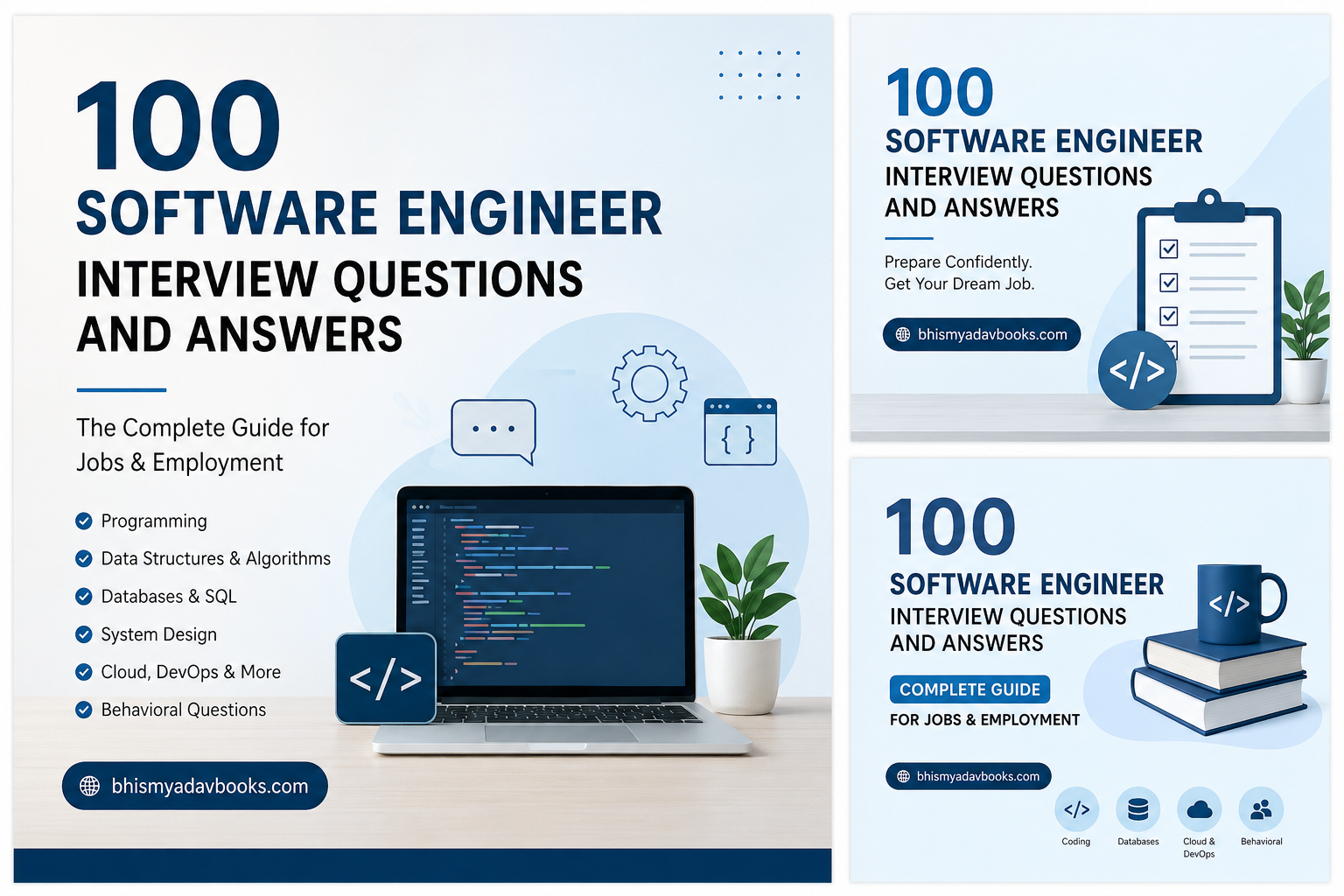
Software Engineer Interview Questions and Answers (2026) – A Complete Guide Freshers & Experienced Candidates can’t miss

Software Engineer Interview Questions and Answers

100 Software Engineer Interview Questions and Answers

Introduction

Software engineering is one of the fastest-growing and highest-paying professions in the technology industry. Every organization, from startups to multinational corporations, depends on skilled software engineers to design, develop, test, deploy, and maintain software applications. Companies such as Google, Microsoft, Amazon, Meta, Apple, Oracle, IBM, Salesforce, Adobe, Intel, and thousands of other organizations conduct rigorous interviews to identify candidates with strong technical and problem-solving abilities.

Preparing for a software engineer interview requires much more than learning a programming language. Interviewers evaluate candidates on data structures, algorithms, object-oriented programming, databases, operating systems, networking fundamentals, software development methodologies, cloud computing, debugging skills, and communication abilities.

This guide presents 100 carefully selected Software Engineer interview questions and answers designed for both freshers and experienced professionals. Each answer is concise, interview-focused, and easy to understand, making this guide ideal for campus placements, technical interviews, coding assessments, and job promotions.

We have some Amazing books in our Shop Page for you.


Software Engineer Interview Questions and Answers

Questions (1–25)

1. What is Software Engineering?

Answer:

Software engineering is the systematic process of designing, developing, testing, deploying, and maintaining software applications using engineering principles. It focuses on producing reliable, scalable, secure, and maintainable software.


2. What are the phases of the Software Development Life Cycle (SDLC)?

Answer:

The SDLC generally includes:

  • Requirement Analysis
  • Planning
  • Design
  • Development
  • Testing
  • Deployment
  • Maintenance

Each phase ensures software quality and minimizes project risks.


3. What is the difference between a program and software?

Answer:

A program is a collection of instructions that performs a specific task.

Software includes:

  • Programs
  • Documentation
  • Configuration files
  • Libraries
  • User manuals
  • Supporting components

Software is a complete solution, whereas a program is only one part of it.


4. What is Object-Oriented Programming (OOP)?

Answer:

Object-Oriented Programming is a programming paradigm based on objects containing data and methods.

Its four pillars are:

  • Encapsulation
  • Abstraction
  • Inheritance
  • Polymorphism

OOP improves code reuse, modularity, and maintainability.


5. Explain Encapsulation.

Answer:

Encapsulation is the process of hiding internal data by restricting direct access and allowing controlled access through methods such as getters and setters.

Benefits include:

  • Better security
  • Easier maintenance
  • Reduced complexity

6. What is Abstraction?

Answer:

Abstraction hides implementation details while exposing only essential functionality.

Example:

A user drives a car without understanding the internal engine mechanics.


7. What is Inheritance?

Answer:

Inheritance allows one class to inherit properties and methods from another class.

Advantages:

  • Code reuse
  • Reduced redundancy
  • Easier maintenance

8. Explain Polymorphism.

Answer:

Polymorphism means “many forms.”

It allows the same method to behave differently depending on the object.

Types include:

  • Compile-time polymorphism (Method Overloading)
  • Runtime polymorphism (Method Overriding)

9. What is the difference between an interface and an abstract class?

Answer:

Interface:

  • Contains method declarations
  • Supports multiple inheritance
  • Used for defining contracts

Abstract Class:

  • Can contain implemented methods
  • Supports partial abstraction
  • Suitable for shared functionality

10. What is a constructor?

Answer:

A constructor is a special method automatically executed when an object is created. It initializes object properties.


11. What is a destructor?

Answer:

A destructor releases resources when an object is destroyed.

Languages like C++ use destructors extensively for memory management.


12. What is recursion?

Answer:

Recursion is a technique where a function calls itself until a base condition is met.

Common examples include:

  • Factorial
  • Fibonacci
  • Tree traversal

13. What is a linked list?

Answer:

A linked list is a linear data structure where each node contains:

  • Data
  • Pointer to the next node

Advantages:

  • Dynamic memory allocation
  • Efficient insertion and deletion

14. Difference between an array and a linked list?

Answer:

Array:

  • Fixed size
  • Fast random access
  • Contiguous memory

Linked List:

  • Dynamic size
  • Sequential access
  • Better insertion/deletion

15. What is a stack?

Answer:

A stack follows the Last In First Out (LIFO) principle.

Operations:

  • Push
  • Pop
  • Peek

Applications:

  • Undo feature
  • Function calls
  • Expression evaluation

16. What is a queue?

Answer:

A queue follows the First In First Out (FIFO) principle.

Operations include:

  • Enqueue
  • Dequeue

Applications:

  • Scheduling
  • Printing jobs
  • Message queues

17. What is a binary tree?

Answer:

A binary tree is a hierarchical structure where each node has at most two children.

Types:

  • Full Binary Tree
  • Complete Binary Tree
  • Balanced Binary Tree
  • Binary Search Tree

18. What is a Binary Search Tree (BST)?

Answer:

In a BST:

  • Left subtree values are smaller.
  • Right subtree values are larger.

Searching has an average complexity of O(log n).


19. What is a graph?

Answer:

A graph consists of vertices connected by edges.

Applications include:

  • GPS navigation
  • Social media
  • Network routing
  • Recommendation systems

20. What is Big O notation?

Answer:

Big O notation measures algorithm efficiency.

Examples:

  • O(1)
  • O(log n)
  • O(n)
  • O(n log n)
  • O(n²)

Lower complexity generally means better performance.


21. What is a hash table?

Answer:

A hash table stores key-value pairs using a hash function for fast lookup.

Average complexity:

  • Search: O(1)
  • Insert: O(1)
  • Delete: O(1)

22. What is dynamic programming?

Answer:

Dynamic programming solves complex problems by storing solutions to overlapping subproblems.

Examples:

  • Fibonacci
  • Knapsack
  • Longest Common Subsequence

23. What is multithreading?

Answer:

Multithreading allows multiple threads to execute concurrently within a process.

Benefits include:

  • Better responsiveness
  • Improved CPU utilization
  • Parallel execution

24. What is a process?

Answer:

A process is an independent program in execution with its own memory space and resources.


25. Difference between a process and a thread?

Answer:

ProcessThread
Independent executionPart of a process
Separate memoryShared memory
Higher overheadLightweight
Slower creationFaster creation

100 Software Engineer Interview Questions and Answers (Part 2)

In Part 1, we covered the fundamentals of software engineering, object-oriented programming, data structures, algorithms, and processes. In this section, we’ll continue with Questions 26–50, focusing on databases, SQL, operating systems, networking, APIs, version control, software testing, and development methodologies.


Software Engineer Interview Questions and Answers (26–50)

Questions (26–50)

26. What is a database?

Answer:

A database is an organized collection of data that allows users to store, retrieve, update, and manage information efficiently. Databases are managed using a Database Management System (DBMS).

Popular databases include:

  • MySQL
  • PostgreSQL
  • Oracle Database
  • Microsoft SQL Server
  • MongoDB

27. What is DBMS?

Answer:

A Database Management System (DBMS) is software that enables users to create, manage, and manipulate databases.

Benefits include:

  • Data security
  • Data consistency
  • Backup and recovery
  • Concurrent access
  • Reduced redundancy

28. What is SQL?

Answer:

SQL (Structured Query Language) is the standard language used to communicate with relational databases.

Common SQL commands include:

  • SELECT
  • INSERT
  • UPDATE
  • DELETE
  • CREATE
  • ALTER
  • DROP

29. What is the difference between DELETE, TRUNCATE, and DROP?

Answer:

DELETETRUNCATEDROP
Removes selected rowsRemoves all rowsDeletes entire table
Can use WHERE clauseNo WHERE clauseRemoves table structure
Can be rolled back (depending on transaction support)Faster than DELETEDeletes data and schema

30. What is normalization?

Answer:

Normalization is the process of organizing database tables to minimize redundancy and improve data integrity.

Common normal forms include:

  • First Normal Form (1NF)
  • Second Normal Form (2NF)
  • Third Normal Form (3NF)
  • Boyce-Codd Normal Form (BCNF)

31. What is a primary key?

Answer:

A primary key uniquely identifies each record in a table.

Characteristics:

  • Unique
  • Cannot contain NULL values
  • One primary key per table

32. What is a foreign key?

Answer:

A foreign key is a column that establishes a relationship between two tables.

It ensures referential integrity by linking records across tables.


33. What are SQL joins?

Answer:

SQL joins combine data from multiple tables.

Types include:

  • INNER JOIN
  • LEFT JOIN
  • RIGHT JOIN
  • FULL OUTER JOIN
  • CROSS JOIN
  • SELF JOIN

34. What is indexing?

Answer:

An index improves the speed of data retrieval by creating a fast lookup structure.

Advantages:

  • Faster searches
  • Improved query performance

Disadvantages:

  • Additional storage
  • Slightly slower INSERT, UPDATE, and DELETE operations

35. What is ACID in databases?

Answer:

ACID properties ensure reliable transactions:

  • Atomicity – All operations succeed or none do.
  • Consistency – Database remains valid.
  • Isolation – Transactions do not interfere.
  • Durability – Committed data is permanently stored.

36. What is an operating system?

Answer:

An operating system (OS) is system software that manages computer hardware, memory, files, and processes while providing services for applications.

Examples:

  • Windows
  • Linux
  • macOS
  • Android

37. What is a deadlock?

Answer:

A deadlock occurs when two or more processes wait indefinitely for resources held by each other.

Deadlocks can be prevented using:

  • Resource ordering
  • Deadlock detection
  • Deadlock avoidance algorithms

38. What is virtual memory?

Answer:

Virtual memory allows a computer to use part of the hard drive or SSD as temporary RAM when physical memory is insufficient.

Benefits:

  • Run larger applications
  • Better multitasking
  • Efficient memory utilization

39. What is paging?

Answer:

Paging is a memory management technique that divides memory into fixed-size pages and frames, allowing efficient allocation and reducing fragmentation.


40. What is context switching?

Answer:

Context switching is the process of saving the state of one process or thread and loading another so the CPU can switch execution efficiently.


41. What is an IP address?

Answer:

An IP (Internet Protocol) address uniquely identifies a device on a network.

Types include:

  • IPv4
  • IPv6

42. What is the difference between TCP and UDP?

Answer:

TCPUDP
Connection-orientedConnectionless
ReliableFaster but less reliable
Error checkingMinimal error checking
Used for web browsing, emailUsed for streaming and gaming

43. What is DNS?

Answer:

DNS (Domain Name System) translates human-readable domain names into IP addresses.

Example:

www.example.com → 192.168.x.x


44. What is HTTP and HTTPS?

Answer:

HTTP is the protocol used to transfer web pages.

HTTPS is the secure version of HTTP that encrypts communication using SSL/TLS certificates.

HTTPS provides:

  • Encryption
  • Authentication
  • Data integrity

45. What is REST API?

Answer:

REST (Representational State Transfer) is an architectural style for designing web services.

Characteristics:

  • Stateless
  • Client-server architecture
  • Uses HTTP methods
  • Supports JSON and XML responses

46. What are common HTTP methods?

Answer:

Common HTTP methods include:

  • GET – Retrieve data
  • POST – Create data
  • PUT – Update an entire resource
  • PATCH – Partially update a resource
  • DELETE – Remove data

47. What is Git?

Answer:

Git is a distributed version control system used to track changes in source code and collaborate with other developers.

Common Git commands:

  • git init
  • git clone
  • git add
  • git commit
  • git push
  • git pull
  • git merge

48. What is GitHub?

Answer:

GitHub is a cloud-based platform that hosts Git repositories and provides collaboration features such as:

  • Pull Requests
  • Code Reviews
  • Issue Tracking
  • CI/CD Integration
  • Project Management

49. What is software testing?

Answer:

Software testing is the process of verifying that software functions correctly and meets specified requirements.

Objectives:

  • Detect defects
  • Improve quality
  • Verify functionality
  • Ensure reliability

50. What is the difference between Unit Testing, Integration Testing, System Testing, and Acceptance Testing?

Answer:

Testing TypePurpose
Unit TestingTests individual functions or components
Integration TestingVerifies interaction between modules
System TestingTests the complete application
Acceptance TestingConfirms software meets business requirements before release

Quick Interview Tips

Before attending a software engineer interview, remember to:

  • Strengthen your understanding of data structures and algorithms.
  • Practice SQL queries and database concepts.
  • Review operating system and networking fundamentals.
  • Build projects and upload them to GitHub.
  • Practice coding problems regularly.
  • Understand REST APIs and HTTP methods.
  • Learn Git workflows used in software teams.
  • Be prepared to explain your projects clearly.
  • Improve problem-solving and communication skills.
  • Stay updated with modern software development practices.

100 Software Engineer Interview Questions and Answers (Part 3)

In Part 2, we covered databases, SQL, operating systems, networking, REST APIs, Git, GitHub, and software testing. In Part 3, we’ll focus on modern software development concepts, including cloud computing, DevOps, software architecture, design patterns, security, Agile methodologies, and behavioral interview questions.


Software Engineer Interview Questions and Answers

Questions (51–75)

51. What is Cloud Computing?

Answer:

Cloud computing is the delivery of computing services such as servers, storage, databases, networking, software, and analytics over the internet instead of relying solely on local infrastructure.

Benefits include:

  • Scalability
  • Cost efficiency
  • High availability
  • Automatic updates
  • Disaster recovery

Popular cloud providers include Amazon Web Services (AWS), Microsoft Azure, and Google Cloud Platform (GCP).


52. What are the different cloud service models?

Answer:

The three primary cloud service models are:

  • Infrastructure as a Service (IaaS): Provides virtual machines, storage, and networking.
  • Platform as a Service (PaaS): Provides a development environment for building applications.
  • Software as a Service (SaaS): Delivers complete software applications over the internet.

53. What is DevOps?

Answer:

DevOps is a software development methodology that combines development and operations teams to improve collaboration, automate workflows, and accelerate software delivery.

Key goals include:

  • Continuous Integration
  • Continuous Deployment
  • Automation
  • Faster releases
  • Improved reliability

54. What is Continuous Integration (CI)?

Answer:

Continuous Integration is the practice of automatically building and testing code whenever developers commit changes to a shared repository.

Benefits include:

  • Early bug detection
  • Better code quality
  • Faster development
  • Reduced integration issues

55. What is Continuous Deployment (CD)?

Answer:

Continuous Deployment automatically releases tested code changes into production without manual intervention.

Advantages include:

  • Faster software delivery
  • Reduced manual effort
  • Frequent updates
  • Quick customer feedback

56. What is Docker?

Answer:

Docker is a containerization platform that packages an application along with its dependencies into lightweight, portable containers.

Benefits include:

  • Environment consistency
  • Fast deployment
  • Easy scalability
  • Simplified dependency management

57. What is Kubernetes?

Answer:

Kubernetes is an open-source platform used to automate the deployment, scaling, and management of containerized applications.

Key features:

  • Auto-scaling
  • Load balancing
  • Self-healing
  • Rolling updates
  • High availability

58. What is software architecture?

Answer:

Software architecture is the high-level design of a software system that defines its components, interactions, technologies, and overall structure.

A well-designed architecture improves:

  • Scalability
  • Maintainability
  • Security
  • Performance

59. What is a monolithic architecture?

Answer:

A monolithic architecture is a software design where all application components are tightly integrated into a single codebase.

Advantages:

  • Simple deployment
  • Easier development for small applications

Disadvantages:

  • Difficult scaling
  • Harder maintenance as the application grows

60. What are microservices?

Answer:

Microservices divide an application into small, independent services that communicate through APIs.

Advantages:

  • Independent deployment
  • Better scalability
  • Easier maintenance
  • Technology flexibility

61. What is an API?

Answer:

An Application Programming Interface (API) enables different software applications to communicate with each other.

APIs allow applications to:

  • Exchange data
  • Access services
  • Integrate functionality
  • Automate workflows

62. What is JSON?

Answer:

JSON (JavaScript Object Notation) is a lightweight format for exchanging data between applications.

Example:

{
  “name”: “Alice”,
  “age”: 25
}

JSON is easy to read and widely used in REST APIs.


63. What is XML?

Answer:

XML (Extensible Markup Language) is a markup language used for storing and transporting structured data.

Although JSON has become more popular, XML is still widely used in enterprise systems and web services.


64. What is software debugging?

Answer:

Debugging is the process of identifying, analyzing, and fixing software defects.

Common debugging methods include:

  • Breakpoints
  • Logging
  • Stack trace analysis
  • Code inspection
  • Unit testing

65. What is exception handling?

Answer:

Exception handling is the mechanism used to detect and manage runtime errors without terminating the program unexpectedly.

Typical keywords include:

  • try
  • catch
  • finally
  • throw

66. What is a design pattern?

Answer:

A design pattern is a proven solution to a commonly occurring software design problem.

Benefits:

  • Reusable solutions
  • Better maintainability
  • Cleaner code
  • Improved communication among developers

67. Name some commonly used design patterns.

Answer:

Popular design patterns include:

  • Singleton
  • Factory
  • Observer
  • Strategy
  • Builder
  • Adapter
  • Decorator
  • Command
  • MVC (Model-View-Controller)

68. What is the Singleton Pattern?

Answer:

The Singleton Pattern ensures that only one instance of a class exists throughout the application while providing a global access point.

Common use cases:

  • Logging
  • Configuration management
  • Database connections
  • Caching

69. What is software scalability?

Answer:

Scalability is the ability of a software system to handle increasing workloads efficiently.

Types:

  • Vertical Scaling (adding more resources to one machine)
  • Horizontal Scaling (adding more machines)

70. What is caching?

Answer:

Caching stores frequently accessed data in temporary memory for faster retrieval.

Benefits include:

  • Faster response times
  • Reduced database load
  • Improved user experience
  • Lower server costs

71. What is authentication?

Answer:

Authentication verifies the identity of a user before granting access.

Examples include:

  • Username and password
  • OTP verification
  • Biometrics
  • Multi-Factor Authentication (MFA)

72. What is authorization?

Answer:

Authorization determines what resources or actions an authenticated user is allowed to access.

Example:

  • Administrator
  • Manager
  • Employee
  • Guest

Each role has different permissions.


73. What is SQL Injection?

Answer:

SQL Injection is a security vulnerability where attackers insert malicious SQL statements into application inputs to manipulate the database.

Prevention methods:

  • Parameterized queries
  • Prepared statements
  • Input validation
  • Least-privilege database accounts

74. Explain Agile methodology.

Answer:

Agile is an iterative software development methodology that emphasizes collaboration, customer feedback, and incremental delivery.

Core principles include:

  • Short development cycles
  • Continuous improvement
  • Frequent releases
  • Team collaboration
  • Customer involvement

75. Describe a challenging project you worked on.

Answer:

A strong interview response should follow the STAR method:

  • Situation: Describe the project and context.
  • Task: Explain your responsibility.
  • Action: Describe the steps you took to solve the problem.
  • Result: Highlight measurable outcomes, such as improved performance, reduced costs, or successful project completion.

Example:

“I worked on developing an e-commerce web application that experienced slow response times during peak traffic. I analyzed database queries, implemented caching, optimized APIs, and reduced page load time by 40%, resulting in a significantly better user experience.”


Software Engineer Interview Preparation Tips

Recommended books for Software Engineer Interview:

Computer Fundamentals by Bhism Narayan Yadav

Software Engineering at Google by Titus Winters (Author), Tom Manshreck (Author), Hyrum Wright (Author)

To maximize your chances of success:

  • Practice coding problems daily on arrays, strings, linked lists, trees, graphs, and dynamic programming.
  • Strengthen your understanding of object-oriented programming concepts.
  • Learn SQL and database optimization techniques.
  • Build real-world projects using modern frameworks.
  • Understand REST APIs and cloud deployment basics.
  • Learn Git workflows and collaborative development practices.
  • Review system design fundamentals for experienced roles.
  • Practice explaining technical concepts clearly.
  • Participate in mock interviews.
  • Stay updated with current software development trends and best practices.

100 Software Engineer Interview Questions and Answers (Part 4)

In Part 3, we explored cloud computing, DevOps, software architecture, microservices, security, Agile methodologies, and behavioral interview questions. This final section covers Questions 76–100, focusing on advanced software engineering concepts, performance optimization, system design fundamentals, leadership, communication, and HR interview questions frequently asked in technical interviews.


Software Engineer Interview Questions and Answers

Questions (76–100)

76. What is time complexity?

Answer:

Time complexity measures the amount of time an algorithm takes to execute as the input size grows. It helps developers compare the efficiency of different algorithms.

Common complexities include:

  • O(1) – Constant time
  • O(log n) – Logarithmic time
  • O(n) – Linear time
  • O(n log n) – Linearithmic time
  • O(n²) – Quadratic time

Choosing efficient algorithms improves application performance, especially for large datasets.


77. What is space complexity?

Answer:

Space complexity measures the amount of memory an algorithm requires during execution.

Lower space complexity generally leads to better resource utilization, particularly in memory-constrained environments.


78. What is concurrency?

Answer:

Concurrency is the ability of a system to execute multiple tasks by making progress on each task during overlapping periods.

Benefits include:

  • Improved responsiveness
  • Better resource utilization
  • Efficient multitasking

Concurrency differs from parallelism, where tasks actually run simultaneously on multiple CPU cores.


79. What is synchronization?

Answer:

Synchronization ensures that multiple threads access shared resources safely without causing inconsistent data or race conditions.

Common synchronization mechanisms include:

  • Mutexes
  • Semaphores
  • Locks
  • Monitors

80. What is a race condition?

Answer:

A race condition occurs when multiple threads access and modify shared data simultaneously, causing unpredictable results.

It can be prevented using synchronization techniques and thread-safe programming practices.


81. What is load balancing?

Answer:

Load balancing distributes incoming requests across multiple servers to improve performance and availability.

Advantages include:

  • High availability
  • Fault tolerance
  • Better scalability
  • Improved response time

82. What is fault tolerance?

Answer:

Fault tolerance is the ability of a system to continue operating even when one or more components fail.

Techniques include:

  • Redundant servers
  • Automatic failover
  • Data replication
  • Backup systems

83. What is horizontal scaling?

Answer:

Horizontal scaling involves adding more servers to distribute workload.

Advantages:

  • Better scalability
  • High availability
  • Reduced single points of failure

84. What is vertical scaling?

Answer:

Vertical scaling increases the resources of an existing server by adding more CPU, RAM, or storage.

It is simple to implement but has hardware limitations.


85. What is software maintenance?

Answer:

Software maintenance refers to modifying and updating software after deployment to fix bugs, improve performance, and add new features.

Types include:

  • Corrective Maintenance
  • Adaptive Maintenance
  • Perfective Maintenance
  • Preventive Maintenance

86. What is code review?

Answer:

Code review is the process of examining another developer’s code before merging it into the main project.

Benefits include:

  • Improved code quality
  • Knowledge sharing
  • Early bug detection
  • Better maintainability

87. What are coding standards?

Answer:

Coding standards are guidelines that ensure code is readable, consistent, maintainable, and easy to understand across a development team.

Examples include:

  • Meaningful variable names
  • Proper indentation
  • Consistent formatting
  • Clear comments
  • Modular functions

88. What is refactoring?

Answer:

Refactoring is restructuring existing code without changing its external behavior.

Benefits:

  • Cleaner code
  • Reduced technical debt
  • Improved maintainability
  • Easier testing

89. What is technical debt?

Answer:

Technical debt refers to the future cost of choosing a quick or suboptimal solution instead of a better long-term approach.

Reducing technical debt improves software quality and lowers maintenance costs.


90. What is system design?

Answer:

System design is the process of defining the architecture, components, interfaces, and data flow of a software system to meet functional and non-functional requirements.

Important considerations include:

  • Scalability
  • Reliability
  • Availability
  • Security
  • Performance

91. How do you optimize application performance?

Answer:

Performance optimization techniques include:

  • Optimizing algorithms
  • Using efficient data structures
  • Database indexing
  • Caching frequently accessed data
  • Reducing network requests
  • Asynchronous processing
  • Load balancing
  • Code profiling

92. How do you handle production bugs?

Answer:

A structured approach includes:

  1. Reproduce the issue.
  2. Analyze logs and monitoring data.
  3. Identify the root cause.
  4. Implement and test the fix.
  5. Deploy the update safely.
  6. Monitor the application after deployment.
  7. Document lessons learned to prevent recurrence.

93. How do you prioritize multiple tasks?

Answer:

I prioritize tasks based on:

  • Business impact
  • Project deadlines
  • Customer requirements
  • Dependencies
  • Risk level

I also communicate regularly with stakeholders to adjust priorities when necessary.


94. How do you keep your technical knowledge up to date?

Answer:

I continuously improve my skills by:

  • Reading technical documentation
  • Completing online courses
  • Building personal projects
  • Following industry blogs
  • Participating in developer communities
  • Practicing coding challenges
  • Learning new frameworks and tools

95. Why do you want to work as a Software Engineer?

Answer:

“I enjoy solving complex problems, building useful applications, and continuously learning new technologies. Software engineering allows me to combine analytical thinking with creativity while developing solutions that positively impact users and businesses.”


96. Why should we hire you?

Answer:

“I have strong problem-solving skills, a solid understanding of software engineering fundamentals, and the ability to learn new technologies quickly. I work well in teams, communicate effectively, and focus on delivering high-quality, maintainable software.”


97. What are your strengths?

Answer:

Sample strengths include:

  • Analytical thinking
  • Problem-solving
  • Adaptability
  • Team collaboration
  • Continuous learning
  • Attention to detail
  • Time management
  • Communication skills

Support your answer with examples from academic projects or professional experience.


98. What is your biggest weakness?

Answer:

Choose a genuine but manageable weakness and explain how you are improving it.

Example:

“Earlier, I found it difficult to delegate tasks during team projects because I wanted to ensure everything met high standards. Over time, I learned to trust teammates, communicate expectations clearly, and collaborate more effectively.”


99. Where do you see yourself in five years?

Answer:

“In five years, I hope to become a highly skilled software engineer, contribute to large-scale projects, mentor junior developers, and continue learning advanced technologies such as cloud computing, artificial intelligence, and distributed systems.”


100. Do you have any questions for us?

Answer:

Always ask thoughtful questions, such as:

  • What technologies does your engineering team primarily use?
  • How do you support learning and professional development?
  • What does success look like for this role in the first six months?
  • How is code quality maintained within the team?
  • What are the biggest technical challenges the team is currently addressing?

Asking relevant questions demonstrates curiosity, preparation, and genuine interest in the role.


Final Software Engineer Interview Tips

To improve your chances of success, keep these points in mind:

  • Master programming fundamentals before learning advanced frameworks.
  • Practice coding problems consistently on arrays, strings, linked lists, trees, graphs, and dynamic programming.
  • Review object-oriented programming, databases, operating systems, and networking concepts.
  • Build real-world projects and host them on GitHub with clear documentation.
  • Learn Git workflows, REST APIs, cloud basics, and modern development tools.
  • Practice explaining your solutions aloud during mock interviews.
  • Prepare concise, structured answers for behavioral and HR questions.
  • Research the company, its products, and the job description before the interview.
  • Demonstrate strong communication, teamwork, and problem-solving skills.
  • Stay calm, think logically, and don’t hesitate to ask clarifying questions during technical interviews.

Frequently Asked Questions (FAQ)

1. What topics are most important for a Software Engineer interview?

The most important topics include programming, data structures, algorithms, object-oriented programming, SQL, operating systems, networking, system design, cloud computing, software testing, and behavioral interview questions.

2. How should freshers prepare for Software Engineer interviews?

Freshers should strengthen computer science fundamentals, practice coding problems daily, build personal projects, learn Git and SQL, and participate in mock interviews to improve confidence.

3. Are coding questions asked in every Software Engineer interview?

Most software engineering interviews include coding assessments or live coding rounds to evaluate problem-solving skills, algorithmic thinking, and code quality.

4. Which programming languages are commonly accepted in coding interviews?

Many companies allow candidates to use languages such as Java, Python, C++, JavaScript, or C#, provided the candidate is proficient in writing efficient and clean code.

5. How important are behavioral interview questions?

Behavioral questions are very important because employers assess communication, teamwork, adaptability, leadership, and problem-solving abilities in addition to technical skills.


Conclusion

Software engineering interviews assess much more than programming knowledge. Employers look for candidates who can analyze problems, write efficient and maintainable code, collaborate effectively, and adapt to new technologies. A balanced preparation strategy that combines coding practice, computer science fundamentals, system design concepts, project experience, and communication skills significantly increases your chances of success.

The 100 Software Engineer Interview Questions and Answers presented in this guide cover the most commonly tested topics in technical interviews, including programming fundamentals, object-oriented programming, data structures, algorithms, databases, SQL, operating systems, networking, cloud computing, DevOps, software architecture, security, testing, behavioral questions, and HR discussions.

Whether you are a fresher preparing for campus placements or an experienced professional seeking career growth, reviewing these questions regularly, practicing hands-on coding, and working on real-world projects will help you approach interviews with confidence.

Thank you for reading this guide on Bhism Yadav Books. We hope it helps you prepare effectively for your next software engineering interview and move one step closer to achieving your career goals.