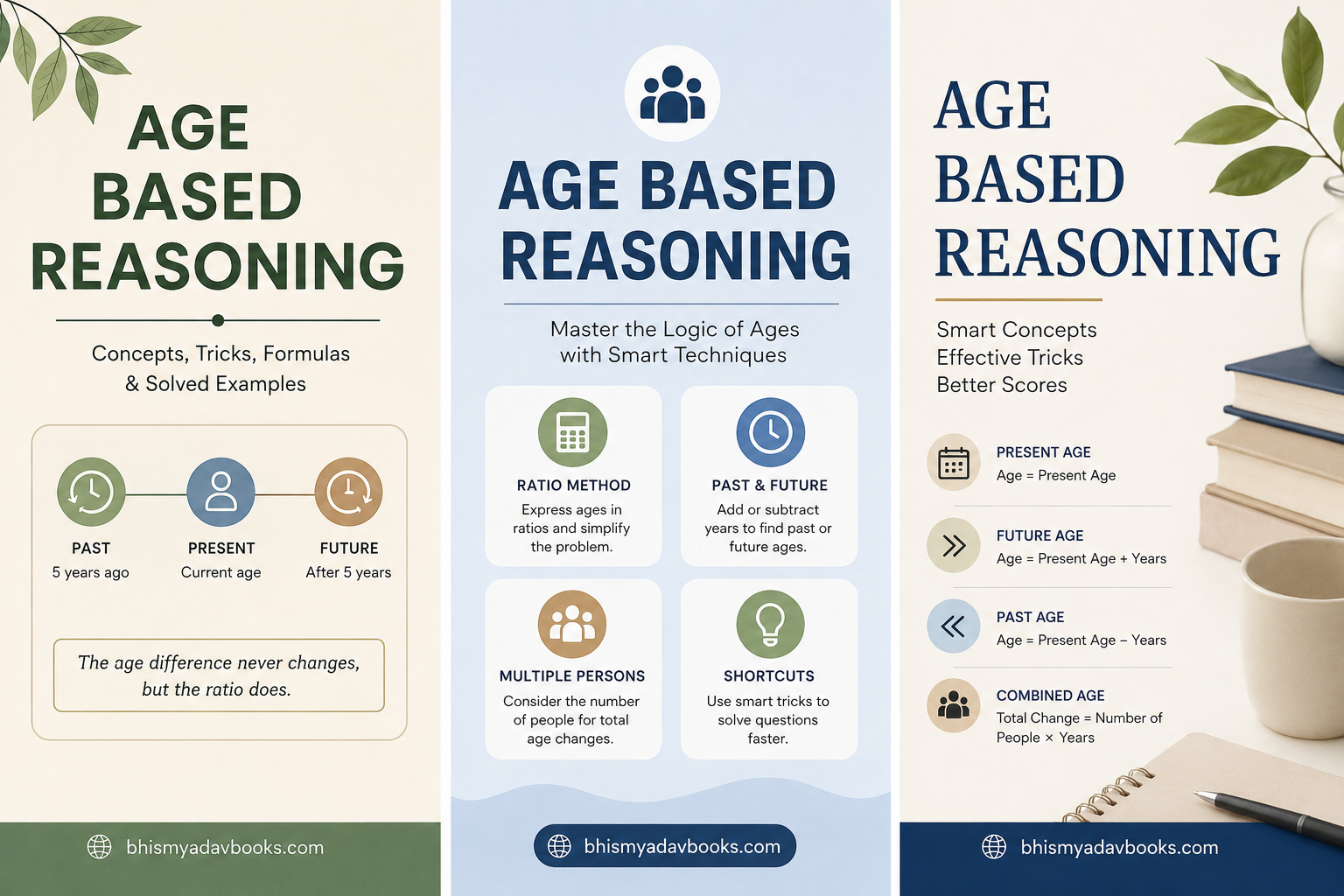
Introduction
Age Based Reasoning is one of the most important topics in Analytical Reasoning and appears regularly in competitive examinations such as SSC CGL, CHSL, Banking, Railway, UPSC, CAT, CUET, NDA, CDS, and State PSC exams. Although these questions seem mathematical, they mainly test logical thinking and relationship analysis.
Many students lose marks because they solve age questions using lengthy calculations instead of recognizing patterns. Once you understand a few basic formulas and logical shortcuts, most age problems can be solved within seconds.
We have some amazing books at our Shop page you may want to buy.
This guide explains everything from basic concepts to advanced techniques, including formulas, tricks, solved examples, and practice questions.
Table of Contents
Age Based Reasoning: Complete Guide to Solve Age Problems Quickly (Analytical Reasoning)
Why Age Based Reasoning is Important
Age questions are popular because they combine arithmetic with logical reasoning. Examiners use them to check whether candidates can interpret relationships involving:
- Present age
- Past age
- Future age
- Ratios of ages
- Differences between ages
- Family relationships
- Multiple-person comparisons
The good news is that almost every age question follows a limited number of patterns.
Exams Where Age Questions Appear
- SSC CGL
- SSC CHSL
- SSC MTS
- IBPS PO
- SBI Clerk
- RBI Assistant
- Railway RRB NTPC
- RRB Group D
- UPSC CSAT
- CAT
- CUET
- State PSC
- Police Recruitment Exams
- Defence Exams
Understanding the Basics of Age
Before solving questions, understand three simple principles.
Rule 1: Everyone’s age increases equally
After one year:
- Rahul: 20 → 21
- Priya: 25 → 26
The difference remains 5 years.
Rule 2: Age difference never changes
If two brothers differ by 7 years today, they differed by:
- 7 years five years ago
- 7 years now
- 7 years ten years later
This is the most important concept in age reasoning.
Rule 3: Ratios change over time
Suppose:
- Father = 40
- Son = 20
Ratio today:
40:20
After 20 years:
- Father = 60
- Son = 40
New ratio:
60:40=3:2
Notice that ratios change, but differences remain constant.
Common Terms Used in Age Questions
Understanding these phrases helps solve questions quickly.
| Phrase | Meaning |
| Present age | Current age |
| Five years ago | Subtract 5 |
| After six years | Add 6 |
| Twice the age | Multiply by 2 |
| Half the age | Divide by 2 |
| Ratio of ages | Compare ages |
| Difference | Subtract ages |
Basic Formulas for Age Based Reasoning
These formulas help solve most questions.
Formula 1: Future Age
Future Age=Present Age+n
Example:
Current age = 25
After 7 years:
25+7=32
Answer: 32 years
Formula 2: Past Age
Past Age=Present Age−n
Example:
Current age = 40
Eight years ago:
40−8=32
Answer: 32 years
Formula 3: Age Difference
Difference=Older−Younger
Example:
Father = 50
Son = 20
Difference:
50−20=30
Even after 15 years:
- Father = 65
- Son = 35
Difference remains:
30
Formula 4: Using Ratios
Suppose two ages are in ratio:
3:5
Let ages be:
- 3x
- 5x
Difference:
2x
If actual difference is 10:
2x=10
Actual ages:
- 15
- 25
Step-by-Step Method for Solving Age Questions
Instead of guessing, follow this process.
Step 1
Identify whose ages are involved.
Step 2
Decide whether the question refers to:
- Present
- Past
- Future
Step 3
Assign variables.
Example:
Rahul’s age = x
Step 4
Write equations.
Step 5
Solve systematically.
Type 1: Present Age Questions
These are the easiest.
Example 1
Rahul is 18 years old.
What will be his age after 12 years?
Solution:
18+12=30
Answer: 30 years
Example 2
Priya is 32 years old.
What was her age 9 years ago?
Solution:
32−9=23
Answer: 23 years
Type 2: Difference-Based Questions
Remember:
Difference never changes.
Example 3
A father is 42 years old.
His son is 15 years old.
What will be their age difference after 20 years?
Current difference:
42−15=27
Future difference:
Still 27 years
Answer: 27 years
Example 4
Two sisters differ by 9 years.
If the elder sister is 35 years old now, how old is the younger sister?
35−9=26
Answer: 26 years
Type 3: Two-Person Age Problems
Example 5
Rahul is twice as old as Aman.
The sum of their ages is 36.
Find their present ages.
Let:
Aman’s age = x
Rahul’s age = 2x
Equation:
x+2x=36
3x=36
x=12
Therefore:
- Aman = 12
- Rahul = 24
Answer: 12 years and 24 years
Example 6
A mother is three times as old as her daughter.
Their total age is 48.
Find both ages.
Let daughter = x
Mother = 3x
Equation:
4x=48
x=12
Mother:
36
Answer:
- Daughter = 12
- Mother = 36
Type 4: Past Age Questions
These require careful reading.
Example 7
Five years ago, Rahul’s age was twice Aman’s age.
Today Aman is 12.
Find Rahul’s present age.
Five years ago:
Aman:
12−5=7
Rahul:
2×7=14
Present Rahul:
14+5=19
Answer: 19 years
Example 8
Ten years ago, a father’s age was four times his son’s age.
Today the son is 20.
Find the father’s present age.
Ten years ago:
Son:
20−10=10
Father:
4×10=40
Present father:
50
Answer: 50 years
Type 5: Future Age Questions
Example 9
After 6 years, Rahul will be twice Aman’s age.
Aman is 10 now.
Find Rahul’s present age.
After 6 years:
Aman:
16
Rahul then:
32
Present Rahul:
32−6=26
Answer: 26 years
Example 10
Eight years later, a mother’s age will be three times her daughter’s age.
The daughter is currently 12.
Find the mother’s present age.
Future daughter:
20
Future mother:
60
Present mother:
52
Answer: 52 years
Quick Tricks for Faster Calculation
Competitive exams require speed.
Trick 1: Never Recalculate Differences
Example:
Father = 48
Son = 18
Difference = 30
After 50 years?
Still 30
No calculation needed.
Trick 2: Convert Ratios into Variables
Instead of guessing.
Ratio:
4:7
Write:
- 4x
- 7x
This method works every time.
Trick 3: Move Together in Time
Instead of calculating separately.
Example:
Five years later:
- Add 5 to everyone.
Three years ago:
- Subtract 3 from everyone.
This avoids mistakes.
Common Mistakes to Avoid
Many candidates lose marks because of small errors.
- Forgetting to change everyone’s age equally.
- Assuming ratios remain constant.
- Recalculating age differences unnecessarily.
- Ignoring present, past, and future timelines.
- Solving without assigning variables.
Avoiding these mistakes alone can significantly improve your accuracy.
Practice Questions (Basic Level)
Try solving these before checking later parts.
Question 1
Riya is 14 years old. What will be her age after 9 years?
Question 2
A father is 46 years old and his son is 18 years old. What is their age difference?
Question 3
Two brothers differ by 11 years. The elder brother is 30 years old. Find the younger brother’s age.
Question 4
Rahul is twice as old as Aman. Their total age is 42 years. Find both ages.
Question 5
Five years ago, Meena was 15 years old. What is her present age?
Ratio-Based Age Problems
Ratio-based questions are among the most frequently asked age problems in competitive exams. Instead of actual ages, the examiner gives a ratio, and you must determine the real ages.
Standard Method
Suppose the ratio of two people’s ages is:
3:5
Represent them as:
- First person = 3x
- Second person = 5x
Once you find the value of xxx, both ages become easy.
Example 1
The ratio of Rahul’s age to Aman’s age is 4:7. Their age difference is 15 years. Find their present ages.
Solution
Assume:
- Rahul = 4x
- Aman = 7x
Difference:
7x−4x=15
3x=15
x=5
Therefore,
- Rahul = 20 years
- Aman = 35 years
Answer: Rahul = 20 years, Aman = 35 years.
Example 2
The ages of two sisters are in the ratio 5:8. Their total age is 65 years.
Solution
Let their ages be:
- 5x
- 8x
Total:
13x=65
Actual ages:
- Younger = 25
- Elder = 40
Answer: 25 years and 40 years.
Shortcut for Ratio Questions
Follow these three steps:
- Write ages as multiples of x.
- Use the given sum or difference.
- Solve for x.
This method avoids unnecessary calculations.
Family Age Reasoning
Family-based age questions combine age calculations with relationships.
Common family members include:
- Father
- Mother
- Son
- Daughter
- Brother
- Sister
- Grandfather
These questions usually involve:
- Sum of ages
- Multiples
- Past relationships
- Future relationships
Example 3
A father is three times as old as his son. Their total age is 64 years.
Solution
Let son’s age = x
Father’s age = 3x
4x=64
x=16
Therefore,
- Son = 16 years
- Father = 48 years
Answer: Father = 48 years, Son = 16 years.
Example 4
A mother is 28 years older than her daughter.
If the daughter is 18 years old, find the mother’s age.
Solution
18+28=46
Answer: Mother is 46 years old.
Family Questions with Past Age
These questions require shifting everyone backward equally.
Example 5
Eight years ago, a father was four times as old as his son.
Today the son is 20 years old.
Find the father’s present age.
Solution
Son’s age eight years ago:
20−8=12
Father’s age then:
4×12=48
Present father’s age:
48+8=56
Answer: 56 years.
Family Questions with Future Age
Example 6
After 10 years, a mother will be twice her daughter’s age.
The daughter is currently 15 years old.
Find the mother’s present age.
Solution
After 10 years:
Daughter = 25
Mother then = 50
Present mother:
50−10=40
Answer: Mother = 40 years.
Age Problems Using Equations
Many exam questions become easier if you form equations instead of guessing.
Example 7
Rahul’s age is 5 years more than Aman’s age.
Together they are 41 years old.
Find their ages.
Solution
Let Aman = x
Rahul = x+5
Equation:
x+x+5=41
2x=36
2x=36
x=18
Therefore,
- Aman = 18
- Rahul = 23
Answer: Aman = 18 years, Rahul = 23 years.
Example 8
The difference between two brothers is 6 years.
Their total age is 42 years.
Find both ages.
Solution
Let younger = xxx
Elder = x+6
Equation:
2x+6=42
2x=36
x=18
Therefore,
- Younger = 18
- Elder = 24
Answer: 18 years and 24 years.
Consecutive Age Relationships
Sometimes questions describe relationships across different time periods.
Example phrases include:
- Three years ago
- Five years later
- Twice the age then
- Half the age now
Draw a simple timeline mentally.
Example:
| Time | Rahul | Aman |
| 5 years ago | ? | ? |
| Present | ? | ? |
| 5 years later | ? | ? |
This makes complex questions easier.
Example 9
Five years ago, Rahul was twice Aman’s age.
Today Aman is 17 years old.
Find Rahul’s present age.
Solution
Aman five years ago:
17−5=12
Rahul then:
24
Present Rahul:
29
Answer: Rahul = 29 years.
Difference and Ratio Combined Questions
These are very common in SSC and Banking exams.
Example 10
The ratio of father and son’s ages is 7:3.
Their age difference is 24 years.
Find both ages.
Solution
Let ages be:
- Father = 7x
- Son = 3x
Difference:
4x=24
x=6
Therefore,
- Father = 42
- Son = 18
Answer: Father = 42 years, Son = 18 years.
Example 11
The ratio of two friends’ ages is 9:5.
The elder is 20 years older.
Find both ages.
Solution
Difference:
9x−5x=20
4x=20
4x=20
x=5
Ages:
- Younger = 25
- Elder = 45
Answer: 25 years and 45 years.
Three-Person Age Problems
Questions involving three people are increasingly common.
Example 12
The ages of A, B, and C are in the ratio:
2:3:5
Their total age is 100 years.
Solution
Total ratio:
2+3+5=10
One part:
100÷10=10
Ages:
- A = 20
- B = 30
- C = 50
Answer: 20 years, 30 years, and 50 years.
Example 13
Three brothers have ages in the ratio 3:4:5.
The youngest is 15 years old.
Find the other two.
Solution
Youngest:
3x=15
x=5
Remaining ages:
- Middle = 20
- Elder = 25
Answer: 20 years and 25 years.
Advanced Equation Method
Some questions require two equations.
Example 14
Rahul is 6 years older than Aman.
Five years later, Rahul will be 1.5 times Aman’s age.
Solution
Let Aman = x
Rahul = x+6
After five years:
x+11=1.5(x+5)
Multiply by 2:
2x+22=3x+15
x=7
Therefore,
- Aman = 7
- Rahul = 13
Check:
After five years:
- Aman = 12
- Rahul = 18
18=1.5×12
Correct.
Mental Calculation Tricks
These shortcuts save valuable exam time.
Trick 1: Fixed Difference Rule
If the difference is given, never calculate it again.
Example:
Father = 55
Son = 25
Difference:
30 forever.
Trick 2: Ratio Shortcut
Ratio:
6:9
Difference:
3 parts.
If difference is 21:
One part:
7
Actual ages:
- 42
- 63
Trick 3: Sum Shortcut
Ratio:
2:5
Total:
56
Total ratio:
7
One part:
8
Ages:
- 16
- 40
Exam-Level Solved Questions
SSC Style Question
The ratio of a mother’s age to her son’s age is 11:4.
After 8 years, the ratio becomes 19:8.
Find their present ages.
Solution
Present ages:
- Mother = 11x
- Son = 4x
After eight years:
11x+8/4x+8=19/8
Cross multiplication:
8(11x+8)=19(4x+8)
88x+64=76x+152
12x=88
x=22/3
Present ages:
- Mother = 242/3 years
- Son = 88/3 years
This type demonstrates why equation methods are essential.
Banking Style Question
A father is 30 years older than his daughter.
After 15 years, he will be twice her age.
Solution
Let daughter’s present age = xxx
Father = x+30
After 15 years:
x+45=2(x+15)
x=15
Father = 45
Answer: Daughter = 15 years, Father = 45 years.
Common Patterns in Competitive Exams
| Pattern | Frequency |
| Sum and Ratio | Very High |
| Difference and Ratio | Very High |
| Father-Son | High |
| Mother-Daughter | High |
| Past Age | High |
| Future Age | High |
| Three Persons | Medium |
| Multiple Equations | Medium |
Practice Questions (Intermediate Level)
Try solving these without looking at the solutions.
Question 1
The ratio of two brothers’ ages is 5:7. Their difference is 12 years. Find both ages.
Question 2
A mother is 32 years older than her daughter. After 8 years, what will be their age difference?
Question 3
Five years ago, a father was three times his son’s age. The son is now 20 years old. Find the father’s present age.
Question 4
The ages of three friends are in the ratio 2:4:6. Their total age is 72 years. Find their ages.
Question 5
Rahul is 8 years older than Aman. Together they are 46 years old. Find both ages.
Mixed Timeline Age Problems
These questions involve both past and future conditions. The key is to create a timeline.
Timeline Method
Instead of solving directly, visualize three stages.
| Time | Example |
| Past | 5 years ago |
| Present | Current age |
| Future | After 8 years |
This simple table prevents calculation mistakes.
Example 1
Five years ago, Rahul was three times Aman’s age. After five years from now, Rahul will be twice Aman’s age.
Find their present ages.
Solution
Let present ages be:
- Rahul = R
- Aman = A
Five years ago:
R−5=3(A−5)
R=3A−10
Five years later:
R+5=2(A+5)
R=2A+5
Now equate both:
3A−10=2A+5
Then,
R=35
Answer: Rahul = 35 years, Aman = 15 years.
Shortcut for Mixed Timeline Questions
- Write present ages as variables.
- Convert every statement into an equation.
- Solve simultaneously.
Never calculate mentally when two timelines are involved.
Reverse Age Questions
Reverse age questions ask you to work backward from a future or past relationship.
Example 2
After 8 years, a father will be three times his son’s age.
Today the father is 44 years old.
Find the son’s present age.
Solution
Father after 8 years:
44+8=52
Son after 8 years:
52/3
Present son’s age:
52/3−8=28/3
This illustrates why equation methods are often safer.
Alternative equation:
Let son’s age = xxx.
After eight years:
44+8=3(x+8)
52=3x+24
3x=28
x=28/3
Example 3
Ten years ago, a mother was four times her daughter’s age.
Today the mother is 42 years old.
Find the daughter’s present age.
Solution
Mother ten years ago:
32
Daughter then:
8
Present daughter:
18
Answer: Daughter = 18 years.
Multiple Generation Problems
Questions involving grandfather, father, and son are common in reasoning exams.
Example 4
Grandfather, father, and son have ages in the ratio:
8:5:2
Their total age is 105 years.
Solution
Total ratio:
8+5+2=15
One part:
105÷15=7
Actual ages:
- Grandfather = 56
- Father = 35
- Son = 14
Answer: 56 years, 35 years, and 14 years.
Example 5
A grandfather is 30 years older than the father.
The father is 24 years older than the son.
The son’s age is 16 years.
Find all ages.
Solution
Son:
16
Father:
16+24=40
Grandfather:
40+30=70
Answer: Son = 16 years, Father = 40 years, Grandfather = 70 years.
Advanced Equation-Based Problems
Some questions involve fractional relationships.
Example 6
Rahul’s age is two-thirds of Aman’s age.
Their total age is 75 years.
Solution
Let Aman = 3x
Rahul = 2x
5x=75
x=15
Ages:
- Rahul = 30
- Aman = 45
Answer: Rahul = 30 years, Aman = 45 years.
Fraction-Based Shortcut
Whenever you see:
- Half
- One-third
- Two-thirds
- Three-fourths
Convert directly into ratios.
Example:
Two-thirds becomes:
2:3
SSC Level Age Problems
These questions resemble actual SSC exams.
Example 7
The ratio of a father’s age to his son’s age is 9:4.
Eight years later, the ratio becomes 2:1.
Find their present ages.
Solution
Present ages:
- Father = 9x
- Son = 4x
Future equation:
9x+8/4x+8=2
Cross multiply:
9x+8=8x+16
Present ages:
- Father = 72
- Son = 32
Check:
After 8 years:
- Father = 80
- Son = 40
Ratio:
80:40=2:1
Correct.
Example 8
A man’s age is five times his son’s age.
After 15 years, it will become twice his son’s age.
Find both ages.
Solution
Let son’s age = x
Man = 5x
Future equation:
5x+15=2(x+15)
3x=15
Ages:
- Son = 5
- Man = 25
Banking Exam Age Questions
Banking exams often combine ratios with future conditions.
Example 9
The present ages of A and B are in the ratio 7:5.
After 6 years, the ratio becomes 13:10.
Find their present ages.
Solution
Present:
- A = 7x
- B = 5x
Future equation:
7x+6/5x+6=13/10
Cross multiply:
70x+60=65x+78
5x=18
This demonstrates why some banking questions produce fractional values.
The method remains the same regardless of complexity.
CAT Style Logical Age Problems
CAT questions often require logical interpretation instead of direct formulas.
Example 10
Three friends have a combined age of 90 years.
Five years ago, their combined age was 75 years.
How many friends are there?
Solution
Difference:
90−75=15
Each person lost 5 years.
15÷5=3
Answer: 3 friends.
This shortcut is frequently useful.
Combined Age Trick
Whenever every person’s age changes by the same number of years:
Number of Persons=Total Change/Years Shift
Example:
Total increased by 20 over 5 years.
20÷5=4
There are 4 people.
Multiple Person Timeline Questions
Example 11
The sum of four siblings’ ages is 64 years.
After 3 years, what will be their combined age?
Solution
Increase:
4×3=12
Future total:
64+12=76
Answer: 76 years.
Example 12
The combined age of six students is 96 years.
Five years ago, what was their total age?
Solution
Reduction:
6×5=30
Past total:
96−30=66
Answer: 66 years.
Fast Mental Tricks
These shortcuts improve speed during exams.
Trick 1: Difference Never Changes
Example:
Mother = 48
Daughter = 18
Difference:
30 forever.
Trick 2: Sum Changes with Number of Persons
Example:
Three people.
After 8 years:
Increase:
3×8=24
Simply add 24.
Trick 3: Convert Words into Ratios
| Words | Ratio |
| Twice | 2:1 |
| Thrice | 3:1 |
| Half | 1:2 |
| Two-thirds | 2:3 |
| Three-fourths | 3:4 |
This saves time.
Common Trap Questions
These questions often confuse candidates.
Trap 1: Ratio Changes
Question:
Father is twice the son’s age today.
Will he always remain twice?
No.
Ratios change over time.
Trap 2: Difference Changes?
No.
Differences remain constant.
Trap 3: Total Age Questions
Always count how many people are included.
Example:
Five people.
After 4 years:
Increase:
5×4=205
Many students mistakenly add only 4.
Advanced Practice Set
Question 1
The ratio of two sisters’ ages is 3:7.
Their difference is 20 years.
Find both ages.
Question 2
Five years ago, a father was four times his son’s age.
Today the son is 18 years old.
Find the father’s present age.
Question 3
Three brothers have ages in the ratio:
2:5:7
Their total age is 98 years.
Find each age.
Question 4
After 10 years, a mother’s age will be twice her daughter’s age.
The daughter is currently 14 years old.
Find the mother’s present age.
Question 5
A family of four has a combined age of 120 years.
What will be their combined age after 7 years?
Question 6
Rahul is 12 years older than Aman.
Five years later, Rahul will be 1.5 times Aman’s age.
Find their present ages.
Question 7
The ages of A and B are in the ratio 5:9.
Their total age is 84 years.
Find both ages.
Question 8
A grandfather is 32 years older than the father.
The father is 27 years older than the grandson.
If the grandson is 15 years old, find everyone’s age.
Question 9
Six years ago, a man’s age was three times his son’s age.
Today the son’s age is 18 years.
Find the man’s present age.
Question 10
The combined age of five friends is 125 years.
What was their combined age 8 years ago?
Age Based Reasoning Practice Questions
Question 1
The present ages of A and B are in the ratio 3:5. If their total age is 64 years, find their ages.
Solution
Let their ages be:
- A = 3x
- B = 5x
Therefore:
3x + 5x = 64
8x = 64
x = 8
Therefore:
A = 24 years
B = 40 years
Answer: 24 years and 40 years
Question 2
A father is 30 years older than his son. If the son’s present age is 16 years, find the father’s age.
Solution
Father’s age:
16 + 30 = 46
Answer: 46 years
Question 3
A mother is four times as old as her daughter. Their combined age is 50 years. Find their ages.
Solution
Let daughter’s age = x.
Mother’s age = 4x.
Therefore:
x + 4x = 50
5x = 50
x = 10
Mother = 40 years.
Answer: Daughter = 10 years, Mother = 40 years
Question 4
Ten years ago, a father was three times as old as his son. The son is currently 20 years old. Find the father’s present age.
Solution
Son’s age ten years ago:
20 – 10 = 10
Father’s age then:
3 × 10 = 30
Present father’s age:
30 + 10 = 40
Answer: 40 years
Question 5
After eight years, Rahul will be twice as old as Aman. Aman is currently 12 years old. Find Rahul’s present age.
Solution
Aman’s age after eight years:
12 + 8 = 20
Rahul’s age then:
2 × 20 = 40
Rahul’s present age:
40 – 8 = 32
Answer: 32 years
Question 6: Ratio and Difference
The ratio of the ages of two brothers is 5:8. Their age difference is 15 years. Find their ages.
Solution
Difference in ratio:
8 – 5 = 3 parts
Therefore:
3x = 15
x = 5
Ages:
5 × 5 = 25
8 × 5 = 40
Answer: 25 years and 40 years
Question 7: Ratio and Sum
The ages of two friends are in the ratio 4:7. Their combined age is 55 years. Find their ages.
Solution
Total ratio:
4 + 7 = 11
One part:
55 ÷ 11 = 5
Ages:
4 × 5 = 20
7 × 5 = 35
Answer: 20 years and 35 years
Question 8: Three Persons
The ages of A, B, and C are in the ratio 2:3:5. Their total age is 80 years. Find their individual ages.
Solution
Total ratio:
2 + 3 + 5 = 10
One part:
80 ÷ 10 = 8
Therefore:
- A = 16
- B = 24
- C = 40
Answer: 16 years, 24 years, and 40 years
Question 9: Combined Age
The combined age of four friends is 100 years. What will be their combined age after 6 years?
Solution
Four people will each become six years older.
Increase:
4 × 6 = 24
Future combined age:
100 + 24 = 124
Answer: 124 years
Question 10: Past Combined Age
The combined age of five family members is 150 years. What was their combined age eight years ago?
Solution
Decrease:
5 × 8 = 40
Past combined age:
150 – 40 = 110
Answer: 110 years
Question 11: Father and Son
A father is twice as old as his son. Their combined age is 63 years. Find their ages.
Solution
Son = x
Father = 2x
x + 2x = 63
3x = 63
x = 21
Father:
2 × 21 = 42
Answer: Son = 21 years, Father = 42 years
Question 12: Mother and Daughter
A mother is 24 years older than her daughter. After six years, the mother will be twice her daughter’s age. Find their present ages.
Solution
Let daughter = x.
Mother = x + 24.
After six years:
Mother = x + 30
Daughter = x + 6
According to the question:
x + 30 = 2(x + 6)
x + 30 = 2x + 12
x = 18
Therefore:
Daughter = 18
Mother = 42
Answer: Daughter = 18 years, Mother = 42 years
Question 13: Two Different Time Periods
Five years ago, A was twice as old as B. Five years from now, A will be 1.5 times as old as B. Find their present ages.
Solution
Let present ages be A and B.
Five years ago:
A – 5 = 2(B – 5)
A = 2B – 5
Five years later:
A + 5 = 1.5(B + 5)
A + 5 = 1.5B + 7.5
A = 1.5B + 2.5
Equating:
2B – 5 = 1.5B + 2.5
0.5B = 7.5
B = 15
A = 25
Answer: A = 25 years, B = 15 years
Question 14: Grandfather, Father and Son
A grandfather is twice as old as his son. The son is twice as old as his own son. If the grandson is 12 years old, find the ages of the father and grandfather.
Solution
Grandson:
12 years
Father:
2 × 12 = 24 years
Grandfather:
2 × 24 = 48 years
Answer: Grandson = 12 years, Father = 24 years, Grandfather = 48 years
Question 15: Age Difference
A father and son have an age difference of 32 years. What will their age difference be after 15 years?
Solution
Age difference does not change.
Answer: 32 years
Question 16: Future Ratio
The present ages of A and B are in the ratio 3:4. After 5 years, their ages will be in the ratio 4:5. Find their present ages.
Solution
Let ages be:
A = 3x
B = 4x
After five years:
3x + 5 and 4x + 5
According to the question:
[
{3x+5}/{4x+5}=4/5
]
Cross multiplication:
15x + 25 = 16x + 20
x = 5
Therefore:
A = 15
B = 20
Answer: 15 years and 20 years
Question 17: Past Ratio
Eight years ago, the ratio of A’s age to B’s age was 3:2. Their present age difference is 12 years. Find their present ages.
Solution
The age difference remains 12 years.
Eight years ago, ages can be represented as:
3x and 2x.
Difference:
x = 12
Therefore, eight years ago:
A = 36
B = 24
Present ages:
A = 44
B = 32
Answer: A = 44 years, B = 32 years
Question 18: Consecutive Age
A is 7 years older than B. B is 5 years older than C. If C is 18 years old, find the ages of A and B.
Solution
C = 18
B:
18 + 5 = 23
A:
23 + 7 = 30
Answer: A = 30 years, B = 23 years, C = 18 years
Question 19: Average Age
The average age of five students is 18 years. Find their total age.
Solution
Total age:
Average × Number of students
18 × 5 = 90
Answer: 90 years
Question 20: Average Age After Several Years
The average age of six students is 20 years. What will their average age be after four years?
Solution
Every student becomes four years older.
Therefore, average age also increases by four.
20 + 4 = 24
Answer: 24 years
Important Age Reasoning Shortcuts
Knowing formulas is useful, but knowing shortcuts can make your calculations faster.
Shortcut 1: Age Difference Is Constant
If:
Father = 50
Son = 20
Difference = 30
After 10 years:
60 – 30 = 30
Therefore, never waste time recalculating the difference.
Shortcut 2: Total Age Changes According to Number of People
If there are 7 people and 5 years pass:
Increase:
7 × 5 = 35
This is particularly useful in questions involving families, teams, students, or groups.
Shortcut 3: Ratio + Difference
Suppose ratio is:
3:7
Difference:
20
Difference in ratio:
7 – 3 = 4
Therefore:
4x = 20
x = 5
Actual ages:
15 and 35.
Shortcut 4: Ratio + Sum
Suppose ratio is:
4:6
Total:
70
Total ratio:
10
One part:
7
Ages:
28 and 42.
Age Reasoning Cheat Sheet
Use this section for quick revision before an examination.
Present Age
[
Present\ Age = Age
]
Future Age
[
Future\ Age = Present\ Age + Years
]
Past Age
[
Past\ Age = Present\ Age – Years
]
Age Difference
[
Difference = Older\ Age – Younger\ Age
]
Ratio Method
If ratio is:
[
a:b
]
Then ages are:
[
ax,\ bx
]
Ratio + Difference
[
(a-b)x = Difference
]
Ratio + Sum
[
(a+b)x = Sum
]
Combined Future Age
[
Future\ Total = Present\ Total + (Number\ of\ People \times Years)
]
Combined Past Age
[
Past\ Total = Present\ Total – (Number\ of\ People \times Years)
]
Most Important Rules to Remember
Rule 1: Age Difference Never Changes
This is the foundation of almost every age problem.
Rule 2: Everyone Ages at the Same Rate
One year passing means everyone’s age increases by exactly one year.
Rule 3: Ratios Change
Do not assume that a present age ratio remains the same in the future.
Rule 4: Convert Relationships into Equations
Words such as:
- Twice
- Thrice
- Half
- Older than
- Younger than
- Five years ago
- Ten years later
should immediately be converted into mathematical expressions.
Rule 5: Read the Time Reference Carefully
“Five years ago” and “after five years” are completely different.
Rule 6: Count All People
In combined-age questions, the number of people determines how much the total age changes.
Common Mistakes in Age Based Reasoning
Mistake 1: Treating Ratio as Constant
If father and son’s present ages are 40 and 20, their ratio is 2:1.
After 10 years:
50:30 = 5:3.
Therefore, the ratio changes.
Mistake 2: Changing Age Difference
If two people have a difference of 15 years today, their difference remains 15 years forever.
Mistake 3: Forgetting to Adjust Both Ages
If a question says “five years ago,” subtract five from everyone’s age.
If it says “after five years,” add five to everyone’s age.
Mistake 4: Ignoring Units
Age questions normally use years. Keep calculations consistent.
Mistake 5: Solving Complex Problems Mentally
For questions involving two or more time periods, variables and equations are safer.
How to Improve Speed in Age Questions
A good approach is to practice questions according to difficulty.
Level 1: Basic
Practice:
- Present age
- Past age
- Future age
- Age difference
Level 2: Intermediate
Practice:
- Ratios
- Sum of ages
- Difference and ratio
- Father-son problems
- Mother-daughter problems
Level 3: Advanced
Practice:
- Multiple people
- Multiple generations
- Two timelines
- Past and future ratios
- Simultaneous equations
Exam Strategy for Age Based Reasoning
When you see an age question in an examination, do not immediately start calculating.
First identify the type of question.
Ask yourself:
- Is a ratio given?
- Is a difference given?
- Is a total given?
- Is the question about the past?
- Is the question about the future?
- Are multiple people involved?
- Is an equation required?
Once the pattern is identified, the solution is usually straightforward.
10-Second Identification Technique
If you see “ratio + sum”
Use:
[
(a+b)x=Sum
]
If you see “ratio + difference”
Use:
[
(a-b)x=Difference
]
If you see “years ago”
Subtract.
If you see “years later”
Add.
If you see “combined age”
Multiply the time change by the number of people.
If you see “age difference”
Remember that it remains constant.
Final Practice Test
Try solving these questions without looking at the answers.
1.
The ages of A and B are in the ratio 5:6. Their difference is 8 years. Find their ages.
2.
A father is 35 years older than his son. The son is 15 years old. Find the father’s age.
3.
A mother is three times her daughter’s age. Their total age is 48 years. Find their ages.
4.
Eight years ago, a father was four times his son’s age. The son is currently 16. Find the father’s present age.
5.
After 12 years, A will be twice as old as B. B is currently 14. Find A’s present age.
6.
Three people have ages in the ratio 2:3:4. Their total age is 72. Find their ages.
7.
The combined age of six people is 120 years. What will their combined age be after five years?
8.
The combined age of four people is 100 years. What was their combined age seven years ago?
9.
The ratio of two brothers’ ages is 4:9 and their difference is 20 years. Find their ages.
10.
A is 10 years older than B. After five years, A will be twice B’s age. Find their present ages.
Answers to the Final Practice Test
- 40 years and 48 years
- 50 years
- 12 years and 36 years
- 48 years
- 40 years
- 16 years, 24 years, and 32 years
- 150 years
- 72 years
- 16 years and 36 years
- 15 years and 5 years
Recommend books for Job Aspirants
Conclusion
Age Based Reasoning is an important and highly manageable topic under Analytical Reasoning. Most questions are based on a small number of fundamental concepts: age difference, ratio, sum, past age, future age, and relationships between people.
The most important principle to remember is that the difference between the ages of two people never changes, while their ratio generally changes with time.
For quick problem solving, convert age relationships into ratios or equations. For example, if two ages are in the ratio 3:5, represent them as 3x and 5x. If a person is 7 years older than another person, represent the ages as x and x + 7. This simple approach makes complicated-looking questions much easier.
Students preparing for SSC, Banking, Railway, UPSC, CAT, CUET, NDA, CDS, and other competitive examinations should practice age problems regularly. Start with basic present-age questions, then move to ratio-based questions, family relationships, multiple-person problems, and finally mixed past-and-future age puzzles.
With regular practice, Age Based Reasoning can become one of the fastest-scoring topics in the Analytical Reasoning section.
Keep these formulas and shortcuts ready for revision, practice different question patterns, and always read the time reference carefully before beginning the calculation.
Master the basics, recognize the pattern, form the equation, and solve with confidence.