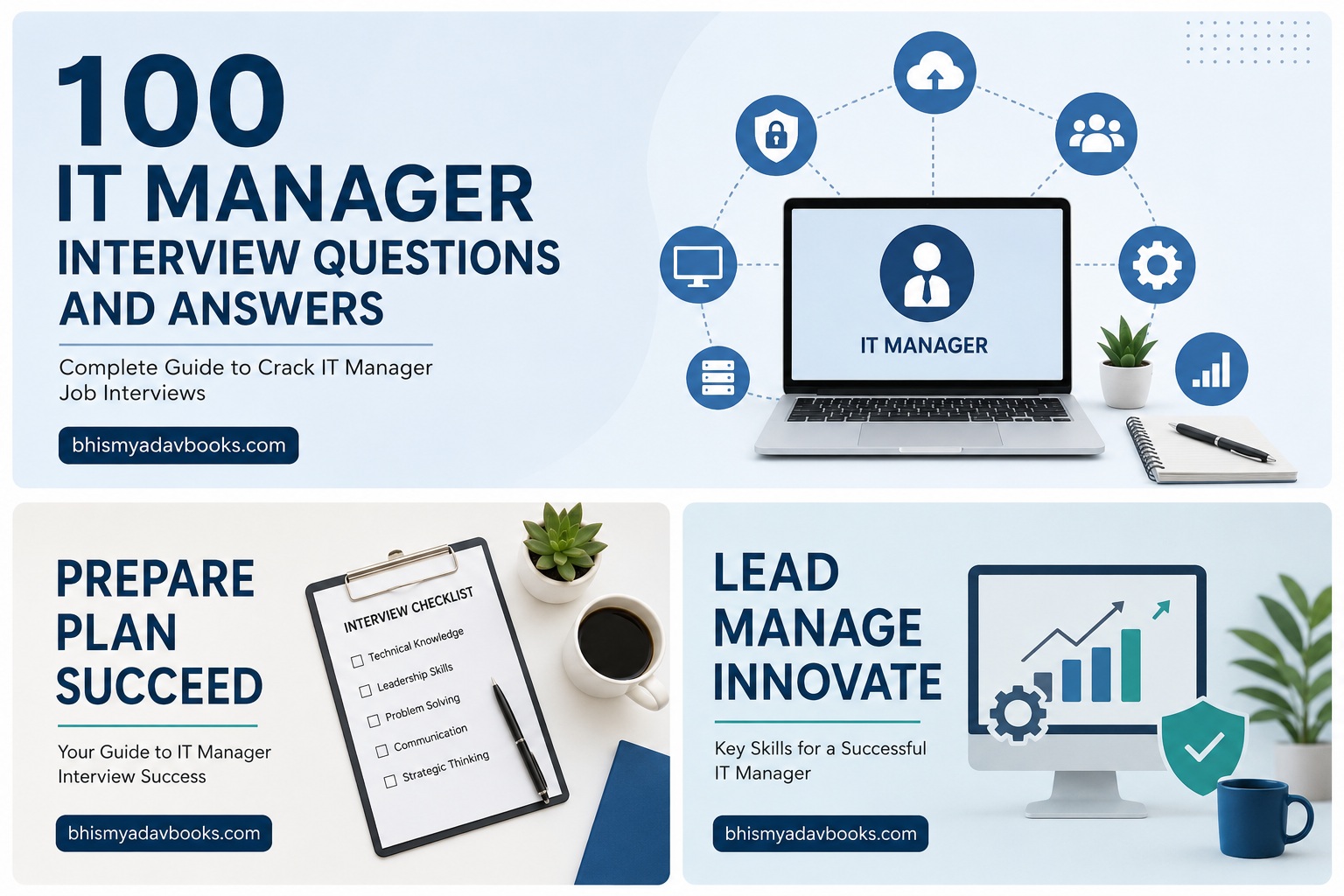
100 IT Manager Interview Questions and Answers
Introduction
An IT Manager is responsible for planning, implementing, maintaining, and securing an organization’s technology infrastructure while aligning IT initiatives with business goals. Modern IT Managers oversee networks, servers, cloud platforms, cybersecurity, software deployment, vendor relationships, budgeting, compliance, disaster recovery, and technical teams.
Employers look for professionals who combine technical expertise, leadership, communication, strategic thinking, budgeting, and problem-solving skills.
We have some amazing books at our Shop page you may like.
Table of Contents
This comprehensive guide contains 100 carefully selected IT Manager interview questions and answers to help job seekers prepare for interviews ranging from mid-level IT Manager roles to senior leadership positions.
(Questions 1–25)
1. Tell us about yourself.
Answer:
I am an experienced IT professional with expertise in infrastructure management, cloud technologies, cybersecurity, project management, and team leadership. I enjoy solving technical challenges while ensuring that IT systems support business objectives efficiently and securely.
2. What are the primary responsibilities of an IT Manager?
Answer:
Responsibilities include:
- Managing IT infrastructure
- Leading technical teams
- Budget planning
- Vendor management
- Cybersecurity
- Disaster recovery
- IT strategy
- Network administration
- Cloud management
- Compliance
- Technical support oversight
3. What qualities make a successful IT Manager?
Answer:
A successful IT Manager demonstrates:
- Leadership
- Technical expertise
- Communication
- Decision-making
- Problem-solving
- Time management
- Risk management
- Strategic planning
- Team motivation
- Business understanding
4. How do you prioritize IT projects?
Answer:
I evaluate:
- Business impact
- Urgency
- Risk
- Cost
- Available resources
- Compliance requirements
- Return on investment (ROI)
Projects with the highest business value receive top priority.
5. What is IT governance?
Answer:
IT governance ensures that technology investments align with business objectives while managing risks, compliance, and performance.
6. Explain ITIL.
Answer:
ITIL (Information Technology Infrastructure Library) is a framework for delivering high-quality IT services through standardized processes like:
- Incident Management
- Change Management
- Problem Management
- Service Request Management
- Asset Management
7. What is Change Management?
Answer:
Change Management ensures IT changes are planned, tested, approved, documented, and implemented with minimal disruption.
8. How do you handle critical system outages?
Answer:
I follow this process:
- Assess impact
- Assemble response team
- Identify root cause
- Restore services
- Communicate with stakeholders
- Document lessons learned
9. What KPIs do you monitor?
Answer:
Examples include:
- System uptime
- Mean Time to Repair (MTTR)
- Mean Time Between Failures (MTBF)
- Ticket resolution time
- SLA compliance
- Security incidents
- Project completion rate
10. What is an SLA?
Answer:
A Service Level Agreement defines expected service quality, response time, uptime, and support commitments.
11. How do you manage IT budgets?
Answer:
I forecast expenses, prioritize investments, monitor spending, negotiate vendor contracts, and optimize infrastructure costs.
12. Explain CapEx and OpEx.
Answer:
- CapEx: Capital expenditures like purchasing servers.
- OpEx: Operational expenses like cloud subscriptions.
13. What is disaster recovery?
Answer:
Disaster recovery involves restoring IT services after failures using backups, replication, and recovery plans.
14. Difference between Disaster Recovery and Business Continuity?
Answer:
Disaster Recovery restores IT systems.
Business Continuity ensures the entire organization continues operating.
15. What is RTO?
Answer:
Recovery Time Objective is the maximum acceptable downtime after an incident.
16. What is RPO?
Answer:
Recovery Point Objective defines the maximum acceptable amount of data loss.
17. Explain virtualization.
Answer:
Virtualization allows multiple virtual machines to run on one physical server, improving resource utilization and reducing costs.
18. What are hypervisors?
Answer:
Hypervisors manage virtual machines.
Examples:
- VMware ESXi
- Hyper-V
- KVM
- Xen
19. Explain cloud computing.
Answer:
Cloud computing provides computing resources over the internet instead of local infrastructure.
20. What are cloud service models?
Answer:
- IaaS
- PaaS
- SaaS
21. Public vs Private Cloud?
Answer:
Public cloud is shared infrastructure.
Private cloud is dedicated to one organization.
22. Hybrid cloud?
Answer:
Hybrid cloud combines on-premises infrastructure with public cloud services.
23. Multi-cloud?
Answer:
Using services from multiple cloud providers to improve redundancy and flexibility.
24. What is Zero Trust Security?
Answer:
Zero Trust assumes no user or device is trusted automatically and requires continuous verification.
25. Explain Multi-Factor Authentication.
Answer:
MFA requires multiple verification methods such as passwords, biometrics, or authentication apps.
(Questions 26–50)
26. What are the biggest cybersecurity threats organizations face today?
Answer:
Common cybersecurity threats include:
- Phishing attacks
- Ransomware
- Malware
- Insider threats
- Data breaches
- Distributed Denial-of-Service (DDoS) attacks
- Credential theft
- Zero-day vulnerabilities
- Supply chain attacks
- Cloud security misconfigurations
An IT Manager should implement layered security controls, employee awareness training, and continuous monitoring to reduce these risks.
27. What is a firewall?
Answer:
A firewall is a network security device or software that monitors and filters incoming and outgoing traffic based on predefined security rules. Firewalls help prevent unauthorized access while allowing legitimate communication.
28. Explain IDS and IPS.
Answer:
- IDS (Intrusion Detection System): Detects suspicious network activity and generates alerts.
- IPS (Intrusion Prevention System): Detects and automatically blocks malicious traffic.
IPS provides proactive protection, while IDS focuses on monitoring and alerting.
29. What is VPN?
Answer:
A Virtual Private Network (VPN) creates an encrypted connection over the internet, allowing remote users to securely access organizational resources.
Benefits include:
- Secure remote work
- Data encryption
- Privacy protection
- Safe access to internal systems
30. How do you ensure endpoint security?
Answer:
I implement:
- Endpoint Detection and Response (EDR)
- Antivirus/anti-malware
- Disk encryption
- Device management policies
- Patch management
- Multi-factor authentication
- USB device control
- Regular security updates
31. What is patch management?
Answer:
Patch management is the process of identifying, testing, deploying, and verifying software updates to fix security vulnerabilities, improve stability, and maintain compliance.
32. Why is vulnerability management important?
Answer:
Vulnerability management helps identify security weaknesses before attackers exploit them.
The process includes:
- Scanning
- Risk assessment
- Prioritization
- Remediation
- Verification
- Continuous monitoring
33. What is network segmentation?
Answer:
Network segmentation divides a network into smaller isolated sections to improve security, reduce attack surfaces, and improve performance.
34. Explain VLAN.
Answer:
A VLAN (Virtual Local Area Network) logically separates devices into different broadcast domains even when connected to the same physical switch.
Advantages include:
- Improved security
- Better traffic management
- Easier administration
- Reduced congestion
35. What is DNS?
Answer:
Domain Name System (DNS) translates human-readable domain names into IP addresses so computers can locate resources on the network.
36. What is DHCP?
Answer:
Dynamic Host Configuration Protocol automatically assigns IP addresses and network configuration settings to devices joining a network.
37. Difference between Layer 2 and Layer 3 switches?
Answer:
Layer 2 Switch
- Operates using MAC addresses
- Switches Ethernet frames
- Supports VLANs
Layer 3 Switch
- Performs routing
- Uses IP addresses
- Routes traffic between VLANs
- Supports dynamic routing protocols
38. What is load balancing?
Answer:
Load balancing distributes workloads across multiple servers to improve performance, availability, and fault tolerance.
Popular load balancers include:
- HAProxy
- NGINX
- F5 BIG-IP
- AWS Elastic Load Balancer
39. Explain high availability (HA).
Answer:
High Availability ensures systems remain operational even if hardware or software failures occur by using redundancy, failover mechanisms, and clustering.
40. What is RAID?
Answer:
RAID (Redundant Array of Independent Disks) improves storage performance and fault tolerance.
Common RAID levels include:
- RAID 0
- RAID 1
- RAID 5
- RAID 6
- RAID 10
41. How do you monitor IT infrastructure?
Answer:
I monitor:
- CPU usage
- Memory utilization
- Disk performance
- Network bandwidth
- Server health
- Application availability
- Security events
- Backup success
- Cloud resources
Monitoring tools may include centralized dashboards, alerts, and performance analytics.
42. Explain capacity planning.
Answer:
Capacity planning ensures sufficient computing resources are available to meet current and future business demands without unnecessary overprovisioning.
43. What is configuration management?
Answer:
Configuration management maintains consistent system settings using version-controlled configurations and automation tools.
Examples include:
- Ansible
- Puppet
- Chef
- SaltStack
44. What is Infrastructure as Code (IaC)?
Answer:
Infrastructure as Code uses scripts and configuration files to provision and manage infrastructure automatically.
Benefits:
- Automation
- Consistency
- Version control
- Faster deployments
- Reduced manual errors
45. Explain DevOps.
Answer:
DevOps combines software development and IT operations to deliver applications faster through collaboration, automation, continuous integration (CI), and continuous delivery (CD).
46. What is CI/CD?
Answer:
Continuous Integration (CI):
Developers frequently merge code into a shared repository with automated testing.
Continuous Delivery/Deployment (CD):
Applications are automatically built, tested, and deployed to production or staging environments.
47. What is containerization?
Answer:
Containerization packages an application with all its dependencies into lightweight containers, ensuring consistent execution across environments.
Popular platforms include:
- Docker
- Podman
- Kubernetes
48. Why is Kubernetes important?
Answer:
Kubernetes automates:
- Container deployment
- Scaling
- Load balancing
- Self-healing
- Rolling updates
- Service discovery
It is widely used for managing large-scale containerized applications.
49. What database management experience should an IT Manager have?
Answer:
An IT Manager should understand:
- Database backups
- High availability
- Replication
- Performance tuning
- Access control
- Disaster recovery
- SQL optimization
- Database security
Common databases include MySQL, PostgreSQL, Microsoft SQL Server, Oracle, and MongoDB.
50. How do you manage IT vendors effectively?
Answer:
Effective vendor management includes:
- Defining clear requirements
- Evaluating proposals
- Negotiating contracts
- Monitoring SLAs
- Reviewing performance regularly
- Managing costs
- Ensuring compliance
- Maintaining strong communication
- Assessing risks
- Building long-term partnerships
Strong vendor management helps improve service quality while optimizing IT spending.
(Questions 51–75)
51. How do you build a high-performing IT team?
Answer:
I focus on hiring skilled professionals, defining clear roles, encouraging collaboration, providing continuous learning opportunities, recognizing achievements, conducting regular performance reviews, and fostering a culture of accountability and innovation.
52. How do you motivate your team during high-pressure situations?
Answer:
I maintain open communication, set realistic priorities, provide the necessary resources, recognize individual contributions, and ensure team members feel supported. Keeping morale high helps maintain productivity during critical incidents.
53. Describe your leadership style.
Answer:
My leadership style is collaborative and results-oriented. I encourage teamwork, delegate responsibilities appropriately, mentor team members, and make data-driven decisions while remaining approachable and transparent.
54. How do you resolve conflicts within your IT team?
Answer:
I address conflicts promptly by listening to all parties, identifying the root cause, encouraging constructive discussions, focusing on facts rather than emotions, and working toward solutions that benefit both the team and the organization.
55. How do you handle underperforming employees?
Answer:
I first identify the reasons behind the performance issues, provide constructive feedback, create a performance improvement plan, offer training and mentoring, monitor progress, and recognize improvements while maintaining accountability.
56. How do you delegate responsibilities effectively?
Answer:
I assign tasks based on individual strengths, experience, workload, and career development goals. I clearly define expectations, provide necessary resources, and monitor progress without micromanaging.
57. What project management methodologies have you used?
Answer:
I have experience with:
- Agile
- Scrum
- Kanban
- Waterfall
- Hybrid project management approaches
The choice depends on project complexity, stakeholder requirements, and delivery timelines.
58. What is Agile project management?
Answer:
Agile is an iterative project management methodology that emphasizes collaboration, customer feedback, continuous improvement, and delivering working solutions in short development cycles called sprints.
59. What is Scrum?
Answer:
Scrum is an Agile framework where work is organized into short sprints, typically lasting two to four weeks. Key roles include the Product Owner, Scrum Master, and Development Team.
60. How do you manage project risks?
Answer:
I identify potential risks early, assess their impact and likelihood, develop mitigation plans, monitor risks throughout the project lifecycle, and communicate updates to stakeholders regularly.
61. What is stakeholder management?
Answer:
Stakeholder management involves identifying individuals or groups affected by a project, understanding their expectations, maintaining effective communication, and ensuring their concerns are addressed throughout the project.
62. How do you manage multiple IT projects simultaneously?
Answer:
I prioritize projects based on business value, allocate resources effectively, use project management tools, monitor milestones, conduct regular status meetings, and adjust priorities when necessary.
63. How do you estimate project costs?
Answer:
I evaluate hardware, software, licensing, cloud services, staffing, training, maintenance, contingency planning, and vendor costs to create a realistic project budget.
64. What is IT asset management?
Answer:
IT asset management involves tracking the lifecycle of hardware, software, licenses, and digital assets from procurement through retirement to maximize value and ensure compliance.
65. Why is software license management important?
Answer:
Proper license management helps organizations:
- Avoid legal penalties
- Reduce software costs
- Maintain compliance
- Prevent over-licensing
- Improve software utilization
66. What is digital transformation?
Answer:
Digital transformation is the integration of modern technologies into business processes to improve efficiency, customer experience, innovation, and decision-making.
67. How do you align IT strategy with business goals?
Answer:
I collaborate with business leaders, understand organizational objectives, prioritize technology investments that support those goals, measure outcomes using KPIs, and regularly review the IT roadmap.
68. What compliance standards should an IT Manager understand?
Answer:
Common compliance frameworks include:
- ISO 27001
- GDPR
- HIPAA
- PCI DSS
- SOC 2
- NIST Cybersecurity Framework
- COBIT
The applicable standards depend on the industry and regulatory environment.
69. What is ISO 27001?
Answer:
ISO 27001 is an international standard for establishing, implementing, maintaining, and continually improving an Information Security Management System (ISMS).
70. How do you prepare for an IT audit?
Answer:
Preparation includes:
- Reviewing policies and procedures
- Verifying documentation
- Ensuring access controls are up to date
- Checking backup and recovery processes
- Reviewing security logs
- Addressing previous audit findings
- Confirming compliance with applicable standards
71. Describe a challenging IT project you managed.
Answer:
In a previous role, I led the migration of critical business applications to a cloud environment with minimal downtime. By conducting detailed planning, risk assessments, stakeholder communication, and phased implementation, the project was completed successfully within budget and improved system scalability and availability.
72. How do you communicate technical issues to non-technical executives?
Answer:
I avoid technical jargon and explain issues in terms of business impact, risks, costs, timelines, and proposed solutions. Visual dashboards and simple examples help executives make informed decisions.
73. How do you handle resistance to new technology?
Answer:
I involve stakeholders early, explain the benefits, provide training, address concerns, gather feedback, and implement changes gradually to increase user adoption and minimize resistance.
74. How do you stay updated with emerging technologies?
Answer:
I regularly:
- Read technology publications
- Attend webinars and conferences
- Earn professional certifications
- Participate in technical communities
- Follow industry experts
- Experiment with new technologies in lab environments
Continuous learning helps me make informed technology decisions.
75. Why should we hire you as our IT Manager?
Answer:
I bring a combination of strong technical expertise, leadership experience, strategic thinking, and a proven ability to deliver reliable IT solutions. I excel at managing teams, improving operational efficiency, strengthening cybersecurity, optimizing budgets, and aligning technology initiatives with business objectives, making me well-equipped to contribute to the organization’s long-term success.
(Questions 76–100)
76. How would you respond to a ransomware attack?
Answer:
My response would follow the organization’s incident response plan:
- Immediately isolate affected systems.
- Notify the incident response team.
- Preserve forensic evidence.
- Restore systems from verified backups.
- Conduct malware analysis.
- Inform stakeholders and management.
- Strengthen security controls to prevent recurrence.
- Perform a post-incident review.
77. How do you ensure business continuity during major outages?
Answer:
I implement redundancy, disaster recovery planning, regular backup testing, failover mechanisms, cloud-based recovery solutions, and periodic disaster recovery drills to minimize downtime.
78. How do you evaluate new technologies before implementation?
Answer:
I assess:
- Business requirements
- Return on Investment (ROI)
- Security implications
- Scalability
- Vendor support
- Integration capabilities
- Long-term maintenance costs
- User adoption requirements
A pilot deployment is often conducted before organization-wide implementation.
79. How do you reduce IT operational costs?
Answer:
Cost optimization strategies include:
- Cloud optimization
- Server virtualization
- Infrastructure automation
- Vendor contract negotiation
- Software license optimization
- Energy-efficient hardware
- Eliminating redundant systems
- Process automation
80. What is technical debt?
Answer:
Technical debt refers to the future cost of choosing quick or temporary technical solutions instead of implementing optimal long-term designs.
Managing technical debt requires regular code reviews, infrastructure modernization, documentation, and scheduled improvements.
81. How do you manage legacy systems?
Answer:
I evaluate business dependency, security risks, maintenance costs, and compatibility. Where replacement isn’t immediately feasible, I implement security updates, monitoring, and phased modernization plans.
82. What factors influence cloud migration decisions?
Answer:
Key factors include:
- Application compatibility
- Security requirements
- Compliance
- Performance expectations
- Migration costs
- Downtime tolerance
- Vendor reliability
- Long-term scalability
83. How do you manage remote IT teams?
Answer:
I use collaboration platforms, regular team meetings, project management tools, performance metrics, clear communication, documentation, and scheduled one-on-one discussions to maintain productivity and engagement.
84. How do you measure IT department success?
Answer:
Success is measured using KPIs such as:
- System availability
- Incident response time
- User satisfaction
- Project completion rate
- Security incident reduction
- Budget adherence
- SLA compliance
- Employee productivity
85. How do you improve customer satisfaction with IT services?
Answer:
I focus on:
- Faster issue resolution
- Self-service portals
- Knowledge base articles
- User training
- Service desk improvements
- Continuous feedback collection
- Service performance reviews
86. What role does Artificial Intelligence play in IT management?
Answer:
AI helps automate repetitive tasks, detect anomalies, improve cybersecurity, predict hardware failures, optimize resource allocation, enhance IT support through chatbots, and generate actionable insights from operational data.
87. How do you handle vendor performance issues?
Answer:
I review SLA metrics, discuss performance concerns with the vendor, define corrective action plans, monitor improvements, and, if necessary, evaluate alternative vendors.
88. Describe an effective incident management process.
Answer:
An effective process includes:
- Incident detection
- Logging
- Classification
- Prioritization
- Investigation
- Resolution
- Verification
- Documentation
- Root cause analysis
- Continuous improvement
89. How do you manage IT documentation?
Answer:
I maintain centralized, version-controlled documentation covering:
- Network diagrams
- Standard operating procedures
- Disaster recovery plans
- System configurations
- Security policies
- Asset inventories
- Change records
Documentation is reviewed and updated regularly.
90. What is root cause analysis?
Answer:
Root Cause Analysis (RCA) identifies the underlying cause of incidents rather than only addressing symptoms.
Common techniques include:
- Five Whys
- Fishbone Diagram
- Fault Tree Analysis
- Pareto Analysis
91. How do you encourage innovation within your IT team?
Answer:
I encourage continuous learning, experimentation, hackathons, knowledge-sharing sessions, certification programs, and open discussions where team members can propose process improvements and new technologies.
92. How do you balance security with user convenience?
Answer:
I implement security controls that minimize user friction, such as Single Sign-On (SSO), Multi-Factor Authentication (MFA), role-based access control, and automated security policies while maintaining a strong security posture.
93. Describe your decision-making approach.
Answer:
I gather relevant data, evaluate risks, consult stakeholders, analyze business impact, compare alternatives, and make informed decisions aligned with organizational objectives.
94. What would you do during your first 90 days as an IT Manager?
Answer:
My priorities would include:
- Understanding business goals
- Meeting stakeholders
- Assessing IT infrastructure
- Reviewing security posture
- Evaluating ongoing projects
- Identifying quick improvements
- Building relationships with the IT team
- Developing a strategic roadmap
95. What trends are shaping the future of IT management?
Answer:
Major trends include:
- Artificial Intelligence (AI)
- Automation
- Cloud-native infrastructure
- Zero Trust Security
- Edge Computing
- Internet of Things (IoT)
- DevSecOps
- Hybrid work technologies
- FinOps
- Sustainable IT practices
96. What certifications are valuable for IT Managers?
Answer:
Highly regarded certifications include:
- PMP
- PRINCE2
- ITIL 4 Foundation
- CompTIA Security+
- CISSP
- AWS Certified Solutions Architect
- Microsoft Azure Administrator
- Google Professional Cloud Architect
- Certified Information Security Manager (CISM)
- Cisco CCNP
97. What common mistakes should IT Managers avoid?
Answer:
Common mistakes include:
- Poor communication
- Inadequate documentation
- Ignoring cybersecurity
- Delaying software updates
- Micromanaging teams
- Weak change management
- Poor vendor oversight
- Lack of strategic planning
- Ignoring employee development
- Failing to align IT with business goals
98. What questions should you ask the interviewer?
Answer:
Good questions include:
- What are the organization’s top IT priorities?
- What challenges is the IT department currently facing?
- Which technologies are planned for future investment?
- How is success measured for this role?
- What opportunities exist for professional growth?
99. What are your greatest strengths as an IT Manager?
Answer:
Example response:
My strengths include strategic planning, technical expertise, leadership, effective communication, cybersecurity awareness, project management, and the ability to build high-performing teams that consistently deliver reliable IT services aligned with business objectives.
100. Where do you see yourself in five years?
Answer:
I aim to grow into a senior technology leadership role where I can contribute to digital transformation, mentor future IT leaders, improve organizational cybersecurity, and help drive business growth through innovative technology solutions.
Recommended books for IT Manager Interview Preparation
IT Strategy and Management by Sanjiva Shankar Dubey (Author)
IT Manager Interview Preparation Tips
Before attending your interview:
- Research the company, its products, services, and technology stack.
- Review networking, cloud computing, cybersecurity, virtualization, and ITIL fundamentals.
- Refresh your knowledge of project management methodologies such as Agile and Scrum.
- Practice explaining technical concepts in business-friendly language.
- Prepare examples using the STAR (Situation, Task, Action, Result) method for leadership and behavioral questions.
- Be ready to discuss budgeting, vendor management, disaster recovery, and strategic planning.
- Demonstrate both technical depth and people management skills.
Frequently Asked Questions (FAQs)
1. What skills are essential for an IT Manager?
Leadership, networking, cloud computing, cybersecurity, project management, budgeting, communication, vendor management, ITIL, and strategic planning.
2. Which certifications help IT Managers advance their careers?
Popular certifications include PMP, ITIL 4 Foundation, CISSP, CISM, AWS Certified Solutions Architect, Microsoft Azure Administrator, Google Professional Cloud Architect, and CCNP.
3. How can I prepare for an IT Manager interview?
Study technical concepts, practice behavioral questions using the STAR method, understand business strategy, review IT governance frameworks, and prepare real-world examples of leadership and problem-solving.
4. What salary can an IT Manager expect?
Salaries vary based on experience, industry, location, certifications, and company size. Professionals with expertise in cloud computing, cybersecurity, enterprise architecture, and digital transformation generally command higher compensation.
5. Is IT Manager a good career?
Yes. IT Management offers strong career growth, competitive salaries, leadership opportunities, and the chance to shape technology strategy while working with modern technologies like cloud computing, AI, automation, and cybersecurity.
Conclusion
An IT Manager plays a critical role in ensuring that technology supports business success. Employers seek candidates who combine technical expertise with leadership, communication, strategic planning, cybersecurity awareness, and operational excellence.
By mastering these 100 IT Manager Interview Questions and Answers, you’ll be well-prepared to demonstrate your ability to lead IT teams, manage infrastructure, oversee projects, secure enterprise systems, and align technology initiatives with organizational goals.
Continue practicing your responses, stay updated with emerging technologies such as AI, cloud computing, DevSecOps, and Zero Trust Security, and approach each interview with confidence.
Disclaimer: The interview questions and sample answers in this article are provided for educational and job preparation purposes. Actual interview questions may vary depending on the employer, industry, job role, location, and candidate experience.