Introduction
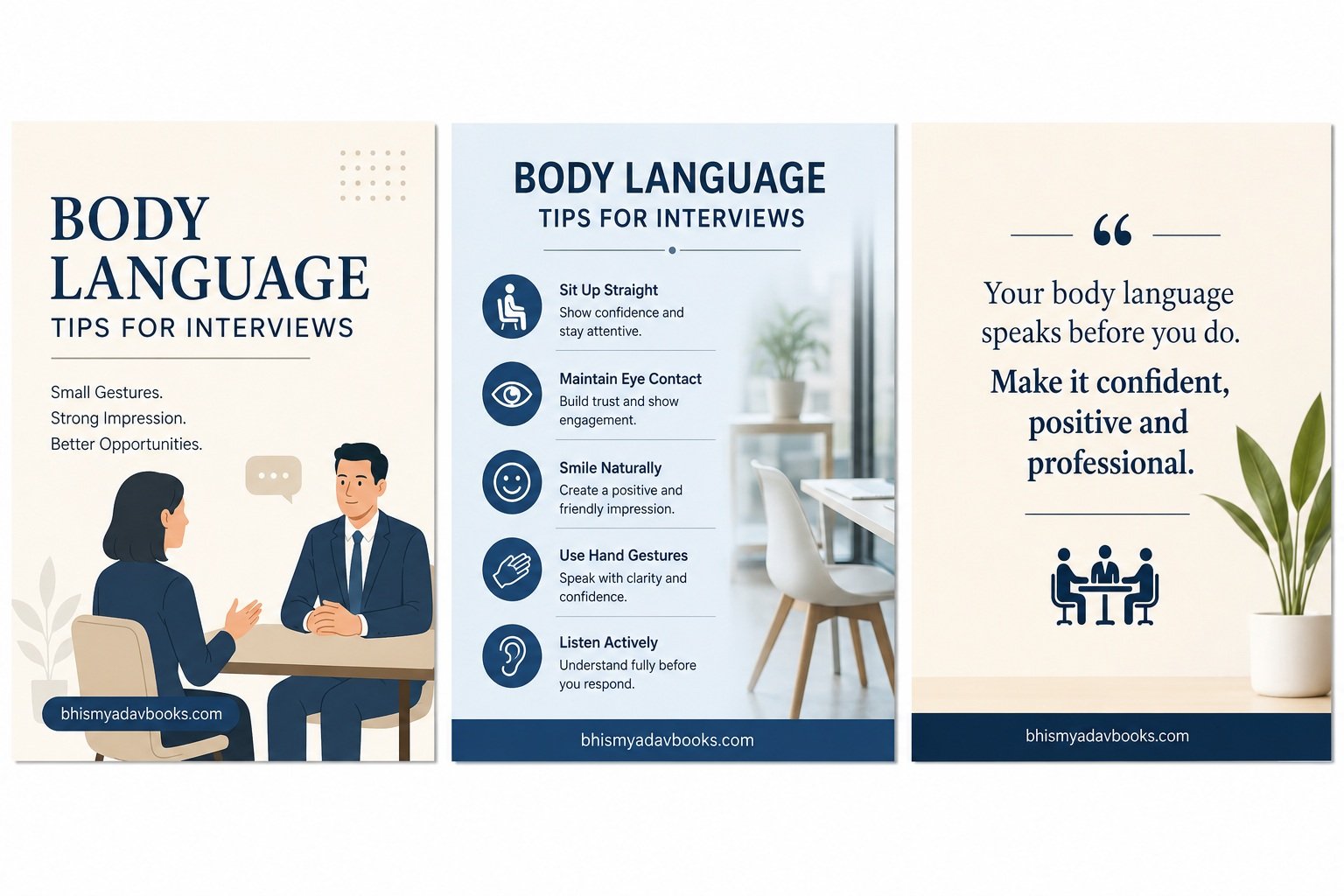
Job interviews are not only about what you say. The way you sit, stand, smile, maintain eye contact, use your hands, and react to questions can influence how an interviewer perceives you. This is why understanding body language tips for interviews is an important part of interview preparation.
You may have excellent qualifications and well-prepared answers, but if your body language communicates nervousness, disinterest, discomfort, or lack of confidence, your words may have less impact. On the other hand, positive and natural body language can help you appear confident, attentive, professional, and genuinely interested in the opportunity.
The good news is that effective body language does not require you to become an actor or completely change your personality. It is mainly about becoming aware of your nonverbal behavior and learning how to communicate confidence and professionalism naturally.
We have some amazing books at our Shop page you may want to buy.
Table of Contents
In this comprehensive guide from Bhism Yadav Books, we will explore practical body language tips that job aspirants can use before, during, and after an interview.
Body Language Tips for Interviews: How to Look Confident, Professional, and Job-Ready
What Is Body Language in an Interview?
Body language is a form of nonverbal communication. It includes the physical behaviors through which you communicate feelings, attitudes, confidence, attention, and reactions without necessarily saying anything.
During a job interview, body language can include:
- Eye contact
- Posture
- Facial expressions
- Hand movements
- Gestures
- Sitting position
- Standing position
- Head movements
- Personal space
- Handshake
- Nervous movements
- Listening behavior
- Overall physical presence
Imagine two candidates giving almost identical answers.
The first candidate sits upright, looks naturally at the interviewer, listens carefully, smiles appropriately, and uses relaxed hand gestures.
The second candidate looks continuously at the floor, slouches in the chair, repeatedly touches their face, and appears distracted.
Even if both candidates have similar qualifications, they may create very different impressions.
That is the power of nonverbal communication.
However, body language should never be treated as a secret code where one gesture automatically reveals what someone is thinking. People behave differently because of personality, culture, disability, nervousness, habit, and many other factors. Instead, interview candidates should focus on using body language to support clear, respectful, and professional communication.
Why Is Body Language Important in a Job Interview?
An interview is a communication process. Your spoken answers communicate one part of your message, while your behavior communicates another.
Positive body language can support several qualities employers commonly value.
1. It Helps You Communicate Confidence
Confidence does not mean acting dominant or pretending that you know everything.
In an interview, healthy confidence means showing that you are comfortable discussing your abilities, experiences, achievements, and willingness to learn.
An upright but relaxed posture, natural eye contact, and controlled movements can reinforce that impression.
Compare these two situations:
Candidate A:
“I believe I can handle this responsibility.”
The candidate says this while looking down, speaking very softly, and shrinking into the chair.
Candidate B:
“I believe I can handle this responsibility.”
The candidate maintains a comfortable posture, looks toward the interviewer, and speaks clearly.
The words are identical, but the overall impression can be different.
Your body language should ideally support what you are saying.
2. It Shows That You Are Listening
Good interviews are not one-way speeches.
You need to listen carefully to:
- Questions
- Follow-up questions
- Information about the company
- Explanations about the role
- Interviewer comments
- Instructions
Your listening behavior can be visible.
Looking toward the person speaking, using occasional natural nods, and avoiding distracting movements can indicate engagement.
Active listening also reduces the likelihood of answering a question that the interviewer did not actually ask.
3. It Can Make Communication More Natural
Appropriate gestures and facial expressions can make conversation feel more natural.
For example, when discussing an achievement that you are genuinely proud of, a slight smile may naturally appear.
When explaining a process, you may use small hand gestures to organize your thoughts.
The goal is not to deliberately manufacture every movement.
Instead, you want to remove distracting habits and allow your natural communication style to become clearer.
4. It Helps Create a Professional First Impression
Your interview begins before you answer the first technical question.
The interviewer may notice how you:
- Enter the room
- Greet people
- Sit down
- Organize your belongings
- Introduce yourself
- Respond to instructions
For an online interview, the equivalent first impression may include your posture, camera position, facial expression, background, and attentiveness when the call begins.
A calm and professional entrance can help establish a positive tone for the conversation.
Positive Body Language vs Negative Body Language
It is useful to understand the general difference between behaviors that support communication and behaviors that may become distracting.
Positive Interview Body Language
Positive behaviors may include:
- Comfortable eye contact
- Upright but relaxed posture
- Natural smiling
- Attentive listening
- Controlled hand gestures
- Calm movements
- Appropriate personal space
- Facing the interviewer
- Natural head movements
- Professional greeting
- Relaxed shoulders
- Clear and composed speaking behavior
Potentially Distracting Body Language
Behaviors that can become distracting include:
- Constantly looking at the floor
- Repeatedly checking the clock
- Looking at your phone
- Excessive fidgeting
- Constantly touching your hair or face
- Slouching heavily
- Frequently shaking your legs
- Playing with a pen
- Repeatedly adjusting clothes
- Turning away while speaking
- Appearing distracted when someone else is talking
One isolated movement does not determine the success or failure of an interview. The aim is to reduce repeated behaviors that interfere with communication.
1. Start Your Body Language Before Entering the Interview
One of the most overlooked body language tips for interviews is that preparation should begin before you meet the interviewer.
If you rush into the building at the last moment, your breathing may be fast, your movements may be hurried, and your mind may still be trying to recover.
Arriving with enough time to settle yourself can make it easier to enter calmly.
Before entering:
- Put your phone on silent.
- Organize your documents.
- Check that your clothing is neat.
- Take a moment to settle your breathing.
- Keep your shoulders relaxed.
- Walk at a comfortable pace.
- Avoid repeatedly checking your phone.
- Be courteous to staff you meet.
Professional behavior should not begin only when you see the hiring manager.
Treat the entire interview environment professionally.
2. Walk Into the Interview Room With Confidence
Your entrance contributes to the first impression.
You do not need to make a dramatic entrance. Simply walk naturally and calmly.
Keep your:
- Head in a neutral position
- Back comfortably straight
- Shoulders relaxed
- Arms natural
- Walking pace controlled
Avoid staring at the floor while walking into the room.
At the same time, do not exaggerate your posture by pushing your chest forward or lifting your chin excessively. This can look unnatural.
Think:
upright + relaxed + attentive.
That combination is more useful than trying to look “powerful.”
3. Use a Natural and Professional Smile
A smile is one of the simplest ways to create a warm first impression.
When greeting the interviewer, a natural smile can communicate friendliness and openness.
However, avoid forcing yourself to smile continuously.
Interviews contain different kinds of conversations. You may discuss achievements, challenges, failures, technical problems, workplace conflicts, or serious responsibilities.
Your facial expression should naturally fit the conversation.
For example:
When greeting the interviewer → a friendly smile is appropriate.
When discussing a serious workplace challenge → a neutral, attentive expression may be more suitable.
When talking about an achievement → a natural smile can reinforce enthusiasm.
The key is authenticity.
4. Maintain Appropriate Eye Contact
Eye contact is among the most frequently discussed interview body language skills.
Natural eye contact can help communicate attention and engagement.
However, there is an important distinction between eye contact and staring.
You do not need to look directly into the interviewer’s eyes every second.
Natural conversations include moments when people briefly look away while thinking, remembering information, or organizing their thoughts.
A useful principle is:
Look at the interviewer while listening and speaking, but allow natural breaks in eye contact.
Avoid deliberately counting seconds or trying to follow a rigid formula. Doing so can make your behavior feel mechanical.
How to Improve Eye Contact for Interviews
If maintaining eye contact makes you uncomfortable, practice gradually.
Practice With a Friend
Ask a friend or family member to conduct a short mock interview.
Practice answering questions such as:
- Tell me about yourself.
- Why do you want this job?
- What are your strengths?
- Describe a difficult problem you solved.
- Why should we hire you?
Instead of concentrating entirely on your answer, also become aware of where you are looking.
Record Yourself
Use your phone or computer camera to record a mock interview.
Watch the recording afterward.
Ask:
- Am I looking down too frequently?
- Do I appear distracted?
- Am I staring unnaturally?
- Do I look comfortable while listening?
- Do I constantly look away when answering difficult questions?
Recording yourself can reveal habits you may not notice while speaking.
5. Use Good Sitting Posture
Once invited to sit, choose a comfortable and professional position.
Your posture should make you look attentive without making you uncomfortable.
A good general approach is:
- Keep your back reasonably upright.
- Relax your shoulders.
- Keep both feet stable when practical.
- Face the interviewer.
- Avoid collapsing deeply into the chair.
- Avoid sitting rigidly like a statue.
You should be able to maintain the position throughout the conversation without constantly readjusting yourself.
Good posture can also support clearer breathing and speaking.
Should You Lean Forward During an Interview?
A slight, natural forward lean at appropriate moments can indicate engagement.
For example, when the interviewer explains an important responsibility, you might naturally lean slightly forward while listening.
But avoid sitting on the extreme edge of the chair throughout the entire interview.
Similarly, leaning far backward may sometimes create an impression of excessive casualness or disengagement.
Use a balanced, comfortable posture.
6. Keep Your Shoulders Relaxed
Stress often appears in the shoulders.
When nervous, some candidates unconsciously raise their shoulders or tighten their upper body.
This can make you feel even more tense.
Before the interview, consciously check:
Are my shoulders relaxed?
Allow them to rest naturally.
You can practice this during mock interviews until relaxed posture becomes easier.
7. Know What to Do With Your Hands
A common interview question is not asked by the interviewer at all:
“What should I do with my hands?”
Many candidates become so conscious of their hands that their gestures become unnatural.
You do not need to hide them.
Keep your hands comfortably:
- On your lap, or
- Lightly on the table when appropriate.
When speaking, natural hand gestures are perfectly acceptable.
The goal is simply to avoid excessive movements that distract from your answer.
8. Use Hand Gestures Naturally
Hand gestures can support verbal communication.
For example, when describing three stages of a project, you may naturally use your hands to emphasize the sequence.
When explaining growth, improvement, comparison, or teamwork, small gestures can make your communication more expressive.
But gestures should support your words rather than compete with them.
Avoid:
- Constantly waving your hands
- Pointing aggressively
- Hitting the table for emphasis
- Repetitive gestures
- Moving objects unnecessarily
- Clicking a pen repeatedly
You do not need to eliminate gestures. You simply need to control distracting ones.
9. Avoid Excessive Fidgeting
Nervousness is normal during interviews.
The problem arises when nervous movements become repetitive enough to distract you or the interviewer.
Examples include:
- Shaking your leg continuously
- Tapping your fingers
- Clicking a pen
- Playing with jewelry
- Touching your hair repeatedly
- Rubbing your hands
- Adjusting your sleeves repeatedly
- Moving constantly in the chair
- Biting your nails
- Touching your face again and again
You may not realize that you are doing these things.
This is another reason why recording mock interviews can be useful.
10. Keep Your Phone Away
Few things communicate distraction more clearly than checking your phone during an interview.
Before entering the interview environment:
- Put your phone on silent or Do Not Disturb.
- Turn off unnecessary alarms.
- Keep it securely in your bag or pocket.
- Avoid placing it prominently on the interview table unless there is a genuine reason.
You should not be thinking about notifications while discussing your career opportunity.
For virtual interviews, close unnecessary apps and silence notifications on your computer as well.
11. Use Appropriate Facial Expressions
Your face communicates continuously while you listen and speak.
Effective facial expressions are generally:
- Natural
- Responsive
- Professional
- Appropriate to the conversation
Suppose the interviewer is explaining an important challenge associated with the job.
If you appear completely distracted or keep smiling inappropriately, your expression may not match the conversation.
Instead, listen attentively and allow your expression to respond naturally.
Do not attempt to control every movement of your face.
Overthinking your facial expressions can make them less natural.
12. Show That You Are Listening
Excellent body language is not only about looking confident while speaking.
It is equally important while listening.
When the interviewer speaks:
- Face them naturally.
- Maintain comfortable eye contact.
- Avoid interrupting.
- Use occasional nods when appropriate.
- Keep a receptive facial expression.
- Avoid looking around the room.
- Do not prepare your next answer so intensely that you stop listening.
Listening is especially important when the interviewer asks multi-part questions.
If necessary, pause briefly before answering.
A thoughtful pause can be better than immediately answering the wrong question.
13. Do Not Overuse Head Nodding
Nodding is a useful listening signal, but excessive nodding can become distracting.
You do not need to nod after every sentence the interviewer says.
Use it naturally when:
- Acknowledging information
- Showing understanding
- Agreeing with a point
- Encouraging the speaker to continue
If you disagree with something, you can still remain attentive without pretending to agree.
Professional communication is more important than mechanical body language.
14. Respect Personal Space
Personal space expectations vary across individuals and cultures.
During an in-person interview, maintain a comfortable professional distance.
Avoid standing unnecessarily close to the interviewer or leaning excessively across the desk.
Follow the physical arrangement of the interview environment.
If the interviewer indicates where you should sit or stand, follow their direction.
Professional body language includes respecting boundaries.
15. Mirror Professional Energy—Not Every Movement
You may have heard advice suggesting that candidates should “mirror” the interviewer.
This idea is often misunderstood.
You should not copy every gesture, posture, or movement the interviewer makes. That can become awkward.
Instead, adapt naturally to the professional tone of the conversation.
If the interviewer is calm and conversational, you can respond with similar calmness.
If the interview is formal and structured, maintain an appropriately formal style.
Think of this as matching the professional tone, not imitating the person’s body.
Body Language Example: Weak vs Strong Interview Presence
Consider the question:
“Tell me about a project you are proud of.”
Weak Presentation
The candidate looks downward and says:
“I worked on a project last year. We had some problems, but eventually we completed it.”
While speaking, the candidate repeatedly clicks a pen and looks toward the door.
Even if the project was impressive, the presentation may not communicate enthusiasm.
Stronger Presentation
The candidate faces the interviewer with a comfortable posture and says:
“One project I am particularly proud of involved improving our reporting process. Our team was spending several hours every week preparing reports manually. I helped automate part of the workflow, which reduced repetitive work and made the reports easier to prepare.”
The candidate uses natural eye contact and small gestures while explaining the result.
The second response combines useful content with supportive nonverbal communication.
That combination is what job aspirants should practice.
The Golden Rule of Interview Body Language
The most important principle is simple:
Your body language should support your message, not distract from it.
You do not need perfect posture.
You do not need constant eye contact.
You do not need a perfect handshake.
And you certainly do not need to memorize dozens of artificial gestures.
Instead, work toward appearing:
Calm + Attentive + Comfortable + Professional + Interested
These five qualities provide a strong foundation for effective interview body language.
16. Use a Professional Handshake When Appropriate
A handshake has traditionally been a common professional greeting in many interview settings, although expectations vary according to culture, personal preference, health considerations, and workplace norms.
Do not assume that every interviewer expects a handshake.
If a handshake is clearly offered, respond naturally.
A professional handshake should generally be:
- Brief
- Comfortable
- Natural
- Respectful
Avoid trying to demonstrate confidence through excessive grip strength.
A handshake is a greeting—not a competition.
Similarly, an extremely hesitant handshake may communicate uncertainty, although physical ability and cultural differences should always be considered.
The simplest approach is to follow the interviewer’s lead.
If no handshake is offered, a friendly verbal greeting and natural smile are perfectly professional.
17. Practice Your Standing Posture
Your standing posture matters before you sit down and when you leave the interview.
When standing:
- Keep your back comfortably straight.
- Keep your shoulders relaxed.
- Avoid locking your knees.
- Keep your head in a neutral position.
- Distribute your weight naturally.
- Avoid rocking from one foot to another repeatedly.
Do not try to make yourself appear taller or more powerful.
Confidence comes from looking comfortable in your own posture.
If you are waiting before the interview, avoid constantly pacing around unless you genuinely need to move.
18. Control Nervous Body Movements
Almost everyone experiences some nervousness during an important job interview.
You might notice:
- Sweaty palms
- Faster breathing
- Restless legs
- Tight shoulders
- Dry mouth
- Repetitive hand movements
- Increased blinking
- Difficulty sitting still
Trying to eliminate nervousness completely can actually create more pressure.
Instead, focus on controlling the behaviors that interfere with your communication.
Ground Yourself Physically
Once seated, notice your physical position.
Feel your feet resting on the floor and your body supported by the chair.
This simple awareness can help reduce unnecessary movement.
Slow Down Your Breathing
Nervous candidates sometimes breathe quickly without realizing it.
Before the interview begins, take a few calm, comfortable breaths.
Avoid exaggerated breathing exercises while sitting directly in front of the interviewer. The objective is simply to settle yourself.
Pause Before Answering
You do not have to answer every question immediately.
A short pause can give you time to organize your thoughts and reduce rushed movements.
For example:
“That’s a good question. Let me think about the best example.”
Then take a brief moment before answering.
This can appear more composed than immediately giving an unstructured response.
19. Be Comfortable With Short Pauses
Silence feels much longer to the candidate than it often does to the interviewer.
Because of nervousness, many job aspirants feel they must fill every second with words.
They may begin using fillers such as:
- Umm
- Uh
- Actually
- Basically
- You know
- Like
- So…
Occasional filler words are normal, but excessive use can weaken communication.
Instead of filling every pause, become comfortable with brief silence.
For example, when asked:
“Tell me about a time you failed.”
You can pause briefly, think about the best example, and then begin.
That pause can communicate thoughtfulness rather than weakness.
20. Remember That Voice Is Part of Nonverbal Communication
Body language is closely connected with vocal communication.
Even when your words are strong, the way you deliver them matters.
Your vocal behavior includes:
- Volume
- Pace
- Tone
- Pauses
- Emphasis
- Rhythm
- Clarity
Imagine saying:
“I am very excited about this opportunity.”
If you say it in a barely audible, flat voice while looking away, your delivery may not reinforce your words.
If you say it clearly, with natural enthusiasm and attentive body language, the message becomes stronger.
21. Speak at a Comfortable Pace
Nervousness often makes candidates speak faster.
When you speak too quickly:
- Words can become unclear.
- You may forget important points.
- The interviewer may struggle to follow your answer.
- You may run out of breath.
- Your body may appear more tense.
Practice speaking slightly slower than your nervous instinct tells you to.
However, avoid speaking so slowly that your answer sounds memorized or unnatural.
The goal is conversational clarity.
22. Keep Your Voice Audible
Speaking too quietly can make communication difficult, especially in a large room, panel interview, or online meeting.
You do not need to shout.
Aim for a voice that is:
Clear + Calm + Audible
If the interviewer repeatedly asks you to speak louder, adjust your volume.
Similarly, avoid speaking unnecessarily loudly when sitting close to someone.
Match your volume to the environment.
23. Avoid a Completely Monotone Delivery
A monotone voice can make even an excellent answer sound less engaging.
Natural variation in tone helps emphasize important ideas.
For example:
“I joined the project when it was already three weeks behind schedule. My responsibility was to identify the main bottleneck and help the team create a realistic recovery plan.”
Slight vocal emphasis on important information makes the answer easier to follow.
Do not exaggerate your voice like a stage performance.
Natural variation is enough.
24. Match Facial Expressions With Your Words
Your facial expressions and verbal answers should generally work together.
If you are discussing something positive, a natural smile may support your message.
If you are describing a serious problem, your expression may naturally become more focused.
Consider:
“I was extremely excited when our team finally achieved the target.”
If you say this with no visible enthusiasm at all, the message may feel less convincing.
Again, this does not mean acting.
It means allowing your genuine reactions to appear naturally.
25. Body Language While Answering Difficult Questions
Difficult questions are often where nervous body language becomes most noticeable.
Examples include:
- Why did you leave your previous job?
- Why were you unemployed for six months?
- What is your biggest weakness?
- Tell me about a failure.
- Why were your grades low?
- Why should we hire you?
- Why do you want to change careers?
- Tell me about a conflict with your manager.
- What salary do you expect?
- Why have you changed jobs frequently?
When such a question appears, candidates may:
- Look away suddenly
- Cross their arms tightly
- Touch their face
- Start moving excessively
- Speak much faster
- Become defensive
- Smile nervously
- Lower their voice
The first technique is simple:
Do not react physically before you have processed the question.
Listen completely.
Pause if necessary.
Then answer calmly.
26. Do Not Become Defensive
Some interview questions may feel uncomfortable.
However, defensive body language can make the conversation more difficult.
Possible defensive behaviors include:
- Folding your arms tightly
- Leaning far backward
- Frowning aggressively
- Rolling your eyes
- Shaking your head while the interviewer is still speaking
- Interrupting the question
- Speaking with an irritated tone
Even if you believe the interviewer has misunderstood something, respond professionally.
For example:
“Let me clarify that situation because there is some useful context.”
Then explain calmly.
Professional disagreement is possible without aggressive body language.
27. What to Do When You Don’t Know an Answer
One of the most stressful interview moments occurs when you simply do not know the answer.
This is especially common in technical interviews.
Suppose the interviewer asks a question and you cannot remember the solution.
Avoid:
- Panicking
- Looking around desperately
- Pretending you know
- Making random guesses without explanation
- Becoming visibly frustrated
- Giving up immediately
Instead, remain composed.
You might say:
“I haven’t worked with that directly, so I don’t want to give you an inaccurate answer. However, based on what I know about the related concept, I would approach it by…”
Or:
“I don’t recall the exact answer at the moment. May I explain how I would work through the problem?”
This approach can demonstrate honesty and problem-solving ability.
Your body language should remain open and attentive.
Not knowing one answer does not automatically mean the interview is over.
28. Do Not Let One Bad Answer Affect the Rest of the Interview
Candidates often make this mistake.
They give one weak answer and immediately think:
“I’ve ruined the interview.”
Then their body language changes.
They:
- Stop smiling
- Lose eye contact
- Slouch
- Become quieter
- Give shorter answers
- Appear discouraged
The interviewer may not even consider the previous answer as damaging as you do.
Treat every question as a new opportunity.
Once an answer is finished, mentally move forward.
Do not allow one difficult moment to control the rest of your performance.
29. Body Language in a Panel Interview
Panel interviews can feel more intimidating because several people may be observing you simultaneously.
You may have:
- A hiring manager
- HR representative
- Technical expert
- Department manager
- Future team member
sitting together.
The most common question is:
“Who should I look at?”
Start by looking toward the person asking the question.
As you answer, you can naturally include the other panel members through occasional eye contact.
Then return your attention toward the person who asked the question.
This helps make the answer feel inclusive.
30. Do Not Ignore Quiet Panel Members
Sometimes one panel member asks most of the questions while another says almost nothing.
It can be tempting to focus only on the most active interviewer.
However, the quieter person may still be involved in the hiring decision.
When appropriate, include everyone naturally in your visual attention.
You do not need to rotate your head mechanically from person to person.
Simply avoid treating the interview as though only one individual is present.
31. Listen to the Entire Panel
Panel interviews may involve rapid transitions.
One interviewer may ask a technical question, followed by HR asking a behavioral question.
Avoid becoming so focused on one interviewer that you fail to notice another person beginning to speak.
Maintain an open posture and stay aware of the whole panel.
If someone interrupts or asks a follow-up question, stop and listen respectfully.
32. Avoid Looking Only at the Most Senior Person
Candidates sometimes identify who they believe is the highest-ranking person in the room and direct almost all attention toward them.
This can be a mistake.
Every interviewer deserves professional attention.
You may not even know who has the greatest influence on the final hiring decision.
Treat each panel member respectfully.
33. Body Language During Behavioral Interview Questions
Behavioral questions usually ask you to describe previous situations.
Examples include:
- Tell me about a time you solved a difficult problem.
- Describe a conflict with a colleague.
- Tell me about a mistake you made.
- Give an example of leadership.
- Describe a time you worked under pressure.
These questions often require longer answers.
Using the STAR method can help organize your response:
S – Situation
Explain the context.
T – Task
Describe your responsibility.
A – Action
Explain what you did.
R – Result
Describe the outcome.
Body language can support this structure.
As you move from situation to action and result, maintain steady posture, natural gestures, and comfortable eye contact.
When discussing your actions, avoid becoming excessively animated.
When discussing the result, show appropriate confidence.
34. Body Language When Talking About Achievements
Candidates sometimes become uncomfortable when discussing their own achievements.
They may:
- Look down
- Minimize their contribution
- Speak quietly
- Use apologetic language
There is nothing wrong with discussing genuine achievements during a job interview.
That is one of the purposes of the interview.
For example:
“I led a five-person team that completed the migration two weeks ahead of the revised deadline.”
Say it naturally.
You do not need to exaggerate your accomplishment, but you also do not need to physically shrink while discussing it.
Use confident, factual communication.
35. Avoid Arrogant Body Language
Confidence and arrogance are not the same.
Confident body language communicates:
“I am comfortable discussing what I can contribute.”
Arrogant behavior can communicate:
“I am more important than everyone here.”
Behaviors that may appear overly dismissive or arrogant include:
- Smirking at questions
- Interrupting repeatedly
- Leaning back excessively while appearing disengaged
- Rolling your eyes
- Looking at your phone
- Pointing aggressively
- Ignoring junior interviewers
- Acting as though basic questions are beneath you
Strong candidates can be confident while remaining respectful.
36. Body Language When Discussing Weaknesses
The question “What is your biggest weakness?” can make candidates visibly uncomfortable.
Do not immediately collapse your posture or look ashamed.
The interviewer is usually evaluating your self-awareness and development.
Maintain the same professional posture you use for other questions.
Explain:
- A genuine but manageable weakness.
- How you became aware of it.
- What you are doing to improve it.
- Any progress you have made.
For example:
“Earlier in my career, I sometimes spent too much time trying to perfect smaller details. I’ve improved this by defining priorities and deadlines before starting a task.”
Your physical confidence should remain steady because discussing an area for improvement is not the same as admitting incompetence.
37. Body Language When Talking About Failure
Failure questions test your ability to reflect and learn.
Avoid smiling excessively because you are uncomfortable.
Likewise, do not become physically defeated.
Explain the failure calmly.
Then shift your energy toward:
- What you learned
- What you changed
- How you improved
- What you would do differently
Your posture can remain confident even while discussing a mistake.
Confidence includes the ability to acknowledge imperfections.
38. Never Show Disrespect Toward a Previous Employer
Questions about previous jobs can become emotionally charged.
Even if you had a difficult manager or workplace experience, avoid negative body language such as:
- Eye rolling
- Sarcastic smiling
- Angry gestures
- Shaking your head dramatically
- Laughing dismissively
- Showing obvious irritation
Keep your explanation professional and factual.
Instead of:
“My manager was impossible to work with.”
You might say:
“I was looking for an environment with clearer responsibilities and stronger opportunities for professional development.”
The goal is not to hide genuine problems. It is to discuss them professionally.
39. Body Language During Salary Discussions
Salary discussions make many candidates nervous.
You may suddenly:
- Look down
- Speak very quickly
- Laugh nervously
- Change posture
- Avoid eye contact
Treat compensation as a normal professional topic.
If asked about your salary expectations, maintain your regular professional posture and answer calmly.
For example:
“Based on the responsibilities of the role and my experience, I’m looking for a competitive package within the appropriate range for the position. I’m also open to discussing the overall compensation structure.”
There is no need to behave as though discussing salary is inappropriate.
40. Control Nervous Laughter
Some people laugh when they feel nervous.
This is a natural reaction, but excessive nervous laughter can create confusion during serious questions.
For example:
Interviewer:
“Why were you terminated from your previous role?”
A nervous laugh before answering may unintentionally communicate the wrong emotion.
If you know you tend to laugh when uncomfortable, practice difficult interview questions beforehand.
Familiarity reduces surprise, which can make nervous reactions easier to control.
41. Avoid Crossing Your Arms Too Tightly
Crossed arms are often automatically described as “defensive,” but body language is not that simple.
People cross their arms for many reasons:
- Comfort
- Habit
- Temperature
- Chair design
- Physical preference
Therefore, one posture should not be overinterpreted.
However, keeping your arms tightly crossed throughout an interview can restrict your gestures and may make you appear less open.
When practical, keep your hands and arms in a comfortable neutral position.
42. Stop Playing With Objects
A pen, notebook, ID card, keychain, watch, ring, or phone can quickly become a nervous object.
You may start:
- Rotating your pen
- Clicking it
- Opening and closing the cap
- Moving your notebook
- Touching your watch
- Playing with a ring
These repetitive movements can distract both you and the interviewer.
If you know you fidget with objects, keep unnecessary items in your bag.
Use a notebook and pen only when needed.
43. Take Notes Without Losing Engagement
It can be appropriate to take brief notes during some interviews, particularly when the interviewer explains:
- Job responsibilities
- Technical requirements
- Next steps
- Important dates
- Team structure
However, do not spend the entire interview looking down and writing.
Listen first.
Write brief notes when appropriate.
Then return your attention to the interviewer.
If you are unsure whether note-taking is acceptable, you can simply ask:
“Would you mind if I take a few notes?”
This demonstrates professionalism and consideration.
44. Body Language When Asking Your Own Questions
Near the end of the interview, you will often hear:
“Do you have any questions for us?”
Your body language should still communicate interest.
Avoid suddenly relaxing as though the interview has ended.
Sit attentively and ask thoughtful questions such as:
- What would success look like in this role during the first six months?
- What are the biggest challenges facing the team?
- How is performance typically evaluated?
- What does the onboarding process look like?
- How does this role collaborate with other teams?
Listen carefully to the answers.
Your questions are another opportunity to demonstrate genuine interest in the position.
45. Maintain Professional Body Language Until You Leave
Do not mentally end the interview before you physically leave.
After the formal questions finish:
- Stand calmly.
- Gather your belongings without rushing.
- Thank the interviewer.
- Maintain a friendly expression.
- Use a handshake if appropriately offered.
- Leave at a normal pace.
- Remain courteous to staff.
Avoid immediately pulling out your phone the moment you leave the interview room.
The professional impression should continue until you have left the interview environment.
Quick Body Language Checklist for Difficult Interview Moments
When you feel nervous during an interview, mentally check five things:
1. Shoulders – Are they relaxed?
2. Hands – Are they calm rather than fidgeting?
3. Eyes – Am I engaging naturally with the interviewer?
4. Breathing – Am I rushing?
5. Voice – Am I speaking clearly and at a comfortable pace?
You do not need to monitor dozens of movements simultaneously.
These five checks can help you regain composure quickly.
Key Lesson From Part 2
Good interview body language is not about performing a collection of memorized gestures.
It is about making your physical communication consistent with your professional message.
If your words say:
“I am prepared, interested, capable, and ready to contribute,”
your overall behavior should ideally communicate the same qualities.
Preparation makes this much easier.
The more you practice common and difficult interview questions, the less mental energy you need to spend worrying about what your hands, eyes, shoulders, and voice are doing.
46. Understand That Virtual Interview Body Language Is Different
A virtual interview changes how nonverbal communication is perceived.
During an in-person interview, the interviewer can observe your overall posture and movements.
During a video interview, they may see only your:
- Head
- Face
- Shoulders
- Upper body
- Limited hand movements
This makes facial expressions, posture, voice, and visual attention especially noticeable.
Technical factors can also influence how your body language appears.
Poor camera placement, for example, can make you appear to be constantly looking downward even when you are trying to engage with the interviewer.
Therefore, preparing your technology is also part of preparing your virtual interview presence.
47. Position Your Camera Correctly
Camera position is one of the most important aspects of virtual interview preparation.
Ideally, place the camera approximately around eye level.
If your laptop is positioned too low, the camera may point upward toward your face.
If the camera is too high, you may appear to be looking upward throughout the interview.
You can raise a laptop using a stable laptop stand or another secure setup.
Before the interview, open your camera application and check how you appear on screen.
Ask yourself:
- Is my face clearly visible?
- Is the camera approximately at eye level?
- Is there too much empty space above my head?
- Am I sitting too close to the camera?
- Am I sitting too far away?
- Can my natural expressions be seen clearly?
Make these adjustments before joining the interview.
48. Understand Virtual Eye Contact
Eye contact becomes more complicated during video interviews.
If you look directly at the interviewer’s image on your screen, it may appear to them that you are looking slightly away from the camera.
If you look continuously into the camera lens, however, you may not see the interviewer’s facial reactions.
The solution is balance.
When speaking, occasionally look toward the camera to create a stronger sense of direct engagement.
When listening, it is natural to look at the interviewer’s image.
You do not need to stare at the camera throughout the entire conversation.
Doing so may prevent you from noticing useful visual feedback from the interviewer.
49. Sit Far Enough From the Camera
Sitting extremely close to the camera can make your movements appear exaggerated.
Instead, position yourself so that your head, shoulders, and some of your upper body are comfortably visible.
This provides room for natural gestures.
You should also be able to move slightly without disappearing from the frame.
Test the setup before the interview rather than discovering problems after the call begins.
50. Keep Good Posture During a Video Interview
Candidates sometimes become too relaxed because they are interviewing from home.
Remember:
You are at home, but you are still attending a professional interview.
Sit in a stable chair whenever possible.
Keep your:
- Back comfortably upright
- Shoulders relaxed
- Head neutral
- Feet stable
- Upper body facing the camera
Avoid lying back in your chair or leaning heavily toward the screen.
A professional posture can also help put you mentally into “interview mode.”
51. Look at the Screen, Not at Yourself
Many video platforms show your own camera preview.
This can become surprisingly distracting.
Candidates may spend the interview:
- Checking their hair
- Watching their facial expressions
- Adjusting their clothing
- Looking at their own image instead of the interviewer
Once you have confirmed that your camera setup is correct, stop monitoring your appearance.
If the platform allows you to hide your self-view without disabling your camera, you may find this helpful.
Your attention belongs on the conversation.
52. Use Natural Hand Gestures on Camera
Hand gestures can still support communication in a virtual interview.
However, remember that the camera frame is limited.
Large gestures may disappear outside the frame or become visually distracting.
Use smaller, natural movements.
If you normally communicate with your hands, do not force yourself to keep them completely still.
Instead, position yourself far enough from the camera that occasional gestures can be visible naturally.
53. Improve Lighting for Better Facial Communication
Facial expressions are difficult to read when your face is poorly lit.
Whenever possible, position yourself so that light falls toward your face rather than strongly from behind you.
For example, sitting with a bright window directly behind you can make your face appear dark.
Before the interview:
- Check your lighting.
- Make sure your face is visible.
- Avoid harsh glare when possible.
- Test how you appear at the actual interview time.
Good lighting is not about creating a professional film studio.
It is simply about making communication easier.
54. Choose a Distraction-Free Background
Your background does not need to be luxurious.
It should simply avoid unnecessary distractions.
A clean, simple environment can help keep attention on you.
Before the interview, remove distracting items when practical.
Also tell family members, roommates, or others nearby that you will be attending an important interview.
Reduce possible interruptions from:
- Television
- Music
- Doorbells
- Pets
- Phone notifications
- Other people entering the room
Some interruptions cannot be controlled. If something unexpected happens, handle it calmly and continue.
55. Test Your Technology Before the Interview
Technical problems can quickly affect your body language.
If your microphone suddenly stops working, you may become visibly stressed.
Before the interview, test:
- Internet connection
- Webcam
- Microphone
- Speakers or headphones
- Interview platform
- Charging cable
- Device battery
- Meeting link
Join early enough to resolve basic issues.
When your technology is prepared, you can focus more fully on communication.
56. What to Do When Technology Fails
Even excellent preparation cannot prevent every technical problem.
Your reaction matters.
If the video freezes or the audio stops working, avoid panicking.
You can say:
“I’m sorry, I think the connection dropped briefly. Could you please repeat the last part of the question?”
If the problem continues, follow any backup communication method arranged with the recruiter.
Handling a technical problem calmly can itself demonstrate composure.
57. Body Language Tips for Freshers
Fresh graduates and first-time job seekers often worry that interviewers will immediately notice their nervousness.
Some nervousness is expected.
Your goal is not to appear like someone with ten years of interview experience.
Your goal is to communicate:
- Willingness to learn
- Preparation
- Interest
- Respect
- Basic confidence
- Professionalism
As a fresher, focus especially on:
- Sitting upright
- Listening carefully
- Speaking clearly
- Avoiding excessive fidgeting
- Maintaining natural eye contact
- Smiling appropriately
- Showing enthusiasm
Do not try to compensate for limited work experience by pretending to be extremely confident.
Authentic enthusiasm is more valuable than artificial authority.
58. Body Language When You Have No Work Experience
If you have little or no professional experience, the interviewer may ask about:
- College projects
- Internships
- Training
- Certifications
- Volunteer work
- Academic assignments
- Extracurricular activities
Do not physically withdraw because you cannot provide corporate examples.
Discuss the experience you genuinely have with confidence.
For example:
“Although I haven’t yet worked in a full-time professional role, I faced a similar situation during our final-year project.”
Then explain your example.
Keep your posture confident.
Being a fresher is a career stage, not something you need to apologize for.
59. Body Language for Experienced Professionals
Experienced candidates face a different challenge.
Interviewers may expect them to communicate professional maturity.
Your body language should demonstrate confidence while remaining collaborative.
Avoid appearing:
- Dismissive
- Impatient
- Overly casual
- Dominating
- Uninterested in basic questions
You may have answered the same interview question many times, but the interviewer is hearing your answer for the first time.
Treat each question respectfully.
60. Body Language for Managers and Leadership Roles
Candidates interviewing for managerial or leadership positions are often evaluated on communication and interpersonal skills as well as technical competence.
Useful qualities to communicate include:
- Calmness
- Confidence
- Attentiveness
- Thoughtfulness
- Respect
- Decisiveness
- Openness
Avoid trying to demonstrate leadership by dominating the conversation.
Strong leadership presence does not require:
- Speaking louder than everyone else
- Interrupting
- Using aggressive gestures
- Taking excessive space
- Appearing emotionally detached
A manager who listens carefully can demonstrate stronger leadership than someone who tries to control every moment of the conversation.
61. Show Confidence Without Trying to Look Dominant
Some interview advice encourages candidates to use “power poses” or deliberately dominant gestures.
Be cautious with this approach.
Your goal in a job interview is not to physically establish superiority over the interviewer.
Instead, communicate professional confidence.
A useful distinction is:
Dominance says: “I need to appear more powerful.”
Confidence says: “I am comfortable explaining what I know and what I can contribute.”
Choose confidence.
62. Understand Cultural Differences in Body Language
Body language is not universal.
Eye contact, personal space, greetings, gestures, and expressions can have different meanings across cultures.
For example, the amount of eye contact considered respectful in one culture may feel excessive in another.
Similarly, expectations regarding handshakes and physical greetings differ.
If you are interviewing for an international company or a role in another country, research professional etiquette relevant to that environment.
However, avoid turning cultural advice into rigid stereotypes.
Individuals differ even within the same culture.
Respect, attentiveness, and adaptability are generally safer principles than memorizing assumptions.
63. Avoid Overanalyzing the Interviewer’s Body Language
Candidates often become distracted trying to “read” the interviewer.
They may think:
“The interviewer crossed their arms. They must dislike my answer.”
“They stopped smiling. I must have failed.”
“They looked at the clock. They want me to leave.”
“They wrote something down. Was my answer wrong?”
These interpretations may be completely inaccurate.
The interviewer may have crossed their arms because they are comfortable.
They may have looked at the clock because another meeting is scheduled.
They may be writing down something positive.
Do not allow one gesture to destroy your confidence.
Focus on giving your best answers.
64. Common Body Language Myth: Constant Eye Contact Means Confidence
One of the biggest misconceptions is that confident candidates should maintain eye contact continuously.
Natural communication does not work this way.
Constant staring can feel uncomfortable.
It is normal to look away briefly while:
- Thinking
- Remembering
- Structuring an answer
- Referring to notes
Aim for comfortable engagement rather than a staring contest.
65. Common Body Language Myth: Never Cross Your Arms
Crossing your arms is not automatically negative.
Body language should be interpreted in context.
However, if you keep your arms tightly crossed for the entire interview while leaning backward and avoiding eye contact, the overall posture may appear closed.
Focus on the complete pattern of your communication rather than obsessing over a single gesture.
66. Common Body Language Myth: Every Gesture Has a Hidden Meaning
There is no reliable dictionary where every physical movement has one fixed meaning.
For example, touching the face does not automatically mean someone is lying.
Looking away does not automatically indicate dishonesty.
Crossed legs do not automatically mean rejection.
Human behavior is more complicated.
This is important because candidates sometimes become so worried about “wrong” gestures that they stop behaving naturally.
Instead of trying to eliminate every supposedly negative gesture, focus on reducing repetitive distractions and improving overall communication.
67. Major Body Language Mistakes to Avoid
Let us bring together some of the most common mistakes.
Mistake 1: Looking at Your Phone
Unless genuinely necessary, keep it away.
Mistake 2: Slouching Excessively
Sit comfortably upright.
Mistake 3: Constantly Looking Down
Engage naturally with the interviewer.
Mistake 4: Staring
Eye contact should feel conversational.
Mistake 5: Fidgeting Continuously
Reduce repetitive nervous movements.
Mistake 6: Fake Smiling
Allow expressions to match the conversation.
Mistake 7: Aggressive Gestures
Use calm, natural hand movements.
Mistake 8: Interrupting
Let the interviewer finish the question.
Mistake 9: Appearing Bored
Stay engaged even when the question seems familiar.
Mistake 10: Checking the Time Repeatedly
This can communicate impatience.
Mistake 11: Playing With a Pen
Keep unnecessary objects out of your hands.
Mistake 12: Overthinking Every Movement
Trying to control your body constantly can make you appear less natural.
68. How to Practice Interview Body Language at Home
Knowing body language theory is not enough.
You need practice.
The advantage is that interview body language can be practiced without expensive equipment.
You need only:
- A phone or webcam
- A chair
- Common interview questions
- Approximately 20–30 minutes
Here is a simple practice routine.
Exercise 1: Record a Five-Minute Mock Interview
Set up your phone or webcam.
Answer five common questions:
- Tell me about yourself.
- Why do you want this job?
- What is your greatest strength?
- Describe a challenge you overcame.
- Why should we hire you?
Do not stop recording when you make a mistake.
Continue as though it were a real interview.
Then review the recording.
Exercise 2: Review Without Sound
This is an excellent way to analyze body language.
Mute the video.
Watch yourself and ask:
- Do I appear attentive?
- Is my posture comfortable?
- Do I fidget?
- Do I look nervous?
- Are my gestures excessive?
- Do my facial expressions appear natural?
- Do I look engaged?
Because you cannot hear the answers, you can concentrate entirely on nonverbal behavior.
Exercise 3: Listen Without Watching
Now reverse the process.
Play the same recording without watching the video.
Focus only on your voice.
Ask:
- Am I speaking too quickly?
- Is my voice clear?
- Am I too quiet?
- Do I use too many filler words?
- Does my tone sound interested?
- Do I pause naturally?
This separates vocal communication from physical behavior.
Exercise 4: Watch the Complete Recording
Finally, watch the recording normally.
Now evaluate how your:
Words + Voice + Body Language
work together.
Your goal is consistency.
If your answer says you are enthusiastic but your voice and expression appear completely disengaged, practice again.
69. Practice Difficult Questions, Not Only Easy Ones
Candidates often practice:
“Tell me about yourself.”
But body language problems are more likely to appear during uncomfortable questions.
Therefore, practice questions such as:
- Why did you leave your previous company?
- Tell me about a failure.
- What is your biggest weakness?
- Why is there a gap in your employment?
- Why were your marks low?
- Why should we hire you?
- What salary do you expect?
- Tell me about a conflict at work.
- What would your previous manager criticize about you?
- What do you do when you disagree with your manager?
Record your answers.
Notice how your body changes when the question becomes uncomfortable.
That is where your practice is most valuable.
70. Ask Someone Else to Conduct a Mock Interview
Self-practice is useful, but another person can create unpredictability.
Ask a friend, family member, mentor, teacher, or colleague to interview you.
Tell them not to give you every question in advance.
This helps simulate the experience of thinking under pressure.
Afterward, ask them specifically:
- Did I appear confident?
- Was my eye contact natural?
- Did I fidget?
- Did I interrupt?
- Did I speak too quickly?
- Did I look interested?
- Were any gestures distracting?
Do not ask only:
“Was I good?”
Specific questions produce more useful feedback.
71. Practice Your Entrance and Exit
Mock interviews often begin after the candidate is already sitting.
But your entrance and exit are also part of your professional presence.
Practice:
- Walking into the room.
- Greeting the interviewer.
- Waiting to be invited to sit.
- Sitting comfortably.
- Beginning the conversation.
- Standing after the interview.
- Thanking the interviewer.
- Leaving calmly.
Repeating this sequence can reduce uncertainty on interview day.
72. Create Your Personal Body Language Improvement List
After watching your recordings, identify your three biggest habits.
For example:
My improvement list:
- I speak too quickly when nervous.
- I touch my face frequently.
- I look downward while thinking.
Do not attempt to fix 20 behaviors at once.
Practice these three first.
Once they improve, identify the next areas.
Gradual improvement is more realistic and sustainable.
73. Build Confidence Through Preparation
The best body language technique may have nothing to do with posture.
It is preparation.
When you have:
- Researched the company
- Read the job description
- Reviewed your resume
- Prepared examples
- Practiced common questions
- Prepared questions to ask
- Tested your interview setup
you naturally have fewer reasons to panic.
Preparation reduces uncertainty.
Reduced uncertainty often produces calmer body language.
Instead of trying to manufacture confidence physically, build confidence through competence and preparation.
A Simple 10-Minute Pre-Interview Body Language Routine
Before your interview, use this quick routine.
Minutes 1–2: Check Your Appearance
Make sure your clothing and overall presentation are professional.
Minutes 3–4: Check Your Posture
Relax your shoulders and stand comfortably upright.
Minutes 5–6: Calm Your Breathing
Take a few normal, steady breaths.
Minutes 7–8: Review Your Key Examples
Think about two or three strong examples you may use in behavioral questions.
Minute 9: Put Your Phone Away
Silence notifications and remove distractions.
Minute 10: Reset Your Mindset
Remind yourself:
“I do not need to perform perfectly. I need to communicate clearly, listen carefully, and explain what I can contribute.”
Then enter the interview.
74. Body Language Before the Interview
Your interview body language begins before the first question.
Preparation influences how you walk, sit, speak, and respond.
If you arrive late, confused, and unprepared, your physical behavior may reflect that stress.
Before leaving for an in-person interview, confirm:
- Interview time
- Office location
- Travel route
- Contact person’s name
- Required documents
- Appropriate clothing
- Resume copies
- Identification if required
- Notebook and pen
- Phone battery
- Transportation arrangements
For a virtual interview, confirm:
- Meeting link
- Interview platform
- Camera
- Microphone
- Internet connection
- Device charging
- Lighting
- Background
- Headphones if needed
- Backup contact information
Removing avoidable uncertainty can help you appear calmer.
75. Arrive With Enough Time to Settle Yourself
Rushing creates physical stress.
Your heart rate may increase, your breathing may become faster, and your thoughts may feel scattered.
Plan enough time for unexpected delays.
You generally want to arrive early enough to prepare without arriving so excessively early that you inconvenience the employer.
For a virtual interview, be technically ready before the scheduled start.
Use the final few minutes to settle your posture, review key points, and remove distractions.
76. Treat Everyone Professionally
Professional body language is not something you switch on only when the hiring manager appears.
Be courteous to:
- Receptionists
- Security personnel
- Administrative staff
- Recruiters
- Other employees
- Interview coordinators
Avoid appearing friendly to senior interviewers while dismissing everyone else.
Professionalism should be consistent.
You never know who may be asked for feedback about your behavior.
77. Enter Calmly
When invited into the interview room:
- Walk at a natural pace.
- Keep your posture comfortably upright.
- Relax your shoulders.
- Make natural visual contact.
- Smile when appropriate.
- Greet the interviewer clearly.
You might simply say:
“Good morning. It’s nice to meet you.”
There is no need for an elaborate entrance.
Calm professionalism is enough.
78. Wait for Guidance Before Sitting
If the seating arrangement is obvious or the interviewer invites you to sit, take your seat naturally.
If you are uncertain, wait briefly for direction.
Once seated:
- Face the interviewer.
- Keep a comfortable posture.
- Place your belongings neatly.
- Keep unnecessary objects away.
- Avoid putting your phone on the table.
- Settle your hands naturally.
The objective is to become comfortable quickly so you can concentrate on the discussion.
79. Maintain Consistent Body Language Throughout the Interview
Some candidates begin strongly but gradually lose their professional posture.
After 20 or 30 minutes, they may:
- Slouch
- Become overly casual
- Stop maintaining visual engagement
- Start fidgeting
- Lean excessively backward
- Become visibly tired
Long interviews can be demanding.
Periodically reset your posture without making it obvious.
A small adjustment can help:
- Relax your shoulders.
- Place your feet comfortably.
- Sit upright again.
- Take a natural breath.
- Refocus on the interviewer.
Think of it as returning to your neutral professional position.
80. Finish the Interview With the Same Confidence
The final few minutes matter.
When the interviewer asks whether you have questions, remain engaged.
Ask one or more thoughtful questions when appropriate.
After the conversation ends:
- Thank the interviewer.
- Stand calmly.
- Collect your belongings.
- Smile naturally.
- Use an appropriate professional greeting or handshake if offered.
- Leave without rushing.
A simple closing statement might be:
“Thank you for your time. I enjoyed learning more about the role and the team.”
Keep the interaction natural.
25 Quick Body Language Tips for Job Interviews
If you want a short revision list before an interview, remember these practical tips.
1. Sit Upright but Stay Relaxed
Professional posture should not look rigid.
2. Relax Your Shoulders
Tight shoulders can make you feel and appear more nervous.
3. Maintain Natural Eye Contact
Engage with the interviewer without staring.
4. Smile Appropriately
Use genuine expressions rather than maintaining a permanent smile.
5. Keep Your Hands Comfortable
Rest them naturally when you are not gesturing.
6. Use Controlled Hand Gestures
Gestures should support your explanation.
7. Avoid Constant Fidgeting
Reduce repetitive movements.
8. Keep Your Phone Away
Give the interview your full attention.
9. Listen Before Answering
Do not begin forming your response before the interviewer finishes.
10. Pause When Necessary
A short thinking pause is completely acceptable.
11. Speak Clearly
Make sure the interviewer can hear and understand you.
12. Slow Down When Nervous
Nervousness often increases speaking speed.
13. Avoid Interrupting
Allow questions and comments to finish.
14. Face the Interviewer
Avoid turning your body away unnecessarily.
15. Avoid Excessive Nodding
Use natural listening signals.
16. Do Not Play With Objects
Pens, jewelry, keys, and phones can become distractions.
17. Stay Calm During Difficult Questions
Listen, pause, and respond thoughtfully.
18. Admit When You Don’t Know Something
Honesty delivered calmly is better than pretending.
19. Include Everyone in Panel Interviews
Do not focus exclusively on one interviewer.
20. Match the Professional Tone
Adapt naturally to the level of formality.
21. Keep Facial Expressions Appropriate
Allow your expressions to fit the topic.
22. Avoid Negative Reactions
Do not roll your eyes, smirk, or show irritation.
23. Stay Engaged Until the End
Do not mentally leave the interview early.
24. Thank the Interviewer Professionally
Finish with a positive, courteous interaction.
25. Practice Before Interview Day
Preparation is the foundation of confident body language.
How to Develop a Confident Interview Presence
Confidence is often misunderstood.
Some candidates believe confidence means:
- Speaking continuously
- Having an answer for everything
- Never appearing nervous
- Using powerful gestures
- Acting highly extroverted
None of these is necessary.
A confident candidate can say:
“I don’t know the exact answer, but here is how I would approach the problem.”
A confident candidate can pause.
A confident candidate can ask for clarification.
A confident candidate can admit a mistake.
A confident candidate can be naturally quiet.
The strongest interview confidence often comes from three things:
Preparation + Self-awareness + Practice
Preparation Creates Confidence
Suppose you have carefully reviewed:
- The job description
- Your resume
- The employer
- Your previous projects
- Your achievements
- Your skills
- Common interview questions
- Technical concepts relevant to the role
You will naturally feel more prepared.
Compare this with entering an interview without even remembering the responsibilities listed in the job description.
No posture technique can completely compensate for poor preparation.
Therefore, work on your knowledge first.
Then use body language to support it.
Self-Awareness Improves Body Language
You cannot improve a habit you do not notice.
Maybe you:
- Tap your foot
- Speak too quickly
- Touch your face
- Avoid eye contact
- Move your hands excessively
- Say “umm” repeatedly
- Slouch when thinking
You may have done these things for years without realizing it.
Video recording and mock interviews can reveal these habits.
Once you identify them, you can improve gradually.
Practice Makes Professional Behavior More Natural
The goal of practice is not to memorize a performance.
It is to reduce the number of things you have to consciously think about during the real interview.
If you have already practiced answering:
“Tell me about yourself,”
you can concentrate more easily on speaking clearly and engaging naturally.
If you have already practiced:
“Tell me about a failure,”
you are less likely to panic when the question appears.
Repeated practice builds familiarity.
Familiarity can reduce nervousness.
Reduced nervousness can improve body language.
7-Day Body Language Practice Plan Before an Interview
If you have one week before an important interview, use this simple plan.
Day 1: Establish Your Baseline
Record yourself answering five interview questions without changing your usual behavior.
Use questions such as:
- Tell me about yourself.
- Why do you want this job?
- What are your strengths?
- What is your biggest weakness?
- Why should we hire you?
Watch the recording.
Identify your three biggest areas for improvement.
Do not criticize every small movement.
Focus on behaviors that genuinely interfere with communication.
Day 2: Practice Posture and Eye Contact
Concentrate primarily on:
- Sitting posture
- Standing posture
- Shoulder relaxation
- Natural eye contact
Practice for approximately 15–20 minutes.
Answer questions while maintaining a comfortable physical position.
Do not try to remain completely still.
Natural movement is fine.
Day 3: Practice Hands, Gestures, and Facial Expressions
Record yourself again.
This time, notice:
- Where you place your hands
- How often you gesture
- Whether you fidget
- Whether your facial expressions match your answers
- Whether you smile naturally
If you gesture excessively, reduce the size and frequency.
If you are completely motionless because you are nervous, allow yourself to communicate more naturally.
Day 4: Practice Voice and Delivery
Focus on:
- Speaking pace
- Volume
- Clarity
- Pauses
- Filler words
- Tone
Answer behavioral questions using the STAR method.
Try to communicate your main points clearly without rushing.
Day 5: Practice Difficult Interview Questions
Use questions that make you uncomfortable.
Examples:
- Why did you leave your previous job?
- What is your greatest weakness?
- Tell me about a failure.
- Why is there a gap in your resume?
- What salary are you expecting?
- Why should we hire you instead of another candidate?
- Tell me about a conflict at work.
Notice what happens to your body when you feel pressure.
Practice remaining physically composed while thinking.
Day 6: Conduct a Full Mock Interview
Ask another person to conduct a 20–30-minute interview.
Dress professionally if possible.
Practice the entire process:
- Entrance
- Greeting
- Sitting
- Questions
- Difficult questions
- Questions for the interviewer
- Closing
- Exit
Ask for specific feedback afterward.
Day 7: Light Review and Rest
Do not spend the entire day before the interview obsessively practicing.
Review:
- Your resume
- Job description
- Key achievements
- STAR examples
- Questions you want to ask
- Your three main body language reminders
Then prepare your clothes, documents, travel arrangements, or virtual interview equipment.
Give yourself enough time to rest.
You want to arrive prepared—not mentally exhausted.
Interview Body Language Checklist
Use this checklist before your next job interview.
Before the Interview
✓ Research the company.
✓ Review the job description.
✓ Review your resume.
✓ Prepare relevant examples.
✓ Practice common questions.
✓ Prepare questions for the interviewer.
✓ Organize documents.
✓ Plan your journey or test your virtual setup.
✓ Silence your phone.
✓ Arrive or log in with enough preparation time.
When Entering
✓ Walk naturally.
✓ Keep your posture comfortable and upright.
✓ Relax your shoulders.
✓ Smile appropriately.
✓ Greet the interviewer clearly.
✓ Follow professional greeting etiquette.
While Sitting
✓ Face the interviewer.
✓ Maintain a comfortable posture.
✓ Keep your hands relaxed.
✓ Keep your belongings organized.
✓ Avoid playing with objects.
✓ Keep your phone away.
While Listening
✓ Maintain natural visual engagement.
✓ Let the interviewer finish speaking.
✓ Use occasional natural nods.
✓ Listen to the entire question.
✓ Ask for clarification when necessary.
While Speaking
✓ Speak clearly.
✓ Use an appropriate volume.
✓ Maintain a comfortable pace.
✓ Use natural hand gestures.
✓ Allow brief pauses.
✓ Avoid excessive filler words.
✓ Keep your facial expressions natural.
During Difficult Questions
✓ Stay physically composed.
✓ Do not become defensive.
✓ Pause before answering.
✓ Ask for clarification if necessary.
✓ Be honest when you do not know something.
✓ Move on after a weak answer.
At the End
✓ Ask thoughtful questions.
✓ Listen to the answers.
✓ Thank the interviewer.
✓ Gather your belongings calmly.
✓ Maintain professional behavior while leaving.
Recommended books for Job Aspirants
Frequently Asked Questions About Interview Body Language
1. Why Is Body Language Important in an Interview?
Body language supports verbal communication and can influence how your confidence, attentiveness, professionalism, and interest are perceived.
Good body language does not replace strong qualifications or good answers. Instead, it helps you communicate them more effectively.
2. What Is the Best Body Language for a Job Interview?
The best interview body language is generally calm, attentive, professional, and natural.
Focus on:
- Comfortable upright posture
- Natural eye contact
- Appropriate facial expressions
- Relaxed shoulders
- Controlled gestures
- Active listening
- Clear speaking
Avoid trying to create a perfect pose.
3. How Much Eye Contact Should I Make During an Interview?
There is no universal percentage or exact number of seconds you must follow.
Maintain comfortable visual engagement while speaking and listening, with natural breaks.
You can briefly look away when thinking without assuming that you are doing something wrong.
4. Is It Bad to Look Away During an Interview?
No.
People naturally look away while thinking, recalling information, or organizing ideas.
The concern is not occasional looking away. The concern is consistently avoiding engagement or appearing distracted.
5. Should I Smile During an Interview?
Yes, when it feels appropriate.
A natural smile can help create a friendly first impression and communicate enthusiasm.
However, you do not need to smile continuously, especially when discussing serious topics.
6. Where Should I Put My Hands During an Interview?
Keep them wherever they feel comfortable and professional, such as lightly on your lap or on the table when appropriate.
Use natural gestures while speaking.
Avoid repetitive movements that distract from your answer.
7. Is Crossing Your Arms Bad During an Interview?
Not automatically.
People cross their arms for many reasons.
However, keeping your arms tightly crossed throughout the interview may restrict natural gestures and contribute to an overall closed appearance.
A relaxed neutral position is generally easier.
8. How Can I Stop Fidgeting During an Interview?
First identify what you do when nervous.
Record a mock interview and look for repetitive behaviors.
Then reduce triggers.
For example:
If you constantly click a pen, do not hold one unnecessarily.
If you repeatedly check your phone, keep it in your bag.
If you shake your leg, consciously place your feet in a stable position.
9. What Should I Do If I Am Extremely Nervous?
Do not expect yourself to eliminate nervousness completely.
Instead:
- Prepare thoroughly.
- Practice mock interviews.
- Arrive early.
- Settle your breathing.
- Relax your shoulders.
- Listen to one question at a time.
- Pause when necessary.
- Speak slightly slower.
Nervousness often decreases once the conversation begins.
10. Should I Shake Hands With the Interviewer?
Follow the professional norms of the situation and the interviewer’s lead.
If a handshake is clearly offered and you are comfortable responding, use a brief, natural handshake.
If no handshake is offered, a professional verbal greeting is sufficient.
11. How Should I Sit in an Interview?
Sit comfortably upright while facing the interviewer.
Relax your shoulders and keep your position stable.
Avoid both extremes:
- Slouching deeply
- Sitting unnaturally rigid
You should look attentive while remaining physically comfortable.
12. How Should I Behave in a Panel Interview?
Look primarily toward the person asking the question, while naturally including other panel members during your response.
Do not ignore quieter interviewers.
Listen carefully when the conversation moves from one panel member to another.
13. What Body Language Should I Use in an Online Interview?
For a virtual interview:
- Position the camera around eye level.
- Sit comfortably upright.
- Keep your face well lit.
- Look toward the camera occasionally while speaking.
- Look at the interviewer while listening.
- Use natural facial expressions.
- Avoid watching your own video continuously.
- Reduce background distractions.
14. Can Bad Body Language Cost Me a Job?
Repeated distracting or disrespectful behavior can negatively affect an interview.
However, candidates should not assume that one nervous gesture automatically causes rejection.
Hiring decisions usually involve many factors, including:
- Qualifications
- Experience
- Technical skills
- Communication
- Role fit
- Interview answers
- Professional behavior
Focus on improving your overall communication rather than fearing individual gestures.
15. How Can Freshers Improve Interview Body Language?
Freshers can improve through regular mock interviews.
Practice:
- Introducing yourself
- Maintaining natural eye contact
- Sitting comfortably
- Speaking clearly
- Discussing academic projects
- Answering difficult questions
- Asking professional questions
Recording yourself is particularly useful because it reveals habits you may not notice otherwise.
16. What Should I Do If I Give a Bad Answer?
Move on.
Do not allow disappointment to affect your posture and confidence during the remaining interview.
If appropriate, you can clarify your answer.
Otherwise, focus fully on the next question.
One weak response does not necessarily determine the entire interview.
17. Is Body Language More Important Than Interview Answers?
No.
Body language supports your answers; it does not replace them.
A candidate with excellent posture but poor preparation is unlikely to succeed simply because they look confident.
Strong interview performance combines:
Knowledge + Relevant Experience + Good Answers + Communication + Professional Behavior
Final Body Language Formula for Interviews
Instead of memorizing dozens of rules, remember this simple formula:
Calm + Attentive + Natural + Professional + Prepared
Calm
Control unnecessary nervous movements and avoid rushing.
Attentive
Listen carefully and remain engaged with the interviewer.
Natural
Do not force gestures, smiles, or eye contact.
Professional
Treat the interviewer and everyone around you respectfully.
Prepared
Know your resume, understand the role, research the employer, and practice your answers.
If you can demonstrate these five qualities, most of the smaller body language behaviors become easier to manage.
Final Thoughts: Master Your Interview Body Language Through Practice
Learning effective body language tips for interviews can help job aspirants communicate their abilities with greater confidence and professionalism.
Remember, the objective is not to create a perfect physical performance.
Interviewers are speaking with a human being, not evaluating a robot.
You may feel nervous.
You may briefly look away.
You may adjust your posture.
You may use an occasional filler word.
None of these automatically ruins an interview.
What matters is the overall impression created by your preparation, communication, behavior, experience, and ability to engage professionally.
Start with the fundamentals:
Maintain a comfortable posture.
Use natural eye contact.
Listen carefully.
Keep your hands relaxed.
Speak clearly.
Avoid distracting movements.
Stay composed during difficult questions.
And most importantly, prepare thoroughly.
Confidence becomes much easier when you know what you want to say.
Before your next interview, record yourself answering common questions. Review your posture, gestures, eye contact, facial expressions, voice, and speaking pace. Identify your three biggest improvement areas and practice them repeatedly.
Over time, these behaviors can become more natural.
The goal is not to make interviewers notice your body language.
The goal is to make your body language so comfortable and professional that they can focus on what truly matters:
Your skills, experience, potential, and ability to contribute to the organization.
Conclusion
A successful interview requires more than memorizing answers. Employers also observe how effectively candidates communicate, listen, respond to pressure, and interact professionally.
That is why developing positive interview body language deserves a place in your preparation strategy.
Do not try to become a different person for the interview.
Instead, remove distracting habits and strengthen the behaviors that help your real abilities come through clearly.
Prepare your answers.
Practice your posture.
Improve your eye contact.
Control unnecessary fidgeting.
Listen carefully.
Speak clearly.
Stay professional.
And enter the interview knowing that you have prepared to communicate the best version of your professional abilities.
With consistent practice, positive body language can stop feeling like something you have to remember and become a natural part of the way you communicate in interviews.
Keep learning, keep practicing, and approach every interview as an opportunity to improve.