Introduction
Why Mind Mapping Can Transform Your Exam Preparation
Exam preparation often becomes difficult not because students are unable to study, but because they try to manage too much information at once.
A textbook may contain hundreds of pages. Class notes may contain dozens of concepts. Online resources may add even more information. Before an examination, students often find themselves asking the same questions:
- What should I revise first?
- How can I remember so many concepts?
- How can I connect different topics?
- Why do I forget what I studied?
- How can I revise an entire chapter quickly?
- How can I turn lengthy notes into something easier to remember?
One powerful answer to these problems is mind mapping for exams.
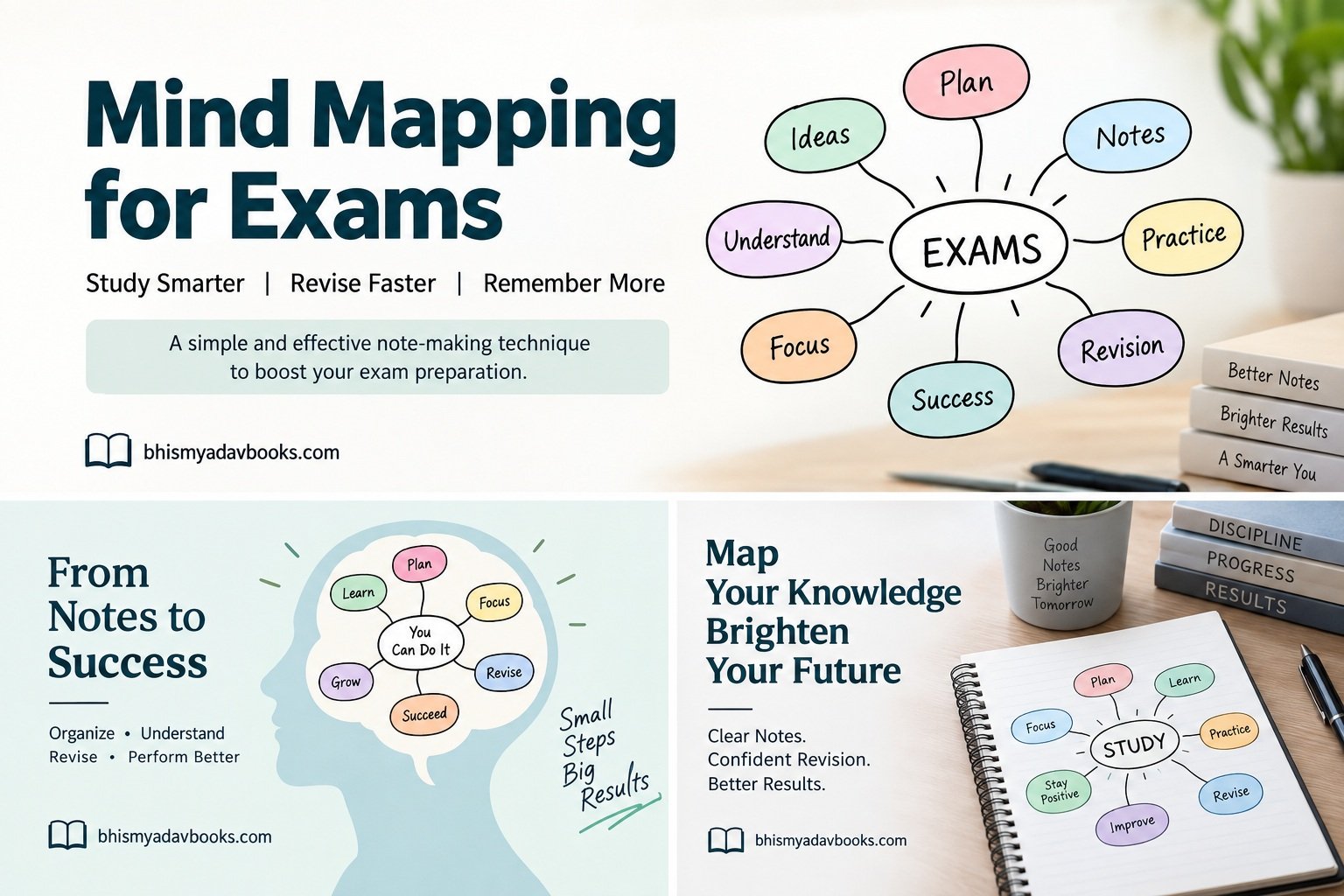
A mind map is a visual note-making technique that organizes information around a central idea. Instead of writing information only in long paragraphs or linear lists, you arrange important concepts, keywords, relationships, examples, and supporting details in a connected visual structure.
For students, this can make learning more organized and revision more efficient.
Imagine that you have a large chapter containing definitions, formulas, dates, causes, effects, examples, and important facts. Reading the entire chapter repeatedly can take considerable time. A well-designed mind map can bring the major ideas together on a single page, allowing you to see the structure of the chapter at a glance.
Mind mapping does not mean replacing textbooks, lectures, practice questions, or traditional notes. Instead, it can work alongside them as a powerful revision and note-making method.
We have some amazing books at our Shop page you may want to buy.
In this comprehensive guide, we will explore how to use mind mapping for exams, how to create effective study mind maps, the benefits of mind mapping, common mistakes students make, and practical techniques for different subjects.
Table of Contents
Mind Mapping for Exams: The Complete Guide to Smarter Revision and Better Memory
What Is Mind Mapping?
Mind mapping is a visual method of organizing information around a central topic.
The central topic is placed in the middle of the page. From that topic, major ideas branch outward. Smaller branches then contain supporting concepts, facts, examples, definitions, formulas, or other details.
A simple structure looks like this:
Central Topic → Main Ideas → Subtopics → Key Details
For example, suppose you are studying Photosynthesis in Biology.
Your central topic could be:
PHOTOSYNTHESIS
From this central topic, you might create branches such as:
- Definition
- Requirements
- Process
- Chlorophyll
- Light Reaction
- Dark Reaction
- Products
- Importance
- Factors Affecting Photosynthesis
Each major branch can then contain smaller branches.
For example:
Factors Affecting Photosynthesis
→ Light intensity
→ Carbon dioxide concentration
→ Temperature
→ Water availability
→ Chlorophyll
The result is a visual representation of the chapter rather than a long sequence of paragraphs.
This is particularly useful during exam preparation because many subjects require students to understand relationships between ideas, rather than simply memorize isolated facts.
Why Is Mind Mapping Useful for Exams?
The examination period creates a special challenge: students must understand large amounts of information and retrieve it accurately under time pressure.
Mind maps can help by reducing unnecessary information and emphasizing relationships between important concepts.
1. Mind Maps Organize Information
One of the biggest advantages of mind mapping is organization.
When information is scattered across different pages of a notebook, it can become difficult to see how concepts are related. A mind map brings related information together.
For example, instead of having separate pages for:
- Causes
- Events
- Important people
- Consequences
- Dates
you can connect all of them to one central historical event.
This gives your brain a clearer overview of the subject.
2. Mind Mapping Makes Revision Faster
Revision is one of the most important parts of exam preparation.
Many students spend too much time rereading complete chapters. While rereading can be useful, it is not always the most efficient way to revise material that you already understand.
A mind map can act as a revision summary.
After studying a chapter thoroughly, you can create a mind map containing only its most important information.
Later, instead of reading the entire chapter again, you can review the mind map first.
If you discover that you have forgotten something, you can return to your textbook or detailed notes.
This creates a useful revision cycle:
Study → Understand → Create Mind Map → Review → Practice → Improve
Mind Mapping vs. Traditional Notes
Traditional notes are usually written from top to bottom.
For example:
Topic: Causes of the Industrial Revolution
- Agricultural development
- Population growth
- Technological innovation
- Availability of coal and iron
- Development of transportation
- Expansion of trade
This format is useful, but it presents information primarily as a list.
A mind map can show how these ideas connect.
At the center:
INDUSTRIAL REVOLUTION
Branches:
Agriculture
→ Improved farming
→ Increased food production
→ Population growth
Technology
→ Steam engine
→ Machinery
→ Factory production
Resources
→ Coal
→ Iron
Transportation
→ Canals
→ Railways
→ Faster movement of goods
Now the student can see not only the individual facts but also the relationships among them.
That is one of the major strengths of visual note making.
The Basic Structure of an Exam Mind Map
An effective exam mind map does not need to be complicated.
You can build one using five basic elements.
1. Central Topic
Start with the main topic in the center of the page.
The central topic should be clear and easy to identify.
Examples:
- Indian Constitution
- Algebra
- Human Digestive System
- Photosynthesis
- World War II
- Marketing Management
- Cell Biology
The central topic acts as the anchor for everything else.
2. Main Branches
Next, identify the major sections of the topic.
If you are creating a mind map for a chapter, the main branches could correspond to the chapter’s major headings.
For example:
Human Digestive System
Main branches:
- Mouth
- Stomach
- Small Intestine
- Large Intestine
- Digestive Enzymes
- Absorption
- Disorders
These branches provide the basic structure.
3. Sub-Branches
Now add supporting information to each major branch.
For example:
Stomach
→ Gastric juice
→ Hydrochloric acid
→ Pepsin
→ Protein digestion
→ Churning
Sub-branches allow you to add detail without making the central map confusing.
4. Keywords
Use keywords instead of lengthy sentences whenever possible.
For example, instead of writing:
“The small intestine is responsible for most of the digestion and absorption of nutrients.”
You might write:
Small Intestine → Digestion + Nutrient Absorption
This makes the mind map easier to scan.
Keywords also force you to identify the essential information.
5. Connections
The most powerful part of a mind map is the relationship between ideas.
Use lines, arrows, or cross-connections when two branches are related.
For example:
Increased CO₂ → Photosynthesis Rate ↑
or:
Population Growth → Increased Demand → Industrial Development
These connections help turn isolated facts into a structured understanding.
How to Create a Mind Map for Exams: Step-by-Step Method
Creating an effective mind map becomes easier when you follow a consistent process.
Step 1: Choose One Topic
Do not try to put your entire syllabus into one giant mind map.
Start with one chapter, lesson, concept, or exam unit.
For example:
Class 10 Science → Life Processes → Nutrition
This gives you a manageable starting point.
Step 2: Identify the Main Idea
Write the main topic in the center.
Make it visually prominent.
You can use:
- A larger heading
- A box
- A circle
- A simple shape
- A short title
The goal is not artistic perfection. The goal is clarity.
Step 3: Identify the Major Concepts
Ask yourself:
“What are the 5–8 most important things I need to know about this topic?”
These become your main branches.
For example, for Nutrition, the branches might include:
- Types
- Autotrophic Nutrition
- Heterotrophic Nutrition
- Photosynthesis
- Human Nutrition
- Digestive System
- Nutrients
- Disorders
Step 4: Add Important Details
Under each branch, add only information that is useful for understanding or answering questions.
Include:
- Definitions
- Formulas
- Dates
- Names
- Examples
- Processes
- Causes
- Effects
- Exceptions
- Important facts
Avoid copying entire paragraphs from your textbook.
Step 5: Add Visual Connections
Look for relationships.
Ask:
“Which ideas influence or depend on each other?”
Use arrows and connecting lines to represent those relationships.
This step can turn an ordinary summary into a powerful learning tool.
Step 6: Review and Simplify
When the mind map is complete, examine it carefully.
Remove:
- Repeated information
- Unnecessary sentences
- Minor details
- Decorative elements that reduce clarity
A good exam mind map should be information-rich but visually simple.
A Simple Rule for Better Mind Maps
Remember this principle:
Do not try to put everything you know into your mind map. Put everything important that you need to remember.
A mind map is not supposed to become another textbook.
Its purpose is to provide a compact visual summary.
The more unnecessary information you add, the harder it becomes to use the map for rapid revision.
Mind Mapping for Different Stages of Exam Preparation
Mind maps can be useful at several stages of studying.
During Initial Learning
You can create a basic mind map while learning a new chapter.
At this stage, focus on:
- Main concepts
- Definitions
- Important relationships
- Major examples
Do not worry about making it perfect.
During Revision
Your mind map becomes more valuable during revision.
You can gradually improve it by adding:
- Frequently forgotten facts
- Important formulas
- Exam questions
- Teacher’s important points
- Mistakes from practice tests
Over time, your mind map can become a personalized revision resource.
Before the Examination
During the final days before an exam, mind maps can provide quick chapter-level revision.
Instead of opening multiple notebooks, you can review the key structure of each chapter.
However, final revision should not consist only of looking at mind maps. Combine them with active recall, practice questions, previous papers, and mock tests.
Mind Mapping and Active Recall
One of the best ways to make mind mapping more effective is to combine it with active recall.
Active recall means attempting to retrieve information from memory rather than simply rereading it.
For example, close your textbook and look only at the central topic:
PHOTOSYNTHESIS
Now try to recreate the branches from memory:
- Definition
- Requirements
- Chlorophyll
- Light reaction
- Dark reaction
- Products
- Factors
Then compare your recalled structure with your original mind map.
This turns a passive review into an active learning exercise.
The 5-Minute Mind Map Revision Technique
When you are short on time, try this simple method.
Minute 1: Central Topic
Write the chapter name.
Minute 2: Main Branches
Add the major concepts.
Minute 3: Key Details
Add essential facts, formulas, definitions, or examples.
Minute 4: Connections
Draw relationships between important ideas.
Minute 5: Recall
Cover the map or look away and try to reproduce its structure from memory.
This technique is particularly useful for reviewing previously studied material.
Mind Mapping for Exams: Benefits, Techniques and Subject-Wise Examples
The Benefits of Mind Mapping for Students
1. Mind Mapping Helps You See the Big Picture
One of the biggest problems with traditional study methods is that students sometimes focus so heavily on individual facts that they lose sight of the larger concept.
A mind map starts with the central idea and expands outward.
For example, when studying The Human Nervous System, you might have:
Human Nervous System
→ Central Nervous System
→ Peripheral Nervous System
→ Brain
→ Spinal Cord
→ Neurons
→ Reflex Action
→ Nervous Disorders
The student can immediately see how the different parts belong to the same overall topic.
This is especially useful for chapters containing many interconnected concepts.
2. Mind Maps Can Make Complex Topics Easier to Understand
Some subjects contain concepts that seem difficult when explained through long paragraphs.
A mind map can break a complicated topic into smaller sections.
For example:
Climate Change
→ Causes
→ Greenhouse Gases
→ Global Warming
→ Effects
→ Sea-Level Rise
→ Extreme Weather
→ Biodiversity Loss
→ Solutions
→ Renewable Energy
→ Energy Efficiency
→ Afforestation
Instead of facing one large topic, the student sees several manageable sections.
This process is sometimes called chunking—breaking information into smaller meaningful groups.
3. Mind Mapping Supports Memory Through Association
Memory becomes easier when information is connected.
Suppose you need to remember the causes of an event in history.
Instead of memorizing ten unrelated points, organize them into categories.
For example:
Revolt → Political + Economic + Social + Military Causes
Then place specific facts under each category.
The categories become memory cues.
During an examination, remembering one major branch can help you retrieve the smaller points connected to it.
4. Mind Maps Make Important Information Stand Out
When every sentence in a notebook looks similar, identifying important information can take time.
Mind maps naturally create hierarchy.
The central topic is the most prominent idea.
Main branches are the next level.
Sub-branches contain supporting information.
This creates a structure such as:
Main Idea
↓
Major Concept
↓
Supporting Concept
↓
Example / Fact
This hierarchy can make revision easier because you can quickly identify what deserves the most attention.
Using Colors in Mind Mapping
Colors can make a mind map easier to navigate, but students should avoid turning their maps into overly complicated works of art.
The purpose of color is organization, not decoration.
A simple color system might be:
- One color for definitions
- One color for formulas
- One color for examples
- One color for important facts
- One color for mistakes or warnings
For example:
Formula → Blue
Definition → Green
Important Date → Orange
Common Mistake → Red
You do not need ten different colors.
A small, consistent color system is usually easier to understand.
The One-Color-per-Branch Technique
Another useful method is to assign a color to each major branch.
For example:
Mathematics
- Algebra — one color
- Geometry — another color
- Trigonometry — another color
- Statistics — another color
This creates visual separation.
When revising, your eyes can quickly identify different sections.
However, if you are preparing for an exam where you need to reproduce diagrams or notes by hand, do not become dependent on colors that you may not use during the examination.
The information itself should remain memorable without color.
Using Symbols and Icons
Simple symbols can also make mind maps easier to scan.
For example:
⭐ = Very important
? = Doubt
! = Common mistake
✓ = Frequently tested
→ = Leads to
↑ = Increase
↓ = Decrease
≠ = Difference
= = Relationship or equality
A student preparing for Mathematics might use:
★ Formula
✓ Frequently asked
! Common error
This creates a personal visual language.
The key is consistency. If you decide that a particular symbol means “important,” use that symbol throughout your notes.
Mind Mapping for Mathematics
Many students assume that mind mapping is mainly useful for theoretical subjects. That is not true.
It can also be useful in Mathematics, especially for organizing formulas, concepts, methods, and problem-solving strategies.
Consider the topic:
Quadratic Equations
Main branches could include:
- Standard Form
- Roots
- Discriminant
- Formula
- Nature of Roots
- Graph
- Methods of Solving
- Applications
Under Methods of Solving, you might have:
→ Factorization
→ Completing the Square
→ Quadratic Formula
Under Discriminant:
→ D = b² − 4ac
Then:
→ D > 0 → Two distinct real roots
→ D = 0 → Equal real roots
→ D < 0 → No real roots
This gives you a compact conceptual map of the topic.
Formula Mind Maps
You can create separate mind maps for formulas.
For example:
TRIGONOMETRY
→ Basic Ratios
→ Identities
→ Complementary Angles
→ Compound Angles
→ Double Angles
→ Applications
Instead of memorizing formulas as a random list, group them according to their relationships.
This can make formula revision more systematic.
Mind Mapping for Science
Science subjects are particularly suitable for mind maps because they contain processes, classifications, structures, causes, effects, and relationships.
Consider Cell Biology.
Central topic:
CELL
Main branches:
→ Cell Structure
→ Cell Organelles
→ Plant Cell
→ Animal Cell
→ Cell Division
→ Transport
→ Functions
Under Cell Organelles:
→ Nucleus
→ Mitochondria
→ Ribosomes
→ Golgi Apparatus
→ Endoplasmic Reticulum
→ Lysosomes
→ Vacuoles
Under Mitochondria:
→ Structure
→ Function
→ Cellular Respiration
→ ATP Production
A map like this gives you a rapid overview before an examination.
Mind Mapping for Biology
Biology involves many classifications and processes, making visual organization particularly helpful.
For example:
HUMAN DIGESTIVE SYSTEM
→ Mouth
→ Oesophagus
→ Stomach
→ Small Intestine
→ Large Intestine
→ Rectum
→ Anus
You can add another branch:
Digestive Enzymes
→ Amylase
→ Pepsin
→ Trypsin
→ Lipase
And another:
Nutrients
→ Carbohydrates
→ Proteins
→ Fats
→ Vitamins
→ Minerals
→ Water
The map can also show the relationship between organs, enzymes, nutrients, digestion, and absorption.
Mind Mapping for Physics
Physics requires students to understand formulas as well as concepts.
A mind map can combine both.
For example:
MOTION
→ Distance
→ Displacement
→ Speed
→ Velocity
→ Acceleration
→ Equations of Motion
→ Graphs
Under Equations of Motion:
→ v = u + at
→ s = ut + ½at²
→ v² = u² + 2as
You can also connect each equation to the situations in which it is useful.
This prevents formulas from becoming isolated pieces of information.
Mind Mapping for Chemistry
Chemistry contains reactions, properties, formulas, classifications, and processes.
A mind map can help organize these relationships.
For example:
ACIDS, BASES AND SALTS
→ Acids
→ Bases
→ Indicators
→ pH Scale
→ Neutralization
→ Salts
→ Applications
Under Indicators:
→ Litmus
→ Methyl Orange
→ Phenolphthalein
Under Neutralization:
Acid + Base → Salt + Water
This provides a quick visual summary for revision.
Mind Mapping for History
History is one of the subjects where mind mapping can be particularly effective.
Historical chapters often contain:
- Dates
- People
- Events
- Causes
- Consequences
- Movements
- Agreements
- Political developments
A linear list can become difficult to remember.
A mind map can organize these details around a central event.
For example:
INDIAN INDEPENDENCE MOVEMENT
→ Early Nationalism
→ Swadeshi Movement
→ Non-Cooperation Movement
→ Civil Disobedience Movement
→ Quit India Movement
→ Important Leaders
→ Major Events
→ Consequences
For a specific movement, you can create branches for:
Causes → Leaders → Methods → Events → Government Response → Results
This structure can help students remember historical information as a connected story rather than as isolated facts.
Mind Mapping for Geography
Geography often involves relationships between physical and human factors.
For example:
MONSOON
→ Causes
→ Seasonal Pattern
→ Southwest Monsoon
→ Northeast Monsoon
→ Rainfall Distribution
→ Agriculture
→ Economy
→ Problems
Under Problems:
→ Floods
→ Droughts
→ Irregular Rainfall
You can also use arrows to represent cause-and-effect relationships.
For example:
Monsoon Rainfall → Agriculture → Crop Production → Rural Economy
This helps students understand the subject rather than simply memorize it.
Mind Mapping for Political Science
Political Science contains many concepts that can be organized hierarchically.
For example:
DEMOCRACY
→ Meaning
→ Features
→ Institutions
→ Elections
→ Rights
→ Responsibilities
→ Challenges
→ Advantages
Under Features:
→ Popular Participation
→ Free Elections
→ Rule of Law
→ Accountability
→ Equality
A mind map can help students compare different political systems or constitutional concepts.
Mind Mapping for Economics
Economics involves relationships between concepts, making visual organization useful.
For example:
INFLATION
→ Meaning
→ Causes
→ Demand-Pull
→ Cost-Push
→ Effects
→ Consumers
→ Producers
→ Government
→ Control Measures
Under Control Measures:
→ Monetary Policy
→ Fiscal Policy
→ Supply-Side Measures
This allows students to understand the structure of the topic before writing long-form answers.
Mind Mapping for Languages
Mind mapping is not limited to factual subjects.
Students can also use it for language learning.
For English, for example:
GRAMMAR
→ Tenses
→ Articles
→ Prepositions
→ Conjunctions
→ Active/Passive Voice
→ Direct/Indirect Speech
→ Subject-Verb Agreement
For vocabulary:
WORD: “IMPORTANT”
→ Significant
→ Essential
→ Crucial
→ Vital
→ Critical
→ Necessary
For writing preparation:
ESSAY
→ Introduction
→ Main Argument
→ Supporting Points
→ Examples
→ Counterpoint
→ Conclusion
This can help students organize ideas before writing.
Mind Mapping for Essay-Based Questions
Essay questions often require more than factual recall. Students need to organize arguments logically.
A mind map can help you plan an answer before writing it.
Suppose the question is:
“Discuss the importance of education in society.”
Create the central topic:
IMPORTANCE OF EDUCATION
Branches:
→ Individual Development
→ Employment
→ Social Awareness
→ Economic Growth
→ Equality
→ Critical Thinking
→ Citizenship
→ National Development
Then add examples beneath each branch.
This gives you an answer structure.
Instead of starting the examination answer with random ideas, you already have a logical framework.
Mind Maps for Long Answers
A common problem during exams is forgetting points while writing long answers.
A mind map can help create a mental checklist.
For a 10-mark answer, you might structure the map as:
INTRODUCTION
↓
DEFINITION
↓
MAIN POINT 1
↓
MAIN POINT 2
↓
MAIN POINT 3
↓
EXAMPLE
↓
ADVANTAGES / EFFECTS
↓
CONCLUSION
The exact structure depends on the subject and question, but the principle remains the same: organize the answer before writing it.
The Difference Between a Good Mind Map and a Bad Mind Map
Not every mind map is automatically effective.
A good mind map should make information easier to understand and retrieve.
Characteristics of a Good Mind Map
A good exam mind map is:
- Clear
- Concise
- Organized
- Hierarchical
- Easy to scan
- Based on keywords
- Focused on important information
- Connected logically
- Useful for revision
Characteristics of a Poor Mind Map
A poor mind map may:
- Contain too much text
- Use too many colors
- Have unclear branches
- Include unnecessary details
- Become visually crowded
- Copy entire textbook paragraphs
- Focus more on decoration than learning
The goal is not to create the most beautiful mind map.
The goal is to create the most useful mind map.
Avoid the “Beautiful Notes Trap”
Many students spend a great deal of time making their notes look attractive.
Beautiful notes can be enjoyable, but there is an important distinction between studying and decorating.
If you spend 60 minutes drawing borders, coloring headings, and adding decorative elements but only 10 minutes thinking about the actual concepts, the process may not improve your learning very much.
Use design elements when they serve a purpose.
For example:
Useful: A box around an important formula.
Useful: An arrow showing cause and effect.
Useful: A symbol marking a frequently tested concept.
Less useful: Large decorative drawings that consume half the page.
Always ask:
“Does this element help me understand or remember the information?”
If the answer is no, remove it.
How to Make Mind Mapping More Effective
A mind map becomes significantly more powerful when you use it as part of a complete study system.
A useful process is:
Read
Study the textbook, lecture, or learning material.
Understand
Make sure you understand the concepts.
Reduce
Identify the most important information.
Map
Create your mind map.
Recall
Close your resources and reproduce the ideas from memory.
Practice
Answer questions related to the topic.
Correct
Add information that you forgot or misunderstood.
This process transforms mind mapping from a simple note-making technique into an active learning strategy.
Mind Mapping and Spaced Revision
Do not create a mind map once and then forget about it.
Review it at spaced intervals.
For example:
Day 1: Create the mind map.
Day 2: Quick recall.
Day 4: Review and test yourself.
Day 7: Reconstruct important branches.
Day 14: Practice exam questions.
Before Exam: Final rapid revision.
The exact schedule can vary, but the principle is simple: revisit information over time instead of trying to memorize everything in one session.
Mind Mapping for Exams: Advanced Techniques, Revision Strategies and Common Mistakes
Advanced Mind Mapping Techniques for Exam Preparation
1. Create a Master Mind Map for Each Subject
Instead of creating only chapter-level mind maps, consider creating a master mind map for each subject.
For example:
MATHEMATICS
→ Algebra
→ Geometry
→ Trigonometry
→ Statistics
→ Probability
→ Mensuration
→ Coordinate Geometry
Each major branch represents a unit or group of related chapters.
You do not need to put every formula into this master map.
Its purpose is to show the structure of the entire subject.
When you look at it, you should immediately understand:
- What topics are included?
- Which chapters are related?
- Which areas are strong?
- Which areas need more revision?
- Where should you focus next?
This can be especially useful when your examination covers a large syllabus.
2. Create Chapter Mind Maps
After creating a subject-level overview, create a separate mind map for each chapter.
For example:
Science
→ Physics
→ Chemistry
→ Biology
Then create individual maps such as:
Physics → Electricity
Branches:
→ Electric Current
→ Potential Difference
→ Resistance
→ Ohm’s Law
→ Series Circuit
→ Parallel Circuit
→ Electrical Power
→ Electrical Energy
The chapter map should contain enough information to support revision without becoming overloaded.
3. Use the “One Page, One Chapter” Technique
A powerful goal is to summarize one chapter on one page.
This does not mean every chapter must literally fit onto one physical sheet. The idea is to create a compact revision overview.
Try to include:
- Main concepts
- Important definitions
- Key formulas
- Major examples
- Important relationships
- Common mistakes
- Frequently tested points
If you cannot summarize a chapter without copying large sections of text, you may need to identify the chapter’s main ideas first.
This technique encourages you to distinguish between essential information and supporting information.
4. Build a Question-Based Mind Map
Most students create mind maps from textbooks.
Try doing the opposite.
Create a mind map from exam questions.
Suppose you are studying a history chapter.
Write the central topic:
HISTORY CHAPTER
Then create branches based on the questions you expect:
→ Causes
→ Important Events
→ Leaders
→ Timeline
→ Consequences
→ Significance
→ Comparison
→ Important Terms
Now place the answers beneath each branch.
This makes the map directly relevant to examination requirements.
5. Use the “Why–What–How” Structure
For conceptual subjects, organize information around three questions:
WHY?
Why does this happen?
WHAT?
What is it?
HOW?
How does it work?
For example:
PHOTOSYNTHESIS
What?
→ Process by which green plants produce food
Why?
→ Produces chemical energy stored in food
How?
→ Uses light energy, carbon dioxide, and water
This approach encourages understanding rather than mechanical memorization.
6. Use Cause-and-Effect Mind Maps
Some subjects contain extensive cause-and-effect relationships.
For these topics, make cause-and-effect relationships the main structure of your map.
For example:
DEFORESTATION
→ Loss of Trees
→ Reduced Carbon Absorption
→ Increased Atmospheric CO₂
→ Climate Effects
Another branch:
Deforestation
→ Soil Exposure
→ Soil Erosion
→ Reduced Soil Fertility
→ Agricultural Problems
Arrows can show the sequence.
This approach is particularly useful for:
- Geography
- Economics
- History
- Political Science
- Environmental Science
- Biology
- Social Science
7. Use Timeline Mind Maps for History
History students often need to remember sequences of events.
A timeline-style mind map can help.
For example:
Historical Movement
→ Beginning
→ Early Events
→ Major Turning Point
→ Important Leaders
→ Major Development
→ Final Stage
→ Result
Add dates where necessary.
You can also connect events using arrows:
Event A → Event B → Event C → Event D
This can make chronological relationships easier to recall.
8. Create Comparison Mind Maps
Comparison questions are common in examinations.
Instead of memorizing two separate descriptions, create a comparison map.
For example:
PLANT CELL vs ANIMAL CELL
Plant Cell
→ Cell Wall
→ Chloroplast
→ Large Vacuole
→ Fixed Shape
Animal Cell
→ No Cell Wall
→ No Chloroplast
→ Smaller Vacuoles
→ Flexible Shape
You can add a shared branch:
Both
→ Cell Membrane
→ Cytoplasm
→ Nucleus
→ Mitochondria
This makes similarities and differences easier to identify.
9. Use Mind Maps for Definitions
Definitions are often important in exams.
Create a dedicated branch for key terminology.
For example:
ECONOMICS
→ Inflation
→ GDP
→ Demand
→ Supply
→ Market
→ Opportunity Cost
Under each term, write a short definition.
Avoid writing an entire paragraph.
For example:
Inflation → Sustained rise in general price level
The goal is to create a memory cue that allows you to recall the complete explanation.
10. Use Formula Maps
Formula-heavy subjects benefit from specialized formula maps.
For example:
MOTION
→ v = u + at
→ s = ut + ½at²
→ v² = u² + 2as
Then create branches showing:
Variables
→ u = Initial velocity
→ v = Final velocity
→ a = Acceleration
→ t = Time
→ s = Displacement
You can also include:
Units
→ velocity = m/s
→ acceleration = m/s²
→ displacement = m
This reduces the need to search through multiple pages during revision.
11. Add “Common Mistakes” Branches
This is an underrated technique.
Your mind map should not only contain what you know. It can also contain what you frequently get wrong.
Create a branch:
COMMON MISTAKES
Then add:
→ Sign errors
→ Formula confusion
→ Unit mistakes
→ Misreading questions
→ Incorrect dates
→ Missing keywords
For example, in Mathematics:
Quadratic Equation
→ Remember: Check sign of b
→ Don’t forget ±
→ Verify solution
These reminders can be extremely valuable before examinations.
12. Add an “Exam Focus” Branch
Create a special branch for material that deserves extra attention.
You can include:
- Frequently asked questions
- Important formulas
- Important definitions
- Teacher-highlighted concepts
- Previous-paper topics
- Topics you frequently forget
For example:
EXAM FOCUS
→ Definition of X
→ Formula Y
→ Diagram Z
→ Difference between A and B
→ Long-answer question
This transforms your mind map into a personalized examination guide.
How to Create a Mind Map from a Textbook
One of the most useful skills is converting a textbook chapter into a mind map.
Follow this process.
Step 1: Preview the Chapter
Before reading every sentence, examine:
- Chapter title
- Headings
- Subheadings
- Diagrams
- Tables
- Summary
- Questions
This gives you an overview.
Step 2: Read for Understanding
Read the chapter carefully.
Do not immediately try to copy everything into your map.
Ask:
What is this section actually trying to explain?
Understanding should come before summarization.
Step 3: Identify the Main Sections
Write down the chapter’s major headings.
These become your main branches.
Step 4: Extract Keywords
For each section, identify the most important:
- Terms
- Facts
- Formulas
- Dates
- Names
- Processes
- Examples
Convert lengthy explanations into short phrases.
Step 5: Identify Relationships
Look for:
- Causes
- Effects
- Comparisons
- Sequences
- Categories
- Dependencies
- Examples
Connect these using arrows or branches.
Step 6: Test Yourself
Close the textbook.
Look only at your mind map.
Try explaining the entire chapter aloud.
If you cannot explain an important concept, return to the textbook and improve the map.
This makes the process much more active.
Mind Mapping for Last-Minute Revision
Mind maps can be especially useful during the final stages of exam preparation.
However, “last-minute revision” should not mean trying to learn an entire subject for the first time.
Instead, use mind maps to refresh previously studied information.
A useful approach is the:
30-Minute Chapter Revision Method
First 5 Minutes: Overview
Look at the chapter mind map.
Identify all major branches.
Next 10 Minutes: Active Recall
Cover sections of the map and try to remember them.
Next 10 Minutes: Practice
Answer a few representative questions.
Final 5 Minutes: Weak Areas
Review the concepts you could not recall.
This combines visual review with active recall and practice.
The “Blank Mind Map” Technique
One of the best ways to test yourself is to create a blank mind map.
Write only the central topic.
For example:
CELL DIVISION
Then, without looking at your notes, create the branches.
Try to remember:
→ Types
→ Stages
→ Purpose
→ Differences
→ Important Terms
After finishing, compare your version with your original map.
Use another pen or symbol to mark what you forgot.
Those forgotten areas deserve additional revision.
The “Rebuild from Memory” Method
Take your original mind map and study it briefly.
Then put it away.
On a blank sheet, recreate the structure from memory.
Do not worry if your new map looks different.
The goal is to retrieve the information.
Afterward, compare both maps.
You might discover that:
- You remembered the main branches.
- You forgot several details.
- You confused two concepts.
- You missed an important formula.
This gives you immediate feedback about your memory.
Mind Mapping for Group Study
Mind maps can also be useful during group study.
Assign each student a section of a chapter.
Each student creates a mind map for their assigned section.
Then combine the maps into a larger subject map.
Another method is to create the map collaboratively on a board.
One student writes the central topic.
Others contribute:
- Main branches
- Definitions
- Examples
- Questions
- Formulas
- Connections
Group members can challenge one another:
“Why does this happen?”
“What is the difference between these two concepts?”
“Can you explain this branch without looking?”
This transforms a mind map into a discussion tool.
Handwritten vs. Digital Mind Maps
Students can create mind maps on paper or digitally.
Both methods have advantages.
Handwritten Mind Maps
Advantages include:
- Easy to create
- No software required
- Flexible
- Useful for handwritten exam preparation
- Easy to draw arrows and diagrams
- Can be created anywhere
A notebook or plain sheet of paper is enough.
Digital Mind Maps
Digital tools can be useful when you want to:
- Edit information
- Move branches
- Store many maps
- Search notes
- Duplicate templates
- Access maps across devices
Digital maps can also be convenient for large subjects.
However, the technology itself does not make the learning better.
A simple handwritten map can be more useful than an elaborate digital map if it encourages deeper thinking and recall.
Choose the method that makes you actively process the information.
When Should You Create a Mind Map?
There is no single correct time.
You can create one:
Before Studying
Use a preliminary map to identify what you already know.
During Studying
Add important concepts as you learn.
After Studying
Create a summary map from memory.
During Revision
Improve and test your existing map.
For most students, creating a more complete map after understanding a chapter is a good approach.
Common Mind Mapping Mistakes Students Should Avoid
Mind mapping is simple, but several mistakes can reduce its effectiveness.
Mistake 1: Writing Too Much
If every branch contains complete paragraphs, the map stops functioning as a quick visual summary.
Solution: Use keywords and short phrases.
Mistake 2: Making One Giant Map
Trying to fit an entire syllabus onto one page can make the map unreadable.
Solution: Use a hierarchy:
Subject → Unit → Chapter → Concept
Mistake 3: Focusing Too Much on Design
Spending more time decorating than learning defeats the purpose.
Solution: Prioritize information and relationships.
Mistake 4: Creating Maps Without Understanding
Copying information directly from a textbook does not guarantee learning.
Solution: Understand first, summarize second.
Mistake 5: Never Testing the Map
Looking at a map repeatedly can create a feeling of familiarity without guaranteeing recall.
Solution: Close the map and reconstruct it from memory.
Mistake 6: Including Every Detail
Not every fact deserves equal space.
Solution: Focus on information that supports understanding, recall, or exam performance.
Mistake 7: Never Updating the Map
Your understanding changes as you practice.
Solution: Add important mistakes, corrections, and exam insights.
How to Turn Mistakes into Better Mind Maps
Suppose you take a mock test and discover that you repeatedly forget one formula.
Do not simply memorize it again.
Add it to your mind map under:
IMPORTANT FORMULAS
If you repeatedly confuse two concepts, create a comparison branch.
If you forget a sequence, add a numbered pathway.
If you make a common calculation mistake, add a warning.
This turns your mind map into a personalized learning system.
A Complete Example: Building a Mind Map Step by Step
Let’s take a simple topic:
“Water Cycle”
Start with the central topic:
WATER CYCLE
Main branches:
→ Evaporation
→ Condensation
→ Precipitation
→ Collection
→ Transpiration
Now add details.
Evaporation
→ Heat from Sun
→ Water → Water Vapour
Condensation
→ Cooling
→ Water Vapour → Droplets
→ Cloud Formation
Precipitation
→ Rain
→ Snow
→ Hail
Collection
→ Rivers
→ Lakes
→ Oceans
→ Groundwater
Transpiration
→ Plants release water vapour
Now add relationships:
Sun → Evaporation → Condensation → Precipitation → Collection
And:
Plants → Transpiration → Water Vapour → Condensation
The final map gives you both the individual stages and the complete cycle.
Turn Your Mind Map into an Exam Answer
This is another powerful technique.
Suppose the exam asks:
“Explain the water cycle.”
Your mind map already provides the structure.
You can write:
Introduction
Define the water cycle.
Stage 1
Explain evaporation.
Stage 2
Explain condensation.
Stage 3
Explain precipitation.
Stage 4
Explain collection.
Additional Process
Explain transpiration.
Conclusion
Explain how water continuously circulates through the environment.
The map therefore acts as an answer blueprint.
Mind Mapping and Exam Writing
A mind map can also improve the organization of written answers.
Before writing a long answer, spend a few seconds mentally creating a mini-map.
Ask:
What is the central idea?
Then:
What are my three or four strongest supporting points?
Then:
What example or evidence can I add?
Finally:
How should I conclude?
This can prevent answers from becoming repetitive or disorganized.
Use Mind Maps to Connect Different Chapters
Advanced students can go beyond chapter-level maps.
Sometimes one concept appears in multiple chapters.
For example:
ENERGY
may connect:
→ Physics
→ Chemistry
→ Biology
→ Environmental Science
You can create cross-connections between these subjects.
This helps you recognize that knowledge is not always divided into isolated textbook chapters.
Understanding these connections can be particularly useful for application-based questions.
The 3-Level Mind Mapping System
For large examinations, use three levels.
Level 1: Subject Map
Shows the complete subject.
Level 2: Chapter Map
Shows the structure of an individual chapter.
Level 3: Concept Map
Shows the details of a difficult concept.
For example:
Science
↓
Physics
↓
Electricity
↓
Ohm’s Law
This system prevents your notes from becoming unnecessarily crowded.
Mind Mapping for Exams: Complete Study System, Final Revision Plan and FAQs
Build a Complete Mind Mapping Study System
Step 1: Learn the Topic
Begin by studying your normal learning material.
This could be:
- A textbook
- Class notes
- Teacher’s explanation
- Reference material
- Educational videos
- Practice material
Do not immediately try to memorize everything.
Your first objective is to understand what the topic is about.
Ask yourself:
What is the main idea?
Why is this topic important?
What are its major components?
How are those components connected?
These questions prepare your brain for creating a useful mind map.
Step 2: Identify the Most Important Information
After understanding the topic, separate important information from less important information.
Look for:
- Key definitions
- Important concepts
- Formulas
- Dates
- Names
- Processes
- Causes
- Effects
- Examples
- Comparisons
- Exceptions
- Frequently tested information
Do not automatically include every sentence from your textbook.
Think like an examiner:
“What information would I need to answer questions about this topic?”
This question can help you build a much more focused mind map.
Step 3: Create the Central Idea
Write the topic in the center of your page.
For example:
CELL DIVISION
Then begin creating your major branches.
Possible branches:
→ Cell Cycle
→ Mitosis
→ Meiosis
→ Stages
→ Importance
→ Differences
→ Applications
Keep the central idea short and clear.
Step 4: Add Main Branches
Main branches should represent the most important parts of the topic.
A useful target is around 5–8 major branches, although the ideal number depends on the complexity of the topic.
Do not force every topic into the same structure.
Some chapters may need fewer branches.
Others may need more.
The important thing is that the structure remains easy to understand.
Step 5: Add Supporting Details
Once your main branches are established, add smaller branches.
For example:
MITOSIS
→ Prophase
→ Metaphase
→ Anaphase
→ Telophase
→ Cytokinesis
Then add the essential characteristics of each stage.
This creates multiple levels of information without requiring lengthy paragraphs.
Step 6: Add Connections
Look for relationships between branches.
For example:
DNA Replication → Cell Division → Daughter Cells
or:
Cause → Process → Result
Use arrows where they make the relationship clearer.
This is particularly valuable for conceptual subjects.
Step 7: Add Exam-Specific Information
Now personalize your mind map for the examination.
Add a small branch such as:
EXAM
Under it, include:
→ Important question
→ Frequently tested concept
→ Important diagram
→ Formula
→ Common mistake
→ Key definition
Your map is now becoming a personalized revision resource.
Step 8: Test Yourself
This is one of the most important steps.
Do not finish the map and simply put it away.
Close your textbook.
Look at the central topic.
Then ask yourself:
Can I explain every major branch?
If yes, continue.
If not, identify the weak areas.
You can also cover individual branches and attempt to recall what they contain.
This transforms mind mapping into active learning.
Step 9: Practice Exam Questions
After reviewing a mind map, solve questions related to the topic.
For example:
Mind Map → Recall → Questions → Feedback
Suppose you remember the basic concept but struggle to answer an application-based question.
That tells you that your understanding needs improvement.
You can then return to the relevant branch and add an example or explanation.
This creates a feedback loop.
Step 10: Update the Map
Your mind map should evolve.
As you solve more questions, you may discover:
- Important topics you initially missed
- Concepts you repeatedly forget
- Formulas you confuse
- Questions that require special approaches
- Connections between chapters
Add these insights.
By the end of your preparation, your mind map becomes much more personalized than a simple textbook summary.
A 7-Day Mind Mapping Revision Plan
You can use mind maps during a one-week revision cycle.
Day 1: Create
Study the chapter and create the initial mind map.
Focus on understanding rather than artistic presentation.
Day 2: Recall
Look at the central topic and reproduce the major branches from memory.
Identify weak areas.
Day 3: Practice
Solve questions related to the chapter.
Add important mistakes to your map.
Day 4: Review
Quickly review the map and explain the topic aloud.
Day 5: Rebuild
Create a simplified version from memory.
Compare it with your original.
Day 6: Exam Practice
Answer timed questions.
Identify areas where recall or application is weak.
Day 7: Final Review
Use the mind map for rapid revision and focus on your weakest branches.
This approach combines mind mapping, active recall, spaced revision, and exam practice.
The “Three Maps” Strategy
Another useful approach is to create three versions of a topic.
Map 1: Learning Map
This is your detailed map.
It may contain:
- Concepts
- Explanations
- Examples
- Definitions
- Relationships
Its purpose is understanding.
Map 2: Revision Map
This is a shorter version.
Remove information that you can already recall easily.
Keep:
- Important facts
- Formulas
- Difficult concepts
- Key relationships
- Common mistakes
Its purpose is efficient revision.
Map 3: Final Recall Map
This is the smallest version.
It may contain only keywords.
For example:
PHOTOSYNTHESIS
→ Light
→ CO₂
→ H₂O
→ Chlorophyll
→ Glucose
→ O₂
→ Factors
Its purpose is rapid memory activation.
This three-stage approach prevents you from using the same level of detail throughout the entire preparation period.
Use Mind Maps for Weekly Revision
Do not wait until the examination is approaching.
At the end of every week, spend some time reviewing your maps.
Ask:
- Which chapters did I study?
- Which concepts do I remember?
- Which concepts have become weak?
- Which formulas need practice?
- Which questions did I get wrong?
Mark weak branches with a symbol such as:
? = Needs Review
Then prioritize those branches during the next study session.
Mind Mapping for Competitive Exams
Mind mapping can also be useful for students preparing for competitive examinations.
Competitive exams often require students to cover large syllabi and revise information repeatedly.
A subject-level map can help you organize:
General Knowledge
→ History
→ Geography
→ Polity
→ Economics
→ Science
→ Current Affairs
Similarly:
Reasoning
→ Analogy
→ Classification
→ Series
→ Coding-Decoding
→ Blood Relations
→ Direction Sense
→ Syllogism
→ Puzzles
The map provides a visual syllabus structure.
However, for competitive examinations, mind maps should be combined with question practice, timed tests, previous-year papers, and regular revision.
A mind map alone cannot replace practice.
Mind Mapping for Exam Anxiety
A large syllabus can sometimes feel overwhelming.
Students may think:
“There is too much to study.”
A mind map can make the syllabus look more manageable by breaking it into sections.
Instead of thinking:
“I have to study the entire subject.”
you can think:
“Today I need to revise these three branches.”
Breaking a large task into smaller components can make your study plan feel more structured.
Mind mapping therefore has a useful organizational role even when the actual learning still requires textbooks, lectures, and practice.
Use Mind Maps to Prioritize Your Weak Areas
Not every topic requires equal study time.
You can categorize branches into three levels:
Strong
✓ I understand this.
Moderate
~ I understand the basics but need revision.
Weak
? I frequently forget or misunderstand this.
Then spend more time on the weak branches.
This is better than repeatedly revising material you already know well.
The 80/20 Principle in Mind Mapping
Students sometimes spend too much time reviewing everything equally.
A better strategy is to identify the concepts that have the greatest impact on your preparation.
Look for:
- Frequently tested concepts
- Foundational concepts
- High-value formulas
- Topics that connect to other chapters
- Areas where you repeatedly make mistakes
Put these at the center of your revision strategy.
The exact proportion will vary by subject and examination, so do not treat the 80/20 idea as a rigid rule.
Use it as a reminder to prioritize intelligently.
Mind Mapping with Flashcards
Mind maps and flashcards can work together.
Your mind map provides the big picture.
Flashcards provide specific recall practice.
For example:
Mind Map
CHEMISTRY → ACIDS AND BASES
→ Acids
→ Bases
→ pH
→ Indicators
→ Neutralization
Then create flashcards for individual facts:
Question: What is neutralization?
Answer: Reaction between an acid and a base producing salt and water.
This creates two levels of learning:
Mind Map = Structure
Flashcards = Detailed Recall
Mind Mapping with Practice Tests
Practice tests can reveal weaknesses that your mind map cannot.
Suppose your mind map contains ten important formulas.
You feel confident because you recognize all ten.
But during a test, you cannot remember which formula to use in a particular problem.
The issue is not necessarily memory. It may be application.
Update your map with a small branch:
WHEN TO USE
Then write the conditions or problem types associated with each formula.
This connects knowledge with application.
Mind Mapping for Oral Revision
Another powerful method is to explain the mind map aloud.
Choose a central topic.
Then follow the branches.
For example:
DIGESTION
→ Mouth
→ Stomach
→ Small Intestine
→ Large Intestine
Explain each branch without looking at your textbook.
If you get stuck, you have identified a knowledge gap.
This technique can be performed alone or with a study partner.
Teach the Mind Map to Someone Else
One of the strongest ways to test your understanding is to teach.
Take your mind map and imagine that you are explaining the topic to a beginner.
Do not simply read the branches.
Explain:
- What the concept means
- Why it matters
- How the parts connect
- What examples illustrate it
- What mistakes students should avoid
If you can explain the topic clearly, your understanding is likely stronger.
If you cannot explain a branch, revisit it.
How Parents and Teachers Can Encourage Mind Mapping
Teachers can use mind maps for:
- Chapter summaries
- Classroom discussions
- Revision activities
- Concept comparisons
- Brainstorming
- Exam preparation
Parents can encourage students to create simple visual summaries rather than focusing exclusively on long hours of reading.
The goal should not be to force students to use one particular note-making technique.
Different learners prefer different approaches.
Mind mapping is most useful when the student finds it genuinely helpful.
How Much Time Should You Spend Creating a Mind Map?
There is no universal answer.
For a simple topic, you might create a useful map in 10–20 minutes.
A large chapter may take longer.
But remember:
The purpose is learning, not map production.
If you spend several hours making a map that you rarely review, the time may not be well spent.
A practical rule is:
Create quickly → Review regularly → Improve when necessary
Should You Use Pictures in a Mind Map?
Pictures can be useful when they improve understanding or memory.
For example, in Biology, a small sketch of a cell may help.
In Geography, a simple map may provide context.
In Physics, a circuit diagram may be useful.
In Mathematics, a graph can clarify a concept.
But pictures are optional.
You do not need artistic skills to create effective mind maps.
Even simple shapes and arrows are enough.
Digital Mind Mapping: When It Is Worth Using
Digital mind maps are particularly useful when:
- You revise from multiple devices.
- You frequently reorganize information.
- You have a very large syllabus.
- You want to keep maps archived.
- You want to duplicate a basic template.
- You prefer typing to handwriting.
However, avoid spending excessive time learning complicated software when your actual goal is studying.
A piece of paper can be completely sufficient.
Choose the simplest tool that allows you to think clearly.
A Simple Mind Map Template for Students
You can use the following structure for almost any chapter:
CENTRAL TOPIC
Branch 1 — Definition
→ Meaning
→ Key terms
Branch 2 — Main Concepts
→ Concept A
→ Concept B
→ Concept C
Branch 3 — Process
→ Step 1
→ Step 2
→ Step 3
Branch 4 — Examples
→ Example 1
→ Example 2
Branch 5 — Important Facts
→ Fact 1
→ Fact 2
→ Formula / Date / Name
Branch 6 — Connections
→ Cause
→ Effect
→ Relationship
Branch 7 — Exam Focus
→ Important question
→ Common mistake
→ Frequently tested point
Branch 8 — Recall
→ What do I still forget?
This template can be adapted to almost any subject.
Final Mind Mapping Checklist for Exams
Before considering a mind map complete, ask yourself:
Content
☐ Is the central topic clear?
☐ Have I included the major concepts?
☐ Are important definitions included?
☐ Are essential formulas or dates included?
☐ Have I removed unnecessary information?
Structure
☐ Are the branches logically organized?
☐ Are related ideas connected?
☐ Is the hierarchy clear?
☐ Can I quickly find important information?
Revision
☐ Can I explain the map without the textbook?
☐ Can I reproduce the major branches from memory?
☐ Have I marked difficult areas?
☐ Have I added my common mistakes?
Exam Preparation
☐ Have I practiced questions?
☐ Can I use the information in an answer?
☐ Can I recall important information under time pressure?
If most answers are yes, your mind map is serving its purpose.
Recommended books for Job Aspirants
Frequently Asked Questions About Mind Mapping for Exams
What is mind mapping for exams?
Mind mapping for exams is a visual note-making and revision technique in which a central topic is connected to major concepts, subtopics, facts, formulas, examples, and relationships. It helps students organize and review large amounts of information.
Is mind mapping good for students?
Yes. Mind mapping can be useful for organizing study material, summarizing chapters, identifying relationships, planning answers, and supporting active recall. Its effectiveness depends on how actively the student uses the map.
Can mind mapping improve memory?
Mind mapping can support memory by organizing information into connected concepts and visual structures. However, simply looking at a mind map is not enough. Combining it with active recall, spaced revision, and practice questions can make it more useful.
Is mind mapping better than traditional notes?
Neither method is universally better. Traditional notes are useful for detailed explanations, while mind maps are particularly useful for summaries, relationships, and rapid revision. Many students benefit from using both.
Can I use mind maps for Mathematics?
Yes. Mind maps can organize mathematical concepts, formulas, methods, conditions, graphs, and common mistakes. They are particularly useful for understanding how different formulas and methods relate to one another.
Can I use mind maps for History?
Absolutely. History mind maps can organize dates, people, causes, events, movements, consequences, and timelines. They can help students see historical relationships more clearly.
Should mind maps be colorful?
They can be, but they do not have to be. Use colors only when they improve organization or make important information easier to identify.
Should I write complete sentences in a mind map?
Usually, no. Keywords and short phrases are generally easier to scan and revise. Complete sentences may be useful when a definition or explanation requires precise wording.
How often should I revise a mind map?
Review it repeatedly rather than relying on one review session. You can revisit it after studying, during weekly revision, before practice tests, and during final examination preparation.
Can mind mapping replace textbooks?
No. Mind maps are a study and revision tool, not a complete replacement for textbooks, lectures, detailed notes, practice questions, or other learning resources.
Is handwritten mind mapping better than digital mind mapping?
Both can work. Handwritten maps are simple and flexible, while digital maps can be easier to edit and organize. Choose whichever method helps you actively process and recall information.
How long should a mind map be?
There is no fixed length. A simple topic may fit on one page, while a complicated subject may require multiple connected maps. The priority should be clarity and usefulness rather than size.
A Practical Daily Mind Mapping Routine
Students who want to make mind mapping a regular habit can use a simple daily routine.
10 Minutes — Review
Look at yesterday’s mind map.
15 Minutes — Learn
Study a new concept.
10 Minutes — Map
Create or update the relevant branch.
10 Minutes — Recall
Close your resources and reproduce the important ideas.
15–30 Minutes — Practice
Solve questions related to the topic.
5 Minutes — Correct
Add mistakes or forgotten information to the map.
Even a short routine like this can make mind mapping part of your regular study system.
The Most Important Rule: Make the Map Work for You
There is no single perfect mind map.
One student may prefer:
- Many colors
- Large diagrams
- Handwritten maps
- Short keywords
Another may prefer:
- Minimal colors
- Digital maps
- Formula-heavy branches
- Simple text structures
Both approaches can work.
The best mind map is the one that helps you understand and retrieve information.
Do not copy someone else’s elaborate style simply because it looks impressive.
Create a system that matches your subject, learning needs, and examination.
Final Conclusion: Use Mind Mapping to Study Smarter
Exams require more than spending long hours with a textbook.
Effective preparation involves understanding information, organizing it, recalling it, applying it, and revising it repeatedly.
Mind mapping for exams can support all of these activities by providing a visual framework for your knowledge.
A well-designed mind map can help you:
- Organize complex information
- Break large topics into manageable sections
- Identify relationships between concepts
- Summarize chapters
- Review formulas and definitions
- Plan long answers
- Identify weak areas
- Track common mistakes
- Support active recall
- Make revision more efficient
But remember that mind mapping is a tool, not a magic shortcut.
The strongest results come when you combine mind maps with:
Understanding + Active Recall + Spaced Revision + Practice Questions + Mock Tests
Do not measure your study progress by how many beautiful pages of notes you create.
Measure it by how well you can explain, remember, apply, and reproduce what you have learned.
Start small.
Choose one chapter today.
Write its central topic in the middle of a page.
Add the major branches.
Use keywords.
Connect related concepts.
Then close your book and try to reconstruct the map from memory.
With regular practice, you can develop a personal note-making system that makes large amounts of study material easier to organize and revise.
The ultimate purpose of mind mapping is simple:
Study less chaotically, understand more clearly, and revise more intelligently.