Organizing Study Material: The Complete Guide to Creating Better Notes and Studying Smarter
Studying becomes much easier when your study material is organized.
Whether you are preparing for school examinations, college assignments, competitive exams, entrance tests, interviews, or professional certifications, you will probably collect a large amount of information. Books, class notes, handwritten notes, PDFs, question papers, online articles, video lectures, presentations, practice questions, formulas, diagrams, and revision sheets can quickly become difficult to manage.
The problem is not always a lack of study material. In many cases, the real problem is having too much material without a proper organization system.
You may have excellent books but not know which chapters to study first. You may have hundreds of PDFs but struggle to find the document you need. You may write detailed notes but later discover that your notes are too long to revise. You may save useful online resources but forget where you found them.
This is why organizing study material is an important part of effective learning.
A good organization system helps you know:
- What you need to study
- Where your study material is located
- Which resources are most important
- What has already been completed
- What needs revision
- Which topics require more practice
- Where to find important formulas and facts
- Which material should be used for final revision
The goal is not to create a complicated filing system. The goal is to create a simple system that allows you to find, understand, revise, and use information quickly.
We have some amazing books at our Shop page you may want to buy.
In this guide, you will learn practical ways to organize study material, create effective notes, manage digital and physical resources, categorize information, avoid common mistakes, and build a study system that works for long-term learning.
Table of Contents
Organizing Study Material: The Complete Guide to Creating Better Notes and Studying Smarter
Why Organizing Study Material Is Important
Imagine preparing for an examination with five textbooks, several notebooks, 50 PDF files, hundreds of screenshots, online lectures, practice papers, and handwritten notes.
Everything contains useful information, but nothing is organized.
When you want to revise a particular topic, you may spend 15 or 20 minutes searching for the correct notes. When you finally find them, you may realize that another notebook contains additional information.
This wastes valuable study time.
Effective organization eliminates much of this unnecessary searching.
1. Saves Valuable Study Time
Students often spend more time searching for resources than actually using them.
A well-organized system makes it easier to locate:
- Chapter notes
- Important questions
- Previous-year papers
- Revision material
- Definitions
- Formulas
- Diagrams
- Practice exercises
Instead of asking, “Where did I save that file?” you can immediately access what you need.
2. Reduces Mental Clutter
Disorganized study material creates mental clutter.
When your desk is covered with books and loose papers, your phone contains hundreds of screenshots, and your computer has unnamed files, studying can feel overwhelming.
Organization creates a sense of control.
You know what you have, what you need, and what you should do next.
3. Makes Revision Easier
Revision becomes particularly important before examinations.
If all your information is scattered across different sources, revision becomes slow and frustrating.
Organized notes allow you to create a clear revision path.
For example:
Textbook → Detailed Notes → Short Notes → Revision Sheet → Practice Questions
This creates a useful progression from learning to examination preparation.
4. Helps You Identify Important Information
Not every piece of information deserves equal attention.
A good organization system separates:
- Essential concepts
- Supporting information
- Examples
- Frequently asked questions
- Additional reading
- Practice material
This allows you to focus your attention on high-value information.
5. Improves Learning Efficiency
Organization is not simply about keeping things neat.
It can also improve how you understand relationships between different concepts.
When related information is grouped together, you can see connections more easily.
For example, while studying history, you might organize information into:
Event → Date → Cause → Important People → Consequences → Related Events
This structure makes the subject easier to understand and remember.
What Does Organizing Study Material Actually Mean?
Organizing study material means creating a logical system for collecting, arranging, labeling, storing, reviewing, and updating educational information.
It applies to both physical and digital resources.
Your study material might include:
- Textbooks
- Reference books
- Class notes
- Handwritten notes
- Printed materials
- Worksheets
- PDFs
- E-books
- Video lectures
- Online articles
- Flashcards
- Question banks
- Previous-year papers
- Mock tests
- Assignments
- Diagrams
- Mind maps
- Formula sheets
- Revision notes
The key is to prevent these resources from becoming a random collection.
Instead, every resource should have a purpose and a location.
Step 1: Collect All Your Study Material
Before organizing your material, determine what you actually have.
Students often begin organizing one notebook or one folder without considering the entire collection.
Start by making an inventory.
Write down all the resources related to your subject or examination.
For example:
Mathematics
- Main textbook
- Class notebook
- Formula notebook
- Practice book
- Previous-year questions
- Mock tests
- Online PDFs
- Video lectures
Science
- Textbook
- Class notes
- Laboratory notes
- Diagrams
- Question bank
- Revision notes
- Previous examinations
Reasoning
- Concept notes
- Topic-wise questions
- Shortcut methods
- Practice sets
- Mock tests
- Previous-year papers
This simple inventory helps you understand the size of your study collection.
Step 2: Separate Essential and Additional Material
One of the biggest mistakes students make is treating every resource as equally important.
They are not.
Some resources are essential, while others are supplementary.
Create two major categories:
Essential Study Material
This should include resources directly connected to your syllabus and examination requirements.
Examples include:
- Official syllabus
- Main textbook
- Teacher’s notes
- Core study material
- Important question sets
- Previous-year papers
Additional Study Material
This can include:
- Extra books
- Optional PDFs
- Online articles
- Additional videos
- Advanced examples
- Reference materials
Your essential material should receive priority.
Additional material should support your learning rather than distract you from the main syllabus.
Step 3: Organize Material According to Subjects
A simple subject-based structure works well for most students.
For example:
Study Material
→ Mathematics
→ Science
→ English
→ Reasoning
→ General Knowledge
Inside each subject, create smaller categories.
For example:
Mathematics
→ Number System
→ Percentage
→ Profit and Loss
→ Ratio and Proportion
→ Algebra
→ Geometry
→ Mensuration
→ Data Interpretation
This structure makes it much easier to find specific information.
Instead of searching through everything, you immediately go to:
Subject → Topic → Resource
Step 4: Organize by Topic, Not Just by Subject
Subject-based organization is useful, but topic-based organization can make your system even more effective.
Suppose you are studying a subject containing 20 chapters.
Rather than keeping all notes together, create a separate section for each chapter or major topic.
For example:
English
Grammar
- Nouns
- Pronouns
- Adjectives
- Verbs
- Tenses
- Articles
- Prepositions
Vocabulary
- Synonyms
- Antonyms
- One-word substitutions
- Idioms
- Phrases
Reading
- Reading comprehension
- Passage practice
- Vocabulary in context
This makes revision much faster because you can focus on one specific area.
Step 5: Create a Master Study Folder
Whether you study using physical notebooks or digital resources, create a master study folder.
This is the central location for your study material.
For digital study, you could create:
Study
→ Exam Name
→ Subject 1
→ Subject 2
→ Subject 3
→ Previous Year Papers
→ Mock Tests
→ Revision
→ Important Resources
For physical study, you can use:
- File folders
- Subject folders
- Binders
- Sectioned notebooks
- Document organizers
The master folder should provide a clear overview of your entire preparation.
Step 6: Use Consistent Naming for Digital Files
Digital organization becomes much easier when files have clear names.
Avoid names such as:
- PDF123
- Notes
- New Notes
- Final Notes
- IMG_2026
- Screenshot123
These names tell you almost nothing.
Instead, use descriptive names.
For example:
- Mathematics_Percentage_Notes
- Reasoning_Coding_Decoding_Practice
- English_Tenses_Revision
- Science_Human_Digestive_System
- General_Knowledge_Important_Questions
You can also include dates when necessary.
For example:
Reasoning_Mock_Test_2026-08-29
A good file name should allow you to understand its contents without opening it.
Step 7: Create a Note-Making System
Organizing study material becomes much more effective when your notes follow a consistent structure.
Instead of writing information randomly, use the same format for every topic.
A simple note structure can include:
Topic Name
Definition:
Explain the concept briefly.
Key Points:
List the most important information.
Examples:
Add one or two useful examples.
Formula/Rule:
Write formulas, rules, or important facts.
Common Mistakes:
Record errors students frequently make.
Practice Questions:
Add questions related to the topic.
Quick Revision:
Summarize the topic in a few lines.
This structure makes your notes easier to read and revise.
Step 8: Keep Notes Short and Useful
One of the most common note-making mistakes is writing everything.
Good notes are not copies of textbooks.
The purpose of notes is to capture the information that helps you understand and remember the subject.
For example, instead of copying an entire paragraph about photosynthesis, you could write:
Photosynthesis
- Process by which green plants prepare food.
- Occurs mainly in leaves.
- Chlorophyll absorbs sunlight.
- Uses carbon dioxide and water.
- Produces glucose and oxygen.
- Light energy is converted into chemical energy.
This is easier to review than several paragraphs.
Step 9: Use Headings and Subheadings
Headings create a visual structure in your notes.
A page containing one large block of text can be difficult to review.
Instead, divide information into sections.
For example:
Indian Constitution
Fundamental Rights
Right to Equality
- Article 14
- Equality before law
- Equal protection of laws
Right to Freedom
- Articles 19–22
- Includes several important freedoms
This hierarchy makes information easier to locate.
Step 10: Use Bullet Points for Important Information
Bullet points are particularly useful when recording:
- Definitions
- Characteristics
- Advantages
- Disadvantages
- Steps
- Causes
- Effects
- Examples
- Important facts
Instead of writing:
“Time management is a process through which an individual plans and controls how much time is spent on different activities in order to improve productivity…”
You could write:
Time Management
- Planning how to use available time
- Prioritizing important tasks
- Reducing unnecessary activities
- Allocating time to specific tasks
- Reviewing progress regularly
The second format is much easier to scan during revision.
The Difference Between Study Material and Study Notes
These terms are often used interchangeably, but they are not exactly the same.
Study material is the complete collection of resources you use for learning.
Study notes are your condensed representation of important information.
For example:
A textbook is study material.
A teacher’s presentation is study material.
A PDF is study material.
A recorded lecture is study material.
Your two-page summary of the chapter is a study note.
This distinction is important because you should not try to turn every piece of study material into lengthy notes.
Instead, extract the most useful information.
The 3-Level Study Material Organization System
A highly practical approach is to organize your resources into three levels.
Level 1: Learning Material
This is where you study the topic in detail.
It can include:
- Textbooks
- Lectures
- Detailed notes
- Reference books
- Educational videos
The purpose is understanding.
Level 2: Revision Material
This contains condensed information.
Examples:
- Short notes
- Important points
- Formulas
- Definitions
- Diagrams
- Mind maps
- Question summaries
The purpose is quick revision.
Level 3: Exam Material
This contains the information needed for final preparation.
Examples:
- One-page revision sheets
- Frequently asked questions
- Previous-year questions
- Mistake lists
- Formula sheets
- Last-minute facts
The purpose is rapid recall and practice.
This three-level system prevents you from repeatedly reviewing large textbooks when a short revision sheet would be sufficient.
How to Organize Handwritten Notes
Handwritten notes remain valuable because writing can encourage active processing of information.
However, loose pages can quickly become difficult to manage.
Follow a few simple rules.
Number Your Pages
Page numbers make it easier to maintain order.
Write the Topic at the Top
Every page should clearly identify the topic.
Use Dates When Necessary
Dates are especially useful for class notes.
Keep Related Pages Together
Avoid mixing unrelated subjects in the same section.
Use Dividers
For a large notebook, use tabs or dividers for major topics.
Maintain an Index
At the beginning of the notebook, maintain a simple index.
For example:
| Topic | Page |
| Number System | 1 |
| Percentage | 12 |
| Profit and Loss | 25 |
| Ratio | 38 |
| Average | 51 |
An index can save considerable time during revision.
How to Organize Printed Notes
Printed material can quickly become a pile of papers.
Use folders or binders to prevent this.
Create sections such as:
Subject → Chapter → Topic
You can also separate documents into:
- Notes
- Practice Questions
- Previous-Year Papers
- Tests
- Revision Material
Avoid storing everything in one large file.
When the file becomes too large, finding individual documents becomes difficult.
How to Organize PDFs and Digital Notes
Digital study material requires a slightly different approach.
Create a logical folder structure.
For example:
Competitive Exam
→ 01 Mathematics
→ 02 Reasoning
→ 03 English
→ 04 General Knowledge
→ 05 Previous Year Papers
→ 06 Mock Tests
→ 07 Revision Notes
Using numbers at the beginning of folder names can keep them in a consistent order.
Within Mathematics:
01 Mathematics
→ 01 Number System
→ 02 Percentage
→ 03 Ratio
→ 04 Average
→ 05 Profit and Loss
This creates a digital filing cabinet for your education.
Avoid Saving Too Many Resources
More study material does not automatically mean better preparation.
In fact, excessive resources can create confusion.
You may download:
- Ten books
- Twenty PDFs
- Dozens of videos
- Hundreds of screenshots
- Multiple question banks
But if you never complete them, they have limited value.
Before saving a resource, ask:
“Will this resource genuinely help me understand, practice, or revise the topic?”
If the answer is no, you probably do not need it.
Build a “Best Resources” Folder
If you regularly collect educational resources, create a folder called:
Best Resources
Only place your most useful resources there.
For example:
- Best mathematics book
- Best reasoning question bank
- Best grammar notes
- Most useful previous-year papers
- Important revision PDFs
This folder becomes your trusted collection.
Instead of repeatedly searching through dozens of resources, you know where your highest-value material is stored.
Organizing Study Material Is About Accessibility
The ultimate goal of organization is not appearance.
A beautifully arranged notebook that you never use is not an effective study system.
Your organization should answer three questions quickly:
What should I study?
Where is the information?
How should I revise it?
If your system helps you answer these questions quickly, it is working.
Organizing Study Material: The Complete Guide to Creating Better Notes and Studying Smarter
Building a Practical Study Material Organization System
How to Build a Complete Study Material Organization System
A useful study system can be divided into five stages:
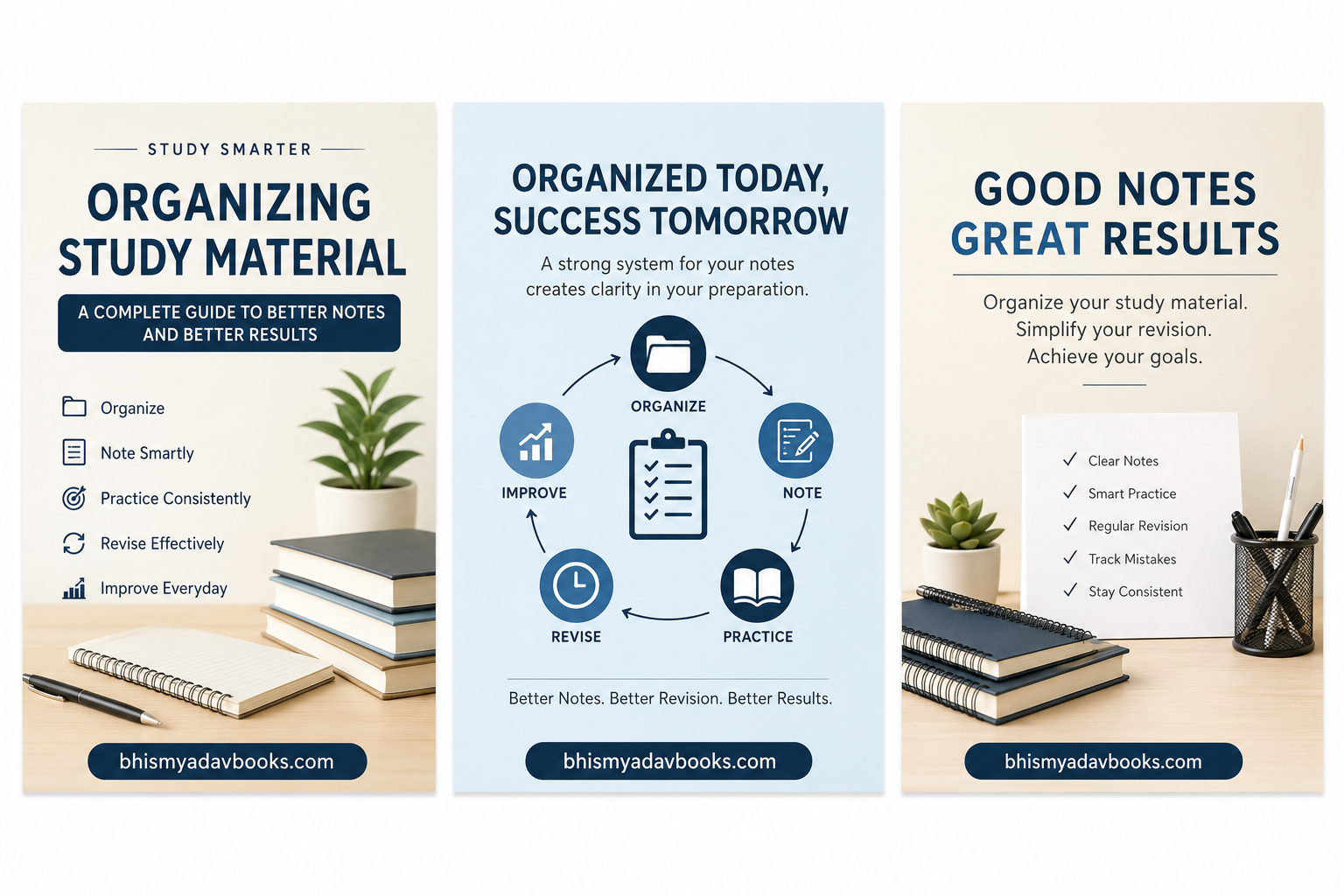
Collect → Organize → Summarize → Practice → Revise
Each stage has a different purpose.
1. Collect
Gather the resources required for your syllabus.
2. Organize
Arrange the resources according to subject, chapter, and topic.
3. Summarize
Convert important information into concise notes.
4. Practice
Add questions, exercises, previous-year papers, and mock tests.
5. Revise
Regularly review your notes and track areas that need improvement.
This system prevents your study material from becoming a passive collection of information.
Create a Master Index for Your Studies
A master index can be one of the most useful tools for organizing study material.
Think of it as a map of your entire preparation.
For example:
Master Study Index
| Subject | Topics | Main Notes | Practice | Revision |
| Mathematics | 15 | Complete | Complete | Ongoing |
| Reasoning | 12 | Complete | Ongoing | Pending |
| English | 10 | Ongoing | Ongoing | Pending |
| General Knowledge | 20 | Ongoing | Pending | Pending |
You can maintain this index in a notebook, spreadsheet, planner, or digital document.
The advantage is that you can see your overall preparation at a glance.
Use a Topic Completion System
Instead of simply saying that you have “studied mathematics,” track individual topics.
For example:
Percentage
- [✓] Concept understood
- [✓] Notes prepared
- [✓] Examples solved
- [✓] Practice questions completed
- Previous-year questions
- Revision 1
- Revision 2
This is much more meaningful than simply marking “Mathematics — Done.”
A topic should ideally pass through several stages before you consider it completely prepared.
Organize Your Notes by Learning Stage
Not all notes should serve the same purpose.
You can divide your notes into four categories.
1. Detailed Notes
These contain explanations, examples, definitions, and supporting information.
Use them while learning a topic for the first time.
2. Short Notes
These contain the most important concepts from your detailed notes.
Use them during regular revision.
3. Quick Revision Notes
These contain formulas, facts, keywords, diagrams, and frequently forgotten information.
Use them shortly before tests or examinations.
4. Mistake Notes
These contain errors you repeatedly make.
Use them to improve performance.
This approach creates a complete learning cycle.
Maintain a Separate Mistake Notebook
A mistake notebook is one of the most valuable additions to an organized study system.
Most students spend considerable time collecting correct answers but do not systematically record their mistakes.
Create a notebook or digital document called:
My Mistakes
Whenever you make an important error, record:
- Question
- Your answer
- Correct answer
- Reason for the mistake
- Correct method
- Lesson learned
For example:
Mathematics Mistake
Topic: Percentage
Mistake: Used the original value instead of the changed value when calculating percentage increase.
Correct approach: Identify the original value first and use the percentage-change formula correctly.
Lesson: Always identify the base value before calculating percentage change.
This transforms mistakes into learning opportunities.
Organize Previous-Year Question Papers
Previous-year papers are extremely useful for examination preparation.
However, keeping them together in one large folder may not be enough.
Organize them according to:
- Year
- Subject
- Topic
- Examination
- Difficulty level
For example:
Previous-Year Papers
→ 2026
→ 2025
→ 2024
→ 2023
→ 2022
Alternatively:
Mathematics PYQs
→ Number System
→ Percentage
→ Algebra
→ Geometry
→ Data Interpretation
Topic-wise organization can be particularly useful when you want to practice a specific chapter.
Create a Question Bank
Your question bank should not simply contain every question you have ever encountered.
Select questions that serve a purpose.
You can divide questions into:
Basic Questions
Used for understanding fundamental concepts.
Moderate Questions
Used for strengthening application skills.
Difficult Questions
Used to challenge your understanding.
Frequently Asked Questions
Questions that appear repeatedly or test important concepts.
Mistake Questions
Questions you previously answered incorrectly.
This makes practice more targeted.
Use a “Priority” System for Study Material
Not every chapter requires the same amount of attention.
You can classify topics using three levels.
High Priority
Topics that:
- Carry significant marks
- Appear frequently
- Are difficult for you
- Are fundamental to other topics
Medium Priority
Topics that:
- Appear occasionally
- Require moderate preparation
- You understand reasonably well
Low Priority
Topics that:
- Have low examination importance
- You already understand well
- Are supplementary
This does not mean low-priority topics should always be ignored.
It simply helps you allocate limited study time intelligently.
How to Use Color Coding in Notes
Color coding can make notes easier to scan, but too many colors can create visual clutter.
Use a small number of colors with specific meanings.
For example:
Black: Main information
Blue: Definitions and explanations
Red: Important warnings or mistakes
Green: Examples or applications
The exact colors do not matter.
Consistency matters more.
If red means “important” on one page and “example” on another, the system becomes confusing.
Do Not Highlight Everything
Highlighting is useful only when it helps you identify important information.
If half the page is highlighted, nothing stands out.
A better approach is to highlight:
- Keywords
- Definitions
- Formulas
- Important dates
- Rules
- Exceptions
- Frequently tested facts
The objective is to make important information visible during revision.
Use Symbols to Speed Up Note Making
You can create your own note-taking symbols.
For example:
★ = Very important
! = Common mistake
? = Need clarification
F = Formula
EX = Example
PYQ = Previous-year question
R1 = First revision
R2 = Second revision
This reduces writing time and makes your notes easier to scan.
Create One-Page Revision Sheets
A one-page revision sheet is a condensed summary of an entire topic.
For example, a percentage revision sheet might contain:
Percentage — Quick Revision
Basic Formula
Percentage = (Part ÷ Whole) × 100
Percentage Increase
Increase ÷ Original Value × 100
Percentage Decrease
Decrease ÷ Original Value × 100
Important Concepts
- Percentage change
- Successive percentage change
- Profit and loss connection
- Discount
- Population growth
- Depreciation
Common Mistake
Do not confuse the original value with the final value.
A single page like this can be extremely useful before an examination.
Organize Formulas Separately
Subjects such as mathematics, physics, chemistry, economics, statistics, and accounting often contain numerous formulas.
Instead of searching for formulas throughout your notes, create a dedicated formula section.
For example:
Mathematics Formula Book
Algebra
- Important identities
- Equations
- Factorization
Geometry
- Area
- Perimeter
- Angles
Mensuration
- Surface area
- Volume
Statistics
- Mean
- Median
- Mode
A formula notebook should be concise.
Do not fill it with long explanations unless they are necessary for understanding.
Organize Definitions and Key Facts
Some subjects require memorization of definitions, facts, dates, terminology, or classifications.
Create a dedicated section for them.
For example:
Biology Key Terms
Cell: The basic structural and functional unit of life.
Tissue: A group of similar cells performing a particular function.
Organ: A structure made of different tissues that performs a specific function.
This can become a valuable quick-revision resource.
Organize Diagrams and Visual Notes
Some concepts are easier to understand visually.
Instead of relying entirely on paragraphs, organize:
- Flowcharts
- Mind maps
- Tables
- Timelines
- Diagrams
- Concept maps
- Process charts
For example, a scientific process could be organized as:
Input → Process → Transformation → Output
A historical event could be organized as:
Background → Cause → Event → Leaders → Consequences
Visual organization helps you see relationships between ideas.
Use Mind Maps for Complex Topics
Mind maps can be particularly useful when a topic contains many related concepts.
For example:
Time Management
→ Planning
→ Prioritization
→ Scheduling
→ Goal Setting
→ Distraction Control
→ Review
Each major branch can contain smaller ideas.
Mind maps should not replace detailed notes completely.
They work best as a summary and connection tool.
Organize Study Material for Different Subjects Differently
There is no single organization method that works equally well for every subject.
Different subjects require different structures.
Organizing Mathematics Study Material
Mathematics requires a combination of concepts and practice.
A useful structure is:
Mathematics
→ Concepts
→ Formulas
→ Solved Examples
→ Practice Questions
→ Previous-Year Questions
→ Mistakes
→ Mock Tests
For each topic, keep both conceptual notes and questions.
Do not create pages of theory without sufficient practice.
Organizing Science Study Material
Science often contains:
- Definitions
- Processes
- Diagrams
- Experiments
- Formulas
- Examples
- Applications
Organize each chapter using sections such as:
Chapter
- Key definitions
- Main concepts
- Important processes
- Diagrams
- Formulas
- Examples
- Important questions
- Previous-year questions
- Quick revision
This format works especially well for science-heavy subjects.
Organizing History Study Material
History can contain a large number of dates, events, personalities, causes, and consequences.
A chronological structure is often useful.
For each event, write:
Event
- Date
- Location
- Background
- Causes
- Important people
- Major developments
- Outcome
- Historical significance
You can also create timelines to connect events.
For example:
Event A → Event B → Event C → Event D
This makes chronological relationships easier to remember.
Organizing Geography Study Material
Geography often benefits from visual organization.
Use:
- Maps
- Tables
- Diagrams
- Definitions
- Comparisons
- Processes
- Location-based facts
For example:
Climate Topic
Factors
→ Latitude
→ Altitude
→ Distance from sea
→ Pressure and winds
→ Relief
→ Ocean currents
A diagram or concept map can make this easier to understand than a long paragraph.
Organizing English Study Material
English study material can be divided into:
Grammar
- Tenses
- Articles
- Prepositions
- Subject-verb agreement
- Active and passive voice
- Direct and indirect speech
Vocabulary
- Synonyms
- Antonyms
- Idioms
- Phrases
- One-word substitutions
- Word meanings
Reading
- Comprehension
- Passage practice
- Contextual vocabulary
Writing
- Essays
- Letters
- Reports
- Applications
This structure allows you to study each skill separately.
Organizing Reasoning Study Material
Reasoning subjects are often best organized according to question type.
For example:
Reasoning
→ Analogy
→ Classification
→ Series
→ Coding-Decoding
→ Blood Relations
→ Direction Sense
→ Syllogism
→ Seating Arrangement
→ Puzzles
→ Data Sufficiency
For each topic, keep:
- Basic concept
- Rules
- Shortcuts
- Solved examples
- Practice questions
- Common mistakes
- Previous-year questions
This is particularly useful for competitive examination preparation.
Digital vs. Physical Study Material
Many students wonder whether digital notes or handwritten notes are better.
There is no universal answer.
Both can be useful.
Physical Notes
Advantages:
- Easy to annotate
- Useful for handwritten practice
- Less screen exposure
- Convenient for quick review
Digital Notes
Advantages:
- Easy to search
- Easy to edit
- Easy to duplicate and back up
- Can contain links and multimedia
- Requires less physical storage
A hybrid system can often work very well.
For example:
Books + handwritten notes + digital PDFs + digital backup
The important thing is to prevent duplication from becoming excessive.
Keep a Backup of Important Digital Notes
Digital study material can be lost due to:
- Device failure
- Accidental deletion
- Storage problems
- Software issues
- Lost phones
- Corrupted files
Important material should therefore have a backup.
You can maintain:
Primary Storage → Backup Storage
For example:
Laptop → Cloud storage
or
Phone → External storage
The specific service is less important than having a reliable backup.
Organize Screenshots Properly
Screenshots can become one of the biggest sources of digital clutter.
Students often save screenshots of:
- Important questions
- Definitions
- Online explanations
- Formulas
- Current affairs
- Educational posts
But hundreds of screenshots quickly become difficult to search.
Instead of allowing them to accumulate, regularly convert useful screenshots into organized notes.
For example:
Screenshot → Review → Extract information → Add to notes → Delete unnecessary screenshot
This keeps your phone storage and study system under control.
Create a “To Be Organized” Folder
Sometimes you do not have time to organize a new resource immediately.
Instead of placing it randomly, create a temporary folder:
TO ORGANIZE
Whenever you download or receive a new study resource, place it there.
Then review this folder periodically.
Move each resource to its proper location.
This is better than having files scattered across your device.
Set a Weekly Organization Routine
Study organization should not become another major task.
A short weekly review is enough.
For example, once a week:
Weekly Study Material Review
- Clean your desk
- Arrange notebooks
- Rename important digital files
- Delete duplicate files
- Organize new PDFs
- Update your master index
- Review your mistake notebook
- Update topic completion
- Prepare next week’s revision material
Even 20–30 minutes can make a major difference.
Avoid the “Perfect Notes” Trap
One of the biggest problems with note making is spending too much time making notes look beautiful.
Students may spend hours:
- Rewriting pages
- Drawing decorative borders
- Using many colors
- Designing elaborate headings
- Recopying information
The result may look excellent but provide little additional learning value.
Remember:
Useful notes are more important than beautiful notes.
Your notes should help you understand, remember, practice, and revise.
They do not need to look like artwork.
Keep Your Organization System Simple
A study system should reduce complexity, not create more of it.
If your organization requires 15 different notebooks, 20 folders, multiple color systems, and complicated labels, maintaining it may become exhausting.
A simple system is often better:
Subject → Topic → Notes → Practice → Revision
That is enough for most students.
Organizing Study Material: The Complete Guide to Creating Better Notes and Studying Smarter
Advanced Note-Making, Revision and Information Management
Organize Study Material Around the Learning Cycle
A powerful way to structure your material is to follow the natural learning cycle:
Learn → Understand → Recall → Practice → Review → Improve
Each stage needs different resources.
Learn
Use:
- Textbooks
- Lectures
- Detailed notes
- Reference material
Understand
Use:
- Examples
- Diagrams
- Explanations
- Concept maps
Recall
Use:
- Short notes
- Flashcards
- Questions
- Blank-page recall
Practice
Use:
- Exercises
- Previous-year questions
- Mock tests
- Topic-wise question banks
Review
Use:
- Revision sheets
- Mistake notebooks
- Formula lists
- Key facts
Improve
Use:
- Error analysis
- Weak-topic lists
- Additional practice
- Targeted revision
This approach ensures that your study material supports the complete learning process instead of simply storing information.
Use the Cornell Note-Taking Method
The Cornell note-taking method is a structured approach that divides a page into different sections.
A traditional Cornell page contains:
Main Notes Section
Write important explanations, examples, formulas, and concepts here.
Cue Column
Write:
- Keywords
- Questions
- Important terms
- Prompts
Summary Section
At the bottom, write a short summary of the page.
For example:
Topic: Photosynthesis
Main notes:
- Plants use sunlight to produce food.
- Chlorophyll captures light energy.
- Carbon dioxide and water are used.
- Oxygen is released.
Cue questions:
- What is photosynthesis?
- Where does it occur?
- What role does chlorophyll play?
Summary:
Photosynthesis converts light energy into chemical energy and enables green plants to produce food.
The advantage of this system is that your notes automatically contain questions that can later be used for revision.
Try the Outline Method
The outline method organizes information hierarchically.
For example:
Human Digestive System
1. Mouth
- Teeth
- Tongue
- Saliva
2. Stomach
- Digestion
- Gastric juices
3. Small Intestine
- Digestion completed
- Nutrient absorption
4. Large Intestine
- Water absorption
- Waste formation
This method is particularly useful for subjects with clear categories and subcategories.
Use the Question-and-Answer Method
Instead of simply writing statements, convert important information into questions.
For example:
Statement:
The Earth revolves around the Sun.
Question:
What does the Earth revolve around?
Answer:
The Sun.
This technique transforms passive notes into active revision material.
You can create a separate question bank containing questions generated from your own notes.
Turn Headings Into Questions
An easy way to make notes more useful is to turn headings into questions.
Instead of:
Causes of Inflation
Write:
What Are the Causes of Inflation?
Then list:
- Increased demand
- Rising production costs
- Supply constraints
- Monetary factors
- External factors
During revision, cover the answers and attempt to recall them.
This makes the notes interactive.
Use Active Recall With Your Organized Notes
Simply reading organized notes repeatedly may create a feeling of familiarity without ensuring strong recall.
Active recall requires you to retrieve information from memory.
For example:
- Read a topic.
- Close your notes.
- Write everything you remember.
- Compare your answer with your notes.
- Identify missing information.
- Review only what you forgot.
This process turns your notes into a testing tool.
Create a “Recall Page”
For every important chapter, keep one blank page or digital document for recall practice.
At the top, write:
Topic: Percentage
Then close your notes and try to write:
- Important formulas
- Key concepts
- Common question types
- Important shortcuts
- Mistakes
- Examples
After completing the recall exercise, compare it with your organized notes.
This immediately shows what you know and what you need to revisit.
Organize Notes According to Importance
Another useful system is to classify information into three levels.
Level A — Must Know
Information that you should be able to recall quickly.
Examples:
- Core definitions
- Important formulas
- Fundamental concepts
- Frequently tested facts
Level B — Should Know
Useful supporting information.
Examples:
- Examples
- Explanations
- Applications
- Secondary facts
Level C — Additional
Information that is helpful but not essential.
Examples:
- Interesting facts
- Advanced explanations
- Extended examples
- Optional references
This classification prevents you from giving equal attention to everything.
Create a “Frequently Forgotten” Section
Some information is easy to understand but difficult to remember.
Create a dedicated list called:
Frequently Forgotten Facts
Add things such as:
- Confusing formulas
- Similar terms
- Difficult definitions
- Dates
- Exceptions
- Rules
- Vocabulary
- Special cases
Review this list regularly.
Over time, items that become familiar can be removed.
Build a Personal Revision Database
Your study material can become more powerful when you gradually create your own revision database.
It can contain:
Concepts
Important ideas you need to understand.
Questions
Important questions you need to practice.
Errors
Mistakes you have made.
Facts
Information that needs memorization.
Formulas
Frequently used equations.
Weak Areas
Topics requiring additional attention.
This database becomes increasingly valuable as the examination approaches.
Organize Study Material According to Revision Frequency
Not every topic needs to be revised equally often.
A useful approach is to classify topics according to your confidence level.
Strong
You understand the concept and can solve questions accurately.
Moderate
You understand the concept but sometimes make mistakes.
Weak
You have difficulty understanding or remembering the topic.
Your revision time should be concentrated more heavily on moderate and weak areas.
For example:
| Topic | Confidence | Revision Priority |
| Percentage | Strong | Low |
| Ratio | Moderate | Medium |
| Algebra | Weak | High |
| Geometry | Moderate | Medium |
| Data Interpretation | Weak | High |
This is much more efficient than revising every chapter for exactly the same amount of time.
Use Spaced Revision
Organized study material becomes particularly useful when combined with spaced revision.
Instead of studying a topic once and forgetting about it, revisit it at intervals.
A simple example could be:
Day 1: Learn the topic
Day 2: First review
Day 4: Second review
Day 7: Third review
Day 14: Fourth review
Day 30: Final review
The exact intervals can be adjusted according to your needs.
The important idea is to distribute revision rather than attempting to memorize everything in one session.
Create Revision Levels
You can also organize revision into levels.
Revision 1: Understanding
Read your detailed notes and identify areas you do not understand.
Revision 2: Recall
Try to remember the concepts without looking at your notes.
Revision 3: Practice
Solve questions related to the topic.
Revision 4: Error Correction
Review mistakes.
Revision 5: Quick Review
Use your short notes or one-page revision sheet.
This creates a structured path from learning to mastery.
Organize Study Material Around Your Weaknesses
Your study organization should reflect your personal performance.
Suppose you are good at basic mathematics but frequently make mistakes in:
- Time and Work
- Probability
- Data Interpretation
Your organization system should make these topics easy to access.
Create a:
Weak Topics
folder or notebook section.
Inside it, maintain:
- Concept notes
- Difficult questions
- Mistakes
- Shortcuts
- Revision dates
This turns your study system into a personalized learning dashboard.
Create a “Last-Minute Revision” Folder
As your examination approaches, you should not need to search through hundreds of pages.
Create a special collection called:
Final Revision
It may contain:
- Formula sheets
- Important definitions
- Key facts
- Frequently asked questions
- Mistake lists
- Important diagrams
- Difficult concepts
- Previous-year questions
- One-page summaries
This should be your most concise study material.
Avoid Creating Multiple Versions of the Same Notes
A common problem is creating:
- Original notes
- Revised notes
- Better notes
- Final notes
- Final revised notes
- Final updated notes
Eventually, you may not know which version is correct.
Instead, maintain one primary version.
When you improve it, update the existing document.
For example:
Mathematics_Percentage_Notes
rather than:
- Percentage Notes
- Percentage Notes New
- Percentage Notes Final
- Percentage Notes Final 2
- Percentage Notes Latest
A clear naming system reduces confusion.
Use Version Dates When Necessary
If you frequently update digital documents, include a date.
For example:
English_Grammar_Notes_2026-08-29
When the document is updated later:
English_Grammar_Notes_2026-09-15
This can be useful when your syllabus or study material changes.
However, avoid creating unnecessary duplicate versions.
Delete or archive outdated versions when appropriate.
Organize Current Affairs Separately
For examinations that include current affairs, organization becomes particularly important because information changes regularly.
Instead of collecting random news screenshots, organize information by:
Month
- January
- February
- March
- April
Or by:
Category
- National
- International
- Economy
- Science and Technology
- Sports
- Awards
- Appointments
- Government Schemes
- Important Days
You can combine both methods:
Current Affairs → August 2026 → Economy
This makes revision much easier.
Create Monthly Current Affairs Summaries
Rather than revising hundreds of individual news items, create a monthly summary.
For example:
August 2026 Current Affairs
National
Important developments.
International
Major global events.
Economy
Important economic developments.
Science and Technology
Significant discoveries and developments.
Awards
Important awards and recipients.
Sports
Major tournaments and achievements.
At the end of the month, condense the information further into a quick-revision sheet.
Organize Vocabulary Systematically
For language examinations, vocabulary can become difficult to manage.
Do not simply write long lists of words.
Create structured entries.
Word
Meaning:
Simple definition.
Synonym:
Related word.
Antonym:
Opposite word.
Example:
Sentence using the word.
Memory Association:
A useful association if applicable.
You can organize vocabulary alphabetically or by topic.
For example:
A — B — C — D
or:
Education Vocabulary
Business Vocabulary
Science Vocabulary
Everyday Vocabulary
Use Flashcards for High-Value Information
Flashcards can be useful for information that requires quick recall.
Front:
What is the formula for simple interest?
Back:
SI = P × R × T / 100
Other useful flashcard topics include:
- Definitions
- Dates
- Vocabulary
- Formulas
- Abbreviations
- Important people
- Scientific terms
- Historical events
However, flashcards should not replace deeper study when the subject requires understanding.
Organize Material for Group Study
If you study with classmates or friends, establish a common structure.
For example:
Subject → Topic → Notes → Questions → Answers
This makes shared material easier to use.
When exchanging notes, avoid immediately adding everything to your personal collection.
First ask:
Is this information new, accurate, and useful?
If it simply repeats what you already know, you may not need it.
Control Information Overload
The internet provides almost unlimited educational content.
This can create a serious problem.
You may start studying one topic and discover:
- A new article
- Another video
- A different PDF
- A new educator
- A new technique
- A new book
Soon you have ten resources for one topic.
This creates information overload.
The solution is to establish a resource limit.
For example:
One primary source + one supplementary source + one practice source
You can adjust this according to the subject.
The objective is not to consume everything available.
The objective is to learn effectively.
Follow the “One Topic, One Primary Source” Rule
For most topics, choose one primary resource.
For example:
Percentage
Primary:
- Main textbook
Supplementary:
- Teacher’s notes
Practice:
- Question bank
This structure prevents you from jumping between multiple explanations.
If the primary source does not explain something clearly, then use a supplementary resource.
Keep a “Questions to Clarify” List
While studying, you will sometimes encounter concepts you do not understand.
Do not stop your entire study session every time this happens.
Create a:
Questions to Clarify
list.
For example:
- Why does this formula work?
- Difference between two similar concepts?
- Why is this answer correct?
- What is the exception to this rule?
Later, you can research or ask a teacher about these questions.
This prevents small doubts from disrupting your study flow.
Separate Learning From Collecting
This is one of the most important principles of modern studying.
Downloading a PDF is not studying.
Saving a video is not studying.
Buying a book is not studying.
Creating beautiful folders is not studying.
Studying happens when you:
- Understand
- Recall
- Practice
- Apply
- Explain
- Review
Therefore, organization should support these activities rather than become a substitute for them.
Conduct a Monthly Study Material Cleanup
At the end of each month, review your study collection.
Ask:
What did I actually use?
Keep useful resources.
What was duplicated?
Remove unnecessary copies.
What is outdated?
Archive or delete irrelevant material.
What remains unfinished?
Decide whether it is still worth completing.
What should be revised?
Move important information into your revision system.
This keeps your study material manageable.
The 80/20 Principle for Study Material
A useful general principle is that a relatively small portion of your study material may contribute disproportionately to your examination performance.
Your frequently tested concepts, common question types, fundamental formulas, and recurring mistakes deserve special attention.
Therefore, identify:
High-value topics → High-value questions → High-value revision notes
This does not mean ignoring the syllabus.
It means organizing your effort intelligently.
How to Organize Study Material One Week Before an Exam
One week before an examination, stop expanding your collection unless something is genuinely necessary.
Focus on:
1. Short Notes
Review concise summaries.
2. Formula Sheets
Revise important formulas.
3. Mistake Notebook
Review previous errors.
4. Previous-Year Questions
Practice examination-style questions.
5. Mock Tests
Test your preparation.
6. Weak Topics
Spend additional time where your performance is poor.
7. Final Revision Sheets
Use highly condensed material for quick review.
At this stage, organization should make your preparation smaller and simpler, not larger.
How to Organize Study Material One Day Before an Exam
The final day is not the time to start organizing hundreds of pages.
Your final material should already be prepared.
Keep only the essentials:
- Important formulas
- Definitions
- Key concepts
- Important dates
- Difficult topics
- Common mistakes
- Frequently asked questions
- Short revision notes
Avoid starting completely new resources unless necessary.
Your goal should be recall and confidence, not resource collection.
A Complete Study Material Organization Workflow
Here is a simple workflow you can use:
Step 1
Collect the resources you genuinely need.
Step 2
Remove duplicate and irrelevant resources.
Step 3
Separate resources by subject.
Step 4
Divide each subject into topics.
Step 5
Choose a primary source for each topic.
Step 6
Create detailed notes while learning.
Step 7
Convert important information into short notes.
Step 8
Create questions for active recall.
Step 9
Add practice questions and previous-year questions.
Step 10
Record mistakes.
Step 11
Create one-page revision sheets.
Step 12
Schedule spaced revision.
Step 13
Track weak topics.
Step 14
Create a final revision folder.
This turns a large amount of information into a structured learning system.
Example of a Fully Organized Topic
Suppose you are preparing Profit and Loss in mathematics.
Your folder could look like this:
Profit and Loss
→ 01 Detailed Notes
→ 02 Formulas
→ 03 Solved Examples
→ 04 Practice Questions
→ 05 Previous-Year Questions
→ 06 Mistakes
→ 07 Short Notes
→ 08 Quick Revision
Your detailed notes might explain the concepts.
Your formula sheet might contain:
- Cost Price
- Selling Price
- Profit
- Loss
- Profit Percentage
- Loss Percentage
- Discount
Your practice folder contains questions.
Your mistake folder contains errors.
Your quick revision page contains only the most important information.
This is what effective organization looks like: every resource has a clear purpose.
Organizing Study Material: The Complete Guide to Creating Better Notes and Studying Smarter
Complete Study Organization System, Common Mistakes, Checklist and Final Strategies
In the first three parts of this guide, we explored the importance of organizing study material, methods for arranging books and notes, digital file management, effective note-making, question banks, revision sheets, active recall, spaced revision, mistake tracking, and strategies for managing information overload.
Now it is time to bring everything together.
The most effective study organization system is not necessarily the most complicated one. It is the system you can understand, maintain, and use consistently.
A good system should help you move smoothly from collecting information to learning, practicing, revising, and finally demonstrating what you know in an examination.
The Complete Study Material Organization System
A practical system can be built around eight stages:
1. Collect
2. Filter
3. Categorize
4. Learn
5. Summarize
6. Practice
7. Revise
8. Improve
Let’s look at each stage.
1. Collect the Right Resources
Start by identifying the resources required for your syllabus.
Your collection might include:
- Main textbooks
- Class notes
- Reference books
- PDFs
- Online lectures
- Practice books
- Question banks
- Previous-year papers
- Mock tests
Avoid collecting resources simply because they are available.
Ask:
Does this resource help me learn, practice, or revise something important?
If not, you probably do not need it.
2. Filter Your Study Material
After collecting your resources, remove unnecessary material.
Look for:
- Duplicate PDFs
- Repeated notes
- Outdated information
- Low-quality resources
- Unused screenshots
- Irrelevant articles
- Resources outside your syllabus
Filtering is important because excessive material creates confusion.
A smaller collection of high-quality resources is often more useful than a huge collection that you never complete.
3. Categorize Everything
Use a consistent structure.
A basic organization system could be:
Exam → Subject → Topic → Resource Type
For example:
Competitive Examination
→ Mathematics
→ Percentage
→ Notes
→ Practice
→ PYQs
→ Revision
This structure can be used for both physical and digital study material.
4. Learn From Your Primary Resource
For each topic, choose a primary resource.
For example:
Mathematics — Percentage
Primary source: Main textbook
Supplementary source: Teacher’s explanation
Practice source: Question bank
This prevents you from repeatedly jumping between multiple books and videos.
5. Summarize Important Information
After understanding the topic, create concise notes.
Your notes can include:
- Definitions
- Concepts
- Formulas
- Examples
- Important facts
- Exceptions
- Diagrams
- Common mistakes
Do not copy the entire source.
The purpose of note making is to create a useful representation of what you have learned.
6. Practice What You Learned
A topic should not be considered complete simply because you have read it.
Add practice questions.
A useful progression is:
Concept → Example → Basic Questions → Moderate Questions → Difficult Questions → Previous-Year Questions
This helps you determine whether you can actually apply the information.
7. Revise Systematically
Create a revision system instead of waiting until the examination.
For example:
First review: Shortly after learning
Second review: A few days later
Third review: About a week later
Fourth review: Later in the month
The exact schedule can be adjusted according to your subject, examination date, and personal learning needs.
The important point is to revisit information regularly.
8. Improve Based on Mistakes
After practicing questions, identify what went wrong.
Ask:
- Did I misunderstand the concept?
- Did I forget a formula?
- Did I make a calculation error?
- Did I misunderstand the question?
- Did I run out of time?
- Was the problem caused by careless reading?
Record recurring mistakes.
Your mistake notebook should become a guide for future revision.
A Daily Study Material Organization Routine
You do not need to spend hours organizing your notes every day.
A simple daily routine can take only a few minutes.
Before Studying
Prepare:
- Required book
- Notebook
- Practice material
- Previous notes
- Water and other essentials
Keep unnecessary materials away from your study area.
This reduces distractions.
During Study
Write information under clear headings.
Mark:
- Important concepts
- Questions
- Doubts
- Mistakes
- Formulas
- Examples
Avoid creating unnecessary notes.
Focus on understanding first.
After Studying
Spend a few minutes:
- Reviewing what you studied
- Updating your notes
- Marking completed topics
- Recording mistakes
- Listing doubts
- Planning the next session
This small routine prevents disorganization from accumulating.
A Weekly Study Material Organization Routine
Once a week, perform a short review.
Review Your Notes
Check whether notes are complete and readable.
Organize New Material
Move new PDFs, worksheets, and documents into their proper folders.
Remove Duplicates
Delete unnecessary copies.
Update Your Progress
Mark completed and pending topics.
Review Mistakes
Identify recurring problems.
Prepare Revision Material
Select topics that need attention during the following week.
Clean Your Study Space
Arrange books, notebooks, stationery, and printed papers.
A weekly review keeps the system manageable.
A Monthly Study Material Review
At the end of each month, conduct a deeper review.
Ask yourself:
Which subjects have I completed?
Which topics remain weak?
Which resources did I actually use?
Which resources were unnecessary?
Which mistakes are recurring?
Which topics need additional practice?
Which notes need updating?
This review allows your organization system to evolve with your preparation.
Organizing Study Material for Competitive Exams
Competitive examinations often involve multiple subjects and large syllabi.
A strong organization system is therefore particularly important.
For example:
Competitive Exam
Mathematics
- Concept Notes
- Formula Sheets
- Practice Questions
- PYQs
- Mock Tests
- Mistakes
Reasoning
- Concepts
- Shortcuts
- Practice
- PYQs
- Mistakes
English
- Grammar
- Vocabulary
- Reading
- Practice
- PYQs
General Knowledge
- Static GK
- Current Affairs
- Important Facts
- Practice Questions
This structure prevents subjects from becoming mixed together.
Organizing Study Material for School Students
School students may need to balance several subjects simultaneously.
A simple structure is:
Class
→ Mathematics
→ Science
→ English
→ Social Science
→ Language
→ Other Subjects
Within each subject:
Chapter → Notes → Questions → Revision
Students should also keep a separate section for:
- Homework
- Assignments
- Projects
- Tests
- Examination revision
Organizing Study Material for College Students
College students often receive information from many sources:
- Lectures
- Textbooks
- Presentations
- Articles
- Research papers
- Assignments
- Laboratory work
Create a folder for each course or subject.
For example:
Semester 1
→ Course 1
→ Course 2
→ Course 3
→ Course 4
Within each course:
- Lecture Notes
- Reading Material
- Assignments
- Projects
- Previous Exams
- Revision
This makes semester-end examination preparation much easier.
Organizing Study Material for Online Learning
Online courses can generate enormous amounts of digital information.
You may have:
- Recorded classes
- PDFs
- Slides
- Assignments
- Quizzes
- Certificates
- Supplementary readings
Create a folder specifically for each course.
Example:
Online Course
→ Module 01
→ Module 02
→ Module 03
→ Assignments
→ Projects
→ Revision
Do not download every optional resource unless you actually intend to use it.
Organizing Study Material on Your Phone
Phones can be useful study devices, but they can also become extremely cluttered.
Create dedicated folders for educational material.
For example:
Study
→ Mathematics
→ Reasoning
→ English
→ General Knowledge
→ PDFs
→ Revision
Avoid keeping important study documents mixed with personal photographs, entertainment files, and miscellaneous downloads.
Clean Your Downloads Folder Regularly
The downloads folder often becomes a digital junk drawer.
At least once a week, review it.
For every file, decide:
Keep → Move → Rename → Delete
For example:
download123.pdf
might become:
Reasoning_Blood_Relations_Practice.pdf
Then move it into the correct subject folder.
Avoid Too Many Note-Taking Apps
Using several note-taking applications may sound productive, but it can make information harder to find.
For example, if your mathematics notes are divided among:
- One phone application
- Another note application
- A cloud document
- A messaging app
- A notebook
you may waste time searching for them.
Whenever possible, choose a primary location for each type of information.
The best system is usually the one you can maintain consistently.
Keep a Central “Study Dashboard”
A study dashboard gives you a quick overview of your preparation.
It can contain:
Current Subjects
What you are studying now.
Completed Topics
What you have already finished.
Weak Topics
Where you need improvement.
Upcoming Tests
Important practice dates.
Revision Due
Topics that need review.
Important Resources
Your most useful books and notes.
A simple dashboard can dramatically improve awareness of your preparation.
Example Study Dashboard
Mathematics
Completed: 8/12 topics
Weak: Algebra, Geometry
Revision Due: Percentage, Ratio
Practice: 70% completed
Reasoning
Completed: 10/12 topics
Weak: Puzzles
Revision Due: Coding-Decoding
Practice: 85% completed
English
Completed: 7/10 topics
Weak: Vocabulary
Revision Due: Tenses
Practice: 60% completed
This provides a much clearer picture than simply saying, “I have studied these subjects.”
Common Mistakes When Organizing Study Material
Even well-intentioned students can make organization more complicated than necessary.
Here are some common mistakes.
Mistake 1: Collecting Too Much Material
Having more resources does not guarantee better preparation.
Solution: Select a limited number of high-quality resources.
Mistake 2: Making Notes Too Long
Copying textbooks into notebooks creates bulky notes.
Solution: Write only information that improves understanding, recall, or revision.
Mistake 3: Using Too Many Colors
Excessive color coding can make pages difficult to read.
Solution: Assign a specific purpose to a small number of colors.
Mistake 4: Spending More Time Organizing Than Studying
Organization can become procrastination.
Solution: Keep your organization routine short and functional.
Mistake 5: Not Updating Notes
Old or incomplete notes may create confusion.
Solution: Update important notes whenever you learn something significant.
Mistake 6: Keeping Duplicate Information Everywhere
The same concept may appear in multiple notebooks.
Solution: Maintain one primary set of notes and add only genuinely useful information.
Mistake 7: Ignoring Mistakes
Students often solve questions and move on without analyzing incorrect answers.
Solution: Maintain a mistake notebook and review it regularly.
Mistake 8: Organizing Only Before Exams
Waiting until examination time creates unnecessary stress.
Solution: Maintain your organization throughout the preparation period.
Mistake 9: Saving Everything From the Internet
The internet provides unlimited resources.
Solution: Save only material that has a clear purpose.
Mistake 10: Creating a Complicated System
A complicated system is difficult to maintain.
Solution: Use a simple structure such as:
Subject → Topic → Notes → Practice → Revision
The “Five-Minute Organization Rule”
If you have only a few minutes, use them wisely.
At the end of a study session, spend five minutes doing the following:
Minute 1: Put books and papers in order.
Minute 2: Save or move digital files.
Minute 3: Record important mistakes or doubts.
Minute 4: Mark today’s completed topics.
Minute 5: Decide what you will study next.
This tiny habit can prevent a large amount of disorder.
The Minimalist Study Material System
If you prefer simplicity, use only five primary categories:
1. Learn
Your main books and detailed resources.
2. Notes
Your personal summaries.
3. Practice
Questions and exercises.
4. Mistakes
Errors and difficult questions.
5. Revision
Short notes and quick-reference sheets.
This is enough for many students.
You do not need dozens of categories.
A Complete Checklist for Organizing Study Material
Use the following checklist to evaluate your current study system.
Study Material
- I know what resources I need.
- My main books are clearly identified.
- Unnecessary resources have been removed.
- My study material is organized by subject.
- Each subject is divided into topics.
Notes
- My notes have clear headings.
- Important information is easy to find.
- My notes are concise.
- I record formulas and definitions separately where useful.
- I maintain short revision notes.
Digital Material
- My digital folders are organized.
- My files have clear names.
- I regularly clean my downloads folder.
- Important files are backed up.
- Unnecessary screenshots are removed.
Practice
- I maintain a question bank.
- Previous-year papers are organized.
- Difficult questions are marked.
- Mistakes are recorded.
- I regularly analyze incorrect answers.
Revision
- I have a revision schedule.
- I use active recall.
- I review weak topics regularly.
- I have quick-revision sheets.
- I have final examination material prepared.
If you can check most of these boxes, your study organization system is probably working well.
A Simple Template You Can Start Today
You can begin with the following structure.
Main Study Folder
01 — Syllabus
Keep your official syllabus and study plan here.
02 — Subjects
Create one folder for each subject.
03 — Notes
Keep your detailed and short notes here.
04 — Practice
Store exercises and question banks.
05 — Previous-Year Papers
Organize papers by year or topic.
06 — Mistakes
Store error logs and difficult questions.
07 — Revision
Keep short notes and revision sheets.
08 — Mock Tests
Store test papers and performance analysis.
09 — Current Affairs
If relevant, organize by month and category.
10 — Final Revision
Keep only the most important examination material here.
This structure can be adapted to almost any course or examination.
How Technology Can Improve Study Organization
Technology can make organization faster when used correctly.
Useful digital functions include:
- Search
- Folders
- Tags
- Bookmarks
- Cloud backup
- Document scanning
- Digital flashcards
- Calendars
- Task lists
- Spreadsheets
But technology should simplify your system rather than make it more complicated.
The objective is not to use the maximum number of applications.
The objective is to find and use information efficiently.
The Most Important Principle: Organize for Retrieval
The ultimate test of your organization system is simple.
Imagine that you suddenly need:
“The formula sheet for algebra.”
Can you find it quickly?
Or:
“The previous-year questions for reasoning puzzles.”
Can you locate them without searching through hundreds of files?
Or:
“The mistakes I made in percentage questions.”
Can you access them immediately?
If the answer is yes, your organization system is effective.
Organization is successful when information becomes easy to retrieve and use.
Organizing Study Material Should Reduce Stress
Examinations can already create enough pressure.
Your study system should not add unnecessary complexity.
When your material is organized:
- You know where everything is.
- You can identify what to study.
- You can revise faster.
- You can recognize weak areas.
- You can track your progress.
- You can avoid unnecessary resource collection.
This creates greater confidence.
You no longer feel that your entire syllabus is one enormous, unmanageable collection of information.
Instead, it becomes a series of smaller and manageable topics.
From Disorganized Notes to an Effective Learning System
Consider two students.
Student A
Has:
- 15 PDFs
- 8 notebooks
- 4 textbooks
- Hundreds of screenshots
- Random bookmarks
- Several question banks
But has no organization system.
Student B
Has:
- One primary textbook
- One detailed notebook
- One practice source
- One mistake notebook
- One revision folder
- Organized previous-year questions
Student A has more material.
Student B has a better system.
The second student may be able to study more effectively because information is easier to access, understand, practice, and revise.
This illustrates an important lesson:
The quantity of study material matters less than the quality of your study system.
Final Strategy for Organizing Study Material
If you want to start immediately, do not attempt to reorganize your entire academic life in one day.
Start with one subject.
Step 1
Gather all material for that subject.
Step 2
Remove duplicates.
Step 3
Divide it into topics.
Step 4
Choose your primary resources.
Step 5
Organize detailed notes.
Step 6
Create short notes.
Step 7
Add practice questions.
Step 8
Create a mistake section.
Step 9
Prepare one-page revision sheets.
Step 10
Schedule future revisions.
Once the system works for one subject, apply it to the others.
This gradual approach is easier and more sustainable.
Recommended books for Job Aspirants
Final Conclusion: Organize Less, Learn More
Organizing study material is not about creating the most beautiful notebooks, the most elaborate folders, or the largest collection of educational resources.
It is about making learning easier.
A well-organized study system helps you move from:
Information → Understanding → Notes → Practice → Revision → Mastery
The best system is one that allows you to find information quickly, identify what matters, recognize what you have forgotten, and focus your time on meaningful learning.
Start by organizing your resources according to subject and topic. Create concise notes instead of copying everything. Separate learning material from revision material. Maintain a question bank and mistake notebook. Use active recall and spaced revision. Keep digital files clearly named and backed up. Remove unnecessary resources regularly.
Most importantly, remember that organization should support studying, not replace it.
You do not need a perfect system.
You need a simple, consistent, and useful system that you can maintain every day.
When your study material has a clear structure, your mind can spend less energy searching for information and more energy understanding it.
That is the real purpose of effective note making and study organization.
Organize your material. Simplify your revision. Focus on what matters. Study smarter and learn with greater confidence.