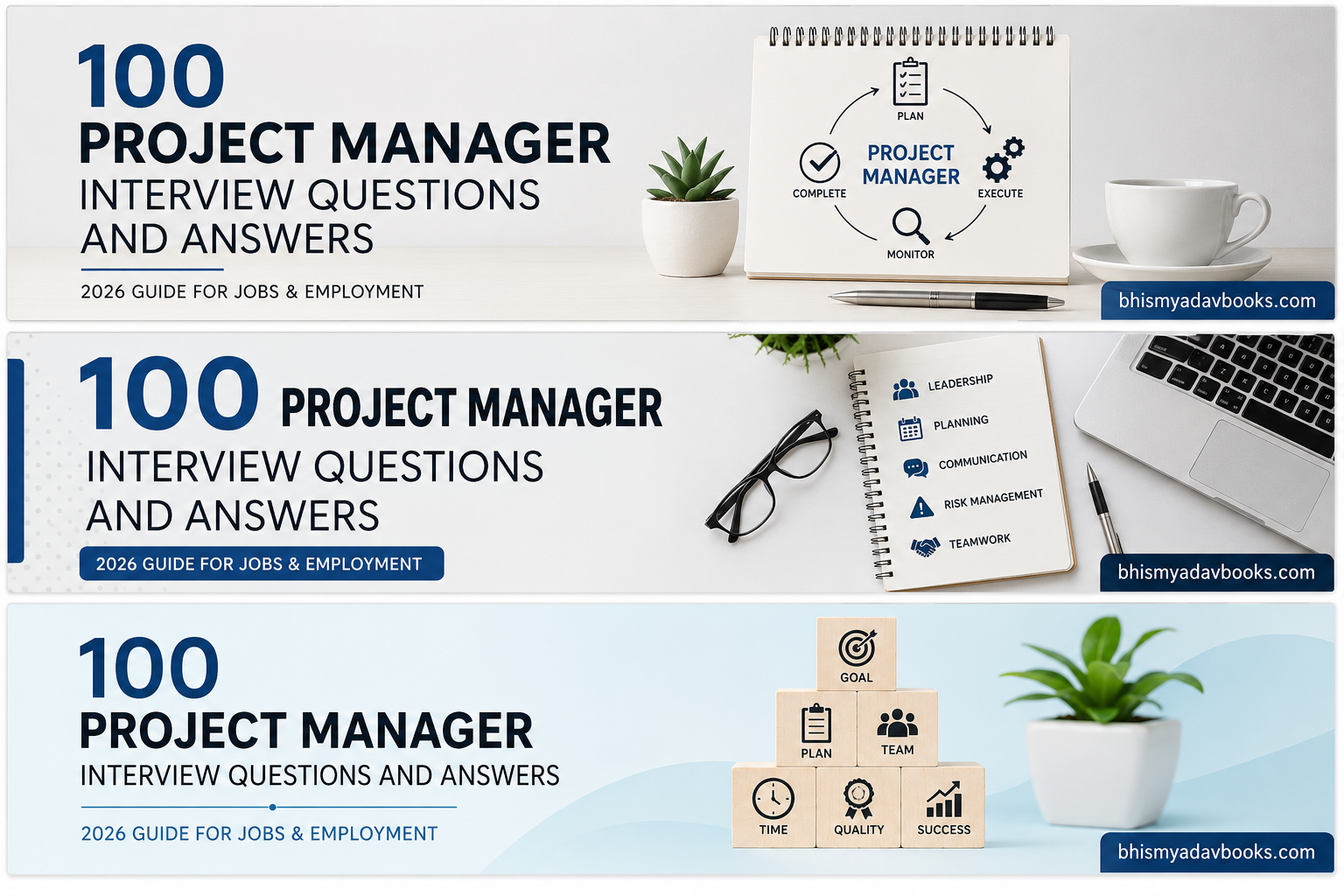
100 Project Manager Interview Questions and Answers (2026)
Introduction
Project management is one of the most rewarding and in-demand career paths across industries, including IT, construction, healthcare, finance, manufacturing, telecommunications, and government organizations. Every successful project depends on a capable Project Manager who can lead teams, manage budgets, reduce risks, and deliver results on time.
Whether you’re applying for your first Project Manager role or preparing for a Senior Project Manager, Technical Project Manager, Agile Project Manager, or PMP-certified position, interview preparation is essential. Employers evaluate candidates on leadership, communication, planning, budgeting, stakeholder management, problem-solving, and project execution skills.
We have some amazing books in our Shop page you may want to buy.
Table of Contents
This comprehensive guide contains 100 Project Manager interview questions and answers designed to help freshers, experienced professionals, and certified project managers confidently answer interview questions and increase their chances of getting hired.
Skills Interviewers Look for in a Project Manager
Before diving into the interview questions, understand the qualities recruiters expect:
- Leadership
- Communication
- Planning
- Scheduling
- Budget Management
- Risk Management
- Team Building
- Stakeholder Management
- Negotiation
- Conflict Resolution
- Agile Methodologies
- Scrum Framework
- Waterfall Methodology
- Critical Thinking
- Time Management
- Decision Making
- Change Management
- Vendor Management
- Reporting
- Problem Solving
Mastering these competencies greatly improves your chances of landing a Project Management role.
Basic Project Manager Interview Questions
(Questions 1–25)
1. Tell me about yourself.
Answer:
I am a project management professional with experience in planning, coordinating, and delivering projects successfully. I enjoy solving problems, leading cross-functional teams, communicating with stakeholders, and ensuring projects are completed on schedule, within budget, and according to quality standards.
2. What does a Project Manager do?
Answer:
A Project Manager plans, executes, monitors, controls, and closes projects while balancing scope, schedule, cost, quality, resources, communication, and risks to achieve business objectives.
3. Why do you want to become a Project Manager?
Answer:
I enjoy organizing work, solving complex problems, collaborating with diverse teams, and delivering measurable business value. Project management allows me to combine leadership with strategic thinking.
4. What are the primary responsibilities of a Project Manager?
Answer:
Responsibilities include:
- Project planning
- Budget management
- Scheduling
- Resource allocation
- Risk management
- Stakeholder communication
- Quality assurance
- Team leadership
- Issue resolution
- Project delivery
5. What is a project?
Answer:
A project is a temporary initiative undertaken to create a unique product, service, or result with defined objectives, timelines, and resources.
6. What is project management?
Answer:
Project management is the practice of applying knowledge, skills, tools, and techniques to successfully complete project objectives while meeting stakeholder expectations.
7. What are the five phases of project management?
Answer:
The five phases are:
- Initiation
- Planning
- Execution
- Monitoring and Controlling
- Closing
8. What is a project lifecycle?
Answer:
The project lifecycle is the sequence of phases a project passes through from initiation to completion.
9. What is a project charter?
Answer:
A project charter formally authorizes a project and provides the Project Manager with authority to utilize organizational resources.
10. What is project scope?
Answer:
Project scope defines all the work required to complete the project successfully while avoiding unnecessary tasks.
11. What is scope creep?
Answer:
Scope creep refers to uncontrolled expansion of project requirements without corresponding adjustments to schedule, budget, or resources.
12. How do you prevent scope creep?
Answer:
I prevent scope creep by:
- Defining clear requirements
- Documenting scope
- Managing change requests
- Communicating with stakeholders
- Reviewing project objectives regularly
13. What is a milestone?
Answer:
A milestone is a significant checkpoint indicating the completion of an important phase or deliverable.
14. What is a deliverable?
Answer:
A deliverable is a measurable product, service, document, or outcome produced during the project.
15. What is a Work Breakdown Structure (WBS)?
Answer:
A WBS divides a project into manageable tasks and sub-tasks to simplify planning, scheduling, and execution.
16. What is stakeholder management?
Answer:
Stakeholder management involves identifying stakeholders, understanding their expectations, maintaining communication, and ensuring their satisfaction throughout the project.
17. What is risk management?
Answer:
Risk management is the process of identifying, analyzing, mitigating, monitoring, and responding to project risks.
18. What is a project schedule?
Answer:
A project schedule outlines activities, durations, dependencies, milestones, deadlines, and assigned resources.
19. What is the critical path?
Answer:
The critical path is the longest sequence of dependent tasks that determines the shortest possible project completion time.
20. What is project baseline?
Answer:
A project baseline is the approved version of scope, schedule, and budget used to measure project performance.
21. What is project governance?
Answer:
Project governance provides the framework for decision-making, accountability, oversight, and project control.
22. What is resource allocation?
Answer:
Resource allocation is assigning people, equipment, budget, and materials efficiently to project tasks.
23. What is project documentation?
Answer:
Project documentation includes plans, schedules, reports, risk registers, meeting notes, requirements, and lessons learned.
24. How do you prioritize project tasks?
Answer:
I prioritize based on business value, dependencies, urgency, resource availability, risks, and stakeholder priorities.
25. What qualities make a successful Project Manager?
Answer:
A successful Project Manager demonstrates:
- Leadership
- Communication
- Organization
- Accountability
- Adaptability
- Decision-making
- Strategic thinking
- Emotional intelligence
- Risk awareness
- Problem-solving
Project Manager Interview Questions and Answers Part 2
This section focuses on intermediate-level Project Manager interview questions covering Agile methodologies, budgeting, scheduling, stakeholder communication, team leadership, project planning, and risk management. These are commonly asked in interviews for IT, software, construction, healthcare, finance, and other industries.
(Questions 26–50)
26. What is the difference between a project and a program?
Answer:
A project is a temporary effort to create a unique product, service, or result, while a program is a group of related projects managed together to achieve broader business objectives. Programs focus on long-term strategic benefits, whereas projects have specific deliverables and timelines.
27. What is the difference between Agile and Waterfall?
Answer:
Waterfall is a linear project management methodology where each phase is completed before moving to the next. Agile is an iterative methodology that delivers work in small increments, allowing teams to adapt to changing requirements quickly.
Waterfall
- Sequential phases
- Fixed requirements
- Limited customer involvement
- Best for predictable projects
Agile
- Iterative development
- Flexible requirements
- Continuous customer feedback
- Faster value delivery
28. What is Scrum?
Answer:
Scrum is an Agile framework that divides work into short development cycles called sprints. Teams collaborate daily, review progress regularly, and continuously improve processes to deliver high-quality products quickly.
29. What is a Sprint?
Answer:
A sprint is a fixed-length iteration, usually lasting two to four weeks, during which a Scrum team completes a defined set of work from the product backlog.
30. What is a Product Backlog?
Answer:
The Product Backlog is a prioritized list of features, enhancements, bug fixes, and tasks maintained by the Product Owner. It serves as the primary source of work for the development team.
31. What is a Sprint Backlog?
Answer:
The Sprint Backlog contains the tasks selected from the Product Backlog that the team commits to completing during the current sprint.
32. What is a Daily Stand-up Meeting?
Answer:
A Daily Stand-up is a short meeting, typically lasting 15 minutes, where team members discuss:
- What they completed yesterday
- What they will work on today
- Any blockers affecting progress
33. What is stakeholder analysis?
Answer:
Stakeholder analysis identifies everyone affected by the project, evaluates their influence and interest, and develops communication strategies to keep them engaged throughout the project lifecycle.
34. How do you handle conflicting stakeholder requirements?
Answer:
I first understand each stakeholder’s concerns, evaluate business priorities, assess project constraints, facilitate discussions, and document agreed-upon decisions. Transparent communication and data-driven decision-making help resolve conflicts effectively.
35. How do you estimate project costs?
Answer:
I estimate costs by analyzing project scope, historical data, labor requirements, equipment, materials, vendor quotations, contingency reserves, and potential risks while reviewing estimates with stakeholders.
36. What is a project budget?
Answer:
A project budget is the approved financial plan that outlines expected costs for resources, equipment, materials, labor, software, travel, and contingency reserves throughout the project.
37. What is contingency reserve?
Answer:
A contingency reserve is additional budget or time allocated to address identified project risks without affecting the overall project objectives.
38. How do you monitor project progress?
Answer:
I monitor progress through:
- Project dashboards
- Status reports
- Milestone tracking
- KPI measurements
- Earned Value Management (EVM)
- Team meetings
- Risk reviews
- Schedule variance analysis
39. What KPIs do you monitor in a project?
Answer:
Common project KPIs include:
- Schedule Performance Index (SPI)
- Cost Performance Index (CPI)
- Budget variance
- Schedule variance
- Defect rate
- Customer satisfaction
- Resource utilization
- Risk status
- Milestone completion
- Team productivity
40. What is Earned Value Management (EVM)?
Answer:
Earned Value Management is a project performance measurement technique that integrates scope, schedule, and cost to evaluate project progress and forecast future performance.
41. What would you do if a project falls behind schedule?
Answer:
I would identify the root cause, reassess priorities, optimize resource allocation, remove bottlenecks, revise the schedule if necessary, communicate with stakeholders, and closely monitor recovery efforts to bring the project back on track.
42. How do you manage project risks?
Answer:
I follow a structured risk management process:
- Identify risks
- Assess probability and impact
- Prioritize risks
- Develop mitigation strategies
- Assign ownership
- Monitor risks continuously
- Update the risk register regularly
43. What is a Risk Register?
Answer:
A Risk Register is a document that records identified risks, their probability, impact, mitigation plans, owners, and current status throughout the project lifecycle.
44. How do you motivate your project team?
Answer:
I motivate team members by:
- Setting clear goals
- Recognizing achievements
- Encouraging collaboration
- Providing constructive feedback
- Supporting professional growth
- Removing obstacles
- Promoting open communication
- Building trust
45. How do you resolve conflicts within your team?
Answer:
I address conflicts promptly by listening to all parties, identifying the root cause, encouraging respectful discussions, focusing on project goals, and working toward a solution that benefits both the team and the project.
46. How do you delegate tasks?
Answer:
I delegate tasks based on each team member’s skills, experience, workload, and career development goals while ensuring responsibilities and expectations are clearly communicated.
47. What project management software have you used?
Answer:
Common tools include:
- Microsoft Project
- Jira
- Trello
- Asana
- Monday.com
- Smartsheet
- ClickUp
- Wrike
- Azure DevOps
- Microsoft Planner
During interviews, mention the tools you have practical experience with and explain how they improved planning, tracking, or collaboration.
48. How do you manage remote project teams?
Answer:
I establish clear communication channels, define expectations, schedule regular virtual meetings, use collaboration tools, track progress transparently, encourage knowledge sharing, and maintain team engagement despite geographical differences.
49. What is change management in project management?
Answer:
Change management is the structured process of evaluating, approving, implementing, and communicating changes to project scope, schedule, budget, or requirements while minimizing project disruption.
50. Describe your project planning process.
Answer:
My project planning process typically includes:
- Defining project objectives
- Gathering requirements
- Identifying stakeholders
- Creating the Work Breakdown Structure (WBS)
- Developing the project schedule
- Estimating costs and preparing the budget
- Allocating resources
- Identifying and assessing risks
- Creating communication and quality plans
- Establishing project baselines and obtaining stakeholder approval
A structured planning process helps reduce uncertainty and increases the likelihood of delivering projects successfully.
Project Manager Interview Questions and Answers Part 3
In this section, we’ll cover advanced and scenario-based interview questions that are commonly asked for experienced Project Manager, Senior Project Manager, Technical Project Manager, and PMO positions. These questions assess leadership, decision-making, quality management, governance, and the ability to manage complex projects.
(Questions 51–75)
51. Describe a challenging project you managed.
Answer:
In my previous role, I managed a project with a tight deadline and limited resources. I prioritized critical tasks, improved communication between teams, mitigated key risks, and closely monitored progress through daily status meetings. By proactively addressing issues, we successfully delivered the project on time while meeting quality standards.
52. How do you manage multiple projects simultaneously?
Answer:
I prioritize projects based on business value, deadlines, available resources, and dependencies. I use project management tools to monitor progress, maintain separate project plans, conduct regular review meetings, and communicate frequently with stakeholders to ensure alignment across all projects.
53. How do you deal with unrealistic deadlines?
Answer:
I analyze the project scope, estimate the required effort, identify risks, and present realistic timelines supported by data. If necessary, I negotiate changes to scope, budget, or resources while explaining the potential impact of unrealistic deadlines.
54. What would you do if a key team member resigned during the project?
Answer:
I would assess the impact, update the risk register, redistribute urgent tasks, onboard a replacement as quickly as possible, document knowledge transfer, and communicate any potential schedule impacts to stakeholders.
55. How do you ensure project quality?
Answer:
I establish quality standards during project planning, conduct regular reviews, monitor deliverables, perform testing, track quality metrics, and encourage continuous improvement throughout the project lifecycle.
56. What is Quality Assurance (QA)?
Answer:
Quality Assurance focuses on improving project processes to prevent defects. It ensures that the team’s processes and methodologies consistently produce high-quality results.
57. What is Quality Control (QC)?
Answer:
Quality Control involves inspecting deliverables, identifying defects, and verifying that the final product meets defined quality requirements before delivery.
58. What is RAID in project management?
Answer:
RAID stands for:
- Risks
- Assumptions
- Issues
- Dependencies
A RAID log helps Project Managers monitor and track these critical project elements throughout the project lifecycle.
59. What is a PMO?
Answer:
A Project Management Office (PMO) is a department that standardizes project management practices, provides governance, manages project portfolios, develops methodologies, and supports Project Managers across the organization.
60. What are the different types of PMOs?
Answer:
The three common types are:
- Supportive PMO – Provides templates, best practices, and guidance.
- Controlling PMO – Ensures compliance with organizational standards.
- Directive PMO – Directly manages projects and assigns Project Managers.
61. What is project governance?
Answer:
Project governance is the framework of policies, roles, responsibilities, and decision-making processes that ensure projects align with organizational goals and are managed effectively.
62. What is project closure?
Answer:
Project closure is the final phase of the project lifecycle where deliverables are accepted, documentation is completed, contracts are closed, lessons learned are recorded, and project resources are released.
63. What lessons learned documentation includes?
Answer:
Lessons learned typically include:
- Project successes
- Challenges encountered
- Risk responses
- Schedule performance
- Budget performance
- Communication effectiveness
- Team collaboration
- Recommendations for future projects
64. How do you manage project communication?
Answer:
I create a communication plan that identifies stakeholders, defines reporting frequency, selects communication channels, schedules meetings, and ensures timely updates throughout the project.
65. What communication methods do you commonly use?
Answer:
Common communication methods include:
- Microsoft Teams
- Slack
- Zoom
- Google Meet
- Status reports
- Dashboards
- Daily stand-up meetings
- Steering committee meetings
- Project review meetings
66. How do you handle project failure?
Answer:
I perform a root cause analysis, document lessons learned, communicate transparently with stakeholders, implement corrective actions, and apply those learnings to future projects.
67. What is root cause analysis?
Answer:
Root cause analysis is a structured method used to identify the underlying cause of a problem rather than simply addressing its symptoms. Techniques such as the 5 Whys and Fishbone Diagram are commonly used.
68. What is resource leveling?
Answer:
Resource leveling is a scheduling technique used to resolve resource conflicts by adjusting task dates based on resource availability without compromising project objectives whenever possible.
69. What is resource smoothing?
Answer:
Resource smoothing adjusts activities within available float so that resource usage becomes more balanced while keeping the project’s completion date unchanged.
70. How do you measure project success?
Answer:
Project success is measured by:
- Completing on schedule
- Staying within budget
- Meeting quality standards
- Achieving project objectives
- Customer satisfaction
- Stakeholder approval
- Business value delivered
- Team performance
- Return on investment (ROI)
71. How do you manage vendor relationships?
Answer:
I establish clear contracts, define service-level expectations, monitor vendor performance, maintain open communication, conduct periodic reviews, and resolve issues collaboratively to ensure successful project delivery.
72. How do you prioritize risks?
Answer:
I evaluate each risk based on its probability and impact, assign a risk score, and focus first on high-probability, high-impact risks while continuously monitoring lower-priority risks.
73. What would you do if stakeholders constantly change requirements?
Answer:
I would follow the formal change management process by documenting each requested change, assessing its impact on scope, budget, schedule, and resources, obtaining appropriate approvals, and communicating decisions clearly to all stakeholders.
74. Tell me about a time you resolved a major project issue.
Answer:
During one project, a critical vendor delay threatened the delivery timeline. I coordinated with stakeholders, identified an alternate supplier, adjusted the project schedule, reassigned internal resources, and maintained transparent communication. As a result, we minimized delays and successfully completed the project with only minor schedule adjustments.
75. Why should we hire you as a Project Manager?
Answer:
I bring a combination of leadership, planning, communication, risk management, and problem-solving skills. I have experience managing cross-functional teams, delivering projects within scope, budget, and schedule, and building strong relationships with stakeholders. My ability to adapt, make data-driven decisions, and focus on continuous improvement enables me to contribute to successful project outcomes from day one.
Recommended books for Project Manager Interview
Project Management Essentials You Always Wanted To Know by Vibrant Publishers (Author)
Computer Fundamentals by Bhism Narayan Yadav
Project Manager Interview Preparation Tips
Before attending your interview, remember to:
- Review the complete project lifecycle from initiation to closure.
- Understand Agile, Scrum, Waterfall, and hybrid methodologies.
- Practice explaining your projects using the STAR (Situation, Task, Action, Result) method.
- Be prepared to discuss budgeting, scheduling, risk management, and stakeholder communication.
- Familiarize yourself with project management tools such as Microsoft Project, Jira, Asana, Trello, ClickUp, and Azure DevOps.
- Prepare examples that demonstrate leadership, conflict resolution, negotiation, and decision-making.
- Review key project management metrics such as SPI, CPI, EVM, and milestone tracking.
- Research the company, its industry, and the specific responsibilities of the role you’re applying for.
Project Manager Interview Questions and Answers Part 4
The final section of this guide covers expert-level interview questions, leadership scenarios, behavioral questions, and practical interview tips. These questions are commonly asked during interviews for Senior Project Manager, Technical Project Manager, PMO Lead, Delivery Manager, and Program Manager roles.
(Questions 76–100)
76. How do you manage project scope changes?
Answer:
I use a formal change management process by documenting the requested change, evaluating its impact on scope, schedule, budget, resources, and risks, obtaining stakeholder approval, updating project documentation, and communicating the changes to the project team.
77. What is the difference between a risk and an issue?
Answer:
A risk is a potential event that may occur in the future and could impact the project positively or negatively. An issue is a problem that has already occurred and requires immediate attention and resolution.
78. How do you manage project dependencies?
Answer:
I identify dependencies during project planning, document them in the schedule, assign owners, monitor them regularly, and coordinate with teams to minimize delays caused by dependency conflicts.
79. What would you do if your project exceeds the budget?
Answer:
I would analyze the reasons for the cost overrun, identify unnecessary expenses, optimize resource utilization, reassess project priorities, seek stakeholder approval for budget adjustments if needed, and implement corrective actions to control future costs.
80. How do you manage project documentation?
Answer:
I maintain centralized documentation, ensure version control, organize files systematically, update documents regularly, and make them easily accessible to stakeholders and project team members.
81. How do you build trust within your team?
Answer:
Trust is built through honesty, transparency, accountability, active listening, recognizing achievements, supporting team members, and encouraging open communication.
82. How do you encourage collaboration?
Answer:
I create a collaborative environment by promoting knowledge sharing, defining common goals, encouraging participation, removing communication barriers, and recognizing team contributions.
83. What leadership style do you follow?
Answer:
I adapt my leadership style based on the team’s maturity and project needs. I generally prefer a collaborative and servant leadership approach while remaining decisive when critical decisions are required.
84. How do you deal with underperforming team members?
Answer:
I first identify the root cause of the performance issue, provide constructive feedback, offer coaching and training, set measurable expectations, monitor improvement, and escalate only when necessary.
85. Describe your decision-making process.
Answer:
I gather relevant information, evaluate available options, assess risks and benefits, consult key stakeholders when appropriate, make timely decisions based on facts, and review outcomes for continuous improvement.
86. How do you manage stakeholder expectations?
Answer:
I establish clear expectations from the beginning, provide regular project updates, communicate risks transparently, manage change requests effectively, and involve stakeholders in key decisions.
87. How do you prioritize competing tasks?
Answer:
I evaluate business value, urgency, dependencies, risk level, and resource availability. High-impact and time-sensitive tasks receive priority while maintaining alignment with project objectives.
88. What metrics indicate project health?
Answer:
Important project health metrics include:
- Schedule Variance (SV)
- Cost Variance (CV)
- Schedule Performance Index (SPI)
- Cost Performance Index (CPI)
- Budget utilization
- Milestone completion rate
- Defect density
- Customer satisfaction
- Team velocity (Agile projects)
- Resource utilization
89. How do you manage project meetings?
Answer:
I prepare an agenda, invite relevant participants, keep discussions focused, document decisions, assign action items, and distribute meeting minutes promptly.
90. What is stakeholder engagement?
Answer:
Stakeholder engagement is the ongoing process of communicating with stakeholders, understanding their needs, addressing concerns, managing expectations, and maintaining their support throughout the project.
91. Describe a successful project you delivered.
Answer:
In one project, my team delivered a software implementation ahead of schedule by improving sprint planning, proactively managing risks, maintaining close stakeholder communication, and resolving blockers quickly. The project met all business objectives and received positive client feedback.
92. What is the most difficult aspect of project management?
Answer:
Balancing scope, time, cost, quality, stakeholder expectations, and team dynamics simultaneously is often the most challenging aspect. Successful Project Managers continuously adapt to changing priorities while keeping the project aligned with business goals.
93. How do you stay organized?
Answer:
I use project management software, maintain detailed schedules, prioritize tasks, track deliverables, review progress regularly, and document important decisions to stay organized.
94. How do you handle project uncertainty?
Answer:
I perform risk assessments, develop contingency plans, monitor project indicators, maintain regular communication, and remain flexible enough to respond quickly to changing circumstances.
95. What project management certifications do you know?
Answer:
Popular certifications include:
- PMP (Project Management Professional)
- CAPM (Certified Associate in Project Management)
- PRINCE2 Foundation & Practitioner
- PMI-ACP (Agile Certified Practitioner)
- Certified ScrumMaster (CSM)
- Professional Scrum Master (PSM)
- SAFe Agilist
- CompTIA Project+
96. Which project management methodologies are you familiar with?
Answer:
I am familiar with:
- Agile
- Scrum
- Kanban
- Waterfall
- Lean
- PRINCE2
- Hybrid Project Management
- Critical Path Method (CPM)
97. How do you continue improving as a Project Manager?
Answer:
I regularly attend training programs, earn certifications, read industry publications, participate in professional communities, seek feedback from stakeholders, and apply lessons learned from previous projects.
98. What questions would you ask the interviewer?
Answer:
Professional questions include:
- What types of projects will I manage?
- How is project success measured?
- Which project management methodology is primarily used?
- What tools does the organization use?
- What are the biggest challenges facing the project team?
- What opportunities exist for professional development?
99. Where do you see yourself in five years?
Answer:
I see myself leading larger, more strategic projects, mentoring junior Project Managers, earning advanced certifications, contributing to organizational project governance, and delivering measurable business value.
100. Do you have any final comments?
Answer:
Thank you for the opportunity to interview me. I am excited about the possibility of contributing my project management, leadership, communication, and problem-solving skills to your organization. I look forward to discussing how I can help deliver successful projects and support your business objectives.
Common Project Manager Interview Mistakes to Avoid
Avoid these common mistakes during your interview:
- Failing to provide real-world examples.
- Speaking negatively about previous employers or team members.
- Not demonstrating leadership and communication skills.
- Ignoring project metrics such as schedule, budget, and quality.
- Giving vague or generic answers.
- Not understanding Agile and Scrum concepts.
- Forgetting to mention stakeholder management.
- Arriving without researching the company.
- Overlooking risk management and change control.
- Not asking thoughtful questions at the end of the interview.
Final Project Manager Interview Preparation Checklist
Before your interview, make sure you can confidently explain:
- ✅ Project lifecycle phases
- ✅ Scope, schedule, and budget management
- ✅ Risk identification and mitigation
- ✅ Stakeholder communication strategies
- ✅ Agile, Scrum, Waterfall, and Hybrid methodologies
- ✅ Work Breakdown Structure (WBS)
- ✅ Critical Path Method (CPM)
- ✅ Earned Value Management (EVM)
- ✅ Change management process
- ✅ Team leadership and conflict resolution
- ✅ Resource planning and allocation
- ✅ Quality Assurance (QA) and Quality Control (QC)
- ✅ Project governance and PMO concepts
- ✅ Behavioral interview examples using the STAR method
- ✅ Experience with tools such as Microsoft Project, Jira, Asana, Trello, ClickUp, Monday.com, and Azure DevOps
Frequently Asked Questions
Are these Project Manager interview questions suitable for freshers?
Yes. The guide starts with foundational questions and gradually progresses to intermediate and advanced topics, making it valuable for both freshers and experienced professionals.
Do companies ask scenario-based Project Manager interview questions?
Yes. Most employers include behavioral and scenario-based questions to evaluate leadership, communication, risk management, and problem-solving skills in real-world situations.
Which project management methodologies should I study before an interview?
Focus on Agile, Scrum, Waterfall, Kanban, Lean, Hybrid Project Management, and the Critical Path Method (CPM). Understanding when to use each methodology is highly beneficial.
Which tools should a Project Manager know?
Commonly used tools include Microsoft Project, Jira, Asana, Trello, ClickUp, Monday.com, Smartsheet, Wrike, Azure DevOps, and Microsoft Planner.
How can I improve my chances of getting hired as a Project Manager?
Practice answering interview questions aloud, prepare STAR-based examples from your experience, research the company, review project management fundamentals, and demonstrate strong leadership, communication, and stakeholder management skills throughout the interview.
Conclusion
Project Managers play a vital role in helping organizations deliver projects successfully while balancing scope, schedule, budget, quality, and stakeholder expectations. Strong leadership, communication, strategic planning, and problem-solving abilities are essential for excelling in this role.
This guide featuring 100 Project Manager Interview Questions and Answers is designed to help both freshers and experienced professionals prepare for interviews with confidence. By understanding core project management concepts, practicing scenario-based questions, and demonstrating your ability to lead teams and manage risks, you can significantly improve your chances of securing your next Project Manager position.
Remember that interview success is not only about answering technical questions—it also depends on showcasing your leadership style, decision-making approach, adaptability, and commitment to delivering value. Continue refining your skills, stay updated with modern project management methodologies, and approach every interview with confidence and professionalism.
Best of luck with your Project Manager interview and your journey toward a successful career in project management!