Introduction
Preparing for a competitive exam is not simply about studying a large number of books or spending long hours at a desk. The real challenge is remembering what you have studied when you actually need it.
A student may understand a chapter today and feel confident about it. But after several days or weeks, many details can become difficult to recall. Important formulas may be forgotten, vocabulary may disappear from memory, historical dates may become confusing, and concepts studied earlier may require another complete revision.
This is where spaced repetition becomes extremely useful.
Spaced repetition is a learning and revision technique in which you review information at carefully increasing intervals instead of repeatedly studying the same material in a short period.
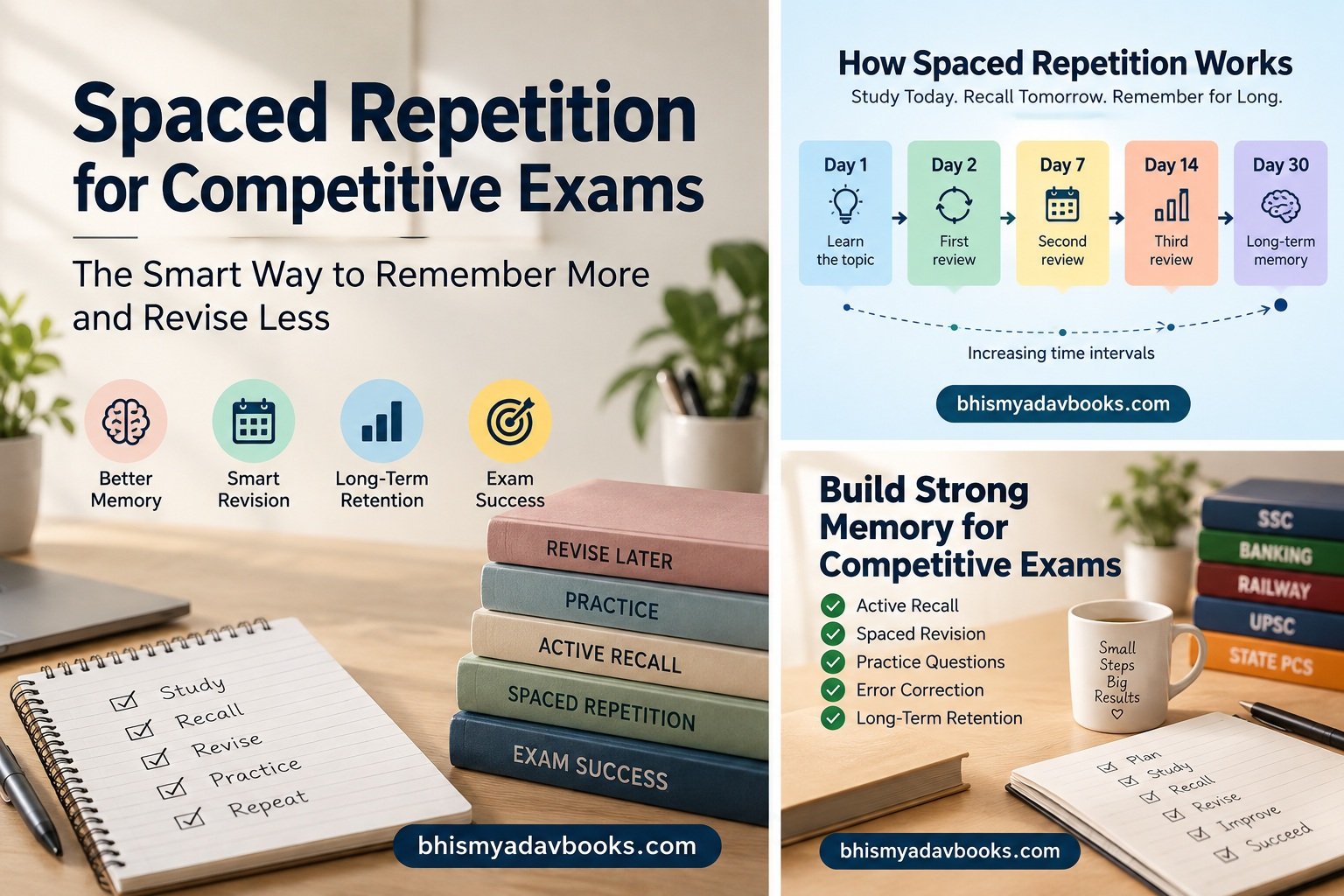
For example, instead of revising a topic five times in one day, you might revise it:
- On the day you learn it
- The next day
- After 3 days
- After 7 days
- After 14 days
- After 30 days
- Before the examination
This approach gives your brain repeated opportunities to retrieve information from memory. Over time, the information becomes easier to recall and more resistant to forgetting.
We have some amazing books at our Shop page you may want to buy.
For competitive exam aspirants, this can be particularly valuable because examinations such as SSC, Railway, Banking, UPSC, State PSC, Defence, Teaching, and other recruitment examinations require candidates to remember information over a long preparation period.
The goal is not merely to study more.
The goal is to remember better.
Table of Contents
Spaced Repetition for Competitive Exams: The Smart Way to Remember More and Revise Less
What Is Spaced Repetition?
Spaced repetition is a systematic revision method based on reviewing information at increasing intervals.
The basic idea is simple:
Review information before you are likely to forget it completely.
Suppose you study the Fundamental Rights in Indian Polity today. If you never revisit the topic, your memory of the details will gradually weaken.
Instead, you can schedule several short revision sessions.
For example:
Day 1: Learn Fundamental Rights
Day 2: Quick recall
Day 4: Second revision
Day 8: Third revision
Day 15: Fourth revision
Day 30: Fifth revision
Day 60: Final reinforcement
The intervals do not have to be exactly these numbers. The important principle is that revision sessions are distributed over time.
Spaced repetition is different from simply reading the same chapter again and again.
When you use spaced repetition correctly, you actively attempt to remember the information before looking at your notes.
That process makes the revision more meaningful.
Why Is Spaced Repetition Useful for Competitive Exams?
Competitive examinations often have enormous syllabi.
A candidate may need to study:
- Mathematics
- Reasoning
- General Awareness
- Current Affairs
- English
- General Science
- History
- Geography
- Polity
- Economics
- Computer Knowledge
- Subject-specific topics
- Formulas
- Vocabulary
- Important facts
The difficulty is that these subjects cannot usually be completed once and then forgotten.
They require continuous revision.
This creates a common problem.
A student spends several weeks completing the syllabus. Then, when revision begins, they discover that much of the earlier material is no longer easy to recall.
As a result, they feel that they need to start studying everything again.
This can consume a huge amount of time.
Spaced repetition helps solve this problem by making revision a continuous part of the learning process.
Instead of waiting until the entire syllabus is completed, you continuously reinforce older topics while learning new ones.
This creates a cycle:
Learn → Recall → Review → Practice → Recall Again → Strengthen Memory
Over time, previously studied information becomes easier to retrieve.
Spaced Repetition vs. Traditional Revision
Consider two students preparing for the same examination.
Student A: Traditional Revision
Student A studies Indian Polity for five days.
They read the chapters carefully and make notes.
After completing the subject, they move to Geography.
Then they study History.
After several weeks, they return to Polity.
Unfortunately, many details have become difficult to remember.
They begin reading the chapters again.
This cycle can continue repeatedly.
Student B: Spaced Repetition
Student B also studies Indian Polity for five days.
However, instead of completely abandoning the subject afterward, they schedule short revision sessions.
For example:
Monday: Study Fundamental Rights
Tuesday: 10-minute recall
Friday: 10-minute revision
Next Friday: Practice questions
Two weeks later: Quick recall
One month later: Mock-test questions
Student B is not spending hours rereading the entire chapter each time.
Instead, they are repeatedly retrieving important information.
This distinction is important.
Effective revision is not necessarily about spending more time with your books.
It is about using your time intelligently.
The Forgetting Curve and Why Revision Matters
Human memory naturally changes over time.
When you learn something new, your ability to recall it is initially strong. If you do not use or revisit that information, recall generally becomes weaker.
This general pattern is often described using the concept of the forgetting curve.
You do not need to calculate a mathematical formula to use this idea.
Simply understand the principle:
Without reinforcement, newly learned information becomes harder to recall over time.
Spaced repetition introduces reinforcement at different points.
Imagine that you learn 20 new vocabulary words.
Immediately after learning them, you may remember most of them.
After several days, some words may become difficult.
If you review the difficult words at that point, they become easier to remember.
After another interval, you review them again.
Eventually, the words become much more familiar.
This is why spaced repetition can be especially useful for information that must be remembered for months.
Competitive exam preparation often lasts several months or even years, making long-term retention extremely important.
The Most Important Principle: Active Recall
Spaced repetition works particularly well when combined with active recall.
Active recall means attempting to retrieve information from your memory instead of simply rereading it.
For example, suppose you studied the causes of the Revolt of 1857.
A passive revision method would be:
Open the textbook and read the causes again.
An active recall method would be:
Close the book and ask yourself: “What were the major causes of the Revolt of 1857?”
Then try to list them from memory.
Only afterward should you check your notes.
This small change can significantly improve the quality of revision.
Passive Revision
Read → Read → Highlight → Read Again
Active Revision
Question → Think → Recall → Answer → Check → Correct
For competitive exams, the second approach can be integrated naturally with multiple-choice questions.
How to Combine Spaced Repetition With Active Recall
A simple system can look like this.
Suppose you study the topic Types of Fundamental Rights.
After studying the topic, create questions such as:
- What are the Fundamental Rights?
- How many Fundamental Rights are currently recognized?
- Which articles deal with Fundamental Rights?
- Which Fundamental Right deals with equality?
- Which article deals with constitutional remedies?
- Which Fundamental Rights are available to citizens?
- Which rights are available to both citizens and foreigners?
Instead of repeatedly reading your notes, use these questions during revision.
On each scheduled revision day, attempt to answer them without looking at the answers.
If you remember the information easily, increase the interval before the next review.
If you struggle, review it sooner.
This creates a personalized revision system.
A Simple Spaced Repetition Schedule for Competitive Exams
You do not need complicated software to start.
A simple schedule can be created using a notebook, calendar, spreadsheet, or study planner.
Here is one practical example:
| Revision | Suggested Time |
| Initial Learning | Day 0 |
| Revision 1 | Day 1 |
| Revision 2 | Day 3 |
| Revision 3 | Day 7 |
| Revision 4 | Day 14 |
| Revision 5 | Day 30 |
| Revision 6 | Day 60 |
| Final Revision | Before Exam |
This is only a practical framework, not a rigid scientific rule.
Different students remember information differently.
A difficult mathematical formula may require more frequent practice, while a familiar vocabulary word may require less.
Therefore, your revision intervals should depend partly on your performance.
Use Short Revision Sessions
One major advantage of spaced repetition is that revision sessions can be relatively short.
You do not necessarily need to spend two hours revising a topic you already understand.
For example:
New Topic: 60 minutes
Next-day recall: 10 minutes
3-day revision: 10–15 minutes
1-week revision: 15 minutes
2-week revision: 10 minutes
1-month revision: 15 minutes
The exact duration will vary according to the subject and difficulty.
The important point is that short, repeated retrieval can be more manageable than repeated full-length study sessions.
This becomes especially useful when preparing multiple subjects simultaneously.
Spaced Repetition for Different Competitive Exam Subjects
Not every subject should be revised in exactly the same way.
Different types of information require different approaches.
1. General Awareness
General Awareness contains numerous facts, concepts, events, institutions, awards, organizations, and other information.
Spaced repetition can help you maintain these facts over a long preparation period.
Create short questions and answers rather than lengthy notes.
For example:
Question: What is the capital of Australia?
Answer: Canberra.
Question: Which planet is known for its prominent ring system?
Answer: Saturn.
Keep the cards short and focused.
2. History
History often requires remembering:
- Dates
- Events
- Personalities
- Movements
- Causes
- Consequences
- Important locations
- Chronological sequences
Spaced repetition can help you review these elements systematically.
Instead of memorizing an entire chapter repeatedly, divide it into smaller units.
For example:
Topic: Indian Freedom Movement
Create separate revision groups for:
- Revolt of 1857
- Formation of INC
- Swadeshi Movement
- Non-Cooperation Movement
- Civil Disobedience Movement
- Quit India Movement
- Important Acts
- Important personalities
This makes revision easier to manage.
3. Geography
Geography contains both conceptual and factual information.
Spaced repetition can be useful for:
- Rivers
- Mountain ranges
- Soil types
- Climate
- Crops
- Minerals
- National parks
- Important geographical locations
- Physical geography concepts
However, do not depend only on flashcards.
Use maps, diagrams, questions, and visual memory techniques alongside spaced repetition.
4. General Science
Science requires understanding as well as memory.
For example, memorizing the definition of photosynthesis is not enough.
You should understand:
- What photosynthesis is
- Where it occurs
- What inputs are required
- What products are formed
- Why it is important
Once you understand the concept, spaced repetition can help retain important terminology, processes, formulas, and facts.
5. Mathematics
Mathematics requires a slightly different approach.
Do not use spaced repetition simply to memorize formulas.
Instead, repeatedly solve problems.
For example, if you are studying percentages:
Day 1: Learn the concept and solve problems.
Day 2: Solve five questions.
Day 4: Solve five different questions.
Day 7: Take a short timed test.
Day 14: Solve mixed questions.
Day 30: Revisit the topic in a mock test.
This combines spaced repetition with deliberate practice.
6. Reasoning
Reasoning also benefits from repeated practice.
Topics such as:
- Coding-decoding
- Series
- Analogy
- Classification
- Blood relations
- Direction sense
- Syllogism
- Seating arrangement
- Puzzles
should be practiced repeatedly.
The objective is not simply to remember an answer.
It is to develop familiarity with the method of solving the problem.
Therefore, spaced repetition for reasoning should involve solving fresh questions rather than repeatedly memorizing old ones.
Spaced Repetition Is Not Just Memorization
One common misunderstanding is that spaced repetition means memorizing everything mechanically.
That is not the goal.
For competitive exams, strong preparation generally involves several layers:
Understanding → Active Recall → Spaced Revision → Practice Questions → Mock Tests → Error Correction
If you understand a concept deeply, you are more likely to remember and apply it.
If you only memorize isolated facts without understanding them, forgetting can happen more quickly and application-based questions may remain difficult.
Therefore, use spaced repetition as a memory reinforcement system, not as a replacement for understanding.
Start Small
You do not need to convert your entire syllabus into flashcards on the first day.
Start with one subject.
Choose a topic that you have recently completed.
Create 10–20 questions from that topic.
Then schedule your revisions.
For example:
Monday: Learn
Tuesday: Recall
Thursday: Recall
Sunday: Review
Next Sunday: Practice
Following month: Test yourself
Once the system becomes comfortable, expand it to other subjects.
This gradual approach prevents your revision system itself from becoming overwhelming.
Spaced Repetition for Competitive Exams: The Smart Way to Remember More and Revise Less
How to Build a Practical Spaced Repetition System
1. Divide Your Syllabus Into Small Learning Units
One of the biggest mistakes students make is treating an entire subject as one revision unit.
For example, saying:
“I need to revise General Science.”
is too broad.
General Science may contain:
- Physics
- Chemistry
- Biology
- Human body
- Environment
- Everyday science
- Scientific discoveries
- Basic scientific terminology
Instead, divide the subject into smaller units.
For example:
Physics
- Motion
- Force
- Work and Energy
- Heat
- Light
- Sound
- Electricity
- Magnetism
Chemistry
- Matter
- Atoms and molecules
- Acids and bases
- Metals and non-metals
- Chemical reactions
- Periodic table
- Everyday chemistry
Biology
- Cell
- Tissues
- Human body
- Nutrition
- Diseases
- Plant biology
- Reproduction
Now your revision system becomes much easier.
Instead of writing:
General Science – Revise
you can write:
Physics – Electricity – Revision 2
This gives you a clear target.
2. Create a Revision Calendar
Once your topics are divided into smaller units, assign revision dates.
Suppose you study Simple Interest on Monday.
You can create a schedule like:
| Revision | Date/Interval |
| Initial Study | Day 0 |
| Revision 1 | Day 1 |
| Revision 2 | Day 3 |
| Revision 3 | Day 7 |
| Revision 4 | Day 14 |
| Revision 5 | Day 30 |
| Revision 6 | Day 60 |
The exact intervals can be adjusted.
The important principle is increasing spacing.
Instead of reviewing something every day forever, you gradually increase the gap when your recall becomes stronger.
3. Use the Difficulty of the Topic to Adjust the Schedule
Not every topic deserves the same number of repetitions.
Suppose you learn two topics:
Topic A
You remember 90% of the information easily.
Topic B
You repeatedly forget important details.
Treating both topics identically is inefficient.
Topic A can move to a longer revision interval.
Topic B should be reviewed sooner.
You can use a simple classification system:
Easy
You recalled the information quickly and accurately.
Action: Increase the interval.
Medium
You remembered most information but made a few mistakes.
Action: Keep the normal interval.
Difficult
You struggled significantly or could not recall important information.
Action: Review sooner.
This makes spaced repetition adaptive.
4. The Three-Level Revision System
A simple system for students is to divide topics into three groups.
Green: Strong Memory
You can recall the topic confidently.
For example:
- 90–100% correct
- Quick recall
- Very few mistakes
Move it to a longer interval.
Yellow: Moderate Memory
You remember the general concept but forget some details.
For example:
- 60–90% correct
- Some hesitation
- Several minor mistakes
Keep the topic in regular rotation.
Red: Weak Memory
You cannot recall important information.
For example:
- Below 60% correct
- Major confusion
- Formula forgotten
- Concept unclear
Review it sooner and consider relearning the difficult portion.
This color-based approach can make your revision system easy to understand at a glance.
5. How to Make Effective Flashcards
Flashcards are one of the most common tools associated with spaced repetition.
But not all flashcards are equally useful.
A poor flashcard may contain an entire page of information.
For example:
Question: Explain the entire Indian Constitution.
This is too broad.
A better approach is to create smaller questions.
Example
Question: Which part of the Indian Constitution deals with Fundamental Rights?
Answer: Part III.
Another card:
Question: Which Article guarantees equality before law?
Answer: Article 14.
Another:
Question: Which Article deals with constitutional remedies?
Answer: Article 32.
Each card focuses on one specific retrieval task.
6. Keep One Main Idea Per Flashcard
A good flashcard should usually test one clear piece of knowledge.
Suppose you are studying biology.
Instead of:
“Describe the structure, functions, types, location and importance of the human heart.”
break it into smaller questions.
For example:
What is the main function of the heart?
How many chambers does the human heart have?
Which chamber pumps oxygenated blood into the body?
Which blood vessels carry blood away from the heart?
This makes retrieval more focused.
7. Avoid Making Flashcards Too Easy
A flashcard should require you to think.
For example:
Question: What is 2 + 2?
This provides almost no meaningful retrieval challenge for most learners.
For a competitive exam, you might instead create a card based on an actual concept:
Question: If the marked price of an item is ₹1,000 and a 20% discount is offered, what is the selling price?**
Then attempt the answer before revealing it.
This turns the flashcard into a miniature practice problem.
8. Use Questions Instead of Long Notes
When converting notes into spaced-repetition material, look for statements that can become questions.
Suppose your notes say:
The Green Revolution significantly increased agricultural production through improved seeds, irrigation, fertilizers and modern farming techniques.
You can create several retrieval questions.
What was the main objective of the Green Revolution?
What role did improved seeds play in the Green Revolution?
Which agricultural inputs contributed to increased production?
This transforms passive notes into active learning material.
9. Use Spaced Repetition for Vocabulary
Competitive exams frequently require vocabulary knowledge.
This includes:
- Synonyms
- Antonyms
- One-word substitutions
- Idioms
- Phrases
- Confusing words
- Definitions
Suppose you want to remember the word:
Abundant
Instead of simply reading its meaning repeatedly:
Abundant = available in large quantities
create a retrieval prompt:
What does “abundant” mean?
Then try to recall:
Available in large quantities; plentiful.
You can also add an example sentence:
The region has abundant water resources.
This provides context.
10. Use Spaced Repetition for Formulas
Formula-based subjects require special treatment.
Consider the formula for the area of a circle:
A = πr²
Rather than simply looking at the formula repeatedly, test yourself.
Question: What is the formula for the area of a circle?
Try to recall it.
Then use it in a problem.
For example:
Find the area of a circle with radius 7 cm.
Now your brain must retrieve the formula and apply it.
This is more useful than simply copying the formula several times.
11. Create Formula Cards With Applications
A formula card can contain three parts:
1. Formula
A = πr²
2. Meaning
A = Area
r = Radius
3. Application
Find the area when r = 7 cm.
This approach combines memory with practical application.
For competitive examinations, this is important because many questions require both formula recall and correct application.
12. Use Spaced Repetition for Current Affairs Carefully
Current affairs can generate a large volume of information.
Instead of trying to memorize every news item, focus on information that is relevant to your examination syllabus and reliable sources.
You might create cards for:
- Important appointments
- Government schemes
- Awards
- Important reports
- International organizations
- Sports events
- Major national developments
- Important economic information
However, current affairs should not become an endless collection of isolated facts.
Whenever possible, understand the context.
For example, if you are studying a government scheme, remember:
- Name
- Purpose
- Target group
- Ministry or organization
- Important features
This provides a useful structure for recall.
13. Combine Spaced Repetition With Previous-Year Questions
Previous-year questions are extremely valuable for competitive exam preparation because they show how knowledge may be tested.
Suppose you study Ratio and Proportion.
Instead of only revising the formulas, include previous-year questions in your revision schedule.
First Revision
Recall the basic concepts.
Second Revision
Solve easy questions.
Third Revision
Solve previous-year questions.
Fourth Revision
Solve mixed questions under time pressure.
This gradually moves you from remembering information to using information.
14. Use the “Recall Before Reading” Rule
One of the simplest techniques you can introduce immediately is:
Try to remember before you look.
Suppose you open your notebook to revise a topic.
Do not immediately start reading.
First close the notebook and ask:
- What do I remember?
- What are the important formulas?
- What were the major points?
- What questions can I answer?
- Which areas am I likely to forget?
Then open your notes and compare.
This creates a feedback loop.
Recall → Check → Identify Gaps → Correct → Repeat
That is much more informative than simply rereading the page.
15. Use the Blank-Page Technique
The blank-page method is another useful form of active recall.
Take a blank sheet of paper.
Write the name of the topic at the top.
For example:
Indian Parliament
Now, without looking at your notes, write everything you remember.
You might write:
- Lok Sabha
- Rajya Sabha
- Speaker
- Chairman
- Sessions
- Bills
- Parliamentary committees
- Money Bill
After finishing, compare your answer with your notes.
Highlight the missing information.
Those missing points become your next revision targets.
16. Use Spaced Repetition With Mock Tests
Mock tests can become part of your spaced repetition system.
For example:
Week 1
Complete Topic A.
Week 2
Test Topic A.
Week 4
Include Topic A in a mixed mock test.
Week 8
Include it again in another mock test.
This allows you to test whether information remains accessible under examination conditions.
A topic that feels familiar during reading may still be difficult when presented as an unfamiliar question.
Mock tests reveal that difference.
17. Maintain an Error Log
One of the most useful additions to spaced repetition is an error log.
Whenever you make a mistake, record:
- Question
- Your answer
- Correct answer
- Reason for the mistake
- Correct concept
- Revision date
For example:
Topic: Percentage
Mistake: Calculated discount incorrectly
Reason: Used the wrong base value
Correction: Discount is calculated on the marked price in this question.
Now schedule that error for future review.
Your mistakes become part of your memory system.
18. Do Not Review Every Topic Equally
Imagine you have 1,000 flashcards.
If you treat all 1,000 cards as equally important, your revision workload can become unnecessarily large.
Instead, prioritize.
High Priority
- Frequently forgotten information
- Frequently tested concepts
- Important formulas
- Previous mistakes
- High-value factual information
Medium Priority
- Moderately difficult topics
- Information you sometimes forget
Lower Priority
- Information you consistently recall correctly
This allows your time to follow your actual learning needs.
19. Build a Daily Spaced Repetition Routine
A practical daily routine could look like this:
Morning – 20 Minutes
Review older flashcards.
Focus on information scheduled for that day.
Study Session – 2 to 3 Hours
Learn new material.
Afternoon – 15 Minutes
Perform active recall from the morning’s study.
Evening – 30 Minutes
Solve practice questions.
Before Sleep – 10 Minutes
Quickly recall key formulas, facts, or concepts studied during the day.
The exact schedule depends on your personal timetable.
The important principle is to combine new learning with older revision.
20. The 60–30–10 Study Distribution
Students who spend all their time learning new material may eventually develop a large backlog of forgotten information.
A simple framework is:
60% – New Learning
Study new concepts and chapters.
30% – Spaced Revision
Review previously studied material.
10% – Error Correction
Focus on mistakes and weak areas.
This is not a universal formula. You can adjust it according to your preparation stage.
For example, near the examination, the balance may shift toward revision and testing.
21. How to Handle a Large Syllabus
A large syllabus can initially make spaced repetition seem impossible.
Suppose you have:
- 15 Mathematics chapters
- 20 Reasoning topics
- 15 English topics
- 20 General Awareness areas
- 15 Science topics
You do not need to revise everything every day.
Instead, maintain a rolling schedule.
For example:
Monday: Mathematics + History
Tuesday: Reasoning + Geography
Wednesday: English + Science
Thursday: Mathematics + Polity
Friday: Reasoning + Current Affairs
Saturday: Mixed revision
Sunday: Mock test + error review
Within each subject, individual topics can have their own revision dates.
This creates a rotating system.
22. Weekly Revision Day
Consider keeping one session each week primarily for revision.
For example, Sunday could be your Weekly Memory Review.
During this session:
- Review the week’s new topics.
- Test older topics.
- Review difficult flashcards.
- Revisit errors.
- Solve selected previous-year questions.
- Update your revision schedule.
This prevents forgotten topics from disappearing from your study plan.
23. Monthly Memory Review
At the end of every month, conduct a larger review.
Ask yourself:
- Which subjects are strong?
- Which subjects are weak?
- Which topics are repeatedly forgotten?
- Which formulas cause mistakes?
- Which vocabulary needs additional revision?
- Which previous-year questions are still difficult?
- Which topics have not been reviewed recently?
This turns your revision system into a continuous improvement process.
24. Avoid the “Perfect Timetable” Trap
A timetable can be useful, but an overly complicated timetable can become difficult to follow.
You do not need 50 different categories, complicated color codes, or dozens of columns.
A simple table may be enough:
| Topic | Learned | Next Review | Status |
| Percentages | Sept 29 | Sept 30 | Yellow |
| Fundamental Rights | Sept 29 | Oct 1 | Green |
| Human Digestive System | Sept 28 | Sept 30 | Red |
| Synonyms | Sept 27 | Oct 2 | Green |
The objective is not to create a beautiful timetable.
The objective is to remember information.
25. Technology Can Make Spaced Repetition Easier
Students can use several types of tools to manage spaced repetition.
These may include:
- Digital flashcard applications
- Spreadsheet software
- Calendar applications
- Note-taking applications
- Study planners
- Physical flashcards
- Simple notebooks
Technology can automatically remind you about review dates in some systems.
However, you do not need an application to benefit from the underlying technique.
A notebook with four columns can work:
| Topic | Last Review | Next Review | Difficulty |
| Ratio | Sept 29 | Oct 1 | Medium |
| Polity | Sept 28 | Oct 3 | Easy |
| Biology | Sept 29 | Sept 30 | Difficult |
The method matters more than the software.
26. Common Mistakes When Using Spaced Repetition
Spaced repetition is powerful, but it can be used incorrectly.
Mistake 1: Creating Too Many Cards
If you create thousands of cards without considering their importance, your review workload can become overwhelming.
Solution: Create focused cards for important information.
Mistake 2: Only Reading the Answer
Looking at the answer and thinking, “Yes, I knew that,” is not the same as retrieving it.
Solution: Hide the answer and attempt recall first.
Mistake 3: Memorizing Without Understanding
Facts without context can be difficult to apply.
Solution: Understand concepts before memorizing details.
Mistake 4: Ignoring Difficult Topics
Students sometimes skip cards they repeatedly get wrong.
Solution: Give weak areas additional practice.
Mistake 5: Never Practicing Questions
Knowing a fact does not guarantee that you can solve an examination question.
Solution: Combine spaced repetition with practice tests.
Mistake 6: Making the System Too Complicated
An elaborate system can consume more time than it saves.
Solution: Start with a simple schedule and improve it gradually.
A Practical Example: Spaced Repetition for One Chapter
Suppose you are preparing Profit and Loss for a competitive examination.
Day 1
Learn:
- Cost price
- Selling price
- Profit
- Loss
- Profit percentage
- Loss percentage
Solve 15 questions.
Day 2
Without looking at notes:
- Recall formulas.
- Solve 5 questions.
Day 4
Solve 5 new questions.
Identify mistakes.
Day 7
Take a 10-question mini-test.
Day 14
Solve mixed Profit and Loss questions.
Day 30
Include Profit and Loss in a larger mathematics test.
Day 60
Check whether you can still solve the topic quickly.
This approach turns one chapter into a long-term learning cycle.
Build a System That Fits Your Preparation
There is no single perfect spaced-repetition schedule for every competitive exam candidate.
A student preparing for an exam in three months may need a different schedule from someone preparing for an examination next year.
Similarly, a student who already has strong fundamentals may need fewer initial repetitions than someone learning the subject from scratch.
Therefore, use the basic principles:
Small topics + active recall + increasing intervals + practice + error correction
Then adjust the system according to your results.
Spaced Repetition for Competitive Exams: The Smart Way to Remember More and Revise Less
Subject-Wise Strategies, Active Recall, Mock Tests, and a 30-Day Memory Plan
Subject-Wise Spaced Repetition Strategies
1. Spaced Repetition for Mathematics
Mathematics is different from subjects that mainly require factual recall.
You cannot become strong in mathematics simply by memorizing formulas.
You need to remember the formulas and know when and how to use them.
Therefore, mathematical spaced repetition should combine:
- Formula recall
- Concept recall
- Problem solving
- Timed practice
- Error analysis
Example: Percentage
Suppose you learn:
Percentage = (Part / Whole) × 100
On the first day, understand the concept and solve several examples.
The next day, try recalling the formula without looking at your notes.
Then solve new problems.
A few days later, solve mixed questions.
After one or two weeks, include percentage questions in a timed mathematics test.
This creates several layers of memory.
Mathematical Revision Cycle
Day 1: Learn concept
Day 2: Recall formula
Day 4: Solve problems
Day 7: Practice mixed questions
Day 14: Timed test
Day 30: Mock test
Day 60: Final reinforcement
The exact intervals can be adjusted according to your performance.
2. Spaced Repetition for Reasoning
Reasoning preparation requires remembering patterns and problem-solving methods.
Important topics may include:
- Number series
- Alphabet series
- Coding-decoding
- Analogy
- Classification
- Blood relations
- Direction sense
- Syllogism
- Inequality
- Seating arrangement
- Puzzles
- Statement and conclusion
For reasoning, do not create flashcards only containing answers.
Instead, create cards that ask about the method.
For example:
Question: What should you check first when solving a number-series question?
You may answer:
Look for common patterns such as addition, subtraction, multiplication, division, squares, cubes, alternating operations, or differences between terms.
You can then practice actual questions.
The objective is to train your brain to recognize patterns quickly.
3. Spaced Repetition for English Vocabulary
Vocabulary is one of the areas where spaced repetition can be especially practical.
Suppose you learn these words:
- Abundant
- Reluctant
- Diligent
- Inevitable
- Fragile
Create a question for each word.
Example
Question: What does “diligent” mean?
Answer: Hardworking and careful in one’s work.
Then create a second type of card:
Question: Give an opposite of “diligent.”
Answer: Careless or negligent, depending on context.
You can also create sentence-based cards.
Question: Complete the sentence:
“She was ______ in completing her assignments.”
Answer: Diligent.
This allows you to learn vocabulary in context rather than memorizing isolated definitions.
4. Spaced Repetition for Synonyms and Antonyms
Instead of memorizing huge lists at once, divide them into small groups.
For example:
Word: Ancient
Possible synonym:
Old
Possible antonym:
Modern
Then test yourself later.
You can create separate cards for:
- Meaning
- Synonym
- Antonym
- Sentence usage
However, do not overload one card with too many questions.
Small retrieval tasks are easier to review consistently.
5. Spaced Repetition for History
History contains a mixture of:
- Events
- Dates
- Personalities
- Movements
- Causes
- Effects
- Acts
- Organizations
- Places
- Chronological sequences
Spaced repetition can be particularly useful when this information needs to remain accessible for months.
Suppose you are studying the Indian freedom movement.
Instead of creating one large card saying:
“Explain the Indian freedom struggle.”
create smaller questions.
For example:
What was the main significance of the Non-Cooperation Movement?
When was the Quit India Movement launched?
What was the slogan associated with the Quit India Movement?
What was the purpose of the Civil Disobedience Movement?
Which event led to the withdrawal of the Non-Cooperation Movement?
Each question requires a specific retrieval task.
6. Use Timelines for Historical Information
Spaced repetition becomes even more useful when combined with timelines.
For example:
1857 → 1885 → 1905 → 1919 → 1920 → 1930 → 1942 → 1947
You can test yourself by asking:
- What happened in 1857?
- What happened in 1885?
- What was significant about 1905?
- What happened in 1919?
- What movement began in 1920?
- What happened in 1930?
- What major movement began in 1942?
- What happened in 1947?
This transforms history from a collection of disconnected facts into a sequence.
7. Spaced Repetition for Geography
Geography includes both factual and conceptual knowledge.
You can use spaced repetition for:
- Rivers
- Mountains
- States
- Capitals
- Crops
- Soil
- Climate
- Minerals
- Industries
- National parks
- Important geographical locations
But geography is highly visual.
Therefore, combine flashcards with:
- Maps
- Diagrams
- Charts
- Location-based questions
- Blank maps
For example, instead of only memorizing the names of rivers, use a blank map and try to identify their locations.
The combination of visual recall + factual recall can make revision more meaningful.
8. Spaced Repetition for General Science
General Science often contains information from Physics, Chemistry, Biology, and everyday science.
Start with understanding.
Suppose you study Newton’s Laws of Motion.
First understand the laws.
Then create recall questions.
What is Newton’s First Law?
What is Newton’s Second Law?
What is Newton’s Third Law?
Then move to application.
Which law explains the recoil of a gun?
Which law relates force, mass, and acceleration?
This approach makes the information easier to retrieve in different question formats.
9. Spaced Repetition for Biology
Biology contains many terms that require repeated exposure.
Examples include:
- Cell organelles
- Human organs
- Hormones
- Vitamins
- Diseases
- Biological processes
- Plant structures
- Classification
- Genetics
You can create question-and-answer cards.
For example:
Question: Which organelle is known as the powerhouse of the cell?
Answer: Mitochondria.
Then test yourself later.
But do not stop at one factual question.
You might also ask:
What is the main function of mitochondria?
This adds conceptual understanding.
10. Spaced Repetition for Indian Polity
Polity contains numerous constitutional provisions, institutions, procedures, rights, duties, offices, and terms.
It is particularly suitable for structured flashcards.
For example:
Question: Which part of the Constitution contains Fundamental Rights?
Answer: Part III.
Another:
Question: Which Article is associated with equality before law?
Answer: Article 14.
Another:
Question: What is the role of the Election Commission?
Answer: It is the constitutional authority responsible for conducting and supervising elections within its constitutional and statutory framework.
Keep the cards precise and verify factual details against reliable study material.
11. Spaced Repetition for Economics
Economics can contain both concepts and factual information.
For example:
- Inflation
- GDP
- Fiscal policy
- Monetary policy
- Banking
- Taxation
- Budget
- National income
- Supply and demand
For conceptual topics, use explanation-based questions.
Example
Question: What is inflation?**
Try to explain the concept in your own words before checking your notes.
Then use examples.
Question: How can a general increase in prices affect purchasing power?**
This type of retrieval is often more useful than memorizing a dictionary definition.
12. Current Affairs and Spaced Repetition
Current affairs can be difficult because the information changes continuously.
A useful strategy is to organize current affairs into monthly groups.
For example:
September Current Affairs
- National
- International
- Economy
- Science and Technology
- Awards
- Sports
- Appointments
- Government initiatives
At the end of the week, perform a short review.
At the end of the month, perform a larger review.
Later, revisit important information through mixed questions.
This prevents every day’s news from becoming an isolated memory burden.
Active Recall: The Engine Behind Spaced Repetition
Spaced repetition determines when you review.
Active recall determines how you review.
Consider two revision methods.
Method A
Open your textbook.
Read the same page.
Underline important sentences.
Read it again.
Method B
Close your textbook.
Ask yourself questions.
Write what you remember.
Check the answer.
Correct mistakes.
The second method forces your brain to retrieve information.
That retrieval process is central to effective memory practice.
The “Close the Book” Method
One of the simplest techniques for competitive exam preparation is the close-the-book method.
After studying a topic:
- Close your textbook.
- Put your notes aside.
- Ask yourself questions.
- Answer without looking.
- Open your notes.
- Compare your answers.
- Mark the missing information.
- Schedule another review.
You can perform this in five to fifteen minutes.
It is especially useful after completing a chapter.
The Feynman-Style Explanation Technique
Another useful technique is to explain the concept in simple language.
Suppose you have studied photosynthesis.
Close your textbook and explain:
“Plants use light energy to convert carbon dioxide and water into glucose, with oxygen released as a by-product.”
If you cannot explain the process clearly, you may need to review the topic.
You can then ask:
- What inputs are required?
- Where does the process occur?
- What role does sunlight play?
- What products are formed?
This combines understanding and active recall.
Use the 3-Question Test
For every important topic, ask yourself three questions:
Question 1: What is it?
This tests definition or basic understanding.
Question 2: How does it work?
This tests conceptual understanding.
Question 3: Can I apply it?
This tests practical use.
For example, with simple interest:
What is simple interest?
How is simple interest calculated?
Can I calculate the simple interest for a given principal, rate, and time?
This creates a stronger learning chain.
Spaced Repetition and Mock Tests
Mock tests should not be treated only as final examination practice.
They can also function as memory tests.
Suppose you have studied 10 chapters of General Science.
Instead of reading all 10 chapters again, take a test.
Your result may reveal:
- Chapter 1: Strong
- Chapter 2: Strong
- Chapter 3: Weak
- Chapter 4: Moderate
- Chapter 5: Strong
- Chapter 6: Weak
Now your next revision can focus more heavily on Chapters 3 and 6.
This makes revision data-driven.
Analyze Every Mock Test
After completing a mock test, do not look only at the score.
Classify your mistakes.
Type 1: Knowledge Gap
You did not know the answer.
Action: Learn and schedule spaced repetition.
Type 2: Memory Failure
You had studied the topic but could not recall it.
Action: Add the information to your revision system.
Type 3: Conceptual Error
You misunderstood the concept.
Action: Relearn the concept before memorizing it.
Type 4: Calculation Error
You knew the method but made a mathematical mistake.
Action: Practice similar problems.
Type 5: Careless Error
You understood the question but marked the wrong answer.
Action: Practice careful reading and timed tests.
This classification makes your error log much more useful.
Create a “Weak Memory List”
Keep a separate list of information that you repeatedly forget.
For example:
Weak Memory List
- Important constitutional Articles
- Difficult vocabulary
- Physics formulas
- Historical dates
- Chemistry reactions
- Geography locations
- Mathematical shortcuts
Review this list more frequently than your strong topics.
The objective is not to repeatedly review everything.
The objective is to strengthen weak areas while maintaining strong areas.
A 30-Day Spaced Repetition Plan
Here is a practical one-month framework.
Days 1–7: Build the Foundation
Day 1
Choose one major subject.
Study two or three small topics.
Create questions from the material.
Day 2
Review Day 1 material using active recall.
Study new material.
Day 3
Review Day 1 and Day 2 topics.
Add new material.
Day 4
Focus on difficult information.
Solve practice questions.
Day 5
Review older material.
Continue new learning.
Day 6
Use active recall and previous-year questions.
Day 7
Take a weekly mini-test.
Analyze your mistakes.
Days 8–14: Expand the System
During the second week, continue learning new material while revisiting the first week’s topics.
Your daily routine might include:
20 minutes: Older flashcards
2–3 hours: New study
30 minutes: Practice questions
15 minutes: Error-log revision
At the end of Day 14, conduct a larger review.
Ask:
- What do I remember easily?
- What do I keep forgetting?
- Which topics need another review?
- Which questions cause repeated mistakes?
Days 15–21: Strengthen Long-Term Memory
By the third week, some of the information from the beginning of the month will be several weeks old.
This is an important stage.
Try recalling the material without reading your notes first.
Use:
- Flashcards
- Blank-page recall
- Previous-year questions
- Short quizzes
- Timed practice
- Formula tests
- Vocabulary tests
If you cannot recall something, do not consider the session a failure.
Forgetting is feedback.
It tells you which information needs additional reinforcement.
Days 22–30: Test and Consolidate
The final part of the 30-day cycle should emphasize application.
Take mixed tests containing topics studied throughout the month.
After each test:
- Identify errors.
- Find the reason.
- Review the relevant concept.
- Add difficult information to your revision system.
- Schedule the next review.
By the end of Day 30, you should have a much clearer picture of your strong and weak areas.
Sample Daily Routine
A competitive exam aspirant could structure a study day like this:
Morning
30 minutes: Spaced repetition
Review older topics scheduled for the day.
Study Block 1
90 minutes: New subject/topic
Understand the material.
Short Break
Take a short break.
Study Block 2
90 minutes: Second subject
Study new material.
Afternoon
30–45 minutes: Practice questions
Solve questions from recently studied topics.
Evening
20 minutes: Active recall
Close the books and recall the day’s learning.
Night
10 minutes: Quick review
Recall formulas, vocabulary, definitions, or important facts.
This routine can be adapted to your personal schedule.
How Much Should You Revise Every Day?
There is no universal number of flashcards or topics that every student should complete.
Your revision load depends on:
- Exam date
- Syllabus size
- Current knowledge
- Study hours
- Number of subjects
- Memory strength
- Number of mistakes
- Previous preparation
A useful rule is:
Review as much as you can recall actively and accurately without allowing the revision backlog to become unmanageable.
If your daily review queue becomes enormous, reduce the number of new cards or simplify your cards.
Consistency is more important than creating a huge system.
What to Do When You Miss a Revision Day
This happens frequently.
You planned to revise a topic on Wednesday but became busy.
Do not abandon the entire schedule.
Simply review the missed topic when possible and continue.
For example:
Planned: Wednesday
Actual: Thursday
You do not need to restart the entire sequence.
Spaced repetition is a flexible learning strategy, not a punishment system.
What to Do Before the Examination
As the examination approaches, the focus should gradually shift from learning large amounts of new material toward:
- Revision
- Practice
- Mock tests
- Error correction
- Formula recall
- Important facts
- Weak topics
- Time management
Do not attempt to memorize your entire syllabus from scratch during the final few days.
Your earlier spaced-repetition work should make the final revision more manageable.
The Final 7-Day Memory Strategy
During the final week, prioritize high-value material.
Day 7 Before Exam
Review major concepts and weak areas.
Day 6
Practice mathematics and reasoning.
Day 5
Review General Awareness, History, Geography, and Polity.
Day 4
Review Science and other subject-specific areas.
Day 3
Take a full or substantial mock test.
Day 2
Review mistakes and important information.
Day 1
Keep revision light and focused.
Avoid overwhelming yourself with entirely new material.
The exact schedule should depend on the examination and your preparation level.
Spaced Repetition Is a Long-Term Habit
The greatest benefit of spaced repetition is not a single revision session.
It is the habit of continuously returning to important information.
Instead of:
Study → Forget → Restudy
you create:
Study → Recall → Review → Practice → Recall → Retain
This changes the way you approach preparation.
You stop treating revision as something that happens only before the examination.
Revision becomes part of everyday learning.
Spaced Repetition for Competitive Exams: The Smart Way to Remember More and Revise Less
Long-Term Strategy, Common Mistakes, Final Revision, and Complete Memory Improvement System
Why Long-Term Memory Matters in Competitive Exams
Competitive examinations often cover a large syllabus.
A student may learn a topic today and not encounter a question from that topic for several weeks.
If the information has not been reinforced, recalling it under examination pressure can become difficult.
For example, imagine that you studied:
- A mathematical formula three months ago
- A historical event two months ago
- A constitutional provision six weeks ago
- A vocabulary word one month ago
- A biology concept three weeks ago
All of these topics may still be part of the examination syllabus.
Therefore, preparation should not simply answer:
“What should I study today?”
It should also answer:
“What should I remember from what I studied previously?”
Spaced repetition helps connect these two questions.
Build a Long-Term Revision Cycle
A useful long-term cycle can look like this:
Stage 1: Learn
Study the topic carefully and understand the concept.
Stage 2: Initial Recall
Test yourself shortly after learning.
Stage 3: Early Reinforcement
Review after a short interval.
Stage 4: Increasing Intervals
Gradually increase the time between successful reviews.
Stage 5: Application
Use practice questions and mock tests.
Stage 6: Error Correction
Identify information or concepts that remain weak.
Stage 7: Long-Term Maintenance
Continue reviewing important information periodically.
The cycle is:
Learn → Recall → Reinforce → Extend → Apply → Correct → Maintain
This can continue for months.
A Three-Month Spaced Repetition Strategy
Suppose you have three months before your examination.
You can divide your preparation into three broad stages.
Month 1: Learning and Foundation
The first month should focus heavily on:
- Understanding concepts
- Completing foundational topics
- Creating concise revision material
- Starting active recall
- Building your error log
Do not worry if your revision system is not perfect.
The goal is to establish the habit.
Month 2: Reinforcement and Practice
During the second month, continue learning remaining topics while increasing:
- Spaced revision
- Previous-year questions
- Topic tests
- Mixed practice
- Error correction
- Active recall
Older topics should remain in your schedule while new topics are added.
Month 3: Consolidation and Testing
During the final month, gradually shift your attention toward:
- Full-syllabus revision
- Mock tests
- Weak areas
- Frequently forgotten information
- Formula revision
- Important facts
- Time management
- Examination practice
At this stage, your spaced-repetition system should help you quickly identify what needs attention.
How to Revise an Entire Syllabus
A large syllabus can seem impossible to revise repeatedly.
The solution is to divide it into layers.
Layer 1: Daily Revision
Topics scheduled for immediate recall.
Layer 2: Weekly Revision
Topics studied during the previous weeks.
Layer 3: Monthly Revision
Older information that needs long-term reinforcement.
Layer 4: Mock-Test Revision
Information revealed as weak through testing.
This creates a moving revision system.
You are not trying to revise your entire syllabus every day.
You are maintaining different groups of information at different intervals.
The “New + Old” Rule
A useful study principle is:
Every study day should contain both new learning and old revision.
For example:
New Learning
Study:
Time and Work
Old Revision
Review:
Percentage
Profit and Loss
Ratio
This prevents your preparation from becoming entirely focused on new chapters.
If you only study new material, your backlog of forgotten information can become very large.
Create a Master Revision Tracker
A simple revision tracker can help you see the entire preparation process.
For example:
| Topic | Learned | R1 | R2 | R3 | R4 | Status |
| Percentage | ✓ | ✓ | ✓ | ✓ | — | Strong |
| Profit & Loss | ✓ | ✓ | ✓ | — | — | Medium |
| Ratio | ✓ | ✓ | — | — | — | Weak |
| Time & Work | ✓ | — | — | — | — | New |
You do not need complicated software.
A notebook or spreadsheet can work.
The purpose of the tracker is simply to answer:
What have I studied?
When did I last review it?
When should I review it again?
How well can I recall it?
Use Performance to Decide the Next Review
Do not blindly follow a fixed schedule.
Let your performance influence your next review.
Suppose you answer 10 questions about a topic.
9–10 Correct
The topic appears strong.
Move it to a longer interval.
7–8 Correct
The topic is reasonably familiar.
Continue with the normal schedule.
5–6 Correct
The topic needs additional reinforcement.
Review it sooner.
Below 5 Correct
Relearn the weak concept before continuing.
This creates a more personalized revision system.
Spaced Repetition and Memory Retrieval Speed
Competitive exams often involve time limits.
Knowing an answer eventually may not be enough.
You may need to retrieve it quickly.
Therefore, as the examination approaches, add timed recall.
For example:
Question: What is the formula for compound interest?
Give yourself five seconds.
Try to retrieve the formula.
Or:
Question: Which Article deals with constitutional remedies?
Try to answer immediately.
This develops faster retrieval.
However, do not sacrifice understanding simply to increase speed.
First build accurate knowledge.
Then improve retrieval speed through practice.
The Importance of Retrieval Accuracy
Fast recall is useful only when it is correct.
Suppose you immediately remember a historical date but remember it incorrectly.
Fast but inaccurate retrieval can create problems.
Therefore, always verify difficult or frequently confused information.
Use reliable textbooks, official sources where appropriate, and trustworthy educational material.
When you repeatedly make the same mistake, record it in your error log.
Handle Similar Information Carefully
One challenge in competitive exam preparation is confusion between similar facts.
For example, you may confuse:
- Similar historical events
- Similar constitutional provisions
- Similar scientific terms
- Similar vocabulary
- Similar mathematical formulas
- Similar geographical locations
Spaced repetition can help, but these topics should sometimes be reviewed together.
For example, if two concepts are frequently confused, create comparison questions.
Example
Concept A: What is its definition?
Concept B: What is its definition?
Question: What is the difference between A and B?
This helps establish a clear distinction.
Use Contrast Questions
Contrast questions are particularly useful for confusing information.
For example:
Question: What is the difference between speed and velocity?
Instead of memorizing two separate definitions, compare them.
Similarly:
Simple Interest vs. Compound Interest
Weather vs. Climate
Lok Sabha vs. Rajya Sabha
Acid vs. Base
Profit vs. Revenue
Comparative recall can strengthen conceptual understanding.
Do Not Overuse Memorization
Spaced repetition is a memory technique, not a substitute for understanding.
Some students try to convert everything into flashcards.
That can create a huge workload.
You do not need a flashcard for every sentence in your textbook.
Create retrieval material for information that genuinely benefits from repeated recall.
Examples include:
- Formulas
- Definitions
- Vocabulary
- Important facts
- Dates
- Articles
- Processes
- Classifications
- Frequently forgotten information
For complex concepts, use explanations and practice questions instead.
The Difference Between Recognition and Recall
This distinction is extremely important.
Recognition
You see the answer and think:
“Yes, I remember this.”
Recall
You see the question and produce the answer yourself.
Competitive examinations usually require recall or application.
Therefore, revision should not depend entirely on recognition.
Instead of reading:
“The SI unit of force is Newton.”
ask yourself:
“What is the SI unit of force?”
Then answer:
“Newton.”
That small change makes revision more active.
Use Spaced Repetition for Previous-Year Questions
Previous-year questions can themselves become revision material.
Suppose you made a mistake on a question.
Record it.
After several days, solve it again without looking at your previous answer.
Later, solve another question testing the same concept.
This helps ensure that you have learned the underlying concept rather than simply memorized the original question.
The Error-to-Mastery Cycle
A mistake should not disappear after you check the correct answer.
Use this cycle:
Mistake → Understand → Correct → Record → Reattempt → Retest
For example:
You incorrectly solve a time-and-work problem.
Step 1
Identify the mistake.
Step 2
Understand the correct method.
Step 3
Write a short explanation.
Step 4
Schedule the concept for review.
Step 5
Solve a similar problem.
Step 6
Test yourself again after an interval.
This converts an error into a learning opportunity.
What to Do When You Feel You Are Forgetting Everything
This feeling is common during long preparation.
You may revise an old chapter and realize that you cannot remember many details.
Do not immediately conclude that your preparation has failed.
Forgetting information is part of learning.
The important question is:
“Can I retrieve it again after reviewing it?”
If yes, the review has served a purpose.
Instead of becoming discouraged, identify the specific information that needs reinforcement.
Turn it into:
- A question
- A flashcard
- An error-log entry
- A practice problem
- A short summary
Then schedule another review.
Avoid the Last-Minute Cramming Cycle
A common preparation pattern looks like this:
Study a lot → Ignore revision → Forget → Panic → Cram → Forget again
Spaced repetition is designed to interrupt this cycle.
Instead:
Study → Review → Practice → Review → Test → Review
The workload becomes distributed across time.
This is particularly useful when the examination is still several months away.
Memory Improvement Is a Process
There is no single technique that will make every fact permanently unforgettable.
Memory depends on several factors, including:
- Attention
- Understanding
- Retrieval
- Practice
- Sleep
- Stress
- Study environment
- Repetition
- Application
Spaced repetition addresses one important part of the process: timing your review and retrieval.
It works best when combined with good overall study habits.
Combine Spaced Repetition With Healthy Study Habits
Your memory system should exist within a balanced preparation routine.
Try to maintain:
Regular Sleep
Adequate sleep supports normal learning and memory processes.
Focused Study Sessions
Avoid constantly switching between unrelated tasks.
Short Breaks
Breaks can help maintain concentration during longer study sessions.
Physical Activity
Regular movement can support general well-being and help break up long periods of sitting.
Hydration and Nutrition
Maintain regular meals and adequate hydration during preparation.
Reduced Distractions
Keep unnecessary notifications and interruptions away during focused study sessions.
Spaced repetition cannot compensate for a study routine that is consistently disrupted.
A Complete Daily Checklist
You can use this simple checklist every day.
Before Studying
☐ Check today’s revision schedule
☐ Identify weak topics
☐ Prepare study materials
During Study
☐ Understand the new topic
☐ Make concise notes
☐ Create important questions
☐ Avoid unnecessary copying
After Study
☐ Close the book
☐ Perform active recall
☐ Solve practice questions
☐ Record mistakes
Revision
☐ Complete scheduled older reviews
☐ Review difficult information
☐ Reschedule strong topics
End of Day
☐ Identify what you learned
☐ Identify what you forgot
☐ Plan the next review
☐ Prepare tomorrow’s study targets
This simple routine can gradually become a habit.
A Complete Weekly Checklist
At the end of each week:
☐ Review newly learned topics
☐ Review older topics
☐ Complete a weekly test
☐ Analyze mistakes
☐ Update the error log
☐ Identify weak subjects
☐ Schedule the next revision cycle
☐ Review important formulas
☐ Review difficult vocabulary
☐ Solve selected previous-year questions
The weekly review keeps your preparation organized.
A Complete Monthly Checklist
At the end of every month:
☐ Review major topics covered
☐ Take a comprehensive mock test
☐ Analyze recurring mistakes
☐ Identify forgotten topics
☐ Revisit weak concepts
☐ Remove unnecessary flashcards
☐ Update the master revision tracker
☐ Review previous-year questions
☐ Adjust the next month’s study plan
Your revision system should evolve with your preparation.
How to Avoid a Revision Backlog
One of the biggest problems with spaced repetition is allowing too many reviews to accumulate.
Imagine you create 100 new flashcards every day.
After several weeks, you may have thousands of reviews waiting.
That can become difficult to manage.
Instead:
Create fewer, better cards.
Focus on high-value information.
Control new material.
If your review queue becomes too large, temporarily reduce new cards.
Prioritize difficult material.
Do not spend excessive time reviewing information you already know very well.
Keep cards concise.
Long cards take more time to review.
The goal is a sustainable system.
Quality Over Quantity
Studying 200 poorly designed flashcards is not necessarily better than studying 50 carefully designed ones.
A good question should have:
- A clear answer
- One main idea
- Useful examination relevance
- Appropriate difficulty
- Minimal unnecessary information
For example:
Poor Card:
Explain everything about the Indian Constitution.
Better Card:
Which Part of the Indian Constitution contains Fundamental Rights?
The second question is specific and easy to retrieve.
How Spaced Repetition Can Save Revision Time
Imagine that you studied a chapter for two hours.
If you wait two months before opening it again, you may need a long session to reconstruct your memory.
Instead, several short reviews may help maintain familiarity.
For example:
10 minutes + 10 minutes + 15 minutes + 15 minutes
spread across several weeks can be easier to manage than another complete two-hour study session.
This does not mean short reviews always replace comprehensive study.
Before the examination, you may still need full revision.
The advantage is that spaced repetition can help maintain the foundation between major revision sessions.
Use a “Memory Bank”
You can create a dedicated section in your notebook called:
Memory Bank
Put only information that deserves repeated recall.
For example:
Mathematics
- Important formulas
- Common shortcuts
- Frequently made errors
Reasoning
- Problem-solving patterns
- Difficult concepts
English
- Confusing words
- Important vocabulary
- Idioms
General Awareness
- Important facts
- Frequently forgotten information
Science
- Formulas
- Definitions
- Processes
This becomes a compact revision resource.
Final 24-Hour Strategy
The day before an examination is not the ideal time for massive new learning.
Focus on familiar material.
Review:
- Important formulas
- Key facts
- Error log
- Difficult vocabulary
- Short notes
- Frequently confused concepts
Avoid trying to memorize hundreds of new facts at the last moment.
Keep your routine calm and organized.
Your goal is to access the knowledge you have already built.
Examination-Day Recall
During the examination, you may encounter questions that appear familiar but require careful thinking.
Do not immediately select an answer simply because it “looks familiar.”
Use the knowledge you developed through active recall and practice.
For calculation questions:
Understand → Select method → Calculate → Check
For factual questions:
Recall → Verify from options → Select
For reasoning questions:
Identify pattern → Apply method → Check
Your preparation should ultimately lead to accurate retrieval and application.
The Complete Spaced Repetition Formula for Competitive Exams
The entire approach can be summarized in one framework:
1. Learn
Understand the topic.
2. Break It Down
Divide the material into small units.
3. Convert to Questions
Create concise retrieval questions.
4. Recall
Attempt to answer without looking.
5. Review
Check the correct answer.
6. Space
Increase the interval when recall becomes strong.
7. Practice
Solve new and previous-year questions.
8. Test
Use topic tests and mock examinations.
9. Analyze
Identify mistakes and weak areas.
10. Repeat
Continue the cycle until examination day.
This creates a complete memory improvement system.
Example of a Complete Revision Cycle
Suppose you study Newton’s Laws of Motion on September 29.
September 29
Understand the three laws.
September 30
Recall the laws without notes.
October 2
Answer conceptual questions.
October 6
Solve numerical/application questions.
October 13
Take a short science quiz.
October 27
Review the topic during a mixed test.
November
Revisit if errors occur.
Before Exam
Include it in final science revision.
Notice what happens here.
You do not study the entire chapter repeatedly for hours.
You repeatedly retrieve and apply the important knowledge.
The Biggest Lesson From Spaced Repetition
The most important lesson is not that you should memorize more.
It is that you should forget less by reviewing intelligently.
Competitive exams reward candidates who can access the right information at the right moment.
That requires more than reading.
It requires retrieval.
It requires practice.
It requires revision.
And it requires consistency.
Spaced repetition gives you a framework for organizing all four.
Recommended books for Job Aspirants
Frequently Asked Questions About Spaced Repetition for Competitive Exams
What is spaced repetition in simple words?
Spaced repetition means reviewing information several times with increasing gaps between reviews instead of studying it repeatedly in one session.
Is spaced repetition useful for competitive exams?
It can be a useful revision strategy for competitive exams because many examinations require candidates to retain large amounts of information over extended preparation periods.
It can be particularly useful for formulas, vocabulary, facts, definitions, dates, concepts, and frequently forgotten information.
How often should I revise a topic?
There is no single schedule that works for everyone. A practical starting point is to review after one day, a few days later, approximately one week later, then after two weeks and one month.
Adjust the interval according to how accurately you can recall the material.
Should I use flashcards?
Flashcards can be useful, particularly for concise information.
However, they should not replace textbooks, conceptual study, problem solving, or mock tests.
Use flashcards where active recall provides value.
Can I use spaced repetition for mathematics?
Yes.
For mathematics, combine spaced repetition with repeated problem solving.
Do not simply memorize formulas. Practice applying them to new questions.
Can spaced repetition help with current affairs?
It can help organize important current-affairs information for repeated review.
However, current affairs change continuously, so focus on examination-relevant information and verify important facts using reliable sources.
How many flashcards should I create?
There is no fixed number.
Start with a manageable number of high-value questions.
If your daily review workload becomes overwhelming, reduce the number of new cards and prioritize important or frequently forgotten information.
What should I do if I forget an answer?
Do not simply mark it as completed.
Review the answer, understand it, and schedule another retrieval attempt sooner.
Repeated difficulty is a signal that the information needs additional reinforcement.
Is rereading enough for revision?
Rereading can be useful for understanding and refreshing material, but active recall provides a stronger test of whether you can actually retrieve the information.
A useful revision session can combine brief rereading with recall and practice.
Final Takeaway
Competitive exam preparation is not a race to see how many chapters you can finish.
It is a process of building knowledge and keeping that knowledge accessible until the examination.
Spaced repetition can help you create that long-term connection.
Instead of studying a topic once and hoping you remember it months later, give your memory repeated opportunities to retrieve it.
Start with a simple schedule.
Break large chapters into smaller topics.
Turn important information into questions.
Recall before looking at the answer.
Review difficult topics more frequently.
Increase the interval for information you remember well.
Use previous-year questions and mock tests.
Maintain an error log.
And continuously adjust your revision schedule based on your actual performance.
The complete learning cycle is:
Learn → Recall → Review → Space → Practice → Test → Correct → Repeat
With consistent use, spaced repetition can turn revision from a last-minute activity into a structured part of everyday competitive exam preparation.
Most importantly, remember that the purpose of a memory technique is not to make studying complicated.
It is to help you spend your study time more intelligently.
Study today. Recall tomorrow. Reinforce over time. Build knowledge that stays with you until exam day.
Conclusion
A strong competitive exam preparation strategy needs more than completing the syllabus. It requires continuous revision, active recall, practice, testing, and correction.
Spaced repetition provides a simple framework for organizing these activities over time.
Whether you are preparing for SSC, Railway, Banking, UPSC, State PSC, Defence, Teaching, or another competitive examination, you can adapt the technique to your syllabus, available study time, and individual learning needs.
Start small.
Choose one subject.
Select a few topics.
Create meaningful questions.
Schedule your reviews.
Track your mistakes.
Then gradually expand the system.
The objective is not to remember everything in one day.
The objective is to build strong, retrievable knowledge over many days and weeks.
That is what makes spaced repetition a valuable tool for long-term memory improvement and competitive exam preparation.