Posted on Leave a comment

Six Sigma Consultant Interview Questions and Answers (2026) for Jobs, Career Growth, and Employment – Complete Guide Freshers and Experienced can’t miss

Six Sigma Consultant Interview Questions

100 Six Sigma Consultant Interview Questions and Answers

Introduction

A Six Sigma Consultant helps organizations improve quality, reduce defects, eliminate waste, optimize processes, and increase customer satisfaction through structured methodologies like DMAIC (Define, Measure, Analyze, Improve, Control) and Lean principles. These professionals work across industries including manufacturing, healthcare, IT, banking, logistics, retail, pharmaceuticals, and automotive.

Employers look for candidates who possess analytical thinking, statistical knowledge, leadership skills, project management expertise, and practical experience in implementing continuous improvement initiatives.

We have some amazing books at our ShoShopp page you may like.

This comprehensive guide includes 100 frequently asked Six Sigma Consultant interview questions and answers, making it an excellent resource for freshers, Green Belt and Black Belt professionals, quality engineers, operations managers, and experienced consultants.


Basic Six Sigma Interview Questions

(Questions 1-25)

1. What is Six Sigma?

Answer:
Six Sigma is a data-driven methodology focused on reducing defects, improving quality, and enhancing process performance by minimizing variation.


2. What does Sigma represent?

Answer:
Sigma represents the standard deviation of a process and measures process variation.


3. What is the objective of Six Sigma?

Answer:
The objective is to achieve near-perfect quality by reducing defects to 3.4 defects per million opportunities (DPMO).


4. What is Lean Six Sigma?

Answer:
Lean Six Sigma combines Lean principles for waste reduction with Six Sigma techniques for defect reduction and quality improvement.


5. What are the main benefits of Six Sigma?

Answer:

  • Reduced defects
  • Improved quality
  • Lower costs
  • Increased customer satisfaction
  • Better productivity
  • Improved profitability

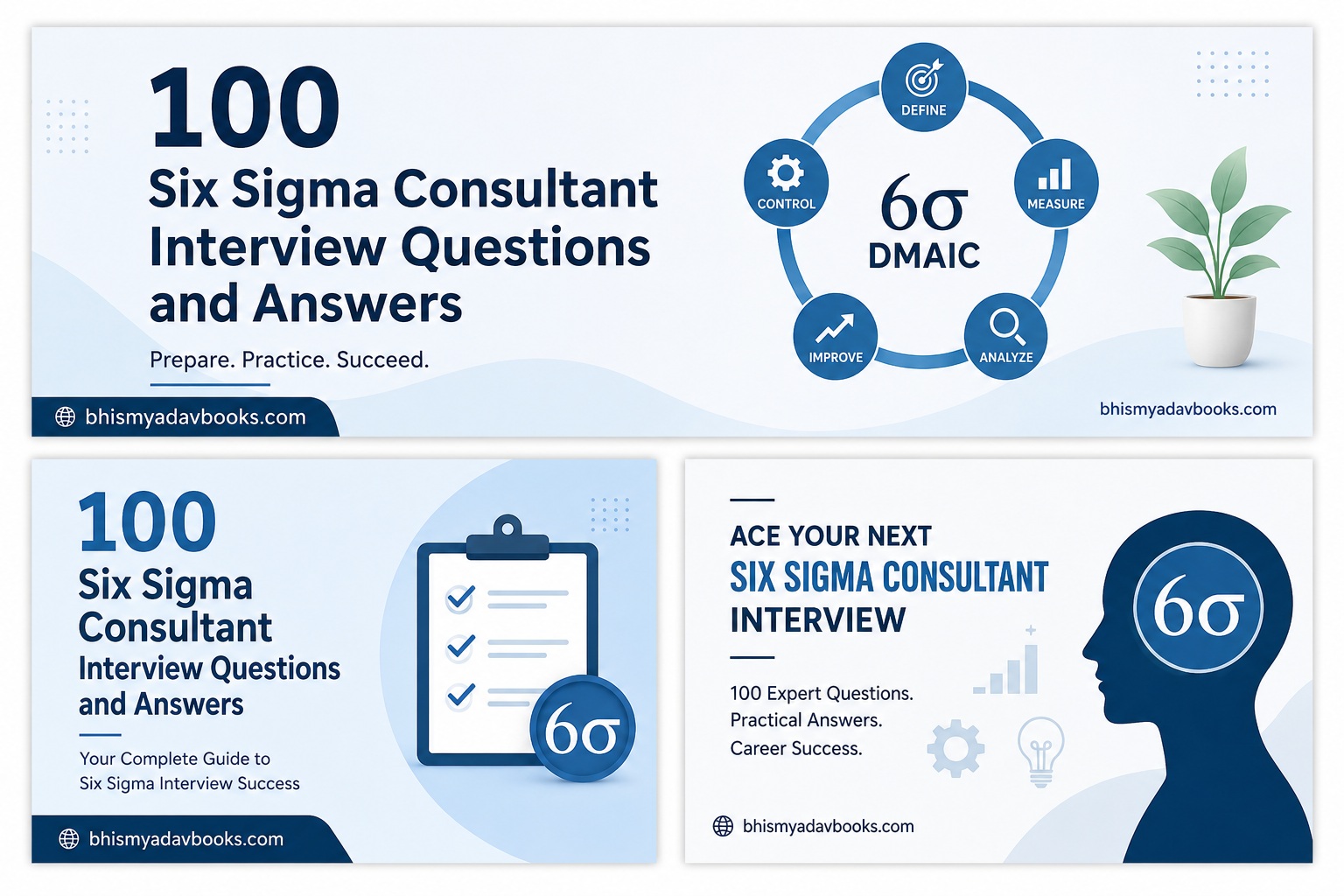
6. What is DMAIC?

Answer:
DMAIC stands for:

  • Define
  • Measure
  • Analyze
  • Improve
  • Control

It is the most widely used Six Sigma improvement methodology.


7. Explain each DMAIC phase.

Answer:

  • Define: Identify the problem.
  • Measure: Collect performance data.
  • Analyze: Determine root causes.
  • Improve: Implement solutions.
  • Control: Sustain improvements.

8. What is DMADV?

Answer:
DMADV stands for Define, Measure, Analyze, Design, and Verify. It is used for designing new products or processes.


9. What is a defect?

Answer:
A defect is any output that fails to meet customer requirements.


10. What is DPMO?

Answer:
Defects Per Million Opportunities measures the number of defects occurring in one million opportunities.


11. What is CTQ?

Answer:
Critical to Quality (CTQ) refers to measurable characteristics essential for customer satisfaction.


12. What is VOC?

Answer:
Voice of Customer (VOC) represents customer expectations, requirements, and feedback.


13. What is COPQ?

Answer:
Cost of Poor Quality includes costs due to defects, rework, scrap, warranty, and customer complaints.


14. What is process capability?

Answer:
Process capability measures how consistently a process meets specification limits.


15. What is Cp?

Answer:
Cp measures potential process capability assuming the process is centered.


16. What is Cpk?

Answer:
Cpk measures actual process capability considering process centering.


17. What is variation?

Answer:
Variation is the difference in process outputs caused by common or special causes.


18. What are common causes?

Answer:
Natural variations inherent in a stable process.


19. What are special causes?

Answer:
Unexpected variations caused by equipment failure, operator error, or external factors.


20. What is standard deviation?

Answer:
It measures data dispersion around the mean.


21. What is the Pareto Principle?

Answer:
The 80/20 rule states that approximately 80% of problems arise from 20% of causes.


22. What is a Pareto Chart?

Answer:
A bar graph used to prioritize the most significant causes of problems.


23. What is a Fishbone Diagram?

Answer:
Also called the Ishikawa Diagram, it identifies possible root causes of problems.


24. What is Root Cause Analysis?

Answer:
A structured approach to identifying the true cause of a problem rather than symptoms.


25. What is the 5 Whys technique?

Answer:
It repeatedly asks “Why?” until the underlying cause is identified.


Statistical and Analytical Questions

(Questions 26-50)

26. What is hypothesis testing?

Answer:
A statistical method used to determine whether a claim about a population is valid.


27. What is regression analysis?

Answer:
A statistical technique used to determine relationships between variables.


28. What is correlation?

Answer:
Correlation measures the strength of the relationship between two variables.


29. What is ANOVA?

Answer:
Analysis of Variance compares means across multiple groups.


30. What is MSA?

Answer:
Measurement System Analysis evaluates measurement accuracy and precision.


31. What is Gage R&R?

Answer:
It measures repeatability and reproducibility of measurement systems.


32. What is a control chart?

Answer:
A graph that monitors process stability over time.


33. Why are control charts important?

Answer:
They distinguish between common and special cause variation.


34. What is histogram analysis?

Answer:
A histogram shows data distribution.


35. What is scatter plot analysis?

Answer:
It shows relationships between two variables.


36. What is sampling?

Answer:
Selecting a subset of data for analysis.


37. What is confidence interval?

Answer:
A statistical range likely containing the true population value.


38. What is p-value?

Answer:
It measures statistical significance.


39. What is normal distribution?

Answer:
A bell-shaped distribution where most values cluster around the mean.


40. What is process stability?

Answer:
A stable process operates consistently with predictable variation.


41. What is takt time?

Answer:
The production rate needed to meet customer demand.


42. What is cycle time?

Answer:
Time required to complete one process cycle.


43. What is lead time?

Answer:
Total time from order placement to delivery.


44. What is throughput?

Answer:
Amount of work completed during a given period.


45. What is yield?

Answer:
Percentage of products meeting quality standards.


46. What is rolled throughput yield?

Answer:
Probability that a product passes every process step without defects.


47. What is process mapping?

Answer:
Visual representation of workflow.


48. What is SIPOC?

Answer:
Supplier, Input, Process, Output, Customer.


49. What is Value Stream Mapping?

Answer:
A Lean tool used to identify waste across an entire process.


50. Why is data important in Six Sigma?

Answer:
Because decisions are based on measurable facts rather than assumptions.

(Questions 51-75)

51. What is Kaizen?

Answer:
Kaizen is a Japanese philosophy of continuous improvement. It encourages everyone in an organization—from frontline employees to senior management—to make small, ongoing improvements that collectively lead to significant gains in quality, efficiency, and productivity.


52. What are the 8 Wastes in Lean Manufacturing?

Answer:

The eight wastes (DOWNTIME) are:

  • Defects
  • Overproduction
  • Waiting
  • Non-utilized talent
  • Transportation
  • Inventory
  • Motion
  • Extra Processing

Reducing these wastes improves operational efficiency.


53. What is Poka-Yoke?

Answer:
Poka-Yoke is a mistake-proofing technique that prevents human errors before they occur. Examples include fixtures that only allow correct assembly or software validations that prevent invalid data entry.


54. What is 5S?

Answer:

5S is a workplace organization methodology:

  • Sort
  • Set in Order
  • Shine
  • Standardize
  • Sustain

It creates a clean, organized, and efficient work environment.


55. Explain the PDCA Cycle.

Answer:

PDCA stands for:

  • Plan
  • Do
  • Check
  • Act

It is an iterative method for continuous process improvement.


56. What is FMEA?

Answer:
Failure Mode and Effects Analysis (FMEA) is a proactive risk assessment tool used to identify potential failures, evaluate their impact, and prioritize corrective actions.


57. What is Risk Priority Number (RPN)?

Answer:
RPN is calculated as:

RPN = Severity × Occurrence × Detection

Higher RPN values indicate higher-priority risks.


58. What is Standard Work?

Answer:
Standard Work documents the best-known method for performing a task safely, efficiently, and consistently.


59. What is Visual Management?

Answer:
Visual Management uses charts, labels, dashboards, color coding, and signs to communicate process status and performance quickly.


60. What is Andon?

Answer:
Andon is a visual alert system used to notify operators and supervisors about process abnormalities requiring immediate attention.


61. What is a Bottleneck?

Answer:
A bottleneck is the slowest step in a process that limits overall throughput and productivity.


62. How do you identify bottlenecks?

Answer:

Methods include:

  • Process mapping
  • Value Stream Mapping
  • Time studies
  • Queue analysis
  • Capacity analysis
  • Workflow observation

63. What is Process Mapping?

Answer:
Process mapping visually documents every step in a workflow, helping identify delays, redundancies, and improvement opportunities.


64. What is Benchmarking?

Answer:
Benchmarking compares an organization’s performance against industry leaders or best practices to identify improvement opportunities.


65. What is Continuous Improvement?

Answer:
Continuous Improvement is the ongoing effort to improve products, services, and processes through incremental changes.


66. What software tools are commonly used in Six Sigma?

Answer:

Popular tools include:

  • Minitab
  • Microsoft Excel
  • Power BI
  • Tableau
  • JMP
  • Visio
  • Python
  • R
  • SAP
  • Microsoft Project

67. Why is Minitab widely used?

Answer:
Minitab provides advanced statistical analysis, hypothesis testing, regression analysis, capability studies, control charts, and DOE in an easy-to-use interface.


68. What is DOE?

Answer:
Design of Experiments (DOE) is a statistical technique used to determine how multiple variables affect process outcomes.


69. What is Pilot Testing?

Answer:
Pilot testing validates proposed improvements on a small scale before organization-wide implementation.


70. What is Change Management?

Answer:
Change Management ensures employees successfully adopt new processes through planning, communication, training, and stakeholder engagement.


71. Why do Six Sigma projects fail?

Answer:

Common reasons include:

  • Poor leadership support
  • Lack of reliable data
  • Weak project selection
  • Employee resistance
  • Inadequate training
  • Poor communication
  • Unrealistic expectations

72. How do you prioritize improvement projects?

Answer:

Projects are prioritized based on:

  • Business impact
  • Customer satisfaction
  • Cost savings
  • Feasibility
  • Available resources
  • Strategic alignment

73. What KPIs are commonly monitored?

Answer:

Examples include:

  • Defect rate
  • First Pass Yield (FPY)
  • DPMO
  • Customer complaints
  • Cost savings
  • Process capability (Cpk)
  • Cycle time
  • On-time delivery

74. How do you measure project success?

Answer:

Success is measured through:

  • Reduced defects
  • Lower operational costs
  • Improved customer satisfaction
  • Increased productivity
  • Reduced lead time
  • Sustained process performance

75. What industries use Six Sigma?

Answer:

Six Sigma is widely used in:

  • Manufacturing
  • Automotive
  • Aerospace
  • Healthcare
  • Pharmaceuticals
  • Banking
  • Insurance
  • Information Technology
  • Logistics
  • Retail
  • Telecommunications
  • Government organizations

Behavioral Interview Questions


(Questions 76-100)

76. Tell us about yourself.

Answer:
“I have experience in process improvement, quality management, and data-driven decision-making. My expertise includes DMAIC, root cause analysis, Lean methodologies, statistical tools, and cross-functional collaboration. I enjoy solving business problems that improve efficiency while reducing operational costs.”


77. Why do you want to become a Six Sigma Consultant?

Answer:
“I enjoy analyzing complex business problems and implementing measurable improvements that enhance customer satisfaction and organizational performance.”


78. Describe a successful improvement project.

Answer:
Describe:

  • Problem
  • Analysis performed
  • Root cause identified
  • Solution implemented
  • Quantifiable results

Always include measurable outcomes.


79. How do you handle resistance to change?

Answer:

I:

  • Listen to concerns
  • Explain business benefits
  • Involve stakeholders early
  • Provide training
  • Demonstrate quick wins
  • Communicate progress regularly

80. Describe a difficult stakeholder.

Answer:
Explain how you maintained professionalism, used data to support recommendations, built trust, and reached a mutually beneficial solution.


81. How do you manage multiple projects?

Answer:

I prioritize based on:

  • Business impact
  • Deadlines
  • Risk
  • Resource availability

Project management tools and regular status reviews help maintain progress.


82. Describe a project that failed.

Answer:
Discuss what happened, lessons learned, corrective actions taken, and how those lessons improved future project execution.


83. How do you motivate teams?

Answer:

I:

  • Set clear goals
  • Recognize achievements
  • Encourage collaboration
  • Provide coaching
  • Remove obstacles
  • Celebrate successes

84. Describe your leadership style.

Answer:
“My leadership style is collaborative and data-driven. I empower teams, encourage continuous learning, and use measurable objectives to guide decision-making.”


85. How do you deal with conflicting priorities?

Answer:
I assess business impact, consult stakeholders, manage risks, and communicate expectations clearly before reallocating resources.


86. How do you communicate technical concepts to non-technical stakeholders?

Answer:
I use simple language, visual dashboards, real-world examples, and focus on business outcomes instead of technical terminology.


87. How do you ensure sustainability after project completion?

Answer:

I establish:

  • Standard Operating Procedures (SOPs)
  • Control plans
  • Performance dashboards
  • Periodic audits
  • Employee training
  • Process ownership

88. How do you resolve team conflicts?

Answer:
I encourage open communication, understand each perspective, focus on shared objectives, and facilitate collaborative problem-solving.


89. What motivates you as a consultant?

Answer:
Helping organizations improve performance, solving challenging problems, achieving measurable business results, and continuously learning new methodologies.


90. Why should we hire you?

Answer:
“I combine analytical skills, statistical knowledge, project management expertise, and strong communication abilities to deliver measurable improvements that align with business objectives.”

91. A manufacturing process has a high defect rate. How would you approach the problem?

Answer:

I would follow the DMAIC methodology:

  1. Define the problem and customer impact.
  2. Measure the current defect rate and collect process data.
  3. Analyze the data using Pareto charts, Fishbone diagrams, 5 Whys, and statistical analysis to identify root causes.
  4. Improve the process by implementing corrective actions, conducting pilot tests, and validating improvements.
  5. Control the process using control charts, SOPs, training, and periodic audits to sustain the improvements.

This structured approach ensures decisions are based on data rather than assumptions.


92. How would you reduce production cycle time without compromising quality?

Answer:

I would:

  • Map the current process.
  • Identify bottlenecks.
  • Eliminate non-value-added activities.
  • Reduce waiting time.
  • Optimize workstation layout.
  • Standardize work procedures.
  • Implement automation where appropriate.
  • Train employees.
  • Continuously monitor KPIs.

The objective is to improve efficiency while maintaining or improving product quality.


93. What would you do if your Six Sigma project was behind schedule?

Answer:

I would:

  • Review the project timeline.
  • Identify the causes of delay.
  • Reprioritize critical tasks.
  • Allocate additional resources if required.
  • Remove obstacles affecting progress.
  • Communicate revised timelines to stakeholders.
  • Conduct frequent project reviews until the project is back on track.

Transparency and proactive communication are essential.


94. How would you convince management to invest in a Six Sigma project?

Answer:

I would prepare a business case demonstrating:

  • Current operational costs.
  • Cost of Poor Quality (COPQ).
  • Expected cost savings.
  • ROI projections.
  • Customer satisfaction improvements.
  • Productivity gains.
  • Risk reduction.
  • Competitive advantages.

Senior management is more likely to approve projects supported by measurable financial benefits.


95. A client disagrees with your analysis. What would you do?

Answer:

I would:

  • Listen carefully to the client’s concerns.
  • Review the available data together.
  • Clarify assumptions.
  • Present objective evidence.
  • Discuss alternative viewpoints.
  • Collaboratively determine the best course of action.

Maintaining professionalism and relying on data helps build trust.


96. What metrics would you present to senior leadership after completing a project?

Answer:

Typical metrics include:

  • Defect reduction percentage.
  • Annual cost savings.
  • Return on Investment (ROI).
  • Customer satisfaction improvement.
  • Process capability (Cp/Cpk).
  • Cycle time reduction.
  • Productivity improvement.
  • First Pass Yield (FPY).
  • Scrap reduction.
  • On-time delivery improvement.

Leadership appreciates concise dashboards focused on business impact.


97. How do you sustain improvements after project completion?

Answer:

I would establish:

  • Standard Operating Procedures (SOPs).
  • Control plans.
  • Process ownership.
  • Performance dashboards.
  • Regular audits.
  • Employee training.
  • Documentation updates.
  • Continuous monitoring using KPIs.
  • Scheduled review meetings.

Sustainability is one of the most important aspects of successful Six Sigma implementation.


98. Describe your ideal Six Sigma project.

Answer:

An ideal project:

  • Solves a significant business problem.
  • Has measurable objectives.
  • Receives strong leadership support.
  • Uses reliable data.
  • Has engaged stakeholders.
  • Produces sustainable improvements.
  • Delivers measurable financial benefits.
  • Improves customer satisfaction.

99. What qualities make an excellent Six Sigma Consultant?

Answer:

An excellent consultant possesses:

  • Analytical thinking
  • Leadership
  • Statistical knowledge
  • Business acumen
  • Communication skills
  • Project management expertise
  • Problem-solving ability
  • Customer focus
  • Change management capability
  • Continuous learning mindset

These qualities enable consultants to drive meaningful organizational improvements.


100. Where do you see yourself in five years?

Answer:

“In five years, I aim to lead large-scale transformation initiatives, mentor Green Belt and Black Belt professionals, manage enterprise-wide continuous improvement programs, and contribute strategically to organizational growth through operational excellence.”


Six SIGMA: A Complete Step-By-Step Guide by Council for Six Sigma Certification Craig Joseph Setter (Author)

Six Sigma Consultant Interview Preparation Tips

Preparing well for your interview can significantly improve your chances of success. Consider the following best practices:

  • Review the DMAIC and DMADV methodologies thoroughly.
  • Understand Lean principles and the eight wastes.
  • Practice statistical concepts such as process capability, control charts, hypothesis testing, and regression.
  • Revise quality tools including Pareto Charts, Fishbone Diagrams, FMEA, SIPOC, and Value Stream Mapping.
  • Prepare examples of projects where you improved quality, reduced costs, or increased efficiency.
  • Be ready to explain your role in cross-functional teams.
  • Quantify your achievements using measurable results.
  • Stay informed about current trends in digital transformation, automation, AI-driven quality analytics, and Industry 4.0.

Common Interview Mistakes to Avoid

Many candidates have strong technical knowledge but lose opportunities due to avoidable mistakes.

Avoid the following:

  • Memorizing definitions without understanding practical applications.
  • Giving vague project examples without measurable outcomes.
  • Ignoring customer-focused thinking.
  • Overusing technical jargon with non-technical interviewers.
  • Failing to explain how data influenced decisions.
  • Not preparing examples of leadership or teamwork.
  • Speaking negatively about previous employers.
  • Neglecting behavioral interview questions.
  • Forgetting to research the company and its industry.

Frequently Asked Questions (FAQ)

Is Six Sigma Consultant a good career?

Yes. Six Sigma Consultants are in demand across manufacturing, healthcare, IT, logistics, banking, retail, pharmaceuticals, aerospace, and many other industries. Organizations value professionals who can improve efficiency, reduce costs, and enhance quality.


Which certification is best for Six Sigma Consultants?

Popular certifications include:

  • Lean Six Sigma Yellow Belt
  • Lean Six Sigma Green Belt
  • Lean Six Sigma Black Belt
  • Lean Six Sigma Master Black Belt

The best certification depends on your experience level and career goals.


Do Six Sigma Consultants need programming skills?

Programming is not mandatory, but familiarity with tools such as Python, R, SQL, or Power BI can help with data analysis and reporting.


Is Six Sigma only for manufacturing?

No. While Six Sigma originated in manufacturing, it is widely used in healthcare, finance, banking, software development, education, telecommunications, logistics, and government services.


Which industries hire Six Sigma Consultants?

Common industries include:

  • Manufacturing
  • Automotive
  • Aerospace
  • Healthcare
  • Pharmaceuticals
  • Banking
  • Insurance
  • Information Technology
  • Retail
  • Logistics
  • Food Processing
  • Energy
  • Construction
  • Telecommunications

Essential Skills for Six Sigma Consultants

Recruiters often seek candidates with a combination of technical and interpersonal skills, including:

  • Lean Six Sigma methodology
  • Statistical analysis
  • Root Cause Analysis
  • DMAIC
  • DMADV
  • Process Mapping
  • Value Stream Mapping
  • FMEA
  • SPC (Statistical Process Control)
  • Minitab
  • Microsoft Excel
  • Power BI
  • Data visualization
  • Project management
  • Leadership
  • Communication
  • Problem-solving
  • Time management
  • Risk assessment
  • Change management

Conclusion

A Six Sigma Consultant plays a pivotal role in helping organizations achieve operational excellence by improving quality, reducing waste, and optimizing business processes. Success in interviews requires more than theoretical knowledge—it demands the ability to demonstrate practical experience, analytical thinking, and a results-oriented approach.

This collection of 100 Six Sigma Consultant Interview Questions and Answers provides a comprehensive resource for both freshers and experienced professionals. By mastering the concepts covered here, practicing real-world scenarios, and preparing measurable examples from your own experience, you can confidently tackle technical, behavioral, and scenario-based interview questions.

Whether you’re pursuing opportunities in manufacturing, healthcare, IT, finance, or consulting, strong preparation can help you stand out and advance your career.