Posted on Leave a comment

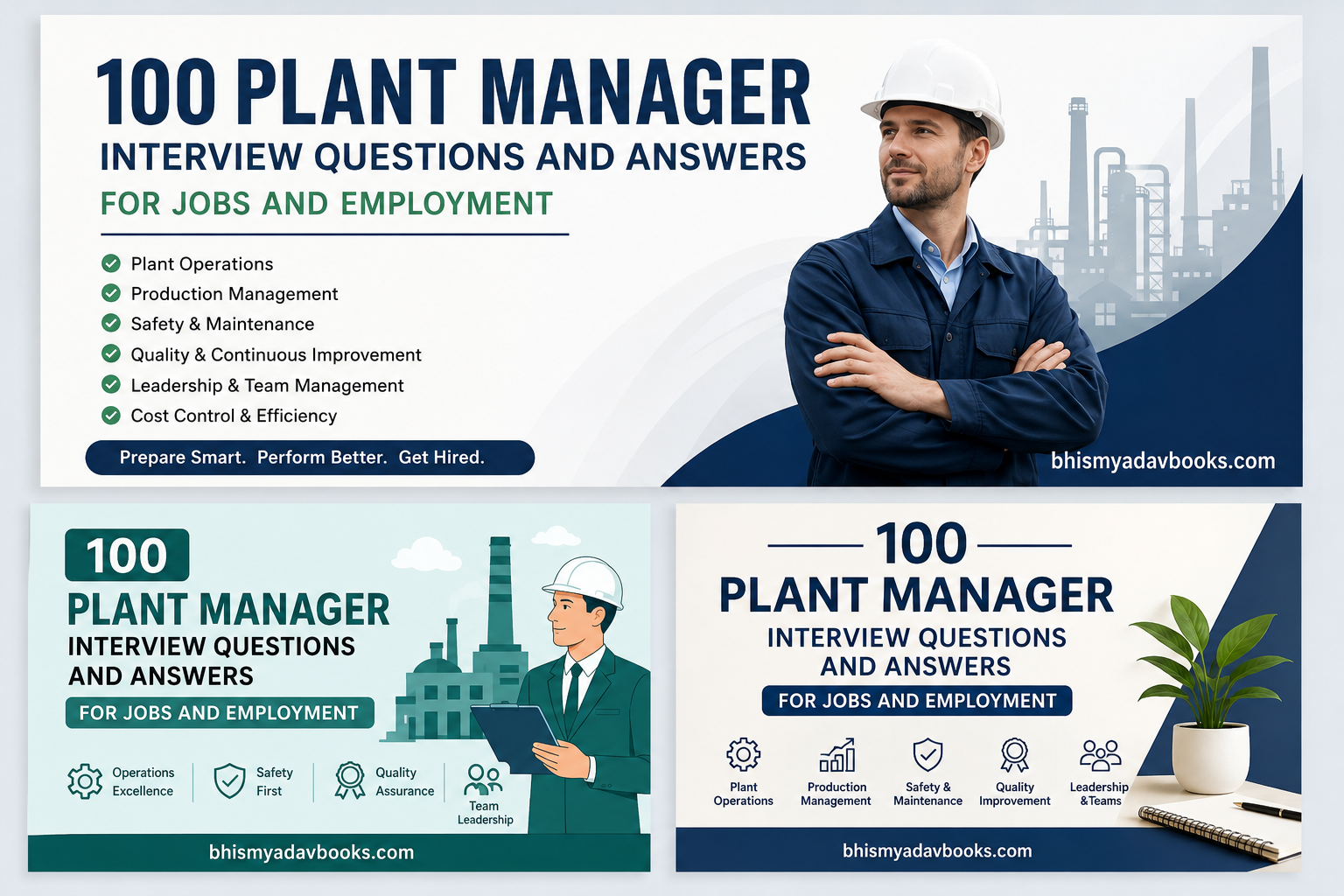
Plant Manager Interview Questions and Answers for Jobs and Employment (2026) : Complete Guide Freshers and Experienced can’t miss

Plant Manager Interview Questions and Answers

100 Plant Manager Interview Questions and Answers

Introduction

A Plant Manager plays a major role in the successful operation of a manufacturing plant, industrial facility, production unit, or factory. Plant Managers are responsible for managing production, employees, equipment, maintenance, safety, quality, inventory, operational costs, and continuous improvement activities.

Companies generally look for Plant Managers who can achieve production targets while maintaining high standards of quality and workplace safety. A successful Plant Manager must possess strong leadership, communication, problem-solving, analytical, and decision-making skills.

During a Plant Manager interview, candidates may face questions related to production planning, lean manufacturing, employee management, equipment maintenance, quality control, budgeting, safety regulations, supply chain coordination, and operational efficiency.

We have some amazing books in our Shop page you may want to buy.

This comprehensive guide from Bhism Yadav Books provides 100 Plant Manager interview questions and answers for jobs and employment. These questions can help manufacturing professionals, production supervisors, operations professionals, engineering graduates, and job aspirants prepare for Plant Manager interviews.


Basic Plant Manager Interview Questions and Answers

(Questions 1-30)

1. Tell me about yourself.

Answer:
I am a manufacturing and operations professional with experience in production management, employee supervision, quality improvement, and plant operations. I focus on achieving production targets safely and efficiently. My strengths include leadership, problem-solving, process improvement, and coordination between different departments.

2. What is a Plant Manager?

Answer:
A Plant Manager is responsible for managing the overall operations of a manufacturing plant or industrial facility. The role includes production planning, employee management, quality control, maintenance coordination, safety management, budgeting, and continuous improvement.

3. Why do you want to become a Plant Manager?

Answer:
I enjoy managing manufacturing operations and improving production processes. The Plant Manager position allows me to combine technical knowledge, leadership skills, and business understanding to improve productivity, quality, and profitability.

4. What are the main responsibilities of a Plant Manager?

Answer:
The main responsibilities include managing production, supervising employees, maintaining workplace safety, controlling operational costs, ensuring product quality, coordinating maintenance, managing resources, and achieving organizational targets.

5. What skills are important for a Plant Manager?

Answer:
Important skills include leadership, communication, production planning, problem-solving, financial management, quality management, safety awareness, employee development, data analysis, and decision-making.

6. Why should we hire you as a Plant Manager?

Answer:
You should hire me because I understand plant operations and can balance productivity, quality, safety, and cost. I believe in data-based decision-making, employee involvement, and continuous improvement.

7. What do you know about our manufacturing company?

Answer:
Before attending the interview, I research the company’s products, manufacturing processes, customers, market position, values, and recent developments. I would explain how my operational experience can support the company’s manufacturing goals.

8. What is your management style?

Answer:
My management style is collaborative and performance-oriented. I clearly communicate expectations, monitor performance indicators, support employees, and encourage teams to identify and solve operational problems.

9. How do you define successful plant operations?

Answer:
Successful plant operations consistently achieve production targets while maintaining quality, employee safety, equipment reliability, customer satisfaction, and cost efficiency.

10. What is the difference between a Plant Manager and a Production Manager?

Answer:
A Production Manager mainly focuses on production activities. A Plant Manager has broader responsibility for the entire facility, including production, maintenance, safety, quality, human resources coordination, and operational costs.


Plant Operations Interview Questions

11. How do you manage daily plant operations?

Answer:
I review production schedules, safety issues, quality reports, equipment status, staffing levels, and key performance indicators. I conduct operational meetings and coordinate with production, maintenance, quality, and supply chain teams.

12. How do you set production targets?

Answer:
I consider customer demand, available capacity, workforce availability, equipment capability, raw material availability, and historical production data. Targets should be realistic, measurable, and aligned with business objectives.

13. What are Key Performance Indicators in plant management?

Answer:
Common KPIs include production output, Overall Equipment Effectiveness, downtime, scrap rate, rejection rate, on-time delivery, safety incidents, labor productivity, energy consumption, and production cost.

14. What is Overall Equipment Effectiveness?

Answer:
Overall Equipment Effectiveness, or OEE, measures equipment productivity by considering availability, performance, and quality. It helps identify production losses and equipment improvement opportunities.

15. How do you improve plant productivity?

Answer:
I analyze production data, identify bottlenecks, reduce downtime, improve employee training, optimize workflows, implement preventive maintenance, and apply continuous improvement methods.

16. How do you identify production bottlenecks?

Answer:
I review cycle times, work-in-process inventory, equipment utilization, downtime records, and production flow. The process or equipment that limits overall output is investigated as a potential bottleneck.

17. How do you manage production delays?

Answer:
I first determine the cause of the delay. I then evaluate production priorities, available resources, maintenance requirements, and customer commitments. A recovery plan is developed and communicated to relevant departments.

18. How do you manage multiple production lines?

Answer:
I use production schedules, performance dashboards, daily meetings, and clearly defined responsibilities. Each production line is monitored using relevant KPIs.

19. How do you handle sudden changes in customer demand?

Answer:
I evaluate available capacity, inventory, staffing, raw materials, and supplier capabilities. I then adjust the production schedule while considering cost, quality, and delivery commitments.

20. What is capacity planning?

Answer:
Capacity planning is the process of determining whether a plant has sufficient resources, equipment, employees, and production capability to meet current and future demand.


Production Planning and Manufacturing Questions

21. How do you prepare a production plan?

Answer:
I review customer orders, forecasts, inventory levels, machine capacity, workforce availability, and material requirements. I then develop a production schedule with clear priorities and deadlines.

22. What is production scheduling?

Answer:
Production scheduling determines when and how manufacturing activities will be performed. It assigns production orders to equipment, employees, and specific time periods.

23. How do you ensure production targets are achieved?

Answer:
I establish measurable targets, communicate expectations, monitor production performance, identify deviations early, and implement corrective actions.

24. What would you do if production is below target?

Answer:
I would analyze equipment downtime, staffing, material availability, cycle time, quality losses, and process problems. After identifying the root cause, I would implement an improvement plan.

25. What is takt time?

Answer:
Takt time represents the rate at which products must be completed to meet customer demand. It helps align production speed with market requirements.

26. What is cycle time?

Answer:
Cycle time is the total time required to complete a production activity or manufacture one unit. Reducing unnecessary cycle time can improve productivity.

27. What is throughput?

Answer:
Throughput is the quantity of products successfully produced during a specific period. It is an important measure of manufacturing performance.

28. How do you reduce manufacturing lead time?

Answer:
I reduce lead time by improving workflow, reducing waiting time, optimizing layouts, eliminating unnecessary activities, improving supplier coordination, and reducing equipment downtime.

29. How do you manage work-in-process inventory?

Answer:
I monitor production flow and establish appropriate inventory limits between processes. Excessive work-in-process can hide production problems and increase costs.

30. How do you balance production lines?

Answer:
I analyze task times and distribute work evenly between workstations. The goal is to minimize waiting time and prevent individual processes from becoming bottlenecks.


Lean Manufacturing Interview Questions

(Questions 31-60)

31. What is lean manufacturing?

Answer:
Lean manufacturing is a management approach focused on maximizing customer value while reducing waste. It aims to improve efficiency, quality, and production flow.

32. What are the major wastes in lean manufacturing?

Answer:
Major wastes include overproduction, waiting, transportation, overprocessing, excess inventory, unnecessary motion, defects, and underutilized employee talent.

33. What is Kaizen?

Answer:
Kaizen is a continuous improvement philosophy that encourages employees to make small and regular improvements to processes.

34. How do you implement continuous improvement?

Answer:
I establish measurable goals, involve employees, analyze performance data, identify improvement opportunities, test solutions, and standardize successful changes.

35. What is 5S?

Answer:
5S is a workplace organization method based on Sort, Set in Order, Shine, Standardize, and Sustain. It improves workplace efficiency, cleanliness, and safety.

36. How would you implement 5S in a plant?

Answer:
I would train employees, identify unnecessary items, organize tools and materials, establish cleaning standards, create visual controls, and conduct regular audits.

37. What is Value Stream Mapping?

Answer:
Value Stream Mapping is a visual method used to analyze material and information flow. It helps identify waste, delays, and opportunities for process improvement.

38. What is Just-in-Time manufacturing?

Answer:
Just-in-Time manufacturing aims to produce the required quantity at the required time. It reduces unnecessary inventory and storage costs.

39. What is Kanban?

Answer:
Kanban is a visual production control system used to manage workflow and inventory. It signals when materials or products need to be replenished.

40. What is a Gemba walk?

Answer:
A Gemba walk involves managers visiting the actual workplace where production occurs. The purpose is to observe processes, communicate with employees, and understand operational problems.


Quality Management Interview Questions

41. How do you ensure product quality?

Answer:
I establish quality standards, monitor process parameters, train employees, review quality data, conduct audits, and ensure corrective actions are implemented.

42. What is quality control?

Answer:
Quality control involves inspecting and testing products or processes to ensure they meet defined quality requirements.

43. What is quality assurance?

Answer:
Quality assurance focuses on establishing systems and procedures that prevent quality problems. It is more process-oriented than quality control.

44. How do you reduce product defects?

Answer:
I analyze defect data, identify root causes, improve process controls, provide employee training, maintain equipment, and monitor corrective actions.

45. What is root cause analysis?

Answer:
Root cause analysis is a systematic process used to identify the fundamental cause of a problem rather than only addressing its symptoms.

46. What is the 5 Whys technique?

Answer:
The 5 Whys technique involves repeatedly asking why a problem occurred until the underlying cause is identified.

47. What is a fishbone diagram?

Answer:
A fishbone diagram is a root cause analysis tool that organizes possible causes into categories such as people, machines, methods, materials, measurement, and environment.

48. How do you handle a major customer quality complaint?

Answer:
I immediately investigate the complaint, contain affected products, communicate with the quality team, identify the root cause, implement corrective actions, and monitor effectiveness.

49. What is Statistical Process Control?

Answer:
Statistical Process Control uses statistical methods and control charts to monitor process variation and determine whether a process is operating consistently.

50. What would you do if the rejection rate suddenly increased?

Answer:
I would review production changes, raw materials, machine conditions, process parameters, employee practices, and inspection data. Production may be temporarily controlled until the cause is identified.


Plant Safety Interview Questions

51. How important is safety in plant management?

Answer:
Safety is a fundamental responsibility of plant management. Production targets should never be achieved by ignoring unsafe working conditions or procedures.

52. How do you create a strong safety culture?

Answer:
I demonstrate management commitment, provide regular safety training, encourage hazard reporting, investigate incidents, recognize safe behavior, and hold employees accountable for safety procedures.

53. What would you do after a workplace accident?

Answer:
My first priority would be emergency response and medical assistance. I would secure the area, report the incident, conduct an investigation, identify root causes, and implement preventive actions.

54. What is a risk assessment?

Answer:
A risk assessment identifies workplace hazards, evaluates the probability and severity of harm, and establishes appropriate control measures.

55. What is a near miss?

Answer:
A near miss is an unplanned event that did not cause injury or damage but had the potential to do so. Near misses should be investigated to prevent future accidents.

56. How do you reduce workplace accidents?

Answer:
I focus on employee training, hazard identification, equipment guarding, personal protective equipment, preventive maintenance, safety audits, and management involvement.

57. How do you handle an employee who repeatedly violates safety rules?

Answer:
I would investigate the situation, ensure the employee understands the safety requirements, provide appropriate training, and follow the organization’s disciplinary procedures if violations continue.

58. What is Lockout/Tagout?

Answer:
Lockout/Tagout is a safety procedure used to isolate hazardous energy before equipment maintenance or repair activities are performed.

59. Why are safety audits important?

Answer:
Safety audits help identify unsafe conditions, procedural weaknesses, and compliance problems before they result in accidents.

60. How do you measure safety performance?

Answer:
I review injury rates, lost-time incidents, near-miss reports, safety observations, audit findings, training completion, and corrective action closure rates.


Maintenance and Equipment Management Questions

(Questions 61-100)

61. How do you manage plant maintenance?

Answer:
I coordinate with maintenance teams to establish preventive maintenance schedules, monitor equipment reliability, review downtime, and prioritize critical equipment.

62. What is preventive maintenance?

Answer:
Preventive maintenance is planned maintenance performed at scheduled intervals to reduce the probability of equipment failure.

63. What is predictive maintenance?

Answer:
Predictive maintenance uses equipment condition data to predict potential failures. Techniques may include vibration analysis, temperature monitoring, and oil analysis.

64. What is corrective maintenance?

Answer:
Corrective maintenance is performed after an equipment problem has been identified. The purpose is to restore equipment to proper operating condition.

65. How do you reduce equipment downtime?

Answer:
I analyze downtime causes, improve preventive maintenance, ensure spare part availability, train operators, and monitor equipment condition.

66. What is Total Productive Maintenance?

Answer:
Total Productive Maintenance is an approach that involves operators and maintenance employees in improving equipment reliability and productivity.

67. How do you prioritize equipment repairs?

Answer:
I consider safety risks, production impact, product quality, equipment criticality, repair time, and customer delivery requirements.

68. How do you manage spare parts inventory?

Answer:
I classify spare parts based on equipment criticality, lead time, failure frequency, and cost. Critical spare parts should be available without creating excessive inventory.

69. What is Mean Time Between Failures?

Answer:
Mean Time Between Failures, or MTBF, measures the average operating time between equipment failures. A higher MTBF generally indicates better equipment reliability.

70. What is Mean Time to Repair?

Answer:
Mean Time to Repair, or MTTR, measures the average time required to repair failed equipment and return it to operation.


Leadership and Employee Management Questions

71. How do you motivate plant employees?

Answer:
I communicate clear goals, recognize good performance, provide development opportunities, involve employees in problem-solving, and create a respectful workplace.

72. How do you handle conflict between employees?

Answer:
I listen to all parties, identify the facts, understand the cause of the conflict, and work toward a professional and fair resolution.

73. How do you manage underperforming employees?

Answer:
I clearly explain performance expectations, identify skill or resource gaps, provide coaching and training, establish improvement goals, and monitor progress.

74. How do you develop future supervisors and managers?

Answer:
I identify employees with leadership potential and provide coaching, challenging assignments, cross-functional exposure, and leadership training.

75. How do you communicate with plant employees?

Answer:
I use daily meetings, shift briefings, visual management boards, individual discussions, and written communication. Communication should be clear and consistent.

76. How do you handle employee resistance to change?

Answer:
I explain the reason for the change, involve employees in implementation, address concerns, provide training, and demonstrate the expected benefits.

77. How do you manage different shifts?

Answer:
I establish standard procedures, consistent performance expectations, shift handover processes, and regular communication between shift supervisors.

78. How do you build teamwork in a manufacturing plant?

Answer:
I establish shared goals, encourage cross-functional cooperation, recognize team achievements, and create opportunities for employees to solve problems together.

79. How do you delegate responsibilities?

Answer:
I assign responsibilities based on skills, experience, and development needs. I clearly define expected outcomes and provide appropriate authority and resources.

80. How do you handle a difficult supervisor?

Answer:
I discuss specific behaviors and performance expectations privately. I listen to the supervisor’s concerns and develop a clear improvement plan.


Cost Control and Financial Management Questions

81. How do you control plant operating costs?

Answer:
I monitor labor costs, material usage, energy consumption, maintenance expenses, scrap, inventory, and overtime. Cost reduction should not negatively affect safety or quality.

82. How do you reduce manufacturing costs?

Answer:
I focus on waste reduction, productivity improvement, energy efficiency, equipment reliability, inventory optimization, and process improvement.

83. What is a plant budget?

Answer:
A plant budget is a financial plan that estimates operational expenses and investments for a specific period. It may include labor, maintenance, utilities, materials, and capital expenditures.

84. How do you manage overtime costs?

Answer:
I analyze the reasons for overtime, including staffing shortages, equipment problems, production planning issues, and demand changes. I then address recurring causes.

85. How do you reduce energy consumption?

Answer:
I monitor energy usage, identify high-consumption equipment, improve operating practices, maintain equipment, reduce leaks, and evaluate energy-efficient technologies.

86. How do you justify capital investment?

Answer:
I prepare a business case explaining the operational need, investment cost, expected savings, productivity improvements, safety benefits, and return on investment.

87. What is Return on Investment?

Answer:
Return on Investment measures the financial benefit of an investment relative to its cost. It helps management evaluate capital projects.

88. How do you control material waste?

Answer:
I monitor material consumption, scrap, rework, process losses, and storage practices. Root cause analysis is used to address excessive waste.

89. How do you manage inventory costs?

Answer:
I optimize inventory levels based on production requirements, supplier lead times, demand variability, and material criticality.

90. How do you balance cost reduction and product quality?

Answer:
I focus on eliminating waste and inefficiency rather than reducing essential quality controls. Sustainable cost reduction should improve processes without compromising customer requirements.


Advanced and Behavioral Plant Manager Interview Questions

91. Describe a difficult operational problem you solved.

Answer:
In a previous manufacturing situation, production output was affected by recurring equipment downtime. I reviewed downtime data, involved production and maintenance teams, and identified a recurring component failure. We improved the preventive maintenance process and spare part planning. This significantly improved equipment availability.

92. Tell me about a time you failed to achieve a production target.

Answer:
I once faced a production target shortfall due to equipment problems and material delays. I reviewed the planning assumptions and developed a recovery plan. The experience taught me the importance of contingency planning and early risk identification.

93. How do you make decisions under pressure?

Answer:
I quickly collect relevant facts, evaluate safety and business risks, consult technical experts when necessary, and select the most practical solution. I also communicate decisions clearly.

94. How would you manage a plant during a major equipment breakdown?

Answer:
I would ensure the area is safe, activate the maintenance response, evaluate production impact, review alternative equipment or schedules, communicate with management, and develop a recovery plan.

95. How do you handle pressure from management to increase production?

Answer:
I evaluate available capacity and identify realistic improvement opportunities. I clearly communicate operational risks and ensure that production increases do not compromise employee safety or product quality.

96. What would you do in your first 90 days as Plant Manager?

Answer:
I would learn the plant’s products, processes, employees, equipment, customers, and performance indicators. I would spend time on the production floor, meet department leaders, review safety and quality performance, and identify improvement priorities.

97. How do you prepare a plant for an audit?

Answer:
I ensure procedures and records are current, responsibilities are clearly assigned, employees understand relevant requirements, corrective actions are completed, and internal audits are conducted before the formal audit.

98. How do you manage a plant during a supply chain disruption?

Answer:
I review available inventory, identify critical materials, coordinate with procurement and suppliers, evaluate alternative materials or sources, and adjust production priorities based on customer requirements.

99. Where do you see yourself in five years?

Answer:
In five years, I hope to have contributed significantly to manufacturing performance and developed stronger operational leadership capabilities. I would like to take on broader responsibilities while continuing to improve plant productivity, safety, and quality.

100. Do you have any questions for us?

Answer:
Yes. I would like to understand the plant’s current operational priorities, major production challenges, key performance indicators, improvement initiatives, and expectations for the Plant Manager during the first six to twelve months.


Harvard Business Review Manager’s Handbook by Harvard Business Review (Author)

Important Skills Required for a Plant Manager

A successful Plant Manager requires a combination of technical, operational, financial, and leadership skills. Employers commonly look for candidates with strong knowledge of manufacturing operations and the ability to manage large teams.

Important Plant Manager skills include:

  • Production planning and scheduling
  • Manufacturing operations management
  • Leadership and employee supervision
  • Lean manufacturing
  • Continuous improvement
  • Quality management
  • Workplace safety
  • Equipment maintenance management
  • Cost control and budgeting
  • Inventory management
  • Supply chain coordination
  • Root cause analysis
  • Data analysis
  • Problem-solving
  • Decision-making
  • Communication
  • Project management
  • Performance management
  • Risk management
  • Strategic planning

Candidates should provide practical examples of these skills during a Plant Manager job interview.

How to Prepare for a Plant Manager Interview

Plant Manager interviews can include technical, managerial, behavioral, and situational questions. Candidates should prepare examples from their previous manufacturing or operations experience.

Start by researching the company’s products, production processes, customers, manufacturing locations, and industry. Review your experience in production management, safety, quality, maintenance, and employee leadership.

Candidates should also understand important manufacturing terms such as OEE, MTBF, MTTR, takt time, cycle time, throughput, 5S, Kaizen, Kanban, Just-in-Time, Value Stream Mapping, and Total Productive Maintenance.

Before the interview, prepare examples of situations where you improved production, reduced costs, managed employees, solved quality problems, reduced equipment downtime, or improved workplace safety.

Use the STAR method when answering behavioral interview questions. STAR represents Situation, Task, Action, and Result. Explain the situation, describe your responsibility, discuss the actions you performed, and present the final result.

Whenever possible, include measurable results. For example, you may explain how you reduced equipment downtime, improved production output, reduced scrap, increased OEE, or improved on-time delivery.

Common Plant Manager Interview Topics

Employers may evaluate candidates in several major areas during a Plant Manager interview.

Production Management: Candidates should understand production planning, scheduling, capacity management, bottleneck analysis, and production performance.

Safety Management: Plant Managers must demonstrate a strong commitment to employee safety and regulatory compliance.

Quality Management: Candidates should understand quality control, quality assurance, root cause analysis, corrective actions, and process improvement.

Maintenance Management: Knowledge of preventive maintenance, predictive maintenance, equipment reliability, and downtime reduction is important.

Employee Leadership: Plant Managers are expected to motivate employees, manage supervisors, resolve conflicts, and develop future leaders.

Cost Management: Employers may ask about budgeting, cost reduction, energy efficiency, labor costs, inventory, and capital investments.

Continuous Improvement: Candidates should understand lean manufacturing, Kaizen, 5S, Value Stream Mapping, and waste reduction.

Tips for Answering Plant Manager Interview Questions

Do not memorize every answer word for word. Instead, understand the purpose of each question and develop answers based on your actual professional experience.

Keep your answers clear and structured. Avoid providing unnecessary details that do not relate to the question.

Use specific examples when discussing leadership, production problems, safety incidents, or process improvements.

Demonstrate a balance between productivity, safety, quality, and cost. Employers generally prefer Plant Managers who understand that long-term manufacturing success requires all four areas.

Show that you are comfortable using data and manufacturing KPIs. Modern plant management requires managers to analyze production information and make evidence-based decisions.

Finally, demonstrate strong leadership and communication skills. A Plant Manager must work with production employees, supervisors, engineers, maintenance professionals, quality teams, supply chain teams, senior management, and customers.

Frequently Asked Questions About Plant Manager Interviews

What questions are asked in a Plant Manager interview?

Plant Manager interviews commonly include questions about production planning, employee leadership, plant safety, quality management, equipment maintenance, cost control, lean manufacturing, and operational problem-solving.

How should I introduce myself in a Plant Manager interview?

Provide a brief summary of your manufacturing experience, leadership responsibilities, technical skills, and major professional achievements. Focus on experience relevant to plant operations.

Is Plant Manager a leadership position?

Yes. A Plant Manager is a senior leadership position responsible for managing employees and coordinating multiple departments within a manufacturing facility.

What qualifications are required for a Plant Manager?

Requirements vary by employer and industry. Many organizations prefer candidates with qualifications in engineering, manufacturing, operations management, industrial management, or business administration, along with relevant manufacturing experience.

What KPIs should a Plant Manager monitor?

Important KPIs may include OEE, production output, downtime, scrap rate, rejection rate, on-time delivery, labor productivity, safety incidents, energy consumption, and production costs.

How can I succeed in a Plant Manager interview?

Research the company, understand its manufacturing environment, review important plant management concepts, and prepare real examples of leadership and operational improvement.

Conclusion

A Plant Manager is responsible for leading manufacturing operations and ensuring that production activities are safe, efficient, cost-effective, and capable of meeting customer requirements. Employers look for candidates who understand production management and can successfully lead employees in a complex industrial environment.

These 100 Plant Manager interview questions and answers for jobs and employment cover important topics including production planning, plant operations, lean manufacturing, quality management, workplace safety, equipment maintenance, employee leadership, and cost control.

Candidates should use these questions as a preparation guide and personalize the sample answers according to their education, industry, and professional experience. Strong preparation can help candidates confidently explain their knowledge and demonstrate their suitability for Plant Manager jobs.

For more educational articles, career preparation resources, interview questions, and fundamental learning materials, visit Bhism Yadav Books.

Posted on Leave a comment

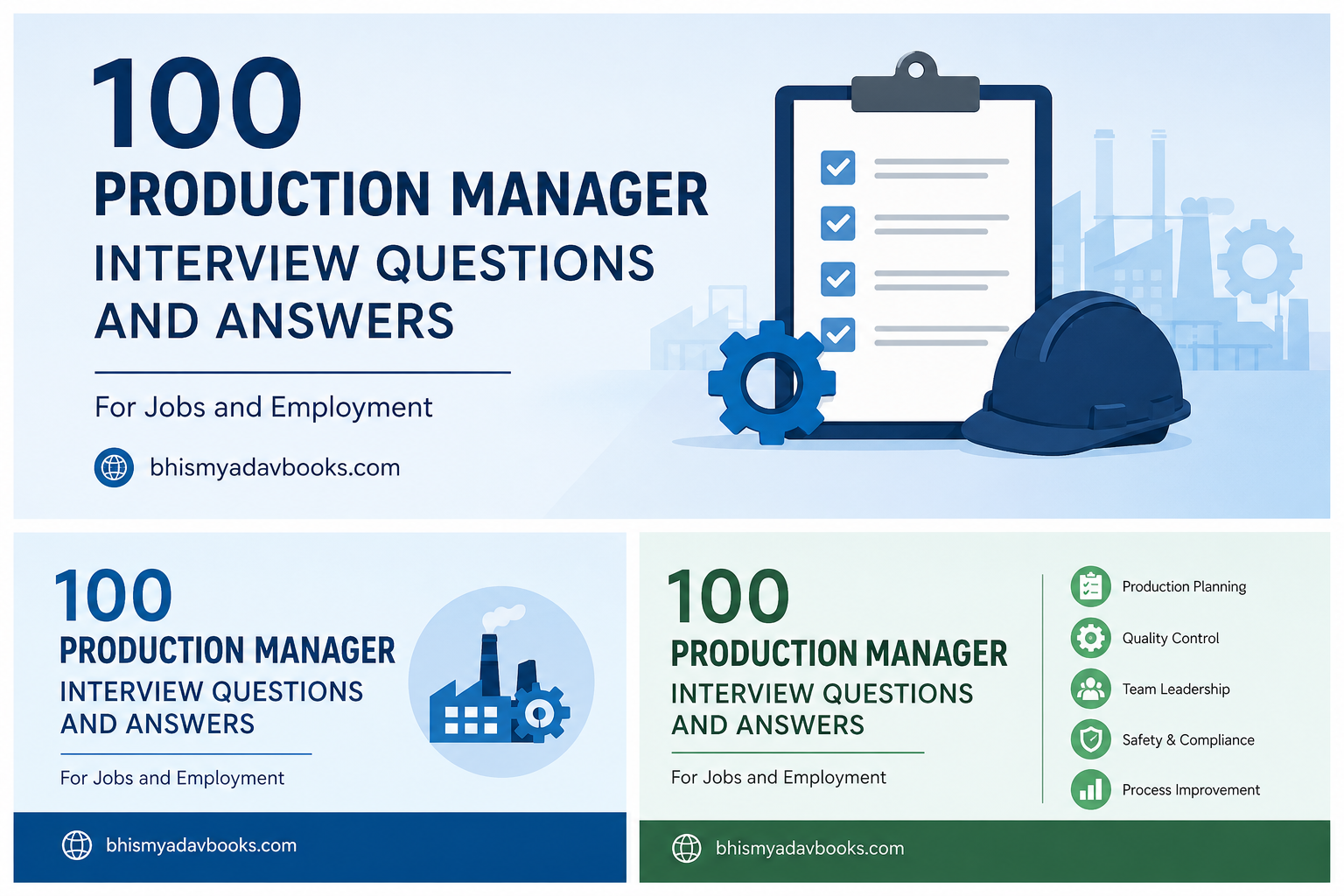
Production Manager Interview Questions and Answers for Jobs and Employment (2026): Complete Guide Freshers and Experienced can’t miss

Production Manager Interview Questions and Answers

100 Production Manager Interview Questions and Answers for Jobs and Employment

Introduction

A Production Manager plays a crucial role in manufacturing and industrial organizations. The professional is responsible for planning production activities, managing employees, controlling costs, maintaining product quality, achieving production targets, and ensuring that manufacturing operations run safely and efficiently.

Production Manager jobs are available in industries such as automobile manufacturing, food processing, pharmaceuticals, electronics, steel, chemicals, textiles, consumer goods, engineering, packaging, and industrial equipment manufacturing.

During a Production Manager interview, employers generally evaluate a candidate’s technical knowledge, production planning ability, leadership skills, problem-solving approach, quality awareness, and understanding of manufacturing processes.

We have some amazing books in our Shop page you may want to buy.

This comprehensive guide from Bhism Yadav Books contains 100 Production Manager interview questions and answers for jobs and employment. These questions can help fresh graduates, production supervisors, manufacturing professionals, engineers, and experienced managers prepare for interviews.


Basic Production Manager Interview Questions and Answers

(Question 1-30)

1. Tell me about yourself.

Answer: I am a production management professional with knowledge of production planning, manufacturing operations, quality control, workforce management, and process improvement. I focus on achieving production targets while maintaining quality, safety, and cost efficiency. I am also comfortable coordinating with maintenance, quality, supply chain, and other departments.

2. Who is a Production Manager?

Answer: A Production Manager is a professional responsible for planning, organizing, supervising, and controlling manufacturing activities. The manager ensures that products are manufactured on time, within budget, according to quality standards, and in compliance with safety requirements.

3. What are the main responsibilities of a Production Manager?

Answer: Major responsibilities include production planning, workforce allocation, resource management, monitoring output, controlling production costs, maintaining quality, coordinating maintenance, ensuring workplace safety, reducing waste, and achieving production targets.

4. Why do you want to work as a Production Manager?

Answer: I enjoy managing manufacturing processes, solving operational problems, and working with teams to improve productivity. Production management allows me to combine technical knowledge, analytical thinking, and leadership skills to achieve measurable business results.

5. What skills are required for a Production Manager?

Answer: Important skills include leadership, production planning, communication, problem-solving, decision-making, quality management, cost control, time management, data analysis, and knowledge of manufacturing processes.

6. What is production management?

Answer: Production management is the process of planning, organizing, directing, and controlling manufacturing activities to convert raw materials and resources into finished products efficiently.

7. What is production planning?

Answer: Production planning determines what products need to be manufactured, how many units are required, when production should begin, and what resources are needed to complete production.

8. What is production control?

Answer: Production control involves monitoring manufacturing activities and comparing actual performance with the production plan. Corrective action is taken when delays, quality problems, or resource shortages occur.

9. What is a production schedule?

Answer: A production schedule is a detailed plan that specifies the products, quantities, machines, employees, and time periods required for manufacturing operations.

10. How do you prioritize production orders?

Answer: I consider customer delivery dates, order urgency, material availability, machine capacity, production complexity, and business priorities. I then create a schedule that maximizes resource utilization while meeting important commitments.


Production Planning Interview Questions

11. How do you prepare a production plan?

Answer: I review customer demand, inventory levels, material availability, machine capacity, workforce availability, and delivery deadlines. Based on these factors, I prepare a realistic production plan and continuously monitor its execution.

12. What is capacity planning?

Answer: Capacity planning determines whether available machines, labor, facilities, and resources are sufficient to meet expected production demand.

13. What is production capacity?

Answer: Production capacity is the maximum quantity of products that a manufacturing system can produce within a specified period under normal operating conditions.

14. What is a Master Production Schedule?

Answer: A Master Production Schedule, or MPS, is a detailed production plan that specifies which finished products will be produced, in what quantities, and during which time periods.

15. What is Material Requirements Planning?

Answer: Material Requirements Planning, or MRP, is a system used to calculate the materials and components required for production based on production schedules, inventory levels, and bills of materials.

16. What is a Bill of Materials?

Answer: A Bill of Materials, or BOM, is a structured list of raw materials, parts, components, and quantities required to manufacture a product.

17. How do you handle sudden changes in production demand?

Answer: I evaluate available inventory, production capacity, material availability, and workforce requirements. I then revise the production schedule, coordinate with relevant departments, and communicate realistic delivery expectations.

18. What is production lead time?

Answer: Production lead time is the total time required to complete a manufacturing process from the beginning of production until the finished product is ready.

19. How do you reduce production lead time?

Answer: Lead time can be reduced through process simplification, better scheduling, layout improvement, automation, waste reduction, supplier coordination, and elimination of production bottlenecks.

20. How do you ensure production targets are achieved?

Answer: I establish clear daily and weekly targets, allocate resources properly, monitor key performance indicators, conduct production meetings, identify problems quickly, and implement corrective actions.


Manufacturing Process Interview Questions

21. What is a manufacturing process?

Answer: A manufacturing process is a series of activities used to transform raw materials or components into finished products using labor, machines, tools, and technology.

22. What are the major types of production systems?

Answer: Major production systems include job production, batch production, mass production, continuous production, and project production.

23. What is batch production?

Answer: Batch production involves manufacturing a specific quantity of similar products together before switching to another product or batch.

24. What is mass production?

Answer: Mass production is the large-scale manufacturing of standardized products using repetitive processes and specialized equipment.

25. What is continuous production?

Answer: Continuous production is a manufacturing system in which production operations run continuously with minimal interruption. It is commonly used in chemical, petroleum, power, and process industries.

26. What is a production bottleneck?

Answer: A production bottleneck is a process, machine, or activity that limits the overall production capacity because its output is lower than the demand placed on it.

27. How do you identify bottlenecks?

Answer: I analyze cycle times, machine utilization, work-in-process inventory, waiting time, production delays, and output data. Processes with continuous queues or capacity limitations are investigated as possible bottlenecks.

28. How do you eliminate a bottleneck?

Answer: I analyze the root cause and may redistribute work, improve the process, increase machine capacity, provide employee training, reduce setup time, or introduce automation.

29. What is cycle time?

Answer: Cycle time is the amount of time required to complete one production cycle or manufacture one unit through a specific process.

30. What is takt time?

Answer: Takt time is the rate at which products must be completed to satisfy customer demand. It helps synchronize production output with market requirements.


Lean Manufacturing Interview Questions and Answers

(Question 31-60)

31. What is lean manufacturing?

Answer: Lean manufacturing is a management approach focused on maximizing customer value while minimizing waste. It aims to improve productivity, quality, flow, and efficiency.

32. What are the major wastes in lean manufacturing?

Answer: Common wastes include transportation, inventory, motion, waiting, overproduction, overprocessing, defects, and underutilized employee talent.

33. What is Kaizen?

Answer: Kaizen is a continuous improvement philosophy that encourages employees at all levels to make small and regular improvements in processes.

34. What is 5S?

Answer: 5S is a workplace organization methodology consisting of Sort, Set in Order, Shine, Standardize, and Sustain. It improves workplace efficiency, cleanliness, and safety.

35. What is Just-in-Time production?

Answer: Just-in-Time, or JIT, is a production strategy in which materials and products are produced or delivered only when required, reducing unnecessary inventory.

36. What is Kanban?

Answer: Kanban is a visual production control system used to manage workflow and material movement based on actual demand.

37. What is value stream mapping?

Answer: Value stream mapping is a visual technique used to analyze the flow of materials and information through a production process and identify waste.

38. What is continuous improvement?

Answer: Continuous improvement is the ongoing effort to improve products, services, and manufacturing processes through regular evaluation and corrective actions.

39. How do you reduce manufacturing waste?

Answer: I analyze process data, identify non-value-added activities, implement lean practices, improve material handling, control defects, optimize inventory, and involve employees in improvement programs.

40. What is Poka-Yoke?

Answer: Poka-Yoke is a mistake-proofing technique designed to prevent errors or detect them before defective products move to the next production stage.


Quality Control Interview Questions

41. What is quality control?

Answer: Quality control is the process of inspecting, testing, and monitoring products to ensure that they meet established specifications and customer requirements.

42. What is quality assurance?

Answer: Quality assurance focuses on designing and maintaining processes that prevent quality problems. Quality control focuses more on detecting product defects.

43. How do you maintain product quality?

Answer: I ensure standardized work procedures, employee training, process monitoring, equipment maintenance, quality inspections, and proper corrective actions.

44. What is a quality standard?

Answer: A quality standard defines specific requirements, characteristics, and acceptance criteria that products or processes must meet.

45. What is root cause analysis?

Answer: Root cause analysis is a systematic method used to identify the fundamental cause of a problem rather than simply treating its symptoms.

46. What is the 5 Why technique?

Answer: The 5 Why technique is a problem-solving method in which the question “Why?” is asked repeatedly to identify the root cause of a problem.

47. What is a fishbone diagram?

Answer: A fishbone diagram, also called an Ishikawa diagram, is a root cause analysis tool used to organize possible causes of a problem into categories.

48. How do you handle repeated quality defects?

Answer: I stop or control the affected process, isolate defective products, analyze the root cause, implement corrective action, verify results, and establish preventive measures.

49. What is Statistical Process Control?

Answer: Statistical Process Control, or SPC, uses statistical methods and control charts to monitor process variation and maintain stable production processes.

50. What is Six Sigma?

Answer: Six Sigma is a data-driven methodology used to reduce defects, minimize process variation, and improve operational performance.


Production Efficiency Interview Questions

51. How do you improve production efficiency?

Answer: I improve efficiency by analyzing workflows, reducing downtime, eliminating waste, optimizing machine utilization, improving employee skills, and using performance data for decision-making.

52. What is Overall Equipment Effectiveness?

Answer: Overall Equipment Effectiveness, or OEE, measures manufacturing productivity using availability, performance, and quality.

53. What factors affect production efficiency?

Answer: Machine downtime, poor scheduling, material shortages, employee skills, quality defects, inefficient layouts, equipment condition, and communication problems can affect efficiency.

54. How do you measure production performance?

Answer: I use indicators such as production output, OEE, cycle time, downtime, rejection rate, yield, productivity, schedule adherence, and production cost.

55. What is productivity?

Answer: Productivity measures the amount of output produced in relation to the resources used, such as labor hours, machine hours, or materials.

56. How do you increase employee productivity?

Answer: I establish clear expectations, provide training, improve workplace conditions, remove process obstacles, recognize good performance, and maintain effective communication.

57. What is production yield?

Answer: Production yield is the percentage of acceptable products produced compared with the total number of units processed.

58. What is first-pass yield?

Answer: First-pass yield measures the percentage of products that meet quality requirements without requiring rework or repair.

59. How do you reduce rework?

Answer: I improve process controls, employee training, work instructions, mistake-proofing systems, equipment maintenance, and root cause analysis.

60. How do you reduce production costs?

Answer: Production costs can be reduced by minimizing waste, improving productivity, controlling inventory, reducing defects, optimizing energy use, and improving equipment efficiency.


Maintenance and Equipment Interview Questions

(Question 61-100)

61. Why is equipment maintenance important?

Answer: Equipment maintenance improves reliability, reduces unexpected breakdowns, protects product quality, increases equipment life, and supports workplace safety.

62. What is preventive maintenance?

Answer: Preventive maintenance is scheduled maintenance performed at predetermined intervals to reduce the risk of equipment failure.

63. What is predictive maintenance?

Answer: Predictive maintenance uses equipment condition data, sensors, and performance trends to predict when maintenance will be required.

64. What is breakdown maintenance?

Answer: Breakdown maintenance is repair work performed after equipment has failed or stopped operating.

65. How do you handle a critical machine breakdown?

Answer: I first ensure workplace safety and inform the maintenance team. I assess the impact on production, consider alternative machines or production routes, revise the schedule, and communicate with relevant departments.

66. What is machine downtime?

Answer: Machine downtime is the period during which production equipment is unavailable or unable to operate.

67. How do you reduce machine downtime?

Answer: I use preventive maintenance, operator inspections, spare parts planning, root cause analysis, equipment monitoring, and maintenance performance reviews.

68. What is Total Productive Maintenance?

Answer: Total Productive Maintenance, or TPM, is a maintenance approach that involves operators and maintenance teams in improving equipment reliability and productivity.

69. What is autonomous maintenance?

Answer: Autonomous maintenance allows trained machine operators to perform basic equipment care activities such as cleaning, inspection, lubrication, and minor adjustments.

70. How do you coordinate with the maintenance department?

Answer: I share equipment performance information, production schedules, downtime reports, and maintenance priorities. Regular coordination helps plan maintenance without causing unnecessary production disruption.


Inventory and Material Management Questions

71. Why is inventory management important in production?

Answer: Inventory management ensures that materials are available when required while preventing excessive stock, storage costs, and material obsolescence.

72. What is raw material inventory?

Answer: Raw material inventory consists of materials and components that have not yet entered the production process.

73. What is work-in-process inventory?

Answer: Work-in-process, or WIP, inventory consists of partially completed products currently moving through manufacturing processes.

74. What is finished goods inventory?

Answer: Finished goods inventory includes completed products that are ready for storage, distribution, or customer delivery.

75. What is safety stock?

Answer: Safety stock is additional inventory maintained to protect production or customer deliveries from unexpected demand or supply disruptions.

76. How do you handle a raw material shortage?

Answer: I determine the production impact, check available stock, coordinate with procurement, identify alternative approved materials or suppliers, and adjust the production schedule.

77. What is FIFO?

Answer: FIFO means First In, First Out. Under this method, older inventory is used or issued before newer inventory.

78. What is inventory turnover?

Answer: Inventory turnover measures how frequently inventory is used or sold during a specific period.

79. How do you prevent excess inventory?

Answer: I use accurate demand planning, MRP, production scheduling, inventory monitoring, supplier coordination, and regular stock reviews.

80. How do you coordinate with the procurement team?

Answer: I provide accurate material requirements, production forecasts, priority information, and consumption data. I also communicate immediately when production schedules or material requirements change.


Safety and Compliance Interview Questions

81. Why is workplace safety important in production?

Answer: Workplace safety protects employees, reduces accidents, prevents production interruptions, protects equipment, and supports legal and organizational compliance.

82. What is a safety risk assessment?

Answer: A safety risk assessment identifies workplace hazards, evaluates their potential impact, and determines appropriate control measures.

83. What is PPE?

Answer: PPE stands for Personal Protective Equipment. Examples include safety helmets, gloves, safety glasses, protective clothing, and safety shoes.

84. How do you promote a safety culture?

Answer: I lead by example, conduct safety meetings, encourage hazard reporting, provide training, enforce safety procedures, and recognize safe work practices.

85. What would you do after a workplace accident?

Answer: I would ensure immediate medical assistance, secure the accident area, report the incident, preserve relevant evidence, participate in the investigation, and implement corrective measures.

86. How do you ensure employees follow safety procedures?

Answer: I provide regular training, clear work instructions, supervision, safety audits, and corrective coaching. Safety expectations must be communicated consistently.

87. What is a Standard Operating Procedure?

Answer: A Standard Operating Procedure, or SOP, is a documented instruction that explains how a specific activity should be performed safely and consistently.

88. How do you ensure compliance with SOPs?

Answer: I provide training, maintain accessible documentation, conduct process audits, observe workplace practices, and correct deviations immediately.

89. What is a safety audit?

Answer: A safety audit is a systematic review of workplace conditions, procedures, documentation, and employee practices to identify safety gaps.

90. How do you handle an employee who repeatedly violates safety rules?

Answer: I discuss the violation with the employee, determine whether training or understanding is an issue, provide corrective guidance, document the situation, and follow organizational disciplinary procedures when necessary.


Leadership and Behavioral Production Manager Interview Questions

91. How do you manage a production team?

Answer: I set clear goals, assign responsibilities based on employee skills, communicate production priorities, monitor performance, provide feedback, and encourage teamwork.

92. How do you handle conflict between employees?

Answer: I listen to all involved employees separately or together as appropriate, identify the actual cause of the conflict, remain neutral, and work toward a practical solution that supports professional teamwork.

93. How do you motivate production employees?

Answer: I recognize good performance, communicate goals clearly, involve employees in improvement activities, provide development opportunities, and create a respectful working environment.

94. How do you handle an underperforming employee?

Answer: I review performance data, discuss expectations with the employee, identify the reason for underperformance, provide coaching or training, establish measurable improvement goals, and monitor progress.

95. Describe your leadership style.

Answer: My leadership style is collaborative and performance-oriented. I provide clear direction and maintain accountability while encouraging employees to share ideas and participate in process improvements.

96. How do you work under production pressure?

Answer: I remain focused on priorities, analyze the situation using available data, allocate resources effectively, communicate clearly, and avoid compromising safety or quality for short-term production output.

97. Tell me about a difficult production problem you solved.

Answer: In one situation, production output was falling because of frequent machine stoppages and increasing cycle time. I reviewed downtime records and production data and worked with the maintenance and operator teams to identify the root cause. We found that repeated minor equipment issues and inconsistent preventive maintenance were affecting production. I coordinated corrective maintenance, revised the preventive maintenance schedule, and introduced daily equipment checks. As a result, machine downtime was reduced, production flow improved, and the team was able to achieve the required production target.

98. Why should we hire you as a Production Manager?

Answer: You should hire me because I understand production planning, team management, process improvement, quality control, and manufacturing performance. I focus on achieving production targets while maintaining safety, quality, and cost efficiency.

99. Where do you see yourself in five years?

Answer: In five years, I see myself taking greater responsibility in manufacturing operations, leading larger teams, and contributing to strategic production and continuous improvement initiatives.

100. Do you have any questions for us?

Answer: Yes. I would like to understand the company’s major production goals, current operational challenges, performance expectations for this position, and opportunities for professional development.


Inventory and Production Management in Supply Chains by Edward A. Silver (Author), David F. Pyke (Author), Douglas J. Thomas (Author)

Important Production Manager Interview Topics to Prepare

Candidates preparing for a Production Manager interview should develop a strong understanding of production planning, capacity management, manufacturing systems, quality control, lean manufacturing, inventory management, equipment maintenance, and workplace safety.

Important concepts include MRP, MPS, BOM, OEE, TPM, Kaizen, 5S, Kanban, JIT, Six Sigma, SPC, cycle time, takt time, production yield, first-pass yield, root cause analysis, and continuous improvement.

Candidates should also prepare examples from their professional experience. Interviewers often ask behavioral questions about machine breakdowns, production delays, employee conflicts, material shortages, safety incidents, and quality problems.

How to Prepare for a Production Manager Interview

Before attending the interview, research the company and understand its manufacturing industry, products, production technology, and business operations. Review the job description carefully and identify the main skills expected by the employer.

Prepare examples of situations where you improved productivity, reduced production costs, solved quality problems, managed employees, or achieved difficult production targets.

Use measurable results whenever possible. For example, instead of simply saying that you improved productivity, explain that you implemented a process improvement that reduced cycle time or increased production output.

You should also review important manufacturing performance indicators. Production Managers are frequently expected to understand output, efficiency, downtime, rejection rate, OEE, yield, labor productivity, and schedule adherence.

Tips for Answering Production Manager Interview Questions

Listen carefully to each interview question and provide a structured answer. Avoid giving unnecessarily long explanations. Focus on your actions, technical understanding, and measurable results.

For behavioral questions, use the STAR method:

Situation: Explain the background of the problem.

Task: Describe your responsibility.

Action: Explain the steps you took.

Result: Describe the final outcome.

Always demonstrate that safety and product quality are important. A Production Manager should never suggest compromising employee safety or customer quality simply to increase output.

Leadership questions should be answered with examples that demonstrate communication, accountability, employee development, and teamwork.

Production Manager Career Opportunities

Production management professionals can find employment in automobile manufacturing, electronics, pharmaceuticals, food processing, chemicals, textiles, steel, cement, consumer goods, aerospace, engineering, packaging, and many other industries.

Common job titles include:

  • Production Manager
  • Manufacturing Manager
  • Production Supervisor
  • Plant Manager
  • Operations Manager
  • Factory Manager
  • Manufacturing Operations Manager
  • Production Planning Manager
  • Process Improvement Manager
  • Industrial Production Manager

With experience, a Production Manager may progress into senior positions such as Plant Head, Head of Manufacturing, Director of Operations, Vice President of Manufacturing, or Chief Operations Officer.

Frequently Asked Questions About Production Manager Interviews

Are Production Manager interviews difficult?

Production Manager interviews can be challenging because they evaluate technical knowledge, management ability, and real-world problem-solving skills. Proper preparation can significantly improve interview performance.

What technical questions are asked in a Production Manager interview?

Interviewers may ask questions about production planning, MRP, OEE, lean manufacturing, quality control, equipment maintenance, inventory, cycle time, takt time, and process improvement.

What leadership questions are asked?

Common leadership questions focus on team management, employee motivation, conflict resolution, performance management, communication, and handling pressure.

Is lean manufacturing important for Production Managers?

Yes. Lean manufacturing concepts help Production Managers reduce waste, improve productivity, shorten lead times, and improve process efficiency.

What KPIs should a Production Manager know?

Important KPIs include production output, OEE, downtime, cycle time, rejection rate, first-pass yield, production yield, schedule adherence, labor productivity, and manufacturing cost.

Conclusion

Preparing for a Production Manager interview requires a combination of manufacturing knowledge, leadership skills, analytical thinking, and practical problem-solving ability. Employers want candidates who can achieve production targets while controlling costs, maintaining product quality, and ensuring employee safety.

These 100 Production Manager interview questions and answers for jobs and employment cover important topics such as production planning, lean manufacturing, quality control, equipment maintenance, inventory management, workplace safety, and team leadership.

Review each question carefully and adapt the sample answers according to your own education, manufacturing experience, and professional achievements. Practical examples and measurable results can make your answers more convincing during the interview.

For more educational resources, job interview questions, fundamental concepts, and career preparation articles, continue exploring Bhism Yadav Books.