Introduction
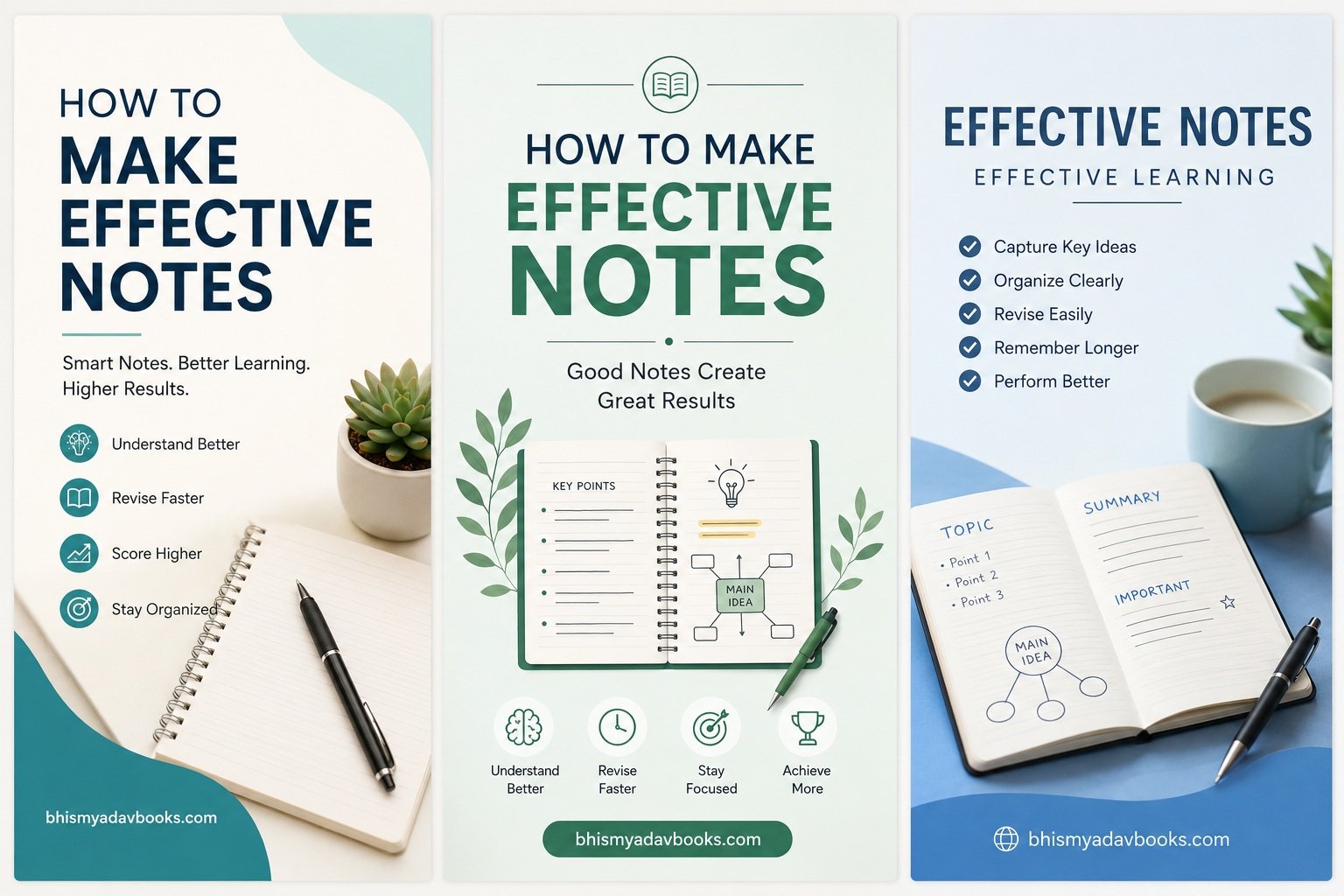
Every successful student shares one common habit—they know how to make effective notes. Whether preparing for school examinations, board exams, competitive examinations like SSC, UPSC, Banking, Railway, NEET, JEE, or university courses, note-making is one of the most powerful learning techniques.
Reading textbooks repeatedly is not enough. The human brain remembers information much better when it actively processes, organizes, and summarizes it. This is exactly what effective note-making does.
We have some amazing books at our Shop page you may want to buy.
Table of Contents
How to Make Effective Notes: The Complete Guide to Smart Note-Taking for Students and Competitive Exam Aspirants
Many students spend hours highlighting textbooks or copying entire chapters into notebooks. Unfortunately, these methods consume time without significantly improving memory. Effective notes are not copies of textbooks. They are carefully organized summaries that help you revise quickly and remember concepts for a long time.
In this detailed guide, you will learn:
- What effective notes are
- Why note-making is important
- Different note-making methods
- Step-by-step process of making notes
- Common mistakes students make
- Best practices for competitive exams
- Digital vs handwritten notes
- Memory improvement techniques using notes
By the end of this article, you will know exactly how to create notes that save time, improve understanding, and boost exam performance.
What Are Effective Notes?
Effective notes are organized, concise, easy-to-understand summaries of important information that capture the key ideas instead of every detail.
Good notes contain:
- Important concepts
- Definitions
- Key formulas
- Examples
- Diagrams
- Short explanations
- Mnemonics
- Keywords
They eliminate unnecessary information while preserving everything required for revision.
Think of effective notes as a personal version of your textbook, designed specifically for your understanding.
Why Is Note-Making Important?
Many educational studies have shown that writing information in your own words improves comprehension and long-term retention.
Effective notes help students:
1. Improve Understanding
When you rewrite information using your own language, your brain processes the concepts more deeply.
Instead of memorizing blindly, you actually understand the topic.
2. Save Revision Time
Imagine revising a 600-page textbook one day before the exam.
Impossible.
Now imagine revising 40 pages of well-organized notes.
That’s the power of effective note-making.
3. Improve Memory
Writing activates multiple parts of the brain.
You:
- Read
- Think
- Analyze
- Write
- Organize
This multi-step process strengthens memory significantly.
4. Increase Concentration
Students often lose focus while reading textbooks.
Making notes keeps the brain actively engaged.
Passive reading becomes active learning.
5. Reduce Exam Stress
Students who have complete notes don’t panic before examinations.
They know exactly what to revise.
This increases confidence.
6. Identify Important Concepts
While making notes, students naturally distinguish:
- Important ideas
- Frequently asked questions
- High-weightage topics
- Key formulas
- Important definitions
This improves exam preparation.
Characteristics of Good Notes
Not every notebook is effective.
Excellent notes usually have these qualities.
Clear
Anyone reading them should immediately understand the topic.
Avoid confusing sentences.
Short
Don’t copy paragraphs.
Summarize them.
Example:
Instead of writing:
“Photosynthesis is the biological process through which green plants prepare their own food using sunlight, carbon dioxide, chlorophyll and water.”
Write:
Photosynthesis
- Food preparation process
- Green plants
- Sunlight + CO₂ + Water
- Chlorophyll
- Produces Glucose + Oxygen
Same meaning.
Much shorter.
Organized
Use:
- Headings
- Subheadings
- Bullet points
- Numbering
- Boxes
- Tables
Organized notes are easier to revise.
Highlight Important Information
Use:
- Bold headings
- Colored pens
- Underlining
- Boxes
- Highlighters
Don’t highlight everything.
Highlight only key concepts.
Easy to Revise
One page should summarize an entire concept whenever possible.
Before You Start Making Notes
Many students immediately begin writing while reading.
This is inefficient.
Instead, follow this preparation process.
Step 1: Read the Entire Topic
Read without writing anything.
Understand the overall idea.
Step 2: Identify Main Concepts
Ask yourself:
- What is this chapter about?
- What are the major ideas?
- Which points are important?
Step 3: Divide into Sections
Break large chapters into smaller parts.
Example:
Chapter:
Human Digestive System
Sections:
- Digestive organs
- Functions
- Digestive enzymes
- Digestion process
- Disorders
Smaller sections are easier to summarize.
Step 4: Keep Required Materials Ready
You need:
- Notebook
- Pens
- Highlighters
- Sticky notes
- Scale
- Colored markers (optional)
Avoid interruptions.
Step-by-Step Process of Making Effective Notes
Step 1: Read Carefully
Never make notes while reading the first sentence.
Understand the entire paragraph first.
Step 2: Find Keywords
Every paragraph contains keywords.
Example:
“The Industrial Revolution began in Britain during the late 18th century because of technological innovations.”
Keywords:
- Industrial Revolution
- Britain
- Late 18th century
- Technological innovations
Only these belong in notes.
Step 3: Rewrite in Your Own Words
Avoid copying.
Original:
“The heart pumps oxygen-rich blood throughout the body.”
Notes:
Heart
- Muscular organ
- Pumps oxygenated blood
- Maintains circulation
Simple and memorable.
Step 4: Use Bullet Points
Bullets improve readability.
Instead of paragraphs:
✔ Easy to scan
✔ Easy to memorize
✔ Faster revision
Step 5: Use Diagrams
Many subjects become easier with visuals.
Examples:
Biology
- Cell
- Heart
- Brain
- Flower
Geography
- Water cycle
- Volcano
- River system
Physics
- Electric circuit
- Lens
- Force diagram
A single diagram often replaces an entire page of text.
Step 6: Add Examples
Examples improve understanding.
Instead of only writing:
“Renewable resources”
Add examples:
- Solar energy
- Wind energy
- Hydropower
- Biomass
Now the concept becomes memorable.
Step 7: Highlight Formulas
For Mathematics and Physics, create separate formula boxes.
Example:
Area of Circle
A = πr²
Perimeter
2πr
Boxes attract attention during revision.
Best Time to Make Notes
Different students prefer different timings.
The most effective options are:
During Class
Write important explanations from teachers.
Do not try to copy everything.
Immediately After Class
This is considered the best time.
Concepts are still fresh.
Memory is strongest.
During Self-Study
While reading books:
Read
↓
Understand
↓
Summarize
↓
Write notes
During Revision
Improve old notes by adding:
- Examples
- Tricks
- New information
- PYQ references
Your notes become more powerful after every revision.
Handwritten Notes vs Digital Notes
Many students wonder which is better.
Handwritten Notes
Advantages:
- Better memory retention
- Improves concentration
- No distractions
- Easy for diagrams
- Ideal for revision
Disadvantages:
- Time-consuming
- Difficult to edit
- Requires physical storage
Digital Notes
Advantages:
- Easy editing
- Fast searching
- Cloud backup
- Add images
- Share easily
Disadvantages:
- Mobile distractions
- Eye strain
- Lower retention for many learners
- Requires electronic devices
Which One Should You Choose?
For most students preparing for board and competitive exams, handwritten notes remain the best choice because the process of writing strengthens learning and recall.
Digital notes can be useful for organizing reference material, but your primary revision notes are often most effective when written by hand in your own words.
The Best Note-Making Methods Every Student Should Know
There is no single note-making method that works for everyone. Different subjects, learning styles, and examination patterns require different approaches.
The best students often combine multiple note-making techniques depending on the topic they are studying.
Below are the most effective methods used by toppers, university students, and competitive exam aspirants worldwide.
1. The Outline Method
The Outline Method is one of the simplest and most widely used note-making techniques. It organizes information using headings and subheadings.
Structure
Main Topic
- Subtopic
- Important Point
- Important Point
- Another Subtopic
- Details
- Examples
Example
Indian Constitution
- Features
- Lengthiest Constitution
- Written Constitution
- Federal System
- Parliamentary Government
- Fundamental Rights
- Right to Equality
- Right to Freedom
- Right against Exploitation
- Right to Freedom of Religion
Advantages
- Easy to organize
- Simple to revise
- Perfect for theory subjects
- Suitable for textbooks
Best For
- History
- Political Science
- Geography
- Economics
- Sociology
- English Literature
2. Cornell Note-Making Method
The Cornell Method is one of the most effective note-taking systems because it combines learning, revision, and self-testing.
Divide each page into three sections.
Cue Column (Left)
Write:
- Keywords
- Questions
- Definitions
Notes Section (Right)
Write detailed explanations.
Summary Section (Bottom)
Write a 3–5 line summary of the entire topic.
Example
Cue
What is Photosynthesis?
Notes
Plants prepare food using sunlight, water, carbon dioxide, and chlorophyll.
Summary
Photosynthesis helps plants produce food and release oxygen, making it essential for life on Earth.
Benefits
- Improves understanding
- Makes revision faster
- Excellent for active recall
- Encourages self-testing
Best For
- College students
- UPSC preparation
- SSC exams
- Banking exams
- School revision
3. Mind Mapping Method
Mind Maps are visual diagrams that connect ideas using branches.
Start with the main topic in the center of the page.
Example:
Climate Change
|
————————————–
| | | |
Causes Effects Solutions Examples
| | | |
Pollution Floods Solar Energy Paris Agreement
Mind maps help the brain recognize relationships between concepts.
Advantages
- Easy to remember
- Highly visual
- Improves creativity
- Makes large chapters manageable
Best For
- Science
- Biology
- Geography
- Business Studies
- Essay preparation
4. Flow Note Method
Flow Notes focus on understanding instead of copying.
Instead of writing every sentence, students write:
- Questions
- Answers
- Connections
- Diagrams
- Examples
This method encourages thinking while studying.
Example:
Electric Current
↓
Movement of electrons
↓
Measured in Ampere
↓
Formula
I = V/R
↓
Used in electrical circuits
Instead of copying the textbook, students build logical connections.
Advantages
- Deep understanding
- Better memory
- Encourages critical thinking
Best For
- Physics
- Chemistry
- Engineering
- Competitive exams
5. Charting Method
This method organizes information into tables.
Example
| Planet | Size | Distance from Sun | Atmosphere |
| Mercury | Small | Closest | Thin |
| Venus | Similar to Earth | Second | Dense |
| Earth | Medium | Third | Oxygen-rich |
| Mars | Smaller | Fourth | Thin |
Charts make comparisons much easier.
Best For
- Geography
- Biology
- Economics
- Current Affairs
- Static GK
6. Boxing Method
Each concept is placed inside a separate box.
Example
Definition Box
Cell
Basic structural and functional unit of life.
Functions Box
- Growth
- Repair
- Reproduction
Examples Box
- Animal Cell
- Plant Cell
This improves organization and quick revision.
7. Sentence Method
In this method, every important point is written as a separate sentence.
Example
- Water boils at 100°C.
- Ice melts at 0°C.
- Water expands on freezing.
Although simple, this method is less effective for large chapters.
Best For
- Short lectures
- Quick revision
- Class notes
Choosing the Right Note-Making Method
| Situation | Best Method |
| Theory subjects | Outline |
| Revision | Cornell |
| Visual learners | Mind Maps |
| Science | Flow Notes |
| Comparisons | Charts |
| Quick review | Boxing |
| Classroom lectures | Sentence Method |
Subject-Wise Note-Making Strategies
Every subject requires a slightly different approach.
Mathematics
Math notes should focus on solving problems rather than writing lengthy explanations.
Include:
- Formula
- Shortcut
- Important theorem
- Example
- Common mistakes
- Practice question
Example
Quadratic Formula
x = (-b ± √(b² − 4ac)) / 2a
Then solve one worked example below it.
Physics
Physics notes should include
- Formula
- Units
- Diagrams
- Derivations
- Applications
Example
Force
Formula
F = ma
Unit
Newton (N)
SI Unit
kg·m/s²
Applications
- Vehicles
- Machines
- Sports
Chemistry
Separate notes into
Physical Chemistry
- Formulae
- Numerical methods
Organic Chemistry
- Reactions
- Mechanisms
- Named reactions
Inorganic Chemistry
- Properties
- Trends
- Exceptions
Use reaction flowcharts whenever possible.
Biology
Biology contains a lot of information.
Use
- Flowcharts
- Diagrams
- Tables
- Mnemonics
- Color coding
Instead of writing long paragraphs, summarize processes step by step.
Example
Respiration
Glucose
↓
Glycolysis
↓
Pyruvate
↓
Krebs Cycle
↓
Electron Transport Chain
↓
ATP
History
History notes should include
- Dates
- Events
- Causes
- Consequences
- Personalities
Example
French Revolution
Causes
- Economic crisis
- Heavy taxation
- Social inequality
Effects
- Democracy
- Human Rights
- Rise of Napoleon
Geography
Use
- Maps
- Tables
- Diagrams
- Flowcharts
Instead of writing long descriptions, draw labeled maps.
Economics
Include
- Definitions
- Graphs
- Examples
- Current examples
- Formulas
Example
GDP
Definition
Gross Domestic Product
Formula
Consumption + Investment + Government Spending + Net Exports
English
Maintain separate notebooks for
Vocabulary
Grammar
Idioms
Phrases
Essay Points
Examples
Daily vocabulary page
Word
Meaning
Synonym
Antonym
Sentence
Computer Science
Use
- Flowcharts
- Algorithms
- Syntax examples
- Code snippets
Instead of copying full programs, write
Concept
↓
Syntax
↓
Example
↓
Output
Note-Making for Competitive Exams
Competitive examinations require highly focused notes.
Do not make textbook-style notes.
Instead, prepare revision-oriented notes.
Include only
- Facts
- Formulas
- Tricks
- Important concepts
- Frequently Asked Questions
- Previous Year Questions
- Shortcuts
SSC Preparation Notes
Maintain separate notebooks for
General Awareness
Current Affairs
Reasoning Tricks
Mathematics Formulae
English Vocabulary
Each notebook becomes easier to revise.
Banking Exams
Maintain separate sections for
Quantitative Aptitude
Reasoning
English
Computer Awareness
Banking Awareness
Current Affairs
Financial Terms
Daily revision becomes much easier.
UPSC Preparation
UPSC notes should be dynamic.
Update them regularly.
Include
- Newspaper facts
- Government schemes
- Supreme Court judgments
- Reports
- International organizations
- Current Affairs
Link static topics with current events.
NEET Preparation
Biology
Short concept notes
Chemistry
Reaction summaries
Physics
Formula sheets
Maintain separate revision notebooks for each subject.
JEE Preparation
Keep
Formula notebook
Mistake notebook
Shortcut notebook
Previous Year Questions notebook
These four notebooks alone can significantly improve revision efficiency.
The Power of Color Coding
Colors help the brain categorize information quickly.
A simple color system works well:
- Blue – Headings
- Black – Main content
- Red – Important definitions and warnings
- Green – Examples and applications
- Purple – Formulas or key facts (optional)
Keep the system consistent throughout your notes. Too many colors can reduce clarity.
Use Symbols to Save Time
Instead of writing long phrases repeatedly, use symbols.
Examples
→ Leads to
↑ Increase
↓ Decrease
≈ Approximately
≠ Not equal
✓ Correct
✗ Incorrect
★
Very Important
?
Needs Revision
These symbols make notes faster to write and quicker to scan during revision.
Advanced Note-Making Strategies Used by Toppers
Making notes is only the first step. The real difference between average students and toppers lies in how they use their notes.
Top-performing students don’t just collect notebooks—they create a revision system that helps them remember information for months or even years. This section covers proven techniques that make your notes far more effective.
Build Notes for Revision, Not Decoration
Many students spend hours making colorful, artistic notes but rarely revise them.
Remember this simple rule:
Your notes should help you learn faster, not just look beautiful.
Good notes are:
- Simple
- Organized
- Easy to scan
- Focused on key concepts
- Quick to revise
Avoid spending excessive time on decorative borders, elaborate lettering, or unnecessary designs.
The 80/20 Rule in Note-Making
The Pareto Principle (80/20 Rule) applies well to studying.
Generally:
- About 20% of the concepts account for 80% of exam questions.
While preparing notes:
Identify:
- Frequently asked topics
- High-weightage chapters
- Important formulas
- Repeated definitions
- Common numerical problems
Highlight these sections for priority revision.
Create a One-Page Summary for Every Chapter
Once you finish detailed notes for a chapter, prepare a single-page revision sheet.
Include only:
- Main definitions
- Key formulas
- Important dates
- Diagrams
- Mnemonics
- Frequently asked concepts
Example:
Chapter: Electricity
- Ohm’s Law
- Resistance Formula
- Power Formula
- SI Units
- Circuit Symbols
- Common Questions
One-page summaries are extremely useful during the final days before examinations.
Maintain Separate Formula Sheets
For subjects involving calculations, keep dedicated formula notebooks.
Subjects include:
- Mathematics
- Physics
- Chemistry
- Statistics
- Economics
Instead of searching through chapters, you’ll have every important formula in one place.
Example:
Trigonometry
sin²θ + cos²θ = 1
tanθ = sinθ / cosθ
sec²θ = 1 + tan²θ
Review these sheets daily for better retention.
Keep a Mistake Notebook
One of the most valuable study habits is maintaining a Mistake Notebook.
Whenever you answer a question incorrectly:
Write:
- Question
- Correct answer
- Reason for the mistake
- Lesson learned
Example
Question:
Capital of Australia?
Wrong Answer:
Sydney
Correct Answer:
Canberra
Reason:
Confused the largest city with the capital.
Revising your mistakes regularly helps prevent repeating them.
Use the Feynman Technique
Named after physicist Richard Feynman, this technique improves understanding.
Step 1
Study the topic.
Step 2
Close your book.
Step 3
Explain the concept as if teaching a 10-year-old child.
Step 4
Identify areas where you struggle.
Step 5
Review and simplify your explanation.
If you cannot explain a concept simply, you probably haven’t understood it completely.
Use Active Recall
Many students repeatedly read notes.
Reading alone creates familiarity but not strong memory.
Instead, use Active Recall.
Method
Read one heading.
Close your notebook.
Try to recall:
- Definitions
- Steps
- Formulas
- Examples
Open your notebook and check your accuracy.
Repeat until you can recall confidently.
This strengthens long-term memory.
Practice Spaced Repetition
Our brain naturally forgets information over time. Reviewing notes at increasing intervals helps reinforce memory.
A simple revision schedule:
- Day 1: Study and make notes.
- Day 2: First revision.
- Day 7: Second revision.
- Day 15: Third revision.
- Day 30: Fourth revision.
- Monthly: Quick review thereafter.
This method reduces forgetting and improves long-term retention.
The Forgetting Curve
Psychologist Hermann Ebbinghaus showed that people forget much of what they learn if they never review it.
Without revision:
- Much of the information is forgotten within a few days.
With spaced revision:
- Retention improves dramatically.
This is why revision is just as important as note-making.
Convert Notes into Questions
Instead of writing only statements, convert important points into questions.
Example
Instead of:
“The Battle of Plassey occurred in 1757.”
Write:
Q. When did the Battle of Plassey take place?
Answer:
1757
Question-based notes improve self-testing.
Create Flashcards
Flashcards are excellent for memorizing facts.
Front Side
Question
Back Side
Answer
Examples
- Vocabulary
- Dates
- Capitals
- Formulas
- Chemical symbols
- Biological terms
Digital flashcard apps can also be helpful if used consistently.
Add Real-Life Examples
Connecting concepts with everyday life improves understanding.
Example
Gravity
Instead of memorizing the definition alone, think about:
- Falling objects
- Rain
- A dropped pen
- Sports
Real-life connections make concepts easier to remember.
Use Flowcharts for Processes
Processes are easier to understand visually.
Example:
Photosynthesis
Sunlight
↓
Chlorophyll
↓
Carbon Dioxide + Water
↓
Glucose
↓
Oxygen Released
Flowcharts are especially useful in Biology, Geography, Chemistry, and History.
Use Tables for Comparisons
Comparing concepts side by side makes revision faster.
Example
| Feature | Mitosis | Meiosis |
| Number of Divisions | One | Two |
| Daughter Cells | Two | Four |
| Chromosome Number | Same | Half |
| Occurs In | Body Cells | Reproductive Cells |
Tables are excellent for comparing:
- Historical events
- Government schemes
- Scientific concepts
- Economic terms
- Computer technologies
Add Memory Tricks (Mnemonics)
Mnemonics make difficult information easier to remember.
Example
Planets
My Very Educated Mother Just Served Us Noodles
Mercury
Venus
Earth
Mars
Jupiter
Saturn
Uranus
Neptune
Create your own memorable mnemonics whenever possible.
Organize Notes by Priority
Mark topics according to importance.
High Priority (★★★★★)
- Frequently asked questions
- Core concepts
- High-weightage chapters
Medium Priority (★★★★☆)
- Supporting concepts
- Moderate-weightage topics
Low Priority (★★★☆☆)
- Rarely asked details
- Additional reading
This helps you allocate study time wisely.
Digital Note-Taking Tools
If you prefer digital notes, several tools can help organize your study material.
Popular options include:
- Microsoft OneNote
- Google Keep
- Notion
- Evernote
- Obsidian
- Apple Notes (for Apple users)
Use folders or notebooks for each subject and synchronize across devices if needed.
Organize Your Notebooks Properly
Whether physical or digital, maintain a clear structure.
Suggested format:
Notebook 1
Subject Overview
Notebook 2
Chapter Notes
Notebook 3
Formulas
Notebook 4
Practice Questions
Notebook 5
Mistakes
Notebook 6
Previous Year Questions
This organization saves time during revision.
Common Note-Making Mistakes
Avoid these frequent errors:
1. Copying the Textbook Word for Word
Notes should summarize information, not duplicate it.
2. Writing Long Paragraphs
Use:
- Bullet points
- Headings
- Keywords
- Tables
- Diagrams
3. Ignoring Revision
Even excellent notes are ineffective if they are never reviewed.
4. Highlighting Everything
If every sentence is highlighted, nothing stands out.
Highlight only the most important information.
5. Poor Organization
Mixing multiple subjects in one notebook creates confusion.
Maintain separate notebooks or clearly divided sections.
6. Not Updating Notes
As you solve practice papers and previous-year questions, add new insights, shortcuts, and corrections to your notes.
7. Using Too Many Colors
A consistent color system is more effective than using many random colors.
8. Making Notes Without Understanding
Always understand the concept before writing.
Memorization without comprehension leads to weak retention.
Daily Note-Making Routine
A simple routine can make note-making a regular habit:
Morning (15–20 minutes)
- Review yesterday’s notes.
During Study Sessions
- Read actively.
- Write concise notes.
- Highlight key ideas.
Evening (20–30 minutes)
- Revise the day’s notes.
- Add examples or diagrams if needed.
- Mark difficult topics for later review.
Following this routine consistently builds a strong foundation for long-term learning.
Recommended books for Job Aspirants
Note-Making Strategies for Different Types of Students
Every student has unique learning needs. The best note-making strategy depends on your academic goals and the type of examinations you are preparing for.
For School Students (Classes 6–10)
School students should focus on building strong fundamentals rather than writing lengthy notes.
Best Practices
- Use simple language.
- Write one notebook for each subject.
- Include diagrams wherever possible.
- Highlight definitions and important terms.
- Prepare chapter summaries after completing each lesson.
- Revise notes every weekend.
Ideal Structure
- Chapter Name
- Definitions
- Important Points
- Examples
- Diagrams
- Practice Questions
For Board Examination Students (Classes 10 & 12)
Board examinations require both conceptual understanding and proper answer presentation.
Include
- NCERT concepts
- Important definitions
- Diagrams
- Flowcharts
- Formula sheets
- Previous year questions
- Frequently asked long-answer points
Maintain a separate notebook for:
- Important definitions
- Diagrams
- Formulae
- Sample answers
For College Students
College subjects are often extensive and concept-based.
Recommended Strategy
- Prepare lecture notes during class.
- Rewrite them neatly after class.
- Add textbook references.
- Include practical examples.
- Maintain separate notebooks for assignments and examinations.
For Competitive Exam Aspirants
Competitive exams demand quick revision and accurate recall.
Your notes should focus on:
- Facts
- Formulas
- Tricks
- Shortcuts
- Previous Year Questions
- Frequently Asked Topics
Examples of exams:
- SSC CGL
- SSC CHSL
- SSC CPO
- SSC MTS
- Railway Recruitment Board (RRB)
- Banking (IBPS, SBI)
- UPSC Civil Services
- State PSC
- CDS
- CAPF
- NDA
- CUET
- CAT
How Long Should Your Notes Be?
A common question among students is:
Should I write detailed notes or short notes?
The answer depends on the purpose.
First-Time Learning
Write moderately detailed notes to build understanding.
Revision Notes
Keep them short.
Final Revision Notes
Limit them to one or two pages per chapter whenever possible.
As your understanding improves, your notes should become shorter because you no longer need detailed explanations.
The 30-Day Note-Making Improvement Plan
Building the habit of making effective notes takes practice. Follow this simple plan.
Week 1 – Learn the Basics
Goals:
- Read actively.
- Identify keywords.
- Write concise summaries.
- Use headings and bullet points.
Practice:
- Prepare notes for one chapter every day.
Week 2 – Improve Organization
Goals:
- Add diagrams.
- Create tables.
- Use flowcharts.
- Introduce a consistent color-coding system.
Practice:
- Revise and improve the notes created in Week 1.
Week 3 – Focus on Revision
Goals:
- Use Active Recall.
- Practice Spaced Repetition.
- Create one-page chapter summaries.
- Build formula sheets and vocabulary lists.
Practice:
- Test yourself without looking at your notes.
Week 4 – Build a Complete Study System
Goals:
- Maintain subject-wise notebooks.
- Create a mistake notebook.
- Organize previous year questions.
- Develop a weekly revision schedule.
Practice:
- Revise all notes prepared during the month.
By the end of 30 days, note-making will become a natural part of your study routine.
Key Takeaways
- Understand the topic before writing notes.
- Use your own words instead of copying textbooks.
- Keep notes concise, organized, and easy to revise.
- Use headings, bullet points, diagrams, and flowcharts.
- Maintain separate notebooks for different subjects.
- Create one-page chapter summaries for quick revision.
- Use Active Recall and Spaced Repetition to improve memory.
- Regularly update your notes with new insights and corrections.
- Review your notes consistently instead of only before exams.
- Focus on clarity, understanding, and revision rather than decoration.
Other Related Posts from Bhism Yadav Books
- Best Daily Study Routine for Students
- How to Remember Answers for a Long Time
- Best Foods for Brain Power
- List of Mathematics Formulas for Classes 6–12
Daily Note-Making Checklist
Before ending each study session, ask yourself:
✅ Did I understand the topic before writing?
✅ Did I use my own words?
✅ Did I avoid copying the textbook?
✅ Did I highlight only important information?
✅ Did I include examples or diagrams?
✅ Did I organize the notes properly?
✅ Did I revise today’s notes?
If the answer to most of these questions is Yes, you are creating effective notes.
Expert Tips for Making Effective Notes
Successful students often follow these habits:
1. Read Before Writing
Understand the topic first.
Never start writing after reading only one sentence.
2. Keep Notes Short
Write keywords instead of paragraphs.
3. Revise Within 24 Hours
Early revision strengthens memory.
4. Use Active Recall
Try to remember information before looking at your notes.
5. Solve Practice Questions
Notes become more valuable when combined with regular practice.
6. Update Notes Regularly
Whenever you learn a better explanation, shortcut, or example, add it to your existing notes instead of creating new ones.
7. Maintain Clean Handwriting
Readable notes reduce revision time.
8. Use Diagrams Frequently
Visual information is often remembered more easily than text alone.
9. Avoid Perfectionism
Do not spend hours decorating notes.
Focus on learning rather than appearance.
10. Revise Consistently
Even the best notes are ineffective if they are never reviewed.
Frequently Asked Questions (FAQs)
1. What are effective notes?
Effective notes are short, organized summaries written in your own words that capture the most important ideas, formulas, examples, and concepts from a topic. They are designed for quick revision and better understanding.
2. Is handwritten note-making better than digital note-taking?
For most students, handwritten notes improve concentration and memory because writing actively engages the brain. Digital notes are useful for organizing information and quick searching, but handwritten revision notes often lead to better retention.
3. How often should I revise my notes?
A good schedule is:
- Within 24 hours of making the notes
- After one week
- After two weeks
- After one month
- Monthly thereafter
Regular revision helps move information into long-term memory.
4. Should I copy my textbook while making notes?
No. Copying entire paragraphs wastes time and reduces active learning. Read the topic carefully, understand it, and rewrite the key ideas in your own words.
5. Which note-making method is best?
There is no single best method.
- Outline Method for theory subjects
- Cornell Method for revision and self-testing
- Mind Maps for visual learners
- Flow Notes for understanding concepts
- Charts and Tables for comparisons
Choose the method that suits your subject and learning style.
6. Can note-making improve memory?
Yes. Writing, organizing, and revising notes strengthen memory through active learning, spaced repetition, and active recall.
7. Should I make separate notebooks for every subject?
Yes. Separate notebooks make organization easier and reduce confusion during revision.
8. Are colorful notes more effective?
Color coding is helpful when used consistently, but too many colors can become distracting. Use colors mainly to highlight headings, formulas, definitions, and important concepts.
9. How long should my revision notes be?
Aim for concise notes. Ideally, one chapter should be summarized into one or two pages for final revision, while still including all essential concepts.
10. Can note-making help in competitive exams?
Absolutely. Well-prepared notes reduce revision time, improve recall, and help you revise large syllabi efficiently before exams such as SSC, Banking, Railway, UPSC, NEET, JEE, and other competitive tests.
Final Revision Checklist
Before every examination, ensure your notes include:
- Important definitions
- Key concepts
- Formula sheets
- Diagrams
- Flowcharts
- Tables
- Important dates
- Examples
- Previous Year Questions
- Frequently Asked Questions
- Common mistakes
- Shortcuts and mnemonics
- One-page chapter summaries
A well-organized set of notes becomes one of your strongest study resources.
Conclusion
Learning how to make effective notes is one of the most valuable study skills a student can develop. Good notes are not about copying information—they are about understanding concepts, organizing knowledge, and creating a personalized resource that makes revision faster and more efficient.
By using proven techniques such as the Outline Method, Cornell Method, Mind Mapping, Flow Notes, Active Recall, and Spaced Repetition, you can improve comprehension, strengthen long-term memory, and reduce the stress of last-minute preparation. Combine concise summaries with diagrams, tables, flowcharts, and regular revisions to make your notes practical and exam-ready.
Whether you are a school student, college learner, or preparing for competitive examinations, consistent note-making can significantly improve your confidence and academic performance. Remember that the most effective notes are the ones you create in your own words and revise regularly.
Start applying the strategies from this guide today. Over time, you’ll build a powerful knowledge base that saves study time, improves recall, and helps you achieve better results in every examination.