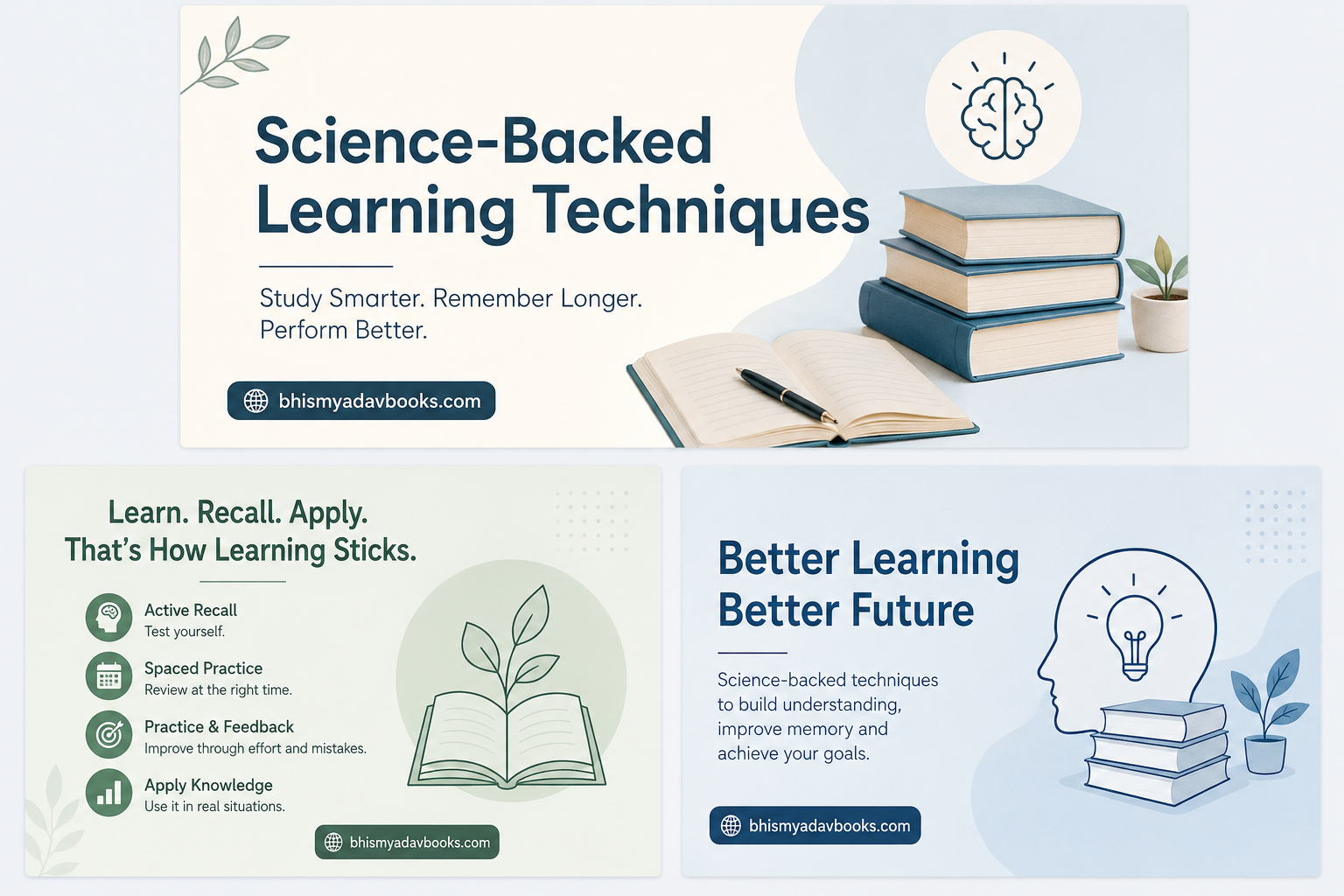
Introduction to Science Backed Learning
Learning is one of the most important skills for students, professionals, competitive-exam aspirants, and lifelong learners. Yet many people spend hours reading books, highlighting paragraphs, watching educational videos, or reviewing notes without achieving the level of understanding and retention they expect.
The problem is often not a lack of effort. It is the method of learning.
Modern research in cognitive psychology and education has identified several learning techniques that can make study time more productive. These methods are designed around how human memory works rather than simply how studying feels.
Some techniques make learning more effective by requiring the brain to actively retrieve information. Others strengthen memory by spreading study sessions over time, mixing related topics, or connecting new knowledge with information already stored in memory.
We have some amazing books at our Shop page you may want to buy.
Table of Contents
In this article, we will explore science-backed learning techniques that can help you learn more efficiently, remember information longer, understand difficult concepts, and prepare more effectively for examinations.
The goal is not to study for longer hours.
The goal is to make every hour of learning more productive.
Science Backed Learning Techniques: Evidence Based Strategies to Study Smarter and Remember More
What Does “Science-Backed Learning” Mean?
The term “science-backed learning” refers to learning strategies supported by findings from research in areas such as:
- Cognitive psychology
- Educational psychology
- Neuroscience
- Memory research
- Learning sciences
- Behavioral science
A technique can feel effective without actually producing strong long-term learning.
For example, rereading a chapter several times may make the material feel familiar. However, familiarity is not necessarily the same as being able to remember or apply the information later.
Effective learning techniques often require greater mental effort.
This may seem surprising.
If a method feels difficult, students may assume they are learning poorly. In reality, certain forms of desirable difficulty can strengthen long-term learning.
This is why learning science emphasizes activities such as retrieval practice, spaced practice, elaboration, self-explanation, and practice testing.
Why Traditional Studying Often Fails
Before discussing effective techniques, it is useful to understand why common study habits can be misleading.
1. Rereading Creates a Feeling of Familiarity
Suppose you read a chapter about the human digestive system three times.
After the third reading, the words may look familiar. You may recognize definitions and diagrams immediately.
But if someone closes the book and asks:
“Explain the process of digestion from beginning to end.”
you may struggle to reproduce the information.
This happens because recognizing information is easier than retrieving it independently.
Rereading can have value, especially when first learning unfamiliar material, but it should not be the only study strategy.
2. Highlighting Can Become Passive
Highlighting important information can help identify key ideas, but excessive highlighting may turn studying into a passive activity.
If almost every sentence is highlighted, the technique provides little assistance.
A better approach is to first understand the material and then identify only the most important concepts.
3. Long Study Sessions Can Reduce Efficiency
Studying continuously for several hours may appear productive.
However, attention naturally fluctuates. As mental fatigue increases, comprehension and concentration can decline.
Shorter, focused sessions combined with appropriate breaks can often be more sustainable.
4. Studying Only Once Is Not Enough
Learning something today does not guarantee that you will remember it next week or next month.
Memory benefits from repeated encounters with information over time.
This is the principle behind spaced repetition.
How Human Memory Supports Learning
To understand science-backed learning techniques, it helps to understand the basic idea of memory.
Memory is not simply a storage box in the brain.
Learning involves processes such as:
- Paying attention to information
- Encoding information
- Connecting information with existing knowledge
- Retrieving information
- Strengthening and modifying memory through repeated use
A useful distinction is between short-term or working memory and long-term memory.
Working memory has limited capacity. When too much unfamiliar information is presented simultaneously, it can become difficult to process.
Long-term memory, on the other hand, can contain an enormous amount of knowledge.
Learning becomes easier when new information can connect with knowledge already stored in long-term memory.
This is one reason why building strong foundational knowledge is so important.
Technique 1: Active Recall
One of the most useful science-backed learning techniques is active recall.
Active recall means deliberately trying to retrieve information from memory instead of simply looking at the answer again.
For example, after reading about photosynthesis, close the book and ask yourself:
- What is photosynthesis?
- Where does it occur?
- What raw materials are required?
- What is the role of sunlight?
- What are the major products?
Try answering without looking at your notes.
Then check your answers.
This process forces the brain to retrieve information.
Why Active Recall Works
Retrieval is not merely a way to measure learning.
It can also contribute to learning.
When you attempt to remember information, you are exercising the pathways associated with that knowledge.
This is why practice testing can be more useful for long-term retention than simply reading the same material repeatedly.
How to Use Active Recall
After completing a section of a textbook:
- Close the book.
- Write down everything you remember.
- Explain the topic aloud.
- Answer questions without checking the answers.
- Compare your response with the source.
- Identify missing or incorrect information.
- Review those weak areas.
- Test yourself again later.
You do not need sophisticated software to practice active recall.
A notebook can be enough.
Example of Active Recall
Instead of reading:
“The Earth rotates on its axis approximately once every 24 hours.”
ask yourself:
Question: How long does Earth take to complete approximately one rotation?
Answer: Approximately 24 hours.
For a deeper level of learning, ask:
Question: What causes day and night?
Then explain the concept in your own words.
The more meaningful the retrieval, the more useful the practice can become.
Technique 2: Spaced Repetition
Another highly effective learning strategy is spaced repetition.
Instead of studying the same information intensively in one session, review it at increasing intervals.
For example:
- Day 1: Learn the topic
- Day 2: Review
- Day 4: Review
- Day 7: Review
- Day 14: Review
- Day 30: Review
The exact schedule does not have to follow these numbers.
The important idea is to spread learning across time.
Why Spacing Helps Memory
When some forgetting has occurred between learning sessions, retrieving the information can require more effort.
That effort can make the learning experience more effective than simply repeating information immediately.
Spacing also gives you multiple opportunities to reconstruct and strengthen knowledge.
Spaced Repetition for Vocabulary
Suppose you are learning English vocabulary.
Instead of learning 50 words once and forgetting many of them, divide them into smaller groups and review them repeatedly over several days.
For each word, try to recall:
- Meaning
- Pronunciation
- Spelling
- Example sentence
- Related words
You can use flashcards to make this process easier.
Spaced Repetition for Exams
Students preparing for examinations can use spaced repetition for:
- Formulas
- Definitions
- Dates
- Scientific terms
- Historical events
- Vocabulary
- Rules
- Important facts
- Short-answer questions
However, spaced repetition should not be confused with memorizing everything through flashcards.
For subjects requiring reasoning, you should combine it with problem-solving and conceptual practice.
Technique 3: Retrieval Practice
Retrieval practice is closely related to active recall.
It means practicing the act of bringing information out of memory.
Examples include:
- Taking practice tests
- Answering textbook questions
- Solving previous examination questions
- Writing answers without notes
- Explaining concepts from memory
- Creating your own questions
- Using flashcards
Retrieval Practice vs. Rereading
Consider two students.
Student A reads a chapter three times.
Student B reads it once and then attempts 20 questions without looking at the answers.
Student A may feel more comfortable with the material.
Student B may experience more difficulty.
But that difficulty can be productive because Student B is practicing retrieval.
The ideal approach is not necessarily to eliminate reading.
Instead, combine reading with retrieval.
A Simple Pattern
Read → Close → Recall → Check → Correct → Retrieve Again
This cycle is far more active than simply reading the same pages repeatedly.
Technique 4: Practice Testing
Practice tests are particularly valuable for students preparing for examinations.
A practice test is not merely a final assessment.
It can be part of the learning process.
Why Practice Tests Help
Practice testing allows you to:
- Identify knowledge gaps
- Practice retrieval
- Improve familiarity with question formats
- Develop time-management skills
- Reduce surprises during examinations
- Discover topics requiring additional study
Practice tests are especially useful when followed by feedback.
After completing a test, do not simply check your score.
Analyze your mistakes.
Ask:
- Did I misunderstand the concept?
- Did I forget a fact?
- Did I misread the question?
- Did I use the wrong formula?
- Was the error caused by careless calculation?
- Did I run out of time?
This turns a test into a learning opportunity.
Technique 5: Elaborative Learning
Elaboration means adding meaning and connections to new information.
Instead of memorizing a fact in isolation, ask questions such as:
- Why is this true?
- How does it work?
- What causes it?
- What is an example?
- What is a counterexample?
- How is it related to something I already know?
- What would happen if one condition changed?
Suppose you are learning that metals generally conduct electricity.
Instead of simply memorizing the statement, explore:
Why do metals conduct electricity?
Thinking about the movement of electrons provides a deeper conceptual connection.
The aim is to transform isolated information into a connected network of knowledge.
Technique 6: Self-Explanation
Self-explanation is another useful method for deep learning.
After reading a concept, explain to yourself:
“What exactly is happening here, and why?”
For example, while studying mathematics, do not simply look at the solution.
Explain every step.
If the equation changes from one form to another, ask:
Why was this operation performed?
If a scientific process contains several stages, explain what happens at each stage and how one stage leads to the next.
The Feynman-Style Explanation Approach
A popular practical approach is to explain a concept using simple language.
For example:
Topic: Evaporation
Instead of memorizing a textbook definition, explain:
“Evaporation happens when some molecules at the surface of a liquid gain enough energy to escape into the air.”
Then ask yourself:
Why does evaporation increase when temperature rises?
If you cannot explain it simply, return to the material and identify the missing part of your understanding.
Technique 7: Interleaving
Interleaving means mixing different but related types of problems or topics during practice rather than completing one type before moving to another.
For example, a mathematics student might practice:
- Percentages
- Ratios
- Profit and loss
- Averages
- Simple interest
in a mixed sequence.
This is different from practicing 20 percentage problems followed by 20 ratio problems and then 20 average problems.
Why Interleaving Can Help
When problems are mixed, you must decide:
“Which method should I use here?”
That decision-making process can be valuable.
In contrast, when every question belongs to the same category, the topic itself often tells you which formula or method to use.
Interleaving therefore encourages learners to recognize differences between problem types.
Technique 8: Dual Coding
Dual coding involves combining words with meaningful visual representations.
Examples include:
- Text + diagrams
- Explanation + timeline
- Definition + flowchart
- Concept + labeled illustration
- Process + sequence diagram
Suppose you are studying the water cycle.
Reading about evaporation, condensation, precipitation, and collection can be useful.
But a simple diagram showing the movement of water between these stages may provide another way to represent the same concept.
The goal is not to decorate notes with unnecessary pictures.
The visual should help explain the information.
Technique 9: Concept Mapping
A concept map represents relationships between ideas.
For example:
Photosynthesis
→ requires sunlight
→ occurs mainly in leaves
→ uses carbon dioxide
→ uses water
→ produces glucose
→ releases oxygen
This structure helps learners see relationships instead of memorizing disconnected sentences.
Concept maps can be especially useful for subjects containing many interconnected ideas.
Examples include:
- Biology
- History
- Geography
- Environmental science
- Economics
- Psychology
- Computer science
Technique 10: Connect New Knowledge With Existing Knowledge
New information becomes easier to understand when it connects to something you already know.
Suppose you are learning about computer networks.
If you already understand how roads connect cities, you can use that idea as a basic analogy for understanding how networks connect devices.
This does not mean every analogy is scientifically exact.
The purpose is to create an initial mental framework.
Ask:
“What does this remind me of?”
and:
“How is this similar to or different from something I already understand?”
These questions encourage deeper processing.
11. Learn to Read Actively
Reading is one of the most common ways people acquire knowledge, but not all reading produces the same level of learning.
There is an important difference between passive reading and active reading.
Passive reading happens when your eyes move across the page but your mind does little work with the information.
Active reading requires you to interact with the material.
You ask questions, predict what comes next, connect ideas, identify important concepts, and periodically recall what you have read.
How to Turn Reading Into Active Learning
Before beginning a chapter, look at:
- The title
- Headings
- Subheadings
- Diagrams
- Summary sections
- Questions
- Key terms
Then ask:
What am I expected to learn from this chapter?
This gives your reading a purpose.
While reading, ask:
- What is the main idea?
- What evidence supports it?
- How does this concept connect to the previous section?
- Can I explain it without using the textbook’s exact words?
- What example would demonstrate this idea?
After reading a section, close the book and recall the key points.
This simple habit can transform reading from a passive activity into a learning exercise.
12. The SQ3R Reading Method
One structured approach to academic reading is the SQ3R method.
SQ3R stands for:
- Survey
- Question
- Read
- Recite
- Review
Survey
First, quickly examine the chapter.
Look at:
- Headings
- Subheadings
- Pictures
- Tables
- Summary
- Questions
- Important terms
This creates an initial mental framework.
Question
Convert headings into questions.
For example:
Heading: Causes of the French Revolution
Turn it into:
Question: What were the major causes of the French Revolution?
Now you are reading to find an answer.
Read
Read the section carefully while looking for answers.
Do not try to memorize every sentence.
Focus on meaning.
Recite
Close the book and explain what you remember.
This is where retrieval becomes part of reading.
Review
Return to the material later.
Review your questions and answers and identify areas that remain unclear.
The SQ3R method can be particularly useful when reading textbooks, academic chapters, and long study materials.
13. Note-Taking: Focus on Thinking, Not Copying
Many students confuse note-taking with copying.
A notebook filled with pages of textbook sentences does not necessarily represent deep learning.
Effective notes should help you:
- Understand
- Organize
- Connect
- Retrieve
- Review
When taking notes, focus on important ideas rather than recording every sentence.
Use Your Own Words
Suppose a textbook gives a complex definition.
Instead of copying it word-for-word, write a simpler explanation.
For example:
Textbook concept: Inflation refers to a sustained increase in the general price level of goods and services over time.
Personal note: Inflation = general prices rise, so money buys fewer goods and services.
The second version is easier to retrieve because you processed the concept yourself.
14. The Cornell Note-Taking Method
The Cornell method divides a page into several sections.
A typical layout contains:
- A large notes section
- A smaller question or cue column
- A summary section at the bottom
During a lecture or reading session, write important information in the main notes area.
Later, add questions or keywords in the cue column.
Then write a short summary.
The advantage is that the notes can become a built-in retrieval practice tool.
Cover the main notes and try answering the questions from the cue column.
Instead of simply reading your notes again, you are using them to test yourself.
15. Don’t Confuse Beautiful Notes With Effective Learning
Organized notes can be helpful.
But spending excessive time on:
- Decorative headings
- Multiple colors
- Elaborate lettering
- Unnecessary borders
- Artistic layouts
may reduce the time available for actual learning.
The purpose of notes is not to create artwork.
The purpose is to create a useful representation of knowledge.
A simple page containing:
Concept → Explanation → Example → Question
may be more valuable than a beautifully decorated page that you never use for retrieval practice.
16. Use Questions as Learning Tools
One of the easiest ways to become a more active learner is to turn information into questions.
Instead of writing:
Photosynthesis requires carbon dioxide, water, and light energy.
write:
What materials are required for photosynthesis?
Instead of:
The heart pumps blood throughout the body.
write:
What is the primary function of the heart?
This transforms notes into a question-and-answer system.
Questions can later be used for self-testing.
17. The Power of “Why?”
Asking “why?” can promote deeper understanding.
Suppose you learn:
Plants need sunlight for photosynthesis.
Ask:
Why?
Then continue:
What does light energy do?
How is the energy used?
What happens if light intensity changes?
Each question pushes you beyond surface memorization.
You can apply the same approach to almost any subject.
Mathematics
Why does this formula work?
History
Why did this event happen?
Science
Why does this process occur?
Geography
Why is this region affected by this climate?
Economics
Why does this policy influence demand or supply?
Computer Science
Why does this algorithm work?
Asking questions turns learning into investigation.
18. Manage Cognitive Load
Human working memory has limitations.
When learners encounter too much unfamiliar information at once, comprehension can suffer.
This is often described using the concept of cognitive load.
A complicated page containing excessive text, distracting graphics, unfamiliar terminology, and multiple concepts can overload a learner.
One practical response is to break complex material into smaller meaningful sections.
Instead of studying an entire chapter in one attempt, divide it into:
- Basic concepts
- Key terms
- Main process
- Examples
- Applications
- Practice questions
This approach can make difficult material easier to process.
19. Chunking: Organize Information Into Meaningful Units
Chunking involves grouping information into meaningful units.
A familiar example is remembering a phone number.
Instead of remembering a long sequence of individual digits, people often group digits into smaller sections.
The same principle can be applied to learning.
Suppose you need to remember the stages of a process.
Instead of memorizing ten unrelated items, organize them into three larger categories.
For example:
Input → Processing → Output
Then place smaller details inside each category.
Chunking reduces the feeling of randomness and creates structure.
20. Build Knowledge From Simple to Complex
Learning becomes easier when new concepts build on previous knowledge.
For example, a student learning algebra may need a strong understanding of:
- Basic arithmetic
- Fractions
- Negative numbers
- Variables
- Equations
before moving into more advanced algebraic problems.
If foundational knowledge is weak, advanced material may feel unnecessarily difficult.
Therefore, when you struggle with a topic, do not always assume that the current chapter is the problem.
Ask:
What earlier concept do I need to understand first?
Sometimes reviewing a prerequisite topic solves the difficulty.
21. Use Examples and Non-Examples
Examples help learners understand abstract ideas.
But non-examples can also be useful.
Suppose you are learning the concept of a prime number.
Examples include:
- 2
- 3
- 5
- 7
- 11
Non-examples include:
- 4
- 6
- 8
- 9
Comparing examples and non-examples helps clarify the boundaries of a concept.
This is particularly useful when studying definitions.
Ask:
“What belongs to this category, and what does not?”
22. Study With a Purpose
Before starting a study session, define a specific objective.
Weak goal:
“I will study biology.”
Better goal:
“I will understand the five major stages of cellular respiration and answer 15 practice questions.”
The second goal is measurable.
At the end of the session, you can determine whether you achieved it.
A useful study goal can include:
Topic + Task + Evidence of Learning
For example:
“Study the chapter on probability, solve 20 mixed problems, and explain the difference between independent and dependent events without notes.”
This creates a clear target.
23. Use Focused Study Sessions
Long study sessions are not automatically better.
A focused session might follow this pattern:
Step 1: Define the objective
Know exactly what you want to accomplish.
Step 2: Remove distractions
Put the phone away or activate an appropriate focus mode.
Step 3: Study actively
Read, solve, recall, explain, or practice.
Step 4: Take a short break
Stand up, walk, stretch, or rest your eyes.
Step 5: Return to learning
Continue with another focused session.
The exact duration should be adapted to your needs.
Some learners may prefer 25-minute sessions, while others may work effectively for 45–60 minutes.
The important factor is quality of attention, not following a magical number of minutes.
24. The Pomodoro Technique: Useful but Flexible
The Pomodoro technique commonly involves working for a short period followed by a brief break.
A traditional version uses approximately:
25 minutes of work + 5 minutes of break
After several cycles, a longer break is taken.
This can help students overcome procrastination because beginning a 25-minute session may feel easier than committing to several hours of studying.
However, the technique is a productivity framework rather than a universal law of human learning.
If you are deeply engaged in solving a difficult problem, interrupting yourself exactly at 25 minutes may not always be ideal.
Use the principle flexibly.
25. Eliminate Attention Switching
One major enemy of effective learning is constant attention switching.
Examples include:
- Studying while checking social media
- Reading while responding to messages
- Watching lectures while browsing unrelated websites
- Switching repeatedly between apps
- Keeping unnecessary notifications active
Even when each interruption lasts only a short time, repeated switching can disrupt concentration.
Create a Study Environment
Before beginning:
- Silence unnecessary notifications.
- Keep only relevant materials nearby.
- Put distracting apps away.
- Keep water available.
- Prepare the required books and stationery.
- Decide what you will study.
The easier it is to begin, the more likely you are to maintain the habit.
26. Use Retrieval Before Looking at the Answer
When solving a question, resist the temptation to immediately check the solution.
Give yourself time to think.
Even an unsuccessful attempt can reveal what you know and what you do not know.
For example:
Question: What is the formula for compound interest?
Before looking at the formula, try writing it from memory.
If you cannot remember, make your best attempt.
Then check the correct formula.
The important step is not merely seeing the answer.
Try to retrieve it again later.
27. Learn From Mistakes
Mistakes are valuable sources of information.
However, simply seeing the correct answer is not enough.
For every significant mistake, ask:
What went wrong?
Then classify the error.
Conceptual Error
You did not understand the idea.
Memory Error
You knew it previously but could not retrieve it.
Procedural Error
You understood the concept but used the wrong process.
Calculation Error
Your method was correct but the arithmetic went wrong.
Reading Error
You misunderstood the question.
Time-Management Error
You spent too much time on one problem.
This classification helps you choose the appropriate corrective action.
28. Create an Error Log
An error log is a simple record of mistakes made during practice.
A useful format is:
| Question | Mistake | Reason | Correct Approach | Review Date |
| Q1 | Wrong formula | Memory gap | Recall formula | Friday |
| Q2 | Incorrect sign | Careless calculation | Check signs | Saturday |
| Q3 | Wrong method | Concept gap | Review chapter | Sunday |
The purpose is not to collect mistakes forever.
The purpose is to identify patterns.
If the same error appears repeatedly, it deserves additional attention.
29. Sleep Is Part of Learning
Students sometimes treat sleep as time taken away from studying.
That is a mistake.
Sleep plays an important role in memory and cognitive functioning.
During sleep, the brain undergoes processes associated with memory consolidation.
This means that learning does not stop when you close your textbook.
A productive learning routine therefore includes sufficient sleep.
Avoid All-Night Study Sessions
Staying awake all night to study may increase the number of hours spent with books open, but it can impair attention, reasoning, and memory.
A better strategy is to distribute learning over multiple days and protect your sleep.
Instead of:
Study 10 hours the night before
try:
Study 1–2 focused hours across several days
The exact schedule depends on the subject and individual.
30. Review Before Sleep, But Don’t Sacrifice Sleep
A short review session in the evening can be useful.
For example:
- Recall important concepts.
- Review difficult flashcards.
- Summarize what you learned.
- Identify tomorrow’s study goal.
But do not turn this into a reason to reduce sleep dramatically.
If the choice is between another hour of exhausted rereading and getting adequate sleep, sleep may be the more productive choice.
31. Physical Activity and Learning
Regular physical activity supports overall physical and cognitive health.
Movement can also provide a useful break from prolonged sitting.
You do not need an elaborate exercise routine during every study session.
Simple activities such as:
- Walking
- Stretching
- Light exercise
- Standing between sessions
can help break up long periods of sitting.
For students, a balanced routine should include both intellectual work and physical activity.
32. Use Breaks Strategically
A break should actually be a break.
If you spend every study break scrolling through highly stimulating social media, returning to a textbook may feel difficult.
Better break activities can include:
- Walking
- Drinking water
- Stretching
- Looking away from the screen
- Breathing calmly
- Talking briefly with someone
- Resting
The purpose is to recover attention rather than replace one demanding activity with another.
33. Study in Different Contexts, When Appropriate
Learning the same material in exactly one environment may sometimes make it feel strongly associated with that environment.
For some learners, varying study locations can encourage more flexible retrieval.
You might study:
- At your desk
- In a library
- In a quiet classroom
- In another suitable study space
However, consistency can also be helpful.
The main principle is to focus on active learning, not constantly changing environments simply for variety.
34. Combine Learning Techniques Instead of Using Only One
The strongest study system usually does not depend on a single technique.
Consider combining:
Active Recall + Spaced Repetition + Practice Testing + Elaboration + Problem Solving
For example, when studying a science chapter:
First Session
Read the basic concepts.
Second Step
Create questions.
Third Step
Close the book and recall.
Fourth Step
Solve practice questions.
Fifth Step
Review mistakes.
Later
Repeat retrieval after a few days.
This creates a learning cycle rather than a one-time study session.
35. A Practical One-Hour Science-Based Study Session
Here is an example of how a student could structure one hour.
First 5 Minutes: Set the Goal
Write:
“By the end of this session, I will be able to explain three major concepts and solve ten practice questions.”
Next 15 Minutes: Learn
Read or watch the required material.
Take minimal notes.
Next 10 Minutes: Recall
Close the material.
Write everything you remember.
Next 15 Minutes: Practice
Solve questions without looking at the solution.
Next 10 Minutes: Check and Correct
Review mistakes.
Identify weak areas.
Final 5 Minutes: Summary
Write:
- What did I learn?
- What do I still find difficult?
- What should I review next?
This is only an example.
The exact timing can be adjusted according to the subject and learner.
36. What to Do When You Cannot Remember Something
Forgetting is normal.
The solution is not to become frustrated.
Instead:
- Attempt retrieval.
- Identify what you remember.
- Check the correct information.
- Understand the missing part.
- Close the material.
- Retrieve again.
- Review later using spaced practice.
This creates a productive response to forgetting.
The goal is not to eliminate forgetting completely.
The goal is to use forgetting as a signal for additional retrieval practice.
37. Don’t Wait Until You “Feel Ready”
One common study mistake is waiting until you feel completely prepared before taking a practice test.
Practice testing should begin earlier.
Why?
Because a test can reveal what you actually know.
If you wait until the end, you may discover weaknesses too late.
Instead:
Learn → Test → Diagnose → Correct → Test Again
This cycle allows feedback to guide your studying.
38. Match the Technique to the Learning Goal
Different goals require different activities.
If your goal is:
Remembering Facts
Use:
- Active recall
- Flashcards
- Spaced repetition
- Practice testing
Understanding Concepts
Use:
- Elaboration
- Self-explanation
- Examples
- Concept maps
Solving Problems
Use:
- Worked examples
- Deliberate practice
- Interleaving
- Mixed problem sets
Preparing for Exams
Use:
- Practice tests
- Timed questions
- Retrieval practice
- Error analysis
- Spaced review
Developing Reading Skills
Use:
- Active reading
- Question generation
- Summarization
- Recall after reading
The best learning strategy depends on what you want to achieve.
39. Build a Weekly Learning System
Instead of deciding what to study every day from scratch, create a weekly structure.
For example:
Monday: New topic + active recall
Tuesday: New topic + Monday review
Wednesday: Practice questions + spaced review
Thursday: New topic + earlier retrieval
Friday: Mixed practice
Saturday: Practice test + error analysis
Sunday: Light review + planning
This structure can reduce decision fatigue and ensure that old material does not disappear while you continue learning new topics.
40. The Most Important Rule: Active Beats Passive
When choosing between two study activities, ask:
“What requires me to think?”
Reading the same page for the fourth time may require relatively little mental effort.
Trying to explain the page without looking requires much more retrieval.
Copying a solution is passive.
Solving a similar problem independently is active.
Watching someone solve ten problems can be useful for learning the method, but solving problems yourself provides stronger practice.
The aim is not to make studying unnecessarily difficult.
The aim is to spend more of your study time performing the mental actions you will need later.
41. Understand the Forgetting Curve
One of the most important ideas in learning science is that forgetting is a normal part of memory.
After learning something, memory can weaken if the information is not retrieved again.
This is sometimes represented using the idea of a forgetting curve.
The exact shape of forgetting varies depending on factors such as:
- How well the material was initially learned
- How meaningful it is
- How often it is retrieved
- How much prior knowledge you have
- How difficult the material is
- How much interference exists from other information
The important practical lesson is simple:
Do not wait until information is almost completely forgotten before reviewing it.
Use spaced retrieval to strengthen knowledge over time.
42. Forgetting Can Actually Help You Learn
Forgetting feels negative, but a certain amount of forgetting between learning sessions can make retrieval more effortful.
Suppose you study a formula today.
Tomorrow, you can remember it immediately.
If you test yourself several days later, you may have to think harder.
That retrieval effort can be useful.
Therefore, effective learning is not about keeping every piece of information continuously active in your mind.
Instead, it involves repeatedly bringing information back into active memory over time.
This is one reason spaced practice is so valuable.
43. Use the Spacing Effect for Long-Term Learning
Imagine two students who each spend six hours learning the same chapter.
Student A
Studies six hours on Sunday.
Student B
Studies one hour each day for six days.
The total study time is the same.
However, spreading learning across multiple sessions can provide advantages because each session creates another opportunity for retrieval and reconsolidation.
For long-term retention, distributed practice is generally preferable to relying entirely on one large study session.
This does not mean intensive study sessions are useless.
Sometimes deadlines require them.
But whenever possible, begin earlier and distribute practice.
44. Create a Spaced Repetition Calendar
You can build a simple review schedule without complicated software.
For example:
Day 1
Learn the topic.
Day 2
First retrieval review.
Day 4
Second review.
Day 7
Third review.
Day 14
Fourth review.
Day 30
Long-term review.
The exact intervals should depend on your performance.
If you repeatedly answer a question correctly, increase the interval.
If you repeatedly forget it, review it sooner.
This creates an adaptive learning system.
45. Flashcards: Powerful When Used Correctly
Flashcards are popular because they make retrieval practice easy.
But not all flashcards are equally useful.
A weak flashcard may contain an enormous amount of information.
For example:
Front: Explain the entire chapter on the Indian Constitution.
Back: Several pages of notes.
This is difficult to use effectively.
A better flashcard asks one focused question.
Front: What is the fundamental purpose of a constitution?
Back: It establishes the basic framework of government and defines fundamental principles, powers, and rights.
Short, focused questions are easier to retrieve and review.
46. Good Flashcards Require Retrieval
The correct way to use a flashcard is not:
Read the front → immediately flip → read the answer.
Instead:
Read the question → stop → attempt to answer → check → evaluate.
If you cannot answer, that is useful information.
The goal is to practice remembering.
47. Use Different Types of Flashcards
Flashcards do not have to contain simple question-and-answer pairs.
You can create:
Definition Cards
Question: What is opportunity cost?
Answer: The value of the next best alternative that is given up.
Explanation Cards
Question: Why does inflation reduce purchasing power?
Answer: Because when prices generally rise, the same amount of money buys fewer goods and services.
Application Cards
Question: If the price of a product rises while other factors remain unchanged, what generally happens to quantity demanded?
Answer: It generally decreases, according to the law of demand.
Comparison Cards
Question: What is the difference between mitosis and meiosis?
Answer: They differ in purpose, number of divisions, chromosome outcomes, and the types of cells produced.
Application and comparison cards can encourage deeper learning than simple definitions alone.
48. Avoid Making Flashcards for Everything
Flashcards are particularly useful for information that benefits from direct retrieval.
Examples:
- Definitions
- Vocabulary
- Formulas
- Dates
- Terminology
- Facts
- Classifications
But not every learning task should become a flashcard.
You cannot learn mathematics, programming, essay writing, or complex reasoning entirely through flashcards.
For these areas, you need substantial practice applying knowledge.
Use flashcards as one component of a larger system.
49. Motivation Is Not Always Reliable
Many students say:
“I will study when I feel motivated.”
The problem is that motivation changes.
Some days you feel energetic.
Other days you feel tired, distracted, or uninterested.
A better strategy is to create routines that reduce dependence on motivation.
For example:
Same time + same place + clear task
can make beginning easier.
Instead of asking:
“Do I feel like studying?”
ask:
“What is the next small action?”
Open the book.
Write the question.
Solve the first problem.
Start the timer.
Beginning is often harder than continuing.
50. Reduce the Size of the Starting Task
Procrastination often becomes worse when a task feels enormous.
Compare:
“I need to finish this entire chapter.”
with:
“I will read the first two pages and answer three questions.”
The second task feels manageable.
Once you begin, momentum can make it easier to continue.
This does not mean you should always study in tiny pieces.
It means you can use a small starting action to overcome resistance.
51. Use Implementation Intentions
An implementation intention is a specific plan connecting a situation with an action.
For example:
If it is 7:00 PM, then I will sit at my desk and begin my mathematics practice.
Another example:
If I finish dinner, then I will review today’s flashcards for 15 minutes.
The advantage is that the decision has already been made.
You do not need to repeatedly ask yourself when or whether you will begin.
52. Design Your Environment for Learning
Your environment can influence your behavior.
If your phone is beside your textbook and constantly produces notifications, distraction is easy.
If your study materials are prepared and your desk is ready, starting is easier.
Try creating a consistent study environment containing:
- Required books
- Notebook
- Pens
- Water
- Calculator when needed
- Practice materials
- Minimal distractions
Make the desired behavior easy.
Make distracting behavior slightly harder.
For example, keeping the phone away from your desk can create an additional barrier to checking it.
53. Use Technology as a Learning Tool, Not a Distraction Machine
Digital tools can make learning easier.
Students can use:
- Educational videos
- Digital textbooks
- Flashcard applications
- Online quizzes
- Simulations
- Digital dictionaries
- Note-taking applications
- Online practice tests
But technology does not automatically produce learning.
A learner can spend two hours watching educational content without being able to explain what was learned.
Use digital resources actively.
Pause videos.
Write predictions.
Answer questions.
Explain concepts.
Take practice tests.
Use the internet to clarify difficult points rather than continuously consuming content.
54. Active Video Learning
Watching an educational video can be useful when the material is well designed.
However, avoid treating video watching as the entire learning process.
A better approach is:
Before Watching
Ask:
What do I already know?
What do I expect to learn?
During Watching
Pause periodically.
Predict what comes next.
Write key ideas.
After Watching
Close the video.
Explain the main concept from memory.
Then answer questions.
This converts passive viewing into active learning.
55. Beware of the Illusion of Learning
An important problem in education is the difference between feeling familiar with information and actually being able to use it.
Suppose you watch a teacher solve ten mathematics problems.
Everything appears clear.
You think:
“I understand this.”
Then you attempt a new problem alone and become stuck.
This is an illusion of competence.
The solution is to include independent performance.
After watching an example:
Try a similar problem without looking at the solution.
That is a much stronger test of understanding.
56. Worked Examples Can Help Beginners
When learning a new problem-solving method, completely independent problem solving can initially be overwhelming.
Worked examples can help.
A worked example shows the steps used to solve a problem.
For example:
Problem → Step 1 → Step 2 → Step 3 → Answer
Study the example carefully.
Then try a similar problem yourself.
As you become more skilled, gradually reduce dependence on worked solutions.
This allows learners to move from guided practice toward independent problem solving.
57. Deliberate Practice
Deliberate practice is more than simply repeating an activity.
It involves focused practice aimed at improving a specific weakness.
Suppose a student repeatedly scores poorly on ratio problems.
Simply solving random questions may not solve the problem.
Instead:
- Identify the weakness.
- Study the relevant concept.
- Practice simpler examples.
- Receive or check feedback.
- Correct errors.
- Practice progressively harder problems.
- Re-test the skill.
The focus is on improvement, not merely accumulating hours.
58. Practice at the Edge of Your Ability
If every practice problem is extremely easy, improvement may be limited.
If every problem is far beyond your current ability, frustration can become excessive.
A useful practice level is challenging but manageable.
You should sometimes think:
“I am not completely sure how to do this.”
That is a signal that your brain is being asked to work.
When necessary, use hints or examples and then attempt the problem again independently.
59. Feedback Is Essential
Practice without feedback can reinforce mistakes.
After completing a question, determine whether your answer is correct.
If it is wrong, find out why.
Feedback should answer:
- What was incorrect?
- Why was it incorrect?
- What should have been done?
- How can I avoid the same error?
Do not merely record that you scored 7 out of 10.
Find out why three answers were wrong.
60. Use Exam-Like Practice Before the Exam
When preparing for a competitive or academic examination, practice should eventually resemble the real assessment.
If the real examination requires:
- Multiple-choice questions
- Strict time limits
- Negative marking
- Long reading passages
- Numerical calculations
your preparation should include these conditions.
This helps you practice not only knowledge but also execution.
61. Start Exam Preparation Early
Last-minute preparation often creates unnecessary stress.
A better strategy is:
Phase 1: Build Understanding
Learn concepts carefully.
Phase 2: Strengthen Memory
Use retrieval and spaced repetition.
Phase 3: Apply Knowledge
Solve practice problems.
Phase 4: Test Yourself
Take practice examinations.
Phase 5: Analyze Errors
Identify weak areas.
Phase 6: Final Revision
Review high-priority material.
This sequence is more systematic than attempting to memorize everything immediately before the examination.
62. Use Mixed Practice for Competitive Exams
Competitive examinations often require switching between problem types.
Therefore, mixed practice can be valuable.
For example, a reasoning session might include:
- Syllogism
- Coding-decoding
- Blood relations
- Direction sense
- Number series
- Data sufficiency
rather than practicing one topic exclusively for the entire session.
Mixed practice forces you to identify which method is appropriate.
63. Use Timed Practice Carefully
Timing matters in examinations.
However, not every practice session needs to be timed.
During the early learning stage, prioritize accuracy and understanding.
Later, introduce time limits.
A useful progression is:
Understand → Practice Accurately → Practice Faster → Practice Under Exam Conditions
Speed without accuracy can reinforce poor habits.
64. Develop Reading Comprehension Through Active Questions
For students preparing for examinations, reading comprehension is a valuable skill.
Instead of merely reading passages repeatedly, ask:
- What is the main argument?
- What is the author’s purpose?
- What evidence is presented?
- What is implied?
- What is the tone?
- Which statement is directly supported?
- Which conclusion follows logically?
Then answer questions without immediately returning to the passage.
After answering, verify your reasoning.
65. Learn to Distinguish Main Ideas From Details
Good readers do not give every sentence equal importance.
When reading a chapter or article, identify:
Main Idea
What is the central point?
Supporting Ideas
What arguments or explanations support it?
Evidence
What facts, examples, or data are provided?
Conclusion
What does the author want the reader to understand?
This structure improves comprehension and makes later recall easier.
66. Summarization Can Be Useful—If Done Correctly
Summarization can support learning, particularly when you produce the summary from memory.
A weak method is:
Read paragraph → copy paragraph into notes.
A stronger method is:
Read → close book → explain main idea → write concise summary → check accuracy.
A useful summary should answer:
- What is this section about?
- What are the most important ideas?
- How are the ideas connected?
Avoid turning a summary into another copy of the textbook.
67. Teach Someone Else
Explaining a topic to another person can reveal gaps in your understanding.
Imagine teaching:
“What is the difference between weather and climate?”
If you can explain the distinction clearly using examples, your understanding is probably reasonably strong.
If your explanation becomes confused, that reveals an area for review.
You do not need an actual student.
You can teach:
- A friend
- A family member
- An imaginary audience
- Yourself aloud
The important part is generating the explanation.
68. Use the Feynman-Style Method Carefully
A simple four-step approach is:
Step 1
Choose a concept.
Step 2
Explain it using simple language.
Step 3
Identify gaps or complicated sections.
Step 4
Return to the source and improve the explanation.
This is useful for conceptual learning.
However, simplicity should not remove important accuracy.
A simple explanation is good only if it remains correct.
69. Connect Theory With Application
Knowledge becomes more useful when you can apply it.
Suppose you learn the definition of probability.
Do not stop there.
Solve practical questions.
If you learn Newton’s laws, examine real-world examples.
If you learn grammar rules, write sentences.
If you learn programming concepts, write code.
If you learn accounting principles, solve numerical problems.
Application tests whether knowledge can be used beyond recognition.
70. Use Analogies, But Check Their Limits
Analogies can make difficult concepts easier.
For example, you might compare computer memory to storage space.
But an analogy is not the actual system.
After using an analogy, ask:
“Where does this analogy stop being accurate?”
This prevents misconceptions.
Good learners use analogies as bridges to understanding, not as replacements for precise knowledge.
71. Avoid Multitasking During Difficult Learning
Multitasking sounds efficient.
For example:
“I can study while watching videos and replying to messages.”
But demanding cognitive tasks compete for attention.
When learning something difficult, focus on one task.
If you need background sound, choose something that does not require active attention.
For important learning:
One task + focused attention + clear goal
is generally a better starting point.
72. Use a “Distraction List”
Sometimes an unrelated thought appears while studying:
“I need to send that message.”
“I should check the news.”
“I need to buy something.”
Instead of immediately switching tasks, write it on a small list.
Then return to studying.
Later, review the list during a designated time.
This gives your brain a place to store the thought without allowing it to interrupt the current task.
73. Learn to Prioritize
Not every topic deserves equal study time.
Classify topics into:
High Priority
Important and difficult.
Medium Priority
Important but reasonably understood.
Low Priority
Less important or already mastered.
Spend more time where the potential benefit is greatest.
For examinations, prioritize topics according to:
- Syllabus importance
- Frequency of questions
- Personal weakness
- Marks available
- Time remaining
74. Use the 80/20 Idea Carefully
The popular “80/20 rule” is often used to suggest that a small number of inputs produce a large percentage of results.
In studying, the exact ratio should not be treated as a scientific law.
However, the broader idea is useful:
Some learning activities have greater value than others.
For example, solving high-quality practice questions may provide more benefit than repeatedly reorganizing notes.
Focus on high-value activities.
75. Build a Personal Learning Dashboard
You can track a few simple indicators:
| Area | Question |
| Understanding | Can I explain the concept? |
| Recall | Can I remember it without notes? |
| Application | Can I solve a new problem? |
| Accuracy | How often am I correct? |
| Speed | Can I perform within the required time? |
| Retention | Can I still retrieve it later? |
This provides a more meaningful picture of learning than simply counting study hours.
76. Measure Output, Not Only Study Time
Two students can study for two hours.
One may spend the time rereading notes.
The other may:
- Learn a concept
- Recall it
- Solve 20 questions
- Analyze mistakes
- Review difficult material
The second student’s study session produces more measurable learning evidence.
Therefore, instead of asking only:
“How many hours did I study?”
also ask:
“What can I now do that I could not do before?”
That is a better indicator of progress.
77. Build a Learning Loop
A powerful science-based learning system can be summarized as:
Learn → Retrieve → Practice → Get Feedback → Correct → Space → Retrieve Again
Let’s break it down.
Learn
Acquire the basic information.
Retrieve
Recall without looking.
Practice
Use the knowledge.
Feedback
Check performance.
Correct
Fix misunderstandings.
Space
Wait before reviewing again.
Retrieve Again
Test long-term retention.
This loop can be adapted to almost any academic subject.
78. What If You Have Very Little Time?
Sometimes you cannot follow a perfect study schedule.
If an examination is tomorrow, prioritize.
Use:
- High-value topics
- Active recall
- Practice questions
- Error review
- Short targeted revision
- Adequate sleep
Avoid spending most of your remaining time creating elaborate notes.
When time is limited, focus on activities that provide evidence of what you can actually remember and apply.
79. A Science-Based Emergency Revision Strategy
If you have one day remaining:
Step 1
List the most important topics.
Step 2
Test yourself on each topic.
Step 3
Mark weak areas.
Step 4
Review those areas.
Step 5
Solve representative questions.
Step 6
Review mistakes.
Step 7
Perform another short retrieval session.
Step 8
Sleep adequately.
This is not a replacement for long-term preparation, but it is generally more productive than repeatedly reading every page.
80. Learning Is a Skill You Can Improve
Perhaps the most encouraging lesson from learning science is that effective learning is not simply a fixed talent.
Students can improve their learning process.
You can become better at:
- Remembering
- Reading
- Concentrating
- Solving problems
- Taking useful notes
- Recognizing mistakes
- Planning revision
- Testing yourself
- Explaining concepts
The key is to deliberately practice the learning behaviors that produce better outcomes.
81. Build Your Personal Science-Backed Learning System
A strong learning system can be organized around five stages:
Understand → Retrieve → Practice → Review → Apply
Let’s examine each stage.
Stage 1: Understand
First, learn what the material means.
Use:
- Textbooks
- Lectures
- Educational videos
- Examples
- Diagrams
- Teacher explanations
- Reference materials
Do not try to memorize everything immediately.
Focus on understanding the basic structure.
Stage 2: Retrieve
Close your learning material.
Try to remember:
- Definitions
- Concepts
- Steps
- Formulas
- Examples
- Relationships
This converts learning from passive exposure into active retrieval.
Stage 3: Practice
Use the knowledge.
Solve:
- Problems
- Questions
- Exercises
- Case studies
- Previous-year questions
- Practice tests
Stage 4: Review
Return to the material after some time.
Use spaced repetition rather than relying exclusively on last-minute revision.
Stage 5: Apply
Ask:
“Can I use this knowledge in a new situation?”
Application provides a deeper test of learning.
82. The Complete Science-Backed Study Cycle
A practical study cycle can look like this:
Preview → Learn → Recall → Practice → Check → Correct → Space → Retrieve → Apply
Preview
Look at headings, questions, diagrams, and learning objectives.
Learn
Study the material carefully.
Recall
Close your notes and reproduce the main ideas.
Practice
Solve questions or perform the relevant task.
Check
Compare your answer with reliable feedback.
Correct
Fix misunderstandings.
Space
Return to the material after an appropriate interval.
Retrieve
Test yourself again.
Apply
Use the knowledge in a new problem or context.
This cycle can be adapted to almost every academic subject.
83. A Practical Daily Study Routine
A daily routine does not need to be complicated.
Here is one example.
Morning: Quick Retrieval
Spend 15–20 minutes recalling material learned previously.
Do not reread everything.
Use questions or flashcards.
Main Study Session
Choose one important topic.
Spend time understanding the material.
Create a small number of useful notes.
Practice Session
Solve questions without immediately checking answers.
Error Review
Analyze mistakes.
Evening Review
Spend a short period recalling the day’s major concepts.
Then identify what should be reviewed later.
This structure combines new learning with retrieval of older material.
84. A Sample Two-Hour Study Schedule
Suppose a student has two hours available.
0–10 Minutes: Previous Recall
Review questions from earlier topics.
10–40 Minutes: New Learning
Study one important concept.
40–50 Minutes: Active Recall
Close the book and reproduce the main ideas.
50–60 Minutes: Break
Move around, drink water, and rest.
60–90 Minutes: Practice
Solve problems or answer questions.
90–105 Minutes: Error Analysis
Identify mistakes and correct them.
105–120 Minutes: Spaced Review and Planning
Review difficult points and decide what should be revisited later.
This is only a model.
Students should adapt the structure to their subject, concentration, schedule, and energy level.
85. A Weekly Science-Based Learning Plan
A weekly schedule can prevent old material from being forgotten while new material is introduced.
For example:
| Day | Main Activity | Revision |
| Monday | New Topic A | Previous topics |
| Tuesday | New Topic B | Topic A |
| Wednesday | New Topic C | Topics A + B |
| Thursday | Practice | Weak areas |
| Friday | New Topic D | Earlier topics |
| Saturday | Mixed Practice Test | Error review |
| Sunday | Revision | Planning + difficult topics |
The exact schedule can vary.
The important idea is to create regular retrieval opportunities.
86. Use a Revision Priority System
Not all material needs the same amount of revision.
Create three categories.
Category A: Weak and Important
These topics deserve the most attention.
Category B: Moderate
You understand them but need occasional retrieval.
Category C: Strong
You can recall and apply them confidently.
Spend less time on Category C and more time strengthening Category A.
This prevents a common mistake: repeatedly reviewing topics you already know because they feel comfortable.
87. Don’t Study Only What Feels Easy
Students naturally prefer familiar topics.
If you are excellent at percentages but weak at probability, you may keep solving percentage questions because they feel satisfying.
Unfortunately, that may not improve your overall performance much.
Effective learning requires spending time on areas where improvement is possible.
Ask:
“What am I avoiding because it is difficult?”
That topic may deserve attention.
88. Use Retrieval to Diagnose Knowledge Gaps
Instead of asking:
“Do I understand this chapter?”
ask specific questions.
For example:
- Can I define the key terms?
- Can I explain the main process?
- Can I solve a basic problem?
- Can I solve a new problem?
- Can I compare related concepts?
- Can I explain why the method works?
- Can I recall the information after several days?
These questions provide stronger evidence than simply feeling familiar with the chapter.
89. Apply Science-Backed Techniques to Mathematics
Mathematics requires more than memorization.
A useful strategy is:
Step 1
Understand the underlying concept.
Step 2
Study a worked example.
Step 3
Explain why each step works.
Step 4
Solve a similar problem independently.
Step 5
Solve a slightly different problem.
Step 6
Mix it with other problem types.
Step 7
Review mistakes later.
For formulas, use spaced retrieval.
For problem-solving, prioritize practice and feedback.
90. Apply Them to Science Subjects
For science subjects such as biology, chemistry, and physics, combine conceptual understanding with retrieval and application.
For each topic:
Understand → Explain → Draw/Visualize → Recall → Practice → Review
For example, while studying the human respiratory system:
- Understand the organs.
- Draw the pathway of air.
- Explain gas exchange.
- Recall the process without notes.
- Answer questions.
- Review later.
Diagrams are useful when they represent actual relationships or processes.
91. Apply Them to History
History contains large amounts of information, but simply memorizing isolated dates is often inefficient.
Organize historical information into:
- Causes
- Events
- People
- Consequences
- Relationships
- Timelines
Ask:
What caused this event?
What happened next?
Why was it significant?
How did it affect later events?
Use timelines and concept maps where appropriate.
Then practice retrieving the information without looking at the notes.
92. Apply Them to Geography
For geography, combine factual knowledge with visual and conceptual learning.
Use:
- Maps
- Diagrams
- Processes
- Case studies
- Comparisons
- Practice questions
For example, instead of memorizing a climate definition alone, connect it with:
Location → Conditions → Process → Effects → Examples
This creates a network of related knowledge.
93. Apply Them to Language Learning
Language learning benefits greatly from repeated retrieval and spaced practice.
You can practice:
Vocabulary
Use spaced flashcards.
Grammar
Retrieve rules and apply them in sentences.
Reading
Read actively and identify meaning from context.
Writing
Produce your own sentences.
Speaking
Retrieve words and structures without looking at notes.
Listening
Listen to appropriate material and explain what you understood.
The key is regular exposure combined with active production.
94. Apply Them to Reasoning and Aptitude
Reasoning subjects require both conceptual knowledge and repeated problem solving.
For example:
- Syllogism
- Coding-decoding
- Blood relations
- Direction sense
- Number series
- Analogy
- Classification
- Data sufficiency
- Seating arrangement
Do not simply memorize shortcuts.
Understand the underlying method.
Then solve varied questions.
After each practice set, classify mistakes.
Was the issue:
- Concept?
- Interpretation?
- Calculation?
- Speed?
- Carelessness?
Use the answer to guide the next practice session.
95. Apply Them to Competitive Examination Preparation
Competitive examinations often demand a combination of:
- Broad knowledge
- Accurate recall
- Conceptual understanding
- Problem-solving
- Speed
- Time management
- Exam strategy
A strong preparation system can therefore use:
Concept Study + Active Recall + Spaced Revision + Mixed Practice + Mock Tests + Error Analysis
Early preparation should focus more on understanding.
As the examination approaches, increase:
- Practice tests
- Mixed question sets
- Timed practice
- Revision
- Error correction
96. The Three-Level Revision System
A useful revision system has three levels.
Level 1: Short-Term Review
Review soon after learning.
Purpose:
Strengthen initial understanding and identify gaps.
Level 2: Spaced Review
Return after several days.
Purpose:
Strengthen retrieval.
Level 3: Long-Term Review
Return after weeks or months.
Purpose:
Maintain durable knowledge.
This is more sustainable than repeatedly reviewing the same material every day.
97. Use Cumulative Revision
Cumulative revision means old material continues to appear alongside new material.
Suppose you study:
Week 1: Topics A, B, C
Week 2: Topics D, E
Do not completely abandon A, B, and C.
Include them occasionally in practice.
For example:
Practice Set: A + C + D + E
This keeps older knowledge accessible.
98. Use Mock Tests as Learning Events
A mock test should not be treated only as a score.
After completing it, perform a detailed analysis.
Create four categories:
Correct and Confident
Strong area.
Correct but Unsure
Needs reinforcement.
Incorrect but Almost Solved
Needs targeted practice.
Completely Unknown
Needs conceptual study.
This analysis can be more valuable than the raw score.
99. Analyze Your Mock-Test Performance
Track:
- Accuracy
- Time taken
- Questions skipped
- Careless errors
- Conceptual errors
- Memory errors
- Difficult topics
Then ask:
“What is the biggest factor reducing my score?”
If knowledge is the problem, study concepts.
If accuracy is the problem, slow down and check reasoning.
If speed is the problem, introduce timed practice.
If careless errors dominate, analyze when and why they occur.
100. Avoid the “More Hours = More Learning” Trap
Study time matters, but more hours do not automatically equal better learning.
Ten unfocused hours can be less productive than four focused hours.
What matters is the quality of cognitive activity.
Ask:
- Was I actively retrieving?
- Did I solve problems?
- Did I receive feedback?
- Did I correct mistakes?
- Did I revisit material later?
- Can I now perform the skill independently?
These questions provide better evidence than hours alone.
101. Common Learning Mistakes to Avoid
Even motivated learners can fall into ineffective habits.
Mistake 1: Rereading Everything
Rereading can create familiarity without strong retrieval.
Better: Read, close the material, and recall.
Mistake 2: Highlighting Too Much
Highlighting everything reduces selectivity.
Better: Identify only key information and use it for later retrieval.
Mistake 3: Copying Notes
Copying may feel productive but can become passive.
Better: Rewrite concepts in your own words.
Mistake 4: Studying Only Before Exams
Cramming can be necessary in emergencies, but it is not an ideal long-term strategy.
Better: Start early and use spaced practice.
Mistake 5: Checking Answers Too Quickly
Immediate feedback without an attempt reduces retrieval practice.
Better: Try first, then check.
Mistake 6: Avoiding Difficult Topics
Easy topics feel comfortable.
Better: Allocate time according to importance and weakness.
102. More Common Mistakes
Mistake 7: Studying While Constantly Using the Phone
Frequent interruptions damage focused attention.
Better: Keep unnecessary notifications away.
Mistake 8: Sacrificing Sleep
Exhaustion can reduce cognitive performance.
Better: Protect regular sleep.
Mistake 9: Watching Too Many Educational Videos
Watching is not the same as mastering.
Better: Pause, recall, explain, and practice.
Mistake 10: Creating Perfect Notes
Perfect notes are not the objective.
Better: Create useful notes that support retrieval.
Mistake 11: Taking Practice Tests Only at the End
Waiting too long delays feedback.
Better: Test yourself throughout preparation.
Mistake 12: Measuring Only Study Hours
Hours do not show what was learned.
Better: Measure performance and retention.
103. A 30-Day Science-Backed Learning Challenge
If you want to improve your learning habits, you can start with a simple 30-day challenge.
Week 1: Build the Foundation
Focus on:
- Active reading
- Clear study goals
- Distraction control
- Active recall
Do not try to change everything at once.
Week 2: Add Spaced Practice
Begin reviewing previous material at increasing intervals.
Create a simple review calendar.
Week 3: Add Practice and Error Analysis
Solve questions regularly.
Maintain an error log.
Identify recurring weaknesses.
Week 4: Add Mixed Practice and Testing
Use mixed questions.
Take practice tests.
Analyze performance.
At the end of 30 days, evaluate which techniques genuinely improved your learning.
104. A Simple Learning Checklist
Before a study session, ask:
- What exactly am I learning?
- Why is it important?
- What do I already know?
- What will I do to test myself?
- What distractions should I remove?
During the session:
- Am I actively thinking?
- Can I explain this concept?
- Can I retrieve it without notes?
- Can I solve a problem using it?
After the session:
- What did I learn?
- What did I forget?
- What mistakes did I make?
- What needs another review?
- When will I retrieve this information again?
This checklist can turn an ordinary study session into a deliberate learning session.
105. The Golden Rules of Science-Backed Learning
If you remember only a few principles from this entire article, remember these.
Rule 1: Retrieve, Don’t Just Reread
Try to remember information without looking at the answer.
Rule 2: Space Your Learning
Distribute study sessions over time.
Rule 3: Practice What You Need to Perform
If you need to solve problems, solve problems.
If you need to write, write.
If you need to speak, speak.
Rule 4: Use Feedback
Find out what you got wrong and why.
Rule 5: Mix Practice
Once the basics are learned, practice different types of questions.
Rule 6: Explain Ideas
If you cannot explain something clearly, investigate what you are missing.
Rule 7: Protect Attention
Remove unnecessary distractions.
Rule 8: Protect Sleep
Learning is not improved by permanently sacrificing recovery.
Rule 9: Focus on Weaknesses
Spend appropriate time on important areas that need improvement.
Rule 10: Measure What You Can Do
The real test of learning is performance, not the number of pages read.
106. A Complete Example: Learning One Chapter
Let’s put everything together.
Suppose you need to learn a chapter on Human Digestive System.
Step 1: Preview
Look at the headings, diagrams, and summary.
Step 2: Identify Questions
Create questions such as:
- What are the major organs?
- What happens in the mouth?
- What is the role of the stomach?
- Where does nutrient absorption occur?
Step 3: Learn
Read the material carefully.
Study the diagrams.
Step 4: Explain
Explain the digestive process in your own words.
Step 5: Recall
Close the textbook and draw the pathway of food from memory.
Step 6: Practice
Answer questions without looking at the material.
Step 7: Check
Compare your answers with reliable sources.
Step 8: Correct
Review mistakes.
Step 9: Space
Return to the topic after several days.
Step 10: Retrieve
Again draw and explain the process without notes.
Step 11: Apply
Answer unfamiliar questions that require understanding.
This is far more comprehensive than simply reading the chapter three times.
107. A Complete Example: Learning Mathematics
Suppose you are studying Percentage and Profit & Loss.
Start by understanding the basic concepts.
Then learn the important relationships and formulas.
Study a few worked examples.
Close the book and write the formulas from memory.
Solve basic questions.
Move to moderate questions.
Then mix percentage questions with profit-and-loss questions.
Analyze mistakes.
After a few days, solve a mixed practice set without reviewing the formulas first.
Finally, complete timed questions.
This sequence gradually moves from understanding to independent performance.
108. How Teachers Can Use Science-Backed Learning
These techniques are not only for students.
Teachers can incorporate them into classrooms.
Instead of explaining a topic continuously for the entire class, teachers can periodically ask students to retrieve information.
Useful classroom activities include:
- Short quizzes
- Retrieval questions
- Think-pair-share
- Student explanations
- Practice problems
- Concept maps
- Cumulative review
- Low-stakes testing
Teachers can also ask students to explain why an answer is correct rather than simply identifying the correct option.
109. How Parents Can Support Better Learning
Parents can support effective learning by encouraging healthy habits rather than focusing only on study hours.
Useful questions include:
“What did you learn today?”
“Can you explain it to me?”
“Which part was difficult?”
“What mistakes did you make?”
“What will you review tomorrow?”
These questions encourage reflection and retrieval.
Parents can also support:
- Regular study routines
- Appropriate sleep
- Breaks
- A suitable study environment
- Reduced distractions
- Encouragement after mistakes
The goal should be to develop independent learners.
110. Learning Is a Long-Term Investment
The benefits of effective learning extend beyond school and examinations.
A person who learns how to learn can apply these skills to:
- Professional training
- New languages
- Technology
- Financial literacy
- Reading
- Personal interests
- Career development
- Lifelong education
The subject may change, but the fundamental learning principles remain useful.
111. Final Science-Backed Learning Framework
The entire article can be condensed into one framework:
Before Learning
Set a goal → Preview → Activate prior knowledge
During Learning
Understand → Question → Explain → Connect
After Learning
Close the material → Retrieve → Practice → Check
Later
Space → Retrieve → Apply → Review
Continuously
Analyze mistakes → Adjust strategy → Repeat
This creates a learning system based on active participation rather than passive exposure.
112. Final Thoughts
Learning is not simply the process of reading more pages or spending more hours at a desk.
Effective learning is an active process.
You learn when you:
- Think
- Retrieve
- Explain
- Practice
- Make mistakes
- Receive feedback
- Correct those mistakes
- Return to the material later
- Apply what you know
Science-backed learning techniques do not promise instant results.
They require effort.
Active recall can feel harder than rereading.
Practice tests can reveal weaknesses that you would rather ignore.
Spaced repetition requires returning to old material when you are eager to move on to something new.
Deliberate practice requires working on difficult areas rather than repeatedly doing what already feels easy.
But these challenges are part of effective learning.
The ultimate objective is not to make studying feel easy.
It is to make learning durable, meaningful, and useful.
A good learner therefore asks not only:
“How much did I study?”
but also:
“What can I remember?”
“What can I explain?”
“What can I apply?”
“What mistakes am I still making?”
“Will I still remember this next week?”
These questions shift the focus from study time to actual learning.
If you consistently use active recall, spaced practice, meaningful explanation, deliberate practice, feedback, focused attention, and healthy study habits, you can create a learning process that is more efficient and sustainable.
The best learning technique is ultimately not one isolated trick.
It is a system of evidence-informed habits used consistently over time.
Quick Revision: 20 Science-Backed Learning Techniques
- Active recall
- Spaced repetition
- Retrieval practice
- Practice testing
- Elaborative learning
- Self-explanation
- Interleaving
- Dual coding
- Concept mapping
- Active reading
- Question generation
- Chunking
- Worked examples
- Deliberate practice
- Error analysis
- Feedback-based practice
- Cumulative revision
- Mixed practice
- Focused study sessions
- Adequate sleep and recovery
These techniques should not be viewed as rigid rules. Different subjects and learners require different combinations.
The best approach is to experiment, monitor your performance, and keep the methods that genuinely improve your understanding and retention.
Recommend books for Job Aspirants
Frequently Asked Questions About Science Backed Learning Techniques
What is the most effective science-backed learning technique?
There is no single technique that is best for every situation. Retrieval practice, including active recall and practice testing, has strong evidence for improving long-term retention. It works especially well when combined with spaced practice and feedback.
Is active recall better than rereading?
For long-term retention, active recall is generally more useful than simply rereading material. Rereading can still help with initial understanding, but learners should follow it with retrieval and practice.
How often should I use spaced repetition?
There is no universal schedule that works for everyone. A practical approach is to review soon after learning and then gradually increase the intervals, while reviewing difficult material more frequently.
Are flashcards good for studying?
Yes, flashcards can be highly useful when they require genuine retrieval. They are particularly suitable for definitions, vocabulary, formulas, facts, and terminology. They should be combined with application and problem-solving for complex subjects.
Does studying for longer hours improve learning?
Not necessarily. Study quality, attention, retrieval, practice, feedback, and recovery all matter. Long periods of unfocused studying may be less productive than shorter, concentrated sessions.
Is highlighting useful?
Highlighting can help identify important information, but excessive highlighting can become passive. It works better when combined with active recall and questions.
Why is sleep important for students?
Sleep supports cognitive functioning and memory-related processes. Consistently sacrificing sleep for additional study time can negatively affect attention, reasoning, and learning performance.
How can I stop forgetting what I study?
Use active recall and spaced repetition. Test yourself after learning and return to the material at increasing intervals. Also make sure you understand concepts rather than memorizing isolated information.
How can I study when I have little motivation?
Create a predictable routine and make the starting task small. Instead of waiting for motivation, decide when and where you will study and begin with a clearly defined task.
How can I improve exam preparation?
Start early, understand concepts, use retrieval practice, solve practice questions, take mock tests, analyze errors, and progressively introduce timed examination-style practice.
Final Takeaway
Learn → Recall → Practice → Get Feedback → Correct → Space → Retrieve → Apply.
This simple cycle captures many of the most useful principles from learning science.
Study actively.
Review strategically.
Practice deliberately.
Protect your attention and sleep.
And remember:
The goal of studying is not to spend more time with information. The goal is to make that information available when you need to use it.
Conclusion: Learn Smarter, Not Simply Longer
The science of learning gives students a powerful message:
You do not have to rely entirely on longer study hours to improve your learning.
Instead, make your study sessions more active.
Read with questions.
Recall without notes.
Practice what you need to perform.
Space your revision.
Analyze mistakes.
Protect your attention.
Sleep properly.
Test yourself.
Connect new information with what you already know.
Most importantly, build a learning routine that you can maintain.
Whether you are a school student, college student, competitive-exam aspirant, teacher, professional, or lifelong learner, these principles can help you approach education more strategically.
Learning is not merely about collecting information.
It is about building knowledge that remains available when you need it.
And that is the real purpose of science-backed learning techniques: not simply to help you study more, but to help you understand better, remember longer, and use knowledge effectively.